Meta Intent: A practical method-design guide for building oxysterol LC-MS workflows that distinguish endogenous trace signals from oxidation created during collection, extraction, cleanup, and analysis.
Oxysterols are analytically awkward because the sample contains the precursor of the artifact in overwhelming excess. Cholesterol can coexist with trace 24S-hydroxycholesterol, 25-hydroxycholesterol, 27-hydroxycholesterol, 7-ketocholesterol, and 7-hydroxycholesterol isomers; any uncontrolled exposure to oxygen, light, heat, metals, or a contaminated reagent can turn part of that precursor pool into the very compounds the assay is intended to measure. A peak is therefore not automatically evidence of an endogenous oxysterol. It is evidence only after the method shows that the peak survived a controlled chain of custody.
This distinction matters in cells, plasma, brain, retina, lipid-rich tissue, and low-input models. The appropriate workflow is not simply "extract, inject, and compare intensities." It is a linked argument: define the analyte pool, protect it before extraction, remove enough cholesterol to keep the chromatographic and ion source burden interpretable, separate isomers, and use quality controls that can reveal a false positive. This article focuses on those decision points rather than repeating a general overview of oxysterol biology.
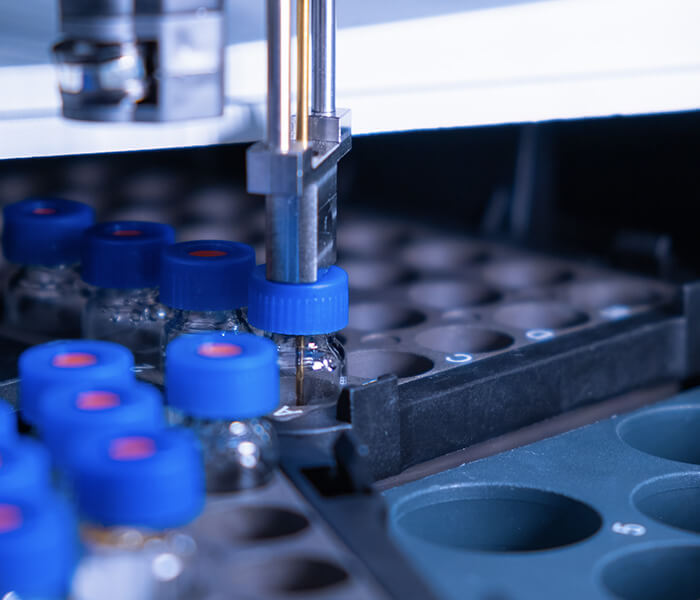
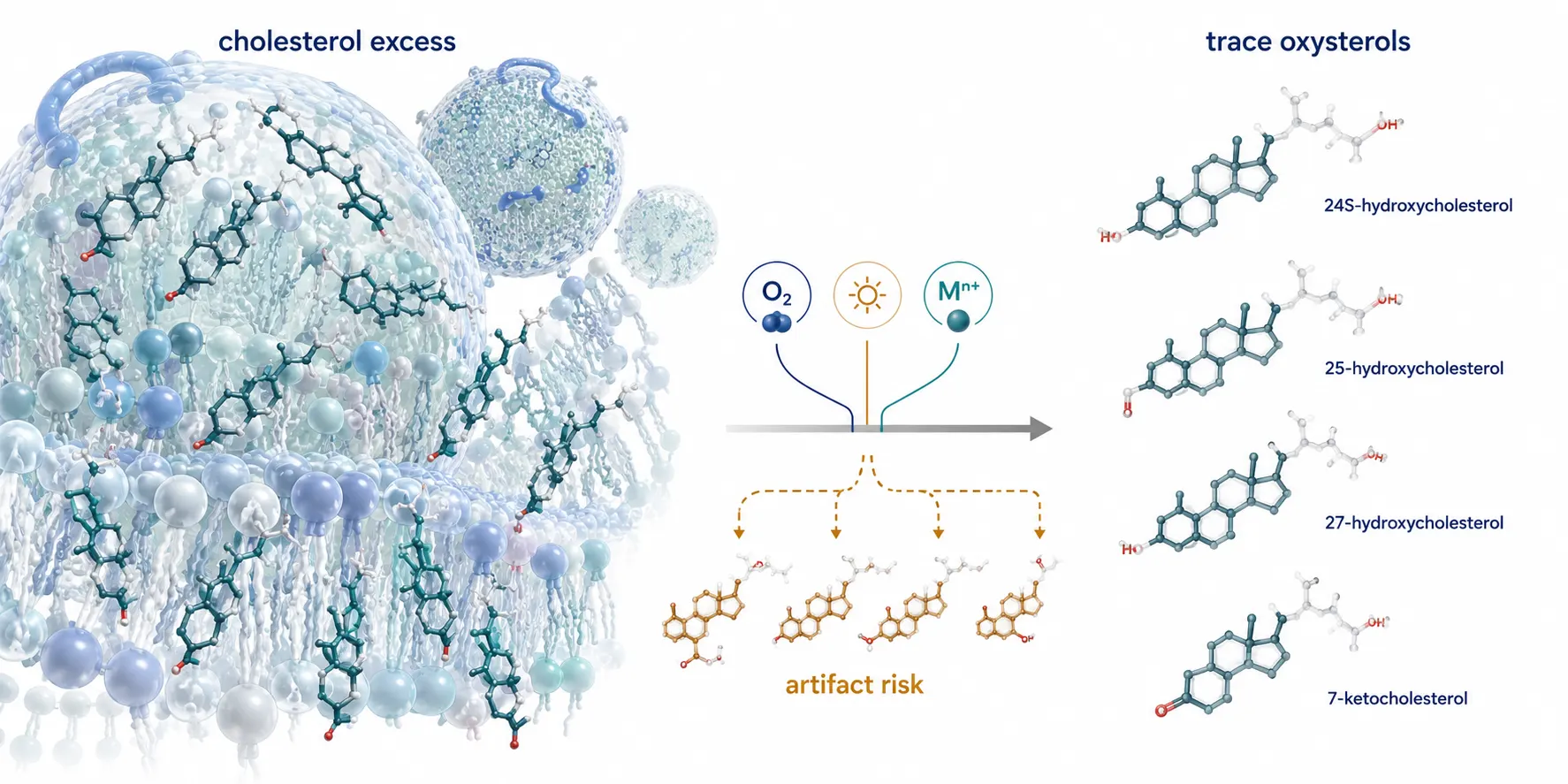 Figure 1. Oxysterol analysis begins with an asymmetry: a large cholesterol pool can generate artifactual oxidation products that overlap the endogenous targets of interest.
Define the analytical claim before selecting a sample-preparation workflow
Start by stating what the assay must distinguish. A targeted panel may ask whether a defined set of free oxysterols changes across a perturbation. Another project may need total oxysterols after controlled release from esterified pools. A discovery study may be looking for unexpected sterol oxidation products, while a mechanistic study may need to discriminate 24S-, 25-, and 27-hydroxycholesterol or the 7alpha and 7beta epimers. These are different analytical claims, not different labels for the same measurement.
That definition determines whether a Targeted Lipidomics method, a focused Targeted Metabolomics assay, or a staged discovery-to-verification design is appropriate. It also determines the correct reporting language. A method that measures free oxysterols should not be described as a total sterol-oxidation measurement. A method that resolves a compound class but not a positional isomer should not assign a precise isomer name. These boundaries should appear in the project brief, sample manifest, and final data table.
The most useful project brief records six items before the first specimen is processed: target list and accepted synonyms, free or total analyte state, matrix, anticipated abundance range, required isomer resolution, and the biological comparison that will be made. This protects against a common failure mode in which an assay is optimized for signal intensity but cannot answer the biological question that motivated it. It also keeps useful but adjacent measurements, such as cholesterol, bile-acid intermediates, and inflammatory lipid mediators, from being treated as interchangeable endpoints.
Use preanalytics to stop new oxidation, then prove that the controls worked
Artifact control begins before the solvent is added. The collection plan should specify light protection, temperature path, time from collection to stabilization, tube composition, homogenization conditions, aliquot strategy, and maximum freeze-thaw exposure. These are not generic laboratory preferences. They are experimental variables because the same sample can produce a different oxysterol pattern after a delayed or poorly protected workflow. Matrix-specific pilot testing is essential: a control that works in plasma may not control tissue homogenate, conditioned medium, or a small lipid-rich specimen in the same way.
Antioxidants, metal chelators, and peroxide-reducing reagents are useful only when their effect has been demonstrated for the chosen targets and extraction route. A protective additive can reduce artifact formation, alter recovery, change the chemical form of a labile product, or interfere with a downstream derivatization step. The practical question is not whether a reagent is commonly used. It is whether, under the intended collection and extraction conditions, it lowers the artifact-sensitive control signal without distorting recovery of the analytes that the study will report. A matrix-matched sample preparation workflow should document that evidence with blanks, spikes, and pooled quality-control material.
A particularly informative control is an oxidation sentinel. Add a suitable stable-isotope-labeled precursor or a labeled oxysterol standard early enough to experience the relevant workup, then inspect whether corresponding labeled oxidation products or unexpected response changes appear. The sentinel does not recreate every endogenous pathway, but it can reveal that a sample preparation route is capable of creating an analytical signal after collection. Use it alongside a solvent blank, process blank, and pooled matrix QC because each answers a different question: reagent background, procedural contamination, and batch stability.
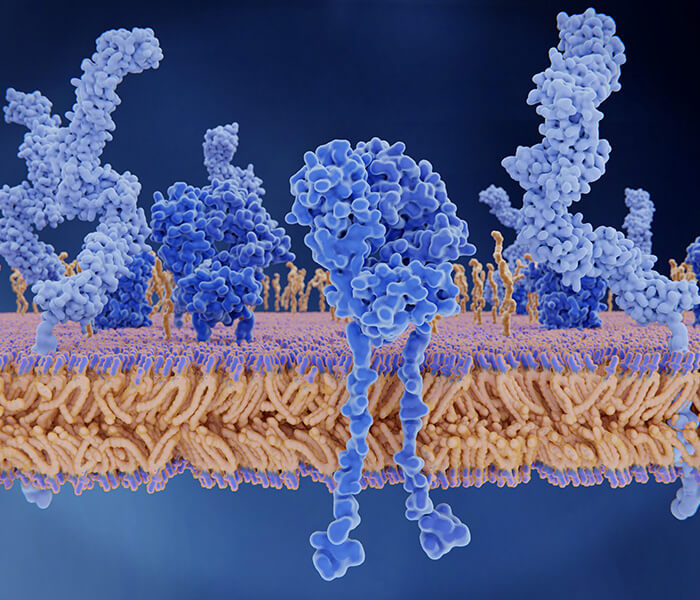
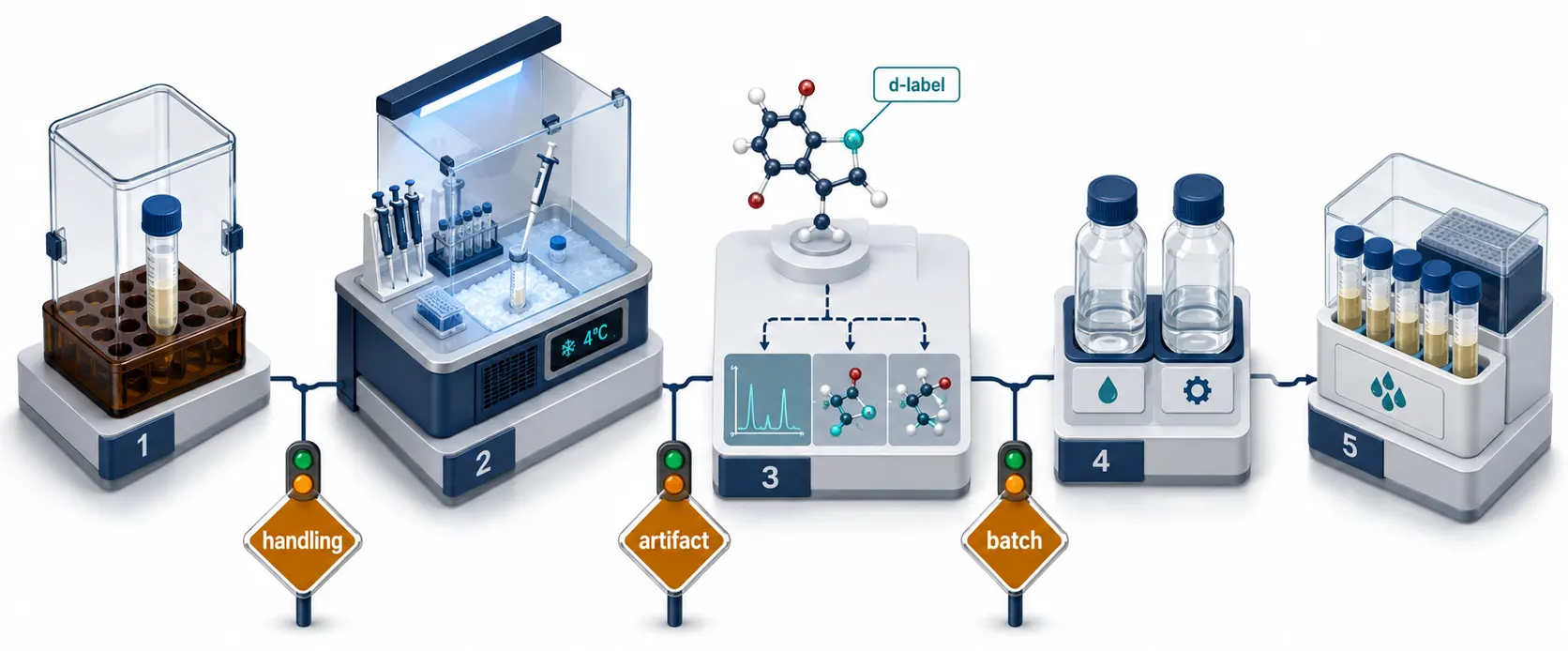 Figure 2. Artifact control is a measurable evidence chain: protected handling is paired with blanks, pooled QC, and an oxidation sentinel that can expose signal created during workup.
Remove the cholesterol burden before asking the mass spectrometer for selectivity
Direct injection of a cholesterol-rich extract often creates several problems at once. High-abundance cholesterol can dominate extraction capacity, obscure low-abundance oxysterols through ion suppression, overload chromatographic behavior, and leave a source or column contamination burden that compromises later injections. More importantly, leaving cholesterol close to the target fraction preserves a large reservoir from which oxidation products can arise during subsequent drying, storage, or reagent steps.
Solid-phase extraction is therefore not only a cleanup step. It is an analytical-separation decision. Depending on analyte chemistry and the broader panel, a method can retain cholesterol while allowing more polar oxysterols to elute, or use a different fractionation architecture to separate neutral sterols, oxysterols, and sterol acids. No universal cartridge or solvent program should be copied into every project. Evaluate the fractionation by measuring recovery of representative target classes, residual cholesterol burden, blank behavior, and the degree to which the cleanup itself changes the artifact-sensitive targets.
For low-input samples, maximize information before maximizing complexity. A long multistep fractionation can deliver clean extracts but consume too much material or create additional handling opportunities. A compact method may conserve sample but require a narrower target panel or more conservative identification claims. This is where an Untargeted Lipidomics feasibility run can be valuable: it can map the major co-extracted lipid burden and show whether the proposed oxysterol fraction is analytically isolated enough to support a later targeted assay.
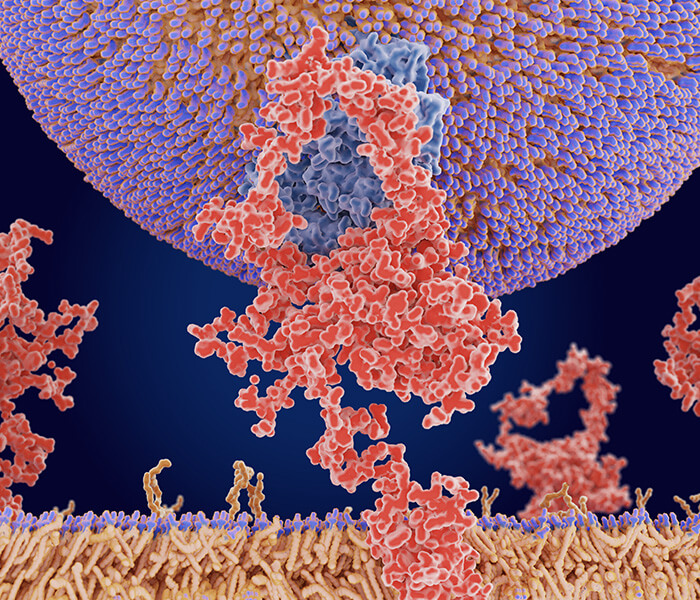
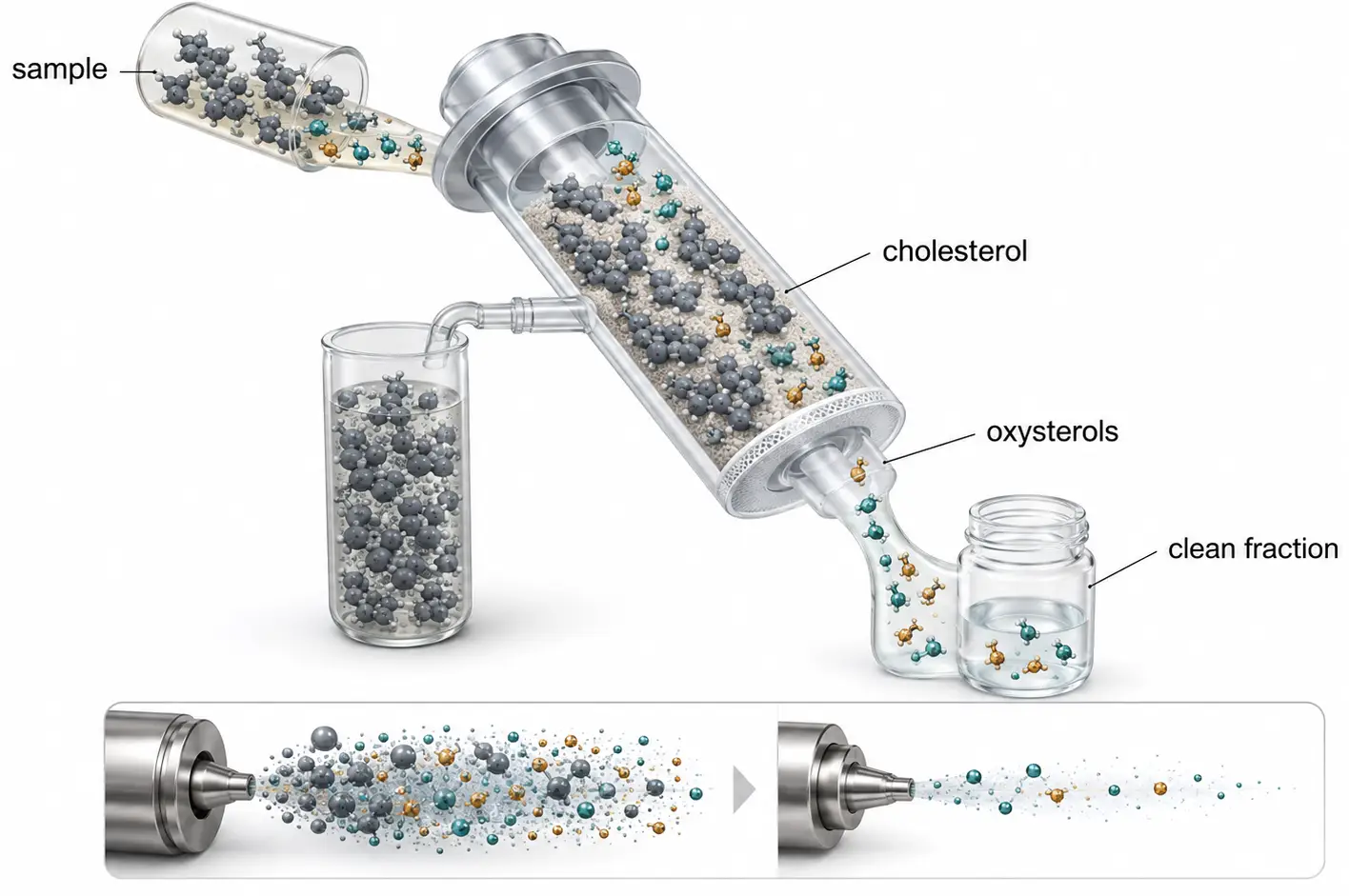 Figure 3. Cholesterol depletion is both a sensitivity and a provenance control: it reduces matrix burden while separating the large precursor pool from the trace oxysterol fraction.
Choose derivatization for the question it solves, not because it makes a peak larger
Native oxysterols are neutral, structurally similar, and frequently inefficient in electrospray. Their spectra may be dominated by common water loss rather than fragments that distinguish a relevant isomer. Derivatization can improve ionization, retention behavior, or fragment informativeness, but it also adds reaction yield, reagent background, carryover, and derivative stability to the validation problem. The question is therefore not whether derivatization is advanced. It is whether the project needs the information it provides badly enough to validate the extra chemical step.
Enzyme-assisted charge tagging with a Girard reagent is a powerful option when the method is designed around a compatible sterol class. An enzymatic oxidation step can convert suitable 3beta-hydroxy sterols into a carbonyl-bearing form, and the charge tag can make positive-ion detection and downstream fragmentation more informative. This approach should be planned as a controlled measurement system, however. The enzyme step changes the observed chemical state, endogenous 3-oxo compounds require careful differentiation, and incomplete conversion or residual reagent can complicate quantification. A paired design with and without the enzyme may be necessary when those chemical states need to remain distinguishable.
Alternative tags and underivatized methods each have a role. Underivatized LC-MS/MS can be preferable for a high-abundance, narrowly defined panel when avoiding a reaction step improves robustness. Other derivatization strategies may fit targets with particular functional groups but should be qualified for selectivity, reaction completeness, and response behavior in the actual matrix. A global metabolomics screen can help identify unexpected background features, but it does not substitute for target-specific chemistry and calibration where the project claims a named oxysterol.
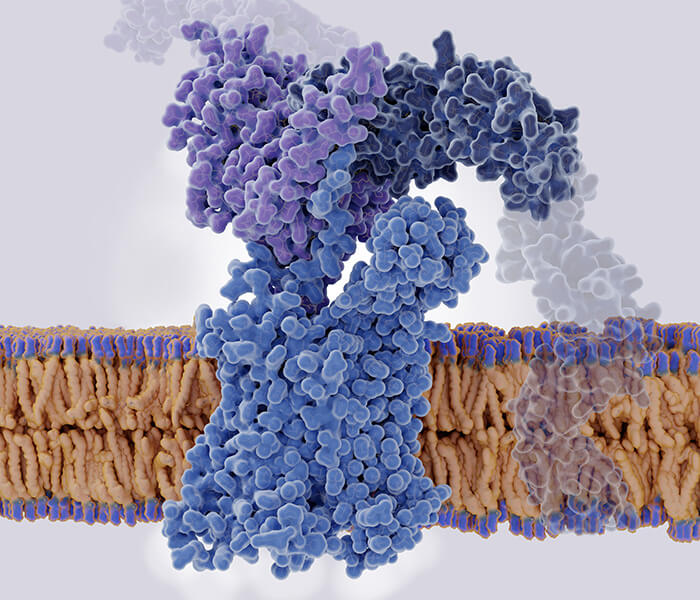
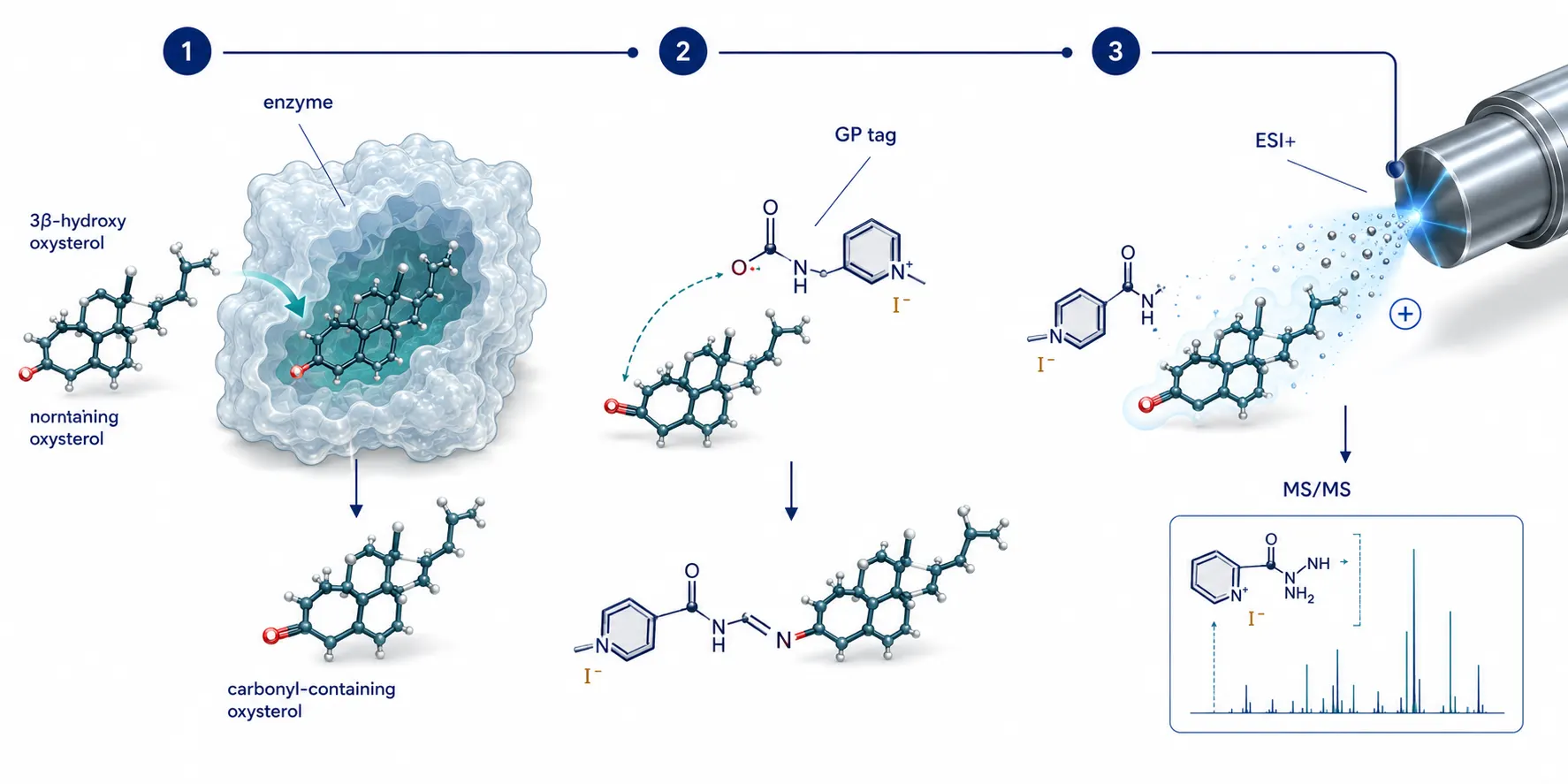 Figure 4. Enzyme-assisted charge tagging can improve ionization and fragmentation, but it must be validated as a chemical transformation rather than treated as a universal sensitivity upgrade.
Make chromatographic resolution carry the burden that MS alone cannot
Many oxysterols share an elemental composition, nominal mass, or a small set of common product ions. This is most consequential when a study needs to resolve positional or stereochemical isomers. A correct precursor-to-product transition does not establish that a chromatographic peak is 24S-hydroxycholesterol rather than another hydroxycholesterol with similar fragmentation. The analyte name must match the level of evidence actually available.
Method development should test the critical isomer set with authentic standards whenever available. Evaluate retention order, peak shape, resolution, and transition ratios under the chosen mobile phases and column chemistry. Reversed-phase phases can provide useful selectivity for many panels, while longer-chain or alternative selectivity phases may be justified when the unresolved pair is central to the decision. Chiral separation is a specialist option when stereochemical assignment is indispensable, but it should not be introduced as decoration if the biological question does not require it.
Use a confidence ladder in the data review. The highest tier combines an authentic standard, appropriate isotope-labeled internal standard, retention-time agreement, and diagnostic fragmentation. A lower but still useful tier may have class-level assignment supported by chromatographic behavior and MS/MS. An accurate mass alone belongs in a hypothesis-generating layer, not in a final quantitative conclusion. This discipline is especially important for 7-position oxidation products, where an ex vivo artifact and an endogenous product can be chemically identical.
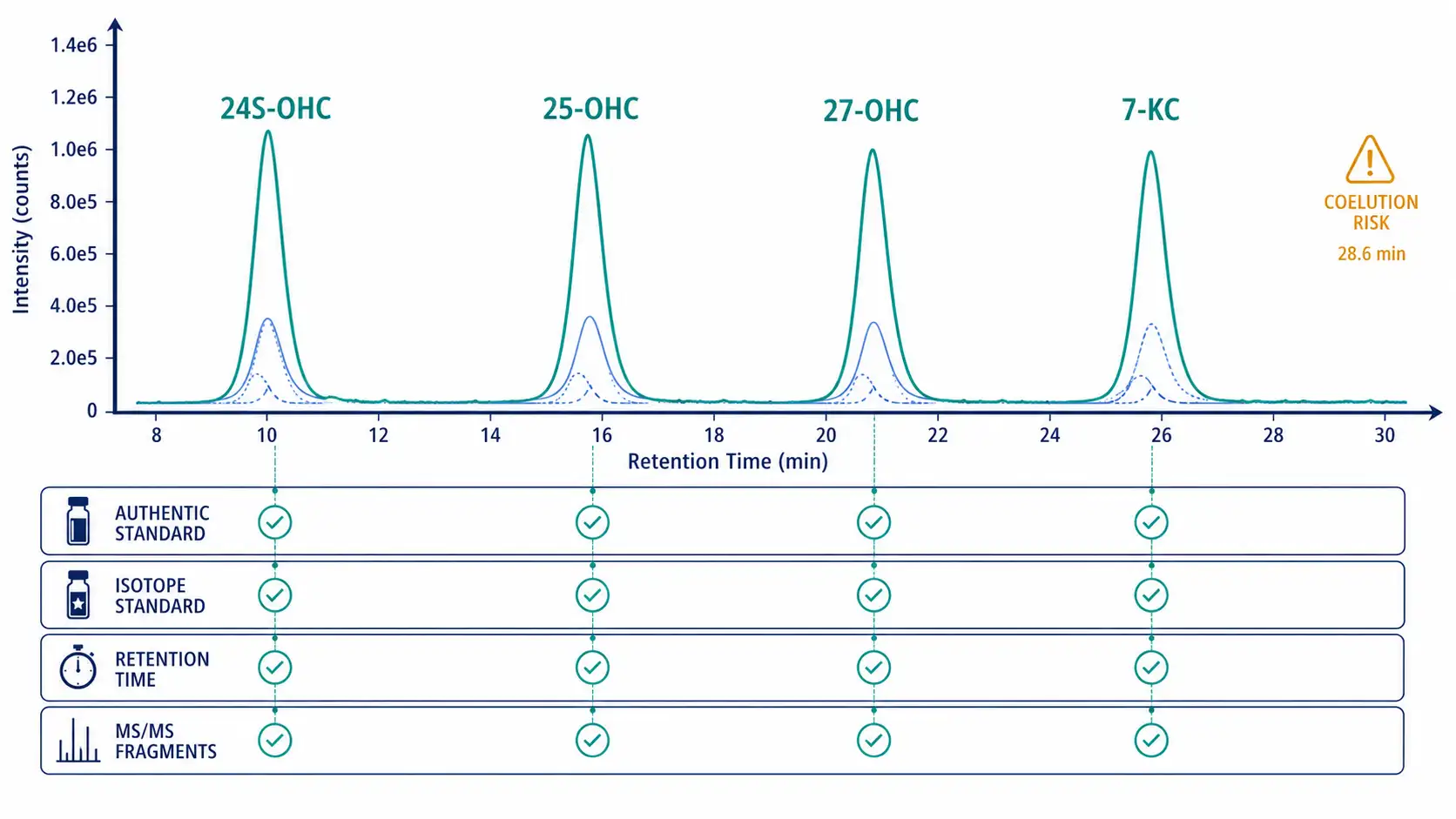 Figure 5. A named oxysterol requires evidence beyond a nominal transition: chromatographic separation and a defined confidence tier determine how specifically a peak can be reported.
Build quantification controls around process recovery and analyte identity
Internal standards are not optional decoration in trace oxysterol work. The strongest design uses analyte-matched stable-isotope standards added before the stages that can affect recovery, adsorption, reaction yield, and ionization. When an exact analog is unavailable, a class-matched surrogate can still monitor process consistency, but the final result should not imply that it corrects every analyte-specific difference. Record the stage at which each standard is added, because a standard introduced after extraction cannot measure extraction loss.
Quantification acceptance should connect to the claims in the report. Use calibration material, blanks, low and high QCs, carryover assessment, and reinjection checks that are relevant to the expected sample range. For derivatized methods, include reaction blank and derivative-stability controls. For fractionation methods, review target recovery across the fractions and verify that a sample with an apparently low value is not simply a specimen with a shifted recovery pattern. A Redox Proteomics layer can provide orthogonal oxidative context, but it cannot repair an oxysterol assay whose target identity or preanalytical provenance remains uncertain.
Interrogate data in batches, not only at the end. Plot internal-standard response, QC recovery, target-to-standard ratio, and blank contribution across extraction order and injection order. A late-batch drift or a peak that appears in process blanks can be more informative than a nominally significant group comparison. Pre-specify what triggers reinjection, re-extraction, exclusion, or a qualified report. This turns quality review from an after-the-fact rescue into part of the analytical design.
Separate the evidence for concentration from the evidence for identity. A calibration curve can support a numerical estimate only for a peak that has first met the method's identity criteria. For each critical target, retain the retention-time window, transition or accurate-mass evidence, qualifier-ion behavior where applicable, and the relationship to an authentic standard or reference material. If the signal is near the lower end of the calibrated range, examine the chromatographic trace and blank contribution rather than treating a software-reported value as self-validating. A value may be suitable for exploratory ranking while remaining unsuitable for a claim about a specific positional isomer.
Recovery and matrix effect should also be interpreted as separate properties. Compare a standard introduced before extraction with one introduced after extraction to identify process loss, then compare a post-extraction matrix spike with a neat solution to expose ionization differences. This does not require a universal threshold borrowed from another assay; it requires acceptance rules that are appropriate for the study's target list and expected decision. When isotope-labeled analogs are available, review analyte-to-standard ratios across matrices and batches. When they are not, clearly mark the affected targets as more dependent on surrogate correction and strengthen the orthogonal identity checks.
Where specimens must be stored or reanalyzed, add stability to the control plan instead of assuming that frozen material remains analytically unchanged. Test the practical intervals that the study will actually use: bench handling before extraction, extracted-sample residence in the autosampler, freeze-thaw cycles, and longer-term storage. Pair those experiments with blanks and the oxidation sentinel, since a stable total signal can hide conversion between related oxysterol species. A stability result is useful only when the protected and comparison conditions are documented well enough to explain what was tested.
Use the matrix to choose the simplest defensible method
Plasma, brain, retina, liver, cells, and conditioned medium do not present the same analytical problem. Plasma may require careful interpretation of free versus esterified pools and collection history. Brain and retina can be material-limited while demanding high selectivity for region-specific sterols. Cultured cells may supply a more controlled biological model but little material and a high risk that a lysis or extraction sequence dominates the apparent oxidation state. The right workflow is the one that protects the relevant targets and resolves the discriminating isomers with the fewest unvalidated steps.
Use method comparison as a decision exercise rather than a list of platforms. A direct underivatized method can suit a concise panel with adequate endogenous signal and stable, resolved targets. A cleanup plus targeted LC-MS/MS method is useful when cholesterol burden and matrix effects are the primary concern. Enzyme-assisted charge tagging is useful when sensitivity and fragment information justify an additional transformation. A discovery workflow is useful when the target space is uncertain, but its findings should move into a verification method before supporting a specific chemical claim.
Oxysterol work also benefits from a deliberate boundary with neighboring lipid questions. An Eicosanoids Analysis panel can address inflammatory lipid mediators, while Fatty Acid Metabolism Analysis can reveal changes in the broader lipid substrate environment. These layers are complementary only when their collection timing and biological comparison are shared. They should not be used to infer a specific oxysterol merely because all are oxidation-related molecules.
Choose the sample number and aliquot layout with the analytical controls in mind. A project with scarce tissue should reserve material for a process blank surrogate, pooled QC, repeat extraction, and confirmation of an unexpected high-value finding instead of allocating every microliter to the first acquisition batch. For studies that compare groups across several collection days, distribute representatives of each group across extraction and injection order. Otherwise, collection day, operator, or reagent lot can become inseparable from the biological comparison. The same principle applies to paired plasma and tissue designs: retain the metadata that explains whether the two matrices were collected, stabilized, and stored under comparable conditions.
A concise method-selection record makes this reasoning transferable. It should state the matrix and expected abundance range, the target oxysterols and unresolved isomer risks, whether free or hydrolyzed material is reported, the cleanup and derivatization rationale, standards available, and the controls that release a batch for interpretation. This record helps a later analyst distinguish a deliberate method boundary from an accidental omission. It also makes it easier to redesign only the failing step when a pilot reveals cholesterol overload, incomplete separation, or a blank-associated signal.
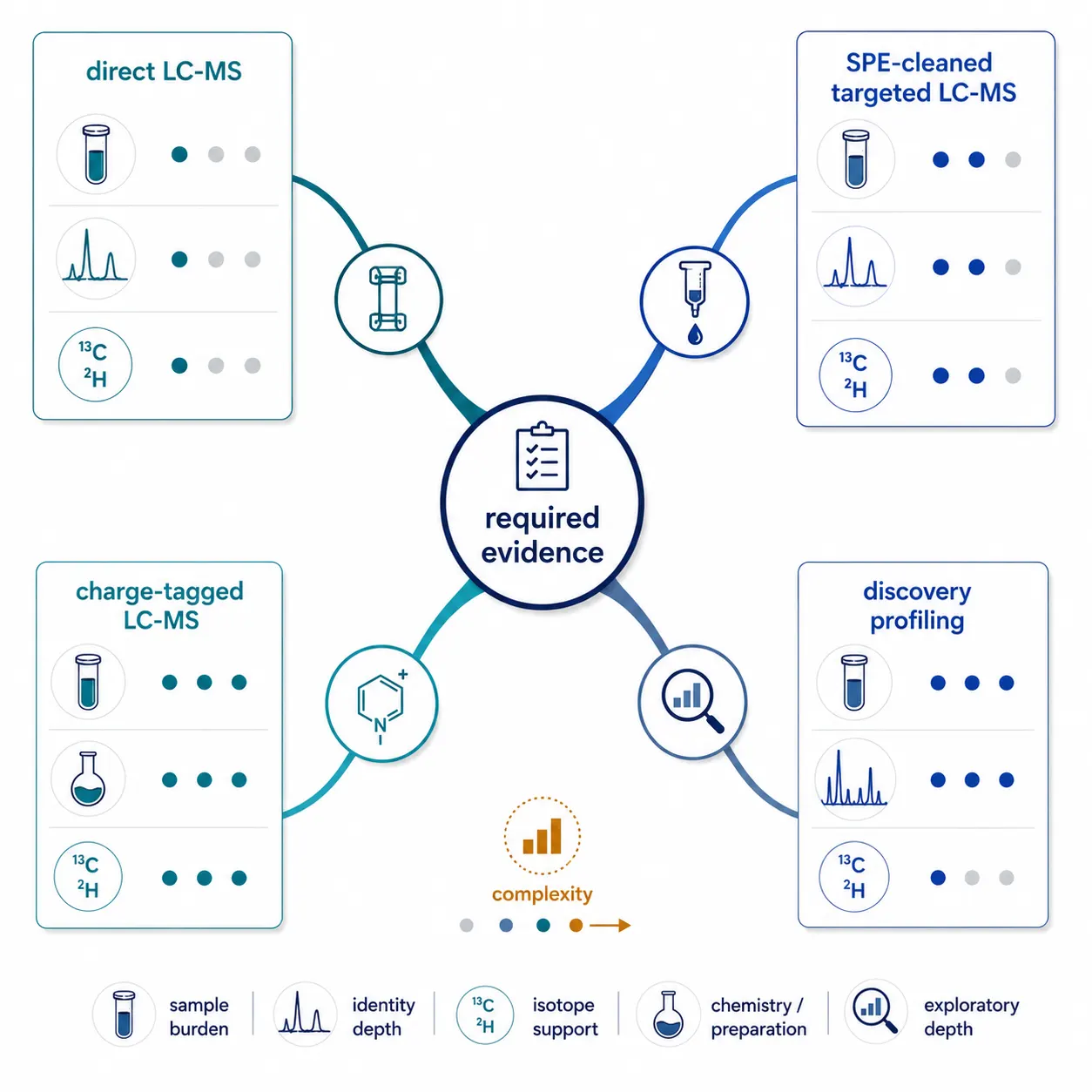 Figure 6. Method selection follows the evidence requirement and matrix burden: the most elaborate workflow is not automatically the most defensible one.
Connect oxysterol data to the wider lipid-oxidation evidence chain
Oxysterols are one branch of lipid oxidation, not a substitute for every oxidative measurement. A rise in 7-ketocholesterol may be biologically meaningful, but it does not identify oxidized phospholipid species or establish a specific regulated cell-death pathway. For phospholipid-centered questions, the companion resource on oxidized lipidomics for ferroptosis addresses molecular lipid evidence and artifact control at the membrane-lipid level. For an integrated excretion or circulating endpoint, the matrix resource on plasma or urine F2-isoprostane analysis provides a separate decision framework.
The most productive multi-omics design asks which layer can falsify the interpretation. Oxysterols may test a cholesterol-centered oxidation or enzymatic-metabolism hypothesis. Oxidized phospholipids may test membrane substrate and peroxide chemistry. F2-isoprostanes may provide a distinct free-radical lipid-peroxidation endpoint. Align their sample timing, handling record, and expected direction before treating them as a coherent panel. If they disagree, investigate matrix choice, analyte form, and artifact control before inventing a biological explanation.
Apply a four-phase release gate before interpreting the first group comparison
Phase one is analytical scoping: define the target list, matrix, analyte state, critical isomer pairs, and the biological question. Phase two is preanalytical qualification: test protected handling, oxidation sentinel behavior, blanks, pooled QC, and recovery. Phase three is identity and quantification: establish chromatographic resolution, internal-standard behavior, calibration, derivative controls if used, and carryover acceptance. Phase four is biological interpretation: apply the pre-specified normalization and compare the final values alongside QC and handling metadata.
Every phase has a meaningful stop rule. If a process blank contains the target, if a labeled sentinel shows uncontrolled oxidation, if critical isomers coelute, or if internal-standard behavior shifts with extraction order, do not compensate by strengthening the biological language. Narrow the claim, revise the chemistry, or collect a better-controlled sample set. The resulting dataset is more valuable because it states exactly what the method can and cannot support.
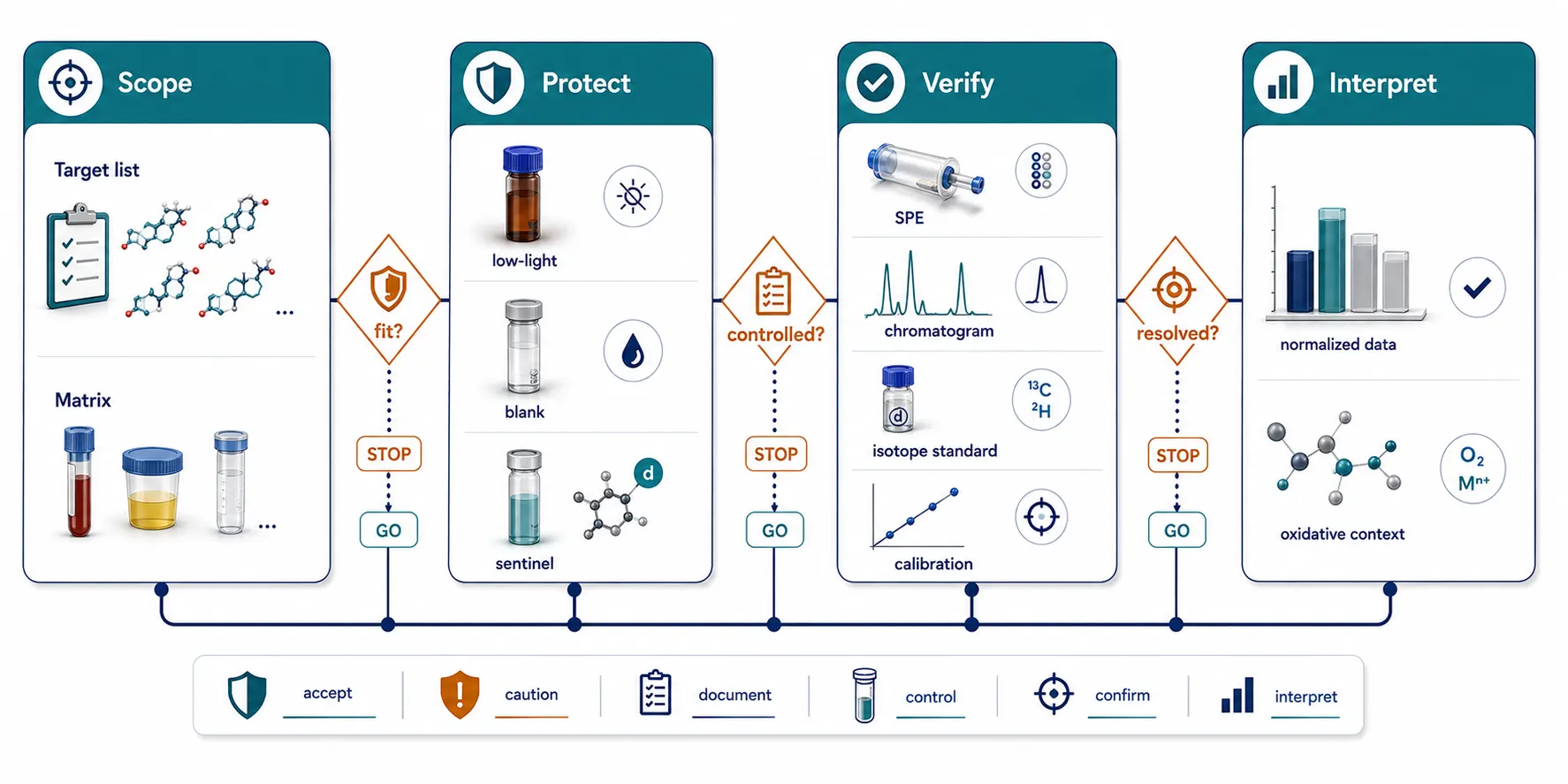 Figure 7. A four-phase release gate prevents a biologically attractive result from outrunning the evidence for artifact control, isomer identity, and quantitative reliability.
Frequently asked questions
Can BHT or another antioxidant be added to every oxysterol sample?
No. It should be tested in the intended matrix and method because protective additives can also affect recovery, chemical form, or a later derivatization step.
Does an isotope-labeled internal standard prove that no artifact formed?
No. It supports process control, but only an appropriately designed sentinel, blanks, and handling validation can show whether the workflow creates an artifact-sensitive signal.
Is derivatization required for oxysterol LC-MS?
No. It is useful when sensitivity or fragment information is limiting, but an underivatized method can be more robust for an appropriate target panel.
Can one LC-MS transition distinguish 24S-OHC, 25-OHC, and 27-OHC?
Not reliably by itself. Use chromatographic resolution, authentic standards where available, and a stated identification confidence level.
Should free and total oxysterols be reported together?
Only if the method and report clearly state the analyte form. Hydrolysis changes the pool being measured and requires its own control evidence.
Can oxysterol results establish ferroptosis?
No. They can contribute to a lipid-oxidation evidence set, but a ferroptosis interpretation needs appropriate molecular lipid and phenotypic controls.
References:
- Griffiths WJ, Hearn T, Crick PJ, et al. Charge-tagging liquid chromatography-mass spectrometry methodology targeting oxysterol diastereoisomers. Chemistry and Physics of Lipids. 2017. doi:10.1016/j.chemphyslip.2017.04.004
- Crick PJ, Aponte J, Bentley TW, et al. Evaluation of novel derivatisation reagents for the analysis of oxysterols. Biochemical and Biophysical Research Communications. 2014. doi:10.1016/j.bbrc.2014.01.173
- Guo Z, Yu H, Yang K, et al. Quantitative Determination of a Series of Oxysterols by an Optimized LC-MS/MS Analysis in Different Tissue Types. International Journal of Molecular Sciences. 2025. doi:10.3390/ijms26010077
- Dickson AL, Yutuc E, Thornton CA, et al. Identification of unusual oxysterols biosynthesised in human pregnancy by charge-tagging and liquid chromatography-mass spectrometry. Frontiers in Endocrinology. 2022. doi:10.3389/fendo.2022.1031013
- Babu AF, Koistinen VM, Turunen S, et al. Identification and Distribution of Sterols, Bile Acids, and Acylcarnitines by LC-MS/MS in Humans, Mice, and Pigs: A Qualitative Analysis. Metabolites. 2022. doi:10.3390/metabo12010049