Live-cell ABPP Service for Cellular Target Engagement Profiling

Cellular target engagement, activity-state profiling, and off-target mapping in intact-cell systems.

A compound can look active in a cell-based assay but still leave a difficult question unanswered: does it engage the intended target inside living cells?

At Creative Proteomics, our Live-cell ABPP Service for Cellular Target Engagement Profiling helps research teams evaluate whether covalent ligands, reactive compounds, or activity-based probes engage targets in intact-cell systems. We support probe feasibility review, live-cell treatment design, enrichment, LC-MS/MS analysis, cellular target ranking, and bioinformatics interpretation.

Key Advantages:

  • Cellular target engagement profiling.
  • Live-cell activity-based probe labeling.
  • Cellular off-target landscape mapping.
  • LC-MS/MS protein and peptide evidence.
  • Bioinformatics-guided target prioritization.
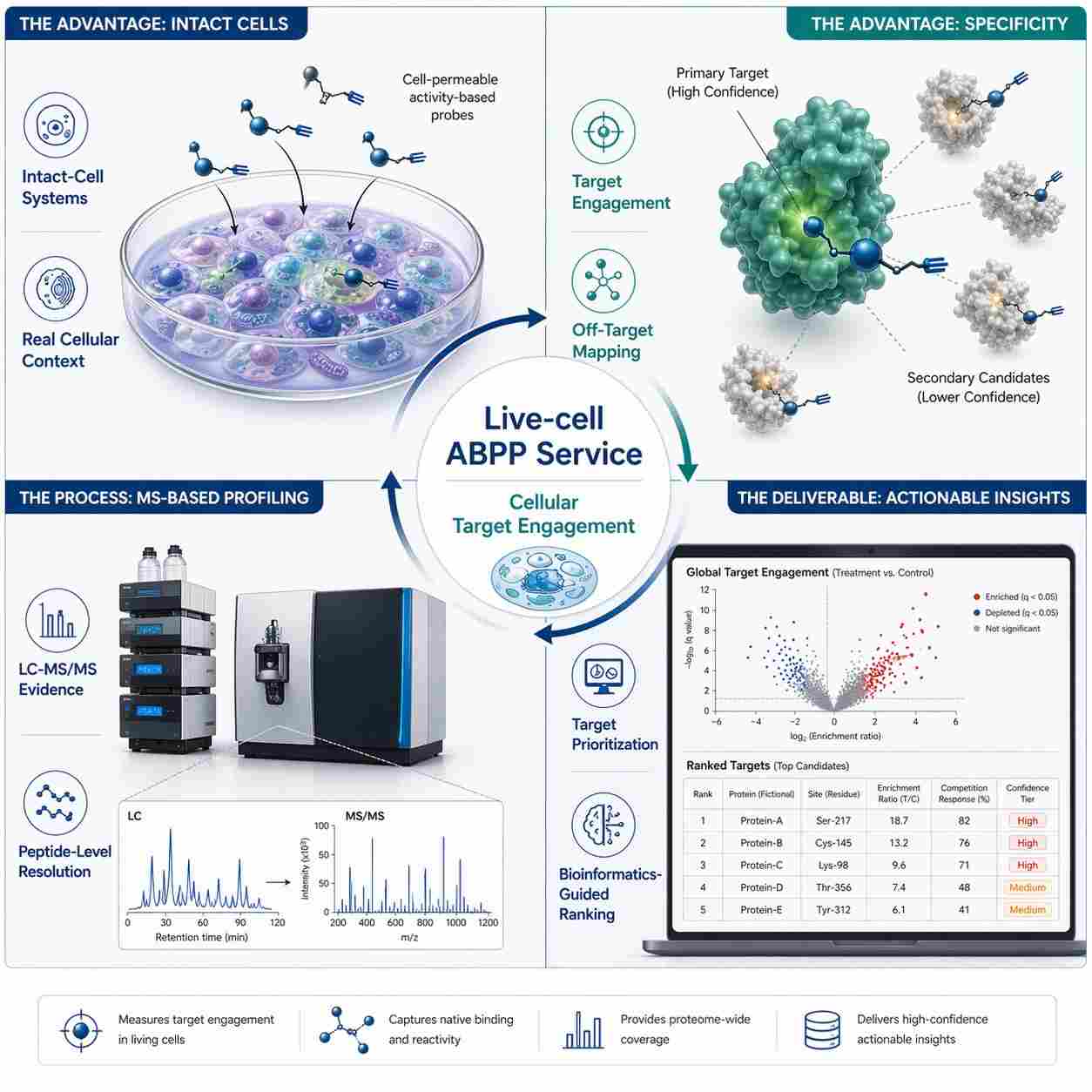
Live-cell ABPP workflow for cellular target engagement profiling and LC-MS/MS target ranking.
Target Engagement Capabilities Workflow Project Types Sample Deliverables Demo Comparison Case Study FAQ Feasibility Review Disclaimer

Live-cell ABPP is designed for projects where cellular context matters. A compound may bind a target in lysate, but the same result may not hold in intact cells because cell permeability, compartment access, metabolism, protein conformation, and treatment timing all affect target engagement.

In a live-cell ABPP workflow, cells are treated with a compound, a cell-permeable activity-based probe, or a probe-compatible chemical system. After cellular exposure, labeled proteins are enriched, digested, and analyzed by LC-MS/MS. The resulting data can help show which proteins or sites are labeled in the cellular environment and how the signal changes across treatment, vehicle, competition, or lysate-comparison conditions.

This service is useful when you need more than a general protein abundance readout. Standard proteomics can show downstream expression changes, but live-cell ABPP can provide activity-linked evidence for target engagement, cellular off-target mapping, and functional protein-state changes.

What Live-cell ABPP Helps You See

  • Cellular target engagement evidence.
  • Cellular off-target landscape mapping.
  • Compound-treated versus vehicle control comparison.
  • Activity-state changes in intact cells.
  • Live-cell versus lysate ABPP differences.
  • Probe-labeled protein evidence.
  • Peptide or site-level evidence where supported.
  • Ranked candidates for follow-up validation.

We do not treat an enriched protein list as a final proof of direct target binding. Live-cell ABPP results must be interpreted with probe coverage, controls, cellular context, peptide evidence, and biological follow-up in mind.

When Live-cell ABPP Is a Good Fit

  • Cell-permeable activity-based probes.
  • Covalent ligands or reactive compounds.
  • Phenotype-driven compounds with unclear targets.
  • Drug-treated cell models.
  • Cellular off-target profiling.
  • Live-cell validation after lysate ABPP.
  • Live-cell versus lysate comparison.
  • Cellular activity-state profiling.

For foundational ABPP workflows, see our Activity-Based Protein Profiling (ABPP-MS) service.

Our Live-cell ABPP Service Capabilities

Live-cell ABPP requires more design review than a standard lysate assay. The probe or compound must reach the relevant cellular space, labeling must occur under controlled treatment conditions, and the final LC-MS/MS results need careful interpretation.

Our team supports the complete workflow from feasibility review to ranked cellular target reporting.

Probe and Compound Feasibility Review

Before starting the project, we review the probe, compound, cell model, treatment window, and project goal. This helps identify risks before valuable cell material is used.

  • Probe structure and reactive group.
  • Cell permeability expectations.
  • Compound or probe solvent.
  • Treatment concentration and exposure window.
  • Known activity or cell-based readout.
  • Expected target class or residue class.
  • Need for competition or inhibitor controls.
  • Need for live-cell versus lysate comparison.
  • Desired readout: protein-level, site-level, pathway-level, or target ranking.

If the probe is not cell-compatible, a lysate-based Global ABPP workflow may be a better first step. For this comparison, see our Global ABPP and LC-MS/MS Chemoproteomics service.

Live-cell Treatment and Labeling Design

Live-cell ABPP begins with matched cell treatment. Depending on the study, cells may be treated with the compound first, then labeled with an activity-based probe, or treated with a probe system designed to label targets directly in living cells.

  • Cell line or model suitability.
  • Cell density or confluency.
  • Treatment timing.
  • Vehicle condition.
  • Probe concentration.
  • Cellular viability context.
  • Wash and harvest consistency.
  • Biological replicate design.

Enrichment, Digestion, and LC-MS/MS Analysis

After live-cell exposure, cells are lysed under controlled conditions. Probe-labeled proteins or peptides are enriched, washed, digested, and analyzed by LC-MS/MS.

The exact workflow depends on the probe design. Some projects produce protein-level target lists. Others may support peptide or site-level evidence. We help define this boundary before project launch.

Controls for Viability, Permeability, and Background

Live-cell ABPP is powerful, but it can be affected by permeability, toxicity, background binding, cell stress, and indirect effects.

  • Vehicle control.
  • No-probe control.
  • Probe-only group.
  • Compound-treated group.
  • Competition or inhibitor group.
  • Lysate comparison condition.
  • Biological replicates.

Target Ranking and Bioinformatics Interpretation

We help prioritize candidates using enrichment over control, treatment or competition response, peptide evidence, site-level evidence where available, replicate consistency, protein family annotation, cellular localization context, known target/off-target information, and background protein review.

The final goal is a ranked target or off-target candidate list that supports follow-up validation.

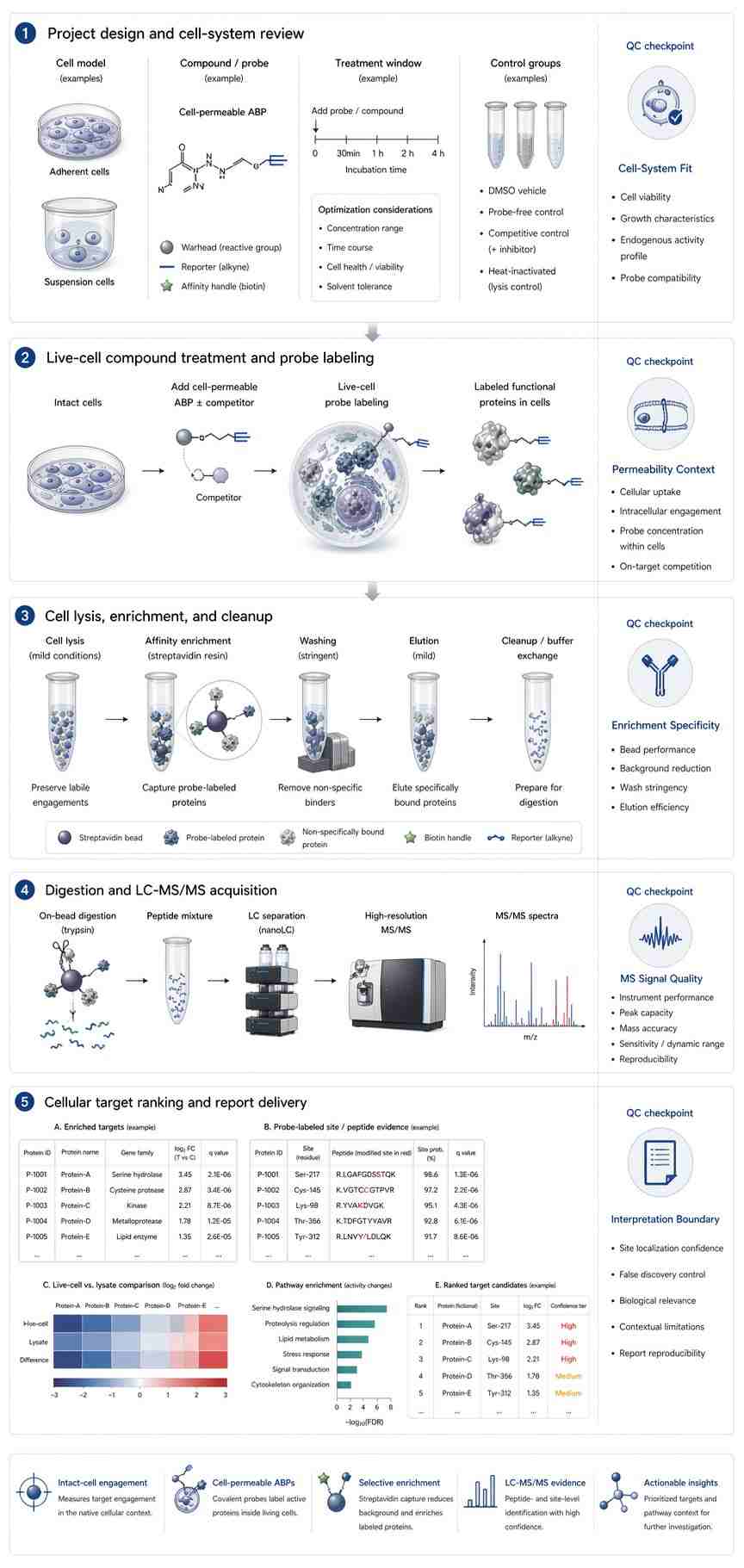
From Live-Cell Treatment to LC-MS/MS Evidence: Workflow and QC Checkpoints

Our workflow follows the project from cell-system review to final data delivery. Each stage includes technical execution and QC checkpoints.

1

Project Design and Cell-System Review

We begin by reviewing your cell model, compound or probe, treatment window, comparison groups, and target engagement question. If you also have lysate ABPP data, we can include a live-cell versus lysate comparison plan.

QC checkpoint: cell model fit, compound/probe information, treatment window, solvent, comparison groups, and expected readout.

2

Live-Cell Compound Treatment and Probe Labeling

Cells are treated under matched conditions. The activity-based probe labels functional proteins or reactive sites in intact cells, depending on probe chemistry and accessibility.

For cellular target engagement studies, treatment timing and viability context are important. A strong signal may reflect real engagement, but stress, toxicity, or poor permeability can also affect the result.

QC checkpoint: cell status, treatment matching, probe exposure, permeability context, vehicle control, and replicate consistency.

3

Cell Lysis, Enrichment, and Cleanup

After treatment and labeling, cells are lysed. Labeled proteins or peptides are enriched and washed to reduce background.

This stage helps determine whether the final target list is interpretable. Non-specific enrichment, bead binding, and abundant proteins can affect the result if controls are weak.

QC checkpoint: protein recovery, enrichment specificity, background binding, lysis compatibility, and control behavior.

4

Digestion and LC-MS/MS Acquisition

Enriched material is digested into peptides and analyzed by LC-MS/MS. The acquisition strategy is selected based on project scope, sample complexity, and whether protein-level or site-level evidence is expected.

QC checkpoint: digestion completeness, LC stability, MS signal quality, peptide identification, and replicate alignment.

5

Cellular Target Ranking and Report Delivery

The final results are processed into protein tables, peptide or site tables where supported, comparison summaries, QC summaries, and visual outputs. We rank targets by combining LC-MS/MS evidence with treatment response, controls, and cellular context.

QC checkpoint: peptide evidence, treatment or competition response, missing value review, pathway context, target ranking logic, and interpretation boundaries.

Vertical live-cell ABPP workflow with cell treatment, probe labeling, enrichment, LC-MS/MS, and target ranking.

Project Types Supported by Live-cell ABPP

Live-cell ABPP can support several project types in drug discovery, chemical biology, and functional proteomics.

Cellular Target Engagement Profiling

This is the core use case. Live-cell ABPP helps assess whether a compound or probe engages proteins in intact cells rather than only in lysate.

Cellular Off-Target Mapping for Covalent Ligands

Reactive compounds can engage intended and unintended proteins. Live-cell ABPP can help profile the cellular off-target landscape and prioritize proteins that require follow-up review. For related covalent ligand studies, see our Covalent Inhibitor Profiling service.

Live-cell vs Lysate ABPP Comparison

A lysate result may show biochemical reactivity, while a live-cell result reflects permeability, compartment access, and cellular treatment conditions. Comparing both formats can help explain why a compound behaves differently across assay systems.

Compound-Treated vs Control Activity-State Profiling

Live-cell ABPP can compare compound-treated and vehicle-treated cells to identify activity-linked changes. These changes may point to direct target engagement, pathway effects, or proteins requiring validation.

Cell-Permeable Probe Target Mapping

If you have a cell-permeable activity-based probe or clickable probe, live-cell ABPP can help map cellular targets and target families. For clickable-probe target deconvolution, see our Bioorthogonal Labeling and LC-MS/MS Target Identification service.

Phenotype-Driven Compound Target Deconvolution

When a compound creates a strong cell phenotype but the target is unclear, live-cell ABPP can provide a functional target landscape to guide validation.

Cell, Probe, Compound, and Control Requirements

Final requirements depend on cell type, probe chemistry, compound treatment, protein yield, and analysis depth. The table below gives practical planning values. Exact requirements are confirmed during feasibility review.

Sample / MaterialRecommended AmountRequired InformationControls to PrepareStorage and ShippingNotes
Adherent cell linePlan around matched biological replicates; proteomics-scale projects often require 5 × 10⁶ to 1 × 10⁷ cells per conditionCell line, culture condition, passage range, confluency, treatment designVehicle, probe-only, no-probe, treatment/control, biological replicatesProcess as agreed after feasibility review; pellets may be flash-frozen and shipped on dry iceSuitable for intact-cell target engagement
Suspension cell lineProject-dependent; final cell number confirmed after reviewCell type, density, treatment condition, collection methodVehicle, probe-only, competition if needed, biological replicatesProcessed or frozen as agreedUseful for suspension or hematologic models
Drug-treated cellsProject-dependentCompound structure, solvent, concentration, exposure window, known activity if availableVehicle, treatment/control, no-probe, probe-onlyProcess as agreedCore input for cellular target engagement
Lysate comparison sampleProtein amount reviewed by workflow; purified or lysate protein often planned around 150–300 μg for focused workflowsLysis method, protein concentration, buffer composition, matched treatment logicLive-cell/lysate matched controlsStore at -80°C and ship on dry ice if shippedUseful for interpreting live-cell vs lysate differences
Activity-based or clickable probeProject-dependentProbe structure, warhead, clickable handle, target class, stock solvent, known activityNo-probe and probe-only controlsShip according to probe stabilityCore feasibility input
Competitor / parent compoundProject-dependentStructure, solvent, stock concentration, known activity, exposure planCompetition series if neededShip according to compound stabilitySupports target engagement interpretation

Please label all biological replicates clearly, avoid repeated freeze-thaw cycles, and provide detailed treatment notes. If cells are sensitive, primary-like, difficult to culture, or affected by the treatment condition, feasibility review is especially important.

What You Receive: Cellular ABPP Data Package and Bioinformatics Analysis

Live-cell ABPP generates layered data. We organize the results so your team can move from LC-MS/MS output to target interpretation.

Minimum Deliverables

  • Raw LC-MS/MS data files.
  • Enriched cellular target protein table.
  • Peptide identification table.
  • Probe-labeled peptide or site table where supported.
  • Treatment/control or competition comparison table.
  • Live-cell versus lysate comparison table, if included.
  • Replicate-level quantitative summary.
  • QC summary.
  • Method summary.
  • Ranked cellular target/off-target candidate list.
  • Visualization-ready figures.

Optional Analysis Add-ons

  • Pathway enrichment analysis.
  • Protein family annotation.
  • Cellular localization annotation.
  • Known target/off-target annotation.
  • Compound-series comparison.
  • Live-cell versus lysate integration.
  • Integration with Thermal Stability Profiling or Global ABPP.
  • Follow-up validation recommendation table.

For broader targetability questions, see our Ligandability Mapping service.

How We Help Interpret the Data

  • Which proteins show cellular probe-labeling changes?
  • Which changes are treatment-associated?
  • Which signals may reflect background or associated proteins?
  • Which proteins have peptide or site-level support?
  • Which targets are consistent between live-cell and lysate formats?
  • Which findings should move into orthogonal validation?

Representative Demo Results for Live-cell ABPP

The following demo results show how the data can be presented. These are representative output formats, not client-specific claims.

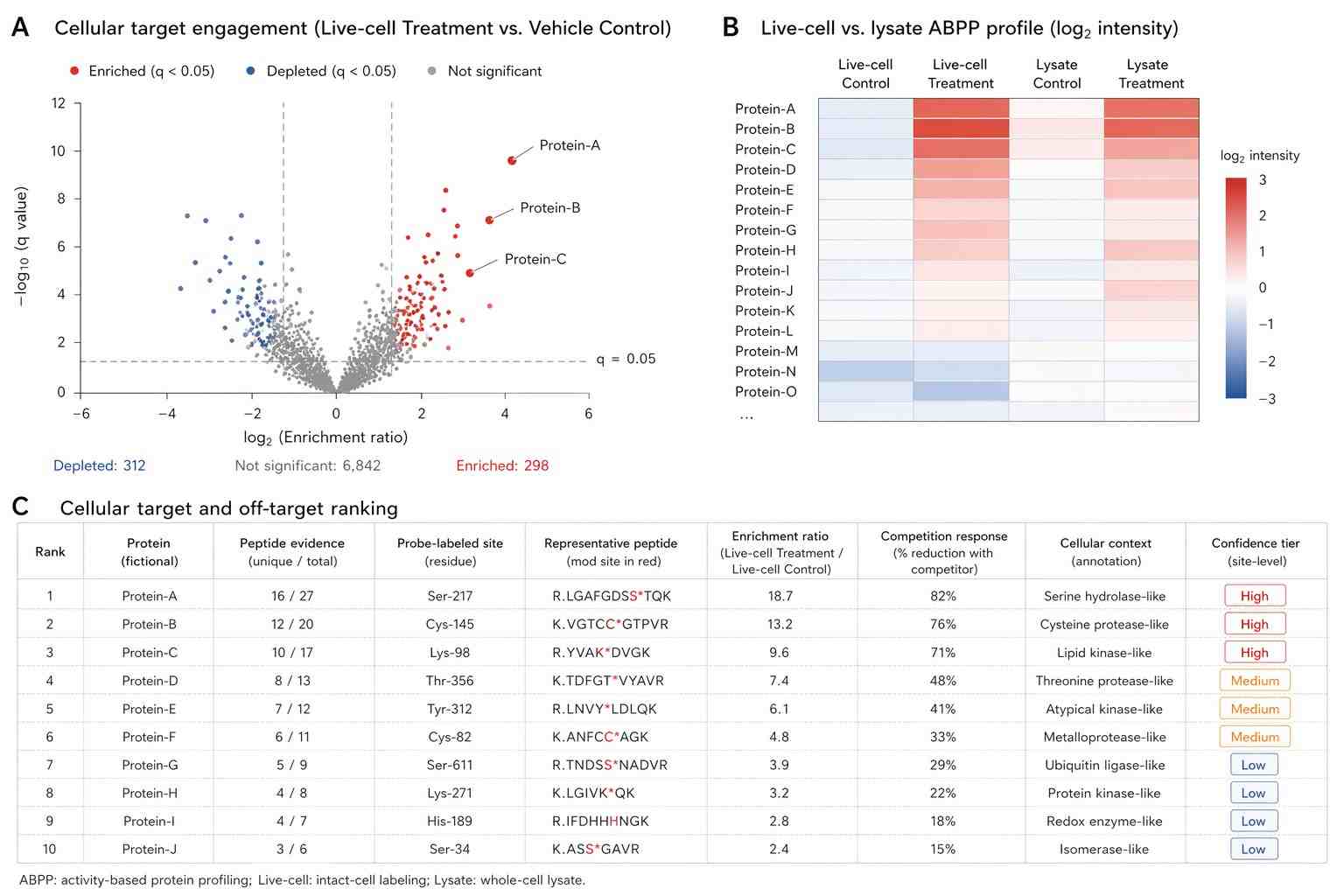
Demo live-cell ABPP results showing cellular target engagement, live-cell versus lysate comparison, and target ranking.

Integrated live-cell ABPP demo results panel

Cellular target engagement volcano plot, live-cell versus lysate heatmap, and target/off-target ranking dashboard.

Demo 1: Cellular Target Engagement Volcano Plot

A volcano plot can compare compound-treated live cells with vehicle control. Enriched or reduced signals can highlight proteins that may be affected in intact-cell context.

How to read it: A stronger candidate should show a clear treatment-associated change, replicate consistency, peptide evidence, and relevance to the project question.

Demo 2: Live-cell vs Lysate ABPP Heatmap

A heatmap can compare probe-labeling intensity across live-cell and lysate conditions. This helps show whether target engagement is consistent across cellular and biochemical contexts.

How to read it: A protein detected in lysate but not in live cells may still be biochemically reactive, but cell permeability, localization, or accessibility may limit cellular engagement.

Demo 3: Cellular Target and Off-Target Ranking Dashboard

A dashboard can combine protein name, peptide evidence, site evidence where available, enrichment ratio, competition response, cellular context annotation, and confidence tier.

How to read it: This view helps turn a broad LC-MS/MS table into a shorter list of targets and off-targets for follow-up validation.

Live-cell ABPP vs Other Target Engagement Workflows

Different workflows answer different questions. We help select the method based on cellular context, probe availability, compound occupancy, site evidence, and need for probe-free validation.

MethodBest Use CaseEvidence LevelStrengthLimitationWhen to Choose
Live-cell ABPP + LC-MS/MSCellular target engagement and off-target mappingIntact-cell probe-labeling and LC-MS/MS evidencePreserves cellular access, permeability, and contextRequires cell-compatible probe and treatment designChoose when cellular engagement matters
Lysate-based Global ABPPBroad activity profiling under controlled biochemical exposureProbe-labeled protein/site evidence in lysateEasier control of protein amount and buffer conditionsMay not reflect cellular permeability or localizationChoose for broad screening or mechanistic follow-up
Competitive ABPPCompound-target competition and selectivityCompetition-dependent probe signal changesStrong for occupancy and selectivityRequires matched probe and competition setupChoose when target occupancy is the key question
Bioorthogonal Labeling Target IDClickable-probe target deconvolutionEnriched protein and peptide evidenceUseful for clickable probes and small-molecule target IDProbe modification and enrichment background must be controlledChoose when target ID from clickable analogs is the goal
Thermal Stability ProfilingProbe-free cellular engagement screenProtein stability shift evidenceNo probe requiredDoes not directly identify probe-labeled active sitesChoose when probe design is not feasible
Standard Quantitative ProteomicsAbundance and pathway responseProtein abundance evidenceBroad biological response profilingDoes not directly measure target engagementChoose for downstream response, not direct engagement

How to Choose the Right Workflow

Choose Live-cell ABPP when the main question is cellular target engagement in intact cells.

Choose Lysate Global ABPP when you need controlled broad activity profiling.

Choose Competitive ABPP when you need compound-target competition and selectivity. See our Competitive ABPP service.

Choose Bioorthogonal Labeling Target ID when a clickable analog is used for target deconvolution.

Choose Thermal Stability Profiling when you need a probe-free engagement screen. See our Proteome-wide Thermal Stability Profiling service.

Choose Quantitative ABPP when site-level comparison is central to the project. See our Isotope Labeling-Based Quantitative ABPP service.

In many projects, the strongest evidence comes from combining live-cell engagement data with an orthogonal workflow.

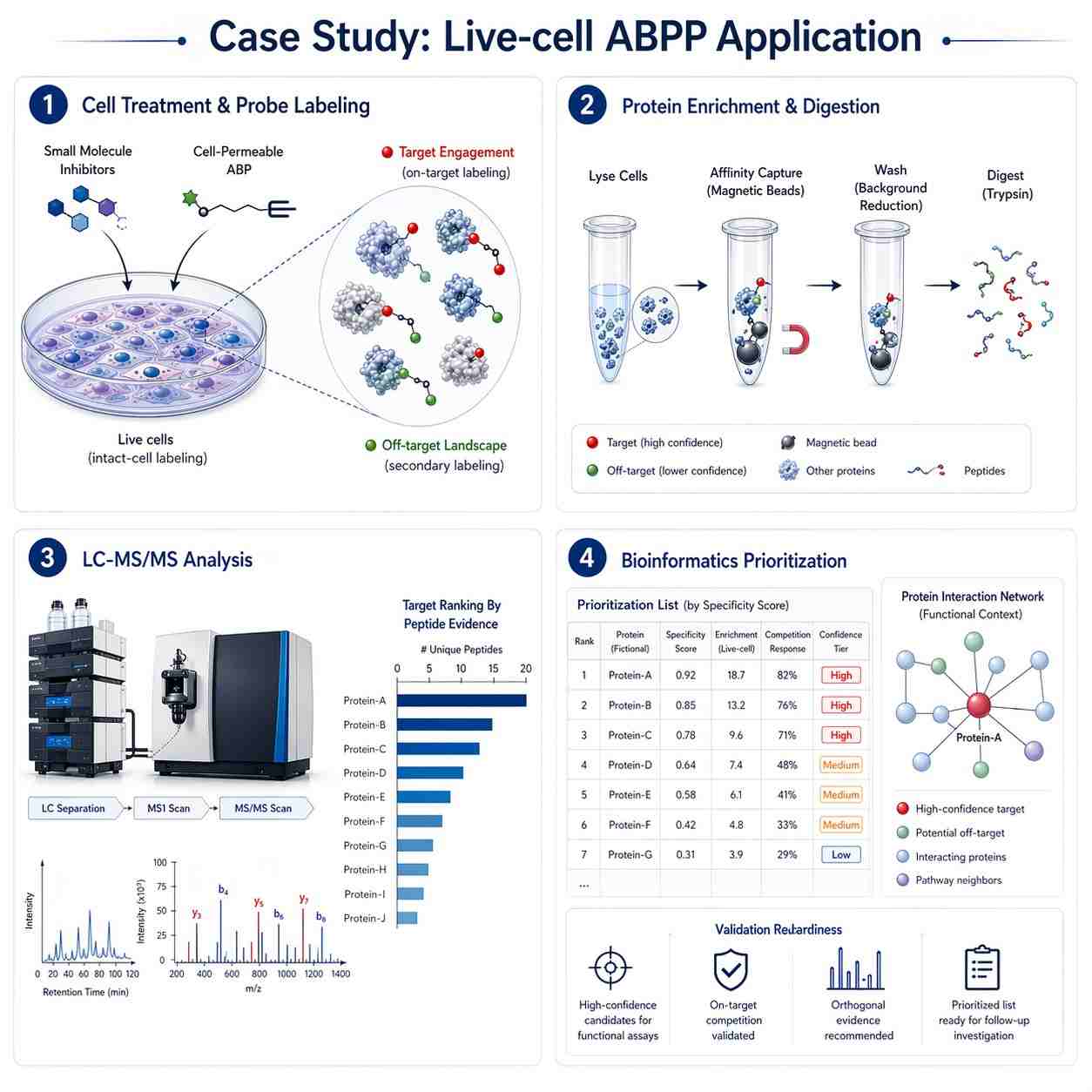
Literature-Supported Case Study: Cellular ABPP for Covalent Inhibitor Target Engagement

This literature-supported case study is based on van Rooden et al., Mapping in vivo target interaction profiles of covalent inhibitors using chemical proteomics with label-free quantification. It is not a Creative Proteomics customer case.

Background

The paper addresses a central problem in covalent inhibitor development: researchers need to understand both intended target engagement and off-target activity in biological systems. The authors describe ABPP as a chemical proteomics method that can guide covalent drug development by assessing on-target engagement and off-target activity.

The article also discusses why this matters for safety and interpretation. The authors previously used ABPP to determine the serine hydrolase interaction landscape of BIA 10-2474, an experimental drug, and reported that this provided a potential explanation for the adverse side effects observed with that compound. The protocol then focuses on a label-free quantitative proteomics workflow that can compare biological samples and map inhibitor interaction profiles in native proteomes.

Methods

The protocol uses chemical proteomics with label-free quantification to identify the in vivo selectivity profile of covalent inhibitors. The workflow includes tissue lysis, probe incubation, target enrichment, sample preparation, LC-MS measurement, data processing, and analysis. The authors describe this approach as suitable for studying target engagement in a native proteome and identifying potential off-targets.

For the demonstrated experiment, the authors assessed the protein interaction landscape of the diacylglycerol lipase inhibitor DH376 in mouse brain, liver, kidney, and testes. Figure 1 presents the chemical proteomics workflow, including inhibitor and probe structures used in the study. Figure 2 presents results from the competitive ABPP experiment in mice treated with DH376 and a probe cocktail, including hierarchical clustering of probe targets. Figure 3 shows protein and peptide abundance data for selected probe targets.

The paper also provides public proteomics data access through the Proteomics Identifications Database accession PXD007965, which strengthens transparency and reuse.

Results

The article reports that ABPP can map protein interaction landscapes of inhibitors in cells, tissues, and animal models. In this protocol, the authors demonstrate the method by profiling DH376 across four mouse tissues: brain, liver, kidney, and testes.

Figure 2 is the key result figure for the demonstrated competitive ABPP experiment. It shows how DH376 treatment affects probe-target activity patterns and uses hierarchical clustering to organize probe targets across tissues. This figure supports the central idea that ABPP can move beyond a single target and reveal a broader target interaction landscape.

The paper also links this workflow to a prior BIA 10-2474 study. The authors state that ABPP was used to determine the serine hydrolase interaction landscape of BIA 10-2474, which provided a potential explanation for adverse side effects. This is important because it shows how ABPP can help identify not only expected target engagement but also possible off-target activity.

The protocol emphasizes that optimization for label-free quantification results in high proteome coverage and allows comparison across multiple biological samples. For service-page interpretation, the important scientific point is that the workflow includes controlled stages from sample processing to LC-MS and data analysis.

Conclusion

The authors conclude that ABPP with label-free quantitative proteomics can be used to study target engagement in native proteomes and identify potential off-targets for covalent inhibitors. Their example with DH376 shows how inhibitor interaction landscapes can be assessed across multiple tissues, while the BIA 10-2474 context shows how ABPP can help explain off-target liability.

For live-cell ABPP service planning, this case supports three practical lessons. First, target engagement should be evaluated in biologically relevant systems instead of relying only on simplified biochemical assays. Second, LC-MS/MS chemoproteomics can reveal a broader interaction landscape than single-target testing. Third, controls, tissue or cell context, probe behavior, and quantitative analysis are essential for separating likely engagement from background or indirect effects.

Chemical proteomics workflow for covalent inhibitor target engagement and off-target profiling.

Figure 2 from van Rooden et al., 2018, shows competitive ABPP results for DH376-treated mouse tissues, including probe-target activity patterns and hierarchical clustering of probe targets.

FAQ

FAQ: Planning a Live-cell ABPP Project

Q: What is Live-cell ABPP?

Live-cell ABPP is an activity-based protein profiling workflow that labels functional proteins or reactive sites in intact cells, followed by enrichment, LC-MS/MS analysis, and target interpretation.

Q: How is Live-cell ABPP different from lysate ABPP?

Live-cell ABPP captures target engagement in intact cells, where permeability, localization, metabolism, and cell state matter. Lysate ABPP provides more controlled biochemical exposure but may not reflect cellular access.

Q: What does cellular target engagement mean in this workflow?

It means the compound, probe, or ligand interacts with a protein target under cellular conditions. Live-cell ABPP helps generate LC-MS/MS evidence for this interaction, but follow-up validation is still needed.

Q: Do I need a cell-permeable activity-based probe?

Yes, for live-cell labeling, the probe usually needs to enter cells and remain compatible with the target biology. If this is unclear, we can review whether live-cell, lysate, or another workflow is more suitable.

Q: Can Live-cell ABPP identify off-targets of covalent compounds?

Yes. When the chemistry and controls are suitable, live-cell ABPP can help map cellular off-target candidates and prioritize them for validation.

Q: What controls are needed for Live-cell ABPP?

Common controls include vehicle control, no-probe control, probe-only group, compound-treated group, competition group, lysate comparison, and biological replicates.

Q: Can I compare compound-treated and vehicle-treated cells?

Yes. Treatment-control comparison is a common design for cellular target engagement and activity-state profiling.

Q: What sample types or cell systems can be used?

Common systems include adherent cell lines, suspension cell lines, drug-treated cells, disease-model cells, and matched lysate samples. Primary cells or difficult-to-culture systems require feasibility review.

Q: What data deliverables will I receive?

Deliverables may include raw LC-MS/MS files, enriched target protein tables, peptide identification tables, site tables where supported, comparison tables, QC summaries, visual outputs, and ranked target candidates.

Q: How do I choose between Live-cell ABPP, Competitive ABPP, and Thermal Stability Profiling?

Choose Live-cell ABPP when cellular target engagement matters. Choose Competitive ABPP when compound occupancy and selectivity are central. Choose Thermal Stability Profiling when a probe-free engagement method is needed.

Start a Live-cell ABPP Feasibility Review

If you need to understand whether a compound, covalent ligand, or activity-based probe engages targets in intact cells, we can help you determine whether live-cell ABPP is the right next step.

Share your cell type, probe or compound structure, treatment plan, controls, and desired readout. Our team will review feasibility, recommend a workflow, and define the data package needed for interpretable cellular target engagement profiling.

Disclaimer

This service is for Research Use Only and is not intended for clinical diagnosis, treatment selection, or medical decision-making.

Online Inquiry

Please submit a detailed description of your project. We will provide you with a customized project plan to meet your research requests. You can also send emails directly to for inquiries.

* Email
Phone
* Service & Products of Interest
Services Required and Project Description