Plasma Protein Binding MS — Accurate fu Determination by RED & LC-MS/MS

Reliable fraction unbound data for PK-PD modeling, DDI risk assessment, and clinical dose projection.

Plasma protein binding (PPB) describes the reversible association between a drug and plasma proteins like albumin and α₁-acid glycoprotein (AAG). Only the free (unbound) fraction can cross membranes, bind its target, and get cleared. That makes accurate fraction unbound (fu) data essential for PK-PD modeling, DDI risk assessment, and clinical dose projections.

Our plasma protein binding MS service uses gold-standard rapid equilibrium dialysis (RED) paired with high-sensitivity LC-MS/MS to deliver fu measurements you can trust across multiple species — including for compounds where fu drops below 0.5%. It's part of our broader ADME/DMPK/PK-PD Research Platforms, designed to support your pipeline from early screening through IND-enabling work.

Key Advantages:

  • Gold-standard RED methodology with optimized incubation per compound class.
  • High-sensitivity UPLC-MS/MS (Waters TQD, Agilent 6495) for fu < 0.5%.
  • Multi-species coverage: mouse, rat, dog, monkey, human.
  • Systematic NSB assessment and correction.
  • Flexible method selection — RED, ultrafiltration, or ultracentrifugation.
  • Integrated ADME platform — combine with metabolic stability, CYP, and PK bioanalysis.
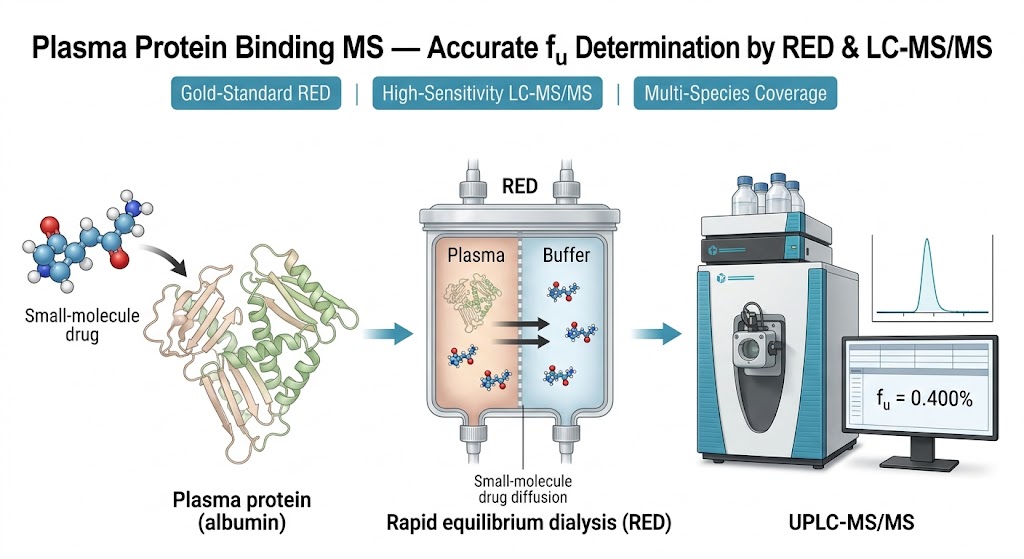
Plasma Protein Binding MS service overview featuring RED equilibrium dialysis setup with LC-MS/MS detection and key advantage tags.
What Is PPB MS Key Advantages When to Use Workflow Method Comparison Sample Deliverables Demo Data Case Study FAQ References

What Is Plasma Protein Binding MS?

Plasma protein binding (PPB) describes the reversible association between a drug and plasma proteins like albumin and α₁-acid glycoprotein (AAG). Only the free (unbound) fraction can cross membranes, bind its target, and get cleared. That makes accurate fraction unbound (fu) data essential for PK-PD modeling, DDI risk assessment, and clinical dose projections.

Our plasma protein binding MS service uses gold-standard rapid equilibrium dialysis (RED) paired with high-sensitivity LC-MS/MS to deliver fu measurements you can trust across multiple species — including for compounds where fu drops below 0.5%. It's part of our broader ADME/DMPK/PK-PD Research Platforms, designed to support your pipeline from early screening through IND-enabling work.

Key Advantages of Our Plasma Protein Binding MS Service

Gold-Standard RED Methodology

Rapid equilibrium dialysis with 8 kDa MWCO membranes at 37°C; incubation optimized per compound class (4–8 h) for accurate fu determination.

High-Sensitivity LC-MS/MS for fu < 0.5%

Waters TQD and Agilent 6495 UPLC-MS/MS systems with MRM detection — LLOQ low enough for highly bound compounds.

Multi-Species Coverage

Mouse, rat, dog, monkey, human as standard. Custom species available upon request.

NSB Assessment and Correction

Systematic NSB screening with protein-free buffer controls; matrix-matched calibration; corrected fu reported.

Flexible Method Selection

RED (gold standard), ultrafiltration (rapid), or ultracentrifugation (minimal NSB) — we help you pick the right one.

Integrated ADME Platform

Run PPB alongside metabolic stability assay, CYP inhibition, permeability, and PK bioanalysis in one streamlined workflow.

When to Use Plasma Protein Binding MS

Our plasma protein binding MS service fits several stages of the drug discovery timeline:

Early Hit-to-Lead Screening

Screen larger libraries to flag compounds with unfavorable free fractions early. A low fu can signal limited tissue distribution that may need addressing.

Lead Optimization

Feed fu data back into medicinal chemistry — structural tweaks that reduce protein binding can raise free drug concentrations at the target site.

IND-Enabling Studies

We generate PPB data aligned with FDA and EMA bioanalytical guidance, suitable for regulatory submissions.

DDI Risk Assessment

Reliable fu values are the backbone of transporter- and enzyme-mediated DDI predictions, especially when binding exceeds 99%.

Special Populations

Disease states alter plasma protein levels. We can run PPB in hepatic impairment, renal impairment, or other disease-state matrices to assess fu shifts.

Parallel ADME Characterization

Consider our drug permeability MS service to pair PPB data with permeability assessment for a complete ADME profile.

Our Plasma Protein Binding MS Workflow

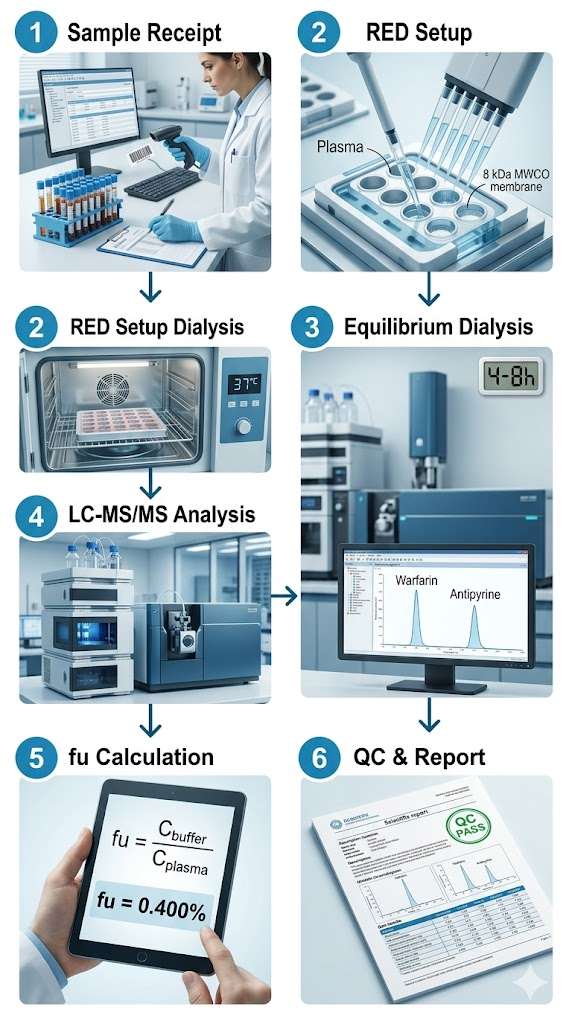
We follow a standardized six-step workflow built for reproducibility:

1

Sample Receipt and Preparation

Plasma is logged, checked for hemolysis, and spiked with the test compound. Each batch includes warfarin (high binding control) and antipyrine (low binding control).

2

RED Setup

Spiked plasma (400 µL) goes into the RED device sample chamber (8 kDa MWCO). PBS (600 µL) fills the receiver chamber.

3

Equilibrium Dialysis Incubation

The assembled plate incubates at 37°C with gentle shaking (100 rpm) for 4–8 hours. Time-course sampling confirms equilibrium is reached.

4

LC-MS/MS Analysis

Samples from both chambers are protein-precipitated and analyzed by UPLC-MS/MS with MRM detection. Calibration curves are matrix-matched to minimize ion suppression.

5

fu Calculation

fu = Cbuffer / Cplasma. PPB (%) = (1 − fu) × 100. Recovery and mass balance are checked per sample.

6

QC Review and Report

We review replicate variability (<20% CV), recovery (70–130%), and apply NSB correction where needed. The final report includes raw chromatograms, calculated fu, and full QC documentation.

Plasma protein binding MS workflow: sample receipt, RED setup, equilibrium dialysis incubation, LC-MS/MS analysis, fu calculation, and QC review.

For downstream PK work, our LC-MS/MS bioanalysis service covers quantitative bioanalysis for in vivo pharmacokinetic studies.

RED vs Ultrafiltration vs Ultracentrifugation: Method Comparison

DimensionRapid Equilibrium Dialysis (RED)Ultrafiltration (UF)Ultracentrifugation (UC)
PrincipleEquilibrium diffusion across semipermeable membranePressure-driven filtration through membraneSedimentation of protein-bound drug by centrifugal force
ThroughputModerate (96-well format)High (96-well format, 2–4 h)Low (batch mode, 4–6 h)
NSB RiskLow (membrane NSB only)High (membrane + device NSB)Very low (no membrane)
fu Range0.01–99.9%0.1–99%1–99%
Cost per CompoundModerateLowHigh
Regulatory AcceptanceGold standard (FDA/EMA preferred)Acceptable with NSB correctionAcceptable for specific cases

How to choose: RED works for most compounds, especially when binding >99% or regulatory-grade data is needed. UF is a good fit for rapid screening of unstable compounds. UC is the fallback when NSB makes membrane methods unreliable.

Sample Requirements

Matrix TypeMinimum VolumeRecommended ConcentrationReplicatesStability
Human plasma (K₂EDTA)200 µL per compound1–10 µM3Stable at −80°C for ≥90 days
Rat plasma (K₂EDTA)200 µL per compound1–10 µM3Stable at −80°C for ≥90 days
Mouse plasma (K₂EDTA)200 µL per compound1–10 µM3Stable at −80°C for ≥90 days
Dog plasma (K₂EDTA)200 µL per compound1–10 µM3Stable at −80°C for ≥90 days
Monkey plasma (K₂EDTA)200 µL per compound1–10 µM3Stable at −80°C for ≥90 days
Custom species200 µL per compound1–10 µM3Confirmed upon request

For compounds with solubility or stability concerns, contact us for an optimized protocol.

Deliverables

  • Fraction unbound (fu) — mean ± SD from triplicate measurements
  • Plasma protein binding (%) — (1 − fu) × 100
  • Recovery (%) — mass balance per compound
  • NSB-corrected fu — where applicable
  • Raw MRM chromatograms — for each analyte
  • QC summary — replicate variability, control performance, batch acceptance

Representative Plasma Protein Binding Data

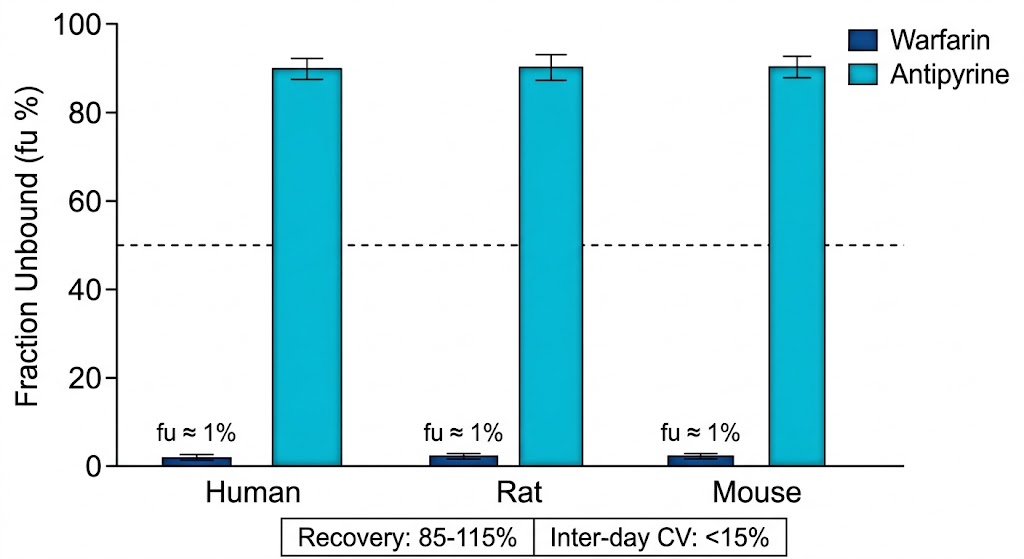
Representative RED-LC-MS/MS data showing fraction unbound for warfarin (highly bound, fu ~1%) and antipyrine (minimally bound, fu ~90%) across human, rat, and mouse plasma.

Example PPB data: warfarin vs antipyrine fu comparison

These numbers show how our RED-LC-MS/MS platform performs with well-characterized model compounds. Warfarin (highly bound): fu ≈ 0.8–1.2% (PPB ≈ 99%) across human, rat, and mouse plasma — consistent with published literature. Inter-day CV stays under 15%. Antipyrine (minimally bound): fu ≈ 88–92% (PPB ≈ 10%) across all species, confirming minimal binding and validating dialysis system integrity.

Equilibrium Time Course: Time-point sampling at 2, 4, 6, and 8 hours shows equilibrium is reached by 4 hours for most compounds, with stable fu through 8 hours.

NSB Assessment: Recovery ranges from 85–115% for test compounds. NSB correction is applied when recovery falls below 80%.

Case Study: Lurbinectedin Plasma Protein Binding by RED-UPLC-MS/MS

King N, Garcia-Martinez S, Alcaraz E, et al. "Quantitative determination of lurbinectedin, its unbound fraction and its metabolites in human plasma utilizing ultra-performance LC–MS/MS." PLoS ONE 18(3):e0283783 (2023). https://doi.org/10.1371/journal.pone.0283783

Background

Lurbinectedin is a small-molecule anticancer agent that binds DNA and inhibits RNA polymerase II. Knowing its free fraction in plasma is critical for PK-PD modeling and dose optimization in the clinic.

Methods

The authors validated a UPLC-MS/MS method for total and unbound lurbinectedin in human plasma. PPB was measured by RED with 8 kDa MWCO membranes — 400 µL spiked plasma against 600 µL PBS, 8 h at 37°C, 100 rpm shaking. Post-dialysis samples ran on Waters Acquity UPLC-TQD and Agilent 6495 systems with MRM detection. The method met FDA and EMA validation criteria.

Results

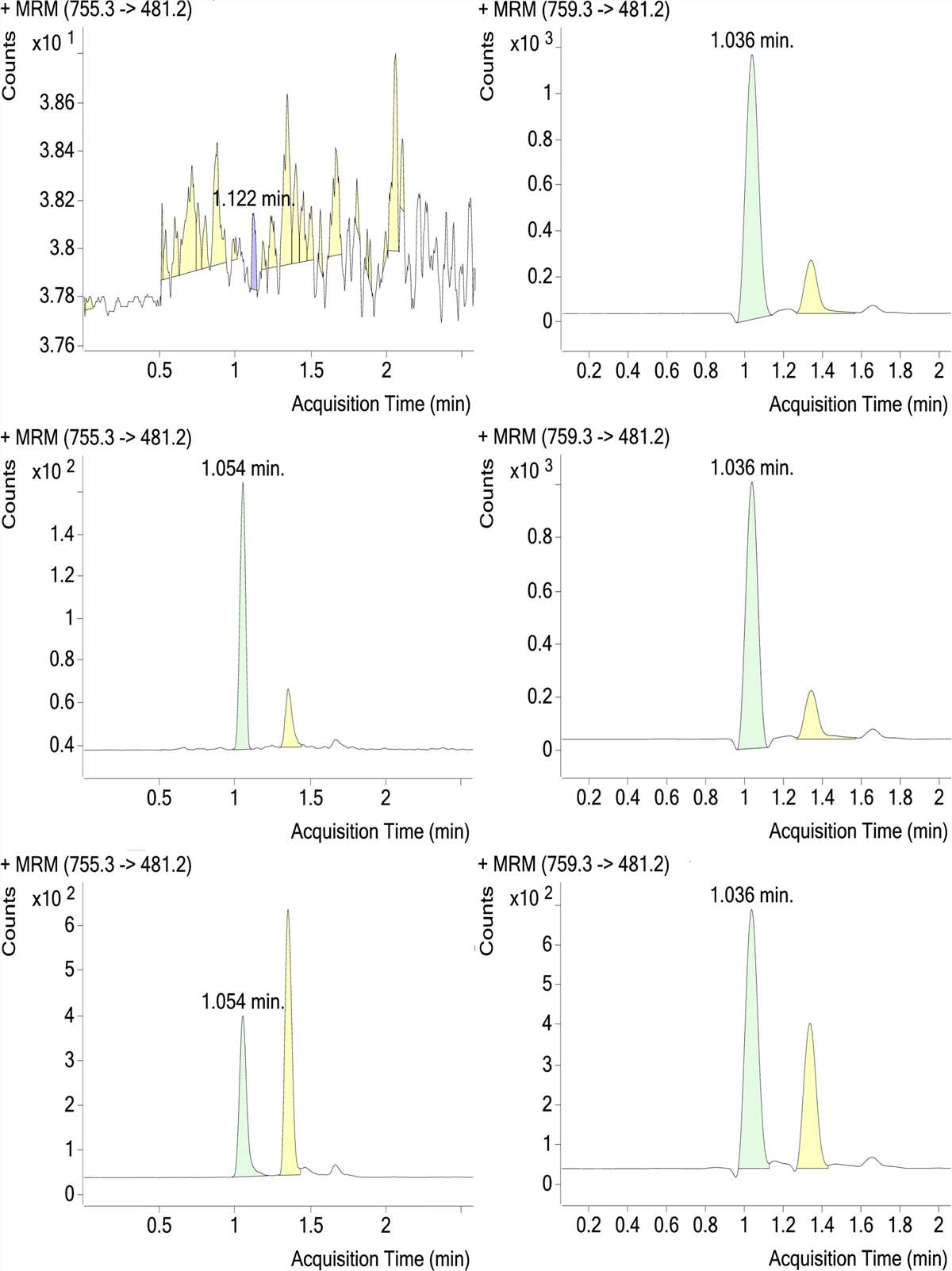
Lurbinectedin showed 99.6% plasma protein binding (fu = 0.400%) in fresh human plasma. The unbound fraction was heavily AAG-dependent: fu ranged from 8.95% (PPB 91.1%) without AAG down to 0.101% (PPB 99.9%) at 4 mg/mL AAG. Albumin (25–50 mg/mL) and lurbinectedin concentration (50–500 ng/mL) had negligible effects. Plasma was stable at −80°C for ≥91 days. In clinical PK studies, only unbound lurbinectedin exposure correlated with efficacy — overall survival and objective response rate.

Why This Matters

This case shows that RED with high-sensitivity UPLC-MS/MS can accurately measure fu for a >99.5% bound drug and identify AAG as the key binding protein — information that directly informs dose individualization.

Lurbinectedin plasma protein binding data from King et al. 2023 showing 99.6% PPB and AAG-dependent fu variation.

Lurbinectedin PPB data. (Source: King et al., 2023, PLoS ONE, Fig. 4)

FAQ

Frequently Asked Questions About Plasma Protein Binding MS

Q: What is the difference between RED, ultrafiltration, and ultracentrifugation for PPB measurement?

RED is the gold standard — lowest NSB but needs 4–8 h incubation. UF is faster (2–4 h) but NSB risk is higher. UC has minimal NSB but lower throughput and higher cost. We'll help you pick based on your compound and project stage.

Q: How do you handle non-specific binding (NSB) in PPB assays?

We run protein-free buffer controls in parallel to detect NSB. When significant, we apply matrix-matching and report NSB-corrected fu alongside the raw data.

Q: Which species do you offer for plasma protein binding studies?

Standard: mouse, rat, dog, monkey, human. Custom species (minipig, rabbit, guinea pig, etc.) on request. For related work, see our tissue binding MS service.

Q: What is the typical turnaround time for a PPB study?

5–7 business days from sample receipt. Rush (3 business days) available at an additional fee.

Q: What sample volume and concentration do you need?

Minimum 200 µL plasma per compound, 1–10 µM recommended. We can optimize for compounds with solubility or NSB issues.

Q: Can I combine PPB with other ADME assays in the same study?

Absolutely. We routinely bundle PPB with metabolic stability, CYP inhibition, permeability, and PK bioanalysis for consistent data across assays.

References

  1. King N, Garcia-Martinez S, Alcaraz E, et al. Quantitative determination of lurbinectedin, its unbound fraction and its metabolites in human plasma utilizing ultra-performance LC–MS/MS. PLoS ONE. 2023;18(3):e0283783.
  2. Jones RS, Chang JH, Flores M, Brecht E. Evaluation of a Competitive Equilibrium Dialysis Approach for Assessing the Impact of Protein Binding on Clearance Predictions. J Pharm Sci. 2021;110(1):536-542.
  3. Qiu F, Dziegielewska KM, Huang Y, et al. Developmental changes in the extent of drug binding to rat plasma proteins. Sci Rep. 2023;13:1266.

Plan Your PPB Study with the MassTarget™ Team

Share your project details and our ADME scientists will design a tailored plasma protein binding strategy for your drug discovery program.

For research use only. Not for use in diagnostic procedures.

Online Inquiry

Please submit a detailed description of your project. We will provide you with a customized project plan to meet your research requests. You can also send emails directly to for inquiries.

* Email
Phone
* Service & Products of Interest
Services Required and Project Description