MSn Structural Elucidation Service

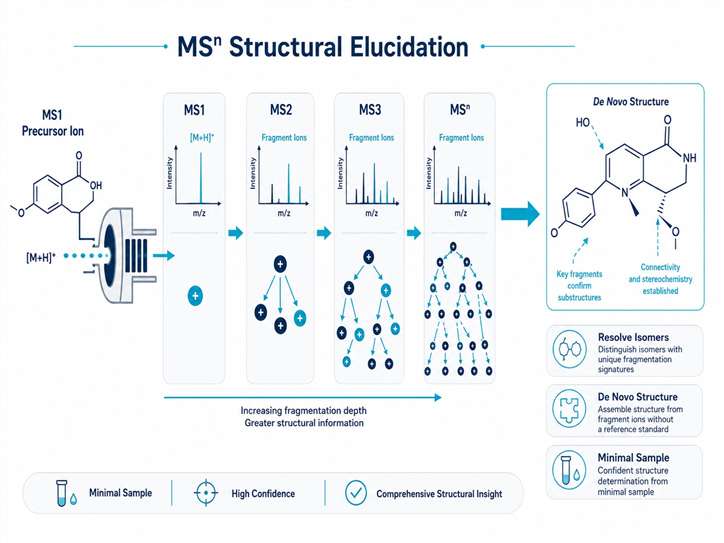
When MS2 is not enough, MSn delivers the structural depth you need.

Multi-stage fragmentation from MS1 to MSn for confident de novo characterization of unknown compounds, unresolved isomers, and complex natural product mixtures.

Key Advantages:

  • Resolve structural isomers
  • Confirm fragmentation pathways
  • De novo structure determination
  • Minimal sample required
MSn structural elucidation service for unknown compound identification.
What MSn Reveals Key Advantages What MSn Can Reveal When MSn Workflow Technology Comparison Sample Deliverables Demo Case Study FAQ

What MSn Reveals That MS2 Cannot

Standard LC-MS/MS gives you one round of fragmentation. That works fine for library-based identification of known compounds, but when you're dealing with something truly unknown — an isomer with no database match, a modified metabolite, or a novel natural product — a single MS2 spectrum often leaves too many questions unanswered.

MSn changes that. By taking a fragment ion from your MS2 spectrum and fragmenting it again (MS3), then taking a fragment from that and going further (MS4, MS5...), we build a hierarchical picture of how the molecule comes apart. Each stage reveals something the previous one couldn't: which fragment carries the core scaffold, where a sugar is attached, or how two isomers differ.

For a research team working on an unknown natural product, the difference is decisive. MS2 might tell you the molecular formula and a few fragments. MSn can tell you the structure.

Key Advantages of Our MSn Service

Stepwise fragmentation depth

Iterative MSn up to MS5 or beyond, depending on compound complexity and instrument configuration. Each stage adds a new dimension of structural evidence.

High-resolution accurate-mass detection

Orbitrap and Q-TOF platforms deliver sub-5 ppm mass accuracy across all fragmentation stages, enabling confident elemental composition assignment for every fragment ion.

Expert spectral interpretation

Our PhD-level scientists combine automated library matching (Mass Frontier, SIRIUS) with manual fragmentation pathway analysis for de novo structural proposals.

Broad compound compatibility

From flavonoids and alkaloids to peptides, lipids, and synthetic small molecules — MSn works across chemical classes without compound-specific assay development.

Minimal sample requirement

As little as 10 µg of purified compound or 50 µg of enriched extract is sufficient for a full MSn structural elucidation workflow.

Rapid project initiation

No assay development phase. Submit your sample, and our team begins MSn acquisition within days, not weeks.

What MSn Structural Elucidation Can Reveal

Molecular weight and formula confirmation

Accurate-mass MS1 measurement combined with isotopic pattern matching confirms the molecular formula with high confidence, narrowing the candidate space before fragmentation begins.

Substructure annotation

Each MSn stage generates fragment ions that correspond to specific substructures. By tracking which fragments persist or disappear across stages, the core scaffold and peripheral groups can be identified.

Isomer discrimination

Structural isomers that produce identical MS2 spectra often diverge at MS3 or MS4, where different connectivity patterns yield distinct fragment ion series. This is particularly valuable for flavonoid glycoside positional isomers and lipid double-bond isomers.

Modification site localization

For modified compounds — glycosylated natural products, methylated metabolites, or drug conjugates — MSn enables precise localization of the modification by tracking which fragment ion carries the mass shift.

Fragmentation pathway mapping

The hierarchical nature of MSn data allows reconstruction of the complete fragmentation tree, showing the sequential relationship between precursor and product ions — essential for understanding gas-phase chemistry and confirming structural assignments.

De novo structure proposal

When no database match exists, the cumulative evidence from multiple MSn stages — combined with HRMS data and fragmentation rules — supports the proposal of a novel chemical structure.

When MSn Structural Elucidation Is the Right Choice

Five research scenarios where MSn provides a clear technical advantage over single-stage MS/MS or alternative techniques.

1

Unknown natural products in complex extracts

When bioassay-guided fractionation yields a bioactive fraction but the active compound is novel or lacks a spectral library match, MSn provides the structural depth needed for de novo characterization. For complementary dereplication strategies, see our LC-HRMS/MS dereplication service.

2

Unresolved structural isomers

Metabolites differing only in the position of a hydroxyl group, glycosidic linkage, or double bond often cannot be distinguished by MS2 alone. MSn resolves these by revealing isomer-specific fragmentation patterns at higher stages.

3

Metabolite identification in untargeted studies

Untargeted metabolomics routinely detects hundreds of unknown features. MSn provides the additional evidence needed to elevate annotations from Level 3 (putative) to Level 2 (confident) or Level 1 (confirmed with standard).

4

Impurity and degradation product characterization

Pharmaceutical impurities and forced degradation products require definitive structural assignment for regulatory filing. MSn delivers the fragmentation evidence needed to propose structures for unknown impurities.

5

Fragmentation pathway elucidation

When understanding gas-phase fragmentation behavior is itself a research goal — for example, in developing diagnostic fragment ions for targeted screening — MSn provides the stepwise evidence to map fragmentation mechanisms. For broader natural product applications, see our natural product MS discovery service.

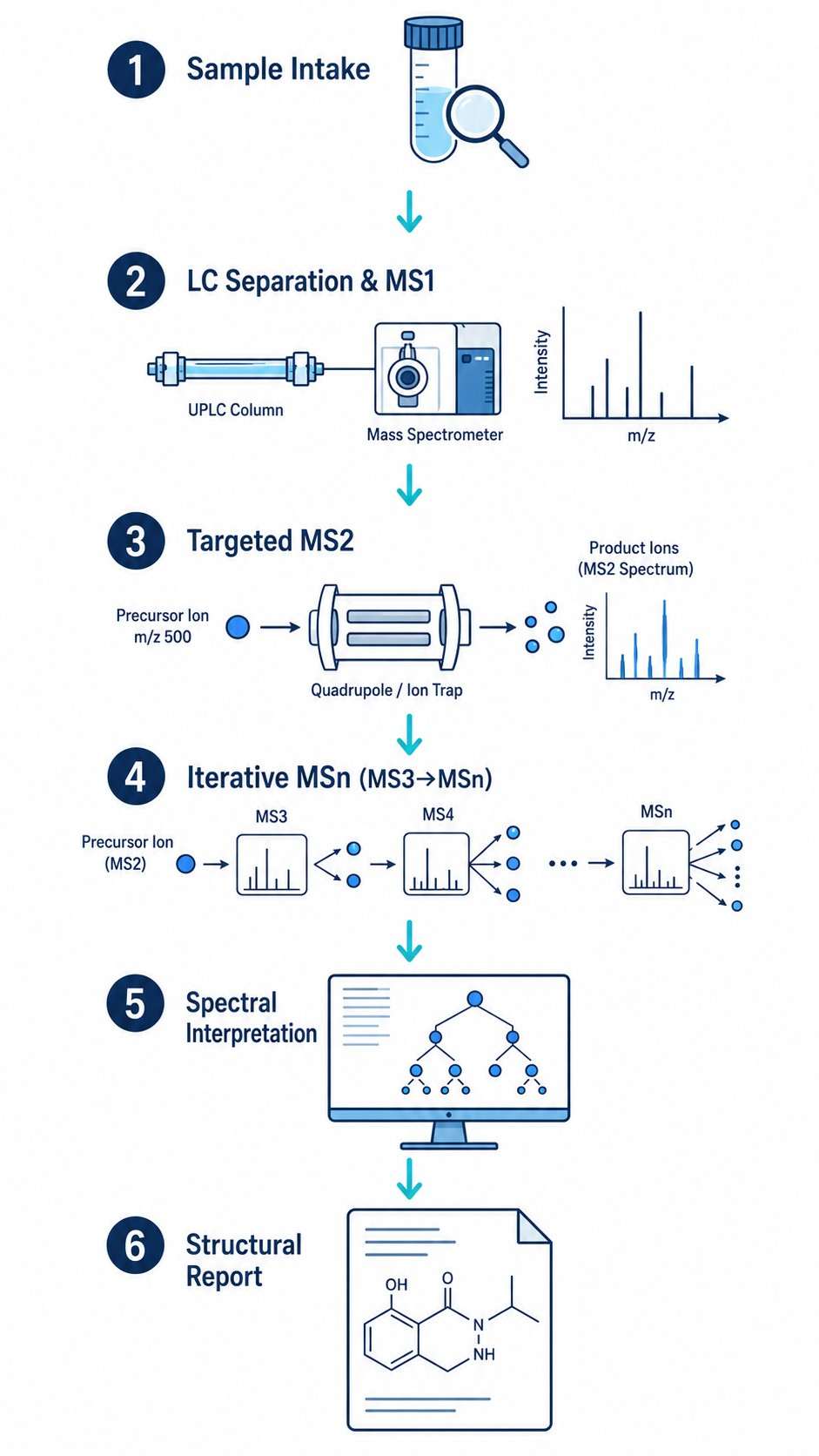
MSn structural elucidation workflow with six technical steps from sample to structure.

Our MSn Structural Elucidation Workflow

A systematic six-step process from sample intake to structural report.

1

Sample intake and method scouting

We review your sample type, solubility, and target compound information to select the optimal LC-MS configuration. A quick solubility test and dilution series are performed to determine the ideal injection concentration.

2

LC separation and MS1 survey scan

The sample is separated by reversed-phase UPLC (or HILIC for polar compounds). Full-scan HRMS acquisition (MS1) provides the precursor ion mass and isotopic pattern for molecular formula assignment.

3

Targeted MS2 acquisition

The precursor ion of interest is isolated in the ion trap or quadrupole and subjected to CID or HCD fragmentation. The resulting MS2 spectrum provides the first layer of structural information — primary fragment ions and neutral losses.

4

Iterative MSn fragmentation (MS3 → MSn)

Key fragment ions from the MS2 spectrum are sequentially isolated and fragmented. Each iteration (MS3, MS4, etc.) reveals deeper structural detail. The process continues until the fragment ion signal is insufficient for further isolation, or until the structural question is answered.

5

Spectral interpretation and fragmentation tree assembly

All MSn spectra are analyzed using Mass Frontier for automated fragmentation tree construction, cross-referenced with SIRIUS for molecular formula assignment of each fragment. Manual expert review resolves ambiguities. For large-scale datasets, this step can be complemented by feature-based molecular networking and GNPS molecular networking to contextualize MSn data within broader chemical space.

6

Structural report and recommendations

A comprehensive report is generated, including annotated MSn spectra, the proposed fragmentation tree, the assigned chemical structure (with confidence level), and recommendations for orthogonal validation if needed (e.g., NMR for absolute configuration).

Technology Comparison: MSn vs. Alternative Structural Elucidation Methods

TechniqueCore PrincipleStructural Information DepthSample RequirementThroughputBest Application
MSn (Multi-Stage MS)Iterative isolation and fragmentation of selected ions through multiple stagesHigh — substructure annotation, isomer discrimination, modification localization10–100 µgMedium — 10–50 compounds per dayDe novo structure elucidation of unknowns; isomer resolution
MS2 (LC-MS/MS)Single-stage fragmentation of precursor ionsModerate — molecular formula and primary fragments1–10 µgHigh — 100+ compounds per dayLibrary-based identification of known compounds
NMR (1D/2D)Nuclear magnetic resonance for connectivity and stereochemistryVery high — complete structure including stereochemistry≥1 mg (pure)Low — 1–5 compounds per dayFull de novo structure determination; absolute configuration
Computational Prediction (SIRIUS, CFM-ID)In silico fragmentation prediction and database matchingLow–Moderate — candidate ranking, formula predictionNone (in silico)Very high — thousands per dayPreliminary annotation; candidate prioritization
Cryo-EMElectron microscopy of frozen-hydrated samplesVery high — 3D structure of large complexes≥100 µg (pure, large complex)Low — 1–2 samples per weekLarge protein complexes; viral particles
X-ray CrystallographyX-ray diffraction of crystalline samplesVery high — complete 3D structure≥5 mg (crystalline)Low — 1–2 samples per weekAbsolute configuration; protein–ligand complexes

How to choose: If you have a pure compound at milligram scale and need absolute configuration, NMR or X-ray is the gold standard. If you have limited sample (microgram scale), complex mixtures, or need to screen multiple unknowns rapidly, MSn provides the best balance of structural depth and sample economy. MS2 is sufficient for library-matched identification of known compounds. Computational prediction is useful for preliminary annotation but cannot replace experimental evidence for novel structures.

For complementary approaches, see our MS2LDA substructure discovery service, which applies pattern recognition to MS2 data for substructure annotation across large datasets.

Sample Requirements

Sample TypeRecommended AmountPurityConcentrationBuffer / Notes
Purified compound≥10 µg≥95%≥100 µMMS-compatible solvent (MeOH, ACN, H₂O); avoid non-volatile salts
Enriched extract≥50 µg≥80%≥50 µMMinimal salt and detergent; provide extraction method details
Crude extract≥100 µgN/AN/AProvide extraction method and solvent composition
Biofluid (plasma, urine)≥200 µLN/AN/AProtein precipitation recommended; provide collection protocol
Tissue lysate≥200 µg proteinN/AN/AProvide homogenization buffer details and tissue source

Note: These are general guidelines. Our team will assess your specific sample and recommend the optimal amount and preparation method during project intake. For samples with limited availability, we can perform a micro-scale feasibility test before committing to the full workflow.

Deliverables

  • Annotated MSn spectra at each fragmentation stage (MS1, MS2, MS3, ..., MSn)
  • Fragmentation tree diagram showing the hierarchical relationship between precursor and product ions
  • Molecular formula assignment for precursor and key fragment ions (≤5 ppm mass accuracy)
  • Proposed chemical structure with confidence level (Level 1–4 based on Metabolomics Standards Initiative)
  • Detailed methods section describing LC conditions, MS parameters, and data processing workflow
  • Raw data files in standard formats (mzXML, .raw, or .d) for independent review

Representative MSn Data

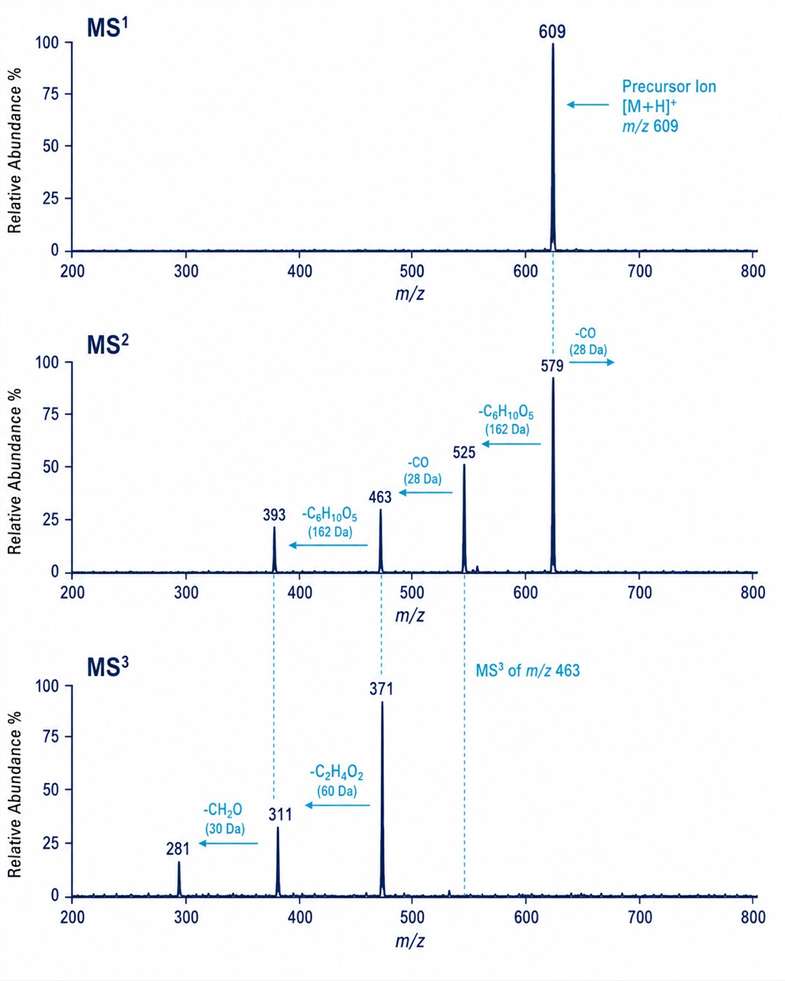
MSn mass spectra showing stepwise fragmentation from MS1 to MS3.

Example MSn spectral tree: stepwise fragmentation from MS1 to MS3

The MS1 spectrum shows the precursor ion at m/z 609. Isolation and CID fragmentation at MS2 generates primary fragment ions including m/z 579, 525, 463, and 393. Further isolation of the m/z 463 fragment at MS3 reveals secondary fragmentation to m/z 371, 311, and 281, confirming the sequential loss of sugar moieties and establishing the glycosylation pattern.

Case Study: UPLC/MSn-Based Structural Elucidation of Bougainvillea glabra Metabolites

El-Nashar HAS, Eldahshan OA, El Hassab MA, Zengin G, Elhawary EA. "UPLC/MSn analysis of Bougainvillea glabra leaves and investigation of antioxidant activities and enzyme inhibitory properties." Scientific Reports 15:28272 (2025). https://doi.org/10.1038/s41598-025-11851-9

Background

Bougainvillea glabra is an ornamental plant with documented traditional uses, but its detailed phytochemical profile remained incompletely characterized. The authors aimed to apply UPLC/MSn for comprehensive structural elucidation of its secondary metabolites, including flavonoids, phenolic acids, and other compound classes.

Methods

Methanol leaf extracts were analyzed using UPLC-ESI-MS/MS in both positive and negative ionization modes. The MSn workflow involved:

  • Full-scan MS1 acquisition for precursor ion detection and molecular formula assignment
  • Data-dependent MS2 fragmentation of detected precursor ions
  • Manual interpretation of MSn fragmentation patterns for structural assignment
  • Comparison of retention times, molecular ions, and fragment ion series with published literature data

Results

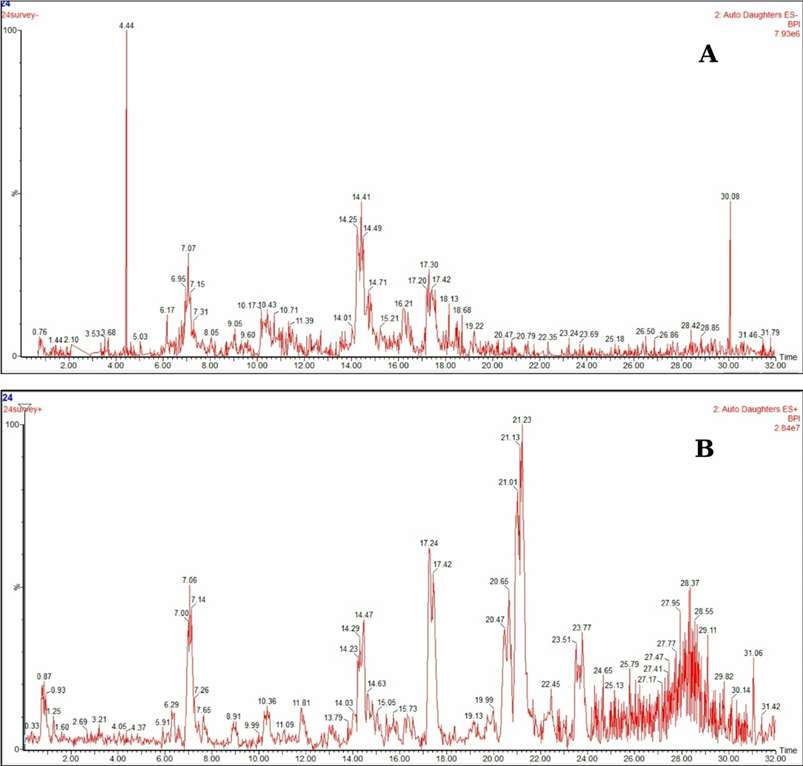
The UPLC/MSn analysis detected 23 chromatographic peaks, of which 21 compounds were tentatively identified (Fig. 1). Key structural assignments included:

  • Flavonoids: luteolin robinobioside (m/z 593 → fragment at m/z 285 confirming luteolin aglycone), rhamnocitrin-O-rutinoside (m/z 609 → MSn fragments at m/z 579, 525, 463, 393, 371, 311, 281), apigenin-C-hexoside-C-pentoside (m/z 563), and biflavonoids including di-hydro-bi-apigenin methyl ether (m/z 553) and manniflavanone (m/z 589)
  • Phenolic acids: caffeic acid hexoside (m/z 341), tri-O-caffeoyl shikimic acid (m/z 659), chlorogenic acid (m/z 353), and rosmarinic acid (m/z 359)
  • Other classes: (+)-syringaresinol hexoside (lignan, m/z 579), delphinidin hexosyl pentosyl malonate (anthocyanin, m/z 683), oleanolic acid (triterpene, m/z 455), and speedoside (iridoid, m/z 685)

The fragmentation patterns at each MSn stage provided diagnostic ions that distinguished between closely related structural isomers — for example, the specific fragment series of tri-O-caffeoyl shikimic acid (m/z 571, 475, 397, 329, 299, 285) confirmed the sequential loss of caffeoyl moieties and established the substitution pattern.

Conclusions

The study demonstrated that UPLC/MSn is a powerful and efficient approach for the structural elucidation of diverse natural product classes from a single plant extract. The MSn fragmentation data enabled confident identification of 21 compounds across multiple chemical classes — flavonoids, phenolic acids, lignans, anthocyanins, triterpenes, and iridoids — without the need for compound isolation or NMR analysis. The authors noted that MSn provided the structural depth necessary to distinguish between isomeric flavonoid glycosides and to assign modification patterns that would have been ambiguous from MS2 data alone.

UPLC/MSn BPI chromatograms of Bougainvillea glabra leaf extract in positive and negative ion modes.

Fig. 1: UPLC/MSn base peak intensity (BPI) chromatograms of B. glabra methanol leaf extract in (A) negative ion mode and (B) positive ion mode. (Source: El-Nashar et al. 2025, Scientific Reports, CC BY 4.0)

FAQ

Frequently Asked Questions

Q: What is MSn structural elucidation and how is it different from standard MS/MS?

Standard MS/MS (MS2) gives you one fragmentation round. MSn extends that by taking a product ion from MS2, fragmenting it again (MS3), and repeating. Each stage peels away another layer of structural information. For de novo structure elucidation of unknowns, that extra depth often makes the difference between a tentative annotation and a confident assignment.

Q: What types of compounds can be analyzed by MSn?

Any compound that ionizes by ESI or APCI and produces informative CID or HCD fragments. Common classes include flavonoids, alkaloids, terpenoids, phenolic acids, peptides, lipids, synthetic small molecules, and drug metabolites. MSn is especially powerful for compounds with multiple functional groups or glycosylation sites.

Q: How many fragmentation stages are typically needed for de novo structure determination?

It depends on compound complexity. Simple molecules may need only MS2 or MS3. Complex natural products with multiple rings or glycosylation sites often require MS3 to MS5. We fragment iteratively until the structural question is answered or the signal is too weak. Our team determines the optimal depth during acquisition.

Q: Can MSn distinguish structural isomers?

Yes — this is a key advantage. Isomers that produce nearly identical MS2 spectra often diverge at MS3 or MS4. Flavonoid glycoside positional isomers (3-O- vs. 7-O-glycoside) and lipid double-bond positional isomers are classic examples where MSn provides the diagnostic fragments that MS2 cannot.

Q: What is the minimum sample amount required for MSn analysis?

For purified compounds, ≥10 µg at ≥100 µM. For enriched extracts, ≥50 µg. Crude extracts and biofluids need more (≥100 µg or ≥200 µL). If your sample is limited, we can run a micro-scale feasibility test first to confirm whether the full workflow will succeed.

Q: How does MSn structural elucidation complement NMR analysis?

NMR gives you definitive carbon skeletons and stereochemistry — but needs milligram-scale pure samples. MSn works at microgram scale and handles mixtures. A common workflow: use MSn for preliminary structure proposal and isomer discrimination, then confirm with NMR if enough pure material can be isolated. For compounds where NMR is impractical, MSn may be the only viable route.

References

  1. Brungs C, Schmid R, Garg N, et al. MSnLib: efficient generation of open multi-stage fragmentation mass spectral libraries. Nature Methods (2025).
  2. El-Nashar HAS, Eldahshan OA, El Hassab MA, Zengin G, Elhawary EA. UPLC/MSn analysis of Bougainvillea glabra leaves and investigation of antioxidant activities and enzyme inhibitory properties. Scientific Reports 15:28272 (2025).
  3. Schmid R, Petras D, Nothias LF, et al. Computational expansion of high-resolution-MSn spectral libraries for metabolite annotation. Analytical Chemistry 95:48, 17648–17656 (2023).

Plan Your MSn Structural Elucidation Project

Submit your sample details and our scientists will design a tailored MSn acquisition strategy for your unknown compound.

Disclaimer: This service and all related deliverables are for research use only. Not for use in diagnostic procedures.

Online Inquiry

Please submit a detailed description of your project. We will provide you with a customized project plan to meet your research requests. You can also send emails directly to for inquiries.

* Email
Phone
* Service & Products of Interest
Services Required and Project Description