Automated Compound–Target Binding HT-MS Screening

Label-free binding detection at scale — automated affinity selection mass spectrometry for hit identification across diverse target classes.

Automated compound-target binding HT-MS combines affinity selection chemistry with high-resolution mass spectrometry to directly detect ligand-target binding events from pooled compound libraries — without fluorescent tags, immobilized targets, or DNA barcodes. Our platform integrates automated liquid handling, affinity separation, and multi-plexed MS readout into a single, standardized workflow capable of screening thousands of compounds per day against soluble proteins, membrane proteins, and protein complexes.

At Creative Proteomics, our MassTarget™ HT-MS binding platform deploys multiple affinity selection formats — SEC-based, ultrafiltration-based, and bead-based — selected to match the biophysical properties of each target. The result: direct, label-free hit identification with rich mass spectrometric data for each binding event.

Core Capabilities:

  • Label-free binding detection — no fluorescent tags, no immobilisation, no DNA barcodes
  • Pooled library screening — 100–1,000 compounds per run with deconvolution by accurate mass
  • Multiple affinity formats — SEC-based, ultrafiltration-based, and bead-based ASMS
  • Broad target compatibility — soluble proteins, membrane proteins, protein complexes, RNA
  • Automated workflow — from plate loading to ranked hit list with minimal hands-on time
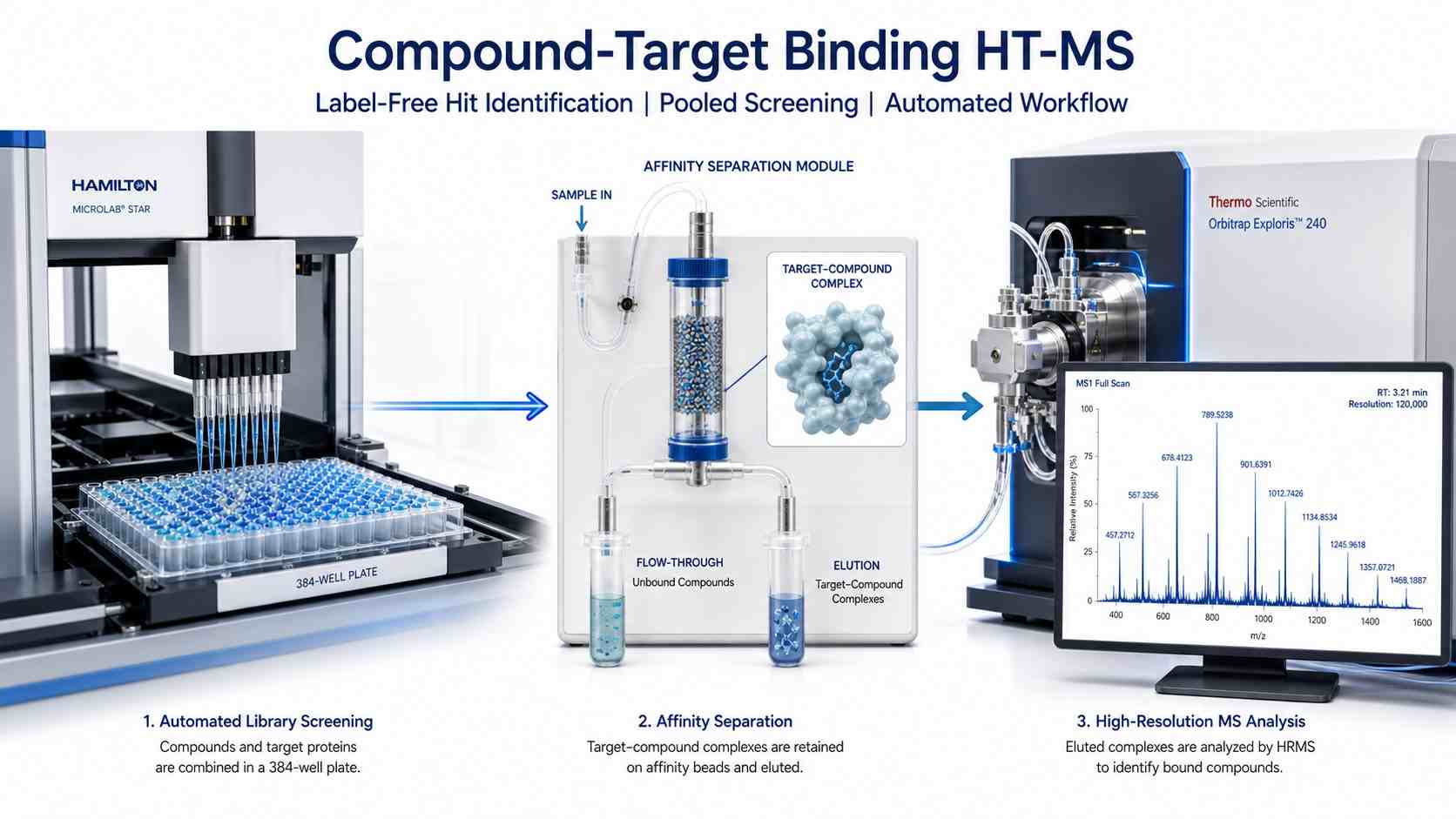
Automated compound-target binding HT-MS screening platform showing automated liquid handler, affinity separation module, and mass spectrometer for label-free hit identification.
What Is HT-MS Binding Screening Why Automate with MS Platform Formats Workflow Applications Method Comparison Sample FAQ

What Is Automated Compound–Target Binding HT-MS Screening?

Automated compound-target binding HT-MS screening — also referred to as high-throughput affinity selection mass spectrometry (HT-ASMS) — is a label-free screening approach that directly detects the formation of non-covalent complexes between a target biomolecule and small-molecule ligands using mass spectrometry as the readout.

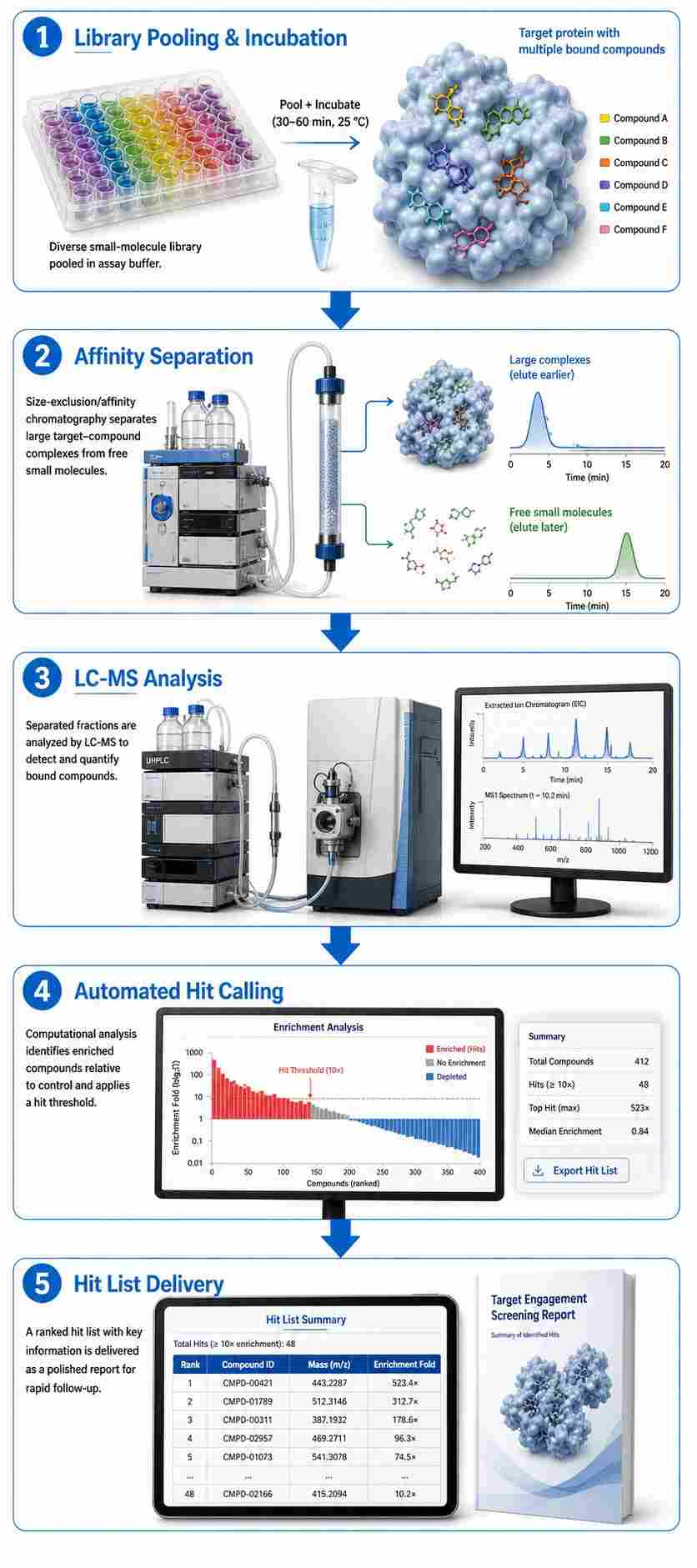
The fundamental principle is straightforward: (1) the target is incubated with a pooled library of compounds under native conditions to allow binding equilibration; (2) bound complexes are separated from unbound compounds — typically by size-exclusion chromatography (SEC), ultrafiltration, or magnetic beads; (3) the retained ligands are eluted and identified by LC-MS or direct-infusion MS; (4) binding is confirmed by comparing compound enrichment in target-containing versus target-free control samples.

What distinguishes our service is the degree of automation. From robotic plate handling to automated data processing, the entire workflow is designed to minimize hands-on time while maximizing reproducibility. The platform integrates with standard 96/384-well plate formats and supports screening of pooled libraries from diverse chemical spaces — small molecules, fragments, macrocyclic peptides, and natural product extracts.

Why Automate Binding Detection with Mass Spectrometry?

Binding detection is the most fundamental measurement in drug discovery. Automated MS-based binding screening addresses critical limitations of established approaches.

No Target Modification Required

Unlike SPR (requires surface immobilisation) or fluorescence polarization (requires labeled ligand), ASMS measures binding in free solution with the native target. This eliminates surface artifacts, orientation bias, and labeling interference — a critical advantage for challenging targets where immobilisation alters activity.

Direct Library Pooling

Pooled screening of 100–1,000 compounds per run dramatically reduces assay plates, reagents, and instrument time compared to single-compound-per-well formats. Compound identity is confirmed by accurate mass and retention time, eliminating deconvolution steps required by pooled fluorescence or absorbance assays.

Broad Chemical Space Compatibility

ASMS detects any ionizable compound — small molecules, fragments, macrocycles, natural products, peptides — without requiring a specific functional group for detection. This is particularly valuable for libraries enriched in natural product extracts or DEL-derived scaffolds.

Integrated Hit Quality Assessment

Each binding event is detected with full mass spectrometric data: accurate mass, isotopic pattern, and (when applicable) fragmentation spectra. This provides immediate hit quality information that orthogonal methods cannot offer without a secondary MS experiment.

Platform Formats: ASMS Modalities We Offer

We deploy three complementary ASMS formats, each optimized for different target types and library formats.

SEC-Based ASMS

The most versatile format. Target-compound complexes are separated from unbound compounds by size-exclusion chromatography. Suitable for targets ≥15 kDa, including soluble proteins, protein complexes, and membrane proteins in detergent or nanodisc. Compatible with library sizes of 100–1,000 compounds per pool. Standard for hit identification in our RapidFire MS platform.

Ultrafiltration-Based ASMS

Uses membrane filtration to retain target-compound complexes while washing away unbound compounds. Ideal for targets<15 kDa where SEC resolution is insufficient, or for libraries containing compounds with high non-specific binding to SEC media. Also the method of choice for continuous-flow MS kinetics integration.

Magnetic Bead–Based ASMS

The target is immobilized on magnetic beads via affinity capture (His-tag, biotin-streptavidin, or antibody). This format enables rapid wash steps and is compatible with complex matrices such as cell lysates. Particularly useful for targets that are difficult to purify or that lose activity during SEC.

Custom Method Development

For specialized target classes, non-standard buffer requirements, or unique library formats, we offer custom method development. This includes buffer optimization, pool size adjustment, cross-reactivity assessment, and informatics workflow customization. Our enzyme activity and mechanism studies complement binding data with functional validation.

The Automated HT-MS Binding Screening Workflow

A fully automated sequence from sample plate to ranked hit list.

1

Library Pooling & Target Incubation

Compounds are pooled (100–1,000 per pool) and incubated with the target in MS-compatible buffer. Incubation time and temperature are optimized for binding equilibrium. Each pool includes a target-free control for enrichment calculation.

2

Affinity Separation

Bound complexes are separated from unbound compounds using SEC, ultrafiltration, or magnetic beads. The separation module is integrated with a liquid handler for automated column/plate switching between samples.

3

Compound Elution & LC-MS Analysis

Retained compounds are eluted from the separated complex and analyzed by reversed-phase LC-MS. High-resolution accurate-mass data is acquired for each eluting peak. Total LC-MS run time: 5–15 min per pool.

4

Automated Hit Calling

Mass spectra are processed automatically: peak picking, retention time alignment, and fold-enrichment calculation versus control. Compounds with enrichment above a user-defined threshold (typically 3–10×) are classified as candidate hits.

5

Hit List Delivery

Ranked hit list with accurate mass, retention time, enrichment fold, and supporting extracted ion chromatograms. Optional: dose-response confirmation, selectivity counterscreening, and orthogonal validation.

Automated HT-MS binding screening workflow showing five steps from library pooling to hit list delivery.

Applications in Drug Discovery

Automated compound-target binding HT-MS is applicable across multiple stages of the drug discovery pipeline.

Primary Hit Identification

Screen diverse or focused libraries against novel targets to identify initial binders. Pooled screening enables rapid triage of large chemical spaces with minimal reagent consumption. Compatible with small-molecule, fragment, macrocyclic peptide, and natural product libraries.

Fragment-Based Lead Discovery

ASMS is particularly well suited to fragment screening due to its ability to detect weak, transient binding events. Fragments are screened as pooled libraries (10–50 compounds per pool) at high concentration, and hits are confirmed by dose-response ASMS or orthogonal methods. Our DESI plate-based HTS provides complementary ultra-rapid readout.

Target Selectivity Profiling

Counter-screen identified hits against related targets, family members, or off-target panels to assess selectivity early. The same ASMS platform can be deployed across multiple targets with minimal method re-optimization, enabling efficient selectivity triage.

Natural Product Extract Screening

Screen complex natural product extracts and fraction libraries for target binding without pre-fractionation or deconvolution. ASMS directly identifies the molecular weight of binding components, guiding downstream isolation and identification efforts.

HT-MS Binding Screening vs. Alternative Hit Identification Technologies

ParameterHT-MS Binding (ASMS)DNA-Encoded Libraries (DEL)SPRFluorescence HTS
Detection principleDirect MS of bound ligandDNA tag sequencingRefractive index changeFluorescence signal
Label requiredNoYes (DNA barcode)NoYes (fluorophore)
Library formatPooled (100–1,000/pool)Ultra-large pooled (10⁶–10¹²)Single compoundSingle compound per well
Library size per runUp to 10³ compounds10⁶–10¹² compounds1 compound1 compound per well
Target requirementµg–mg scale, nativeµg scale, nativeImmobilisedFunctionally active
Binding affinity rangeµM–nMnM–pMmM–pMµM–nM (functional)
Hit confirmation built-inYes (mass identity)Requires re-synthesisRequires orthogonal methodRequires orthogonal method

HT-MS binding screening is optimally positioned between DEL (for ultra-large libraries) and SPR (for detailed kinetic characterization) in the drug discovery pipeline. For downstream validation, we also offer enzyme-ligand residence time MS for detailed kinetic profiling of confirmed hits.

Sample Requirements

Sample TypeRequired AmountConcentrationBufferNotes
Target Protein50–500 µg1–50 µM stockMS-compatible (≤50 mM ammonium acetate/bicarbonate)≥85% purity preferred; provide stabilisation conditions
Compound Library10–50 µL of 10 mM stock per compound10 mM in DMSODMSO (≤2% final)Provide compound list with exact masses
Known Binder (control)50 µL10 mM stockDMSO or MS-compatibleRecommended for assay validation
Buffer ComponentsAs requiredMS-compatible or exchangeableAvoid glycerol >5%, Triton >0.1%

General Guidelines:

  • Library pooling strategy is designed in consultation with our team based on target properties
  • Minimum 2–3 replicate pools for statistical enrichment calling
  • Include positive control (known binder) and negative control (no-target) in each run
  • Buffer exchange to MS-compatible conditions can be performed by our team

Deliverables

  • Ranked hit list with accurate mass, retention time, and enrichment fold
  • Extracted ion chromatograms for each confirmed hit (target vs. control overlay)
  • MS spectra with isotopic pattern confirmation
  • Hit statistics: hit rate, enrichment distribution, replicate reproducibility
  • Optional: dose-response confirmation by ASMS (multi-concentration screening)
  • Optional: selectivity profiling against related targets

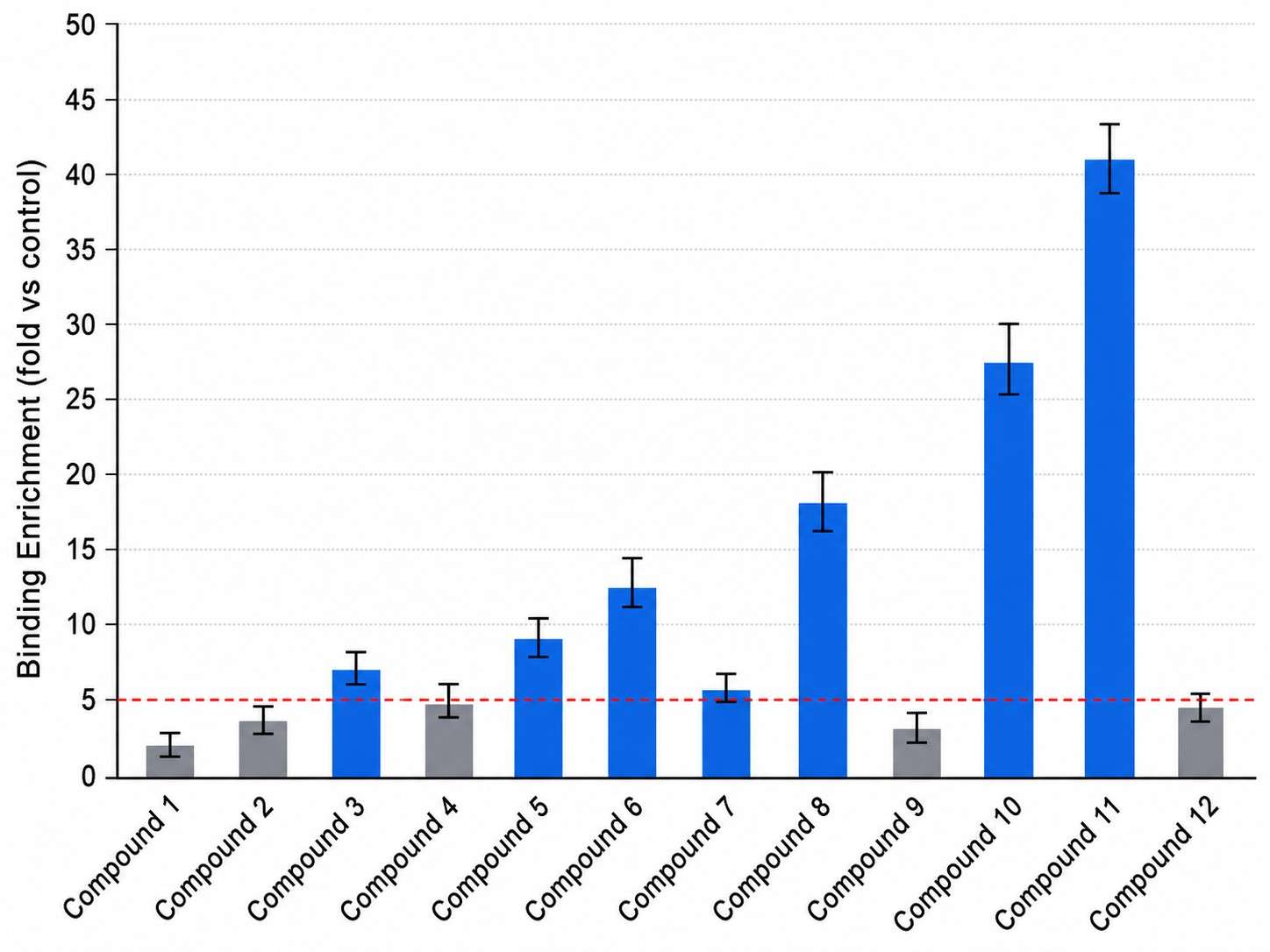
Representative ASMS Screening Data

Representative affinity selection mass spectrometry hit-ranking bar plot showing binding enrichment for compounds screened against a protein target.

Example ASMS hit-ranking plot with enrichment fold for pooled library screening

FAQ

Frequently Asked Questions

Q: What is the difference between compound-target binding HT-MS and activity-based HTS?

Binding HT-MS detects physical association between a compound and its target irrespective of functional effect. Activity-based HTS requires a measurable biochemical response. Binding HT-MS is therefore applicable to targets where no functional assay exists, and it detects both agonists and antagonists — as well as allosteric and orthosteric binders — in a single experiment.

Q: How many compounds can be screened per experiment?

Typical pool sizes range from 100–1,000 compounds per SEC-ASMS run. With automated plate handling, we can process 10–50 pools per day, corresponding to 1,000–50,000 compounds screened daily. For larger libraries, we offer multi-cycle pooling strategies.

Q: What target types are compatible?

Soluble proteins, protein complexes, membrane proteins (in nanodiscs, detergent micelles, or liposomes), and RNA targets are all compatible. The primary requirement is a target of sufficient molecular weight (>10–15 kDa for SEC-based ASMS) to enable efficient separation of bound from unbound compounds.

Q: How do you distinguish specific binders from false positives?

We use three complementary strategies: (1) target-free control samples to identify compounds that bind non-specifically to the separation matrix; (2) replicate screening to assess reproducibility; (3) dose-response confirmation, where hit compounds are re-tested at multiple concentrations to confirm concentration-dependent binding.

Q: Can you screen natural product extracts?

Yes. ASMS is particularly well suited for natural product extract screening because it provides immediate molecular weight information for binding components. This enables direct prioritization of active constituents without the need for initial deconvolution.

References

  1. Prudent R, Annis DA, Dandliker PJ, et al. Exploring new targets and chemical space with affinity selection-mass spectrometry. Nat Rev Chem. 2021;5:62-71. doi:10.1038/s41570-020-00229-2. https://www.nature.com/articles/s41570-020-00229-2
  2. Muchiri RN, van Breemen RB. Drug discovery from natural products using affinity selection-mass spectrometry. Drug Discov Today Technol. 2021;40:59-63. doi:10.1016/j.ddtec.2021.10.005. https://doi.org/10.1016/j.ddtec.2021.10.005
  3. Kordylewski SK, Bugno R, Podlewska S. Residence time in drug discovery: current insights and future perspectives. Pharmacol Rep. 2025;77(4):851-873. doi:10.1007/s43440-025-00748-z. https://doi.org/10.1007/s43440-025-00748-z
  4. Quinn JG. A rebinding-assay for measuring extreme kinetics using label-free biosensors. Sci Rep. 2021;11:8301. doi:10.1038/s41598-021-87880-x. https://www.nature.com/articles/s41598-021-87880-x

Plan a binding screening campaign with the MassTarget™ team

Share your target and library details — our scientists will design a tailored HT-MS binding strategy for your hit discovery program.


For research use only. Not for use in diagnostic procedures. Creative Proteomics provides compound-target binding HT-MS screening services exclusively for research and development purposes. Results are not intended for clinical diagnosis or medical decision-making.

Online Inquiry

Please submit a detailed description of your project. We will provide you with a customized project plan to meet your research requests. You can also send emails directly to for inquiries.

* Email
Phone
* Service & Products of Interest
Services Required and Project Description