Dose-Response Thermal Stability Analysis Service

Dose-Response Thermal Stability Analysis helps you see whether protein stabilization changes in step with compound concentration, giving you stronger target engagement support than a single-condition readout alone. We use this format when your team needs a clearer basis for analog ranking, target confirmation, or orthogonal support for mechanism-focused decisions.

We build each study around the scientific decision you need to make, then return a structured output package your team can review, compare, and act on.

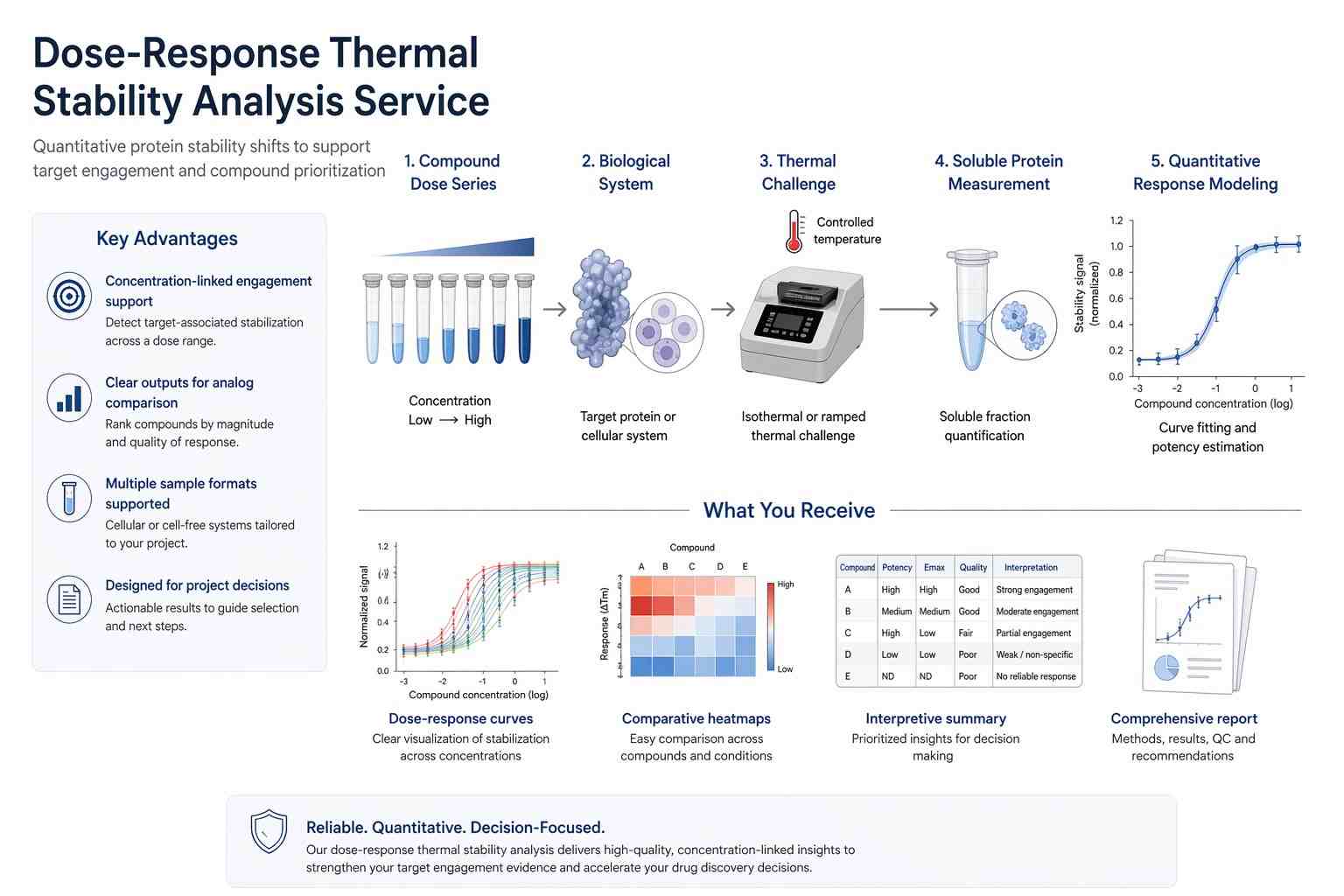
  • Concentration-linked engagement support
  • Clear outputs for analog comparison
  • Multiple sample formats supported
  • Designed for project decisions
Dose-Response Thermal Stability Analysis workflow and value summary for target engagement support
What It Shows Service Overview Method Comparison Workflow Deliverables Sample Demo Case Study FAQ

What Dose-Response Thermal Stability Analysis Can Show You

Dose-Response Thermal Stability Analysis is designed for situations where a simple yes-or-no thermal shift is not enough. Instead of asking only whether a target appears stabilized under one treatment condition, this format asks whether stabilization strengthens across a defined compound concentration series. That added concentration dimension makes the result more useful when you need to compare compounds, support a target engagement claim, or decide whether the project should move into a broader follow-up study.

In practice, we expose your selected biological system to a concentration range, apply a defined thermal challenge, measure the remaining soluble protein signal, and model how the response changes as compound exposure increases. Published assay guidance for thermal shift workflows describes the same core principle: an isothermal dose-response format is typically performed after the thermal behavior of the target has been characterized, so the challenge condition can be chosen to create a useful assay window for concentration-dependent interpretation. Screening for Target Engagement using the Cellular Thermal Shift Assay

This makes the method particularly valuable when your team already has a target hypothesis and now needs a more decision-ready readout to support prioritization, triage, or orthogonal validation.

The core readout: concentration-dependent thermal stabilization

The central output is a concentration-linked response curve. Rather than relying only on one treatment condition, we evaluate whether the signal shifts in a progressive pattern across the concentration series. That gives you a more informative way to compare compounds and judge whether the observed response is consistent with engagement.

How this differs from one-condition confirmation

A single-condition thermal readout can be useful for rapid confirmation, but it often leaves open questions about relative response strength, comparability across analogs, and how much confidence to place in a single stabilization event. A dose-response format adds a stronger interpretive layer for project decisions.

Why teams use it for compound ranking

When multiple compounds appear promising, this format helps your team decide which one deserves deeper follow-up. It can also help show when a biological signal is not matched by a convincing concentration-linked protein-state response.

Our Service Capabilities and Project Fit

We do not treat this as a generic assay handoff. We scope the study around the actual project question, whether that is target confirmation, analog comparison, or orthogonal support for a mechanism hypothesis.

Our support typically covers study design, concentration-series planning, sample review, assay execution, quantitative analysis, QC interpretation, and structured deliverables. We also help position this method relative to adjacent options such as Targeted Thermal Shift Assay, TPP, Limited Proteolysis–MS (LiP-MS), Activity-Based Protein Profiling (ABPP-MS), and HDX-MS / HDX-driven Epitope Mapping when the project needs a broader or more structural answer.

Best-fit projects

This service is usually the strongest fit when you already have a defined compound or analog series, a target hypothesis, and a need for concentration-linked engagement support. It is especially useful in hit-to-lead and lead optimization settings where the next decision depends on more than one readout.

Supported sample contexts

Depending on study design, we can support intact cultured cells, lysates, tissue-derived material, and selected purified protein contexts, provided the biological system and thermal readout window are appropriate for interpretation.

Why this matters when functional data alone is not enough

Functional assays are essential, but they do not always show whether a compound is engaging the intended target directly. A thermal stability readout helps add a more direct protein-state layer to the interpretation when phenotype data, pathway activity, or transcriptional responses still leave uncertainty.

When we recommend another method

If your primary question is broad off-target discovery, we are more likely to recommend TPP or 2D-TPP. If you need local conformational evidence, LiP-MS or HDX-MS may be a better follow-up. If active-site engagement is the central question, ABPP-MS may provide a better route.

Why This Matters When Functional Data Alone Is Not Enough

Functional assays are essential, but they do not always show whether a compound is engaging the intended target directly. A pathway response can be real while still leaving uncertainty about direct binding, intracellular access, or analog-specific engagement behavior. That is why many discovery teams look for an orthogonal thermal stability readout before they commit more chemistry, biology, or downstream validation resources.

We use this service when you need to answer a practical question such as whether a compound shows a concentration-linked engagement signal, whether two analogs behave differently at the protein-state level, whether there is enough evidence to justify a broader profiling study, or whether the target engagement story aligns with the biology story.

Choosing the Right Thermal Stability Strategy for Your Project

Choosing the right method matters as much as running it well. Different thermal and orthogonal MS strategies answer different questions, and the best choice depends on whether your program needs focused engagement support, broader discovery, or structural follow-up.

MethodMain question answeredBest fitKey strengthsMain limitations
Dose-Response Thermal Stability AnalysisDoes stabilization strengthen across a concentration series?Target engagement support, analog comparison, decision-oriented follow-upConcentration-linked interpretation, practical for ranking, stronger than one-condition confirmationNot designed for broad proteome-wide discovery
Targeted Thermal Shift AssayDoes a known target show measurable stabilization?Focused confirmation on predefined proteinsEfficient and narrow in scopeLimited breadth and lower value for broader selectivity questions
Thermal Proteome ProfilingWhich proteins shift across the proteome?Off-target discovery, pathway-level interpretation, broader MoA workProteome-wide view and richer discovery potentialMore complex and broader than many focused projects need
LiP-MSAre there local conformational changes?Structural follow-up and orthogonal confirmationCaptures local structural effectsNot primarily a concentration-linked engagement ranking method
ABPP-MSIs there active-site or covalent engagement?Covalent or reactivity-centered programsStrong functional-site informationBest suited to specific chemistry questions
HDX-MSWhere is the binding-linked structural change?Binding-region and conformational follow-upUseful structural localization informationGreater structural complexity and not a simple screening replacement

When to choose this format

Choose Dose-Response Thermal Stability Analysis when you need a stronger engagement support layer for a defined target question and want a result that can help rank compounds or decide whether the project should move forward.

When targeted thermal shift is enough

Choose Targeted Thermal Shift Assay when your question is very narrow and you only need a focused confirmation on a fixed target list.

When broader discovery is the better route

Choose TPP or 2D-TPP when the key question is broader selectivity, pathway behavior, or proteome-wide response.

Selection guidance:

  • Use this format when concentration-linked engagement support is the key decision need.
  • Use focused thermal shift methods when the target list is fixed and the question is narrow.
  • Use proteome-wide thermal profiling when broader discovery is the real goal.
  • Use structural or chemoproteomic methods when conformational change or active-site behavior matters more than concentration-linked stabilization.

Workflow Overview with Quality Control Checkpoints

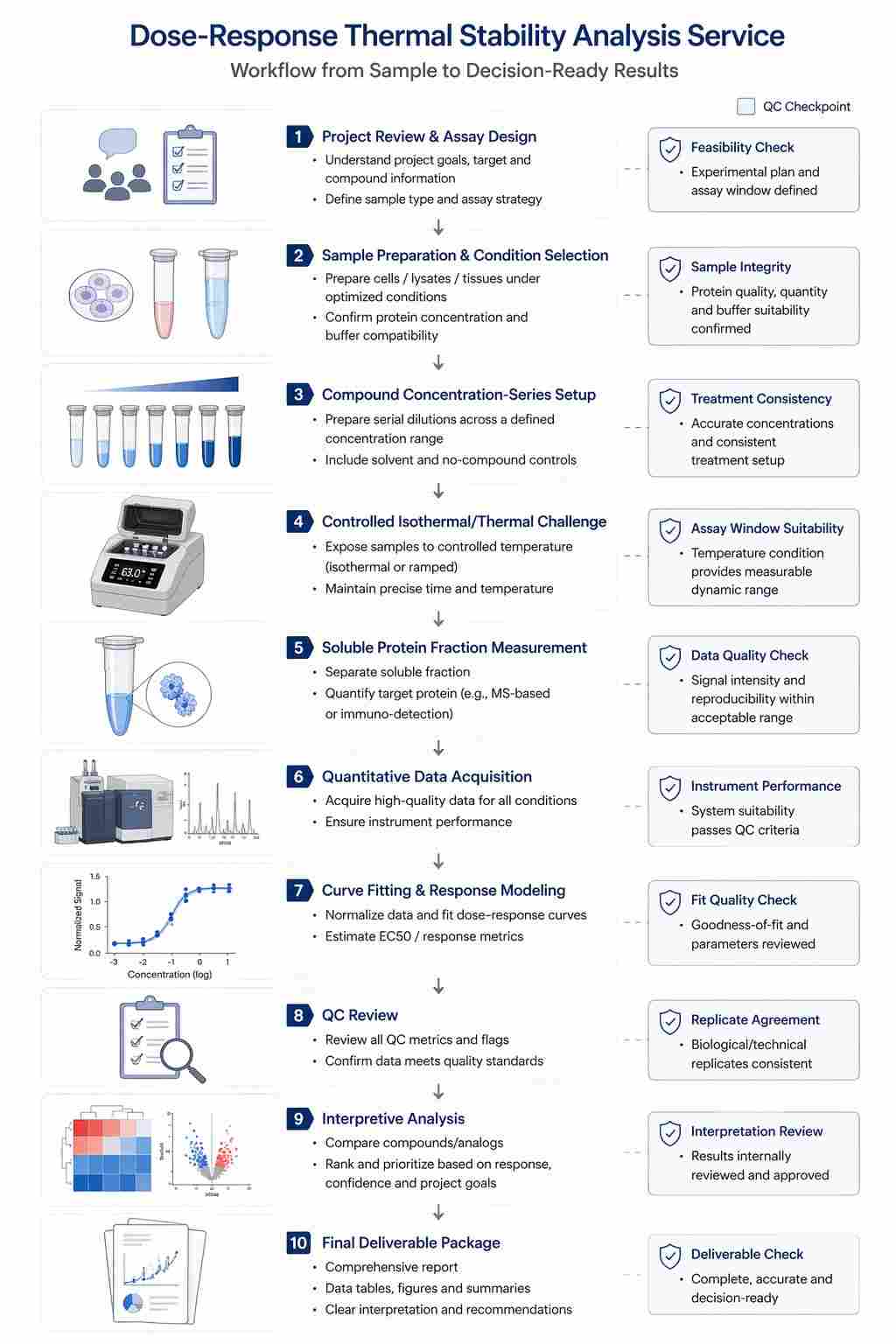
Our workflow runs from project intake to final reporting, not just from one lab step to the next.

1

Project review and sample preparation

We begin by reviewing your compound context, target question, and sample format, then confirm whether the study should be run in intact cells, lysate, tissue-derived material, or a more focused protein context. We review sample state, compound handling, and buffer compatibility before execution so the assay window is meaningful and the result is interpretable.

2

Isothermal challenge and concentration-series design

Next, we build the concentration series and select the thermal challenge condition. Published assay guidance indicates that the challenge temperature is generally chosen near or above the apparent aggregation point so the readout has enough dynamic range without erasing ligand response. Screening for Target Engagement using the Cellular Thermal Shift Assay

3

Quantification and response modeling

After measurement, we normalize the data and fit the concentration-linked response so the output can be compared across conditions or analogs.

4

QC review and final reporting

We look at signal consistency, assay-window behavior, replicate agreement, and fit quality before a result is included in the final interpretation, then return the structured deliverable package for internal review and next-step planning.

Dose-Response Thermal Stability Analysis workflow with QC checkpoints

What Data You Receive and How It Supports Decisions

A strong data package should help your team interpret the study quickly and move into the next decision with confidence.

Core quantitative outputs

A typical package may include normalized quantitative data tables, concentration-response curves, assay-window summaries, ranked interpretation tables, and a project report that explains the key observations.

QC and interpretive outputs

We include fit-quality context and filtering logic so your team can distinguish strong signals from weak or non-actionable ones.

How the outputs support internal review

This structure helps your group decide whether to advance a compound, compare analogs more deeply, expand into a broader profiling study, or add a structural follow-up such as LiP-MS or HDX-MS.

Bioinformatics and data interpretation

After normalization and response modeling, we organize the outputs into a framework that helps your team see which response patterns are strong, which are borderline, and which should not be overcalled. When a project needs broader follow-up, we can also help position the result relative to methods such as Stability-Shift MS Screening or TPP.

Typical Use Scenarios

This service is most useful when you need a practical, concentration-linked engagement support layer that sits between simple confirmation and broader discovery workflows.

  • Target engagement support for lead compounds: a focused concentration-linked thermal response can strengthen the evidence that a lead compound is engaging the intended target in the selected biological context.
  • Analog ranking during lead optimization: when several compounds look similar in functional assays, this service can help show whether their engagement behavior differs in a way that matters for prioritization.
  • Orthogonal support for mechanism-focused projects: if your team already has a biology story but needs a more direct protein-state layer of evidence, this assay can provide a practical orthogonal step before a broader workflow.

Sample Requirements and Study Planning Considerations

Sample typeTypical starting amountPreparation notesShipping / handlingQC focus
Intact cultured cellsAbout 5 × 10⁶ to 1 × 10⁷ cells per conditionKeep cells healthy and treatment conditions consistentFrozen pellets or agreed live-handling planViability and treatment consistency
Cell or tissue lysateAbout 150–300 μg total protein per conditionUse low-interference buffer conditionsFrozen shipment preferredProtein concentration and buffer suitability
Tissue-derived materialAbout 100 mg starting material when availableRapid freezing after collection is preferredDry-ice shipmentSample integrity and background control
Compound submissionTypically a concentrated stock such as 10 mM, or project-agreed equivalentProvide solvent and solubility informationHandled according to compound stabilityConcentration-series feasibility and solvent control

These values are meant to support planning discussions rather than replace final project review.

Demonstrated Results: What a Successful Output Package Looks Like

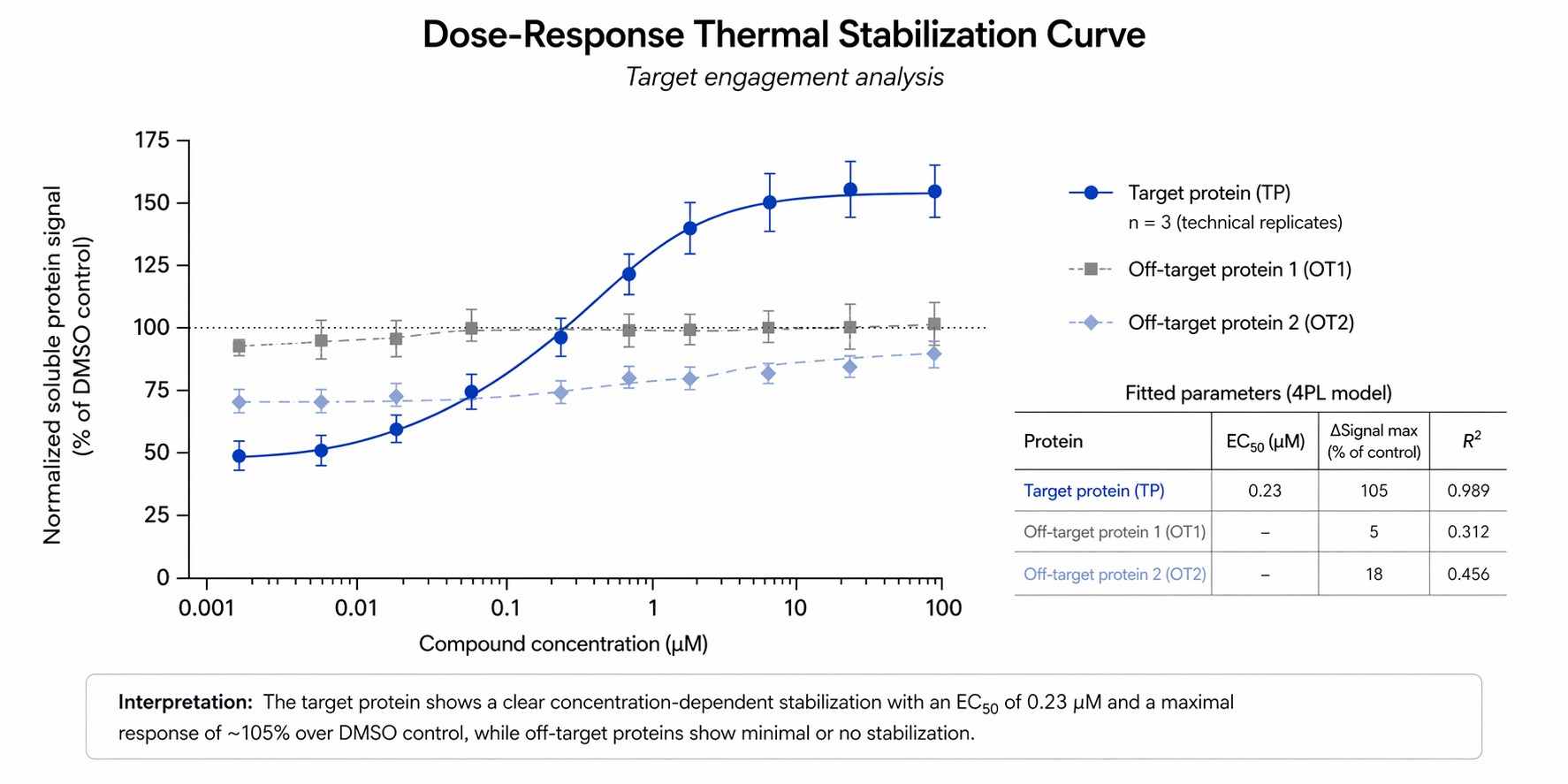
Dose-response stabilization curve for target engagement analysis

Dose-response stabilization curve

This is the clearest view of whether the target-associated signal changes in a concentration-linked pattern consistent with engagement.

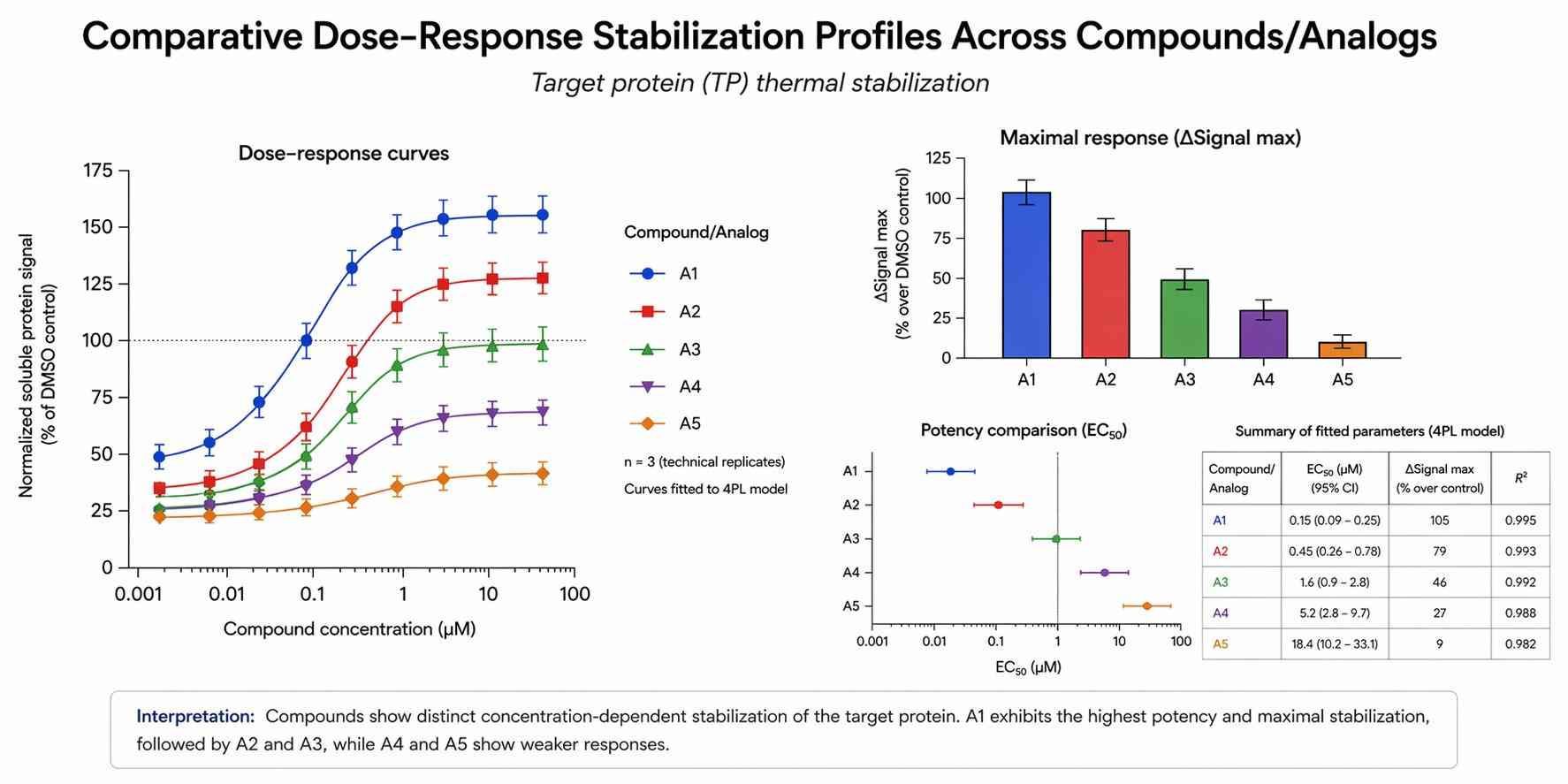
Comparative compound-response view for analog ranking

Comparative compound-response view

A side-by-side response plot or heatmap helps compare analog behavior and prioritize follow-up candidates.

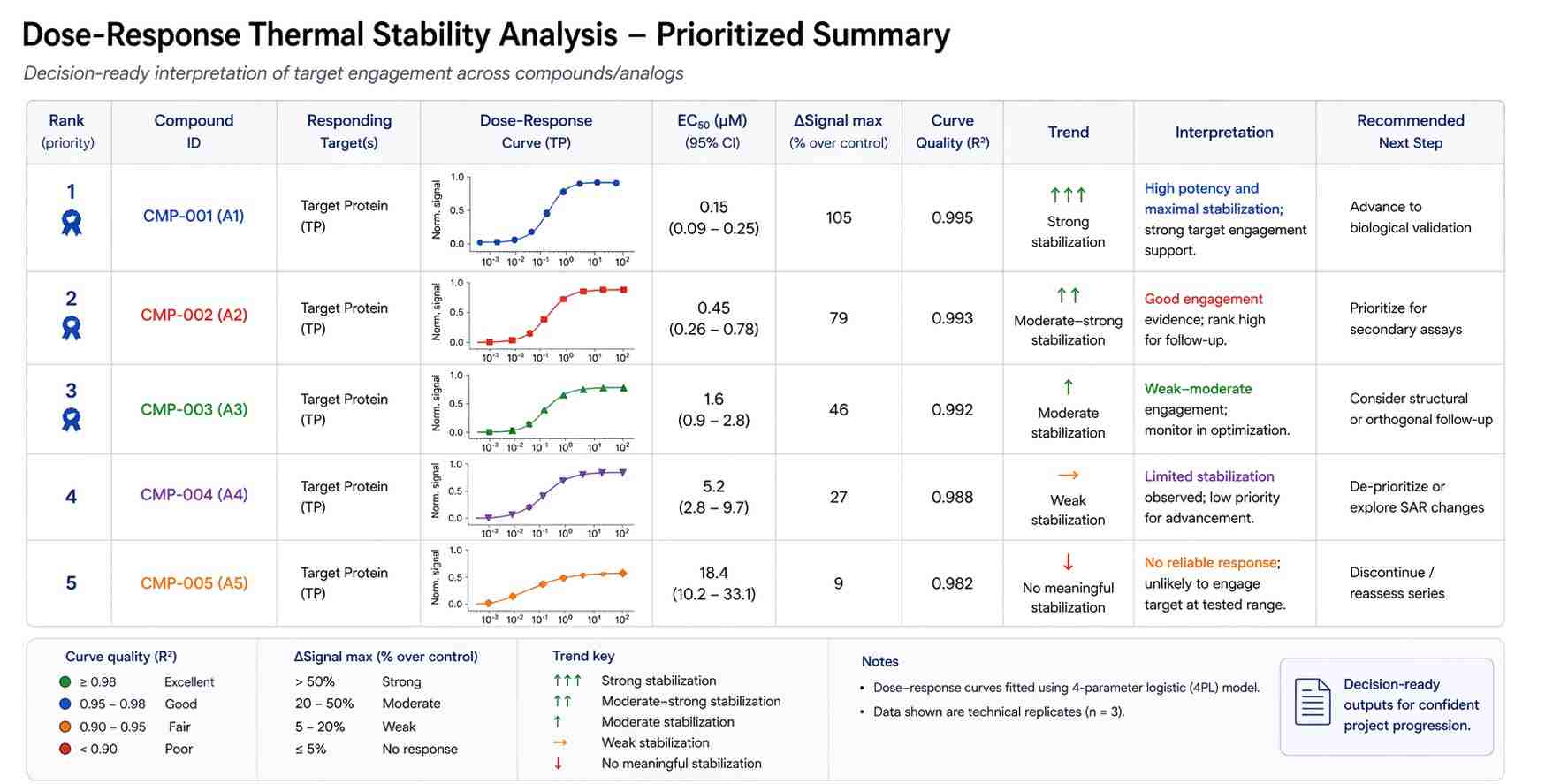
Prioritized interpretation table for concentration-linked engagement signals

Prioritized interpretation table

A compact summary table pulls together response direction, fit quality, and interpretation notes so project teams can make decisions without having to reassemble the logic from raw files alone.

Published Example Supporting the Use of Thermal Stability Readouts in Drug-Response Research

MS CETSA deep functional proteomics uncovers DNA repair programs leading to gemcitabine resistance

Background

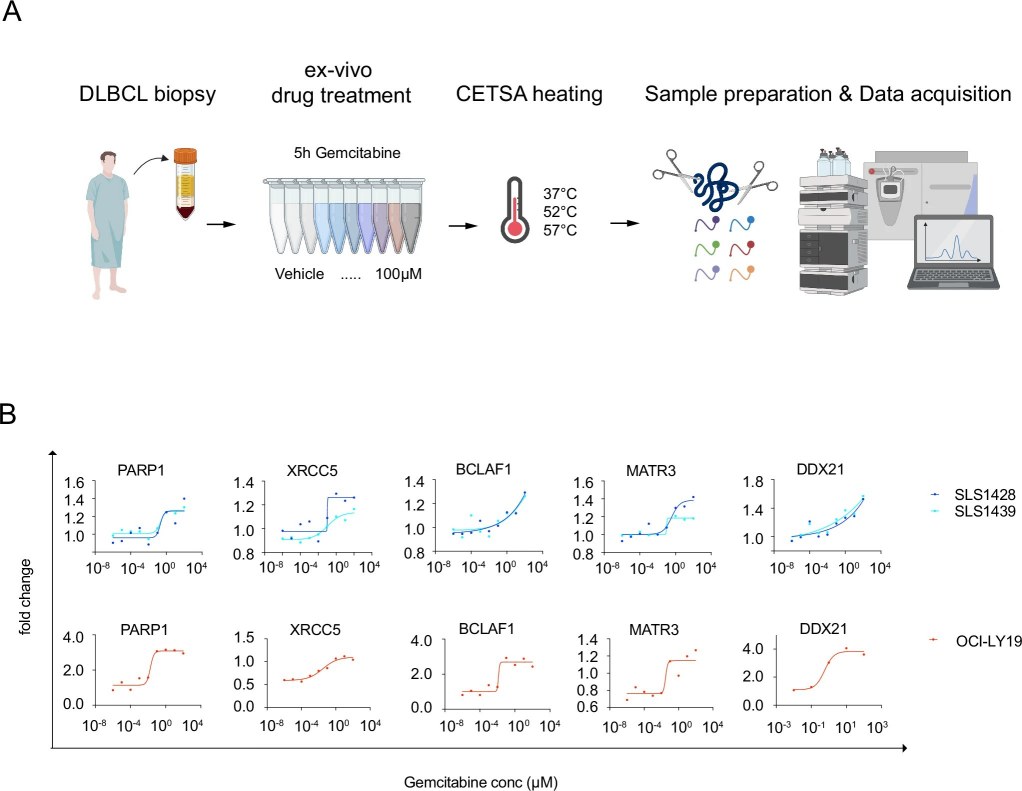
Drug resistance studies often reveal biology that is difficult to interpret with targeted assays alone. A 2025 paper in Nature Communications used MS-CETSA deep functional proteomics to study gemcitabine resistance in diffuse large B-cell lymphoma and identify resistance-associated biochemical programs.

Methods

The authors compared resistant and sensitive DLBCL cell models after gemcitabine exposure and analyzed proteome-wide thermal stability behavior to identify differential pathway responses. They then used complementary validation to connect the observed signals to DNA repair biology.

Results

The most relevant figure for this page is Fig. 4, titled "Translesion synthesis in gemcitabine resistant cells." In that figure, the authors show resistance-associated pathway behavior linked to translesion synthesis, including pathway-level evidence and supporting biochemical validation. This makes the figure especially useful for our page because it demonstrates how thermal stability readouts can move beyond simple target confirmation and support mechanism-relevant interpretation.

Conclusion

This case is a strong public example of why thermal stability readouts matter in drug discovery. They can help move a project from "there is a biological effect" toward "there is a protein-state signal that helps explain the effect and supports the next decision."

Figure 4 from a 2025 thermal stability proteomics study showing translesion synthesis signals in gemcitabine-resistant cells

Figure adapted from a 2025 open-access study showing translesion synthesis-associated thermal stability signatures in gemcitabine-resistant cells.

FAQ

Frequently Asked Questions

Q: What does Dose-Response Thermal Stability Analysis add beyond a single-condition thermal shift assay?

It adds concentration dependence, which usually makes the result more useful for ranking, comparison, and follow-up decisions.

Q: When should I choose this method instead of a targeted thermal shift assay?

Choose it when a simple confirmatory readout is not enough and you need a stronger concentration-linked engagement signal.

Q: When is Thermal Proteome Profiling a better choice?

Choose TPP when your main question is broader discovery, off-target mapping, or pathway-level interpretation.

Q: Can this service support analog-ranking decisions?

Yes. It is especially useful when you need a more direct engagement layer to compare compounds that look similar in other assays.

Q: Can the study be extended with other MS methods?

Yes. Depending on the project question, we may recommend 2D-TPP, LiP-MS, ABPP-MS, or HDX-MS.

Plan your next thermal stability study with the MassTarget team

Share your target context, compound information, and project question, and we will help you choose the most practical thermal stability strategy for your next decision point.


Disclaimer: All products and services provided by Creative Proteomics are for research use only. They are not intended for use in diagnostic, therapeutic, or clinical procedures.

Online Inquiry

Please submit a detailed description of your project. We will provide you with a customized project plan to meet your research requests. You can also send emails directly to for inquiries.

* Email
Phone
* Service & Products of Interest
Services Required and Project Description