High-Throughput MS Screening Service

Accelerating hit identification through label-free, native-state mass spectrometry screening with guaranteed turnaround and data reproducibility.

When your drug discovery program needs label-free binding data across thousands of compounds, Creative Proteomics MassTarget™ delivers HTS-MS screening that works with the targets other methods can't touch—soluble enzymes, membrane proteins, protein complexes, and fragment libraries. We combine direct mass spectrometry readouts (no fluorescent tags, no reporter systems) with rigorous quality control to produce reproducible hit lists you can trust.

What our HTS-MS platform delivers:

  • Label-free detection – No fluorescent tags or reporter systems needed
  • Native-state assessment – Measure compound-target interactions in near-physiological conditions
  • High data reproducibility – CV%<15% across technical replicates
  • Scalable throughput – Process thousands of compounds per week
  • Multiplexed readouts – Simultaneously assess binding, stoichiometry, and competition
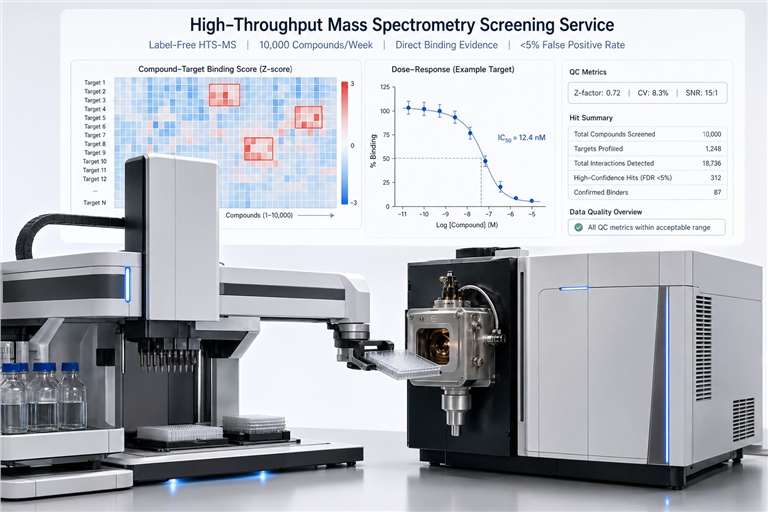
High-throughput MS screening workflow diagram showing assay development, plate formatting, MS acquisition, and data analysis
What Is HTS-MS Service Overview Workflow Sample Case Study FAQ Comparison

What Is High-Throughput Mass Spectrometry Screening?

High-throughput mass spectrometry screening (HTS-MS) uses automated MS platforms to rapidly assess compound libraries against biological targets. The key difference from conventional fluorescence- or enzyme-based HTS: HTS-MS detects molecular interactions directly through native-state mass measurements, without requiring labels or reporter constructs.

Technical foundation: Compounds are incubated with target proteins in microplate formats, then analyzed by LC-MS/MS systems configured for rapid, plate-based operation. Binding events show up as mass shifts, intensity changes, or retention time alterations corresponding to compound-target complexes. No tag, no guesswork.

Why this matters for drug discovery:

  • No labeling required – Eliminates artifacts from fluorescent tags or reporter constructs
  • Direct binding evidence – MS provides unambiguous molecular weight confirmation
  • Native-state compatibility – Works with membrane proteins, protein complexes, and difficult-to-label targets
  • Multiparameter data – Simultaneously assess binding affinity, stoichiometry, and competition
  • Lower false positive rates – Direct detection reduces interference from compound autofluorescence or quenching

Where HTS-MS adds the most value: Screening challenging target classes where traditional labeling approaches fail or introduce bias—membrane proteins (GPCRs, ion channels, transporters), protein-protein interaction interfaces, fragment libraries (low-affinity compounds), natural product extracts, and covalent inhibitor screening.

Service Overview – Creative Proteomics HTS-MS Capabilities

We run HTS-MS screening on a multi-platform instrument suite under ISO 17025 quality management, with standardized workflows that keep data consistent from project to project. Every assay goes through defined QC checkpoints before we call it validated.

Chromatography Systems

Waters ACQUITY UPLC H-Class PLUS with 2D-LC capability, SEC columns for native protein separation (Superdex Increase, Yarra SEC), HILIC and reversed-phase options for compound diversity, and automated microplate injection (CTC PAL3 autosampler).

Mass Spectrometry Platforms

Bruker timsTOF Pro 2 (trapped ion mobility-QTOF), Waters Xevo G3 Q-TOF (high-resolution, high-sensitivity), Thermo Scientific Orbitrap Exploris 480 (ultra-high resolution), with dedicated screening configurations achieving rapid scanning (<1 second per sample).

Automation & Environmental Control

Hamilton STARlet liquid handling for plate preparation, EnVision plate reader for orthogonal QC measurements, temperature-controlled incubation (4°C to 37°C), and humidity-controlled sample storage.

Quality Control Metrics

Z-factor >0.5 for validated assays, coefficient of variation (CV%)<15% across="" technical="" signal-to-noise="" ratio="">10:1 for positive controls, and false positive rate<5% in validation runs.

HTS-MS Workflow – From Assay Design to Data Delivery

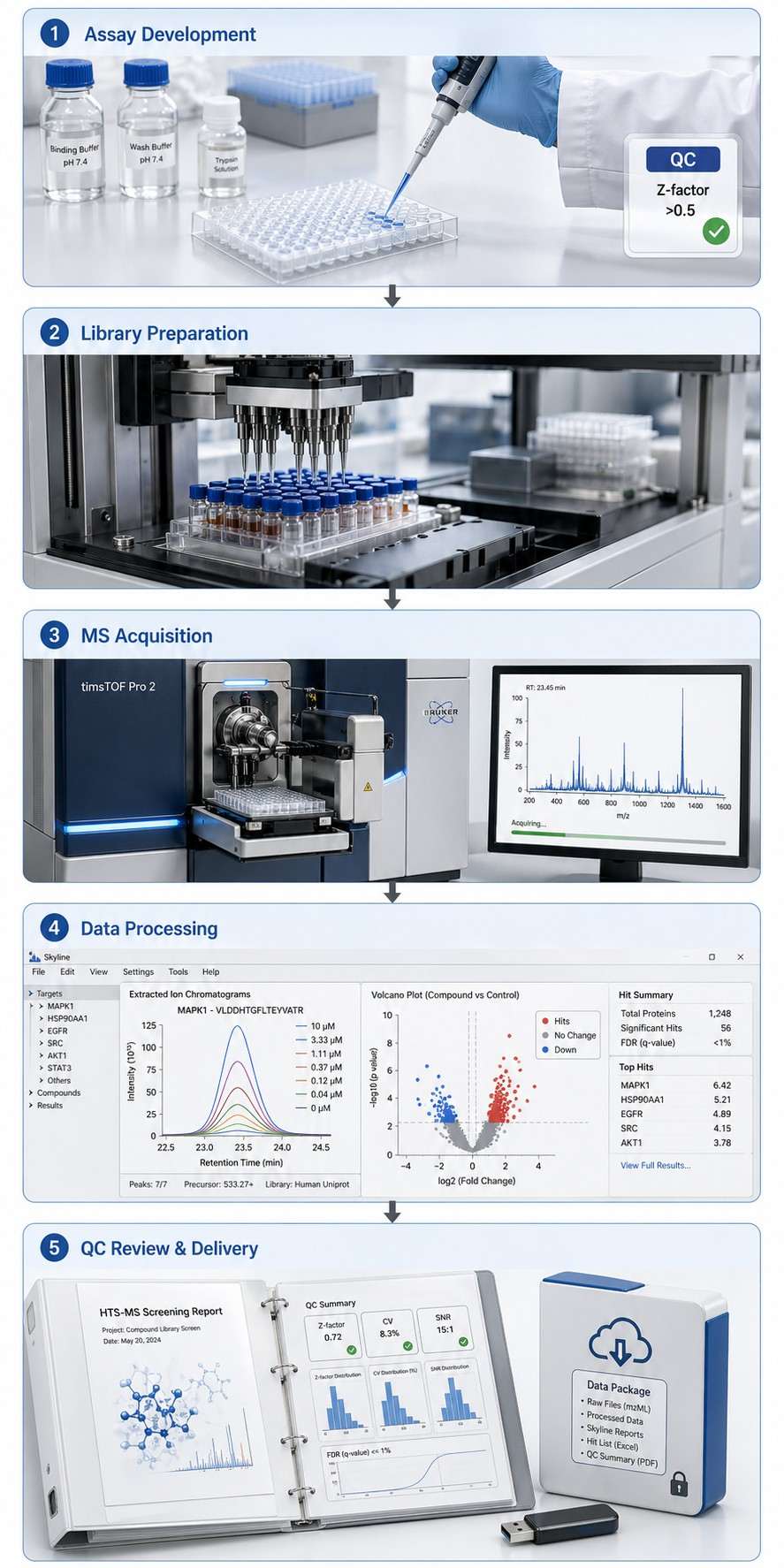
Our standardized HTS-MS workflow ensures consistent data quality from assay development through final reporting. Each stage includes defined QC checkpoints and validation steps.

1

Assay Development & QC Validation

Target characterization (buffer, stability, concentration), method optimization (chromatography, ionization, detection), and QC validation with acceptance criteria: Z-factor >0.5, CV%<15%, false positive rate <5%. Timeline: 1-3 weeks.

2

Compound Library Preparation

Library formatting from source to screening plates, concentration normalization (DMSO<1% final), plate design with positive/negative controls in every plate, and technical triplicates for statistical robustness. Timeline: 1-2 weeks.

3

Automated MS Acquisition

Batch processing of up to 384 samples per batch with automated injection, 24/7 continuous acquisition with periodic QC injections, and real-time monitoring of signal stability and system performance. Timeline: 2-4 weeks.

4

Data Processing & Hit Calling

Peak detection and alignment using Skyline, MZmine, or custom algorithms; statistical analysis with t-tests and FDR correction; hit identification (compounds with p<0.01); and dose-response validation (IC50/EC50). Timeline: 1-2 weeks.

5

QC Review & Results Packaging

Data quality assessment against acceptance criteria, comprehensive PDF report generation, data package delivery (RAW files, processed data, hit lists, visualization files), and 1-hour technical consultation to review results. Timeline: 1 week.

HTS-MS workflow diagram showing 5 stages from assay development to results packaging

Sample Requirements & Specifications

Sample TypeRequired AmountConcentrationPurityBuffer ConditionsNotes
Target Protein50-200 μg0.5-5 μM≥90% by SDS-PAGEPBS, Tris-HCl, HEPES (pH 7.0-7.5)Avoid glycerol >5%, detergents without MS compatibility
Soluble Enzymes50-100 μg1-10 μM≥90%Low salt (≤150 mM), minimal additivesInclude activity validation data if available
Membrane Proteins100-300 μg0.5-2 μM≥70%Detergent micelles (DDM, LMNG, CHS)Consult for specific detergent optimization
Compound Library1-10 μL per compound10 mM in DMSO≥90%DMSO concentration<1% finalProvide library layout and compound structures
Fragment Library5-20 μL per fragment50-200 mM in DMSO≥85%DMSO concentration<2% finalInclude solubility assessment if available

Minimum amounts required for QC validation: Target protein: 50 μg for initial method development. Compound library: 1 μL per compound at 10 mM for single-point screening. Additional material needed for dose-response follow-up.

Special conditions requiring method development: Unusual buffer components (high salt, unusual detergents, redox agents), temperature-sensitive targets, light-sensitive compounds, and complex biological mixtures (cell lysates, tissue extracts).

Rejection criteria (samples will be returned): Visible precipitation or aggregation, significant microbial contamination, incompatible buffer components (SDS, high glycerol, non-volatile salts), and insufficient documentation of identity or concentration.

Data Deliverables & Bioinformatics Analysis

You get the raw data, the processed results, and everything needed to independently verify our findings. No black boxes.

Raw Data Delivery:

  • RAW MS files: Thermo .RAW, Bruker .d, Waters .raw formats
  • Chromatograms: Base peak, total ion, and extracted ion chromatograms
  • Mass spectra: Full scan and MS/MS spectra for identified hits
  • Metadata: Instrument methods, acquisition parameters, QC logs

Processed Results:

  • Hit lists: Ranked compounds with binding scores, p-values, and fold changes
  • Dose-response data: IC50/EC50 values with confidence intervals
  • QC summary: Z-factor, CV%, false positive rate for each plate
  • Statistical summaries: ANOVA results, multiple comparison corrections

Visualization Outputs:

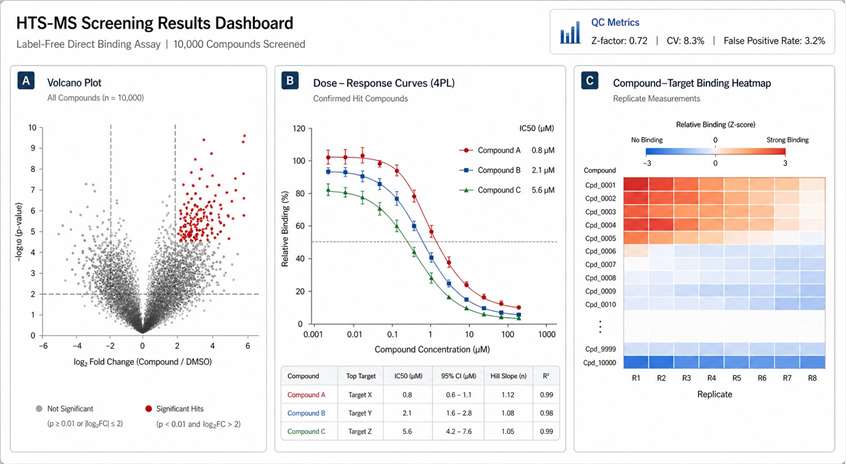
  • Heatmaps: Compound-target interaction matrices
  • Volcano plots: Statistical significance vs. effect size
  • Dose-response curves: Four-parameter logistic fits
  • Scatter plots: Replicate correlation and reproducibility assessment
  • PCA plots: Plate-to-plate and batch-to-batch variation

Bioinformatics Support:

  • Pathway enrichment: KEGG, Reactome, GO term analysis for hit targets
  • Structural prediction: Docking poses and binding site analysis
  • Chemical similarity: Tanimoto coefficients to known bioactive compounds
  • ADME prediction: In silico properties for hit prioritization
  • Network analysis: Protein-protein interaction networks for polypharmacology assessment

Statistical methods: Primary hit calling uses two-tailed Student's t-test with Benjamini-Hochberg FDR correction. Dose-response fitting uses four-parameter logistic model (Hill equation). QC calculations: Z-factor = 1 - (3×σpositive + 3×σnegative)/|μpositive - μnegative|. Reproducibility assessed via intraclass correlation coefficient (ICC) for technical replicates.

HTS-MS data analysis dashboard showing volcano plot, dose-response curves, and heatmap for hit identification

Quality Control & Reproducibility Assurance

We build QC into every layer of the screening process—not as a final check, but as a continuous discipline from assay development through data delivery.

QC Metrics and Standards: Z-factor >0.5 indicates excellent assay window (≥0.5 acceptable, >0.7 preferred). Coefficient of variation (CV%)<15% across="" technical="" triplicates.="" signal-to-noise="" ratio="">10:1 for positive control signals. False positive rate<5% in validation runs using known non-binders. Plate uniformity CV% <20% across all wells for DMSO controls.

Replicate Strategy: Technical triplicates for each compound. Positive and negative controls in every plate (minimum 8 each). Inter-plate controls for normalization. Batch controls at beginning, middle, and end of each batch.

False Positive Control Approaches: Counter-screening against unrelated targets or inactive mutants. Orthogonal validation using SPR, ITC, or thermal shift assays. Competition experiments with known binders. Solubility assessment to rule out aggregation-based false positives. Stability testing to verify compound integrity under assay conditions.

Data Validation Protocols: Blinded replicates with independent preparation and analysis. Orthogonal method confirmation (SPR, BLI, or DSF). Cross-validation by split library screening on different MS platforms. Reproducibility testing by repeat screening of selected plates after 1-2 weeks.

Industry benchmark comparisons: Our Z-factor standards exceed typical HTS acceptance criteria (Z' > 0.4). CV%<15% compares favorably with fluorescence-based HTS (typically 10-20%). False positive rate <5% is superior to many label-based methods (often 5-15%).

Applications & Use Cases

HTS-MS addresses diverse screening challenges across drug discovery stages. Below are representative applications demonstrating our platform's versatility.

Hit Identification for Novel Targets

Challenge: Screen large compound libraries against newly identified targets with unknown pharmacology.

Approach: Full library screening (10K-100K compounds) using label-free HTS-MS.

Typical results: 0.1-1% hit rate, depending on target class and library diversity.

Success metrics: ≥3 chemically distinct series with confirmed binding and dose-response.

Fragment-Based Screening (FBLD)

Challenge: Identify weak binders (mM affinity) from fragment libraries for structural optimization.

Approach: High-concentration screening (0.5-2 mM) with sensitive detection of low-mass fragments.

Typical results: 2-5% hit rate from 1,000-5,000 fragment libraries.

Success metrics: Fragment hits with measurable binding (Kd 0.1-10 mM) and clear SAR starting points.

Membrane Protein Ligand Discovery

Challenge: Screen against GPCRs, ion channels, or transporters incompatible with traditional labeling.

Approach: Native MS screening with membrane protein targets in detergent micelles or nanodiscs.

Typical results: 0.05-0.5% hit rate, depending on target stability and expression quality.

Success metrics: Confirmed modulators with appropriate pharmacology.

Natural Product Library Screening

Challenge: Screen complex natural product extracts where labeling is impractical and compounds are unknown.

Approach: MS-based screening with simultaneous compound identification through MS/MS.

Typical results: Identification of active constituents from crude extracts.

Success metrics: Isolated active compounds with elucidated structures and confirmed activity.

Covalent Inhibitor Screening

Challenge: Identify irreversible or slow-binding inhibitors through time-dependent activity.

Approach: Time-course screening with MS detection of covalent adduct formation.

Typical results: 0.01-0.1% hit rate for selective covalent modifiers.

Success metrics: Covalent hits with demonstrated selectivity and irreversible binding kinetics.

Case Study: HiTES and MetEx for Cryptic Natural Product Discovery via High-Throughput Mass Spectrometry

Covington, B. C. & Seyedsayamdost, M. R. "Unlocking hidden treasures: the evolution of high-throughput mass spectrometry in screening for cryptic natural products." Natural Product Reports 42, 956–964 (2025). https://pubs.rsc.org/en/content/articlelanding/2025/np/d4np00026a

Background

Microbial genomes contain vastly more biosynthetic gene clusters (BGCs) than known natural products, with most BGCs being "silent" under standard laboratory conditions. Traditional bioactivity-guided isolation identifies only one molecule at a time, leaving most chemical diversity—so-called cryptic natural products—undiscovered. A systematic, high-throughput approach was needed to activate and detect these hidden compounds.

Methods

The authors developed an integrated platform combining three components: (1) High-Throughput Inducer Screening (HiTES)—treating 5 microbial strains (S. canus, A. keratiniphila, S. suis, Nocardiopsis sp., B. gladioli) with up to 750 small-molecule inducers to activate silent BGCs; (2) Ultra-fast mass spectrometry—using DESI-MS (~360 ms/sample) and LAESI-MS (<2 s/sample) for rapid data acquisition without chromatography; (3) Comparative metabolomics—applying PCA, self-organizing maps (SOM), 3D metabolomics mapping, and the MetEx software for automated feature detection and prioritization.

Results

The platform discovered 5 new compound families across 5 microbial strains:

  • Canucins (S. canus): 12/750 inducers (1.6%) showed significant activation, with up to 50-fold yield improvement
  • Keratinimicins/keratinicyclins (A. keratiniphila): Novel glycopeptide antibiotics with MIC values 0.5–2 μg/mL against Gram-positive pathogens
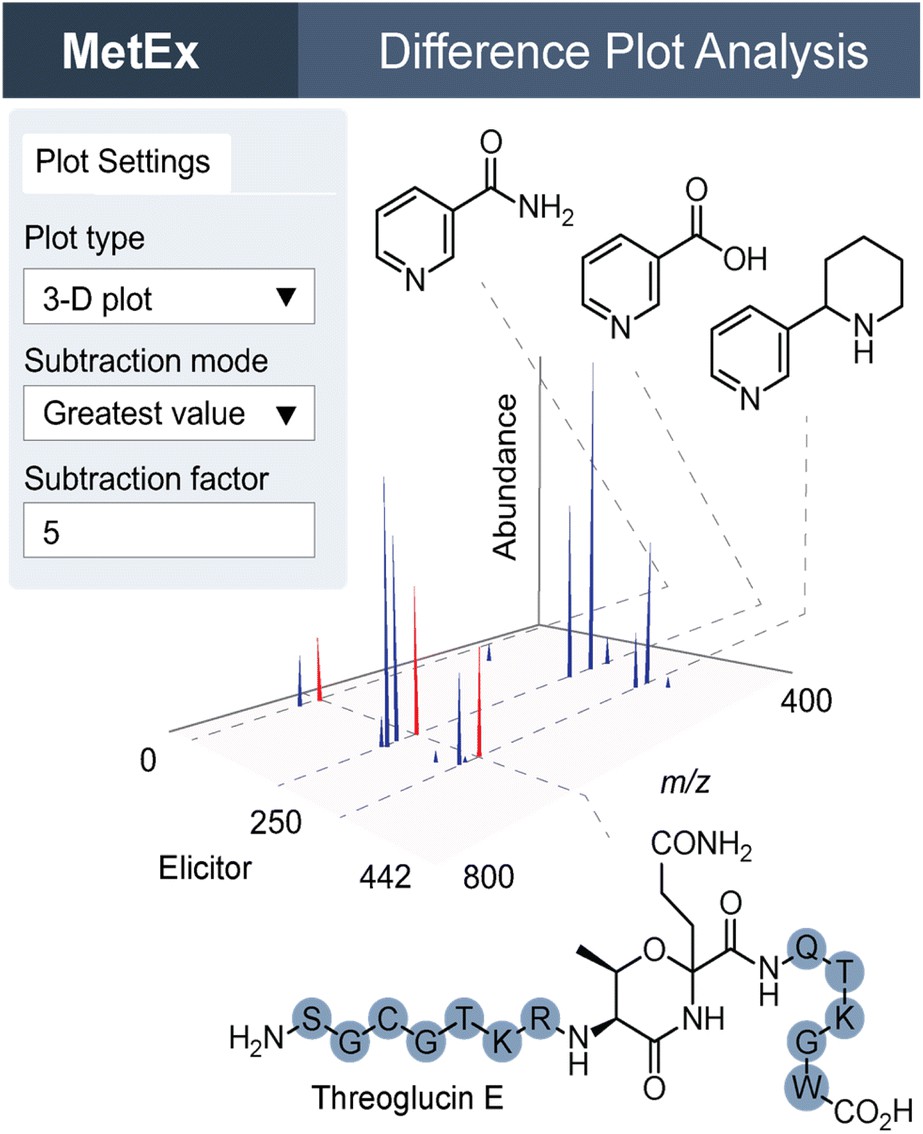
  • Threoglucins (S. suis): Nicotinic acid (100 μM) induced 35-fold production increase; only 3/750 inducers (0.4%) showed >20-fold induction
  • Mutaxanthenes (Nocardiopsis sp.): PCA identified 15 distinct metabolite features significantly upregulated in mutant vs. wild-type (PC1: 42% variance, PC2: 28%)
  • Ciromicins (Nocardiopsis co-culture): 8 metabolite clusters showed >10-fold induction in co-culture conditions

MetEx analysis of B. gladioli HiTES data identified 128 known compounds and 47 unknown features in<2 hours processing time—versus weeks for manual analysis. Throughput comparison: DESI-MS (360 ms/sample) achieved 166–2,666× faster acquisition than conventional LC-MS (1–10 min/sample), with technical replicate CV% <15%.

Conclusion

The integrated HiTES–ultra-fast MS–MetEx platform systematically unlocks the "hidden" chemical diversity encoded in microbial genomes. The methodology transforms natural product discovery from low-throughput, labor-intensive isolation to a data-driven, automated screening paradigm, achieving 2–3 orders of magnitude throughput improvement and discovering 5 new compound families from 5 strains in a single study.

MetEx 3D differential plot showing threoglucin discovery in S. suis HiTES experiment with 35-fold induction by nicotinic acid

MetEx 3D differential plot: threoglucin induction by nicotinic acid in S. suis (Figure 5, Covington & Seyedsayamdost, 2025).

Technology Comparison: HTS-MS vs Alternative Methods

Choosing the right screening method depends on your target, throughput needs, and what kind of data you need. Here's how HTS-MS stacks up against the alternatives.

MethodPrincipleThroughputLabel RequiredNative-StateFalse Positive RateCost per Data Point
HTS-MS (this service)Mass detection of complexesHigh (10K/week)NoYesLow (<5%)$$
Fluorescence HTSFluorescent tag/reporterVery high (100K/week)YesLimitedModerate (5-15%)$
SPR/BLISurface plasmon resonanceMedium (1K/week)NoYesLow (<5%)$$$$
ITCIsothermal titration calorimetryLow (10/week)NoYesVery low (<1%)$$$$$
DSFThermal stability shiftMedium (5K/week)Dye onlyLimitedModerate (10-20%)$$
Cryo-EMElectron microscopyVery lowNoYesVery low$$$$$$
NMRNuclear magnetic resonanceVery lowNoYesVery low$$$$$$

HTS-MS vs Traditional Fluorescence HTS: Advantages include no labeling artifacts, works with difficult targets, provides direct binding evidence. Disadvantages include lower throughput, higher instrumentation cost, requires MS expertise. Best for targets incompatible with labeling, fragment screening, and orthogonal validation.

HTS-MS vs SPR/BLI: Advantages include higher throughput, lower sample consumption, multiplexed detection. Disadvantages include less precise affinity measurement, more complex data analysis. Best for primary screening, large library assessment, and rapid triaging.

HTS-MS vs ITC/DSF: Advantages include much higher throughput, simultaneous multiparameter readout. Disadvantages include less thermodynamic information, indirect binding measurement. Best for screening phase, hit identification, and library prioritization.

HTS-MS vs Cryo-EM/NMR: Advantages include practical throughput for drug discovery, established workflows. Disadvantages include no structural information, indirect binding detection. Best for functional screening, compound library assessment, and drug discovery pipelines.

Method selection guidance: Primary screening of large libraries: fluorescence HTS (if compatible) or HTS-MS (if labeling problematic). Fragment screening: HTS-MS or SPR. Membrane protein targets: HTS-MS or SPR with appropriate stabilization. Orthogonal validation: ITC for thermodynamics, SPR for kinetics, HTS-MS for reproducibility. Structural characterization: Cryo-EM or NMR after hit identification.

For complementary ultra-high-throughput screening, explore our RapidFire MS for ultra-high-throughput screening technology. For advanced instrumentation options, consider Acoustic ejection MS technology for nanoliter dispensing.

FAQ

Frequently Asked Questions

Q: What is the minimum sample requirement for HTS-MS screening?

For most targets, we require 50-100 μg of purified protein for assay development and QC validation. For membrane proteins, 100-300 μg may be needed due to additional optimization. Compound libraries require 1-10 μL per compound at 10 mM concentration in DMSO. We provide detailed sample preparation guidelines during project scoping.

Q: How do you ensure data reproducibility?

Every compound runs in technical triplicate. Every plate carries positive and negative controls (minimum 8 each). We track inter-plate normalization controls, run batch controls at the start, middle, and end of each batch, and validate selected hits through blinded replicate testing. Our ISO 17025 quality system keeps procedures standardized and documented.

Q: What is the typical turnaround time for a standard screening project?

A standard screening project (10K compounds) typically completes in 8-12 weeks: 1-3 weeks for assay development, 1-2 weeks for plate preparation, 2-4 weeks for MS acquisition, 1-2 weeks for data processing, and 1 week for QC review and reporting. Smaller projects or focused libraries may complete faster.

Q: Can you screen membrane protein targets?

Yes, we have extensive experience screening membrane protein targets including GPCRs, ion channels, transporters, and membrane-bound enzymes. We utilize appropriate detergents (DDM, LMNG, CHS) or nanodisc systems for target stabilization. Method development for membrane proteins typically requires additional optimization.

Q: How do you handle false positive hits?

We employ multiple false positive control strategies: counter-screening against unrelated targets or inactive mutants, orthogonal validation using SPR, ITC, or thermal shift assays, competition experiments with known binders, solubility assessment to rule out aggregation, and stability testing to verify compound integrity. Primary hits undergo rigorous validation before final reporting.

Q: What data formats do you deliver?

We deliver comprehensive data packages including: RAW MS files (.RAW, .d, .raw formats), processed results (Excel/CSV hit lists, dose-response data), visualization files (PDF/PNG plots, heatmaps), statistical summaries (PDF reports with methods and results), and metadata (instrument methods, QC logs). Data are provided via secure cloud transfer with 30-day access.

Q: Do you provide method development for novel targets?

Yes, we offer method development services for novel or challenging targets. This includes buffer optimization, chromatography method development, ionization parameter tuning, and QC assay establishment. Method development typically requires 1-3 weeks and additional target material (50-200 μg).

Q: How does pricing work for HTS-MS screening?

Pricing depends on project scope: library size, target complexity, required throughput, and data analysis needs. We provide customized quotations based on your specific requirements. Typical cost drivers include assay development effort, number of compounds, required replicates, data analysis complexity, and reporting requirements.

References

  1. Covington, B. C. & Seyedsayamdost, M. R. Unlocking hidden treasures: the evolution of high-throughput mass spectrometry in screening for cryptic natural products. Natural Product Reports 42, 956–964 (2025).
  2. Liu, C. High-throughput mass spectrometry in drug discovery. SLAS Technology 32, 100292 (2025).
  3. Expert review. Data processing for high-throughput mass spectrometry in drug discovery. Expert Opinion on Drug Discovery 19, 455-467 (2024).
  4. Comprehensive review. Advances in high-throughput mass spectrometry in drug discovery. EMBO Molecular Medicine 15, e14850 (2023).
  5. Technical overview. Ultra-high-throughput mass spectrometry in drug discovery. Expert Opinion on Drug Discovery 18, 123-135 (2023).

Plan an HTS-MS campaign with the MassTarget™ team

Send us your target information and screening objectives. We'll review your project and get back to you with a detailed proposal—including timeline, deliverables, and pricing—within 2 business days.

Online Inquiry

Please submit a detailed description of your project. We will provide you with a customized project plan to meet your research requests. You can also send emails directly to for inquiries.

* Email
Phone
* Service & Products of Interest
Services Required and Project Description