AI-Driven Multi-Omics Integration for Drug Discovery — Proteomics, Metabolomics & Lipidomics

Accelerate drug discovery decisions with integrated multi-omics evidence and AI-powered data analysis.

Our platform combines high-resolution mass spectrometry-based proteomics, metabolomics, and lipidomics with advanced bioinformatics to deliver actionable mechanistic insights — from target identification to mechanism-of-action elucidation.

Roughly 90% of drug candidates fail in clinical development, with poor target selection and incomplete mechanism-of-action understanding cited among the leading causes. When proteomics, metabolomics, and lipidomics data are generated in isolation, critical cross-omics relationships remain hidden, and the biological signal needed to make confident go/no-go decisions is fragmented across disconnected datasets.

At Creative Proteomics, our AI-driven multi-omics integration service is designed to solve this problem: we produce and integrate orthogonal omics data layers from the same biological samples, apply transparent computational methods to reveal cross-omics correlations, and deliver interpretable results that directly support drug discovery decisions.
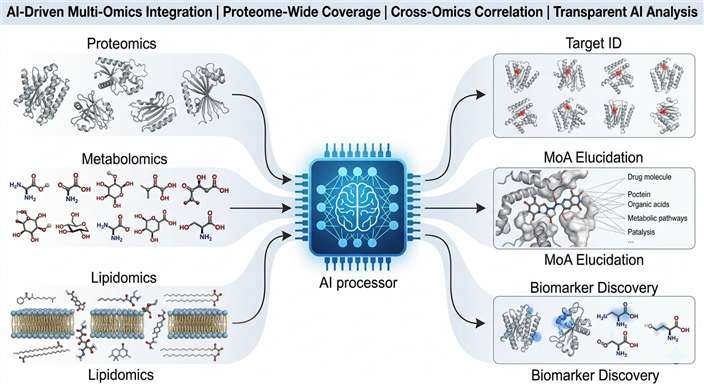
AI-driven multi-omics integration platform combining proteomics, metabolomics, and lipidomics with AI-powered bioinformatics for drug discovery.
How AI Integration Improves Decisions Service Overview Integration Approaches Sample Demo Case Study FAQ

How AI-Driven Multi-Omics Integration Improves Drug Discovery Decisions

Drug discovery teams face a structural problem: the biological complexity of a novel target or mechanism cannot be captured by any single omics technology alone. Proteomics reveals protein-level changes, metabolomics captures downstream metabolic perturbations, and lipidomics reports on membrane remodeling and signaling lipid dynamics — but each layer only tells part of the story.

When these datasets are produced separately — often by different CROs, on different sample aliquots, at different times — the opportunity to observe how a drug candidate simultaneously reshapes the proteome, metabolome, and lipidome of the same biological system is lost. Cross-study variability, batch effects, and differences in sample handling obscure the very signals that matter most for understanding mechanism, off-target activity, and translational potential.

Integrated multi-omics analysis addresses this gap directly. By generating and analyzing proteomics, metabolomics, and lipidomics data from the same biological samples and applying AI-powered cross-omics integration, our approach enables:

  • Mechanism-of-action reconstruction: Observe how proteomic changes (e.g., pathway activation, target engagement markers) correlate with metabolic and lipidomic perturbations in the same system.
  • Confidence through orthogonal evidence: A target hit that appears in proteomics data and is independently reflected in metabolomic or lipidomic readouts carries substantially more weight than a signal from any single omics layer.
  • Early off-target detection: Unexpected lipid or metabolite perturbations can flag off-target pharmacology or toxicity signals before they become problems in later development stages.
  • Biomarker panel identification: Cross-omics correlation analysis identifies multi-analyte biomarker panels that are more robust than single-omics candidates.

Our team works with biotech, pharmaceutical, and translational research groups that have already recognized the value of multi-omics but need a partner who can deliver genuinely integrated analysis — not just parallel omics datasets packaged together.

What We Mean by Deep Multi-Omics Integration

"Multi-omics integration" is a term used broadly in the CRO industry, but the depth of integration varies substantially between providers. At Creative Proteomics, we distinguish four levels of integration and apply the appropriate strategy based on the specific biological question:

Integration LevelDescriptionBest Suited For
Feature-level integrationIndividual omics features (proteins, metabolites, lipids) are measured independently, then correlated across datasets by statistical associationBiomarker discovery, simple correlation studies
Latent-space integrationAI methods (e.g., MOFA, multi-omics factor analysis) project all omics layers into a shared low-dimensional space to reveal hidden structureMoA elucidation, pathway discovery
Network-centric integrationProtein, metabolite, and lipid entities are mapped onto shared biological pathway and interaction networks, with enrichment and topology analysisMechanistic interpretation, target validation
Decision-level integrationEach omics dataset is analyzed independently for its contribution to a specific decision, then combined by weighted evidence synthesisGo/no-go decisions, candidate ranking

Our Multi-Omics Service Overview

We offer an end-to-end multi-omics service that covers data generation, integration, and interpretation under a single workflow. Our core omics modules include:

PROTEOMICS

DIA/SWATH & TMT Profiling

Deep proteome coverage from cell lysates, tissues, plasma, or biofluids. Label-free DIA/SWATH for unbiased discovery; TMT multiplexing for balanced comparison across conditions. Phosphoproteomics and PTM enrichment available.

See our proteomics drug-response profiling service for details.

METABOLOMICS

Untargeted & Targeted Analysis

Broad-spectrum metabolome coverage by LC-MS/MS and GC-MS. Targeted panels for key metabolic pathways (TCA cycle, amino acids, energy metabolism). Stable isotope tracing (fluxomics) for pathway activity measurement.

Our untargeted metabolomics for MoA workflow covers the full pipeline.

LIPIDOMICS

Comprehensive Lipid Profiling

Full lipidome coverage including phospholipids, sphingolipids, glycerolipids, and sterols. Class-specific and shotgun lipidomics workflows with quantitative lipid species annotation at chain-level resolution.

Explore our lipidomics drug profiling capabilities.

AI BIOINFORMATICS

AI-Powered Data Integration

Multi-omics factor analysis and latent-space modeling. Pathway enrichment and network-based integration (KEGG, Reactome, WikiPathways). Cross-omics correlation matrices and interactive visualization dashboards.

Multi-Omics Data Integration Approaches

Choosing the right integration strategy depends on the biological question, data structure, and desired output. Below we compare the four principal approaches we employ:

ApproachComputational MethodOutputApplication Example
Correlation-basedPearson/Spearman correlation, sparse canonical correlation analysisCross-omics correlation heatmapIdentify metabolite panels that correlate with proteomic drug-response signatures
Factor analysis (MOFA)Multi-Omics Factor AnalysisLatent factor loadings per omics viewDiscover hidden biological axes explaining variation across all omics layers
Network integrationOver-representation analysis, gene-set enrichment, network propagationShared pathway maps with multi-omics overlayMap proteomic and metabolomic changes onto the same metabolic pathway
Supervised MLRandom forest, XGBoost, elastic net, neural networksFeature importance ranking, classifier modelsBuild a multi-omics classifier distinguishing responders from non-responders

AI & Bioinformatics Analysis Platform

Our bioinformatics team applies established, documented computational methods rather than opaque black-box models. The analysis framework includes:

  • Data Preprocessing & QC: Per-omics quality control, missing value filtering, normalization, batch effect correction, and outlier detection before integration.
  • Dimensionality Reduction: PCA, t-SNE, and UMAP for exploratory data analysis across omics layers.
  • Multi-Omics Factor Analysis (MOFA): A Bayesian latent-variable model that decomposes multi-omics data into interpretable factors, capturing shared and view-specific sources of variation.
  • Pathway & Network Analysis: Over-representation and gene-set enrichment using KEGG, Reactome, and WikiPathways. Protein–metabolite interaction networks from curated databases.
  • Machine Learning: Supervised classification and feature selection to identify multi-omics biomarker panels.

Our analysis pipeline generates publication-ready figures — correlation heatmaps, factor loadings plots, pathway enrichment bubble charts, and network diagrams — along with underlying processed data tables for client-side review.

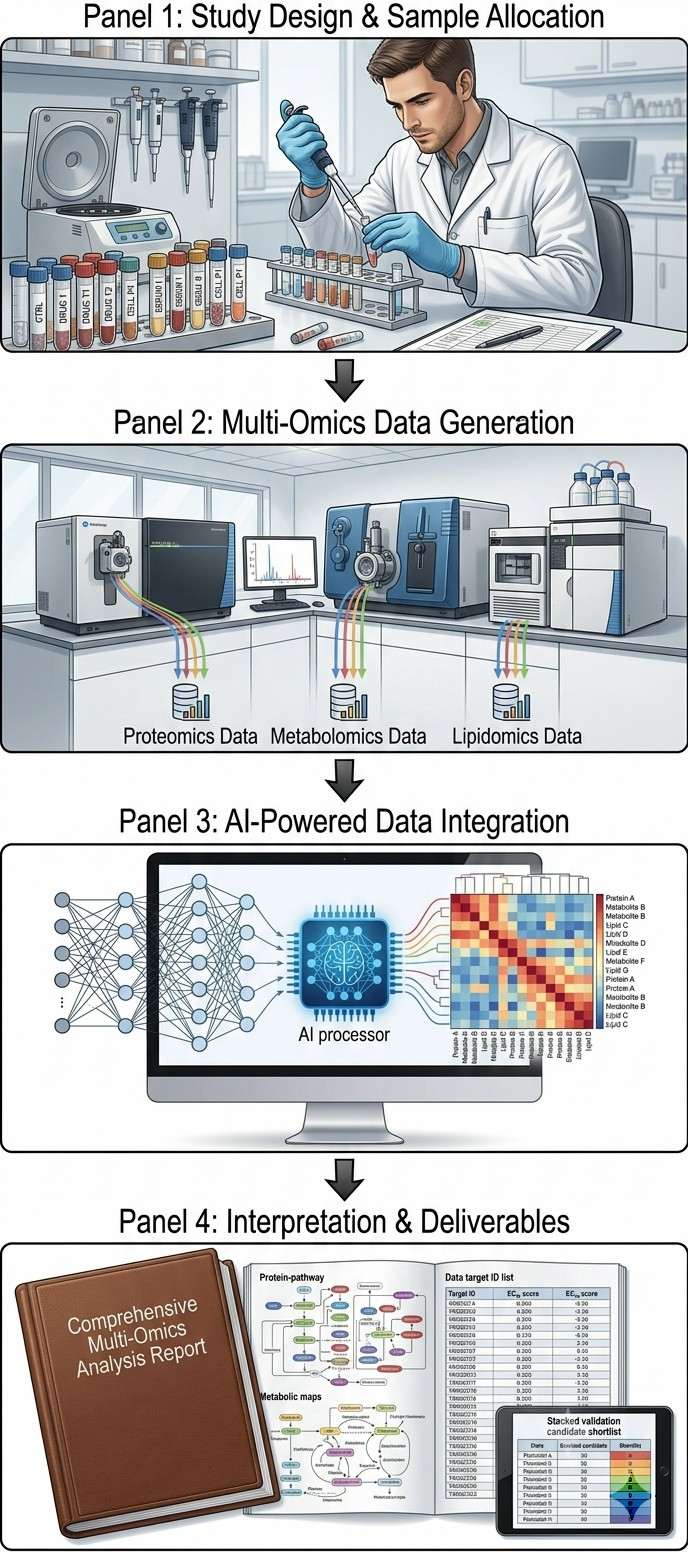
Integrated Workflow: From Sample to Insight

1

Study Design & Sample Allocation

Replicate design, sample allocation across omics assays, randomization to minimize batch effects.

2

Multi-Omics Data Generation

Proteomics, metabolomics, and/or lipidomics from the same samples using Orbitrap, QTRAP, and UPLC platforms.

3

AI-Powered Data Integration

Pre-agreed integration strategy (correlation, factor analysis, network, or ML-based) applied iteratively.

4

Interpretation & Deliverables

Comprehensive report with correlation matrices, MOFA outputs, pathway enrichment, and ranked biomarkers.

End-to-end multi-omics integration workflow from sample to insight showing four sequential stages.

Platform Instrumentation

Omics ModuleSeparation SystemMass SpectrometerKey Specifications
Proteomics (DIA/SWATH)Nano UPLC Ultimate 3000Orbitrap Q Exactive HF120,000 resolution, <1 ppm mass accuracy
Proteomics (TMT)Nano UPLC Ultimate 3000Orbitrap Fusion LumosMS3-based quantification
Metabolomics (untargeted)UPLC HSS T3 / HILICQ Exactive / OrbitrapFull-scan + DIA, pos/neg switching
Metabolomics (targeted)Acquity UPLCSciex QTRAP 6500+MRM quantification, 200+ metabolite panel
LipidomicsUPLC CSH C18Sciex QTRAP 6500+ / OrbitrapClass-specific MRM + shotgun
Fluxomics (13C)UPLCQTRAP 6500+Isotopologue distribution analysis

How to Choose Your Integration Strategy

If Your Question IsRecommended ApproachWhy
"Does my compound affect specific pathways across proteomics and metabolomics?"Network-centric integrationDirectly overlays multi-omics changes onto shared pathway maps
"What hidden biological processes are driving the drug response?"Latent-space integration (MOFA)Reveals low-dimensional structure across high-dimensional omics data
"Can I find a multi-analyte biomarker panel for response monitoring?"Supervised ML integrationFeature selection optimizes for classification performance
"How do metabolic perturbations correlate with protein expression?"Correlation-based integrationSimple, interpretable pairwise association analysis

Sample Requirements

For multi-omics projects where all assays are performed from the same biological sample, the following material guidelines apply:

Sample TypeProteomics (DIA)Metabolomics (Untargeted)LipidomicsNotes
Animal tissue (soft)100–200 mg100–200 mg100–200 mgSame tissue piece, snap-frozen, split for multi-omics
Animal tissue (hard)200–500 mg200–500 mg200–500 mgDecalcification may be required; consult for protocol
Plant tissue200 mg200 mg200 mgFlash-frozen in liquid nitrogen
Cell pellet5 × 10⁶ cells>1 × 10⁷ cells>1 × 10⁷ cellsSame cell population, split after harvest
Plasma/serum20 µL>100 µL>100 µLEDTA plasma preferred for proteomics
Urine10 mL200–500 µL200–500 µLCentrifuge to remove particulates
Culture supernatant20 mL>2 mL>2 mLSerum-free medium required for proteomics

Key Principles:

  • All samples must be flash-frozen in liquid nitrogen and stored at −80 °C. Ship on dry ice.
  • Avoid repeated freeze–thaw cycles. Aliquot samples before freezing where possible.
  • We recommend 6–8 biological replicates per group for animal studies; 8–10 for cell-based experiments.
  • A minimum of one extra sample per group as backup is strongly recommended.

Contact our technical team for sample types not listed here (e.g., FFPE, exosomes, swabs, soil).

Representative Results

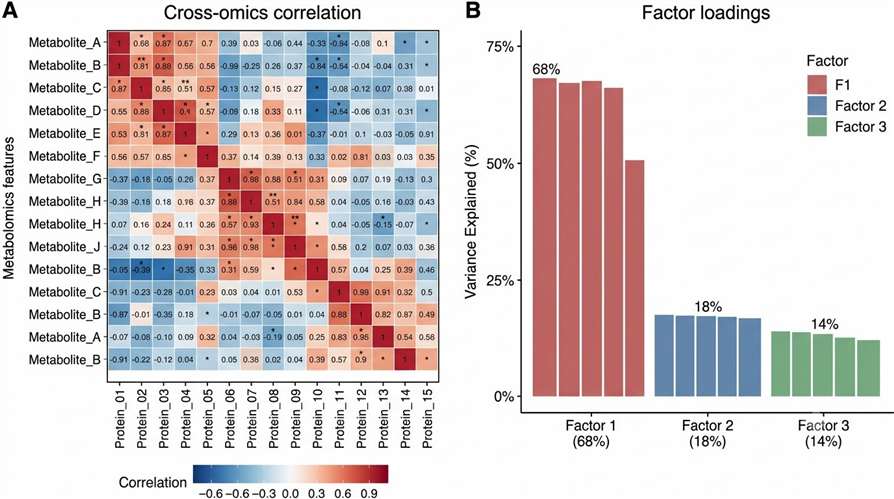
Multi-omics factor analysis (MOFA) results showing cross-omics correlation heatmap and latent factor loadings.

Cross-omics correlation analysis by MOFA

Cross-Omics Correlation Analysis: In a representative multi-omics drug-response profiling study, proteomics and metabolomics data were generated from the same cell lysate samples following compound treatment. Integration by MOFA revealed three latent factors that jointly explained 68% of the cross-omics variance. Factor 1 captured the dose-dependent drug response shared across both omics layers, Factor 2 identified treatment-specific metabolic rewiring independent of proteomic changes, and Factor 3 captured residual batch variation.

Cross-omics correlation analysis identified a panel of 12 metabolites whose abundance significantly correlated with the expression levels of 8 drug-target-pathway proteins (|r| > 0.7, FDR < 0.05), providing orthogonal validation of the compound's mechanism of action.

Pathway Enrichment with Multi-Omics Overlay: Network-centric integration mapped 143 differentially expressed proteins and 67 differentially abundant metabolites onto shared KEGG pathways. The oxidative phosphorylation pathway showed the strongest multi-omics concordance (proteomics enrichment q = 0.002; metabolomics enrichment q = 0.008), followed by arginine biosynthesis and purine metabolism.

Deliverables

  • Integrated multi-omics report (PDF): Study summary, methods, integration strategy rationale, and biological interpretation
  • Cross-omics correlation matrix with significance annotation
  • MOFA model outputs: Factor loadings, variance decomposition per omics view
  • Pathway enrichment results with multi-omics overlay network diagrams
  • Raw and processed data tables: Per-omics abundance matrices, QC metrics per sample
  • Interactive visualization dashboards (optional)
  • Methods section ready for manuscript or report inclusion

Case Study: Multi-Omics Profiling in Non-Small Cell Lung Cancer

Appadurai M.I., Chaudhary S., Shah A., et al. "ST6GalNAc-I regulates tumor cell sialylation via NECTIN2/MUC5AC-mediated immunosuppression and angiogenesis in non–small cell lung cancer." Journal of Clinical Investigation 135(10), 2025. https://doi.org/10.1172/JCI186863 (CC BY 4.0)

Background

ST6GalNAc-I is a sialyltransferase that modifies O-glycans on cell surface proteins, yet its role in lung cancer immune evasion remained incompletely characterized. The authors sought to determine how ST6GalNAc-I-driven sialylation affects tumor cell interactions with the immune microenvironment in lung adenocarcinoma.

Methods

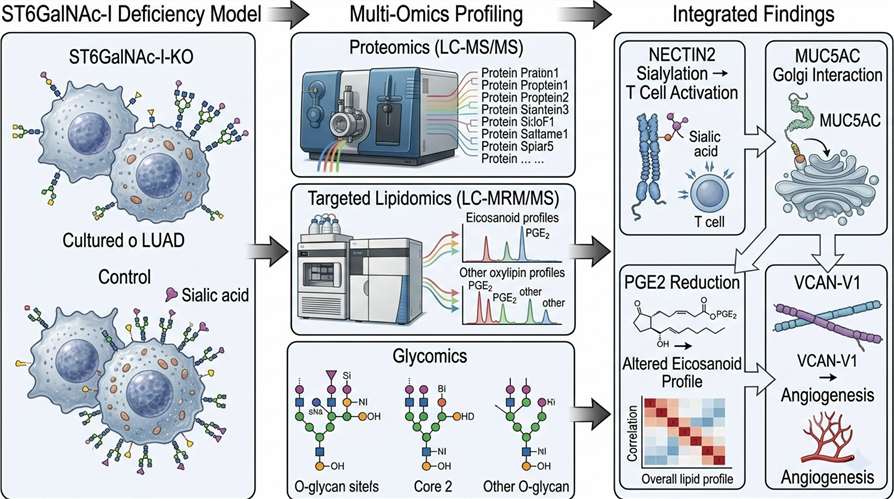
Proteomic profiling (LC-MS/MS) and targeted lipidomics analysis (eicosanoids/oxylipins by LC-MRM/MS) were performed on ST6GalNAc-I-deficient and control LUAD cell lines. Glycomic characterization was conducted to map sialylation patterns. Computational integration of proteomic and lipidomic datasets was used to identify correlated molecular signatures.

Results

ST6GalNAc-I deficiency led to reduced NECTIN2 sialylation, which enhanced T cell activation. Integrated lipidomic analysis revealed altered eicosanoid profiles with prostaglandin E2 levels significantly reduced, consistent with diminished immunosuppressive signaling. Proteomic profiling identified MUC5AC as a key interaction partner of ST6GalNAc-I in the Golgi, and VCAN-V1 as a downstream effector of angiogenesis.

Conclusions

The study demonstrated that ST6GalNAc-I coordinates a multi-modal immunosuppressive program through NECTIN2 sialylation and eicosanoid modulation. Integrated proteomic and lipidomic analysis was essential for capturing both the protein-level and lipid-mediator arms of this mechanism.

Multi-omics study workflow in non-small cell lung cancer showing proteomic and lipidomic integration approach.

Schematic of the multi-omics profiling approach used in the case study.

FAQ

Frequently Asked Questions

Q: What types of omics data can be integrated in a single project?

Our platform supports integration of proteomics (DIA/SWATH, TMT, phosphoproteomics), metabolomics (untargeted and targeted), lipidomics, and — where project goals require — transcriptomics and spatial omics data. The integration strategy is selected based on the biological question and data types involved.

Q: How does AI improve multi-omics integration compared with traditional correlation analysis?

AI-powered methods (factor analysis, network-based integration, supervised ML) capture non-linear relationships, latent structure across omics layers, and multi-feature interaction effects that pairwise correlation cannot detect. This makes them more suitable for complex drug discovery questions involving multi-factorial biological responses.

Q: Can you integrate our existing omics datasets with newly generated data?

Yes — we routinely integrate client-generated data with data produced in our laboratory. The key requirement is access to raw or preprocessed data files and sufficient experimental metadata to evaluate cross-dataset comparability and apply appropriate batch-effect correction.

Q: What is the minimum sample amount for a multi-omics project combining proteomics and metabolomics?

For cell pellets, a minimum of 1 × 10⁷ cells per sample is recommended to accommodate both assays from the same biological replicate. For tissues, 100–200 mg is sufficient. For plasma/serum, a minimum of 100 µL is required.

Q: How long does a typical multi-omics integration project take?

For a standard project (proteomics + metabolomics + lipidomics, 3 groups × 5–6 replicates, with bioinformatics integration), typical turnaround is 6–10 weeks from sample receipt. Timelines are confirmed at project kick-off based on scope and complexity.

References

  1. Subramanian I., Verma S., Kumar S., Jere A., Anamika K. "Multi-omics Data Integration, Interpretation, and Its Application." Bioinformatics and Biology Insights 14:1177932219899051 (2020). doi:10.1177/1177932219899051
  2. Argelaguet R., Velten B., Arnol D., et al. "Multi-Omics Factor Analysis — a framework for unsupervised integration of multi-omics data sets." Molecular Systems Biology 14:e8124 (2018). doi:10.15252/msb.20178124
  3. Singh A., Shannon C.P., Gautier B., et al. "DIABLO: an integrative approach for identifying key molecular drivers from multi-omics assays." Bioinformatics 35(17):3055–3062 (2019). doi:10.1093/bioinformatics/bty1054
  4. Reel P.S., Reel S., Pearson E., Trucco E., Jefferson E. "Using machine learning approaches for multi-omics data analysis: A review." Biotechnology Advances 49:107739 (2021). doi:10.1016/j.biotechadv.2021.107739

Plan an AI-Driven Multi-Omics Integration Study

Share your project goals and sample details — our scientists will design a tailored multi-omics integration strategy for your drug discovery program.

For Research Use Only. Not for use in diagnostic or clinical procedures.

Online Inquiry

Please submit a detailed description of your project. We will provide you with a customized project plan to meet your research requests. You can also send emails directly to for inquiries.

* Email
Phone
* Service & Products of Interest
Services Required and Project Description