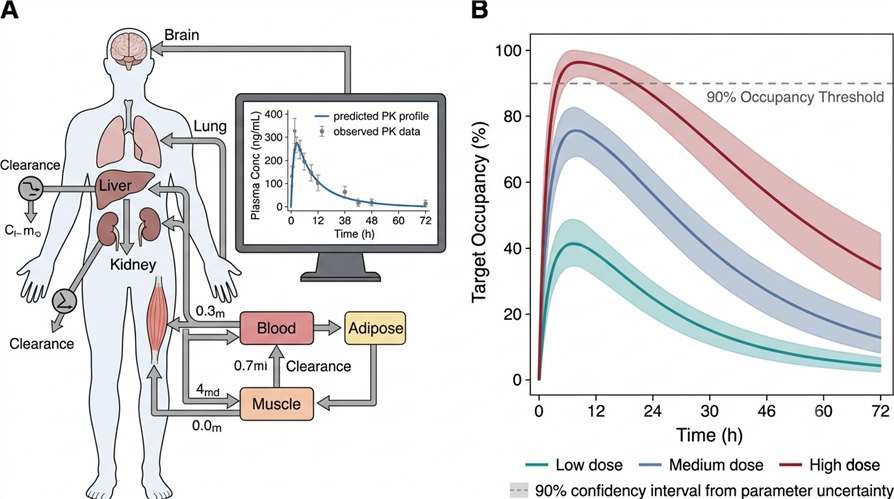
Systems Pharmacology MS Modeling Service — Integrating Mass Spectrometry with Computational Pharmacology for Drug Discovery

Bridge the gap between proteomics data and pharmacometric models. Combine MS-based protein quantification, target engagement, and metabolic profiling with quantitative systems pharmacology (QSP), PBPK, and PK/PD modeling.

Systems pharmacology integrates quantitative experimental data with computational modeling to predict how a drug interacts with its biological targets across multiple scales — molecular, cellular, tissue, and organism. By combining mass spectrometry-based proteomics and bioanalysis with pharmacometric modeling, our service enables measurement-informed model parameterization rather than reliance on literature assumptions.

At Creative Proteomics, we connect our LC-MS/MS and high-resolution MS platforms with PBPK, QSP, and PK/PD modeling pipelines to provide discovery-stage teams with predictive pharmacology models built on measured data — supporting better candidate selection, first-in-human dose projection, and mechanistic understanding of drug action.
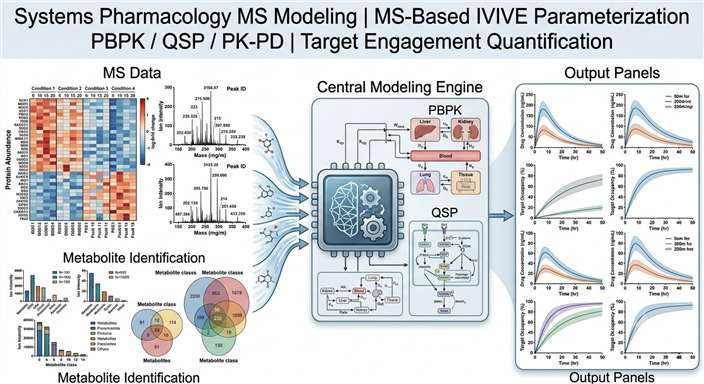
Systems pharmacology MS modeling workflow integrating LC-MS/MS proteomics data with computational PBPK and QSP models for drug discovery
What Is Systems Pharm MS to Parameters Modeling Approaches Target Engagement Workflow Platform Case Study FAQ

What Is Systems Pharmacology MS Modeling?

Systems pharmacology is a multiscale modeling discipline that integrates experimental data across molecular, cellular, and tissue levels to predict drug disposition, target engagement, and pharmacological effect. When mass spectrometry provides the experimental foundation — quantifying proteins, metabolites, drug concentrations, and drug-target interactions — the resulting models are grounded in measured biology rather than estimated parameters.

At Creative Proteomics, our service covers the full pipeline: targeted LC-MS/MS proteomics for enzyme and transporter abundance, intact protein MS for target engagement, LC-HRMS/MS for metabolite identification, and bioanalysis for drug quantification. These data are integrated into PBPK, QSP, or PK/PD models built with industry-standard platforms including PK-Sim, MoBi, and NONMEM. The output is a predictive, data-informed pharmacology model that directly supports drug discovery decisions.

From MS Data to Pharmacometric Parameters

Protein Abundance for IVIVE

Targeted LC-MS/MS with stable isotope-labeled peptide standards quantifies absolute abundances of drug-metabolizing enzymes (CYPs, UGTs) and transporters (OATP, P-gp, BCRP) in liver, kidney, intestine, and brain. These values directly scale in vitro clearance to in vivo human PK predictions.

Target Engagement and Occupancy

Intact protein MS, thermal stability profiling (PISA/TPP), and limited proteolysis-MS (LiP-MS) measure drug-target binding directly in cells or tissues. Binding curves and EC50 values inform target occupancy predictions in PK/PD models.

Protein Turnover Rates

pSILAC combined with LC-MS/MS quantifies protein synthesis and degradation rates. Turnover half-lives are essential input parameters for modeling target recovery kinetics, particularly for drugs with long residence times or irreversible binding.

Signaling Pathway Activity

Time-resolved phosphoproteomics captures pathway activation dynamics (MAPK/ERK, PI3K/AKT, JAK/STAT) in response to drug treatment. Dose-response and time-course data feed directly into QSP models that simulate drug action at the pathway level.

Modeling Capabilities and Approaches

Model TypeMS Data InputsTypical Application
PBPKCYP/transporter abundance (LC-MS/MS), LogD, protein bindingFirst-in-human dose prediction, DDI risk assessment
PK/PDTarget engagement (MS), in vitro potency, PK parametersEfficacy dose prediction, regimen optimization
QSPPhosphoproteomics, metabolomics, protein turnoverMoA elucidation, combination therapy prediction
Network PharmacologyProteomics, PPI network data, transcriptomicsTarget ID, polypharmacology, repurposing
IVIVEEnzyme/transporter abundance, intrinsic clearanceHuman PK projection from in vitro ADME

Models are built using PK-Sim, MoBi, NONMEM, or open-source frameworks, calibrated against measured MS data and independently validated where possible. We also support integration of client-generated ADME data through our comprehensive ADME DMPK PK-PD research platforms.

Intact Protein MS

Direct measurement of mass shift caused by covalent drug binding enables quantification of bound versus unbound target fractions. This approach is especially valuable for covalent inhibitors (KRAS G12C, BTK, EGFR) where residence time and target resynthesis drive pharmacodynamics.

Limited Proteolysis-MS (LiP-MS)

Detects conformational changes in target proteins upon drug binding, providing label-free engagement evidence across the proteome. LiP-MS selectivity profiles inform off-target predictions in QSP models.

Thermal Stability Profiling (PISA/TPP)

Measures drug-induced shifts in protein melting temperature across the proteome at multiple concentrations. Dose-response data directly parameterize target occupancy predictions in PK/PD models.

Metabolite Identification Integration

LC-HRMS/MS metabolite identification tracks drug biotransformation pathways and identifies active metabolites. These data are integrated into PBPK models for accurate prediction of metabolite exposure and activity. We support this through our dedicated metabolite identification service.

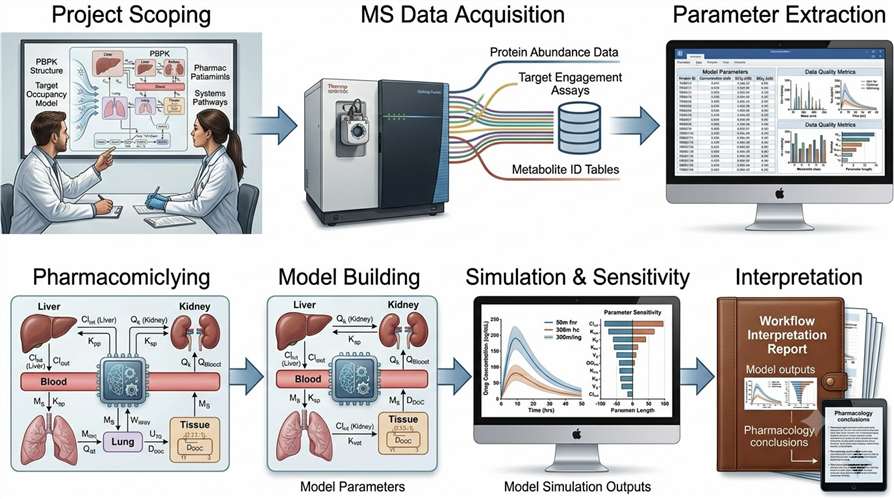
Workflow — From Biological Question to Pharmacometric Model

1

Project Scoping

Define pharmacology question, select model type (PBPK / QSP / PK-PD), identify MS-measurable parameters.

2

MS Data Acquisition

Targeted proteomics (SIS peptides, TMTpro), intact protein MS, phosphoproteomics, or bioanalysis as specified.

3

Parameter Extraction & QC

Extract protein abundances, target engagement metrics, metabolite profiles, drug concentrations. Review for biological consistency.

4

Model Building & Calibration

Build model in PK-Sim / MoBi / NONMEM; calibrate against measured MS data and available PK/PD literature.

5

Simulation & Sensitivity Analysis

Simulate dose scenarios, predict human PK, explore combination strategies, identify key parameters driving outcome.

6

Deliverables & Interpretation

Model file, simulation outputs, sensitivity analysis, written pharmacology interpretation for the drug discovery program.

Six-step systems pharmacology MS modeling workflow from project scoping through model interpretation

Platform Instrumentation

InstrumentConfigurationPharmacology Application
Orbitrap ID-XTribrid HRMS, HILIC + RP LCIntact protein MS, phosphoproteomics, PTM characterization
Q Exactive HFQuadrupole-Orbitrap, 120,000 FWHMSIS peptide quantification, TMTpro multiplexed proteomics
QTRAP 6500+Triple quad with linear ion trap, MRMBioanalysis, metabolite ID, CYP phenotyping, transporter quantification
TSQ AltisTriple quadrupole, H-SRMHigh-sensitivity drug and biomarker quantification
ACQUITY UPLC I-ClassBinary HILIC + RP systemsMetabolite separation, bioanalytical method development

Data Integration and Custom Model Design

Our workflow is designed to incorporate client-generated data alongside new MS measurements. We conduct a data audit to identify parameter gaps, design targeted MS experiments for missing parameters, construct the model with measured values, perform sensitivity analysis to prioritize further experiments, and generate dose projections with quantified uncertainty. When appropriate, we integrate MS data with transcriptomic or proteomic datasets through our multi-omics integration service to inform broader network-level models.

Deliverables

  • MS data package: protein abundance tables (absolute or relative), target engagement curves, phosphoproteomics time-course data, metabolite ID reports
  • Model file: PBPK, QSP, or PK/PD model in PK-Sim, MoBi, or NONMEM format
  • Simulation outputs: dose-exposure projections, target occupancy time profiles, DDI risk scenarios, sensitivity analysis
  • Model documentation: parameter sources, assumptions, calibration results, limitations
  • Interpretation report: pharmacology implications, recommended next experiments, translational relevance

Applications in Drug Discovery

Systems pharmacology modeling schematic showing MS data inputs feeding into PBPK and QSP model simulations for drug discovery decisions

Preclinical candidate selection — Combine in vitro ADME data with MS-quantified enzyme/transporter abundances to predict human PK and rank compounds by projected therapeutic index. Mechanism of action — Use time-resolved phosphoproteomics and metabolomics to build QSP models that distinguish on-target pharmacology from adaptive resistance. Covalent drug development — Intact protein MS target occupancy data with PK/PD modeling enables rational dosing schedule design. Translational biomarker strategy — MS proteomic profiling of PD biomarkers in preclinical models informs clinical matrix selection. Combination therapy prediction — QSP models parameterized with proteomics data simulate combination effects across pathways.

We provide additional orthogonal approaches for target confirmation, including thermal proteomics for MoA studies to independently verify target engagement, and comprehensive pharmaco-proteomics support for larger-scale proteomic drug profiling programs.

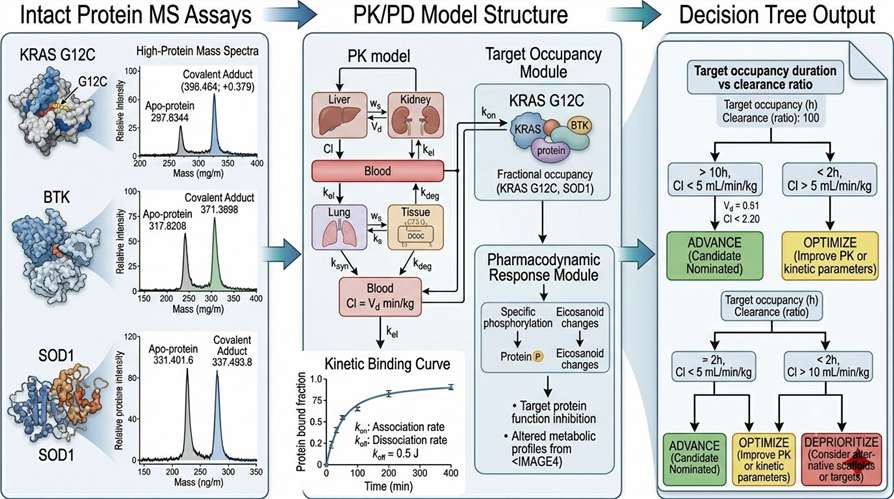
Case Study — Intact Protein MS and PK/PD Modeling Guides Covalent Drug Development

Götze M., et al. "Mass spectrometry methods and mathematical PK/PD model for decision tree-guided covalent drug development." Nature Communications 16, 1777 (2025). https://doi.org/10.1038/s41467-025-56985-6 (CC BY 4.0)

Background

Covalent drug development requires balancing target occupancy, selectivity, and off-target risk. Traditional approaches rely on empirical optimization without quantitative models linking in vitro binding to in vivo occupancy.

Methods

Intact protein MS measured drug-target adduct formation for covalent inhibitors targeting KRAS G12C, BTK, and SOD1 in cellular lysates and intact cells. Time-resolved MS quantified association kinetics, target occupancy, and target resynthesis rates. A PK/PD model was built incorporating binding kinetics (kon, koff), target turnover, drug PK, and irreversible adduct formation.

Results

The integrated MS-PK/PD platform successfully predicted in vivo target occupancy from in vitro MS measurements. Sensitivity analysis identified target resynthesis rate as the most influential parameter for sustained occupancy, directly guiding dosing frequency optimization.

Conclusions

Combining intact protein MS data with PK/PD modeling enables quantitative, mechanism-based decision-making in covalent drug discovery that empirical screening alone cannot achieve.

Research workflow diagram showing intact protein MS and PK/PD modeling integration for covalent drug development

Overview of the integrated MS-PK/PD workflow for covalent drug development.

FAQ

Frequently Asked Questions

Q: What types of MS data can be integrated into pharmacology models?

Absolute protein abundances (SIS peptide LC-MS/MS), target engagement data (intact protein MS, LiP-MS, TPP), phosphoproteomics time courses, metabolite identification, and drug concentration bioanalysis can all serve as model inputs.

Q: Do I need existing in vitro ADME data to use this service?

No. We can generate all necessary data de novo, including metabolic stability, CYP phenotyping, protein binding, and enzyme/transporter abundance by MS. We also incorporate client-provided data where available.

Q: What model formats do you support?

Models are built in PK-Sim and MoBi (open-source platform), NONMEM, and R-based frameworks. Final model files are provided in the chosen format for client use or regulatory submission.

Q: Can you model biologics (antibodies, ADCs)?

Yes. We support PBPK models for monoclonal antibodies using FcRn-mediated recycling parameters, target-mediated drug disposition (TMDD) models, and ADC modeling with DAR distribution measured by intact protein MS.

Q: How long does a typical project take?

PBPK model construction from existing data typically requires 1–2 weeks. Full QSP models incorporating time-resolved MS data may require 4–8 weeks depending on scope and the number of MS experiments needed.

Q: Is the modeling suitable for regulatory submission?

Our PBPK and PK/PD models follow current best practices for model-informed drug development (MIDD). Model documentation includes full parameter justification and sensitivity analysis suitable for regulatory interactions.

References

  1. Götze M., et al. "Mass spectrometry methods and mathematical PK/PD model for decision tree-guided covalent drug development." Nature Communications 16, 1777 (2025). https://doi.org/10.1038/s41467-025-56985-6
  2. Karr J.R., et al. "A whole-cell computational model predicts phenotype from genotype." Cell 150, 389–401 (2012). https://doi.org/10.1016/j.cell.2012.05.044
  3. Bai J.P.F., Liu G., Zhao M., et al. "Landscape of regulatory quantitative systems pharmacology submissions to the U.S. Food and Drug Administration: An update report." CPT Pharmacometrics Syst. Pharmacol. 13, 2102–2110 (2024). https://doi.org/10.1002/psp4.13208

Ready to Build Data-Informed Pharmacology Models?

Contact our team to discuss how MS-based systems pharmacology modeling can support your drug discovery program — from target engagement quantification to first-in-human dose projection.

Our systems pharmacology MS modeling service is intended for research use only (RUO). Not for use in diagnostic or clinical procedures.

Online Inquiry

Please submit a detailed description of your project. We will provide you with a customized project plan to meet your research requests. You can also send emails directly to for inquiries.

* Email
Phone
* Service & Products of Interest
Services Required and Project Description