Reactive Residue Profiling (Cys/Lys/Tyr/Ser) Service

Advance your covalent drug discovery with our comprehensive reactive residue profiling service. If your team is struggling to map precise binding sites for challenging probes, we are here to help.

We specialize in mapping Cysteine (Cys), Lysine (Lys), Tyrosine (Tyr), and Serine (Ser) binding sites, delivering robust target and off-target evidence straight from complex biological matrices.

Using high-resolution mass spectrometry (HRMS), we provide the transparent, actionable data you need to make confident Go/No-Go decisions on your hit compounds.

Reactive Residue Profiling Service platform diagram featuring multi-residue coverage, complex matrix adaptability, and actionable data deliverables.
Beyond Cys Profiling Capabilities Workflow & QC Deliverables Strategy Comparison Sample Case Study FAQ

Breaking the Covalent Bottleneck: Beyond Traditional Cys Profiling

For years, covalent drug discovery has heavily relied on targeting Cysteine due to its high natural nucleophilicity and reactivity. However, as the field moves toward more diverse and challenging targets—such as historically undruggable proteins, transcription factors, or molecular glues—relying solely on Cys is no longer sufficient. Exploring other nucleophilic amino acids like Lysine, Tyrosine, and Serine opens up entirely new and massive target spaces across the human proteome.

But mapping these non-Cys residues comes with a steep technical barrier. Lysine and Tyrosine have lower inherent reactivity in physiological environments and can produce highly complex fragmentation patterns inside a mass spectrometer. Unlike the predictable fragmentation of standard tryptic peptides, these covalent adducts often undergo neutral losses or unusual cleavages during tandem mass spectrometry (MS/MS). This complexity often leads to high background noise, misassigned peaks, and a high rate of false positives in standard proteomic pipelines.

Our platform is built specifically to address this bottleneck. We apply tailored chemoproteomic enrichment strategies and specialized MS parameters to clearly separate true binding events from the noise, giving you reliable site-specific mapping regardless of the residue's natural difficulty.

Our Chemoproteomics Service Capabilities & Advantages

We provide platform-level evidence that links your early hits to definitive cellular mechanisms, ensuring you do not waste time on dead-end compounds.

Comprehensive Target & Off-Target Discovery

We do not just confirm your primary target; we scan the entire proteome to identify potential off-target liabilities early in your pipeline. Understanding the full selectivity profile is critical before moving into costly animal models.

Complex Sample Matrix Adaptability

Our protocols are optimized for biological complexity. Whether you are working with live cell models, tissue lysates, or complex biological mixtures, our methods handle the heterogeneity and lipid-rich environments that typically interfere with MS analysis.

High-Fidelity Multi-Residue Enrichment

We adjust our chemistry to match your probe. We utilize distinct buffer systems, temperature controls, and capture beads specifically tuned to preserve fragile Lys/Tyr/Ser adducts during sample prep, ensuring no data is lost.

Synergy with Broader Workflows

We seamlessly integrate this profiling with our target deconvolution services to support your entire hit-to-lead journey, or incorporate mass spectrometry imaging to understand the spatial distribution in tissues.

End-to-End Workflow with Strict QC Checkpoints

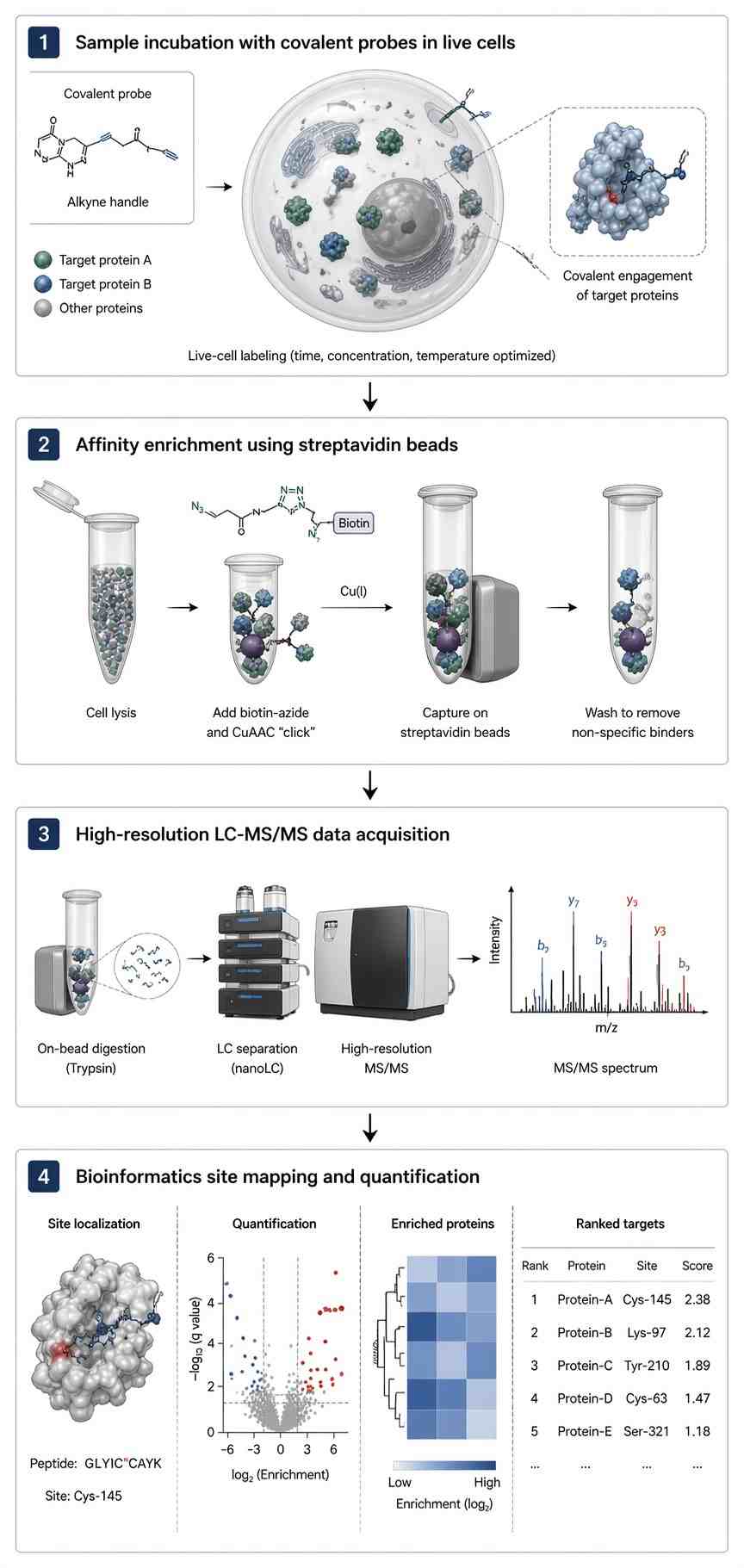
A successful profiling project requires a tightly managed process. We combine rigorous technical execution with clear service milestones.

1

Project Initiation & Probe Evaluation

We review your probe's structure and reactivity, designing a customized sample prep protocol to avoid degrading sensitive covalent bonds.

2

Sample Processing & Incubation

We perform incubation under strictly controlled physiological conditions, effectively capturing accurate cellular target engagement.

3

Affinity Enrichment & Digestion (QC Checkpoint 1)

We assess enrichment efficiency and confirm that enzymatic digestion has successfully generated the required peptide lengths.

4

LC-MS/MS Acquisition (QC Checkpoint 2)

We monitor instrument calibration, spray stability, and precursor ion intensities using spike-in peptides to ensure no data is lost to technical drift.

5

Bioinformatics & Site Mapping (QC Checkpoint 3)

Our algorithms search for exact mass shifts. False Discovery Rates (FDR) are strictly controlled at ≤1% using target-decoy approaches.

6

Data Delivery & Consultation

You receive a comprehensive data package, and we schedule a walkthrough meeting to help integrate the findings into your pipeline.

A professional scientific flowchart showing chemoproteomics probe incubation, enrichment, LC-MS/MS, and bioinformatics, with explicit QC check marks at each stage

Actionable Data Deliverables & Bioinformatics Support

We believe in complete data transparency. You will never receive a "black box" conclusion from us. We deliver raw data files alongside structured, easy-to-read reports that your cross-functional team can immediately use.

CORE

Key Result Types

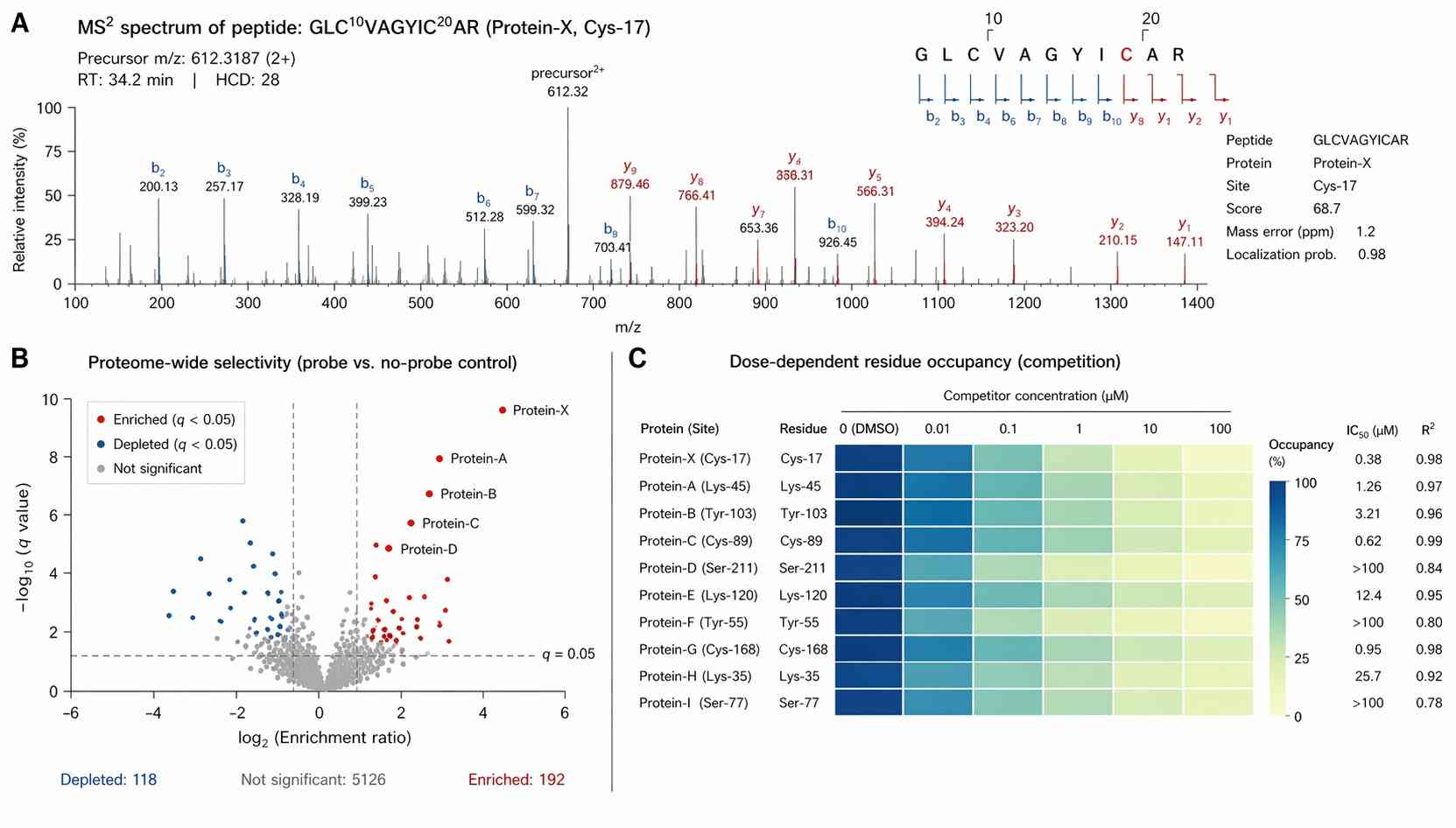
  • Site-Specific MS2 Mapping: High-resolution fragmentation spectra unambiguously confirming the exact amino acid residue modified.
  • Global Selectivity Volcano Plot: Visual representation of statistically significant targets versus off-targets across the proteome.
  • Target Occupancy Quantification: Heatmaps showing dose-dependent residue engagement metrics at the binding site level.
DATA

Bioinformatics Deliverables

  • Raw Data: Full access to Raw MS data files (.raw format) for your internal archives.
  • Summary Tables: Confidence-scored peptide/protein tables indicating exact modification sites and intensities.
  • Optional Add-ons: Network topology analysis, Pathway enrichment (GO/KEGG), and PDB structural mapping for off-target hits.

Choosing the Right Profiling Strategy

Selecting the optimal mass spectrometry strategy depends heavily on the nature of your electrophile and the target pocket environment. Using the wrong approach can lead to noisy data. Use the comparison below to guide your approach.

Comparison DimensionTraditional Cys-ABPPMulti-Residue Profiling (Lys/Tyr/Ser)
Enrichment DifficultyLow to Moderate (Highly established protocols)High (Requires custom neutral buffers to prevent adduct hydrolysis)
MS/MS ComplexityStandard (Predictable b/y ion series)High (Complex fragmentation patterns require advanced scoring algorithms)
FDR ControlStandard database search parametersStringent filtering and manual MS2 validation needed to manage risks
Biological RelevanceExcellent for kinases and targeted covalent inhibitorsEssential for undruggable pockets, molecular glues, and broad-spectrum probes

Sample Requirements & Project Preparation

To ensure the highest quality results, proper sample handling is the first critical step in preventing probe degradation. If your project involves a unique matrix, please contact us for customized preparation guidelines.

Sample TypeRecommended InputContainer & BufferShippingNotes
Cell Pellets≥ 1 × 10⁷ cellsWash with cold PBS, snap-frozenDry iceAvoid amine-containing buffers (e.g., Tris) if targeting Lysine.
Tissue Samples≥ 50 mgPre-washed, snap-frozenDry icePlease specify the tissue origin, perfusion status, and pre-treatments.
Pre-enriched Beads> 20 μL bed volumeRecommended buffer provided by usDry iceProvide probe structure/linkage details securely to guide MS.

Validated Chemoproteomics Case Studies

Targeting Reactive Lysines in Live Cells

Reference link: https://pmc.ncbi.nlm.nih.gov/articles/PMC10988577/

Background

While cysteine profiling is standard, identifying reactive lysines globally in live cells remains difficult due to lysine's lower physiological nucleophilicity and high proteome abundance. Mapping these sites is crucial for discovering new allosteric pockets and molecular glue degraders.

Methods

Researchers developed a platform utilizing a specific pyridinium-based probe for the selective modification of lysine residues. The workflow involved incubating the covalent probe directly in live cells, cell lysis, streptavidin enrichment, and rigorous on-bead tryptic digestion. Peptides were analyzed using high-resolution LC-MS/MS with heavily customized bioinformatic pipelines.

Results

As demonstrated in Figure 1 of the referenced study, the methodology successfully mapped hundreds of highly reactive, ligandable lysine sites across the human proteome directly in a live-cell environment. The MS2 spectra provided clear, unambiguous b and y ion series flanking the modified residues.

Conclusion

This application definitively proves that with the right combination of probe chemistry, tailored enrichment buffers, and precise HRMS parameters, it is entirely feasible to achieve deep, site-specific mapping of challenging non-Cys residues.

Figure 1 from PMC10988577, illustrating a robust methodology for lysine-selective chemoproteomic profiling and active site mapping.

Figure 1: Illustration of lysine-selective chemoproteomic profiling methodology.

FAQ

Frequently Asked Questions

Q: How do you address the high false-positive rates typical in Lysine or Tyrosine profiling?

We use a combination of stringent sample preparation, optimized collision energies during MS/MS acquisition to ensure clear fragmentation, and rigorous bioinformatics filtering. We require high-confidence b/y ion coverage directly flanking the modified residue to confirm a hit, keeping our FDR strictly controlled. Manual spectral validation is also performed for top hits.

Q: What structural information about our probe is required to initiate the project?

To accurately set up the mass spectrometer and bioinformatics search parameters, we absolutely need the exact mass shift (Delta Mass) your probe introduces on the protein, the target reactive groups (e.g., alkyne or azide for click chemistry pull-downs), and any known stability issues of the adduct. We handle all structures under strict confidentiality agreements.

Q: Do you provide raw MS data files for our internal bioinformatics team?

Yes. We deliver the raw instrument files alongside our processed data tables. We believe in complete transparency, allowing your team to re-analyze, verify, or archive the data as needed.

Q: Can this service be applied directly to tissue samples, or only cell lines?

We can process both. While cell lines are common for initial high-throughput screening, tissue samples can be successfully processed through our optimized homogenization and lipid-removal protocols to perform highly valuable in vivo target engagement studies.

References

  1. Targeting the Reactive Proteome: Recent Advances in Activity-Based Protein Profiling and Probe Design.
  2. Activity-based protein profiling: A graphical review.
  3. Protein painting for structural and binding site analysis via intracellular lysine reactivity profiling with o-phthalaldehyde.

Disclaimer: All services and data provided by our platform are for Research Use Only (RUO). Not for use in diagnostic procedures. The information provided is not intended to substitute for professional medical advice or clinical diagnosis.

Plan your Chemoproteomics campaign with the MassTarget™ team

Share your probe and target details, and our scientists will design a tailored profiling strategy for your discovery program.

Online Inquiry

Please submit a detailed description of your project. We will provide you with a customized project plan to meet your research requests. You can also send emails directly to for inquiries.

* Email
Phone
* Service & Products of Interest
Services Required and Project Description