Metabolite Identification (MetID) Service for Drug Metabolism Studies

Identify metabolic soft spots, map biotransformation pathways, and compare metabolite profiles across species — with high-resolution mass spectrometry and expert data review.

Understanding how your drug candidate is metabolized is a strategic necessity that shapes lead optimization, tox species selection, and preclinical decision-making. Our metabolite identification (MetID) service delivers structural characterization of phase I and phase II metabolites using high-resolution mass spectrometry (HRMS), providing the data you need to guide medicinal chemistry decisions, select appropriate animal species for toxicology studies, and build confidence in your candidate's metabolic profile.

We combine advanced Orbitrap and Q-TOF platforms with expert medicinal chemistry review to ensure every metabolite assignment is both accurate and actionable. Whether you need rapid metabolic soft-spot identification during lead optimization or comprehensive cross-species metabolite profiling for preclinical candidate selection, our MetID service is designed to integrate seamlessly with your DMPK workflow.

Key Advantages:

  • High-resolution Orbitrap and Q-TOF platforms delivering sub-ppm mass accuracy for confident elemental composition assignment.
  • Expert medicinal chemistry review of every metabolite structure assignment by experienced drug metabolism scientists.
  • Comprehensive cross-species coverage across rat, dog, monkey, and human hepatocytes or microsomes in parallel.
  • Novel modality capability optimized for PROTACs, oligonucleotides, peptides, and antibody-drug conjugates.
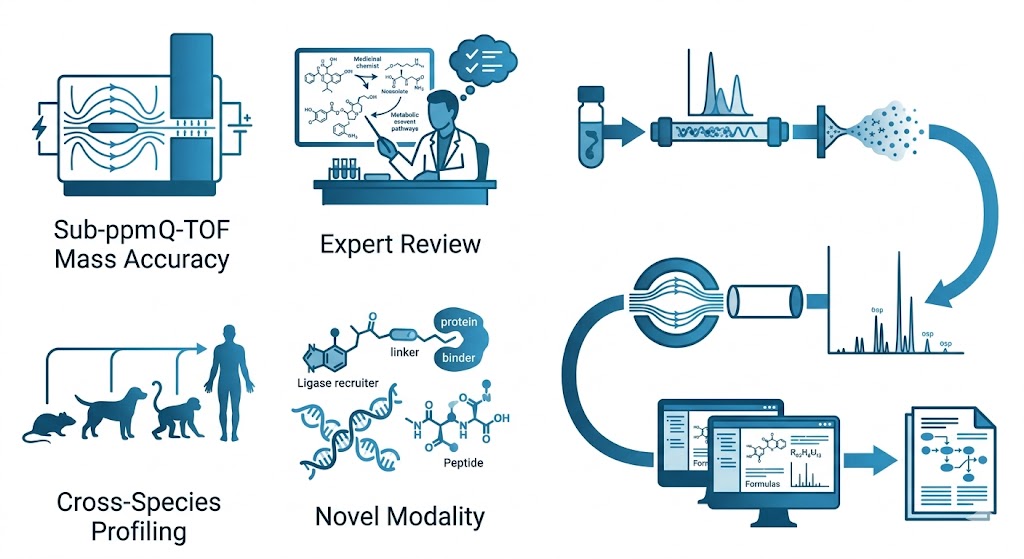
Metabolite identification (MetID) service overview featuring HRMS platforms, cross-species metabolite profiling, and four key advantages for drug metabolism studies.
Overview Key Advantages When to Use Incubation Systems Workflow HRMS Data Processing Technology Comparison Sample Demo Case Study FAQ

Accelerate Drug Development with Comprehensive Metabolite Identification

Metabolite identification (MetID) is the systematic characterization of phase I and phase II biotransformation products formed from a drug candidate. It answers fundamental questions that drive drug development decisions: Where is the molecule metabolized? Which metabolic pathways are dominant? Are there human-specific or disproportionate metabolites that could affect preclinical safety assessment?

Our MetID service addresses these questions through a structured workflow that combines in vitro incubation systems, high-resolution mass spectrometry acquisition, and expert-driven data interpretation. We profile metabolites across multiple preclinical species and human systems in parallel, enabling direct cross-species comparison that supports toxicology species selection and cross-species metabolite coverage assessment. Each study is designed in consultation with your DMPK team to ensure the incubation conditions, analytical parameters, and data deliverables align with your specific development stage and study objectives.

For a broader view of how MetID fits into your drug metabolism strategy, explore our ADME / DMPK / PK-PD Research Platforms.

Why Choose Our MetID Service for Your Drug Metabolism Studies

High-Resolution Mass Spectrometry Platforms

We operate Thermo Orbitrap and Waters Q-TOF instruments, delivering sub-ppm mass accuracy for confident elemental composition assignment of all detected metabolites, including low-abundance species that would be missed by nominal-mass instruments.

Expert Medicinal Chemistry Review

Every metabolite structure assignment is reviewed by experienced drug metabolism scientists who understand fragmentation pathways, biotransformation chemistry, and the structural context of your chemical series.

Comprehensive Cross-Species Coverage

We profile metabolites across rat, dog, monkey, and human hepatocytes or microsomes in parallel, enabling direct comparison of metabolic pathways and early identification of human-specific or disproportionate metabolites.

Novel Modality Capability

Our HRMS data acquisition and processing workflows are optimized for PROTACs, oligonucleotides, peptides, and antibody-drug conjugates — modalities that challenge conventional MetID approaches.

Rapid Turnaround for Chemistry Cycles

Standard in vitro MetID results are delivered within 2–3 weeks, with expedited options for metabolic soft-spot identification to keep your design–synthesize–test cycles moving.

Integrated DMPK Context

We position MetID within your broader DMPK strategy, connecting metabolite profiles with metabolic stability data, CYP phenotyping results, and PK-PD outcomes for a complete metabolic picture.

When to Invest in Metabolite Identification During Drug Discovery

MetID delivers the greatest value when applied at specific decision points in the drug development pipeline. Below are the most common scenarios where metabolite identification provides critical data to guide program direction.

Lead Optimization — Metabolic Soft-Spot Identification

When your lead series shows high clearance in metabolic stability assays, MetID pinpoints the exact sites of biotransformation, giving medicinal chemists a structural roadmap for blocking metabolic liability.

MetID solves: identifying the specific atoms or functional groups responsible for rapid clearance, enabling targeted structural modification.

Cross-Species Metabolite Coverage Assessment

Before committing to a candidate, MetID across multiple species confirms that your chosen animal tox model adequately covers human metabolite exposure, reducing the risk of late-stage metabolite-related surprises.

MetID solves: providing the cross-species metabolite coverage data needed to select the most appropriate toxicology species.

Clinical Metabolite Monitoring

Clinical Metabolite Monitoring

When unexpected metabolites appear in clinical samples, we provide rapid structural elucidation to determine whether they represent a safety concern or a benign clearance pathway.

MetID solves: resolving clinical metabolite questions quickly to avoid program delays.

Reactive Metabolite Assessment

If your compound contains structural alerts for bioactivation, we offer complementary reactive metabolite trapping studies using GSH, cyanide, or other nucleophilic trapping agents.

MetID solves: identifying bioactivation pathways early to mitigate toxicity risk before candidate advancement.

For related metabolic profiling capabilities, see our Metabolic Soft-Spot Analysis and Metabolic Stability services.

In Vitro Incubation Systems for Metabolite Generation

The choice of in vitro system determines the metabolic coverage of your MetID study. We offer three complementary systems, each suited to different study objectives.

SystemPhase I MetabolismPhase II MetabolismSpecies OptionsBest Used For
Liver MicrosomesStrong (CYP450, FMO)Limited (UGT only)Rat, dog, monkey, human, mouseRapid soft-spot ID, CYP phenotyping, reactive metabolite trapping
Hepatocytes (primary/cryopreserved)CompleteComplete (all phase II enzymes)Rat, dog, monkey, human, mouseComprehensive metabolite profiling, cross-species comparison, intrinsic clearance
S9 FractionModerateModerateRat, dog, monkey, humanMetabolite generation when both cytosolic and microsomal enzymes are needed

Each system is selected based on your specific study objectives. For early-stage soft-spot identification, microsomal incubations provide rapid results. For comprehensive metabolite profiling and cross-species comparison, hepatocytes are the preferred system as they contain the full complement of drug-metabolizing enzymes.

Our MetID Workflow: From Sample to Structural Assignment

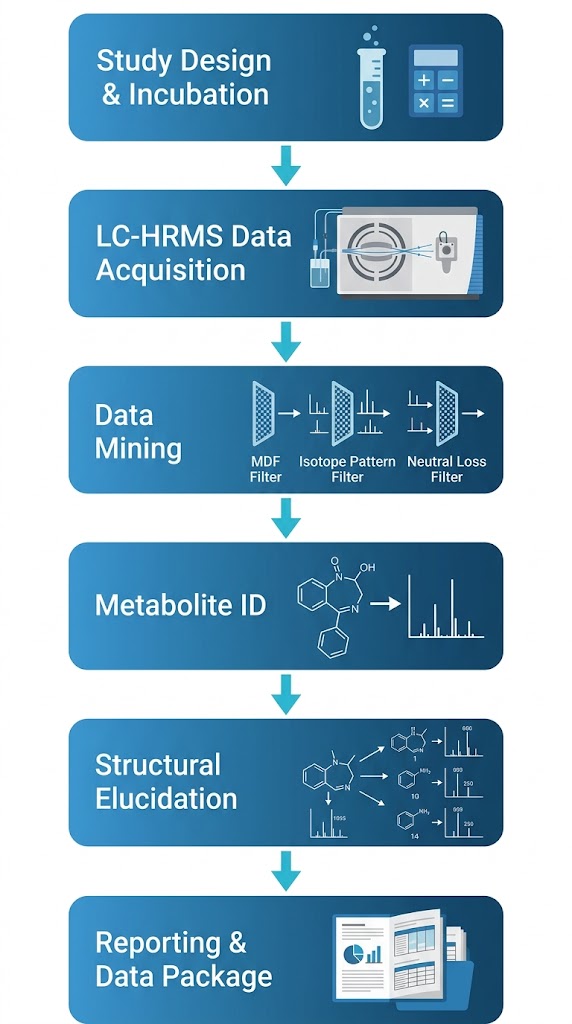
The workflow consists of six essential stages, from study design through final data package delivery:

1

Study Design & Incubation Optimization

We design incubation conditions (substrate concentration, protein concentration, incubation time, cofactors) based on your compound's physicochemical properties and the metabolic system selected.

2

LC-HRMS Data Acquisition

Samples are analyzed on Orbitrap or Q-TOF platforms using full-scan HRMS acquisition with data-dependent MS/MS (DDA) or data-independent acquisition (DIA) for comprehensive fragmentation coverage.

3

Data Mining with Advanced Filters

We apply multiple HRMS data-mining techniques — mass defect filtering (MDF), isotope pattern recognition, neutral loss scanning, and product ion filtering — to extract metabolite signals from complex biological matrices.

4

Metabolite Identification

Each detected metabolite candidate is assigned an elemental composition, matched against predicted biotransformation products, and confirmed through MS/MS fragmentation pattern analysis.

5

Structural Elucidation

For unambiguous assignment, we perform detailed fragment ion analysis, comparing MS/MS spectra of metabolites with the parent drug to determine the exact site of modification.

6

Reporting & Data Package

We deliver a comprehensive report including metabolite tables, extracted ion chromatograms, MS/MS spectra, proposed metabolic pathway maps, and cross-species comparison summaries.

MetID workflow diagram showing six steps from study design and incubation optimization through LC-HRMS data acquisition, data mining, metabolite identification, structural elucidation, to final reporting and data package delivery.

Advanced HRMS Data Processing for Confident Metabolite Identification

Generic HRMS acquisition alone is insufficient for comprehensive MetID — the difference lies in how the raw data is mined. We employ four complementary data processing techniques to ensure no metabolite is missed and every assignment is confident.

TechniquePrincipleBest For
Mass Defect Filtering (MDF)Exploits predictable shifts in mass defect (fractional mass) caused by phase I and phase II biotransformations; applies MDF windows centered on the parent drug's mass defect to selectively extract metabolite ions while filtering out endogenous matrix background.Detecting low-abundance metabolites in complex biological samples (plasma, urine, bile)
Isotope Pattern RecognitionAutomated identification of metabolites containing chlorine, bromine, or other elements with distinctive isotopic signatures through pattern matching algorithms.Rapid identification of halogenated metabolites, reducing false positives from endogenous interferences
Neutral Loss ScanningTargeted filtering for metabolites that fragment via characteristic neutral losses (e.g., glucuronides losing 176 Da, sulfates losing 80 Da).Detecting entire metabolite classes (glucuronides, sulfates, GSH conjugates) in a single pass
MSⁿ Structural ElucidationWhen MS/MS fragmentation is insufficient to resolve isomeric metabolites, MS³ or higher-order fragmentation differentiates between alternative modification sites.Unambiguous structural assignment for complex biotransformation products with multiple possible modification sites

These techniques are applied in combination, with results cross-validated against predicted metabolite lists and literature biotransformation knowledge. This multi-layered approach ensures comprehensive metabolite coverage and minimizes the risk of false assignments.

MetID Technology Comparison: Choosing the Right Analytical Approach

DimensionHRMS (Orbitrap/Q-TOF)Triple Quadrupole (QQQ)NMR SpectroscopyRadiolabeling
Mass AccuracySub-ppm (HRMS)Unit mass resolutionN/A (structure via chemical shift)N/A (detection via radioactivity)
Structural InformationHigh (MS/MS fragments, elemental composition)Moderate (MRM transitions only)Highest (complete structure determination)Low (co-chromatography only)
QuantitationSemi-quantitativeQuantitative (MRM)Quantitative (with standards)Quantitative (radio-detection)
ThroughputHigh (full scan + DDA/DIA)High (targeted MRM)Low (per-sample analysis)Moderate
Sample RequirementLow (ng–ug)Low (ng–ug)High (ug–mg, purified)Moderate (radiolabeled compound needed)
Cost per SampleModerateLow–ModerateHighHigh (synthesis + analysis)

Our primary MetID platform is HRMS, which offers the optimal balance of structural information, sensitivity, and throughput for routine metabolite identification. We recommend NMR or radiolabeling as complementary approaches when definitive structure confirmation or absolute quantitation is required.

Sample Requirements for Metabolite Identification Studies

Sample TypeRecommended AmountConcentrationStorage ConditionShipping Condition
Test Compound (in vitro)1–5 mg10 mM in DMSO (or specified solvent)-20 C, desiccated, light-protectedRoom temperature, with desiccant
In Vitro Incubation Samples200 uL per time pointAs prepared-80 CDry ice
Plasma (in vivo)>=100 uL per time pointN/A-80 CDry ice
Urine (in vivo)>=500 uL per collectionN/A-80 CDry ice
Bile (in vivo)>=100 uL per collectionN/A-80 CDry ice

Note: Sample requirements may vary depending on the specific study design, compound properties, and analytical sensitivity requirements. We will confirm exact requirements during study planning.

What You Receive: Comprehensive MetID Deliverables

  • Metabolite Identification Table — Complete listing of all detected metabolites with retention times, measured mass, mass error (ppm), elemental composition, MS/MS fragment ions, proposed structure, and relative abundance across species
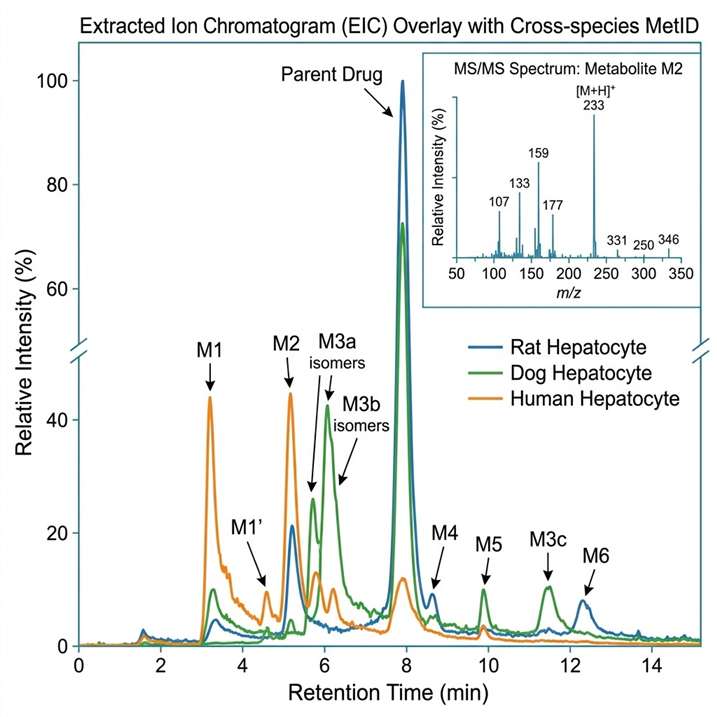
  • Extracted Ion Chromatograms (EICs) — Overlay of parent drug and all detected metabolite peaks with retention time alignment
  • MS/MS Spectra — High-quality fragmentation spectra for each identified metabolite with annotated diagnostic fragment ions
  • Proposed Metabolic Pathway Map — Schematic diagram showing the biotransformation reactions connecting parent drug to each metabolite
  • Cross-Species Comparison Summary — Side-by-side comparison of metabolite profiles across all species tested, highlighting species-specific and disproportionate metabolites
  • Experimental Methods Section — Detailed description of incubation conditions, LC-HRMS parameters, data processing workflows, and structure assignment rationale

Representative MetID Data

Representative extracted ion chromatogram (EIC) overlay from a cross-species MetID study showing parent drug peak alongside multiple metabolite peaks with retention time alignment and annotated MS/MS spectrum inset.

Example cross-species MetID EIC overlay with annotated metabolite peaks

Case Study: Cross-Species Metabolite Identification of KM-819 Using LC-MS/MS and LC-HRMS

Choi H-I, Kim T, Kim JW, et al. "Rat Pharmacokinetics and In Vitro Metabolite Identification of KM-819, a Parkinson's Disease Candidate, Using LC-MS/MS and LC-HRMS." Molecules 2024, 29(5), 1004. DOI: 10.3390/molecules29051004

Background

KM-819 is a novel FAF1 (Fas-associated factor 1) inhibitor developed as a potential therapeutic for Parkinson's disease. Before advancing to clinical trials, its metabolic fate needed to be characterized across preclinical species and humans to support toxicology species selection and regulatory filing.

Methods

Choi et al. developed and validated an LC-MS/MS method for quantifying KM-819 in rat plasma, then applied it to pharmacokinetic studies following intravenous and oral administration. For metabolite identification, KM-819 was incubated with cryopreserved hepatocytes from rat, dog, and human at 10 uM for 90 minutes. Samples were analyzed using LC-HRMS on a Q-TOF platform, with metabolite structures assigned based on accurate mass measurements, MS/MS fragmentation patterns, and comparison with the parent drug fragmentation pathway.

Results

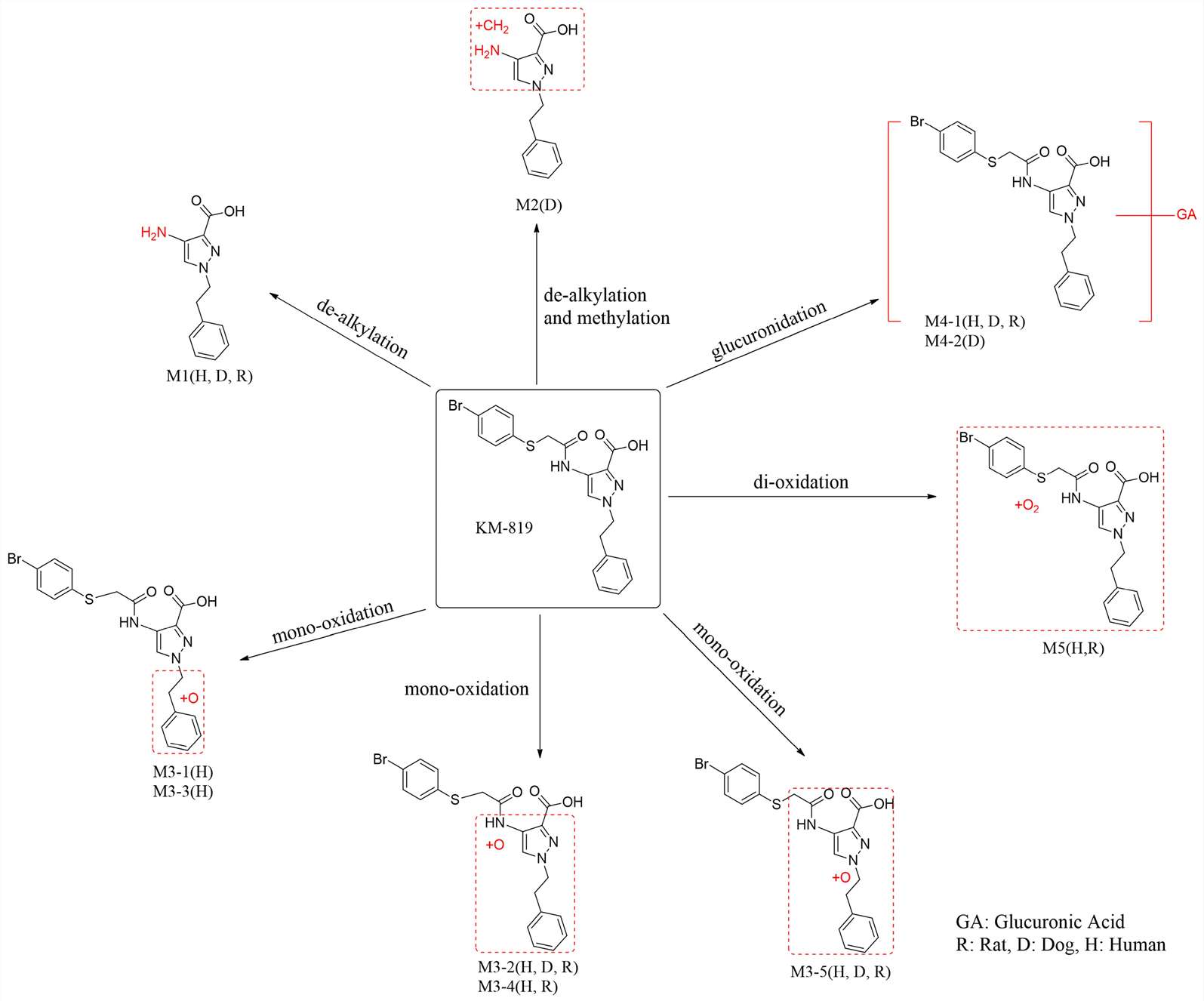
A total of 10 potential metabolites (designated M1–M5, with multiple positional isomers) were identified across the three species. The major metabolic pathways were glucuronidation (M4, the most abundant metabolite) and mono-oxidation (M3). Species-specific differences were observed: 6 metabolites in rat hepatocytes, 6 in dog hepatocytes, and 8 in human hepatocytes. Two human-specific metabolites (M3-1 and M3-3) were detected, but their abundance was below 10% of total drug-related exposure, indicating a low risk of disproportionate human metabolite liability. Metabolic stability assessment showed moderate intrinsic clearance, with half-lives of 21.8 minutes (rat), 35.3 minutes (dog), and 21.7 minutes (human) in hepatocytes.

Conclusion

The cross-species MetID study successfully characterized KM-819's metabolic pathways, identified human-specific metabolites at safe exposure levels, and provided the data needed to support toxicology species selection and preclinical candidate advancement.

Proposed metabolic pathway of KM-819 showing glucuronidation (M4) and mono-oxidation (M3) as major pathways, with species-specific metabolite profiles across rat, dog, and human hepatocytes.

Proposed metabolic pathway of KM-819. Adapted from Choi et al. (2024), Molecules 29(5), 1004, Figure 6.

FAQ

Frequently Asked Questions About Metabolite Identification Services

Q: What information does a metabolite identification study provide?

A MetID study identifies the structures of phase I and phase II metabolites formed from your drug candidate, determines the major metabolic pathways (e.g., oxidation, glucuronidation), and provides semi-quantitative assessment of metabolite abundance across species. This information is critical for guiding medicinal chemistry optimization, selecting toxicology species, and addressing regulatory MIST guidance requirements.

Q: How long does a typical MetID study take?

Standard in vitro MetID studies are completed within 2–3 weeks from sample receipt. More comprehensive studies involving multiple species, in vivo samples, or novel modalities may require 3–5 weeks. Expedited options are available for rapid metabolic soft-spot identification to support fast-paced medicinal chemistry cycles.

Q: What sample types and amounts are needed for MetID?

For in vitro studies, we typically require 1–5 mg of test compound and standard incubation matrices (microsomes, hepatocytes, or S9 fractions). For in vivo studies, plasma, urine, bile, or tissue homogenates from dosed animals are suitable. We confirm exact requirements during study planning based on your compound properties and study design.

Q: How do you conduct cross-species metabolite comparison?

We incubate the test compound with hepatocytes or microsomes from multiple species (typically rat, dog, monkey, and human) under identical conditions, then compare metabolite profiles using LC-HRMS to identify species-specific or disproportionate metabolites. The results are summarized in a cross-species comparison table highlighting differences in metabolite abundance and pathway coverage.

Q: How do you ensure cross-species metabolite coverage in your MetID studies?

We profile metabolites across multiple preclinical species and human systems in parallel under identical incubation conditions, enabling direct comparison of metabolite profiles. The results include identification of human-specific or disproportionate metabolites and a cross-species comparison summary that supports toxicology species selection.

Q: Do you handle MetID for novel modalities such as PROTACs or oligonucleotides?

Yes. Our HRMS platforms and data processing workflows are optimized for novel modalities. We have experience with PROTAC metabolite profiling, oligonucleotide metabolism assessment, and peptide metabolite identification. These modalities often require specialized acquisition parameters and data interpretation approaches that differ from conventional small-molecule MetID.

Request a MetID Study Consultation

Share your compound details and study objectives — our DMPK scientists will design a tailored metabolite identification strategy for your drug development program.

Online Inquiry

Please submit a detailed description of your project. We will provide you with a customized project plan to meet your research requests. You can also send emails directly to for inquiries.

* Email
Phone
* Service & Products of Interest
Services Required and Project Description