Covalent Labelling Mass Spectrometry Service for Protein Conformational and Binding Analysis

Residue-aware structural comparison for protein accessibility, binding, and conformational change studies.

Our Covalent Labelling Mass Spectrometry Service helps you compare protein states through residue-aware labeling and LC-MS/MS analysis. We use covalent footprinting strategies such as DEPC, GEE, and related probes to support protein conformational analysis, binding studies, and site-linked interpretation of structural change.

When you need to understand how a protein changes across states, a simple identification result is often not enough. You may need to know which regions become more exposed, which sites become more protected, or whether ligand binding changes solvent accessibility in a way that supports a mechanism hypothesis.

This service is built for that kind of question. We focus on project fit, labeling strategy selection, sample readiness, and reportable outputs that can support scientific review and next-step decision-making.

What we help you evaluate:

  • Protein conformational change across defined states.
  • Ligand-induced accessibility shifts.
  • Apo vs bound structural differences.
  • Stress- or formulation-related perturbation.
  • Site-linked evidence for mechanism-focused studies.
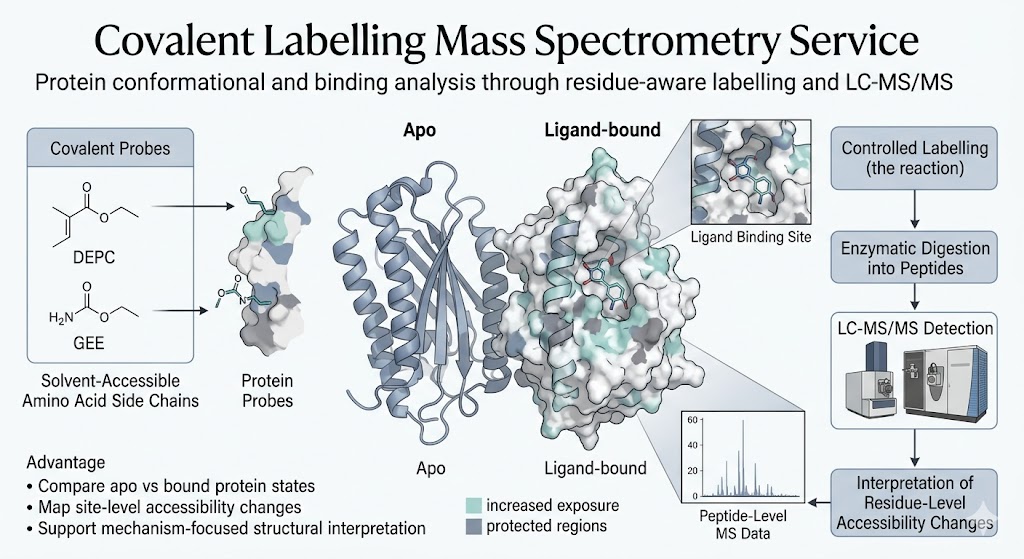
Covalent labelling mass spectrometry workflow for protein conformational and binding analysis
What It RevealsRight FitCapabilitiesWorkflowDeliverablesDemoSampleAnalysisComparisonCase StudyFAQReferences

What covalent labelling mass spectrometry can show you about protein structure

Covalent labelling mass spectrometry works by exposing a protein to a chemical probe that reacts with solvent-accessible amino acid side chains under controlled conditions. After labeling, the protein is digested and analyzed by LC-MS/MS so that modified peptides and sites can be identified and compared across experimental states.

This makes the workflow especially useful when your question is not simply whether the protein is present, but whether its accessibility profile changes in a biologically meaningful way.

This service can help you ask:

  • Does ligand binding alter local accessibility?
  • Do two protein states differ at specific exposed regions?
  • Does a mutation shift surface behavior in a way that supports a structural hypothesis?
  • Does stress introduce localized perturbation or protection?

Because the readout is tied to side-chain reactivity, this method can complement other structural approaches instead of trying to replace them. In practice, it is most useful when you want an interpretable comparison between protein states and a site-aware explanation of what changed.

What is actually measured. The core signal is differential covalent modification at residues that are accessible enough to react under the labeling conditions used. When you compare states, changes in labeling can suggest that a region has become more exposed, less exposed, differently shielded, or otherwise structurally perturbed.

Why DEPC, GEE, and related probes matter. Different covalent probes do not behave the same way. Their residue preferences, reactivity windows, and interpretation boundaries shape which protein questions they can support. That is why we do not treat the reagent as an afterthought. We start with your protein question and then assess whether DEPC, GEE, or another covalent labeling route is the better fit for the comparison you want to make.

When covalent labelling MS is the right choice for your project

This service is usually a strong fit when your project centers on protein accessibility, state comparison, and site-aware structural interpretation.

Projects that often fit well

We are commonly asked to discuss purified recombinant proteins, ligand-bound vs unbound comparisons, wild-type vs mutant comparisons, protein complexes with a defined analytical question, and antibody or biologic samples where structural comparability matters.

Questions this service supports well

It is often a good choice when you need to compare apo and ligand-bound protein states, assess mutation-driven structural perturbation, study local accessibility changes, support mechanism-focused work with orthogonal structural evidence, or investigate stability-related and stress-induced structural change.

Projects that need early discussion

Some systems need closer feasibility review before we recommend this route, especially unstable or aggregation-prone proteins, samples with challenging additives, low-amount materials, or highly heterogeneous systems without a clear comparison design.

When another route may be better

This service is less useful when the main question is better answered by a distance-restraint method, broad backbone dynamics profiling, or a purely functional assay. In those cases, another analytical route may be more appropriate, or covalent labelling MS may be better used as one part of a broader evidence pathway.

How to choose the right strategy for your protein question

Choose covalent labelling MS when your core question is about accessibility or localized structural change, when you need a comparison between defined protein states, when residue-aware evidence would materially improve interpretation, and when you want a practical orthogonal layer for mechanism discussion.

Consider another route first when you primarily need backbone dynamics rather than side-chain reactivity, when you need spatial restraints or interface architecture, when the sample context is incompatible with the intended labeling chemistry, or when your project expects a fully resolved structural model from this readout alone.

Use an integrated strategy when one method answers the accessibility question but another is needed for validation, when internal stakeholders need stronger triangulation before follow-up investment, or when the protein system is complex enough that multiple evidence types will improve confidence.

Our covalent labelling MS capabilities for structure, binding, and stability studies

We built this service for teams that want more than a generic footprinting assay description. We support projects where the main value comes from linking a protein-state question to a practical mass spectrometry readout and then turning that readout into a structured result package.

Our service scope is centered on structure- and conformation-focused MS projects in which the key outputs are site-level or region-level change mapping, comparative result tables, and raw plus processed data packages that you can review with confidence.

We can review your biological question, protein format, known state differences, comparison design, and whether the expected output should be site-focused, region-focused, or comparison-focused. We can also discuss whether this service should stand alone or support a broader structural workflow.

AREA 1

Question-first project review

We start from the scientific question rather than from a fixed reagent choice.

  • Assess whether the project is better suited to DEPC, GEE, or another route.
  • Review the comparison design before sample submission.
  • Align the workflow with the evidence you need.
AREA 2

Support for multiple protein formats

We can discuss protein targets, complexes, membrane proteins, antibodies, and matched state comparisons.

  • Protein targets for accessibility or perturbation questions.
  • Protein complexes with defined stoichiometric context.
  • Antibody and biologic samples for comparability or stress-related studies.
AREA 3

Comparison-ready outputs

We organize the project around interpretable differences across defined states.

  • State-comparison tables for changed sites or regions.
  • Annotated figures for scientific review.
  • Raw and processed data packages for downstream use.
AREA 4

Early feasibility support

Projects are easier to scope when sample context is clear before launch.

  • Review buffer composition and handling notes.
  • Consider stability, additives, and ligand context.
  • Clarify whether follow-up orthogonal work is likely to be needed.

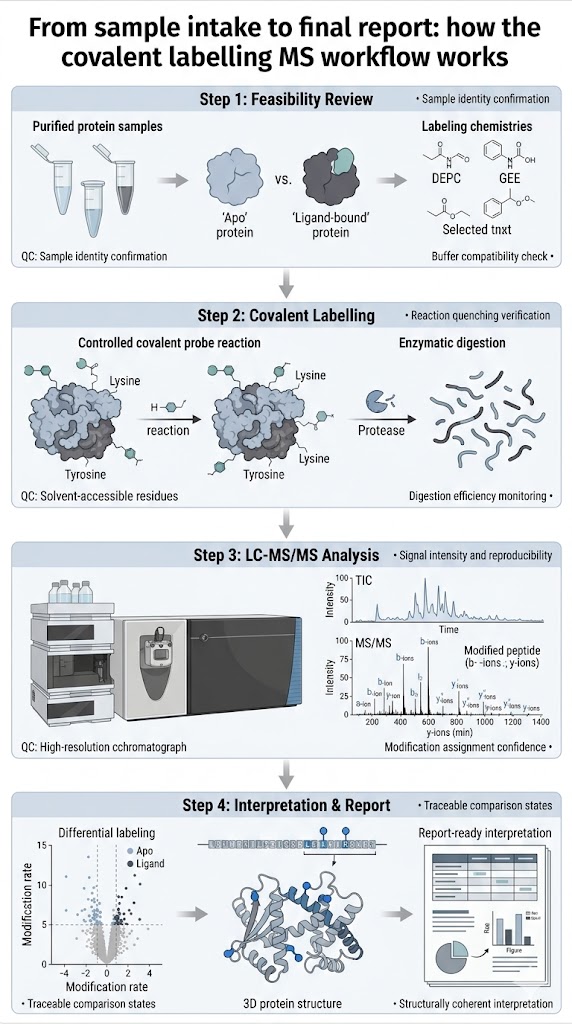
From sample intake to final report: how the covalent labelling MS workflow works

The workflow consists of four essential stages:

1

Feasibility review, study design, and labeling strategy selection

We assess the protein system, desired comparison, sample context, and labeling strategy before project launch. Typical checkpoints include confirmed protein identity, clear comparison logic, reviewed buffer additives, documented handling history, and a labeling route selected around the analytical question.

2

Controlled covalent labeling and sample preparation

The protein is exposed to the selected probe under defined conditions, then prepared for peptide-level analysis. Typical checkpoints include appropriate labeling extent, traceable control and comparison states, and sample preparation that supports peptide recovery and MS readiness.

3

LC-MS/MS acquisition and modified peptide identification

The labeled sample is analyzed by LC-MS/MS to obtain interpretable modified peptide evidence for site-level or region-level comparison. Typical checkpoints include sufficient signal quality, identifiable modified peptides, reviewable modification assignment, and acquisition quality that supports cross-state analysis.

4

Comparative interpretation and reporting

We compare submitted states, organize changed sites or regions, and build a report structure that shows what changed, where it changed, and how strongly those changes support your question. Typical checkpoints include complete differential summaries, annotated residues or regions, decision-ready figures, and interpretation notes matched to the evidence boundary of the data.

Vertical workflow of covalent labelling mass spectrometry service with QC checkpoints

What you receive from a covalent labelling MS project

When you outsource this type of work, the deliverable structure matters almost as much as the experimental workflow. Scientists need enough detail to review the evidence. Project leads need enough structure to decide whether follow-up work is justified.

Core deliverables

Your project package can include raw acquisition files or equivalent primary MS outputs, processed result tables for modified peptides, residue- or region-linked labeling summaries, state-comparison tables showing increased or decreased labeling patterns, annotated figures for review and presentation, and method summary plus parameter record where applicable.

Interpretation-oriented outputs

Depending on project fit, we can also organize the output so it is easier to use in downstream review, including summarized change tables by site or region, sequence-level annotation of affected areas, structure-aware mapping where suitable, and report notes highlighting patterns relevant to binding, perturbation, or comparability.

Analysis support

The analysis layer is centered on modified peptide identification, site- or region-linked annotation, comparison of labeling behavior across submitted states, summary tables of changed sites or affected regions, and annotated result figures for scientific review.

Optional add-ons

Where project fit supports it, we can also discuss structure-aware residue mapping, comparative summary formatting for internal review packages, output organization for follow-up orthogonal study planning, and expanded interpretation notes tied to the biological question.

What covalent labelling MS results can look like

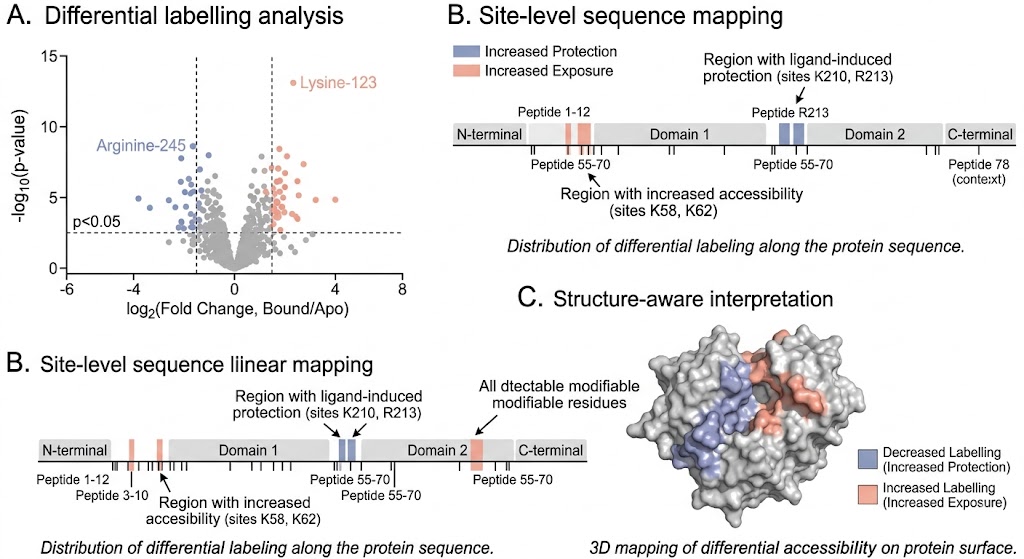
Integrated covalent labelling MS demo results showing differential sites and structure mapping

Representative result panel for state comparison and structure-aware interpretation

One common output is a comparative result panel that shows which sites or peptides change between states such as apo vs bound, control vs stressed, or wild-type vs mutant. Another useful result format maps modified residues or changed regions back onto the protein sequence or domain architecture. When a structural model or suitable reference is available, changed sites can also be mapped onto a 3D view to support interpretation of exposure, protection, or ligand-associated perturbation.

Sample requirements for covalent labelling mass spectrometry

Good sample design makes the project easier to interpret. For covalent labelling mass spectrometry, we recommend preparing samples in a clean, MS-compatible format, keeping comparison states consistent, and sharing enough context for early feasibility review.

Sample TypeRequired AmountConcentrationPurityBuffer ConditionsNotes
Protein target50-200 µg1-10 µM≥90% preferredMS-compatible buffer, no glycerol, low detergentsPlease provide sequence, tags, and known ligands
Protein complex100-300 µg1-5 µM≥85%Native buffer preferredPlease indicate stoichiometry and key cofactors
Membrane protein200-500 µg1-5 µM≥80%DDM or LMNG acceptablePlease provide stabilization conditions
Apo vs ligand-bound pair50-200 µg per state1-10 µM≥90% preferredKeep buffer conditions matched across both statesPlease specify ligand identity and binding condition
Wild-type vs mutant pair50-200 µg per state1-10 µM≥90% preferredKeep matrix and buffer composition consistentPlease provide mutation details and the structural question
Antibody or biologic sample100-300 µgProject-specific reviewHigh purity preferredFormulation compatibility should be reviewed before project launchPlease share formulation context and whether comparability or stress response is the main goal

Information that helps us review your sample faster:

  • Protein name and sequence or construct details.
  • Sample type and target state.
  • Exact comparison groups.
  • Buffer composition.
  • Known ligands, cofactors, additives, or formulation notes.
  • Available material amount and concentration context.
  • Storage and freeze-thaw history.
  • Backup aliquot availability if possible.

Practical submission notes: A backup aliquot is helpful when sample volume allows. Repeated freeze-thaw should be avoided whenever possible. If your project involves matched states, please keep sample handling, matrix, and buffer composition as consistent as possible before shipment.

Bioinformatics and analysis support

  • Modified peptide identification.
  • Site- or region-linked annotation.
  • Comparison of labeling behavior across submitted states.
  • Summary tables of changed sites or affected regions.
  • Annotated result figures for scientific review.
  • Optional structure-aware residue mapping and formatted review summaries.

How this method compares with other structural MS options

MethodWhat It Primarily MeasuresBest ForKey StrengthsMain LimitsWhen to Consider It
Covalent Labelling MSSide-chain accessibility and state-linked reactivityApo vs bound comparison, localized perturbation, accessibility mappingSite-aware comparison, useful orthogonal evidence, adaptable to targeted structural questionsInterpretation depends on probe behavior, sample context, and comparison designChoose when you need residue-aware accessibility information
Hydrogen-Deuterium Exchange Mass SpectrometryBackbone exchange behavior and broader conformational dynamicsDynamic regions, interface change, conformational flexibilityStrong for state comparison and dynamic behavior across larger regionsRequires careful control of exchange workflow and interpretation expertiseChoose when backbone dynamics are central to the question
Cross-Linking Mass SpectrometryProximity and distance-related relationships between linked residuesInterface architecture, assembly relationships, complex organizationUseful for interaction architecture and structural restraintsDoes not directly read out solvent accessibilityChoose when interaction geometry or assembly topology matters more than exposure
Fast photochemical footprinting / related oxidative routesRapid accessibility-linked labelingFast exposure-sensitive comparisons under selected conditionsCan support structural perturbation studies with complementary chemistryRequires fit-for-purpose design and interpretation boundariesChoose when an alternate footprinting chemistry better matches the system
Orthogonal biophysical assaysGlobal binding, stability, or conformational behaviorValidation and cross-checkingUseful for confirmation and multi-method confidenceOften lacks residue-linked detailChoose when a broader validation layer is needed alongside MS

Literature case: DEPC covalent labelling MS for site-specific structural change detection

Site-Specific Structural Changes in Long-Term-Stressed Monoclonal Antibody Revealed with DEPC Covalent-Labeling and Quantitative Mass Spectrometry

Background

A useful published example of this workflow comes from a study on long-term-stressed monoclonal antibody samples. The research question was whether DEPC-based covalent labeling mass spectrometry could reveal site-specific structural changes that were not obvious from a single bulk readout alone.

Methods

The study applied DEPC covalent labeling together with quantitative mass spectrometry to compare monoclonal antibody samples under different stress-related conditions. The workflow linked differential label incorporation to specific sites and then mapped affected regions back to structural context. The paper also used supporting analytical readouts to strengthen interpretation.

Results

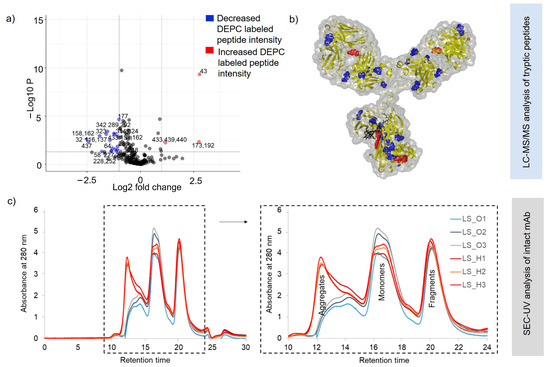
The published study reported significant site-level differences in DEPC labeling between compared antibody conditions. In Figure 5, the authors presented a combined results view that included differential-site analysis together with 3D structure mapping. The paper reported 21 significantly different sites between the stressed sample groups, and the mapped pattern showed that affected regions were concentrated mainly in the Fab portion of the antibody.

Conclusion

This case supports the practical value of covalent labelling MS when your project needs more than a generic structural statement. It shows how DEPC-based labeling can support site-specific interpretation in a comparability or stress-related protein study and how the resulting outputs can be organized into a reviewable evidence package.

Published DEPC covalent-labelling mass spectrometry figure showing differential labeling sites and structure mapping in stressed monoclonal antibody samples

Figure 5 from a published DEPC covalent-labelling MS study showing differential labeling sites and 3D structure-mapped affected regions in stressed monoclonal antibody samples.

FAQ

Frequently asked questions

Q: What kinds of protein questions are best suited to covalent labelling MS?

This service is best suited to questions about solvent accessibility, state-linked conformational change, ligand-associated perturbation, and localized structural differences across defined protein conditions.

Q: How do I know whether DEPC, GEE, or another labeling strategy is the better fit?

That depends on your protein system, your comparison design, and the type of residue-level information you need. We review the biological question first and then evaluate whether the chemistry supports that question.

Q: Can this service compare apo vs ligand-bound or stressed vs control states?

Yes. Comparative design is one of the strongest uses of covalent labelling MS, especially when you want a site-aware view of what changed between defined sample states.

Q: What sample information should I prepare before submission?

Please share the protein identity, sequence or construct context, comparison design, available amount and concentration context, buffer composition, storage history, and any known ligands, cofactors, or formulation details.

Q: Can antibody, protein complex, or difficult protein systems be discussed?

Yes. These systems often benefit from early feasibility review so that the labeling strategy, sample handling, and interpretation expectations are aligned before the project starts.

Q: What kind of resolution should I expect from the final interpretation?

This depends on the protein system, labeling chemistry, peptide coverage, and comparison design. In many projects, the most practical outcome is site-aware or region-aware interpretation rather than a complete structural model.

Q: What do you deliver besides raw MS data?

We can structure the project output to include modified peptide tables, state-comparison summaries, annotated figures, and report notes that help connect the data back to your scientific question.

Q: When should covalent labelling MS be paired with another structural method?

It is often useful to pair this workflow with another structural or biophysical readout when the project needs stronger validation, broader dynamics information, or interaction-architecture context.

Disclaimer

This service is for research use only. It is not intended for clinical, diagnostic, or therapeutic use.

Online Inquiry

Please submit a detailed description of your project. We will provide you with a customized project plan to meet your research requests. You can also send emails directly to for inquiries.

* Email
Phone
* Service & Products of Interest
Services Required and Project Description