Native MS Fragment Screening Service

Direct fragment-binding evidence under native-like conditions.

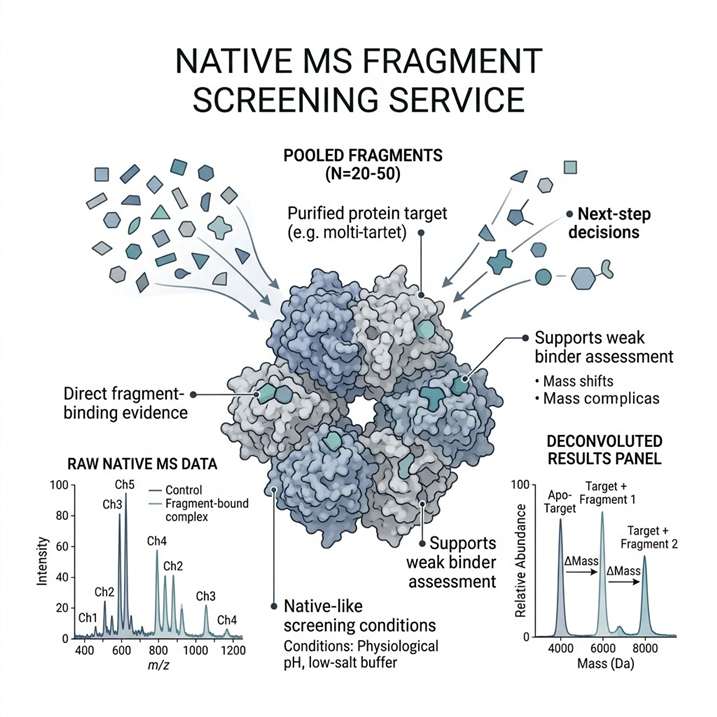
Native MS fragment screening helps us detect fragment binding under native-like conditions and turn spectral evidence into clear next-step decisions. We use this service to support hit triage, weak binder assessment, target-fit review, and orthogonal follow-up planning in early discovery programs.

Key Advantages:

  • Direct fragment-binding evidence.
  • Supports weak binder assessment.
  • Native-like screening conditions.
  • Useful for target-fit review.
  • Built for triage decisions.
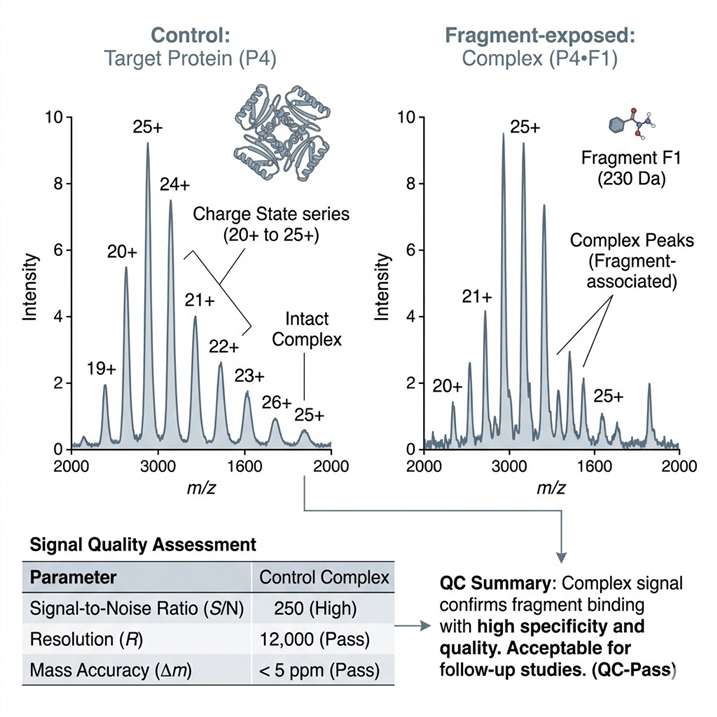
Native MS fragment screening overview showing direct fragment-binding evidence, triage support, and native-like screening conditions.
Early DiscoveryCapabilitiesProject FitWorkflowConfidenceResultsSampleComparisonCase StudyFAQReferences

What Native MS Fragment Screening Can Show in Early Discovery

In early discovery, a fragment screen is only useful if the output helps you decide what to do next. Native MS can do more than flag possible binders. It can help us distinguish unchanged protein signal from fragment-associated signal, review whether the observed binding pattern is worth follow-up, and build a cleaner starting list for orthogonal validation.

This matters most when your team is working with weak binders, limited target availability, or a project that needs direct evidence before investing in broader validation work. Native MS is well suited to fragment-based campaigns because the method has high sensitivity for weakly binding ligands and can support binding-focused decisions early in the workflow.

For many projects, the main value is practical. You may not need a full mechanistic story at this stage. You may need to know which fragment pools deserve attention, whether the target gives interpretable signal under screening conditions, and whether the project should move toward a second-pass validation step.

Our Native MS Fragment Screening Capabilities

Weak binder assessment

We support early fragment campaigns where weak interactions still need to be turned into useful evidence for project decisions.

Triage-focused project design

We help organize screening outputs into a form that can narrow follow-up lists and support the next validation step.

Target-fit review

We review target condition, sample handling, buffer composition, and fragment format before moving into acquisition.

Complex and challenging systems

We can support more demanding projects involving complexes or target-specific feasibility review when the study requires careful interpretation.

Decision-ready reporting

Our reporting connects spectral findings to project-level next steps rather than leaving your team with raw spectra alone.

Orthogonal follow-up planning

We position native MS results within a broader evidence path when SPR, BLI, NMR, or other follow-up methods are needed.

When This Service Is a Good Fit for Your Target and Project Stage

Purified proteins and well-defined fragment campaigns

If your target is purified, the buffer system is known, and the fragment set is already organized, the workflow can focus directly on signal quality, binding assessment, and hit triage.

Protein complexes and structurally challenging targets

Projects involving assemblies, higher-order states, or difficult targets may still be suitable, but they depend more heavily on feasibility review and careful interpretation.

Early hit finding and evidence-based hit validation

The service can support both early screening and later-stage confirmation, with the reporting framed around the decision that matters at each stage.

Workflow From Sample Review to Fragment Binding Interpretation

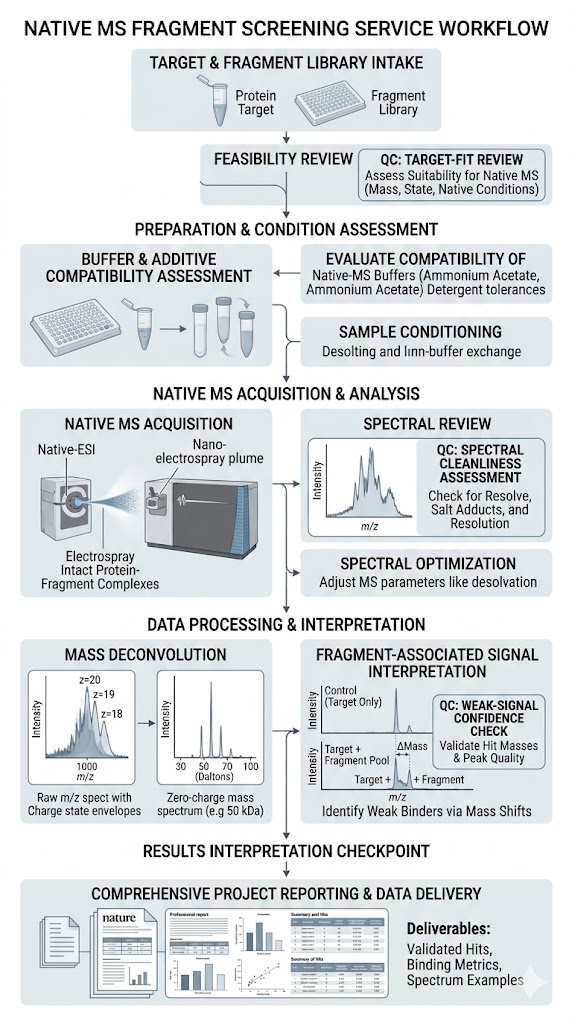
STEP 1

Feasibility review and fragment library planning

We begin with the target, its expected behavior, the current sample condition, and the fragment screening design. We review protein format, buffer composition, additives, solvent system, and fragment library structure.

STEP 2

Buffer compatibility, sample conditioning, and QC checkpoints

We assess salts, detergents, stabilizers, solvent content, background complexity, and any target-specific handling constraints before acquisition begins.

STEP 3

Native MS acquisition, deconvolution, and result reporting

After acquisition, we compare control and fragment-exposed conditions, process the spectra, and organize the results into a form that can support triage and follow-up decisions.

What We Check Before Calling a Fragment Signal Actionable

1

Signal quality and spectral cleanliness

We review whether the target gives a stable, interpretable signal and whether the background is clean enough for assignment.

2

Weak binder assessment and confidence boundaries

We assess whether the observed spectral change is consistent enough to support prioritization or whether the result should be treated more cautiously.

3

Comparative views for prioritization

We compare controls, related pools, or matched conditions to determine whether a fragment-associated signal is useful for next-step decisions.

Vertical workflow for native MS fragment screening from feasibility review to acquisition, deconvolution, and reporting.

Representative Results You Can Receive From a Native MS Fragment Screen

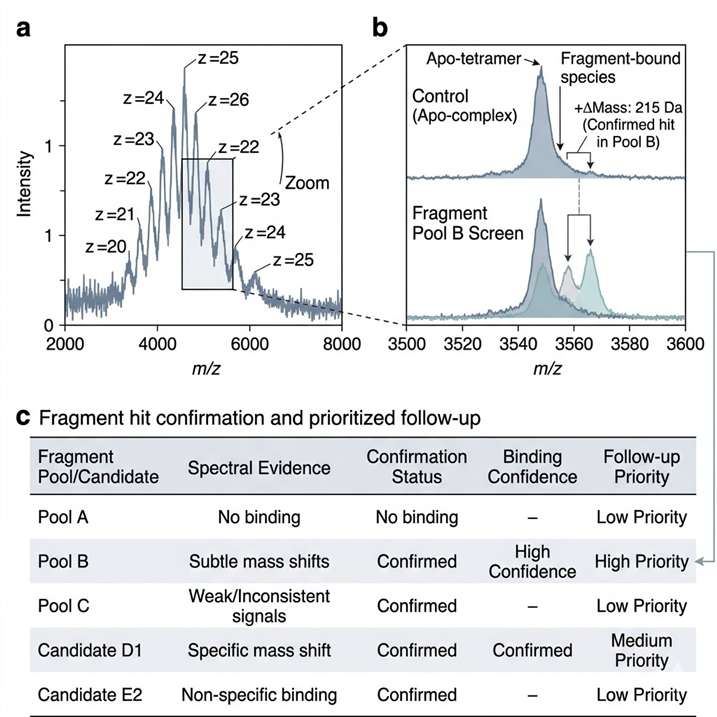
Ranked fragment screening summary with annotated spectrum snippets.

Fragment hit confirmation and prioritization view

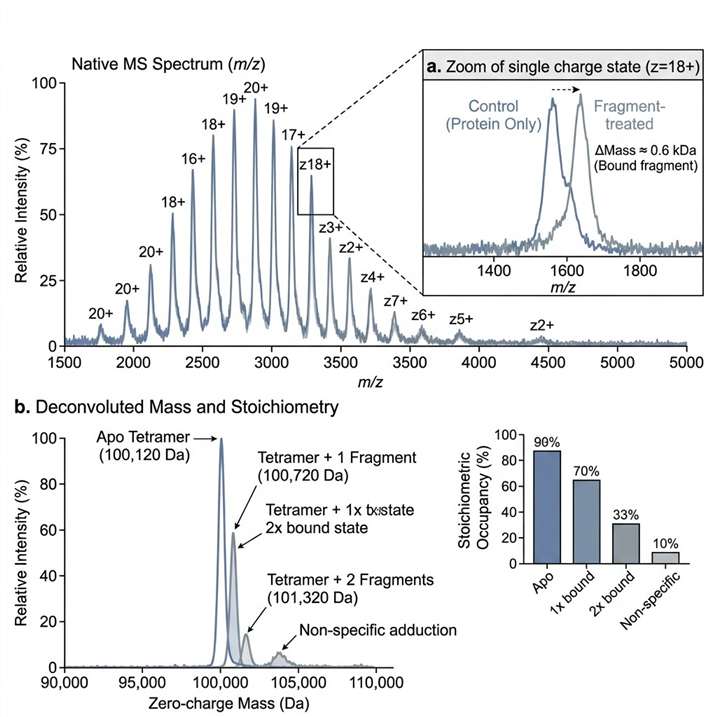
Native MS spectrum with deconvolution and fragment-associated mass shift annotation.

Stoichiometry or occupancy-aware interpretation

Control versus hit comparison spectra with QC-linked interpretation notes.

QC-linked summary views for next-step decisions

A result set can show which fragment pools or candidates produce fragment-associated signal worth follow-up. When target behavior and data quality allow it, native MS can also support interpretation of fragment-associated mass change and place the observation in a more informative binding context.

Our reporting can include raw and processed spectra, deconvoluted mass views, fragment-associated signal summaries, QC observations, and concise comments on how the result supports prioritization or follow-up.

Sample Requirements and Submission Planning

Sample typePractical quantity guideHandlingProject note
Purified protein target150 µg recommended; 300 µg optimizedFreeze promptly, store at -80°C, ship on dry iceBest fit for direct fragment screening
Cultured cell pellets5 × 106 recommended; 1 × 10⁷ optimizedPre-chilled PBS wash, quick-freeze, ship on dry iceUseful for upstream target preparation workflows
Plasma / serum20 µL without depletion; 50-100 µL with depletion; >100 µL in metabolomics guideFreeze promptly, store at -80°C, ship on dry iceUse mainly when the project begins from upstream biological material
Culture supernatant / medium10 mL recommended; 20 mL optimized; >2 mL in metabolomics guideQuick-freeze, store at -80°C, ship on dry iceRelevant for upstream enrichment or related feasibility work
Urine200-500 µLTransfer clear supernatant, quick-freeze, store at -80°C, ship on dry iceUseful for upstream exploratory work rather than direct fragment screening

In addition to target material, please provide fragment library format, solvent system, concentration or pooling logic, and matched controls when available. If your sample contains unusual additives, surfactants, polymers, or special pretreatment requirements, please declare them before the project starts.

Native MS vs Other Fragment Screening Methods

MethodMain question it answersTypical outputStrengthLimitationBest use stage
Native MS fragment screeningDoes a fragment-associated signal appear under native-like conditions, and is it useful for triage?Binding-focused spectral evidence, fragment-associated mass change, interpretable screening summaryDirect readout, useful for weak binder assessment, good fit for triage and follow-up planningDepends strongly on target behavior, sample condition, and spectral qualityEarly screening, hit triage, orthogonal pre-validation
SPR / BLIIs there measurable binding, and how strong or how fast is it?Response curves, affinity or kinetic informationStrong for orthogonal confirmation and rankingDoes not provide the same mass-resolved fragment signal viewFollow-up confirmation, ranking, kinetic comparison
NMR fragment screeningDoes the fragment produce a ligand- or target-observed NMR response?Fragment interaction evidence with structural context potentialStrong orthogonal route, especially when NMR infrastructure is availableMay require different project setup and does not replace native MS spectral evidenceFragment confirmation and orthogonal support
Ligand-observed MSDoes the ligand show a measurable MS-based response in the presence of target?Ligand-side interaction evidenceUseful alternative MS path for some workflowsLess centered on intact target-associated signal than native MSComplementary screening or follow-up
AS-MS / CE-MS affinity screeningCan binders be enriched and recovered from a broader screening format?Enrichment-based hit informationUseful in some screening configurationsDifferent evidence logic from native MS fragment triageAlternative screening strategy

If your main need is direct fragment-binding evidence under native-like conditions, native MS is usually the stronger starting point. If you need stronger orthogonal confirmation or kinetic context, SPR, BLI, or NMR may be the better next step.

Case Study

Electrophilic fragment screening using native mass spectrometry to identify covalent probes for surface cysteines

Background

Electrophilic fragment campaigns need a reliable way to identify fragment-associated modification and separate real signals from unchanged protein readouts. In this study, the goal was to build a native MS workflow for screening pooled electrophilic fragments against a protein target and to identify specific binders for surface-exposed cysteines.

Methods

The study developed a native mass spectrometry method for pooled electrophilic fragment screening. The workflow used intact protein readout to compare the protein-only spectrum with fragment-exposed conditions and then interpret mass shifts to identify fragment-associated binding events.

Results

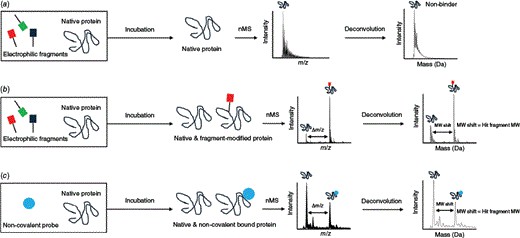
In Fig. 1, the workflow distinguishes three practical screening outcomes. With no covalent fragment binding, the mass spectrum remains unchanged. With covalent binding or noncovalent binding, an additional peak appears that corresponds to the mass of the protein plus the fragment. The difference between the protein-only and protein-fragment signals can then be used to identify the fragment through the observed mass shift.

Conclusion

This case supports native MS fragment screening as a practical route for fragment identification, triage, and follow-up planning. It demonstrates that the method can separate unchanged protein signal from fragment-associated signal and organize that evidence into a format that supports project decisions.

Published case-study figure showing native MS workflow for electrophilic fragment screening and interpretation of unchanged, covalent-bound, and noncovalent-bound protein signals.

Source for verification: Australian Journal of Chemistry, DOI: 10.1071/CH25081.

FAQ

Frequently Asked Questions

Q: Is native MS better suited for fragment screening or hit validation?

It can support both. In an earlier-stage campaign, the value often lies in triage and prioritization. In a later-stage setting, the value shifts toward cleaner evidence and stronger support for orthogonal follow-up.

Q: Can native MS detect weak fragment binders?

Yes. Native MS is considered useful in fragment-based drug discovery because of its sensitivity for weakly binding ligands.

Q: What information should we provide before a project starts?

The most useful starting information includes target format, sample condition, buffer and additive details, fragment library format, solvent system, and any relevant controls.

Q: Can we use our own fragment library?

Yes. Client-supplied fragment libraries can be part of the project as long as the library format, solvent conditions, and screening design are reviewed during feasibility assessment.

Q: What will we receive at the end of the project?

You can receive raw and processed spectra, fragment-associated signal summaries, deconvoluted mass views where appropriate, QC observations, and interpretation focused on triage and next-step planning.

Q: Can this service be combined with other methods?

Yes. Native MS often works best as one part of a broader evidence path that may include SPR, BLI, NMR, or other structural and biophysical follow-up methods.

Discuss Your Native MS Fragment Screening Project

Share your target, fragment library format, and sample condition, and we will help you evaluate project fit, interpretability, and the most suitable next-step screening strategy.

Disclaimer: This service and all related deliverables are for research use only. They are not intended for diagnostic procedures, clinical decision-making, or patient management.

Online Inquiry

Please submit a detailed description of your project. We will provide you with a customized project plan to meet your research requests. You can also send emails directly to for inquiries.

* Email
Phone
* Service & Products of Interest
Services Required and Project Description