Thermal Shift Assay-MS Service for Target Engagement and Mechanism Studies

Probe-free thermal shift proteomics for target engagement, mechanism interpretation, and candidate prioritization.

Our Thermal Shift Assay-MS Service helps you link compound exposure to proteome-level thermal stability changes in a biologically relevant system. We use this workflow to support target engagement, mechanism-of-action studies, and target deconvolution, with a practical focus on study design, interpretable outputs, and next-step decision support for discovery-stage research.

We build each TSA-MS project around the question you need to answer. That means we do not stop at explaining the method. We work with you on study context, sample format, control design, readout strategy, and how the final dataset should support candidate review and follow-up work.

Key Advantages:

  • Probe-free thermal shift readout for proteome-level target engagement review.
  • Support for mechanism-of-action studies and target deconvolution workflows.
  • Project-fit planning across tissues, cells, lysates, and selected biofluids.
  • Deliverables structured for hit review and follow-up decisions.
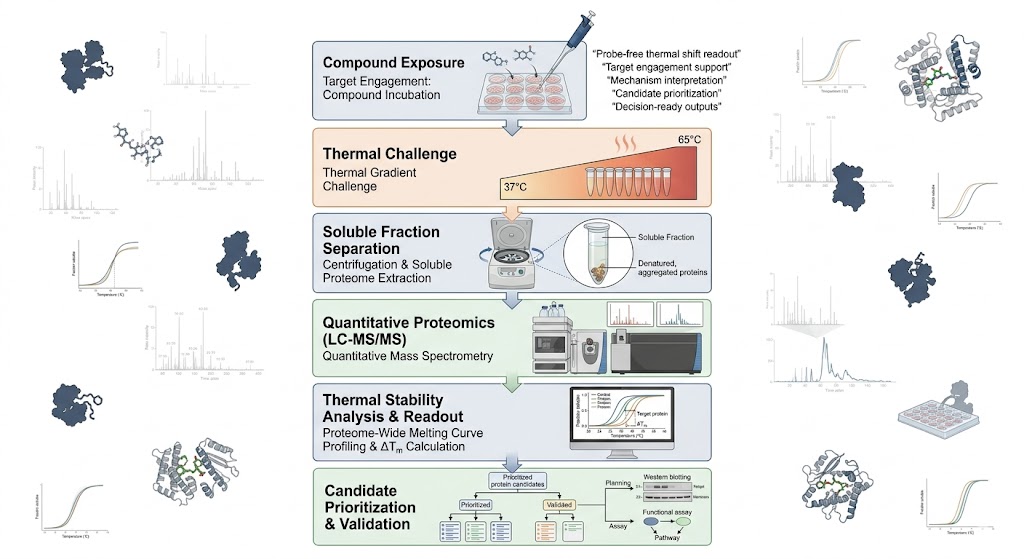
Thermal Shift Assay-MS workflow overview for target engagement and mechanism studies.
What Is TSA-MSService OverviewTechnology ComparisonSampleDemoCase StudyFAQ

What Is Thermal Shift Assay-MS?

TSA-MS is a proteome-level thermal shift workflow that helps you examine how compound exposure changes protein thermal stability across a biological system. It is most useful when your project needs more than a single-target binding readout and when you want to compare protein-level changes across conditions in a way that supports target engagement or mechanism interpretation.

In practice, we commonly position TSA-MS for three types of questions. First, target engagement studies benefit from a broader view of protein stability changes that can support candidate ranking and follow-up validation planning. Second, mechanism-of-action studies benefit from stability-shift patterns that can point to pathway-level signals and protein classes worth deeper review. Third, target deconvolution studies use the workflow to narrow candidate proteins when a phenotype is clear but the molecular explanation still needs refinement.

TSA-MS is particularly valuable when you want probe-free evidence from a system that still preserves useful biological context. It is also a strong fit when your team needs interpretable outputs rather than only a raw data package. To explore related workflows in the same technical family, you can review thermal shift proteomics.

What TSA-MS can support in your study

Target engagement review

We use TSA-MS to help you assess whether compound exposure is associated with measurable protein stability changes in a biologically relevant system, then turn those observations into a ranked candidate view for follow-up work.

Mechanism interpretation

When your project goes beyond one presumed target, TSA-MS helps reveal broader stability-shift patterns, pathway-level signals, and protein classes that deserve deeper interpretation.

Target deconvolution

If a phenotype is clear but the molecular explanation is still open, the workflow can contribute evidence that narrows candidate proteins and helps define the next validation route.

Project-fit planning

We help align study context, sample format, control design, and output expectations before project kickoff so the dataset is built around the question you actually need answered.

Why this matters for discovery teams

Many teams do not need another method summary. They need a workflow that can support target engagement, mechanism studies, or candidate prioritization in a way that makes follow-up decisions easier. TSA-MS fills that role when you want broader protein-level context and a study design built around the project question rather than around a one-size-fits-all assay format.

Service Overview: Study Design, Workflow, Deliverables, and Bioinformatics

The same TSA-MS platform should not be run the same way for every project. We shape the design around what you need the data to answer, whether that is target engagement, mechanism-of-action interpretation, target deconvolution, or comparative review across multiple compounds or exposure conditions.

For target engagement-focused work, we emphasize matched exposed and control groups, temperature challenge design, replicate consistency, and a result structure that makes it easier to move from global shifts to shortlisted proteins. For mechanism or deconvolution work, we put more attention on biological context, candidate prioritization logic, and interpretation layers that go beyond a simple ranked list.

Before experimental kickoff, we typically align on sample type and biological context, compound groups and controls, replicate structure, thermal challenge design, and the kind of output that will be most useful for your next experiment. If you are also considering neighboring methods, you may want to compare TSA-MS with MS-based Proteome-wide Thermal Stability Profiling, Thermal Proteome Profiling (TPP), PISA, or Limited Proteolysis-MS (LiP-MS) before locking the final design.

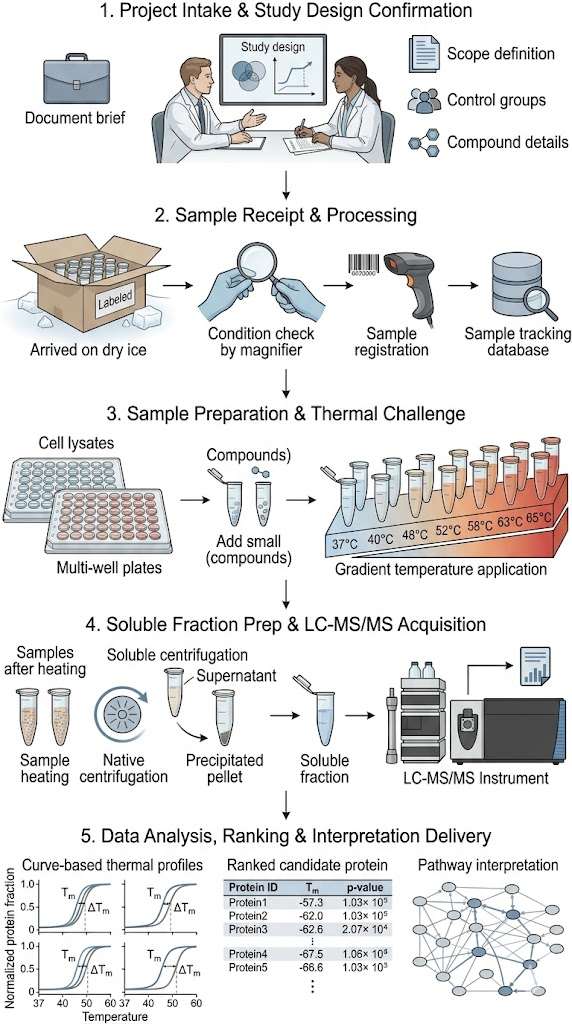
STEP 1

Project intake and study design confirmation

We review your study objective, sample matrix, compound grouping, controls, and replicate structure, then confirm whether the project is best framed for target engagement, mechanism analysis, or comparative profiling.

STEP 2

Sample receipt, condition check, and registration

When samples arrive, we verify labeling, grouping, replicate completeness, storage condition, and container suitability because pre-analytical variation can directly affect stability-shift interpretation.

STEP 3

Sample preparation and thermal challenge

Samples proceed into compound incubation or condition setup, thermal challenge across defined points, separation of soluble fractions, and preparation for MS-compatible analysis.

STEP 4

LC-MS/MS acquisition and data processing

Prepared fractions are analyzed by mass spectrometry, followed by protein identification, quantification, normalization, and thermal-shift assessment, with attention to signal consistency and group comparability.

STEP 5

Interpretation delivery for follow-up review

We organize summary observations, ranked candidates, representative thermal profile views, and interpretation notes into a structure that supports internal review and follow-up planning.

QC

Checkpoints throughout the workflow

Key checkpoints include sample labeling and group integrity, replicate completeness, sample condition at receipt, extraction consistency, usable MS signal quality, and fit between output structure and study objective.

What you receive

  • Protein and peptide identification and quantification tables
  • Normalized abundance matrix across thermal conditions
  • Thermal profile fitting and shift assessment
  • Ranked candidate table
  • Functional annotation and pathway context
  • Project summary report with interpretation notes

Bioinformatics analysis

The analytical layer is often where TSA-MS becomes truly useful. Our baseline analysis scope can include protein identification and quantification, matrix normalization, thermal profile assessment, candidate ranking, annotation of prioritized proteins, and pathway-oriented interpretation summary. If your study needs a more decision-focused readout, we can expand the analysis toward replicate-aware advanced statistics, target-family-focused interpretation, comparison across multiple compounds or exposure conditions, mapping against hypotheses from CETSA-MS, LiP-MS, or ABPP-MS, and support for orthogonal validation planning.

TSA-MS workflow overview

From project intake to LC-MS/MS data interpretation, the workflow is designed to keep study conditions consistent and outputs review-ready.

1

Project intake

Study goals, sample format, controls, and replicate structure are aligned before sample processing begins.

2

Condition check

Sample labeling, storage condition, grouping, and replicate completeness are reviewed at receipt.

3

Thermal challenge

Samples move through compound exposure, defined thermal points, and soluble fraction preparation for MS-compatible analysis.

4

LC-MS/MS and interpretation

Mass spectrometry acquisition, normalization, thermal-shift assessment, and candidate prioritization are organized into a usable review package.

Workflow diagram for Thermal Shift Assay-MS from project intake to LC-MS/MS interpretation.

To explore adjacent methods, see:

MS-based Proteome-wide Thermal Stability Profiling

Thermal Proteome Profiling (TPP)

PISA

LiP-MS

ABPP-MS

SPR

BLI

Stability-Shift MS Screening

How TSA-MS Compares with CETSA-MS, TPP, PISA, and LiP-MS

MethodPrimary Question It Helps AnswerBiological ContextProteome ScopeWhat It Is Strong ForMain LimitationCommon Follow-Up
TSA-MSDoes compound exposure associate with proteome-level thermal stability changes that support target engagement or mechanism review?Flexible; often adapted around study contextBroadProbe-free profiling, candidate ranking, comparison across conditionsThermal shifts alone may not prove direct bindingSPR, BLI, orthogonal target-ID workflows
CETSA-MSIs target engagement visible in a native cellular context?Strong cell-context emphasisBroadCellular engagement framing, biologically relevant contextDesign may be more constrained by cell system and engagement questionFunctional assays, binding confirmation
TPPHow do thermal profiles change across the proteome under defined conditions?Broad in vitro, in situ, and in vivo framingBroadEstablished thermal proteome framework, rich protocol literatureMay require more complex data interpretationDeeper pathway analysis, follow-up validation
PISACan thermal-shift information be captured in a streamlined format for target analysis?BroadBroadEfficient integral solubility alteration workflow, useful for target analysisInterpretation still depends on downstream validationSPR, complementary target validation
LiP-MSDoes structural accessibility or protease susceptibility change under defined conditions?Structure- and conformation-orientedBroadConformation-sensitive readout, complementary to thermal methodsAnswers a different mechanistic question than thermal stabilizationCross-method interpretation with thermal profiling

TSA-MS is a strong fit when you want probe-free evidence, broader protein-level context, and a workflow that can support target engagement or mechanism studies without forcing the page into a single-target assay narrative. If your highest priority is direct cellular target engagement under native conditions, CETSA-MS may be the closer comparison point. If your project needs a broader thermal proteome framework, TPP may fit better. If you want a streamlined integral-solubility approach, PISA becomes highly relevant. If your real question is about conformational accessibility rather than thermal stability, LiP-MS may be the better route.

In many discovery programs, the strongest workflow is not a single method. A thermal-shift dataset may identify candidates, while a binding assay, structural method, or chemoproteomics workflow provides the next layer of evidence. We often treat method selection as a staged decision rather than a one-shot choice.

Sample Requirements and Study Setup Planning

Sample TypeRecommended InputContainerShippingQC CheckpointsNotes
Animal or soft tissue100-200 mgCryovial or centrifuge tubeDry iceGroup consistency, rapid freezing, low-temperature storageUseful for comparative tissue-level studies
Hard tissue or dense matrix200-500 mgCryovialDry iceSample integrity, clean handling, matrix suitabilityMay need stronger preparation planning
Cultured cells5×106 to 1×10⁷ cells1.5 mL tube with pelletDry icePellet quality, replicate consistency, PBS wash completenessSuitable for many cell-based TSA-MS designs
Trace cell samples200-5000 cellsLow-bind tubeDry iceLow-input feasibility, signal expectationsBest discussed before study lock
Plasma or serum20-100 μL1.5 mL tubeDry iceHemolysis control, anticoagulant notes, freeze-thaw avoidanceInput depends on depletion strategy
Culture supernatant or conditioned medium2-10 mLScrew-cap tubeDry iceMatrix consistency, centrifugation clarity, medium backgroundCondition definition should be fixed early
Saliva or tears500 μL-1 mL1.5 mL tubeDry iceTiming consistency, debris removal, low-temp storageUseful when biofluid context is central

Across sample types, the same handling principles remain important: rapid processing, immediate low-temperature preservation, storage at -80°C, dry-ice shipment, clear replicate labeling, and avoidance of repeated freeze-thaw cycles.

Typical TSA-MS Result Views and How to Interpret Them

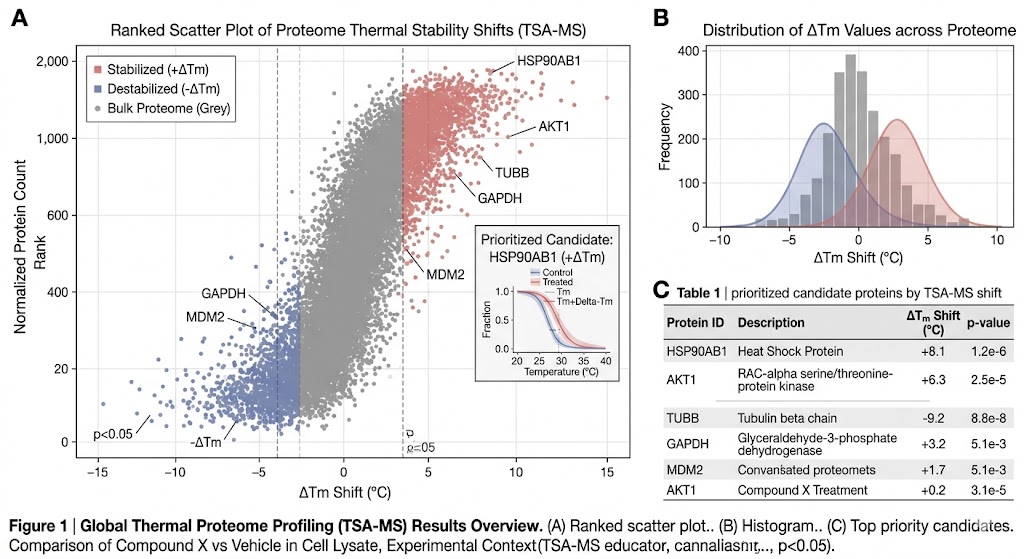
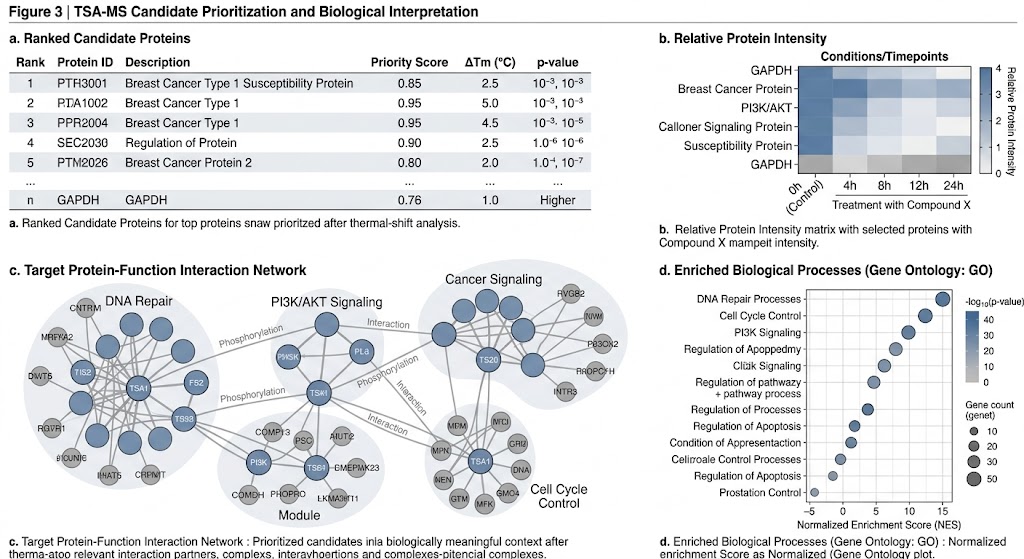
Global TSA-MS stability-shift overview used to review stabilization and destabilization patterns across experimental groups.

Global stability-shift overview

This view gives you a fast read on which proteins show stabilization or destabilization under one experimental condition relative to another. It is useful for screening the overall shape of the dataset and spotting whether the contrast is broad, selective, or unexpectedly weak.

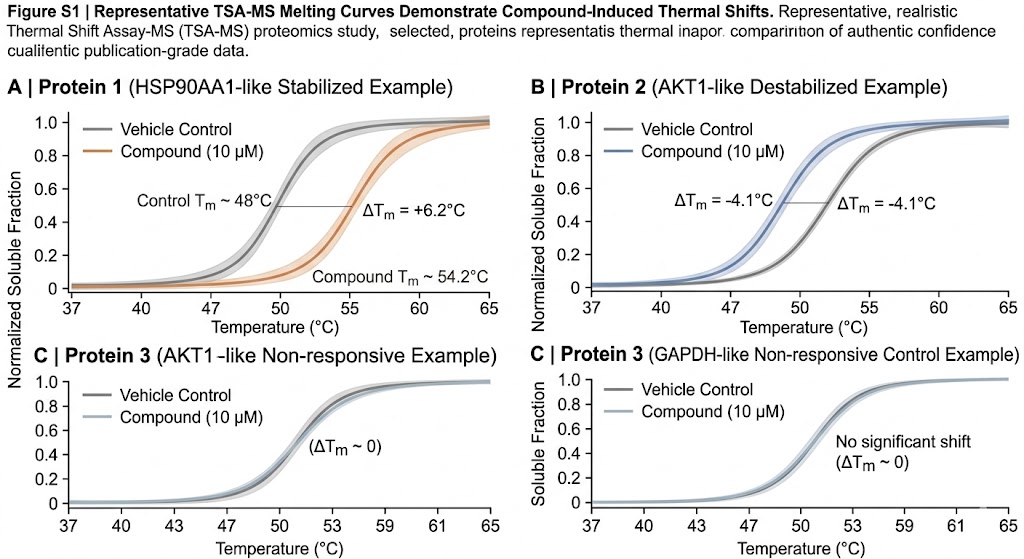
Representative TSA-MS thermal profile comparison for selected proteins across conditions.

Representative thermal profile comparison

This view helps you inspect the thermal behavior of selected proteins across conditions. It is often where candidate review becomes more concrete, because you can compare patterns instead of relying only on one summary statistic.

Candidate prioritization with pathway context in a TSA-MS project.

Candidate prioritization with pathway context

A ranked list is more useful when it is connected to pathway context, protein class, or known biology. This layer helps turn a long candidate table into a smaller set of proteins that make sense for validation.

Case Study: Proteome-Level Target Analysis Using a Streamlined PISA Workflow

Streamlined analysis of drug targets by proteome integral solubility alteration indicates organ-specific engagement

Background

Small-molecule studies often need a bridge between compound exposure and a more actionable target or mechanism hypothesis. This 2024 Nature Communications paper showed how a streamlined PISA workflow could support proteome-level target analysis across different biological matrices.

Methods

The study used a label-free PISA workflow that combined compound incubation, thermal challenge, soluble-fraction preparation, DIA-MS acquisition, and downstream target analysis across rat organs and human cell lines.

Results

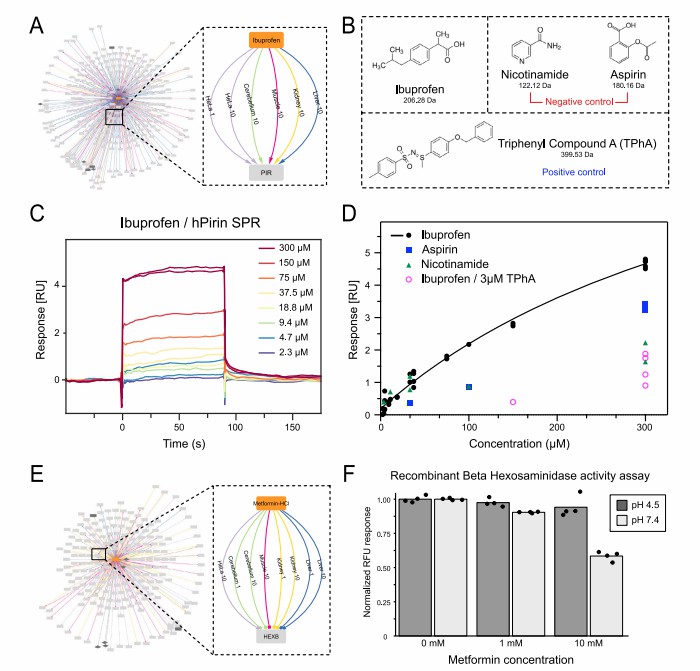
In Fig. 7, the authors highlighted follow-up confirmation around Ibuprofen-Pirin using SPR and contrasted it with Metformin-related observations. The figure is useful because it shows more than a screening result. It shows how a thermal-shift-style workflow can move from candidate discovery to follow-up confirmation and biological interpretation.

Conclusion

This example supports a practical way to position TSA-MS on your page: not as a standalone proof of direct binding, but as a high-value route for generating proteome-level evidence that helps you prioritize candidates and structure the next experiment.

Figure-style case visual for proteome-level target analysis using a streamlined PISA workflow.

Proteome-level target analysis can support candidate discovery, follow-up confirmation, and biological interpretation in a single decision-support workflow.

FAQ

Frequently Asked Questions

Q: When is TSA-MS a better fit than CETSA-MS or TPP?

TSA-MS is often a strong fit when you want a probe-free thermal stability workflow that supports target engagement or mechanism studies with a broad protein-level view. If your project is centered on native cellular engagement, CETSA-MS may be the closer comparison. If you want a broader thermal proteome framework, TPP may be more appropriate.

Q: Can TSA-MS be performed on lysates, intact cells, or tissues?

Yes. The study design can be adapted to different biological contexts. The best format depends on your project goal, the type of evidence you need, and the sample quality you can support consistently.

Q: What sample and control setup is typically recommended?

A useful TSA-MS design usually starts with clearly defined exposed and control groups, biological replicates, stable handling conditions, and a sample matrix that can be preserved consistently through thermal challenge and MS preparation.

Q: What kinds of result views should I expect?

Most projects benefit from three views: a global stability-shift overview, representative thermal profile comparisons, and a ranked candidate summary with pathway or biological context.

Q: How are candidate proteins prioritized after thermal shift analysis?

Prioritization usually combines the strength and consistency of the thermal-shift pattern with replicate behavior, protein relevance, known biology, and how well the signal fits the study objective.

Q: Does TSA-MS prove direct binding on its own?

Not always. TSA-MS can generate strong evidence that supports target engagement or mechanism hypotheses, but many projects still benefit from orthogonal follow-up such as SPR, BLI, or complementary target-identification methods.

Q: What follow-up methods are commonly used after TSA-MS?

Common follow-up routes include SPR, BLI, LiP-MS, and ABPP-MS, depending on whether your next question is about direct binding, conformational change, or broader target identification.

Q: What deliverables are most useful for mechanism-of-action studies?

The most useful package usually includes ranked candidates, interpretable thermal profiles, annotation and pathway context, and a summary that helps your team decide what to validate next.

Plan your TSA-MS study with our team

Share your study objective, sample format, and comparison strategy, and we will help you shape a TSA-MS workflow that fits your target engagement or mechanism research goals.

This service is for research use only.

Online Inquiry

Please submit a detailed description of your project. We will provide you with a customized project plan to meet your research requests. You can also send emails directly to for inquiries.

* Email
Phone
* Service & Products of Interest
Services Required and Project Description