Native ESI-MS for Noncovalent Complexes

Direct analysis of intact noncovalent complexes under native-like conditions.

Native ESI-MS helps us analyze intact noncovalent complexes under native-like conditions and turn complex mass spectra into clear project answers. We use this approach to confirm complex formation, assess stoichiometry and occupancy, and compare assembly-state changes across ligands, constructs, and experimental conditions.

Key Advantages:

  • Direct readout of intact noncovalent complexes.
  • Stoichiometry and occupancy assessment.
  • Support for protein-ligand and protein-protein studies.
  • Comparison of assembly states across conditions.
  • Clear project-fit review before analysis.
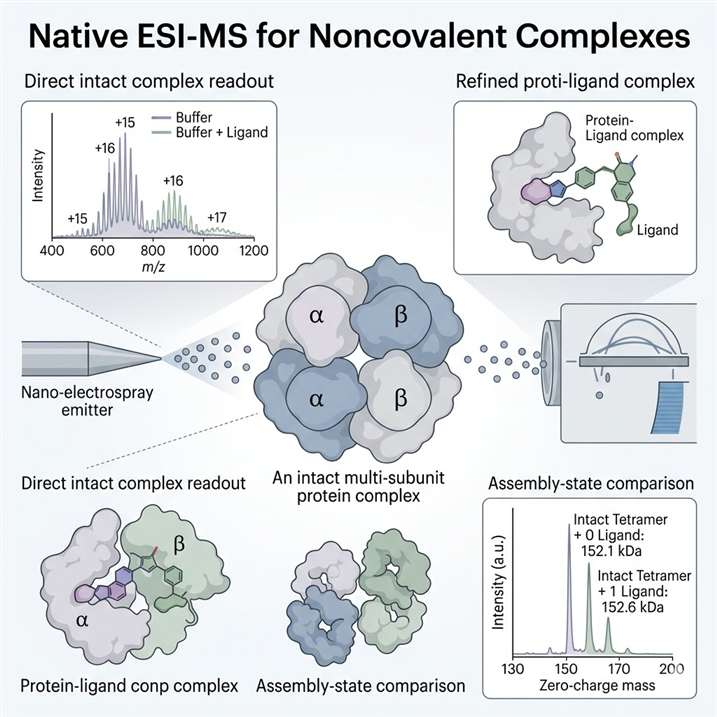
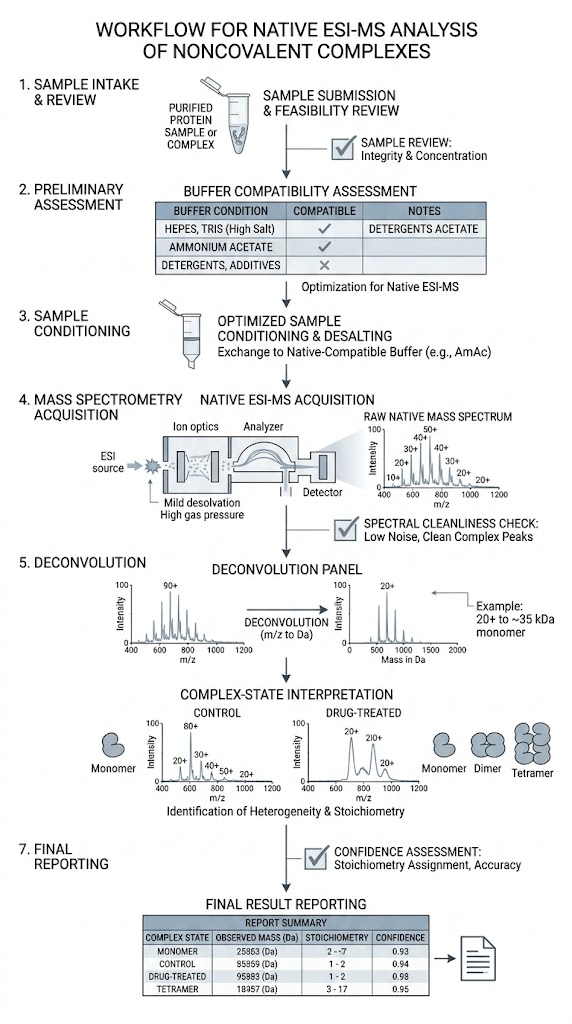
Native ESI-MS workflow diagram showing intact complex readout, stoichiometry assessment, and condition comparison.
Direct ReadoutProject FitWorkflowConfidenceResultsSampleAnalysisComparisonExtended OptionsCase StudyFAQReferences

Native ESI-MS for Direct Intact Complex Readout

When you need to know whether an intact complex is really present, native ESI-MS can provide a direct answer. Instead of measuring an indirect signal, this method preserves noncovalent interactions as much as possible during ionization and allows us to observe intact species in a mass-resolved format.

This is especially useful when your project needs more than a simple yes-or-no binding result. In many studies, the real question is not only whether binding occurs, but also which complex state dominates, whether multiple bound forms are present, and whether ligand addition changes the oligomeric balance of the target.

We commonly apply native ESI-MS to protein-ligand complex confirmation, protein-protein interaction analysis, multimeric assembly profiling, comparison of apo and bound states, condition-dependent complex stability studies, and fragment or hit follow-up projects.

Because the output is mass-resolved, native ESI-MS can support a more detailed understanding of complex composition than methods that only report signal intensity or response curves. This makes it highly valuable when intact complex evidence matters to your next decision.

When Native ESI-MS Is a Good Fit

Protein-ligand complex confirmation

If you need to determine whether a purified target forms a stable complex with a ligand, native ESI-MS can reveal whether bound species are present and whether one or more ligand occupancy states can be distinguished.

Protein-protein and multimeric complex analysis

For protein assemblies, native ESI-MS can help answer whether the expected complex remains intact, whether smaller subcomplexes dominate, or whether the sample shifts among multiple oligomeric states.

Condition-comparison studies

When you need to compare buffer systems, ligands, constructs, or matched controls, native ESI-MS can reveal whether those changes affect complex formation, occupancy, or assembly stability.

Projects that need direct intact-complex evidence

If your project needs a label-free, mass-based view of the complex itself, native ESI-MS is often more informative than approaches that only provide enrichment, kinetics, or regional conformational information.

Our Workflow From Sample Review to Final Interpretation

STEP 1

Feasibility review

We begin with a review of your target class, expected complex type, ligand or binding partner information, buffer composition, additives, and sample history. This allows us to judge whether the project is suitable for native analysis and whether the current sample condition supports reliable interpretation.

STEP 2

Sample conditioning and compatibility review

Sample compatibility has a direct impact on spectral quality. We review salts, detergents, stabilizers, solvents, and other matrix components that may affect ionization, adduct burden, or complex stability.

STEP 3

Native ESI-MS acquisition

We acquire spectra under conditions designed to preserve intact complex information as much as possible. During data collection, we pay close attention to spectral clarity, charge-state behavior, and the visibility of intact species relevant to your project question.

STEP 4

Deconvolution and complex-state interpretation

After acquisition, we process the spectra into a more interpretable form, including deconvoluted mass lists, charge-state assignments, and condition-by-condition comparisons. We then connect the processed result back to the original project question.

STEP 5

Result reporting

Our reporting focuses on what matters for your study: whether a complex is observed, which stoichiometries are present, how occupancy is distributed, whether assembly-state changes occur, and what factors may limit confidence or require follow-up analysis.

How We Evaluate Complex Confidence

We do not treat every shifted peak as proof of a meaningful complex. We examine multiple aspects of the data before assigning a confident interpretation.

1

Charge-state distribution

A charge-state pattern should be consistent with intact native-like species rather than highly disrupted or non-informative signal.

2

Spectral cleanliness

Salt burden, background complexity, and adduct formation can reduce confidence. We assess whether the spectrum is clean enough to support a reliable assignment.

3

Mass-shift logic

The observed mass difference should make sense for the proposed bound state or assembly model. We compare apo and bound conditions to determine whether the detected shift is coherent with the expected interaction.

4

Condition consistency

When matched samples or comparative conditions are available, they strengthen confidence. Consistent behavior across related conditions supports a more robust interpretation.

5

Assembly-state agreement

For multimeric systems, the detected species should align with the expected monomeric, dimeric, or higher-order assembly logic.

Native ESI-MS interpretation workflow showing charge-state review, spectral cleanliness, and deconvolution.

Typical Results You Can Receive

Native ESI-MS can generate several types of results that are directly useful for project decisions.

Stoichiometry and occupancy profiles

A native spectrum can show whether the target is present in apo and holo forms, whether one or multiple ligands are associated with the complex, and which bound state is most abundant.

Oligomeric-state and assembly-state changes

For protein assemblies, native ESI-MS can reveal whether a ligand, formulation, or construct changes the dominant assembly state.

Comparative spectral analysis across conditions

When multiple conditions are analyzed side by side, the result can show how signal quality, occupancy, or complex stability changes from one condition to another.

Interpretable deconvolution output

Deconvoluted mass views help turn complex spectral envelopes into a clearer picture of complex composition, occupancy, and assembly-state distribution.

Sample Requirements and Submission Planning

Sample TypeSuggested Starting QuantityStorage and ShippingSubmission Notes
Purified protein or pre-formed complex150 µg recommended; 300 µg optimizedFlash-freeze, store at -80°C, ship on dry iceBest suited to direct intact complex analysis
Cultured cells5 × 106 cells recommended; 1 × 10⁷ optimizedQuick-freeze, store at -80°C, ship on dry iceUseful when upstream enrichment or isolation is required
Plasma or serum20 µL without high-abundance depletion; 50-100 µL recommended and 100 µL optimized with depletion; metabolomics planning threshold >100 µLQuick-freeze, store at -80°C, ship on dry icePlease declare anticoagulant and freeze-thaw history
Urine200-500 µLQuick-freeze, store at -80°C, ship on dry iceMatrix composition should be noted during submission
Culture supernatant or medium10 mL recommended; 20 mL optimized; metabolomics planning threshold >2 mLQuick-freeze, store at -80°C, ship on dry icePlease state medium type and collection conditions

Before shipment, please clearly label replicates and matched controls. For liquid samples, please provide solvent, additive, or pretreatment information when relevant. If your sample contains detergents, surfactants, polymers, corrosive components, or unusual stabilizers, please declare them before submission so we can review compatibility in advance.

Bioinformatics and Data Analysis

  • Raw spectra and processed spectra
  • Charge-state assignment summary
  • Deconvoluted mass list
  • Complex-state annotation table
  • Stoichiometry and occupancy interpretation
  • QC observations and sample-behavior notes

For native ESI-MS, the most useful analysis layer is careful spectral interpretation rather than broad downstream omics reporting. Our goal is to give you an answer that your team can use directly in project review, follow-up study design, and internal decision-making.

When the project requires deeper interpretation, we can also support condition overlays, mobility-assisted separation logic, and recommendations for orthogonal follow-up methods.

Method Comparison and Selection Strategy

MethodBest Suited QuestionMain OutputStrengthLimitation
Native ESI-MSDoes an intact complex form, and what stoichiometry is present?Intact complex-state readoutDirect mass-based evidence of complex composition and assembly stateStrongly influenced by sample compatibility and spectral quality
Affinity Selection-MS (AS-MS)Which compounds are enriched as binders from mixtures or libraries?Enrichment-based hit listUseful for screening and binder selection from complex mixturesDoes not provide the same direct intact stoichiometry view
Surface Plasmon Resonance (SPR) / Bio-Layer Interferometry (BLI)How strong is binding, and how fast does binding or dissociation occur?Affinity and kinetic parametersStrong choice for kinetic comparison and rankingDoes not directly show intact complex composition
Ion Mobility MS (IM-MS / TIMS-MS)Are different conformational or shape states separable?Mobility-resolved structural informationAdds shape-state resolution to mass analysisUsually complements intact complex analysis rather than replacing it
HDX-MS / HDX-driven Epitope MappingWhere do structural dynamics or protection changes occur?Regional conformational-change mapValuable for interface and dynamics questionsNot a direct intact-complex stoichiometry method
Ligand-Observed ESI-MS Binding AssaysDoes the ligand show a measurable response in the presence of target?Ligand-side binding evidenceUseful for fast ligand-focused follow-upLess informative for full assembly-state interpretation

If your main question is whether an intact noncovalent complex forms and which state dominates, native ESI-MS is usually the most direct choice.

If your priority is higher-throughput screening, Native MS Fragment Screening or AS-MS may be more suitable.

If you need kinetic ranking, SPR or BLI may be the better starting point. If your main question concerns conformational separation or structural dynamics, IM-MS or HDX-MS may provide the more relevant answer.

Extended Options for More Complex Projects

Extension PathWhen It HelpsWhat It Adds
Ion mobility supportWhen overlapping mass populations are difficult to separate by m/z aloneAnother dimension of discrimination for shape-related states
Native top-down or composition-focused follow-upWhen subunit composition or proteoform-level differences matterMore detail beyond the initial intact complex readout
Orthogonal expansionWhen kinetic, interface, or conformational evidence is needed alongside intact complex confirmationA broader multi-method workflow for deeper project support

Some projects need more than one layer of evidence. In those cases, native ESI-MS can serve as the starting point for a broader structural analysis path.

Representative Native ESI-MS Result Views

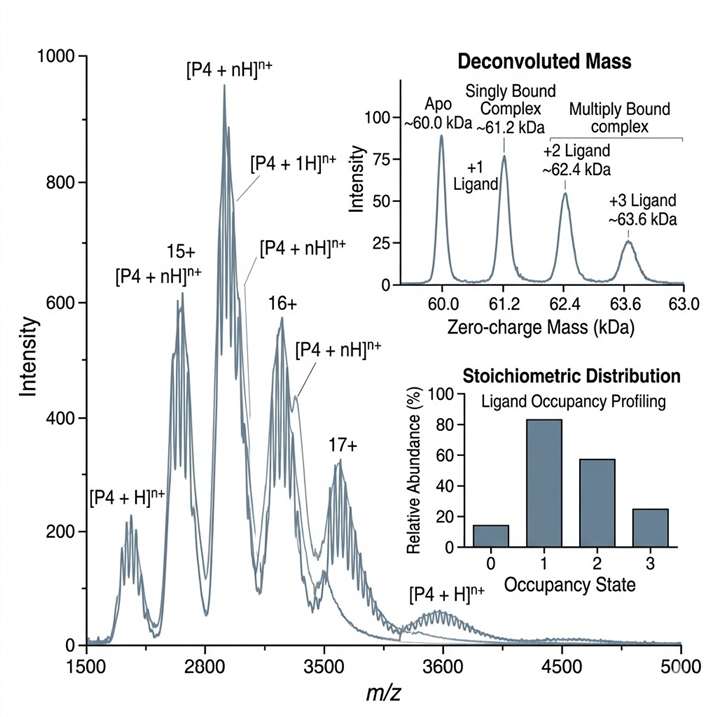
Annotated native ESI-MS spectrum showing stoichiometry and occupancy states.

Stoichiometry and occupancy profile

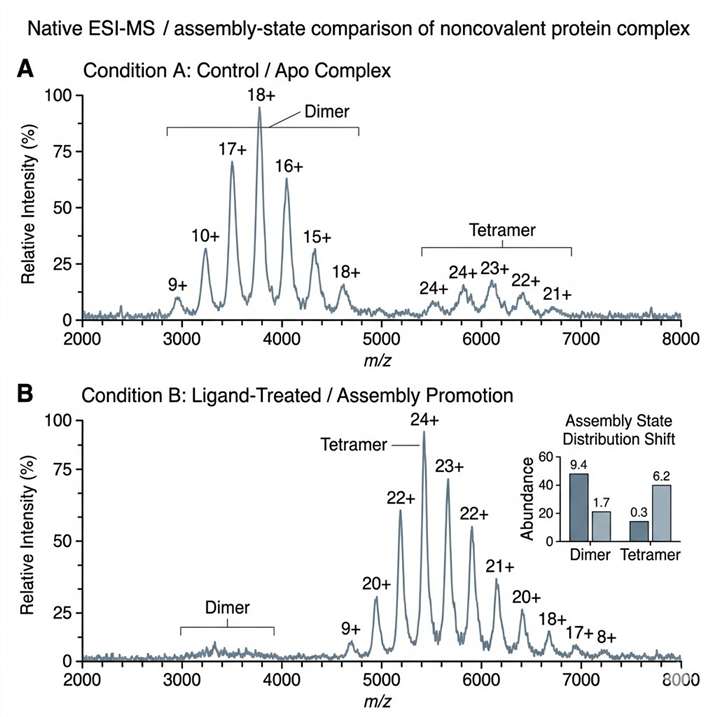
Comparative native ESI-MS spectra showing assembly-state changes across conditions.

Assembly-state comparison across conditions

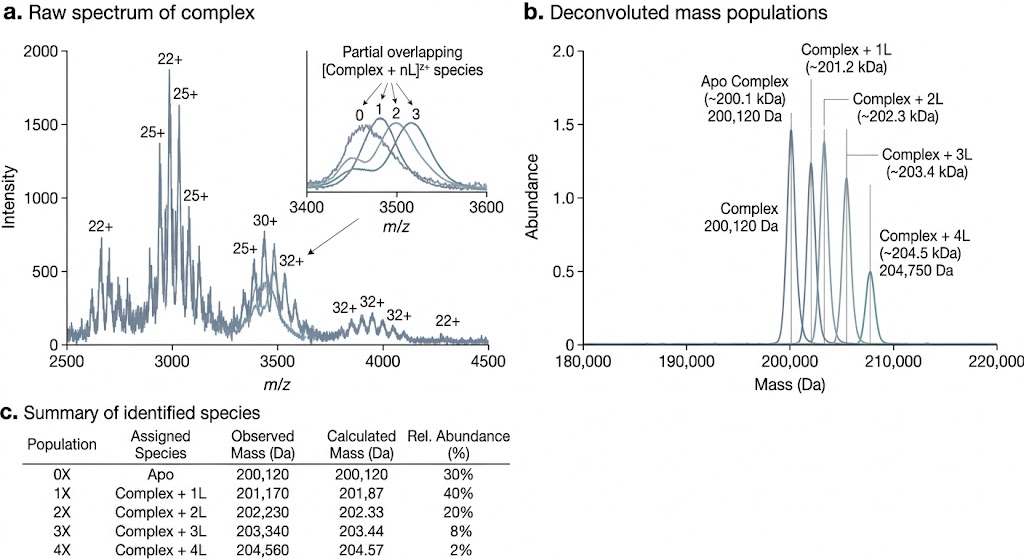
Processed deconvolution view of a heterogeneous noncovalent complex.

Processed deconvolution of heterogeneous complexes

Case Study

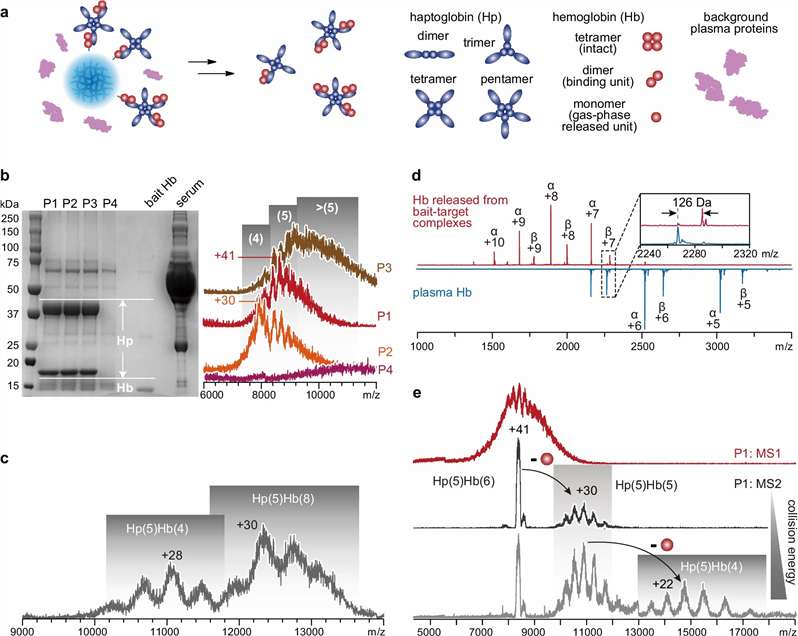
Biofunctionalized dissolvable hydrogel microbeads enable efficient characterization of native protein complexes

Background

Native complex characterization can become difficult when the sample is low-input, heterogeneous, or challenging to preserve during preparation.

Methods

The study combined affinity capture with native MS to recover and profile intact complexes under native conditions.

Results

Fig. 4 shows how the workflow distinguishes heterogeneous complex populations and donor-dependent oligomeric distributions in a biologically complex sample.

Conclusion

This case illustrates how native MS can provide direct complex-state evidence in samples where conventional simplified readouts may miss important assembly-level differences.

Native ESI-MS case-study figure view showing heterogeneous complex populations and donor-dependent oligomeric distributions.

Published figure example supporting intact complex-state interpretation in heterogeneous samples.

FAQ

Frequently Asked Questions

Q: What types of complexes are best suited to native ESI-MS?

Native ESI-MS is well suited to protein-ligand complexes, protein-protein assemblies, multimeric systems, and studies that compare intact complex behavior across different conditions.

Q: Can native ESI-MS distinguish true binding from nonspecific signal?

It can support that distinction when spectral quality, matched controls, mass-shift logic, and overall assembly behavior are interpreted together.

Q: Do I need purified material?

Purified proteins or pre-formed complexes are usually the most direct starting point. More complex materials may still be feasible, but they typically require a clearer review of sample condition and project goals.

Q: What will I receive beyond raw spectra?

You may receive processed spectra, deconvoluted masses, charge-state interpretation, complex-state annotations, and a concise written interpretation aligned to your study question.

Q: When should I choose native ESI-MS instead of SPR, BLI, or AS-MS?

Choose native ESI-MS when intact complex-state evidence is your priority. Choose SPR or BLI when kinetics matter most. Choose AS-MS when screening throughput from mixtures is the leading need.

Q: Can this workflow be expanded with other methods?

Yes. Native ESI-MS can be combined with ion mobility, native-state follow-up, or orthogonal structural methods when the project needs deeper evidence.

Discuss Your Native ESI-MS Project with Our Team

Share your target, complex type, and sample details, and we will help you assess project fit, sample planning, and the most appropriate native MS readout strategy.

Disclaimer: This service and all related deliverables are for research use only. They are not intended for diagnostic procedures, clinical decision-making, or patient management.

Online Inquiry

Please submit a detailed description of your project. We will provide you with a customized project plan to meet your research requests. You can also send emails directly to for inquiries.

* Email
Phone
* Service & Products of Interest
Services Required and Project Description