Enzyme Activity & Reaction Mechanism by Mass Spectrometry

Label-free, direct detection of substrates, products, and intermediates — kinetic characterization and mechanistic elucidation for any enzyme class using native substrates.

Mass spectrometry-based enzyme activity analysis offers a fundamental advantage over fluorescence, absorbance, or radiometric assays: it detects the actual substrate and product molecules by their mass-to-charge ratio. There is no need for fluorogenic substrate analogues, radiolabeled tracers, or coupled enzyme systems. The result is direct, unambiguous measurement of enzyme turnover — in native conditions, with native substrates, at native concentrations.

Creative Proteomics' MassTarget™ platform deploys a comprehensive suite of MS-based enzyme activity and mechanism services, covering eight complementary approaches from single-point activity screening to real-time continuous-flow kinetics and drug-target residence time determination. Whether you need to characterize a single enzyme target, profile inhibitor selectivity across a panel of isoforms, or elucidate a multi-step reaction mechanism, we provide a tailored MS strategy supported by rigorous data analysis and regulatory-compliant documentation.

Our MS-Based Enzyme Activity Platform:

  • 8 complementary MS approaches covering the full spectrum of enzyme activity analysis
  • Native substrate detection — any ionizable molecule, no labeling required
  • From single-point screening to full kinetic characterization (Km, Vmax, kcat, IC50, Ki)
  • FDA/ICH-compliant documentation for regulated drug metabolism studies
  • Microgram-scale enzyme consumption — conserve precious reagents
  • Rapid turnaround — assay development in days, not weeks
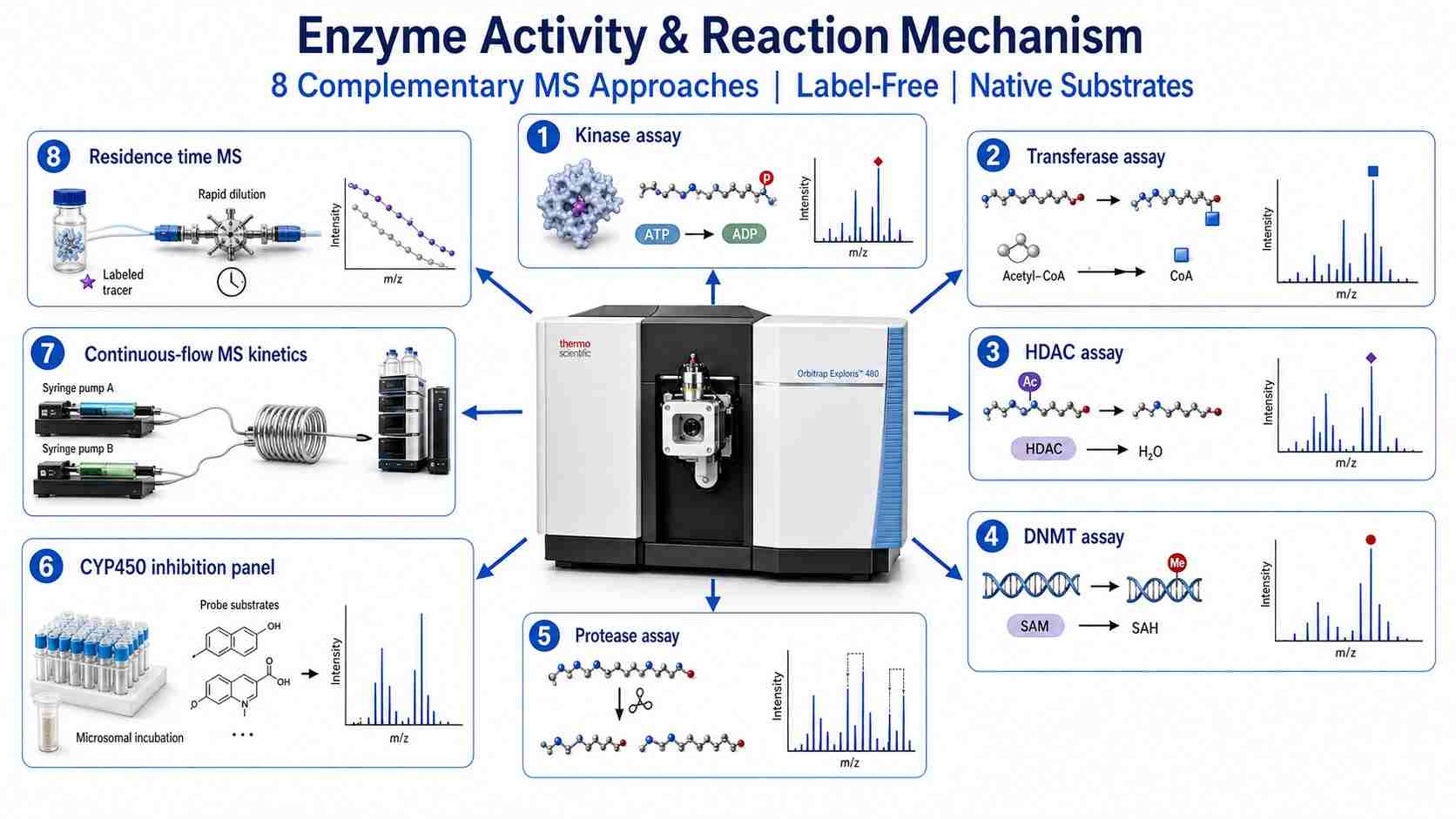
Mass spectrometry-based enzyme activity and reaction mechanism platform showing eight complementary MS approaches for label-free enzyme characterization in drug discovery.
Why MS for Enzyme Activity? Our 8 Service Approaches Enzyme Class Coverage Workflow Case Study Method Selection Guide FAQ

Why Mass Spectrometry for Enzyme Activity Analysis?

Enzyme activity has traditionally been measured by spectrophotometric, fluorometric, or radiometric methods. Each has limitations: fluorogenic substrates may not reflect native enzyme kinetics, radiometric assays require specialized handling, and coupled enzyme systems introduce secondary reaction variables. Mass spectrometry overcomes these limitations by measuring the enzyme's natural substrates and products directly.

Direct Substrate & Product Detection

MS identifies and quantifies substrate consumption and product formation simultaneously in a single experiment. No surrogate readouts, no coupled reactions — you see exactly what the enzyme is doing.

Native Substrates, Native Kinetics

Use the enzyme's physiological substrate — not a fluorogenic analogue that may alter binding affinity or turnover rate. The kinetic parameters you obtain reflect true biological activity.

Multi-Analyte Monitoring

Track substrate, product, intermediate, and cofactor (e.g., ATP/ADP, NADPH/NADP+) simultaneously. Detect unexpected metabolites, side reactions, or pathway branching in a single MS run.

Label-Free & Universal

No radioactive labels, no fluorophores, no antibodies. Any ionizable molecule is detectable. This universality makes MS applicable to enzyme classes where no other assay format exists.

Our 8 Complementary MS Approaches for Enzyme Activity & Mechanism

Each approach is optimized for a specific enzyme class, throughput requirement, and mechanistic question. Select the method that matches your research objective, or contact our scientists for a recommendation.

Kinase MS Activity Assays

Label-free detection of phosphopeptide product formation by LC-MS/MS or direct infusion MS. Determine Km for ATP and peptide substrates, IC50 for kinase inhibitors, and selectivity profiles across serine/threonine and tyrosine kinase families. No radioactive ATP, no phospho-antibodies, no coupled enzyme systems.

Transferase (HAT/HMT) MS Activity Assays

Direct detection of acetylated and methylated peptide products by high-resolution MS. Monitor histone acetyltransferase (HAT) and histone/lysine methyltransferase (HMT) activity using native histone peptide substrates. Quantify site-specific acetylation and methylation stoichiometry by MS/MS fragmentation.

HDAC Activity MS Assays

Label-free measurement of histone deacetylase activity by direct detection of deacetylated peptide products. Distinguish class I, II, and IV HDAC isoforms using selective substrates. No fluorogenic acetyl-lysine mimics — use native acetylated peptide sequences for physiologically relevant IC50 determination.

DNMT Activity MS Assays

Direct detection of methylated cytosine in DNA substrate oligonucleotides by LC-MS/MS. Monitor DNA methyltransferase (DNMT1, DNMT3A, DNMT3B) activity and inhibition using native CpG-containing DNA substrates. Quantify methylation site specificity and hemimethylation preference.

Protease MS Substrate/Product Assays

Direct detection of peptide substrate cleavage by monitoring both intact substrate depletion and product fragment formation. Determine kcat/Km specificity constants for serine, cysteine, aspartyl, and metalloproteases. Multiplex up to 10 substrates simultaneously for selectivity profiling.

CYP450 Inhibition Panel MS

FDA/ICH-compliant CYP450 inhibition profiling using probe substrate LC-MS/MS assays. Cover CYP1A2, 2B6, 2C8, 2C9, 2C19, 2D6, 3A4/5 with validated probe reactions. Determine IC50 and classify inhibition mechanism (reversible, TDI, mixed) with full documentation for regulatory submissions.

Continuous-Flow MS Kinetics

Real-time enzyme kinetic characterization by interfacing a microfluidic flow reactor directly with a high-resolution mass spectrometer. Capture continuous progress curves — not end-point snapshots — for determination of Km, Vmax, kcat, IC50, and Ki. Detect non-linear kinetics, product inhibition, and pre-steady-state phenomena invisible to discrete sampling methods.

Enzyme-Ligand Residence Time MS

Determine drug-target residence time (koff, t1/2) by MS-based dissociation kinetics. Direct detection of free ligand re-equilibration after rapid dilution or competition with an isotopically labeled tracer. No fluorescent labeling, no surface immobilization — measure dissociation from soluble native enzyme in solution.

Enzyme Class Coverage & Recommended MS Approach

Our platform covers all major enzyme classes relevant to drug discovery. The table below maps each class to the most appropriate MS-based activity assay approach.

Enzyme ClassRecommended MS ApproachDetection StrategyKey Parameters
Kinases (Ser/Thr, Tyr, lipid)Kinase MS Activity AssaysPhosphopeptide product detection; ATP/ADP ratio monitoringKm(ATP), Km(peptide), IC50, selectivity score
Histone Acetyltransferases (HATs)Transferase MS Activity AssaysAcetylated peptide product by HRMS; site-specific acetyl stoichiometryKm(acetyl-CoA), Km(peptide), IC50
Histone/Protein Methyltransferases (HMTs, PRMTs)Transferase MS Activity AssaysMethylated peptide product; methylation state distribution (me1/me2/me3)Km(SAM), Km(peptide), methylation state ratio, IC50
Histone Deacetylases (HDACs)HDAC Activity MS AssaysDeacetylated peptide product; isoform-selective substrate discriminationIC50, isoform selectivity ratio, mode of inhibition
DNA Methyltransferases (DNMTs)DNMT Activity MS Assays5-methylcytosine in DNA oligonucleotide substratesKm(DNA), Km(SAM), site-specific methylation, IC50
Proteases (Ser, Cys, Asp, Metallo)Protease MS Substrate/Product AssaysSubstrate depletion + product fragment detection; multiplex substrate panelkcat/Km, substrate specificity profile, IC50
Cytochrome P450s (1A2, 2C9, 2D6, 3A4, etc.)CYP450 Inhibition Panel MSProbe substrate metabolite formation by LC-MS/MS; NADPH consumptionIC50, TDI classification, reversible vs. mechanism-based
Any enzyme with ionizable substrate/productContinuous-Flow MS KineticsReal-time continuous ion intensity trace of substrate and productKm, Vmax, kcat, Ki, progress curve shape
Any target (enzyme, receptor, transporter)Enzyme-Ligand Residence Time MSFree ligand re-equilibration kinetics by MS after rapid dilutionkoff, t1/2, residence time

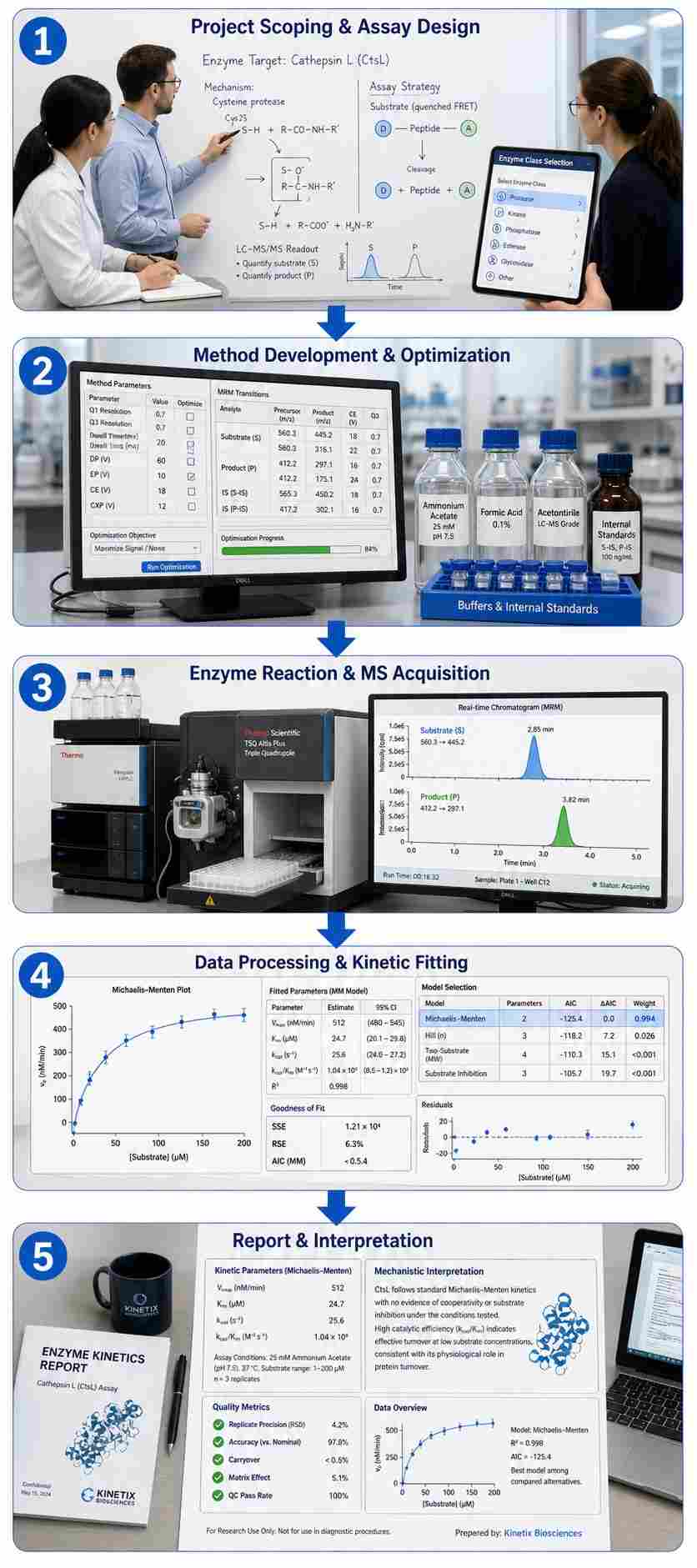
Our Enzyme Activity MS Workflow

A standardized, quality-controlled process from project scoping to final report. Each project is tailored to the specific enzyme class, substrate, and mechanistic question.

1

Project Scoping & Assay Design

Consultation to define the enzyme target, substrate, desired parameters, and throughput requirements. We recommend the optimal MS approach from our 8-method platform and design the assay protocol.

2

Method Development & Optimization

MS parameter optimization (ionization mode, MRM transitions, collision energy), buffer compatibility assessment, internal standard selection, and linearity/LOQ determination for substrate and product analytes.

3

Enzyme Reaction & MS Acquisition

Enzyme reaction under controlled conditions (temperature, time, cofactor concentration). Reaction quench at defined time points, followed by LC-MS/MS or direct infusion MS analysis. For CF-MS: continuous real-time acquisition.

4

Data Processing & Kinetic Fitting

Peak integration, calibration curve quantitation, initial velocity calculation, and kinetic model fitting (Michaelis-Menten, substrate inhibition, Hill, or custom models). 95% confidence intervals reported for all parameters.

5

Report & Interpretation

Comprehensive report including raw chromatograms, calibration curves, fitted kinetic plots, parameter tables, and mechanistic interpretation. Optional: statistical comparison between conditions, model selection criteria.

Enzyme activity MS workflow diagram showing five steps from project scoping through assay design, method development, MS acquisition, data processing, and final report delivery.

Case Study: LIMS-Kinase — Label-Free In Vitro Kinase Activity Measurement by MS

Meyer C, McCoy M, Li L, Posner B, Westover KD. "LIMS-Kinase provides sensitive and generalizable label-free in vitro measurement of kinase activity using mass spectrometry." Cell Reports Physical Science 4(10):101599 (2023). https://doi.org/10.1016/j.xcrp.2023.101599

Background

Kinase activity assays in drug discovery are dominated by radioactive [γ-³²P]-ATP incorporation, fluorescence-based methods using fluorogenic peptide substrates, or immunoassays relying on phospho-specific antibodies. Each approach has significant limitations: radioactivity requires specialized handling and disposal; fluorogenic substrates may not reflect native enzyme kinetics; and phospho-antibodies are costly, target-specific, and often unavailable for non-standard phosphorylation sites. The authors, from the University of Texas Southwestern Medical Center, aimed to develop a label-free, high-throughput mass spectrometry-based assay for studying individual kinase enzymology in a purified system, with a focus on validated drug targets.

Methods

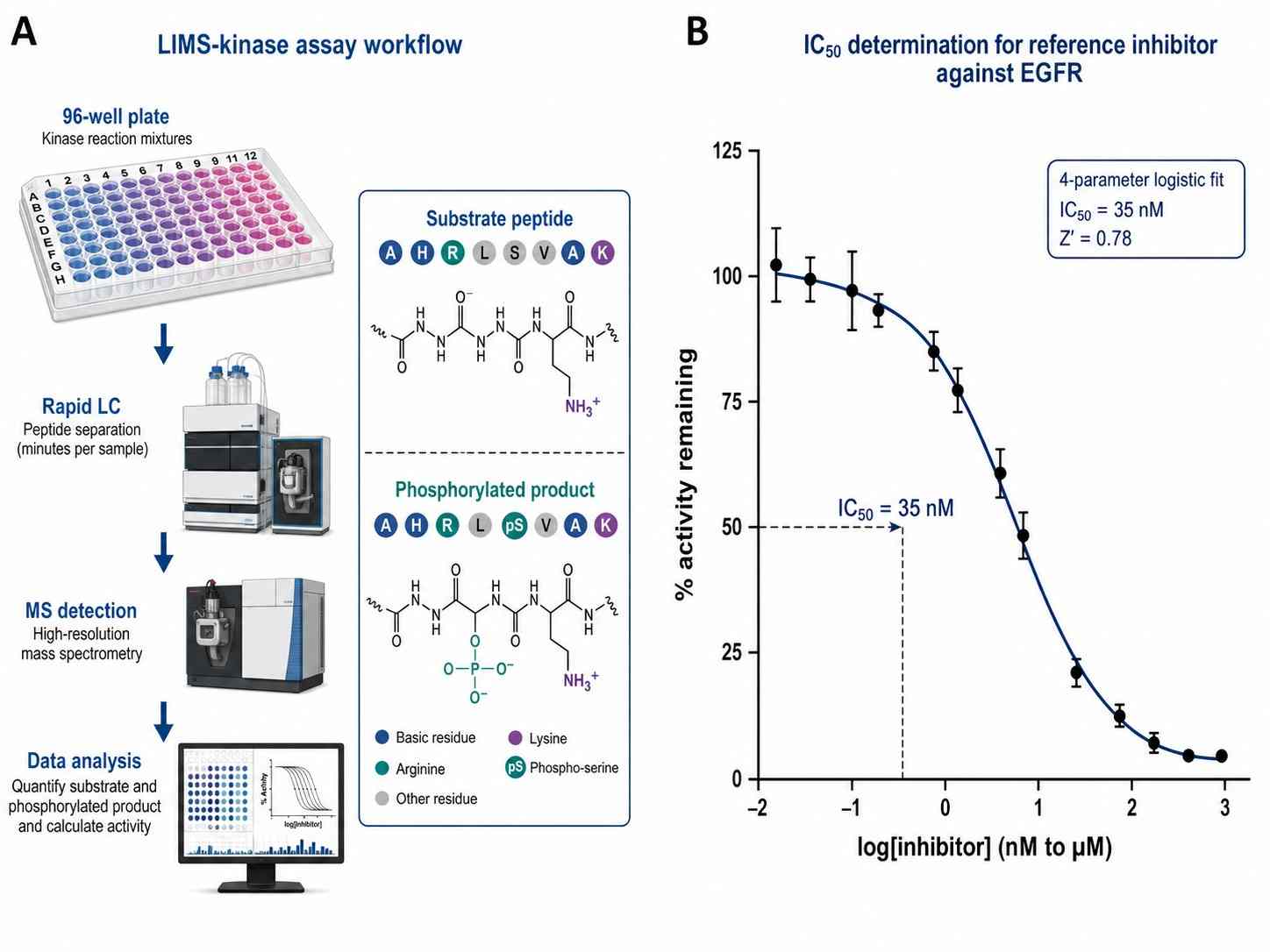
The LIMS-Kinase (Label-free In-solution MS Kinase) assay uses a liquid chromatography-mass spectrometry (LC-MS) platform to directly detect and quantify unmodified peptide substrates and their corresponding phosphorylated products. Kinase reactions are performed in 96-well plate format, quenched, and analyzed by LC-MS. Each well is processed in under 2 minutes by rapid LC separation, enabling throughput of approximately 500 samples per instrument per day. The assay was validated against a panel of 20 recombinant kinases, including clinically relevant targets such as EGFR, BRAF, PI3Kα, and CDK4/6, using both known substrate peptides and optimized peptide sequences. Data analysis uses automated peak integration and a custom computational pipeline for parameter calculation.

Results

The LIMS-Kinase assay demonstrated high sensitivity with limits of detection in the low femtomole range for phosphopeptide products. Linear dynamic range exceeded 2 orders of magnitude with R² > 0.99 across all tested kinase-substrate pairs. For the 20-kinase panel, the assay successfully measured Michaelis-Menten kinetics (Km and Vmax for both ATP and peptide substrates) with Z′-factors exceeding 0.6, indicating excellent assay quality suitable for high-throughput screening. IC50 determination for reference inhibitors (e.g., gefitinib against EGFR, vemurafenib against BRAF V600E) yielded values consistent with published literature. The assay also demonstrated the ability to detect kinase inhibition by clinical-stage compounds and to profile selectivity across the kinase panel, identifying off-target activities that would be missed by single-kinase fluorescence assays.

Conclusions

LIMS-Kinase provides a sensitive, generalizable, and label-free platform for measuring kinase activity in vitro. Its key advantages are: (1) no radioactive reagents or phospho-antibodies required, (2) compatibility with any ionizable peptide substrate, (3) direct detection of both substrate and product, enabling accurate kinetic parameter determination, and (4) throughput sufficient for both detailed enzymology and screening applications. The approach is directly applicable to drug discovery programs requiring accurate kinase activity measurement in native-like conditions.

LIMS-Kinase workflow schematic showing label-free LC-MS-based kinase activity measurement with 96-well plate format and automated data analysis (adapted from Meyer et al. 2023, Cell Reports Physical Science).

Adapted from Meyer et al. (2023): LIMS-Kinase assay workflow. LC-MS-based label-free detection of kinase activity enables high-throughput kinetic characterization and inhibitor profiling without radioactive or fluorescent labels.

Method Selection Guide: Which MS Approach for Your Enzyme?

Choosing the right MS-based enzyme activity method depends on your enzyme class, throughput requirements, and the specific mechanistic question. Use this guide to identify the best approach for your project.

If You Need...Choose This MethodThroughputEnzyme per Assay
Kinase inhibitor IC50 / selectivity profilingKinase MS Activity AssaysMedium (32–96 assays/day)1–10 µg per IC50 curve
Epigenetic enzyme (HAT/HMT) activity & inhibitionTransferase MS Activity AssaysMedium (24–48 assays/day)0.5–5 µg per assay
HDAC isoform-selective inhibitor screeningHDAC Activity MS AssaysMedium (24–48 assays/day)0.5–5 µg per assay
DNMT activity & DNA methylation inhibitionDNMT Activity MS AssaysLow–Medium (16–32 assays/day)1–10 µg per assay
Protease substrate specificity / inhibitor profilingProtease MS Substrate/Product AssaysMedium (up to 10 substrates multiplexed)0.1–5 µg per assay
FDA/ICH-compliant CYP450 DDI assessmentCYP450 Inhibition Panel MSHigh (96-well plate format)0.1–1 mg/mL microsomes
Real-time progress curves / pre-steady-state kineticsContinuous-Flow MS KineticsLow (4–8 conditions/hour)0.1–10 µg per curve
Drug-target residence time (koff, t1/2)Enzyme-Ligand Residence Time MSLow–Medium (8–16 compounds/day)1–20 µg per measurement

Not sure which method fits your enzyme target? Contact our scientists for a personalized recommendation based on your enzyme class, substrate, and research objectives.

FAQ

Frequently Asked Questions

Q: How does MS-based enzyme activity analysis compare to fluorescence-based assays?

The key difference is that MS detects the actual substrate and product molecules by mass, not a surrogate signal. This means you can use native substrates (no fluorogenic analogues), detect unexpected products or side reactions, and multiplex multiple substrates in a single run. Fluorescence assays offer higher throughput and lower cost per data point, but MS provides higher information content per experiment and eliminates artifacts from fluorophore-modified substrates.

Q: Which kinetic parameters can I obtain from MS-based enzyme assays?

Depending on the method selected: Km, Vmax, kcat (single-substrate and multi-substrate), IC50, Ki (competitive, non-competitive, uncompetitive, mixed), koff and residence time (t1/2), substrate specificity constants (kcat/Km), and inhibition mode classification. For continuous-flow MS, we also report progress curve shape analysis and detection of non-linear kinetics.

Q: Do I need to provide purified enzyme, or can you handle crude lysates?

Purified enzyme is preferred for unambiguous kinetic characterization, as it eliminates competing activities from other enzymes in the lysate. However, for certain applications (e.g., CYP450 microsomal assays, native enzyme complexes), we work with enriched fractions or defined lysates. We will assess matrix effects and adjust the MS method (e.g., LC separation, selective MRM transitions) to ensure specific detection of your substrate and product in the sample matrix.

Q: What is the turnaround time for an MS-based enzyme activity study?

Assay development and method optimization: 5–10 business days. Full kinetic characterization (Michaelis-Menten + IC50): 10–15 business days after method approval. CYP450 inhibition panel (8 isoforms × 10 concentrations): 15–20 business days. Real-time CF-MS kinetics: 10–15 business days. Residence time determination: 10–15 business days. Rush timelines are available upon request.

Q: Can you handle multi-substrate enzyme mechanisms (e.g., bi-substrate ping-pong, random order)?

Yes. For multi-substrate enzymes, we design experiments varying one substrate at fixed concentrations of the second (matrix design), followed by global fitting to the appropriate kinetic model (ping-pong, sequential ordered, random order). Our data analysis pipeline supports model discrimination using Akaike Information Criterion (AIC) and reports the best-fit mechanism with supporting statistical evidence.

Q: How do you ensure data quality and reproducibility?

Every assay includes: (1) isotopically labeled internal standards for each analyte, (2) no-enzyme and no-substrate controls, (3) known inhibitor positive control, (4) triplicate technical replicates, (5) QC samples at low, medium, and high concentrations every 20 injections, and (6) system suitability tests (mass accuracy, retention time stability, signal intensity) at the start and end of each batch. All data are reviewed against pre-defined acceptance criteria before reporting.

References

  1. Meyer C, McCoy M, Li L, Posner B, Westover KD. LIMS-Kinase provides sensitive and generalizable label-free in vitro measurement of kinase activity using mass spectrometry. Cell Rep Phys Sci. 2023;4(10):101599. doi:10.1016/j.xcrp.2023.101599. https://doi.org/10.1016/j.xcrp.2023.101599
  2. Thiele U, Crocoll C, Tschöpe A, et al. Efficient derivatization-free monitoring of glycosyltransferase reactions via flow injection analysis-mass spectrometry for rapid sugar analytics. Anal Bioanal Chem. 2024;416:5191-5203. doi:10.1007/s00216-024-05457-9. https://doi.org/10.1007/s00216-024-05457-9
  3. Lin YH, Tu WC, Urban PL. Kinetic profiling of homogeneous and heterogeneous biocatalysts in continuous flow by online mass spectrometry. J Am Soc Mass Spectrom. 2023;34(1):109-118. doi:10.1021/jasms.2c00283. https://doi.org/10.1021/jasms.2c00283
  4. Berger SA, Grimm C, Nyenhuis J, et al. Rapid, label-free screening of diverse biotransformations by flow-injection mass spectrometry. ChemBioChem. 2023;24(11):e202300170. doi:10.1002/cbic.202300170. https://doi.org/10.1002/cbic.202300170
  5. Prudent R, Annis DA, Dandliker PJ, et al. Exploring new targets and chemical space with affinity selection-mass spectrometry. Nat Rev Chem. 2021;5:62-71. doi:10.1038/s41570-020-00229-2. https://www.nature.com/articles/s41570-020-00229-2

Plan your enzyme activity study with the MassTarget™ team

Tell us about your enzyme target, substrate, and research questions — our scientists will recommend the optimal MS-based approach and design a tailored study for your discovery program.


For research use only. Not for use in diagnostic procedures. Creative Proteomics provides enzyme activity and reaction mechanism MS services exclusively for research and development purposes. Results are not intended for clinical diagnosis or medical decision-making.

Online Inquiry

Please submit a detailed description of your project. We will provide you with a customized project plan to meet your research requests. You can also send emails directly to for inquiries.

* Email
Phone
* Service & Products of Interest
Services Required and Project Description