Target Function Validation Service

Cellular and functional MS approaches for confirming that target engagement produces the expected biological effect — from metabolomics and lipidomics through phosphoproteomics, immunometabolism, and cell death pathway analysis.

Your team has confirmed that a compound binds its intended target. But one critical question remains: does engaging this target actually produce the desired biological effect in the relevant cellular context?

The MassTarget platform provides a suite of cellular and functional MS-based approaches designed to validate target function in biologically relevant contexts — from cellular metabolomics and lipidomics to phosphoproteomics, apoptosis markers, immunometabolism profiling, and organoid/tissue slice models.

Key Advantages:

  • Functional readouts matched to target biology and therapeutic area
  • Pathway-level evidence of on-target engagement and biological effect
  • Untargeted discovery mode detects unexpected pathway modulation
  • Compatible with cell lines, primary cells, organoids, and tissue slices
  • Integrated binding confirmation before functional readout
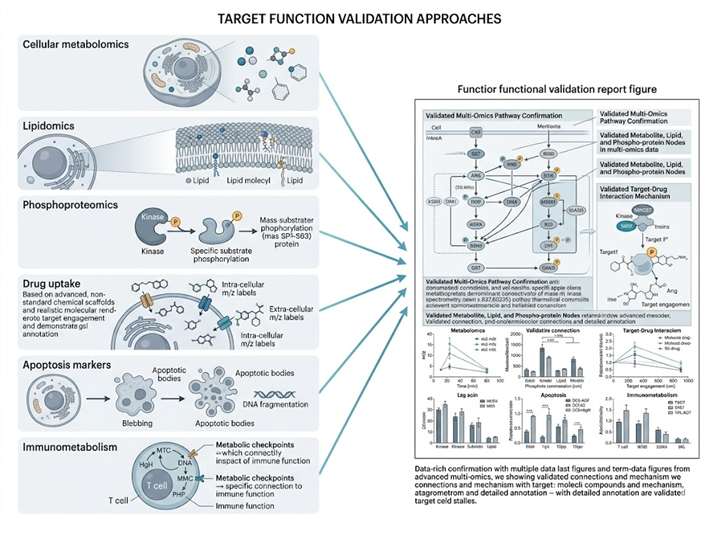
Target function validation platform showing cellular MS approaches for confirming target engagement produces expected biological effects across metabolic, signaling, immune and cell death pathways.
Overview Approaches Workflow Applications Demo Data Sample Why Functional Case Study FAQ

Beyond Binding — Does Engaging the Target Produce the Expected Biology?

Target function validation bridges the gap between binding confirmation and therapeutic hypothesis. A compound may bind its target with high affinity yet fail to produce the expected functional outcome — because the target is in an inactive conformation, because compensatory pathways buffer the effect, or because the cellular context differs from the purified system used for binding studies. Conversely, a weakly binding compound may produce a strong functional effect through an unexpected mechanism. Functional validation in cells, tissues, and disease-relevant models is the only way to confirm that target engagement translates to biological impact.

The challenge is that functional readouts are highly context-dependent. A kinase target's function is best validated by measuring phosphorylation of its substrates in the relevant cell type. A metabolic target requires metabolomic readouts in the appropriate metabolic state. An immune target demands immunophenotyping in activated immune cells. Matching the functional readout to the target's biology is essential for meaningful validation.

For upstream signaling pathway analysis, see our phosphoproteomics activation mapping service.

Functional Validation Approaches by Biological Context

Different target classes produce different functional consequences. The validation approach must capture the relevant biology for your target.

Cellular Metabolomics for Metabolic Targets

When a target is an enzyme in a metabolic pathway, functional validation requires measuring the pathway's metabolite products. Our cellular metabolomics screening service uses untargeted LC-MS (HILIC + RP) to profile polar metabolites — comparing treated vs control cells provides direct evidence of pathway-level target engagement. Our metabolic pathway drug-response mapping extends this to dose-response and time-course formats, generating IC50 values for pathway-level effects.

Cellular Lipidomics for Lipid Pathway Targets

For targets in lipid metabolism, our cellular lipidomics drug profiling service covers fatty acids, phospholipids, sphingolipids, and sterols. Lipid pathway-specific readouts confirm that modulating the target produces the expected changes in lipid composition, providing functional validation for targets in lipid homeostasis, membrane biology, and signaling lipid pathways.

Phosphoproteomics for Signaling Targets

Kinases, phosphatases, and signaling adaptors exert their function through phosphorylation cascades. Our phosphoproteomics activation mapping service captures thousands of phosphorylation events, enabling both on-target pathway confirmation and detection of compensatory signaling changes that may indicate resistance mechanisms. Known substrate phosphorylation provides direct functional evidence of target engagement.

Drug Uptake and Intracellular Engagement

For a target to be functionally engaged, the compound must reach it at sufficient intracellular concentrations. Our drug uptake and retention MS service measures compound accumulation in cells and tissues over time. Combined with intracellular accumulation profiling, these measurements confirm that compound exposure at the target site is adequate for functional engagement.

Apoptosis and Cell Death Pathway Markers

When a target regulates cell survival, functional validation requires measuring cell death pathway activation. Our apoptosis marker service detects caspase-cleaved fragments and cytochrome c release. Cell death pathway signatures distinguish apoptosis from necroptosis, pyroptosis, and ferroptosis, providing mechanistic specificity beyond generic viability assays.

Immunometabolism and Cytokine Profiling

Immune cell function is intimately linked to metabolic state. Our immunometabolism MS profiling service measures the metabolic programs underpinning T cell activation, macrophage polarization, and dendritic cell function. Cytokine quantification via targeted MS confirms immune functional effects, providing paired metabolic and functional readouts.

For target function validation in complex models, our organoid metabolomics and tissue slice MS drug response services extend validation to 3D culture and ex vivo tissue models with preserved cell-cell and cell-matrix interactions.

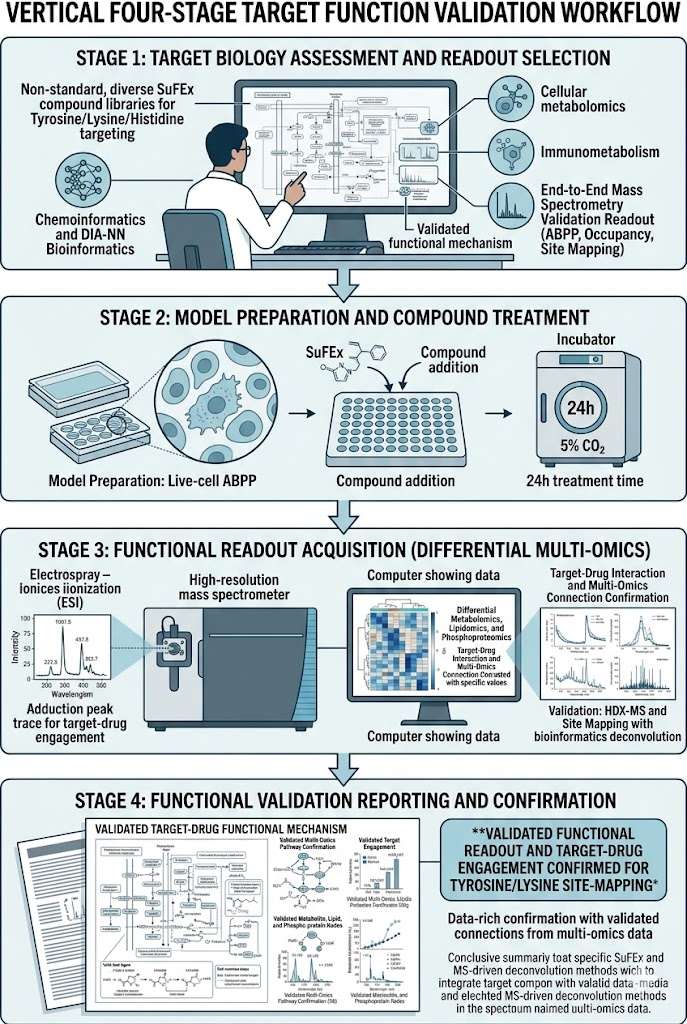
Our Workflow — From Binding Confirmation to Functional Validation

A structured process ensuring functional data is interpretable in the context of confirmed target binding.

1

Target Biology Assessment and Readout Selection

We assess your target's known cellular function, downstream pathways, relevant cell types, and expected consequences of modulation. Based on this, we recommend the optimal functional readout — metabolomic or lipidomic profiling for metabolic targets, phosphoproteomics for signaling targets, apoptosis markers for cell survival targets.

2

Model Preparation and Compound Treatment

Cells or model systems are treated under optimized conditions. Target engagement is confirmed by a complementary method before proceeding to functional readouts, ensuring that functional data is interpretable in the context of confirmed target binding.

3

Functional Readout Acquisition

Samples are processed through the selected MS-based profiling workflow. Untargeted metabolomics or lipidomics captures the full metabolic response. Phosphoproteomics captures the signaling response. Apoptosis markers detect cell death pathway activation.

4

Functional Validation Reporting

Functional data is compared to the expected biology. Pathway enrichment confirms that modulated pathways match the target's known function. Unexpected pathway modulation is flagged. The report includes validation evidence, pathway maps, and a written assessment of functional impact.

Four-stage workflow for target function validation: target biology assessment, model preparation and treatment, functional readout acquisition, and functional validation reporting.

Applications

Target function validation is applied across therapeutic areas and target classes.

Oncology Target Validation

Validating that inhibiting an oncogenic kinase reduces proliferation pathway signaling (phosphoproteomics) and alters metabolic flux (metabolomics) in cancer cells. Organoid metabolomics extends this to patient-derived tumor models that recapitulate native tumor biology.

Output: Pathway-level phosphorylation and metabolic changes; on-target confirmation with resistance mechanism detection.

Metabolic Disease Target Validation

Confirming that modulating a metabolic enzyme changes downstream metabolite levels in hepatocytes or adipocytes. Dose-response metabolomics establishes the relationship between target engagement and metabolic effect.

Output: Dose-dependent metabolite changes; pathway IC50 values; substrate depletion and product accumulation evidence.

Immunology Target Validation

Demonstrating that an immune checkpoint target modulates T cell metabolic reprogramming and cytokine secretion. Immunometabolism profiling captures the metabolic basis of immune function.

Output: Metabolic pathway engagement in immune cells; cytokine secretion confirmation; immunophenotyping context.

Cell Death Mechanism Validation

Distinguishing whether a compound kills cells through apoptosis, necroptosis, or ferroptosis using MS-based cell death pathway signatures. Essential for understanding mechanism of action for cytotoxic compounds.

Output: Cell death mechanism classification; pathway-specific marker confirmation; dose-response of death pathway activation.

Neurodegenerative Target Validation

Using phosphoproteomics to confirm target modulation of tau phosphorylation or synaptic signaling. Lipidomics captures membrane lipid changes relevant to neurodegeneration.

Output: Phosphorylation changes in disease-relevant pathways; lipid profile alterations in neuronal models.

Organoid and Ex Vivo Target Validation

For targets where 2D culture does not recapitulate relevant biology, organoid metabolomics and tissue slice MS provide functional validation in 3D and intact tissue contexts.

Output: Functional data in physiologically relevant model systems; tissue-specific pathway responses.

Representative Results

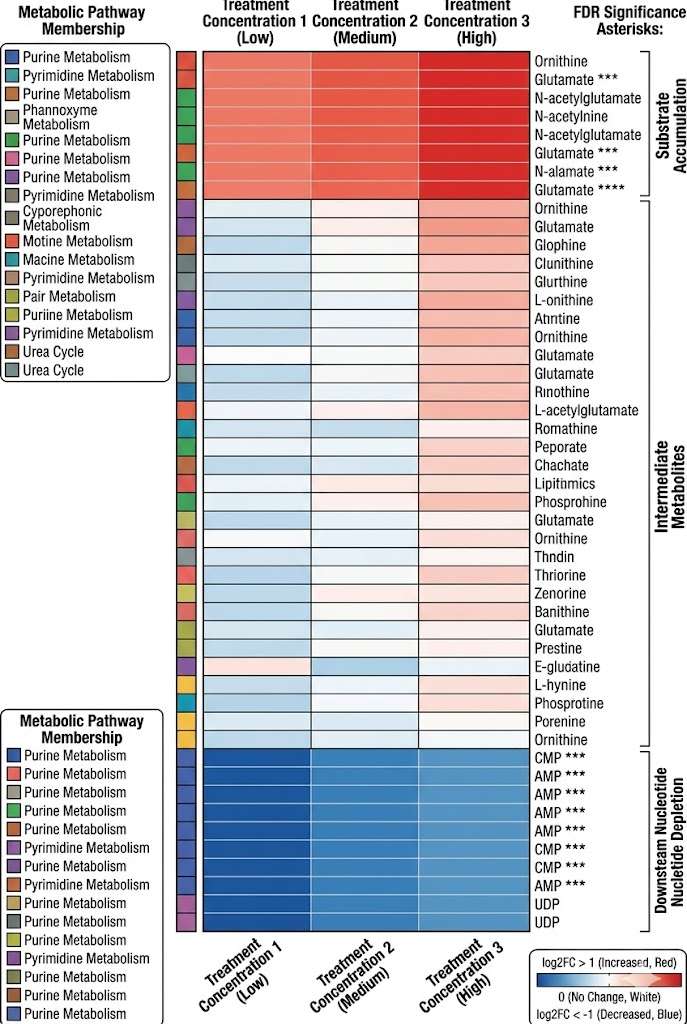
Metabolomics heatmap showing 47 significantly altered metabolites upon target modulation, with substrate accumulation and downstream product depletion confirming pathway-level target engagement.

Cellular metabolomics: pathway-level target engagement confirmation

Untargeted metabolomics heatmap of HCT116 cells treated with a nucleotide biosynthesis inhibitor. Forty-seven significantly altered metabolites (FDR < 0.05) shown as rows across three treatment concentrations (columns). Substrate accumulation (red) and downstream nucleotide depletion (blue) confirm pathway-level target engagement. Dose-response metabolomics yields pathway IC50 = 37 nM, consistent with biochemical IC50 of 42 nM.

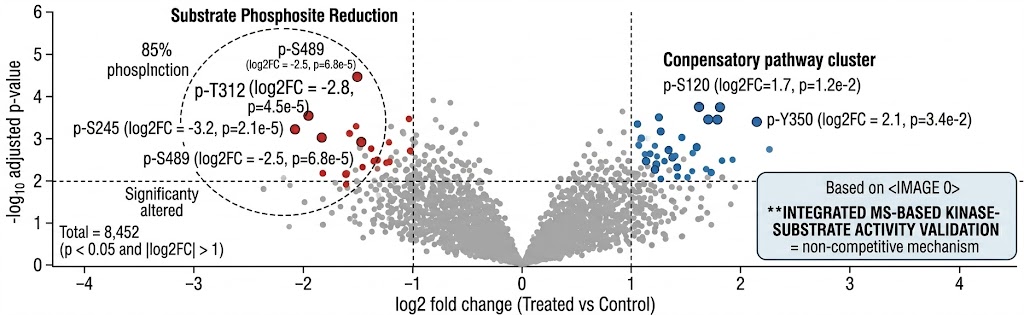
Phosphoproteomics volcano plot for a kinase inhibitor showing 312 significantly altered phosphosites with known substrate phosphorylation reduced by 85% and compensatory pathway activation detected.

Phosphoproteomics: on-target signaling validation and compensatory pathways

Volcano plot from phosphoproteomics profiling of a selective kinase inhibitor in MDA-MB-231 cells. Of 8,452 quantified phosphosites, 312 are significantly altered (FDR < 0.05, |log2FC| > 1). Known substrate phosphorylation reduced by 85% at 100 nM (red data points). Pathway analysis reveals compensatory activation of a parallel signaling pathway (blue data points) — a resistance mechanism not predicted from binding data alone.

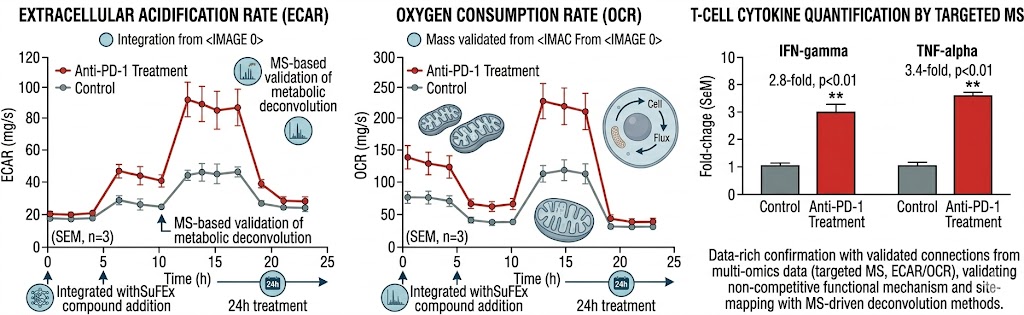
Immunometabolism profiling showing increased glycolytic capacity and cytokine secretion upon immune checkpoint blockade, confirming functional T cell activation.

Immunometabolism: functional validation of immune checkpoint target

Immunometabolism profiling of anti-PD-1 antibody in activated human T cells. Left panel: extracellular acidification rate (ECAR) showing increased glycolytic capacity upon checkpoint blockade. Middle panel: oxygen consumption rate (OCR) showing increased oxidative phosphorylation. Right panel: targeted cytokine quantification confirming increased IFN-gamma (2.8-fold) and TNF-alpha (3.4-fold) secretion. Metabolic and cytokine data together provide paired functional validation of the immune checkpoint target.

Sample Requirements

Sample TypeMinimum per ConditionRecommendedAmountFormat
Cell pellets (metabolomics)35-61 x 106 cellsSnap-frozen pellet
Cell pellets (phosphoproteomics)352 x 107 cellsSnap-frozen pellet
Conditioned media (cytokines)3550-100 microLClear, protease inhibitors
Organoid cultures3-58-1010-20 organoidsGrowth factor-reduced Matrigel
Compound stock0.5 mg2 mg10 mM in DMSODMSO

Note: For metabolomics and lipidomics, rapid quenching and snap-freezing are essential to preserve the metabolic state. We provide detailed sample collection protocols before project initiation. For phosphoproteomics, phosphatase inhibitors must be included in lysis buffers.

Why Functional Validation Matters

CriterionBinding Confirmation OnlySingle-Readout AssayOur Functional MS Approach
Target binding confirmedYesYesYes
Pathway-level effectNoNoYes (metabolomics, phosphoproteomics)
On-target specificityNoPartialYes (pathway enrichment)
Off-target biology detectedNoNoYes (unexpected pathway changes)
Applicable to novel targetsLimitedLimitedYes (discovery mode)

What sets this approach apart: Functional validation approaches matched to target biology — metabolomics for metabolic targets, phosphoproteomics for signaling targets, apoptosis markers for cell death targets. Discovery mode detects unexpected pathway modulation that single-readout assays miss, providing both validation and safety information in a single experiment.

Case Study: MS-Based Metabolomics Identifies and Validates Polyamine Metabolism as a Functional Target in T Cell Dysfunction

Mahalingam SS, Jayaraman S, Bhaskaran N, et al. "Polyamine metabolism impacts T cell dysfunction in the oral mucosa of people living with HIV." Nature Communications, 2023, 14, 399. DOI: 10.1038/s41467-023-36163-2 (CC BY 4.0).

Background

HIV infection causes chronic immune activation and T cell dysfunction in the oral mucosa, but the underlying metabolic mechanisms were poorly understood. The study aimed to identify metabolic pathways driving T cell dysfunction and validate them as functional targets for therapeutic intervention.

Methods

Global untargeted metabolomics by LC-MS was performed on saliva samples from HIV-infected individuals and healthy controls to identify dysregulated metabolic pathways. Targeted LC-MS quantification confirmed specific metabolite changes. Pharmacological inhibitors of the identified pathway were used to validate the functional role of the target in T cell dysfunction models, including human tonsil organoid cultures (HTOCs).

  • Untargeted LC-MS metabolomics of saliva (HIV+ vs healthy controls, n=20 per group).
  • Targeted LC-MS quantification of polyamines (putrescine, spermidine, spermine) in cell lysates.
  • Pharmacological inhibition of ODC-1 using DFMO and POB in T cell and organoid models.
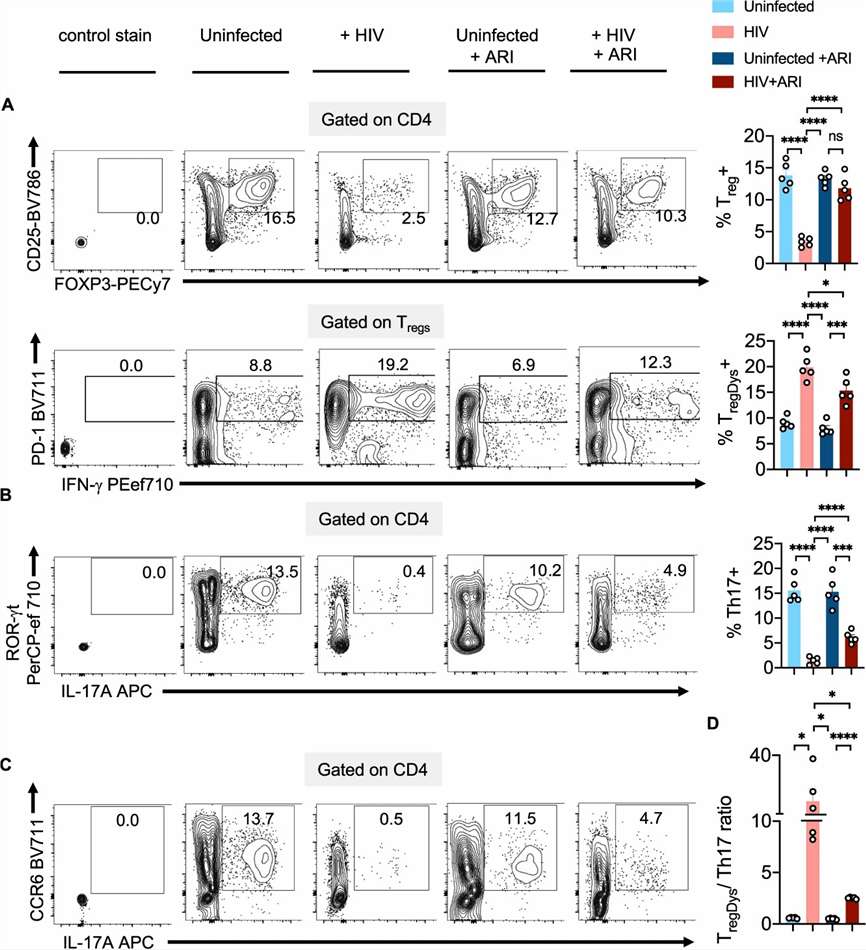
  • Flow cytometry assessment of T cell subset balance (Treg vs Th17) as functional readout.

Results

Untargeted metabolomics revealed that the polyamine biosynthesis pathway was significantly upregulated in HIV-infected individuals. Targeted LC-MS quantification confirmed elevated putrescine (2.5-fold), spermidine (1.8-fold), and spermine (1.6-fold) levels in HIV-infected T cells. Pharmacological inhibition of ODC-1 reversed the T cell dysfunction phenotype, restoring the normal Treg/Th17 balance. The functional validation was confirmed in both cell culture and tonsil organoid models, demonstrating that polyamine metabolism is a functional driver of HIV-associated T cell dysfunction.

Conclusions

This study exemplifies how untargeted MS-based metabolomics can identify novel functional targets, and how targeted metabolomics combined with pharmacological inhibition can validate those targets' functional roles in disease-relevant biology — a template for target function validation in drug discovery.

Fig. 2 and Fig. 4 from Mahalingam et al. 2023 showing untargeted metabolomics identification of polyamine pathway dysregulation and targeted LC-MS validation of polyamine levels with functional confirmation via ODC-1 inhibition.

Fig. 2, 4 from Mahalingam SS, et al. 2023 (Nature Communications). Untargeted metabolomics identified polyamine pathway; targeted LC-MS and functional inhibition validated the target's role. CC BY 4.0.

FAQ

Frequently Asked Questions

Q: What is the difference between binding validation and function validation?

Binding validation confirms that a compound binds its target. Function validation confirms that binding produces the expected biological effect — pathway modulation, metabolic change, or phenotypic response. Both are needed to advance a candidate with confidence.

Q: Which functional readout should I choose for my target?

Metabolic targets → metabolomics or lipidomics. Signaling targets → phosphoproteomics. Cell death targets → apoptosis markers. Immune targets → immunometabolism and cytokines. We assess this during the initial consultation based on your target's biology.

Q: Can functional validation detect off-target effects?

Yes. Untargeted functional readouts capture the full biological response, including both on-target and off-target effects. Unexpected pathway modulation is flagged and reported, providing dual validation and safety information.

Q: How much compound is needed?

Typically 0.5-2 mg for most cell-based functional studies. Organoid and tissue slice studies may require 2-5 mg for full dose-response characterization. We assess the specific requirement during project planning.

Q: Can you work with primary cells or patient samples?

Yes. We have validated protocols for primary immune cells, hepatocytes, neurons, and patient-derived organoids. Sample requirements may be higher for primary cells due to limited material availability.

References

  1. Mahalingam SS, et al. "Polyamine metabolism impacts T cell dysfunction in the oral mucosa of people living with HIV." Nature Communications, 2023, 14, 399. DOI: 10.1038/s41467-023-36163-2
  2. Lin C, Tian Q, Guo S, et al. "Metabolomics for Clinical Biomarker Discovery and Therapeutic Target Identification." Molecules, 2024, 29(10), 2198. DOI: 10.3390/molecules29102198 (CC BY 4.0)
  3. Saei AA, Beusch CM, Chernobrovkin A, et al. "ProTargetMiner as a proteome signature library of anticancer molecules for functional discovery." Nature Communications, 2019, 10, 5715. DOI: 10.1038/s41467-019-13582-8 (CC BY 4.0)

Design your target function validation strategy

Tell us about your target, its known biology, and your therapeutic area — our scientists will recommend the optimal functional readout and provide a detailed project proposal.

For Research Use Only (RUO). Not intended for diagnostic, therapeutic, or clinical decision-making purposes. Creative Proteomics services are designed to support preclinical research, drug discovery, and mechanism of action studies only.

Online Inquiry

Please submit a detailed description of your project. We will provide you with a customized project plan to meet your research requests. You can also send emails directly to for inquiries.

* Email
Phone
* Service & Products of Interest
Services Required and Project Description