Yeast Display Ligand Screening and LC-MS Analysis Service

Target-binding peptide, scFv, antibody fragment, and engineered binder discovery with LC-MS/MS characterization.

Creative Proteomics provides Yeast Display Ligand Screening and LC-MS Analysis Service for researchers who need to identify, rank, and characterize target-binding peptides, antibody fragments, or engineered binders. We help connect target and library design, display-based enrichment, LC-MS/MS characterization, and candidate prioritization in one practical workflow.

Our service is built for teams working on peptide ligand discovery, macrocyclic peptide screening, scFv or antibody fragment selection, captured-target identification, and protein-ligand interaction research. From the first project discussion to the final data package, we focus on clear controls, interpretable results, and follow-up-ready candidate lists.

Service strengths:

  • Screen target-binding ligands and binders.
  • Support peptide, scFv, and engineered libraries.
  • Combine display selection with LC-MS/MS analysis.
  • Evaluate target, library, controls, and capture design.
  • Deliver ranked candidates and characterization reports.
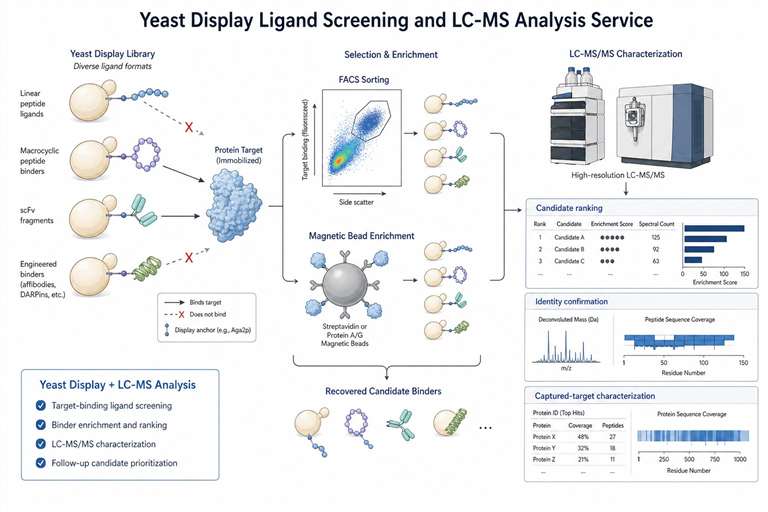
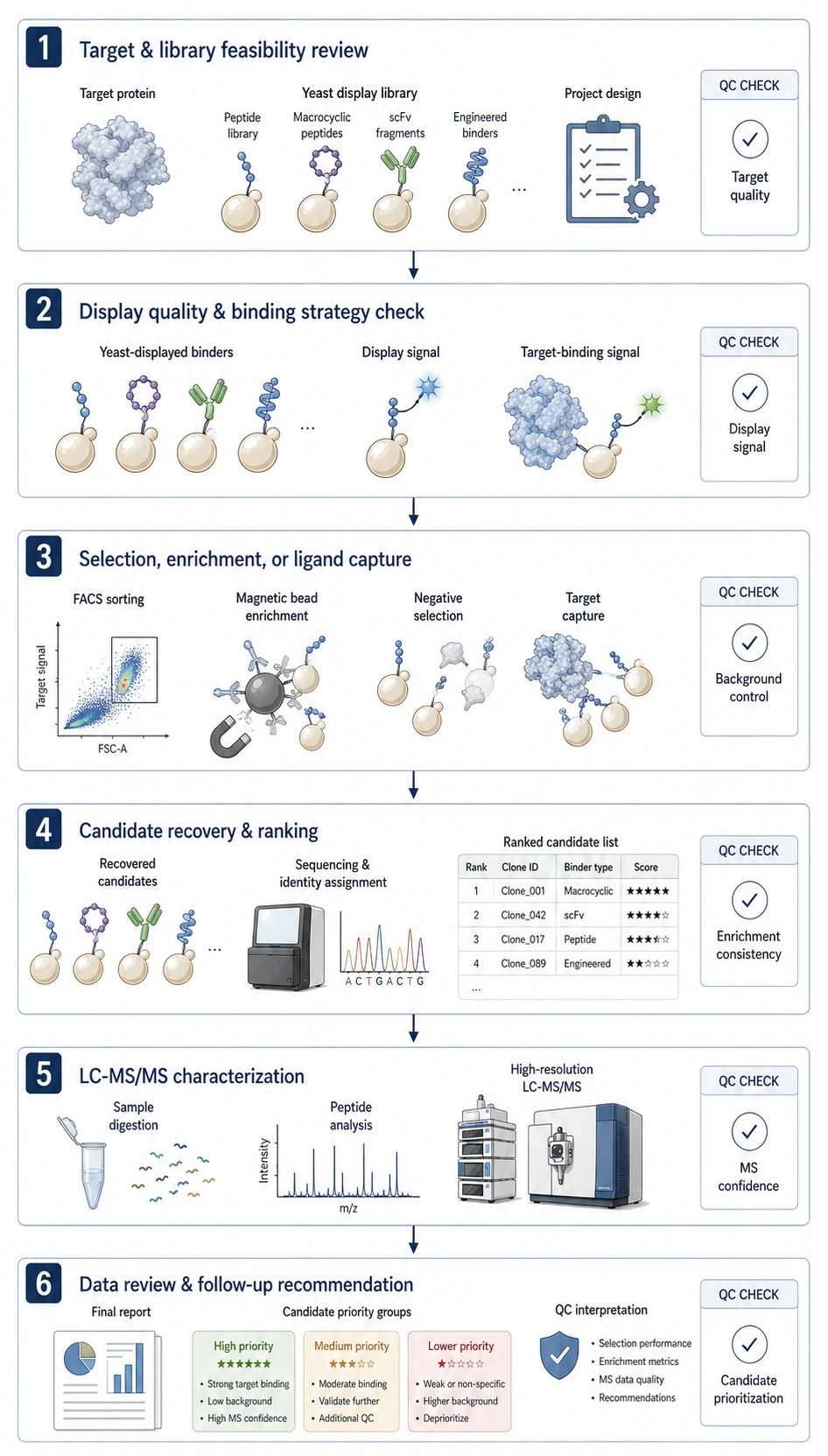
Yeast display ligand screening and LC-MS analysis workflow showing displayed binders, target binding, enrichment, LC-MS/MS, and candidate reports.
Ligand Discovery Capabilities Workflow Sample Comparison Applications Deliverables Demo Evidence FAQ References

Discover Target-Binding Ligands with Yeast Display and LC-MS/MS Support

Yeast display is a cell-surface display method that presents peptides, antibody fragments, scFv binders, or engineered proteins on yeast cells while maintaining a connection between the displayed molecule and its coding sequence. This makes the method useful for enrichment, clone recovery, and candidate ranking.

In a typical ligand screening project, a target protein or antigen is exposed to a yeast-displayed library. Binding populations can then be enriched by fluorescence-activated cell sorting, magnetic bead selection, or a related capture strategy. Candidate clones, enriched fractions, or captured materials can then be analyzed by sequencing, LC-MS/MS, or both, depending on the project goal.

LC-MS/MS adds value when a project needs candidate identity support, peptide or protein confirmation, captured-target characterization, or enriched-material analysis. It should not be treated as a direct replacement for kinetic assays. When a project needs exact affinity constants, on-rates, or off-rates, we may suggest follow-up tools such as SPR, BLI, HDX-MS, or other orthogonal methods.

Our Yeast Display + LC-MS Service Capabilities

We support ligand and binder discovery projects that need more than a simple enrichment readout. Our team helps connect target preparation, display quality, selection design, LC-MS/MS analysis, and result interpretation.

MODE 1

Peptide and Macrocyclic Peptide Ligand Screening

Yeast display can support peptide and macrocyclic peptide library screening against purified protein targets. These projects are useful when a team wants to discover ligands for protein-protein interaction surfaces, enzyme-adjacent regions, receptor domains, or target classes that are difficult to address with only small-molecule screening.

  • Target format, labeling strategy, and display design review.
  • Selection pressure and negative selection planning.
  • LC-MS/MS support when candidate identity or captured material needs characterization.
MODE 2

Antibody Fragment, scFv, or Binder Library Screening

Yeast display is widely used for scFv and antibody fragment screening because display signal and target-binding signal can be evaluated together.

  • Supports existing display libraries, enriched yeast populations, candidate clones, or binder panels.
  • Helps separate true binding enrichment from poor expression or nonspecific background.
  • Can include enrichment summaries, candidate ranking, and control comparison.
MODE 3

Yeast Display Ligand Capture and Target Characterization

In some projects, yeast-displayed binders can act as capture reagents for target proteins or antigens from a mixture. LC-MS/MS can then support captured-target or antigen identification.

  • Useful when target identity is uncertain.
  • Supports target confirmation for selected binders.
  • Requires careful background and control review.
MODE 4

Candidate Confirmation by LC-MS/MS

LC-MS/MS can support several parts of a yeast display project, especially when MS-based identity support is needed.

  • Candidate peptide or protein identity confirmation.
  • Captured target or antigen characterization.
  • Peptide / protein identification from enriched material.
  • Target capture comparison against control capture.
  • QC review of enriched fractions.
  • Prioritization based on MS confidence and biological context.
MODE 5

Feasibility Review for Target, Library, and Capture Design

Before sample submission, we evaluate whether the target, library, and selection design match the intended endpoint.

  • Target size, purity, labeling format, and biotinylation status.
  • Expression evidence, library type, and enrichment method.
  • Control groups and LC-MS/MS fit for the project question.

Workflow with QC Checkpoints

Our workflow follows the full project path from submitted project information to final results. It combines the technical screening process with service-level QC review.

1

Target and Library Feasibility Review

We begin with the target and library. Your team provides the target name, protein format, antigen source, labeling status, library type, binder format, and expected endpoint. We determine whether the project is better suited to peptide screening, scFv selection, binder enrichment, ligand capture, or captured-target identification.

QC focus: target quality, library format, selection endpoint, and control feasibility.

2

Display Quality and Binding Strategy Check

For yeast display screening, display quality matters. We assess whether the displayed molecule is expected to fold, present, and bind in the chosen format. The binding strategy may involve a labeled target, bead-based target, soluble antigen, competition selection, or negative selection.

QC focus: display signal, target-binding signal, background risk, and nonspecific binding controls.

3

Selection, Enrichment, or Ligand Capture

The yeast-displayed library or clone pool is exposed to the target. Binding candidates are enriched by FACS, magnetic bead selection, or a capture-based workflow. Negative selection can help reduce bead binders, tag binders, irrelevant target binders, or other background signals.

QC focus: enrichment consistency, control separation, and recovery of useful candidate material.

4

Candidate Recovery and Ranking

Enriched clones or populations are recovered for candidate identification. Depending on project design, candidate identity may come from clone sequencing, NGS-assisted frequency analysis, LC-MS/MS characterization, or a combination of these approaches.

QC focus: candidate reproducibility, ranking logic, and control-group comparison.

5

LC-MS/MS Characterization

LC-MS/MS is used when the project needs peptide / protein identity support, captured-target analysis, enriched-fraction characterization, or MS-based confirmation of candidate material. Samples are digested, analyzed by LC-MS/MS, searched against the proper database, and reviewed for identification confidence.

QC focus: MS signal quality, peptide evidence, protein identification confidence, contaminant review, and background filtering.

6

Data Review and Follow-Up Recommendation

The final report includes ranked candidates, LC-MS/MS tables where applicable, QC notes, interpretation boundaries, and practical follow-up suggestions. If the project requires kinetic, structural, or functional confirmation, we may suggest SPR/BLI, HDX-MS, chemical cross-linking MS, or another orthogonal method.

QC focus: clear interpretation and follow-up-ready candidate prioritization.

Vertical workflow for yeast display ligand screening and LC-MS analysis with QC checkpoints.

Sample, Library, and Target Requirements

The exact input depends on whether the project starts from a yeast display library, enriched clones, purified target, captured material, cells, protein fractions, or prepared gels. The table below provides practical planning values for common LC-MS/MS-related submissions.

Project / Material TypeRecommended InputStorage / ShippingKey Notes
Yeast-displayed peptide or scFv libraryProject-specific; provide library size, vector, host strain, and display formatConfirm before shipmentInclude induction condition, selection history, and available display data
Enriched yeast clones or populationsProject-specific; provide clone IDs or round informationConfirm before shipmentInclude selection round, target concentration, and sorting or bead-selection conditions
Pure or enriched protein material150 μg for label-free; 300 μg for DIA-style workflowsFrozen unless otherwise agreedProvide buffer composition and preparation method
IP / Co-IP / pulldown or ligand-capture eluateSDS loading buffer elution around 20 μL may be used when compatibleFrozen or as agreedProvide all buffer components and capture workflow details
Short SDS-PAGE gel lane from capture eluateRun 1–1.5 cm into separating gel and submit gel piece4°C with deionized water covering the gelUseful when captured mixtures need protein identification
Visible gel band for protein identificationProtein ≥20 μg for gel-strip identification; ≥5–10 μg for gel-spot identification4°C with ice packsCoomassie-stained bands often perform better than silver-stained bands
Cultured cells for downstream proteomics5 × 106 cells for label-free; 1 × 10⁷ cells for DIA-style workflowsFrozen pellet, ship on dry iceKeep cell number and processing consistent across groups
Trace cell proteomics sample200–5,000 cells for DIA trace workflowsFrozen low-bind tube where applicableFeasibility confirmation required before submission
Culture supernatant10 mL for label-free; 20 mL for DIA-style workflowsFrozen, ship on dry iceSerum-containing medium may increase background
FFPE material, if used for related proteomics support10 slices for label-free; 15–20 slices for DIA-style workflowsShip under agreed conditionsEach slice should be about 10 μm thick and 1.5 × 2 cm in area

Before submission, please prepare target name, target format, library type, selection design, labeling status, control groups, replicate plan, capture conditions, buffer composition, and expected comparison groups.

Yeast Display + LC-MS vs Alternative Screening and Binding Methods

MethodWhat It Does BestStrengthsLimitationsWhen It Fits
Yeast display + LC-MS/MSEnriches binders and supports MS-based identity or capture characterizationLinks display selection with candidate or target characterizationLC-MS/MS does not directly provide kinetic constantsBinder discovery with MS confirmation or captured-target support
Phage displayScreens very large peptide or antibody librariesHigh diversity and mature selection workflowsLess direct cell-surface quantitative sorting than yeast displayVery large discovery libraries
mRNA displayScreens extremely large genetically encoded peptide librariesStrong for peptide and macrocycle discoveryMore specialized workflow and downstream validation needsUltra-large peptide ligand discovery
FACS-only yeast displaySorts binders based on display and binding signalQuantitative cell-level enrichmentNo MS-based identity or target characterizationProjects that only need sorting and clone recovery
ASMSScreens ligand binding from compound pools by MSUseful for small-molecule or fragment bindingNot a display-library enrichment methodDirect ligand screening from compound libraries
SPR / BLIMeasures binding kinetics or affinityProvides kinetic or affinity valuesLower throughput for large discovery librariesFollow-up validation of prioritized candidates
HDX-MS or cross-linking MSMaps conformational or contact evidenceUseful for structural interpretationNot a primary binder-library selection methodFollow-up epitope, interface, or structural studies

Selection Rules by Project Goal

Use yeast display + LC-MS/MS when the project needs binder enrichment plus MS-based characterization or captured-target support. Use phage display or mRNA display when library scale is the main priority. Use FACS-only yeast display when sorting is enough and MS characterization is not needed. Use Affinity Selection Mass Spectrometry when the project focuses on direct small-molecule binding from compound pools. Use SPR or BLI when kinetic constants are the main endpoint. For orthogonal interaction or structural evidence, consider chemical cross-linking mass spectrometry or HDX-MS epitope mapping.

Applications for Ligand Discovery and Target Characterization

Peptide and Macrocyclic Peptide Binder Discovery

Yeast display can help enrich peptide or macrocyclic peptide binders from diverse libraries. This is useful when the target surface is broad, shallow, or difficult to address with only small molecules.

Antibody Fragment or scFv Binder Screening

For antibody engineering teams, yeast display can support scFv or antibody fragment screening and candidate ranking. Display signal and binding signal can be evaluated together, which helps separate expression problems from binding performance.

Captured Target or Antigen Identification by LC-MS/MS

If a yeast-displayed binder captures a target from a mixture, LC-MS/MS can help identify the captured protein or antigen. This is useful when target identity is uncertain or when candidate binders need MS-supported characterization.

Cell-Surface or Membrane-Associated Target Studies

Some targets are difficult to purify or preserve. A capture-based design may help explore cell-surface or membrane-associated antigens, but these projects require careful controls and feasibility review.

Hit Prioritization for Follow-Up Testing

Final candidates can be prioritized for SPR/BLI, HDX-MS, functional testing, structural studies, or chemical optimization. For ligand-target projects, related workflows may include photoaffinity labeling MS, Activity-based protein profiling, and Proteome-wide thermal stability profiling.

LC-MS/MS Deliverables and Data Interpretation

A useful result package should make it clear what was enriched, how the control behaved, what LC-MS/MS identified, and which candidates are most practical for follow-up.

Minimum Deliverables

DeliverableWhat You Receive
Project design and feasibility notesTarget, library, control, and workflow assessment
Selection / enrichment summaryOverview of selection rounds, sorting, or capture workflow
Candidate binder or ligand ranking tablePrioritized candidate list with interpretation notes
Binding signal and control comparison summaryReview of target vs control behavior
LC-MS/MS raw data files where applicableRaw MS files for data traceability
Peptide / protein identification tableIdentified candidates or captured proteins
Captured target or candidate characterization reportMS-supported identity and confidence summary
QC summaryNotes on enrichment, background, and MS confidence
Follow-up validation recommendationSuggested next-step experiments

Optional Analysis Add-Ons

  • FACS enrichment trend visualization.
  • NGS-assisted clone frequency analysis.
  • LC-MS/MS protein identification.
  • Peptide sequence confirmation.
  • Captured antigen characterization.
  • Target/control specificity comparison.
  • Candidate clustering.
  • Follow-up validation planning.

What the Data Can and Cannot Claim

Yeast display enrichment can support binder discovery and ranking. LC-MS/MS can support identity confirmation and captured-target characterization. These outputs do not automatically prove binding kinetics, cellular function, or direct mechanism. Those conclusions need follow-up validation.

Demo Results: What the Data Can Show

Demo results help your team understand the final report format before starting a project.

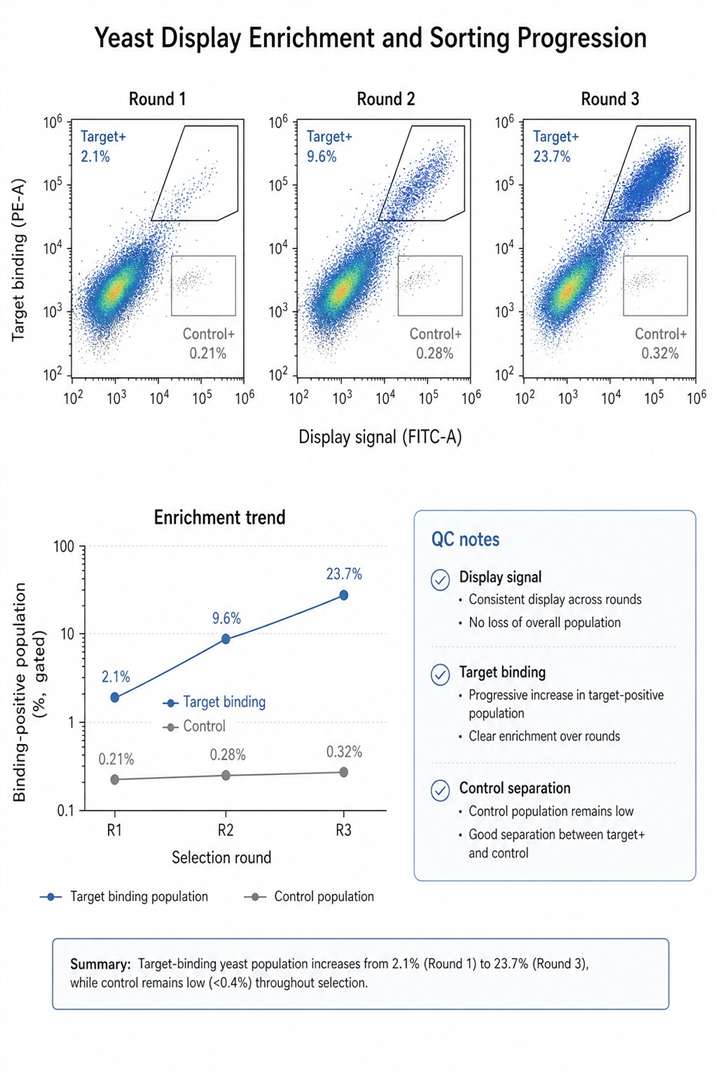
FACS-style enrichment progression for yeast display ligand screening.

Enrichment and Sorting Progression

A FACS-style progression plot can show how a binder-enriched population changes across selection rounds. This helps evaluate whether target-binding signal increases while control signal remains low.

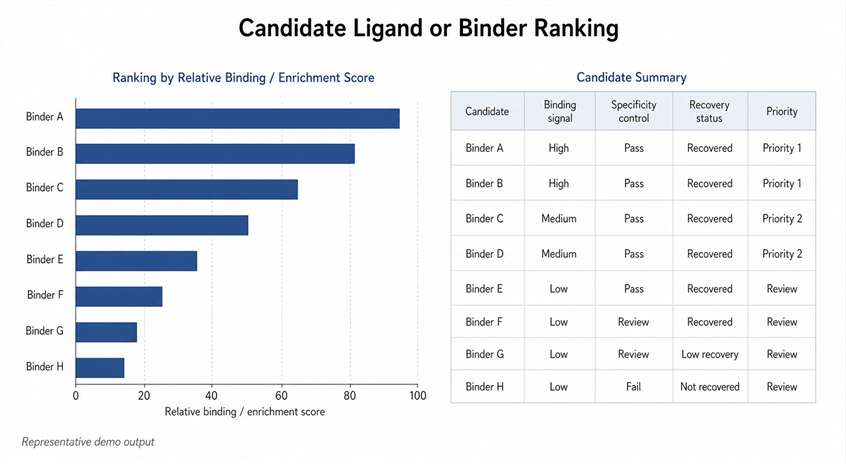
Candidate ligand or binder ranking table for yeast display LC-MS analysis.

Candidate Ligand or Binder Ranking

A candidate table can rank Binder A, Binder B, Binder C, and other placeholders by binding signal, specificity control, recovery status, and priority group.

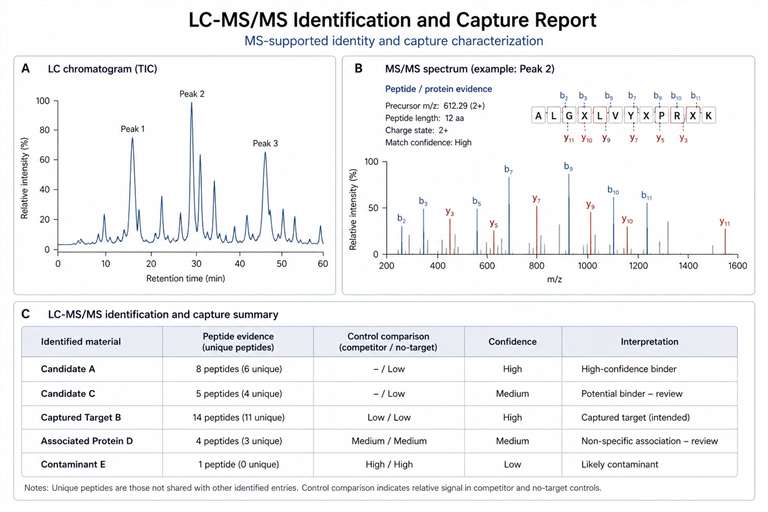
LC-MS/MS identification and capture report for yeast display ligand screening.

LC-MS/MS Identification and Capture Report

An LC-MS/MS report may include identified proteins, peptide evidence, confidence score, coverage summary, and control comparison. For capture workflows, the report helps distinguish likely target candidates from background proteins.

Literature Evidence for Yeast Display and LC-MS Ligand Capture

Screening macrocyclic peptide libraries by yeast display allows control of selection process and affinity ranking

Background

The study reported a yeast display-based strategy for generating, screening, and characterizing disulfide-cyclized macrocyclic peptide ligands. The work focused on discovering peptide ligands against five diverse protein targets and used flow cytometry to monitor binding, expression, affinity ranking, and specificity.

Methods

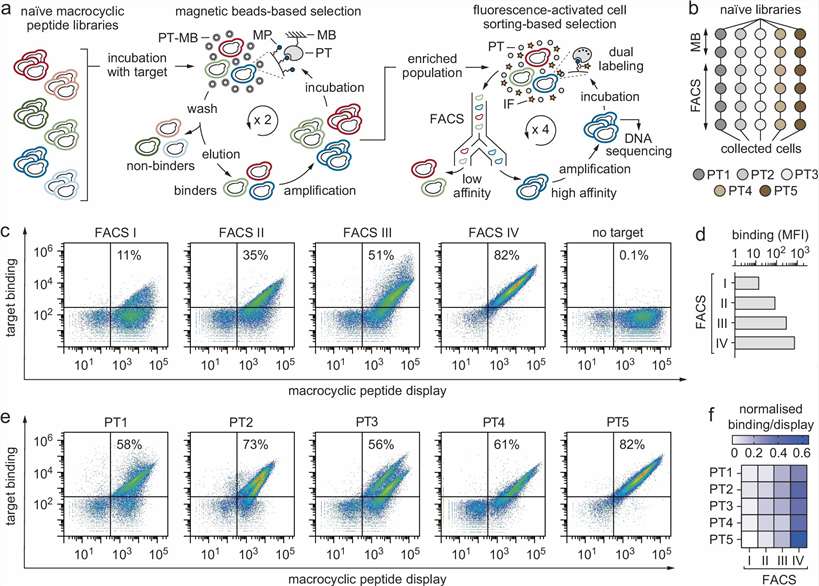
The authors generated yeast-encoded macrocyclic peptide libraries and pooled multiple library designs. As shown in Figure 3, the screening strategy used magnetic bead-based selection followed by FACS-based selection. Candidate clones were then analyzed by Sanger sequencing and NGS. Selected clones were characterized directly on the yeast surface using target titration assays, and follow-up work included specificity testing and structural analysis for selected ligand-target pairs.

Results

The study identified multiple macrocyclic peptide ligands across five protein targets. Figure 5 shows apparent binding affinity measurements from yeast surface titrations, with reported apparent dissociation values spanning a broad range from 0.2 nM to 1 μM. Figure 7 supports specificity testing against diverse and homologous proteins, helping distinguish target-selective binders from broad nonspecific binders. The paper also reported structural analysis for one selected ligand-target complex, showing how yeast display screening can move from library enrichment to detailed ligand characterization.

Conclusion

This published example supports the value of yeast display for peptide ligand discovery and affinity ranking. For our service, it is most relevant because it shows how display-based selection, candidate recovery, ranking, and follow-up characterization can be linked into a practical ligand discovery path. In our workflow, LC-MS/MS adds a separate layer of candidate or captured-target characterization when MS-based identity support is needed.

Yeast display macrocyclic peptide ligand screening evidence with selection and affinity ranking.

Published yeast display macrocyclic peptide screening evidence supports selection, affinity ranking, specificity testing, and follow-up ligand characterization.

FAQ

Frequently Asked Questions

Q: What is Yeast Display Ligand Screening and LC-MS Analysis?

It is an integrated workflow that uses yeast surface display to enrich target-binding peptides, scFv fragments, antibody fragments, or engineered binders, then applies LC-MS/MS where candidate identity, peptide/protein confirmation, or captured-target characterization is needed.

Q: What kinds of ligands or binders can be screened?

Projects may involve peptide libraries, macrocyclic peptide libraries, scFv libraries, antibody fragment libraries, engineered binder libraries, enriched clones, or candidate panels.

Q: Where does LC-MS/MS fit into the yeast display workflow?

LC-MS/MS may be used after enrichment to confirm candidate identity, characterize captured proteins, analyze enriched fractions, or support target identification from capture experiments.

Q: Can this service identify captured targets or antigens?

Yes, if the capture design and sample quality are suitable. We evaluate controls carefully because abundant proteins and nonspecific binders can affect MS interpretation.

Q: Can this service be used for peptide or macrocyclic peptide ligand discovery?

Yes. Yeast display can support peptide and macrocyclic peptide screening, and the workflow can be paired with sequencing, LC-MS/MS, and follow-up validation.

Q: Can this service be used for scFv or antibody fragment screening?

Yes. Yeast display is commonly used for scFv and antibody fragment display, selection, and ranking. LC-MS/MS can be added when MS-based characterization is needed.

Q: Does LC-MS/MS provide binding affinity values?

LC-MS/MS supports identity and characterization. Binding affinity or kinetic constants usually require a dedicated binding assay such as SPR, BLI, or a validated titration design.

Q: What controls are recommended for ligand capture workflows?

Useful controls may include negative target, irrelevant binder, bead-only control, mock capture, tag-only target, competition control, and replicate selections.

Q: Can I submit an existing yeast display library or enriched clones?

Yes. Please provide library format, host strain, display design, selection history, target details, and any available FACS or sequencing data.

Q: What deliverables will I receive?

Deliverables may include feasibility notes, enrichment summary, ranked candidate table, control comparison, LC-MS/MS raw files where applicable, identification tables, QC notes, and follow-up recommendations.

Q: How does this compare with phage display or mRNA display?

Phage display and mRNA display may offer larger library scales. Yeast display provides cell-surface display with FACS-compatible enrichment and can be paired with LC-MS/MS characterization when the project needs MS support.

Q: When should I choose ASMS, SPR/BLI, or HDX-MS instead?

Choose ASMS for direct small-molecule pool screening, SPR/BLI for kinetic or affinity validation, and HDX-MS for structural or epitope-level follow-up.

Submit a Yeast Display LC-MS inquiry to the MassTarget™ team

Share your target, display library, enrichment status, capture design, and expected endpoint. Our scientists will evaluate feasibility and suggest a yeast display LC-MS/MS workflow aligned with your project.

Disclaimer

This service is for Research Use Only and is not intended for clinical diagnosis, treatment selection, patient management, or medical decision-making.

Online Inquiry

Please submit a detailed description of your project. We will provide you with a customized project plan to meet your research requests. You can also send emails directly to for inquiries.

* Email
Phone
* Service & Products of Interest
Services Required and Project Description