Droplet Microfluidics MS for Label-Free High-Throughput Screening

Compartmentalize reactions in picoliter-to-nanoliter droplets, screen thousands of variants by mass spectrometry, and sort hits in real time — all without fluorescent labels.

Droplet microfluidics transforms high-throughput screening by encapsulating individual reactions in aqueous droplets suspended in an immiscible carrier phase. When coupled directly to mass spectrometry, each droplet becomes a discrete, label-free assay vessel — the mass spectrum reveals substrate conversion, product formation, and binding events without the need for engineered fluorophores or reporter enzymes. This principle was first demonstrated at production scale by Holland-Moritz et al. (2020), who established mass-activated droplet sorting (MADS) as a practical, high-accuracy screening platform.

Our droplet microfluidics MS platform implements MADS, where a split portion of each droplet is analyzed inline by ESI-MS and the remainder is routed based on the MS readout. This closed-loop architecture achieves 0.7 samples per second with >98% sorting accuracy, enabling library-scale screens at nanoliter consumption per data point. We have extended the core MADS workflow across four service modes — enzyme activity screening, monoclonal antibody characterization, protein–ligand binding fingerprinting, and reaction condition optimization — each tailored to deliver hit lists with structural confirmation from the very first spectrum.
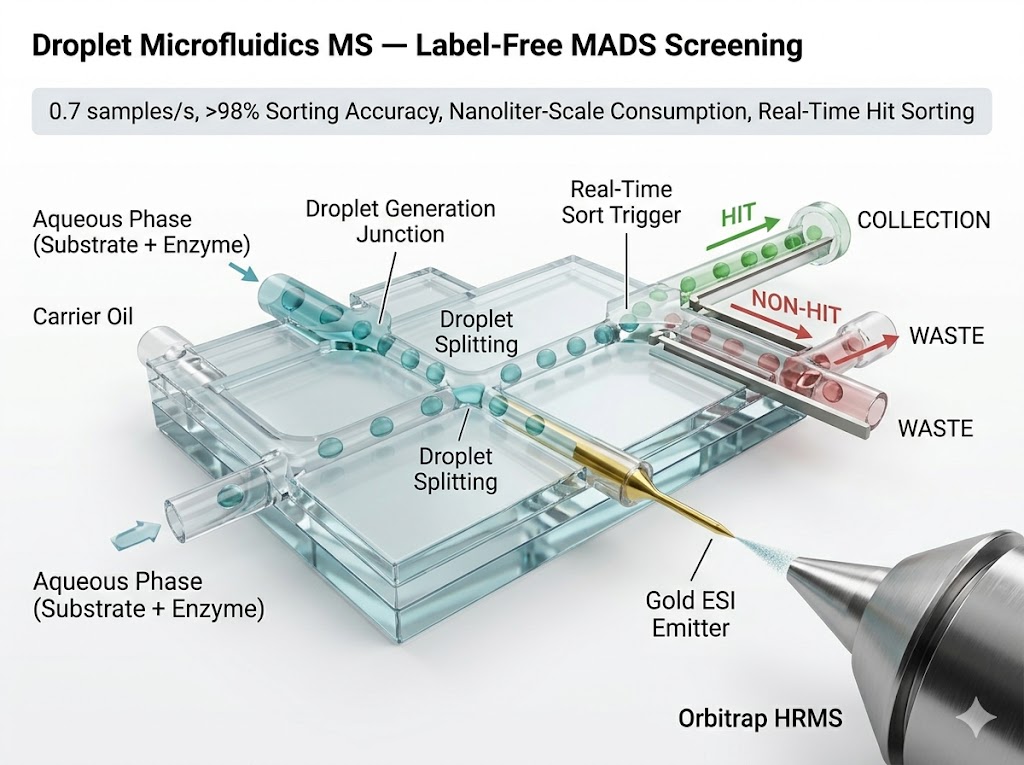
Droplet microfluidics mass spectrometry MADS screening platform diagram
What Is Droplet MS Service Overview Technology Comparison Workflow Sample Demo Case Study FAQ

What Is Droplet Microfluidics–Mass Spectrometry?

Droplet microfluidics–mass spectrometry integrates two technologies: microfluidic generation of monodisperse picoliter-to-nanoliter aqueous droplets separated by an immiscible carrier oil (typically a fluorinated oil such as HFE-7500), and direct mass spectrometric analysis of droplet contents via electrospray ionization. Each droplet functions as an isolated reaction compartment — confining enzymes, substrates, cells, or binding partners within a volume 1,000 to 1,000,000 times smaller than a typical microtiter plate well. The carrier oil prevents cross-contamination between droplets and enables thousands of discrete reactions to be queued in a single microfluidic channel.

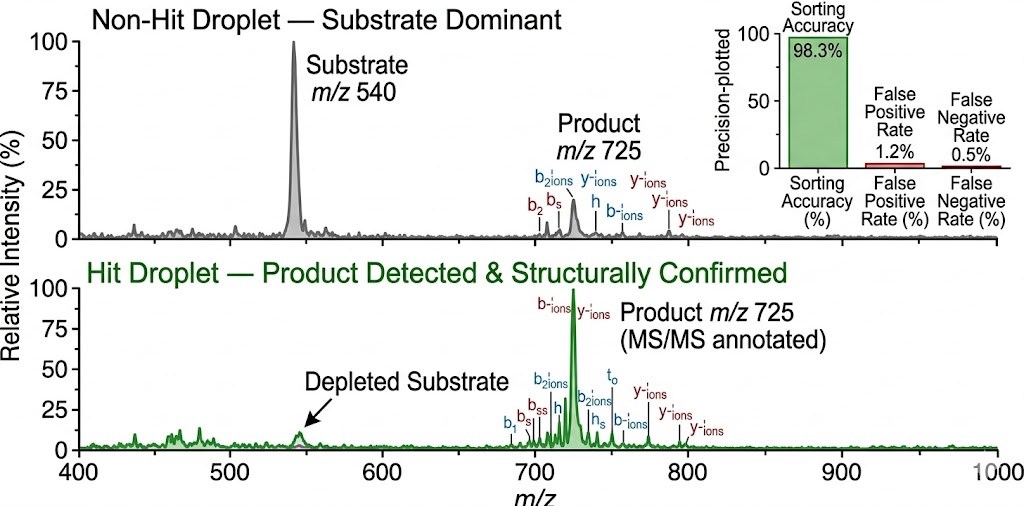
The defining capability of this platform is mass-activated droplet sorting (MADS). A droplet stream passes through a microfluidic splitter: a portion of each droplet (typically 5–20% by volume) is diverted to an ESI-MS inlet for real-time mass analysis, while the remainder continues through a sorting junction. Based on the MS spectrum — presence of a product ion at a defined m/z, a shift in protein–ligand complex mass, or depletion of a substrate peak — the corresponding parent droplet is directed to a collection channel or waste via dielectric sorting electrodes controlled by an FPGA-based real-time controller. This closes the screening loop: every reaction is analyzed by MS with structural confirmation, and hits are physically recovered for downstream validation, scale-up, or DNA sequencing. A recent review by Shepherd et al. (2025) highlights MADS as the fastest label-free MS-based screening method available for isomer discrimination and low-concentration substrates where fluorescent reporters are unavailable.

Key Advantages of Droplet Microfluidics MS

Label-Free Detection With Structural Confirmation

Every analyte is detected by its intrinsic mass-to-charge ratio. Tandem MS fragments provide simultaneous activity readout and chemical identity confirmation — no fluorescent tags, no antibody-based reporters, no engineered coupling enzymes. This is particularly valuable for isomer-resolving screens where optical methods cannot distinguish between regioisomeric or stereoisomeric products.

1,000-Fold Reduction in Reagent Consumption

Picoliter-to-nanoliter droplet volumes reduce enzyme, substrate, and cofactor consumption by three orders of magnitude versus 384-well plates. Screens requiring milligram quantities of protein in plate format consume micrograms in droplets — a critical advantage for precious enzyme variants, rare natural product substrates, or costly isotopically labeled reagents.

Real-Time Hit Sorting and Physical Recovery

MADS physically separates hit-containing droplets from non-hits during the screen via dielectric sorting. Recovered droplets can be re-injected for MS/MS confirmation, transferred to deep-well plates for scale-up, or subjected to DNA sequencing in directed evolution campaigns — establishing genotype–phenotype linkage without fluorescent reporters.

Multi-Parametric Readout From a Single Spectrum

A single mass spectrum resolves substrate, product, multiple intermediates, and potential side products simultaneously. This multi-parametric information — invisible to optical assays — directly informs structure–activity relationships and reaction mechanism, and can reveal unexpected catalytic activities that would be missed by single-wavelength readouts.

Service Overview

MODE 1

Enzyme Activity Screening & Directed Evolution

Encapsulate enzyme variants in individual droplets with substrate. MS detection of product formation enables label-free activity scoring at throughputs up to 0.7 samples/s. MADS sorting physically recovers active variants for downstream sequencing and round-by-round enrichment. Applied to transaminases, esterases, glycosidases, and cytochrome P450 variants — 15,000+ variants screened in under 6 hours. For detailed kinetic characterization of top hits, we recommend follow-up analysis through our enzyme kinetics via continuous-flow MS service to determine kcat, Km, and substrate specificity parameters.

MODE 2

Monoclonal Antibody Titer & Glycan Profiling

Encapsulate single antibody-secreting cells in droplets, incubate for secretion, and analyze supernatant by MS. Simultaneously quantify IgG titer and profile N-glycan structures from individual clones — resolving G0F, G1F, G2F, and sialylated glycoforms in a single spectrum. Identify top-producing clones with desired glycosylation patterns in a single integrated workflow: no separate titer ELISA and glycan HPLC required. The label-free MS readout detects productivity differences invisible to surface-staining FACS, enabling selection of clones that combine high specific productivity with clinically preferred glycoform distributions.

MODE 3

Protein–Ligand Binding Fingerprinting by IM-MS

Couple droplet introduction with ion mobility–mass spectrometry for collision-induced unfolding (CIU) fingerprinting of protein–ligand complexes. Droplet delivery at ~40 nL per sample achieves a 16-fold throughput increase over conventional nanoESI. Screen compound libraries against protein targets — including soluble proteins and membrane protein targets solubilized in MS-compatible detergents — and identify binders from CIU fingerprint shifts. This mode integrates with our broader high-throughput IM-MS and CCS profiling platform for collision cross-section-based compound screening, and with our automated compound–target binding HT-MS service for orthogonal binding confirmation in a higher-throughput format.

MODE 4

Reaction Condition Screening & Microdroplet Synthesis

Screen catalyst, solvent, stoichiometry, and temperature parameters in parallel droplet reactors with direct MS readout. Reaction acceleration in microdroplets (103–106-fold vs. bulk) enables rapid condition optimization — a phenomenon exploited to identify catalysts and conditions that would appear inactive in conventional flask-based screening. Hit conditions are recovered and scaled to preparative flow chemistry for product isolation and full characterization (NMR, HRMS, optical spectroscopy).

Workflow

1

Droplet Library Generation

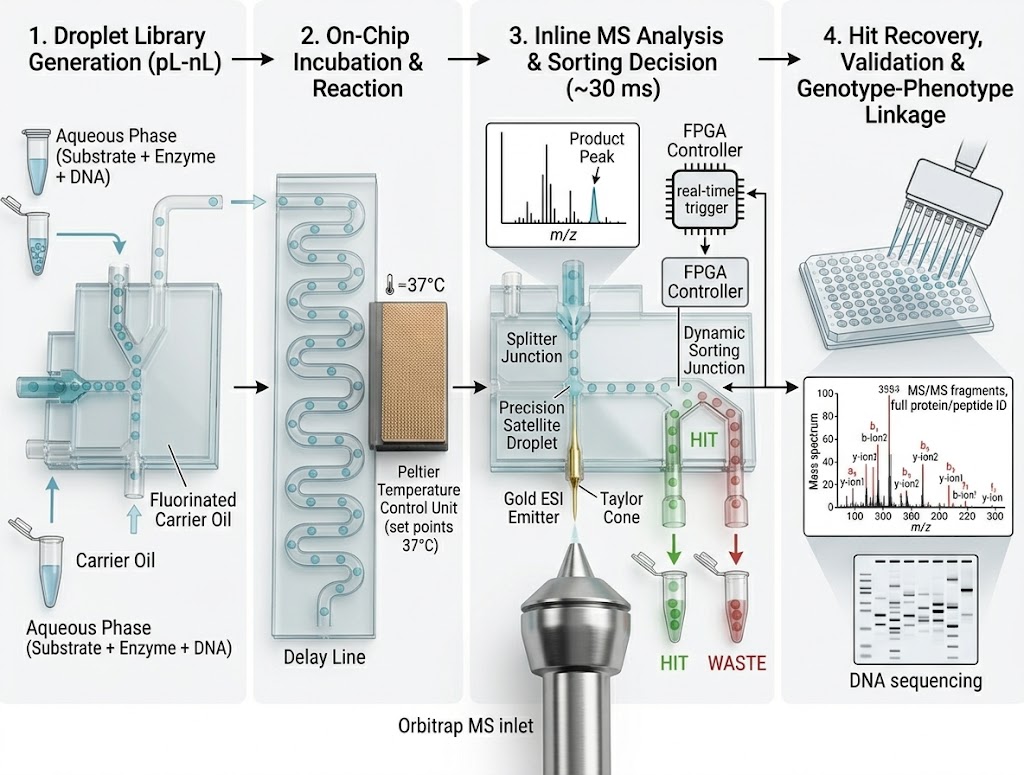
Enzyme variants, substrate mixtures, or compound libraries are co-encapsulated with reaction buffer in monodisperse pL–nL droplets using flow-focusing or T-junction microfluidic chips. Droplet generation frequency (0.3–2 Hz) is tuned to match downstream MS acquisition speed. Droplet monodispersity is verified by real-time optical imaging (CV<3%).

2

On-Chip Incubation & Reaction

Droplets transit through delay lines of defined length or are collected in on-chip reservoirs for controlled incubation (4–95 °C, Peltier-regulated). Temperature, residence time, and droplet spacing are precisely regulated to ensure uniform reaction progress across the library — critical for quantitative activity comparisons between variants.

3

Inline MS Analysis & Sorting Decision

A split portion of each droplet (5–20% volume) is diverted through a microfluidic side channel and ionized by ESI with sheath-flow carrier fluid removal to eliminate oil interference. High-resolution MS data are processed in real time: a software-defined intensity threshold for the target product or complex ion triggers the dielectric sorting junction within ~30 ms, directing the parent droplet to hit or non-hit collection channels.

4

Hit Recovery, Validation & Data Reporting

Sorted hit droplets are collected offline, re-analyzed by LC-MS/MS for structural confirmation of the product or complex, and transferred to 96-well plates for scale-up or DNA sequencing. Comprehensive report includes ranked hit lists, annotated MS and MS/MS spectra, activity rankings with Z-scores, MADS sorting statistics, and QC metrics.

Droplet microfluidics MS MADS workflow from library generation to hit sorting

Platform Instrumentation

ModuleInstrument / SystemCore Capability
Droplet GenerationFlow-focusing & T-junction microfluidic chips (glass/PDMS), syringe pumps with pulse-dampeningMonodisperse pL–nL droplets at 0.3–2 Hz generation frequency; CV<3%
Droplet SortingCustom MADS manifold with splitter junction, dielectric sorting electrodes, real-time MS-triggered FPGA controller>98% sorting accuracy at 0.7 samples/s; sorting decision latency ~30 ms
IonizationESI with orthogonal sheath-flow carrier fluid removal; optional nanoESI for low-flow operationCarrier oil interference eliminated via sheath dilution; stable spray at 0.5–2 μL/min effective flow
Mass SpectrometryOrbitrap ID-X Tribrid HRMS, Q Exactive HF, Sciex QTRAP 6500+High-resolution accurate mass (R > 120,000), MRM quantitation, MSn for structural ID

Technology Comparison

FeatureDroplet Microfluidics MS (MADS)Conventional Plate-Based HTSConventional LC-MS Screening
Detection ModeLabel-free, mass-based with structural confirmationFluorescence / absorbance / luminescenceLabel-free, mass-based with structural confirmation
Reaction VolumepL–nL10–100 μLμL–mL injection
Throughput0.3–0.7 samples/s (label-free)1–100 samples/s (labeled)0.01–0.05 samples/s
Structural InformationMS and MS/MS per data point; isomer discriminationNone (optical only)MS and MS/MS per data point
Hit RecoveryPhysical sorting inline; genotype–phenotype linkageWell address knownFraction collection off-line
Enzyme ConsumptionFemtomole–picomole per data pointNanomole per wellPicomole–nanomole per injection
Assay Development TimeMinimal (MS method only, hours)Weeks–months (fluorescent probe or coupled assay engineering)Minimal (MS method only, hours)
False Positive RiskLow (mass-confirmed)High (aggregation, autofluorescence, compound interference)Low (mass-confirmed)

Sample Requirements

Sample TypeRequired AmountCompatible Conditions
Enzyme / Protein Target5–50 μg total (femtomole–picomole per droplet)MS-compatible buffer (ammonium acetate, ammonium bicarbonate); avoid non-volatile salts (>50 mM), glycerol (>1%), and PEG-based surfactants that suppress ESI signal
Small-Molecule Substrate / Ligand Library1–100 μM per compound in droplet; total compound may be <1 mg for a full library screenDMSO stock (≤1% v/v in final droplet); aqueous solubility preferred for consistent droplet encapsulation
DNA / Enzyme Variant LibraryPlasmid or linear PCR product; concentration per cell-free expression kit protocolCell-free expression system (e.g., PURExpress or S30 extract) compatible with droplet format; fluorescent tagging NOT required
Whole Cells (Secretion Assays)104–106 cells/mL in droplet suspensionCulture medium compatible with cell viability in fluorinated oil emulsion; single-cell encapsulation verified by Poisson statistics

Deliverables

  • Ranked hit list with MS signal intensity, sorting decision (hit/non-hit), Z-score relative to plate median, and MS/MS confirmation data for each hit
  • Extracted ion chromatograms and annotated mass spectra for all sorted hits, with fragment ion assignments confirming product or complex identity
  • MADS sorting statistics: total droplets analyzed, sort rate (samples/s), sort accuracy (%), hit rate (%), carryover assessment from blank droplet controls
  • QC report: droplet monodispersity (CV%), size distribution histogram, MS system suitability, and carrier oil ESI suppression assessment
  • Recovered hit droplets in 96-well plate format (upon request, for downstream DNA sequencing, scale-up cultivation, or orthogonal validation)
  • Written interpretation of screening results with dose–response or kinetic profiling recommendations for top hits

Representative Demo Data

MADS droplet sorting MS spectra showing hit vs non-hit droplet mass spectra

Case Study

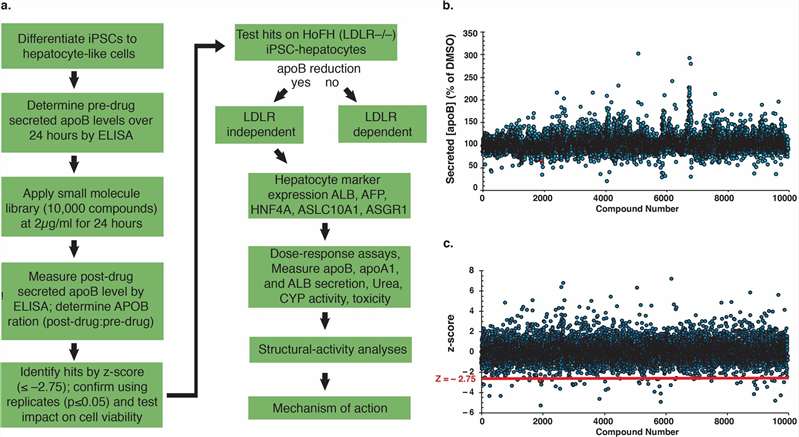
iPSC-Derived Hepatocyte Phenotypic Screen Identifies Novel ApoB-Lowering Compounds

Liu JT, Doueiry C, Jiang YL, Blaszkiewicz J, Lamprecht MP, Heslop JA, Peterson YK, Debrito Carten J, Traktman P, Yuan Y, Khetani SR, Twal WO, Duncan SA. (2023) A human iPSC-derived hepatocyte screen identifies compounds that inhibit production of Apolipoprotein B. Communications Biology, 6: 452.

Study design: Homozygous familial hypercholesterolemia (hoFH) patients lack functional LDL receptors, rendering statins and PCSK9 inhibitors ineffective. Existing apoB-lowering drugs cause hepatic steatosis — a dose-limiting side effect. The research team at the Medical University of South Carolina developed a phenotype-driven screening platform using human iPSC-derived hepatocytes to identify compounds that reduce apoB secretion without triggering abnormal lipid accumulation. From a ~130,000-compound library, ~10,000 representatives were screened, and hits were validated in humanized mouse livers. Creative Proteomics provided LC/MS-based bile acid profiling to confirm that lead compounds did not disrupt hepatocyte metabolic function, a critical safety endpoint for any apoB-targeted therapy.

Key results: The phenotypic screen identified a chemical series that reduced apoB secretion by >50% at sub-micromolar concentrations both in cultured hepatocytes and in mice with humanized livers — without inducing steatosis or elevating liver enzymes. LC/MS bile acid profiling confirmed that treated hepatocytes maintained normal bile acid homeostasis (cholic acid, chenodeoxycholic acid, and conjugated species within physiological ranges), distinguishing these compounds from lomitapide and other microsomal triglyceride transfer protein inhibitors. Critically, the lead compounds share a chemical scaffold unrelated to any known cholesterol-lowering drug, representing an entirely new therapeutic starting point for hoFH.

Relevance to our droplet MS services: This study exemplifies the type of label-free phenotypic screen that can be miniaturized onto our MADS platform. Each step in the workflow — compound dosing of hepatocytes, incubation, sampling of secreted apoB-derived peptides, and bile acid profiling — can be executed within picoliter-to-nanoliter droplets with inline ESI-MS readout. MADS eliminates the need for ELISA-based apoB detection and separate LC/MS bile acid runs, instead providing simultaneous quantitation of protein secretion endpoints and metabolite safety markers from each individual droplet. For drug discovery programs targeting metabolic diseases, this integrated readout — efficacy + hepatotoxicity in one measurement — compresses a weeks-long, multi-assay workflow into hours of automated droplet MS screening.

iPSC hepatocyte compound screen identifying apoB-lowering hits study figure

References

  1. Holland-Moritz DA, Wismer MK, Mann BF, Farasat I, Devine P, Guetschow ED, Mangion I, Welch CJ, Moore JC, Sun S, Kennedy RT. Mass Activated Droplet Sorting (MADS) Enables High-Throughput Screening of Enzymatic Reactions at Nanoliter Scale. Angew Chem Int Ed. 2020;59(11):4470–4477.
  2. Liu JT, Doueiry C, Jiang YL, Blaszkiewicz J, Lamprecht MP, Heslop JA, Peterson YK, Debrito Carten J, Traktman P, Yuan Y, Khetani SR, Twal WO, Duncan SA. A human iPSC-derived hepatocyte screen identifies compounds that inhibit production of Apolipoprotein B. Commun Biol. 2023;6:452.
  3. Shepherd RA, Fihn CA, Tabag AJ, McKinnie SMK, Sanchez LM. 'Need for speed: high throughput' – mass spectrometry approaches for high-throughput directed evolution screening of natural product enzymes. Nat Prod Rep. 2025;42(6):1037–1054.
FAQ

Frequently Asked Questions

Q: What types of reactions can be screened in droplet format?

Enzymatic reactions (hydrolases, oxidoreductases, transferases, lyases, isomerases), protein–ligand binding, antibody–antigen interactions, chemical synthesis reactions, and cell-based secretion assays are all compatible. The primary requirement is that reactants and products be soluble in aqueous buffer and detectable by ESI-MS within the mass range of the instrument (typically m/z 50–8,000). Reactions producing isomeric products — which optical assays cannot distinguish — are a particular strength of the MADS platform.

Q: How does MADS compare to FACS for enzyme screening?

FACS requires fluorescent substrates or coupled assays that produce fluorescent products — adding weeks to months of assay development time and introducing potential artifacts from fluorophore interference with enzyme active sites. MADS detects the native substrate and product directly by mass, eliminating fluorescent label constraints. MADS throughput (0.7 samples/s) is lower than FACS (kHz rates), but the information content per data point is far higher: each MS spectrum provides structural confirmation of product identity alongside quantitation, and isomer discrimination is inherent to the mass-based readout. For enzymes lacking known fluorescent substrates — which describes the majority of biosynthetic enzymes — MADS is the fastest label-free screening option available.

Q: What is the sorting accuracy and how is it validated?

Sorting accuracy exceeds 98%, validated by re-analyzing sorted droplets off-line by LC-MS/MS and comparing the MS signal of sorted "hit" versus "non-hit" populations. Accuracy is maintained by real-time MS triggering with software-defined intensity thresholds and self-correcting adaptive algorithms, and by periodic blank oil-only droplets that verify absence of cross-contamination between sorted populations. We report sorting accuracy, false positive rate, and false negative rate for every campaign.

Q: Can you screen membrane protein targets?

Yes. Membrane proteins solubilized in MS-compatible detergents (e.g., C8E4, DDM, or maltoside-based surfactants) can be encapsulated in droplets for ligand binding screens. Ion mobility–MS coupled with droplet introduction is particularly effective for membrane protein targets, as collision-induced unfolding (CIU) fingerprints detect ligand binding through changes in gas-phase unfolding behavior without requiring high-resolution structural data. Our high-throughput IM-MS and CCS profiling service provides complementary ion mobility capabilities for larger screening campaigns needing collision cross-section-based hit identification.

Q: How many variants can be screened in a typical campaign?

A standard MADS campaign screens 10,000–20,000 variants in a single day (approximately 6 hours of continuous operation at 0.5–0.7 samples/s). Larger libraries (50,000+) can be accommodated by running multiple sessions with staggered droplet generation. We recommend tiered screening strategies: a primary MADS screen at 0.7 samples/s to identify active variants, followed by dose–response or kinetic profiling of top hits using our enzyme activity and reaction mechanism analysis service to quantify kcat, Km, and substrate specificity for the most promising candidates.

Q: Can I recover and scale up hits identified by MADS?

Yes. Sorted hit droplets are collected in 96-well plates. For enzyme variants expressed in cell-free systems, the collected droplets contain the encoding DNA template — enabling PCR recovery and sequencing of active variants to establish genotype–phenotype linkage. For whole-cell screening (e.g., secretion assays), sorted droplets contain viable cells that can be plated for colony recovery. For chemical reactions, hit droplets can be pooled and the products isolated by preparative LC or scaled directly in flow chemistry systems. This connects seamlessly with our broader microfluidics and emerging MS platforms service suite for integrated screening-to-characterization workflows.

Accelerate Your Screening Campaign With Label-Free Droplet MS

From enzyme engineering and mAb clone selection to protein–ligand binding fingerprinting and whole-cell biocatalyst screening, our droplet microfluidics MS platform delivers the throughput of miniaturized screening with the information content of high-resolution mass spectrometry. Contact our team to discuss your target, library, and screening objectives — we will design a MADS workflow tailored to your specific analyte chemistry and throughput requirements.

Online Inquiry

Please submit a detailed description of your project. We will provide you with a customized project plan to meet your research requests. You can also send emails directly to for inquiries.

* Email
Phone
* Service & Products of Interest
Services Required and Project Description