AirID In Vivo Proximity Labeling CRO Service

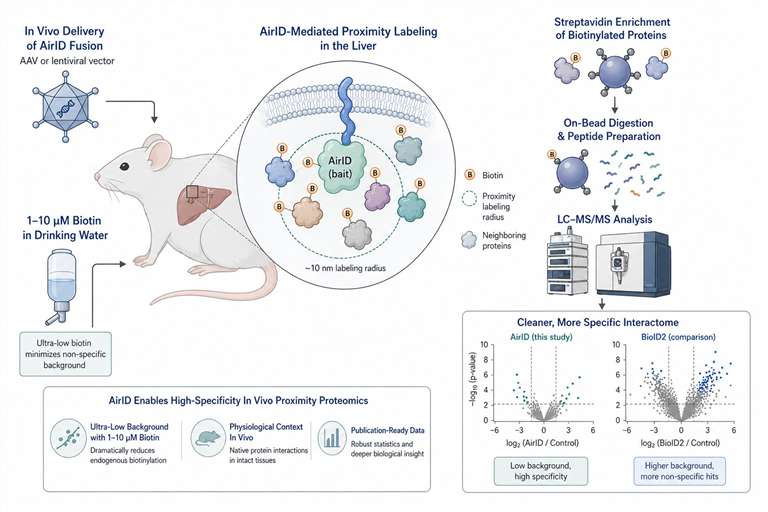
Cleaner in vivo interactomes start with lower background. AirID delivers them.

Our AirID proximity labeling service provides ultra-low-background proteomics optimized for animal models—from viral delivery to publication-ready interaction networks, with less noise and fewer false positives.

You've run the BioID2 experiment in vivo. You've validated the hits. And too many turned out to be noise—endogenous biotinylated proteins, metabolic artifacts, background that built up over long labeling windows. The real interactors are in there somewhere, buried under false positives.

AirID changes that. It's an engineered biotin ligase that produces dramatically less background than BioID2, works with far lower biotin concentrations, and labels for up to 48 hours without accumulating a haze of non-specific signal. For in vivo work—where you can't just wash away background and you can't risk losing your animal model to toxicity—that's the difference between a candidate list you trust and one you chase.

We've built a complete in vivo AirID workflow around this advantage. Viral packaging. Animal dosing. Tissue harvest. Mass spectrometry. All connected, all optimized for low background from the start. What you get is a cleaner shortlist of interactors you can take straight into validation.

Key Advantages:

  • Ultra-low background, ideal for in vivo
  • Full workflow: virus, animal, tissue, MS
  • Optimized for low biotin concentrations
  • Publication-ready, traceable data
AirID low background proximity labeling service

What Is AirID and Why It Outperforms in Low-Background Labeling

AirID is a proximity-dependent biotin ligase engineered from the ancestral BirA enzyme. Same basic principle as BioID and BioID2: fuse it to your protein, add biotin, and it tags everything within about a 10-nanometer radius. The difference? It's cleaner.

The enzyme produces far fewer reactive biotin-AMP intermediates that escape the active site and cause non-specific background. What does that mean in practice? You label longer (24 to 48 hours). You use less biotin (as low as 1 µM). And you don't accumulate the noise that makes BioID2 or TurboID in vivo experiments painful to interpret.

Where this matters. Working in a mouse model, feeding biotin over several days to capture a developmental process? AirID gives you the extended window without the background tax. Your model is sensitive to high biotin? AirID's low-concentration efficiency keeps your animal physiology intact. Validating heterobifunctional degrader targets and need minimal false positives? AirID gives you the cleanest list in the toolbox.

Our AirID Service Advantage: Proven Low-Background Workflows for In Vivo Applications

AirID isn't just a different enzyme you drop into a generic protocol. It works best when the whole pipeline—biotin concentration, wash stringency, labeling duration—is tuned around its low-background design. We've done that tuning across multiple tissue types and time windows.

What you get when you work with us:

  • Background you can see—before the mass spec. We run side-by-side streptavidin-HRP blots comparing your AirID sample to a BioID2 or TurboID equivalent. The difference is on film. If background isn't where it should be, we troubleshoot before your samples ever hit the expensive step.
  • Full in vivo workflow. One provider. No handoffs. We package your AirID construct into AAV or lentivirus. We handle the injections. We manage the biotin feeding regimen. We perfuse and harvest tissues. We enrich. We run the LC‑MS/MS. You don't coordinate three labs or worry about a virus sitting in a freezer.
  • Biotin dosing that respects your model. We've optimized AirID protocols with biotin as low as 1 µM in drinking water or diet—far below levels that cause metabolic side effects. Your labeled proteome reflects your biology, not biotin stress.
  • Controls that make low background interpretable. Every project includes a matched negative control: empty vector, non-targeting bait, or BirA*-dead AirID. Without it, low background can look like a failed experiment. With it, you know your hits are real.
  • One scientist, start to finish. The same PhD-level scientist oversees your virus prep, your animal cohort, your tissue processing, and your data analysis. No triage desk. No handoffs.

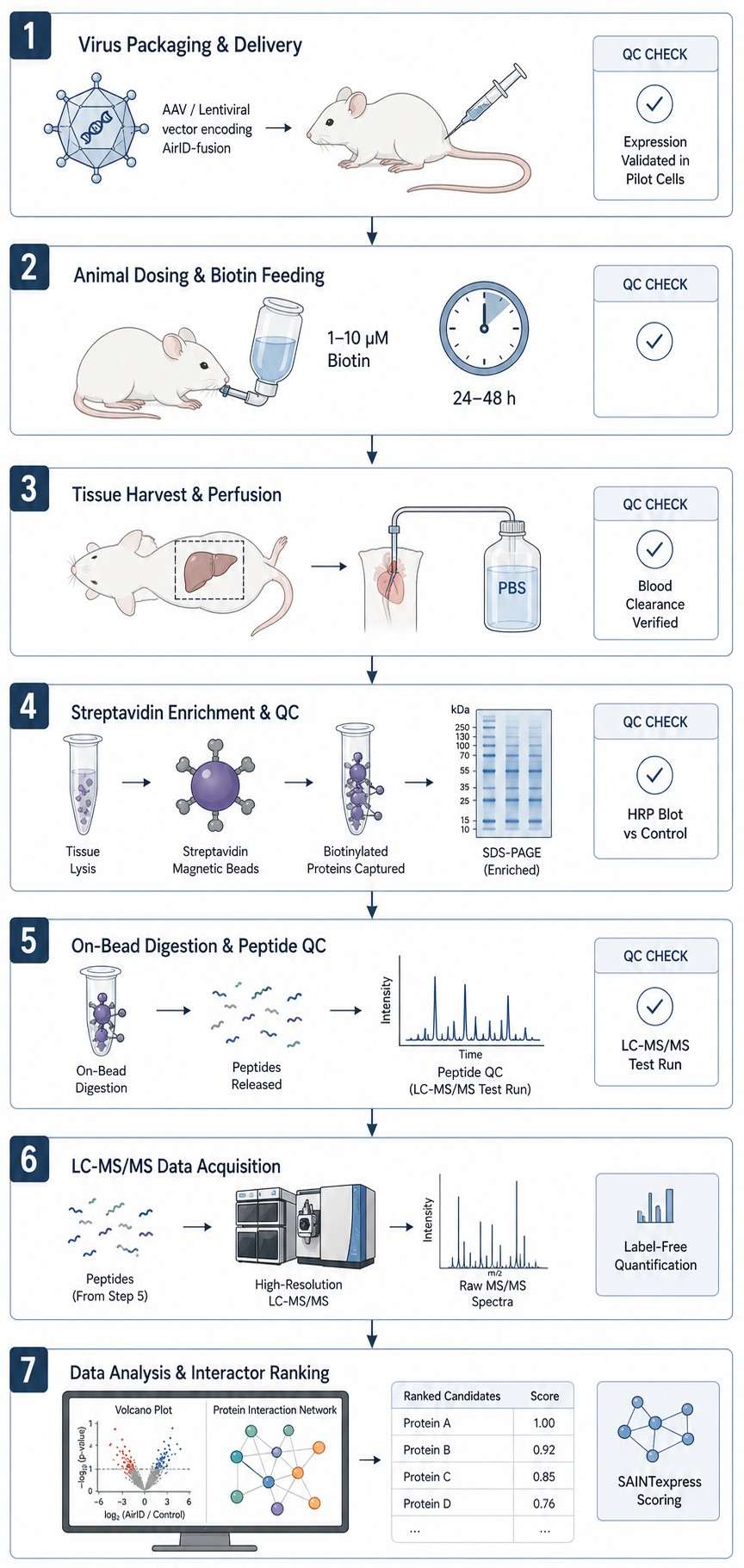
AirID Experimental Workflow & QC Checkpoints

Here's the path your samples take—and the gates we check before moving on.

1

Virus packaging and delivery

No construct yet? We design and clone it. We package AAV or lentivirus, titer it, and validate expression in a pilot cell line before any animal gets an injection.

2

Animal dosing and biotin feeding

Virus goes to your target tissue by the appropriate route. Biotin is supplied in drinking water or diet at the optimized low concentration. We monitor animal health throughout labeling—typically 24 to 48 hours. AirID can go longer.

3

Tissue harvest and perfusion

Animals are perfused with PBS to clear blood-borne biotinylated proteins—a major background source in vivo. Tissues are dissected, snap-frozen, stored at -80°C.

4

Streptavidin enrichment and QC

Denaturing lysis. Streptavidin bead capture. Stringent washes. An aliquot on SDS-PAGE with streptavidin-HRP must show a pattern clearly distinct from the negative control. We also run a side-by-side against BioID2 if you've provided one, so you see the background difference.

5

On-bead digestion and peptide QC

Reduction, alkylation, trypsin directly on the beads. A quick LC‑MS/MS run confirms complexity and chromatographic quality.

6

LC‑MS/MS data acquisition

Nano-flow UPLC coupled to high-resolution MS in data-dependent acquisition. Label-free quantification across your conditions.

7

Data analysis and interactor ranking

Raw files searched against the appropriate database. Enriched proteins called by comparing AirID to the negative control using SAINTexpress or equivalent. You get a ranked list of high-confidence, low-background interactors.

AirID proximity labeling workflow diagram

Representative AirID Proteomics Results

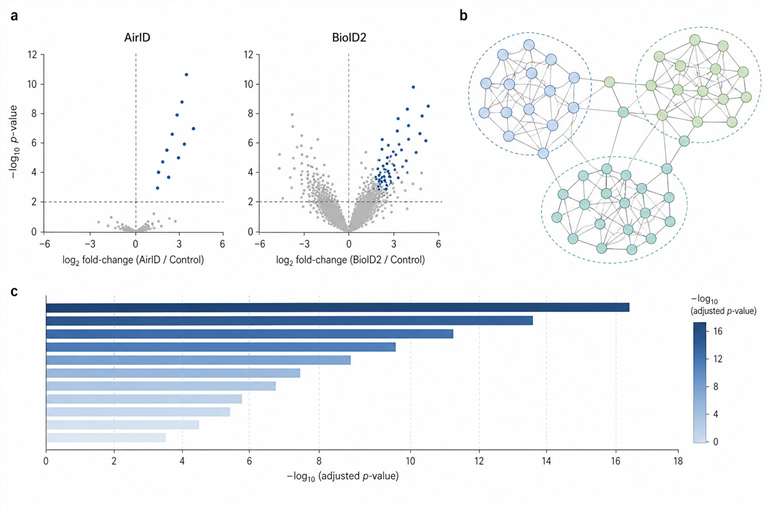
Here's what you'll receive. The example compares an AirID-tagged bait to a BioID2 equivalent, both in mouse liver. Same formats apply regardless of your tissue or model.

AirID proteomics demo results volcano plot network and enrichment

Side-by-side volcano plots, interaction network, and GO enrichment

1. Side-by-side volcano plots. Two plots, identical scales. On the AirID side: fewer grey dots hugging the baseline—lower background. On the BioID2 side: a wider smear of non-significant signal. The enriched proteins (blue, upper right) are largely the same—AirID doesn't miss real biology—but the false discovery background is visibly smaller. One look tells you the AirID experiment ran cleaner.

2. Interaction network. High-confidence AirID interactors become nodes, edges showing known or predicted associations. Clusters resolve into clear modules—metabolic enzyme complexes, junctional proteins, signaling cascades. Because background is lower, the network is sparser. Easier to read. You're looking at biology, not a hairball.

3. GO enrichment. Enriched terms—biological process, molecular function, cellular component—displayed as bar or bubble charts. The terms that emerge map cleanly to your tissue and bait. Liver bait? You see metabolic processes and apical junctions. No generic "cytosolic ribosome" contamination from background noise.

Sample Submission Requirements for AirID Projects

Most in vivo AirID projects start with a construct you've already validated in cells. The table below covers the common entry points.

Sample TypeRecommended InputContainerShipping ConditionsQC CheckpointsNotes
Adherent or suspension cells (for pilot)≥1×10⁷ cellsSnap-frozen pelletDry ice (−80°C)Viability ≥90%; Mycoplasma‑freeInclude empty vector or parental control
Transfected cells (transient, for pilot)≥1×10⁷ cellsSnap-frozen pelletDry ice (−80°C)Confirm expression by western blotProvide plasmid map and sequence
Mouse tissue (post-labeling)20–50 mg per tissueSnap-frozen, wrapped in foilDry ice (−80°C)Perfusion with PBS prior to harvestInclude tissue from negative control animal
Purified plasmid or viral prep1–2 µg plasmid or ≥10¹¹ GC virusTE buffer or sterile PBSIce packs (4°C) or dry iceTiter verified prior to shipment (virus)Coordinate with our team before shipping live virus

Got a model not listed here? Rat, zebrafish, xenograft—send us a note. We'll confirm feasibility quickly.

Bioinformatics Analysis & Data Deliverables

Core deliverables come standard. Add-ons are there when you need them.

Included with every project:

  • Raw MS files (.raw and .mzML formats), downloadable from your secure portal
  • Protein identification and label-free quantification matrix (.csv or .xlsx)
  • List of significantly enriched proteins, with fold-change, p-value, and confidence score
  • QC summary: streptavidin-HRP blot, enrichment gel, chromatographic metrics, in vivo health monitoring log

Available as add-ons:

  • Cytoscape-ready interaction network files and publication-quality figures
  • GO, KEGG, and Reactome pathway enrichment with downloadable result tables
  • Custom volcano plots, heatmaps, and Venn diagrams
  • Extended statistical analysis: SAINTexpress scoring, permutation-based FDR
  • A written methods section ready for your manuscript

All files through a secure portal. Raw data archived at least 12 months after project close.

Choosing the Right Proximity Labeling Enzyme for Your Research

Not every enzyme fits every question. Here's the honest comparison.

FeatureBioIDBioID2TurboIDminiTurboAirID
Labeling time18–24 hours6–24 hours10–60 minutes10–60 minutes24–48 hours
Background levelLowLow-ModerateModerateLowUltra-Low
Biotin concentration50 µM (cell)50 µM (cell)50–100 µM50 µM1–10 µM
In vivo suitabilityLimitedGoodModerateGoodExcellent
Key advantageProven broadlyCompact; in vivo-readyFast kineticsFast + low backgroundLowest background; in vivo-optimized
Best forGeneral mappingIn vivo, low toxicityCell lines, acute stimuliDynamic signalingLong-term in vivo, low-abundance targets, degrader validation

Our honest take:

  • In vivo and need the cleanest possible interactome? AirID. Ultra-low background, efficient at low biotin, built for long windows.
  • Already using BioID2 or TurboID and tired of chasing false positives? Switch to AirID. You'll see the difference on the first streptavidin-HRP blot.
  • Need fast signaling snapshots in cell culture? That's miniTurbo territory—speed without the light gear.
  • Not sure? Describe your model and your biggest background headache. We'll help you pick during the feasibility review.

Frequently Asked Questions

Q: What makes AirID better than BioID2 for low-background experiments?

AirID was engineered from ancestral BirA to leak fewer reactive biotin-AMP intermediates from its active site. Less leakage, less non-specific background. You see the difference on streptavidin-HRP blots and in your mass spec candidate list. It's not subtle.

Q: Can AirID be used for long-term labeling with low biotin?

That's exactly where it shines. We routinely label for 24–48 hours with biotin at 1 µM in cell culture or drinking water. BioID2 and TurboID typically need higher biotin and pick up more background the longer they run.

Q: What controls should I use?

A matched negative control is essential: empty vector, non-targeting bait, or BirA*-dead AirID. For in vivo, littermate controls without the AirID construct but with the same biotin regimen are ideal. We'll define the best control for your model during experimental design.

Q: Is AirID suitable for in vivo animal models?

Yes—it's the most in vivo-compatible proximity labeling enzyme available. Low biotin means less metabolic interference. Low background means fewer false positives from endogenous biotinylated proteins that are abundant in tissues like liver and kidney.

Q: How does AirID compare to TurboID for background and toxicity?

TurboID is fast—10 to 60 minutes—but comes with moderate background and needs high biotin (50–100 µM) that can be toxic in vivo. AirID is slower (24–48 hours) but dramatically cleaner and biocompatible at 1–10 µM biotin. Speed or cleanliness? For in vivo, we usually recommend cleanliness.

Case Study: AirID Validates Heterobifunctional Molecule Interactome

Yamada, K., et al. (2025) Commun Biol, 8, 1323

Background

Heterobifunctional molecules—PROTACs and molecular glues—induce proximity between a target protein and an E3 ligase, marking the target for degradation. Validating these ternary, transient interactions is hard: they fall apart during lysis, and conventional immunoprecipitation often misses them. You need a proximity labeling method with low background and minimal cellular perturbation—exactly what AirID delivers.

Methods

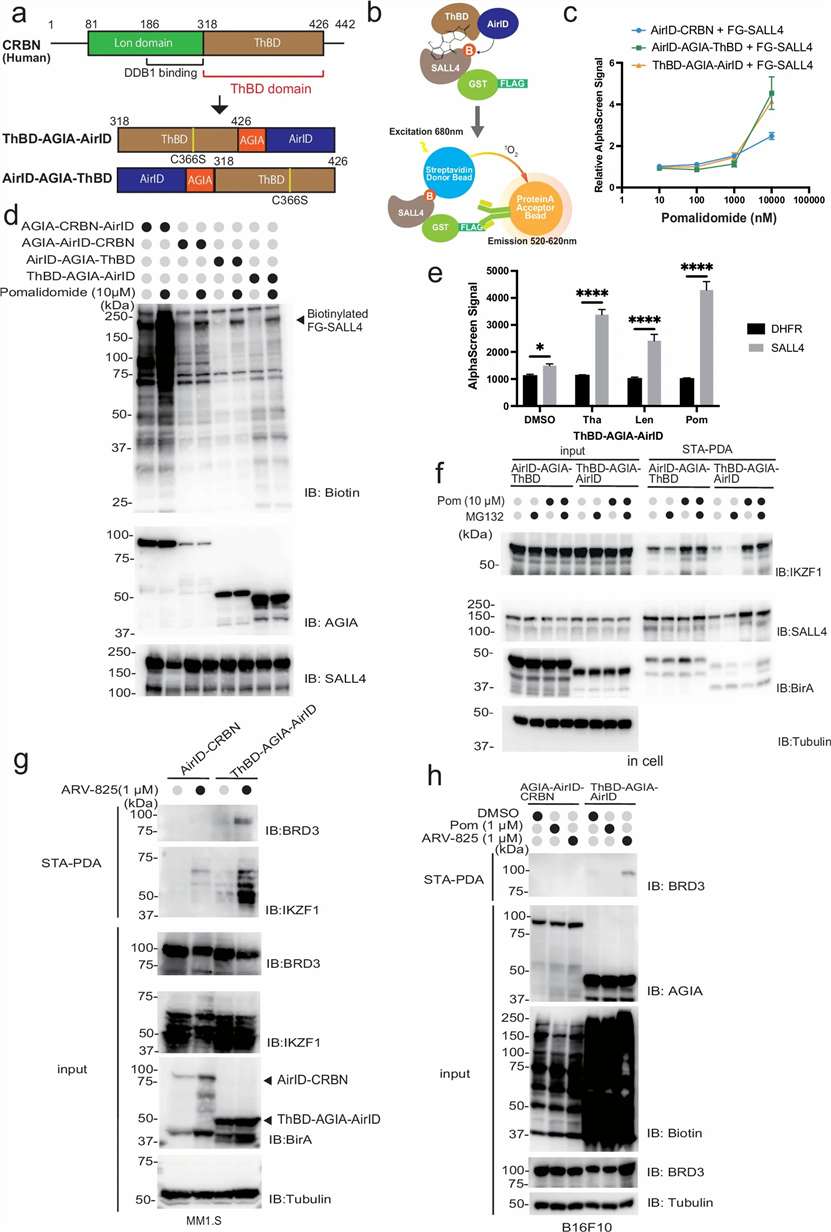
Yamada et al. (2025, Commun Biol) built ThBD-AirID, fusing a thalidomide-binding domain (ThBD) to AirID, and expressed it in HEK293T cells. This construct acts as a universal proximity probe for any CRBN-recruiting heterobifunctional molecule. When a PROTAC bridges a target protein to CRBN, the probe is recruited, and AirID labels the target's nearby proteins. Biotinylated proteins were enriched and identified by quantitative mass spectrometry. A TurboID equivalent was run in parallel to benchmark background and specificity.

Results

ThBD-AirID successfully labeled known PROTAC targets including BRD4 and FKBP12, with significantly lower background than the TurboID construct (see Figure 3 of the original paper). AirID's reduced biotin-AMP leakage meant labeling was predominantly proximity-dependent, not driven by non-specific biotinylation. The clean background enabled the team to distinguish subtle interactome changes induced by different PROTAC chemotypes, separating warhead-specific from E3 ligase-dependent effects.

Conclusion

This study shows AirID's core value for degrader target validation: cleaner signal means fewer false-positive ubiquitination targets to chase down and less wasted validation effort. For any group developing heterobifunctional degraders, this approach provides the cleanest proximity evidence short of structural biology. That's the confidence our AirID service is designed to produce—project after project.

AirID ThBD fusion proximity labeling PROTAC interactome validation

Figure 3. AirID validates heterobifunctional molecule interactomes, revealing E3 binder-dependent proximity proteins. (Adapted from Yamada et al., 2025, Commun Biol, Open Access)

Disclaimer: Creative Proteomics services are for research use only. They are not intended for clinical diagnostic or therapeutic purposes.

Online Inquiry

Please submit a detailed description of your project. We will provide you with a customized project plan to meet your research requests. You can also send emails directly to for inquiries.

* Email
Phone
* Service & Products of Interest
Services Required and Project Description