LC-HRMS/MS Dereplication Service for Natural Product Identification

Accelerate natural product discovery by rapidly identifying known compounds in complex extracts.

LC-HRMS/MS dereplication is a targeted analytical strategy that identifies known natural products in complex extracts by matching high-resolution mass spectrometry data against comprehensive compound databases. For natural product chemists and drug discovery teams, this service eliminates the costly and time-consuming re-isolation of previously characterized molecules, allowing you to focus resources on truly novel or bioactive compounds.

At Creative Proteomics, our LC-HRMS/MS dereplication service integrates high-resolution mass spectrometry, extensive natural product databases, and expert-led annotation workflows to deliver confident compound identifications from plant, microbial, marine, and fungal extracts.

Key Advantages:

  • Comprehensive database coverage including Dictionary of Natural Products (DNP), GNPS, PubChem, and AntiBase.
  • High-confidence annotations with MS/MS spectral matching, retention time alignment, and expert manual verification.
  • Fast turnaround — standard dereplication reports delivered within 2–3 weeks.
  • Flexible sample acceptance — plant extracts, microbial broths, marine organisms, and purified fractions.
  • Integrated molecular networking (GNPS-compatible) to visualize known vs. novel compound clusters.
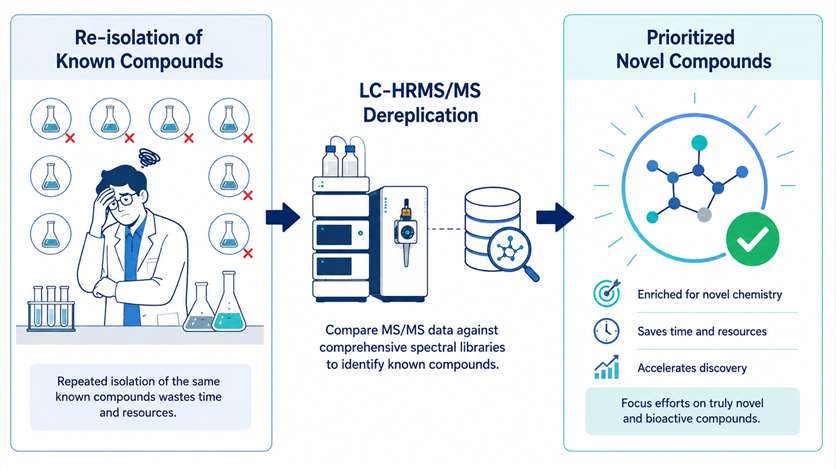
LC-HRMS/MS dereplication service overview — pain point of re-isolation of known compounds solved by high-resolution MS/MS database matching to prioritize novel natural products.
What Is Dereplication Workflow Capabilities Sample Demo Case Study Comparison FAQ

What Is LC-HRMS/MS Dereplication and Why Does It Matter?

Dereplication is the process of rapidly identifying known compounds in a complex mixture before committing to full-scale isolation and structural elucidation. In natural product research, where extracts can contain hundreds to thousands of metabolites, dereplication serves as a critical triage step — it tells you what you already have so you can focus on what is new.

LC-HRMS/MS dereplication combines the separation power of liquid chromatography with the mass accuracy and fragmentation information of high-resolution tandem mass spectrometry. By comparing experimental MS and MS/MS data against curated natural product databases, we can assign putative identities to detected features with varying levels of confidence. This approach dramatically reduces the risk of re-isolating known compounds — a problem that, according to some estimates, affects up to 90% of hits in natural product screening campaigns.

For drug discovery teams, the value is clear: every known compound identified early in the pipeline saves weeks of isolation work, conserves precious sample material, and accelerates the path to novel chemical entities.

Our LC-HRMS/MS Dereplication Workflow

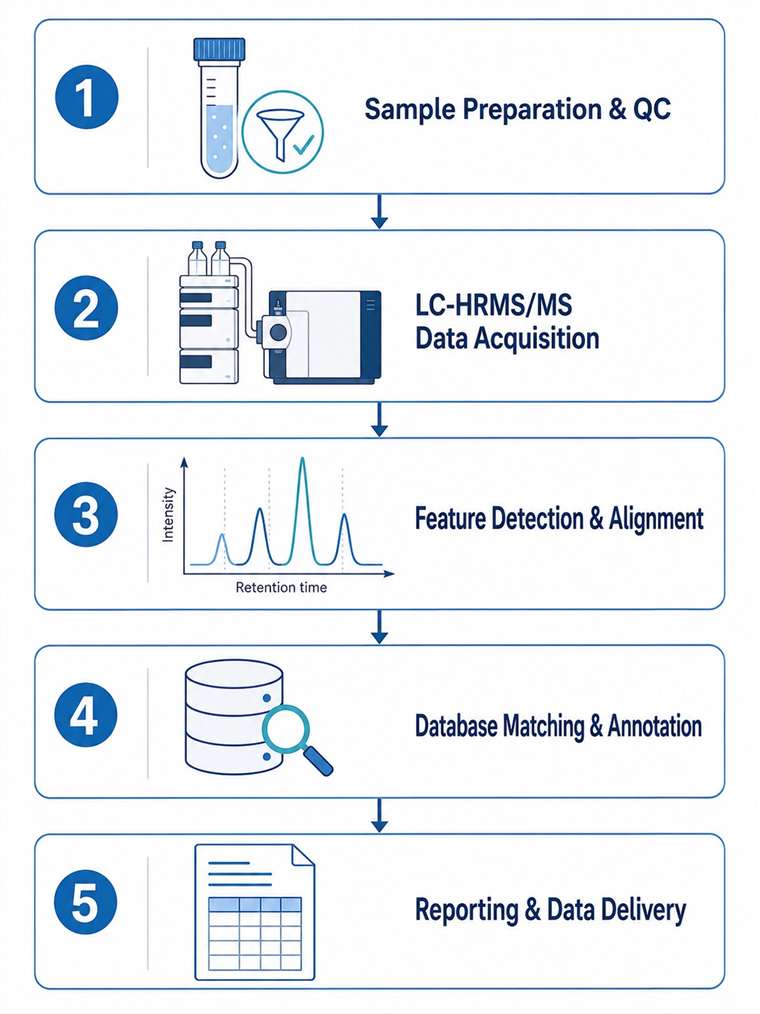
Our dereplication workflow is designed to maximize annotation confidence while maintaining throughput. The process follows five key stages:

1

Sample Preparation & Quality Check

Extracts are filtered, diluted to optimal concentration, and spiked with internal standards. A quick LC-MS QC run confirms sample suitability before full acquisition.

2

LC-HRMS/MS Data Acquisition

Samples are analyzed on a high-resolution QToF or Orbitrap mass spectrometer using data-dependent acquisition (DDA) or data-independent acquisition (DIA) modes, generating both MS1 and MS/MS spectra.

3

Feature Detection & Alignment

Raw data are processed using peak-picking algorithms (e.g., MZmine, XCMS) to detect, align, and quantify features across samples. Retention time, m/z, and intensity are recorded for each feature.

4

Database Matching & Annotation

MS1 accurate mass and MS/MS fragmentation patterns are matched against multiple databases (DNP, GNPS, PubChem, AntiBase, in-house libraries). Confidence scores are assigned based on match quality.

5

Reporting & Data Delivery

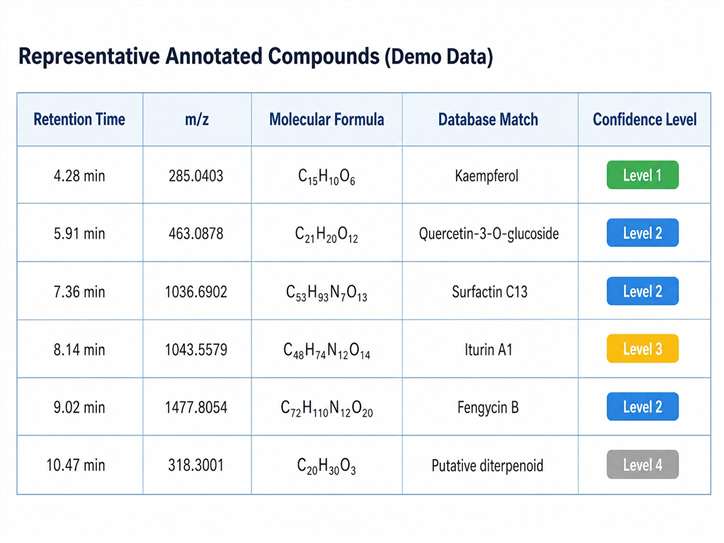
An annotated compound table is delivered with retention time, m/z, molecular formula, database match, confidence level, and MS/MS match spectra. Optional molecular networking visualization is available.

LC-HRMS/MS dereplication workflow diagram showing five steps: sample preparation, data acquisition, feature detection, database matching, and reporting.

To explore related techniques, see:

Key Capabilities of Our Dereplication Platform

Comprehensive Database Coverage

Our dereplication pipeline integrates multiple natural product databases to maximize annotation coverage:

  • Dictionary of Natural Products (DNP) — over 170,000 natural product entries with structural and physicochemical data.
  • GNPS (Global Natural Products Social Molecular Networking) — community-curated MS/MS spectral library with hundreds of thousands of reference spectra.
  • PubChem — >100 million compounds with bioassay data.
  • AntiBase — focused microbial natural product database.
  • In-house reference libraries — curated MS/MS spectra for common natural product classes.

High-Resolution Mass Spectrometry

  • Mass accuracy < 3 ppm (typical < 1 ppm with internal calibration).
  • Resolution > 30,000 (FWHM) for confident molecular formula assignment.
  • DDA and DIA acquisition modes for comprehensive MS/MS coverage.
  • Retention time reproducibility < 0.1 min for confident cross-sample alignment.

Multi-Level Annotation Confidence

We report annotations with clearly defined confidence levels:

  • Level 1 (Confirmed): Match with reference standard (retention time + MS/MS).
  • Level 2 (Putative): High-quality MS/MS match to database spectrum.
  • Level 3 (Tentative): MS1 accurate mass match with formula assignment.
  • Level 4 (Unknown): No database match — candidate for novel compound prioritization.

Sample Requirements for Dereplication Analysis

Sample TypeRecommended AmountConcentrationPreparationNotes
Plant Extract (crude)1–5 mg≥ 0.1 mg/mLFiltered (0.22 μm)Provide extraction solvent and method
Microbial Fermentation Extract0.5–2 mg≥ 0.1 mg/mLFiltered; remove culture media componentsInclude strain information and culture conditions
Marine Organism Extract1–3 mg≥ 0.1 mg/mLDesalting recommendedHigh salt content may affect ionization
Purified Fraction0.1–1 mg≥ 0.05 mg/mLAs suppliedProvide fractionation method if available
Dried Extract Powder2–10 mgN/A (reconstituted in lab)Reconstitute in MS-compatible solventProvide solubility information

Note: For sample types not listed here, please contact our team. We routinely handle a wide variety of natural product matrices and can advise on optimal preparation for your specific sample.

Representative Dereplication Results

Our dereplication reports provide a comprehensive view of the chemical composition of your extract. Below are representative examples of the data you can expect.

Annotated compound table showing retention time, m/z, molecular formula, database match, and confidence score for dereplication results.

Annotated compound table with database matches

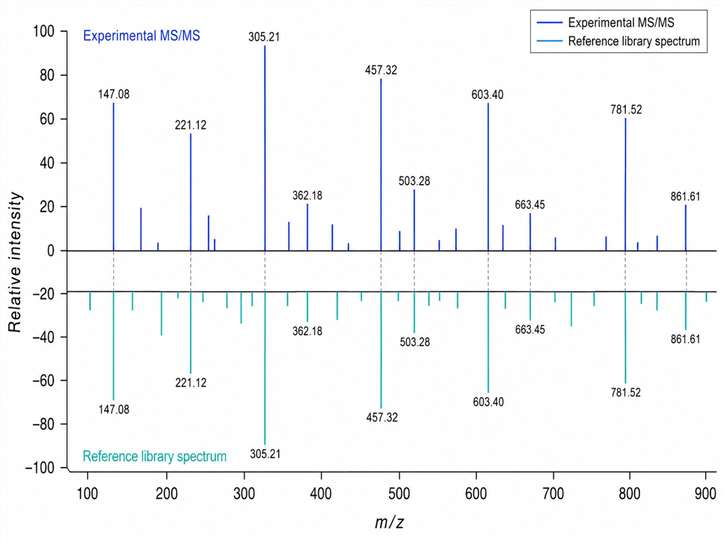
MS/MS spectral match overlay showing experimental versus library reference spectrum for a dereplication hit.

MS/MS spectral match visualization

Molecular Network Visualization (Optional)

For projects involving multiple extracts or fractions, we can generate molecular networks (GNPS-compatible) that cluster related compounds based on MS/MS spectral similarity. Known compounds appear in established clusters, while unannotated nodes represent candidates for novel compound discovery. This approach is particularly powerful for comparing bioactive vs. non-bioactive fractions.

Case Study: LC-MS-Based Dereplication of Bioactive Natural Products from Gabonese Medicinal Plants

Otogo N'nang E, Essone PN, Ella Ndong J, et al. "LC-MS based analysis reveal antimicrobial compounds from Gabonese pharmacopoeia: chemical characterisation and cytotoxicity evaluation." Frontiers in Natural Products 3:1478361 (2024). https://doi.org/10.3389/fntpr.2024.1478361

Background

Natural product researchers investigating Gabonese medicinal plants needed to rapidly identify known antimicrobial compounds in complex plant extracts to prioritize fractions for further isolation. Traditional bioassay-guided isolation often leads to re-discovery of known molecules, wasting time and resources.

Methods

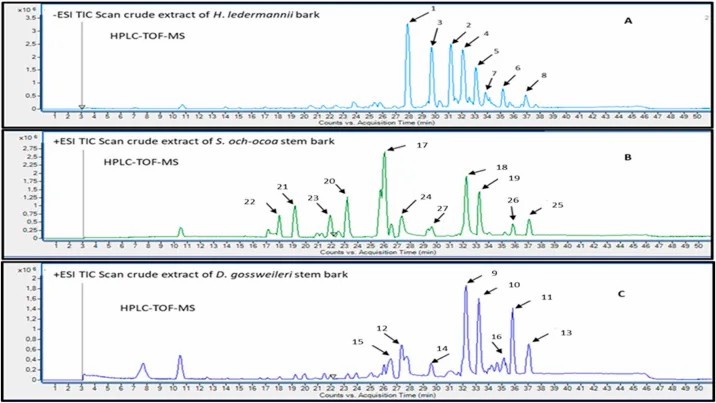
Otogo N'nang et al. (2024) applied an LC-ESI-MS-guided dereplication workflow to three active plant extracts (Hymenocardia ledermannii, Distemonanthus gossweileri, and Sacoglottis ochocoa). Crude extracts were analyzed by HPLC-QTOF-HRMS/MS in data-dependent acquisition mode. The resulting MS and MS/MS data were matched against the Dictionary of Natural Products and other spectral libraries to identify known compounds. Active extracts were further evaluated for cytotoxicity against human cell lines.

Results

The LC-MS dereplication workflow enabled the identification of 27 compounds across the three active extracts, including triterpenoid saponins, dibenzofurans, and flavonoids — many of which are known antimicrobial natural products. By identifying these known compounds early, the researchers could focus isolation efforts on the most promising fractions containing potentially novel bioactive molecules. Three extracts showed significant antimicrobial activity against Gram-positive bacteria, and two extracts demonstrated acceptable cytotoxicity profiles in the Galleria mellonella model.

Conclusions

This study demonstrated that LC-MS-based dereplication is an effective strategy for rapidly identifying known compounds in complex medicinal plant extracts, enabling researchers to prioritize novel bioactive molecules for isolation. The approach significantly reduces the risk of re-isolation and accelerates the natural product discovery pipeline.

Total ion chromatograms of three active plant extracts analyzed by LC-HRMS/MS dereplication.

Total ion chromatograms of the three active extracts (H. ledermannii, D. gossweileri, S. ochocoa) analyzed in the dereplication study.

Technology Comparison — Dereplication Approaches

TechniqueCore PrincipleTypical ApplicationsKey StrengthsKey Limitations
LC-HRMS/MS DereplicationLC separation + high-resolution MS/MS → database matchingNatural product extract profiling, known compound identification, novel compound prioritizationHigh throughput, sensitive, MS/MS provides structural information, compatible with most extract typesRequires database coverage for known compounds; unknown annotation requires additional tools
NMR-Based Dereplication1D/2D NMR spectral matching against databasesStructural confirmation, stereochemistry assignmentNon-destructive, provides definitive structural informationLower sensitivity, requires more sample, slower throughput
GC-MS DereplicationGC separation + EI-MS library matchingVolatile compounds, essential oils, fatty acidsMature spectral libraries (NIST), reproducible fragmentationLimited to volatile/derivatizable compounds; no MS/MS for unknowns
Bioassay-Guided IsolationActivity-based fractionation → isolation → structure elucidationBioactive compound discovery from active extractsDirectly identifies bioactive moleculesTime-consuming, high re-isolation rate, resource-intensive
Molecular Networking (GNPS)MS/MS spectral similarity clusteringComparative metabolomics, analog discovery, chemical space mappingVisualizes relationships between known and unknown compoundsRequires computational expertise; annotation quality depends on reference library

For most natural product dereplication needs, LC-HRMS/MS offers the best balance of throughput, confidence, and sample flexibility. We recommend combining LC-HRMS/MS dereplication with molecular networking for projects requiring comparative analysis across multiple extracts or fractions.

FAQ

Frequently Asked Questions

Q: What is LC-HRMS/MS dereplication and how does it differ from standard LC-MS analysis?

LC-HRMS/MS dereplication is specifically designed to identify known compounds in complex mixtures by matching high-resolution MS and MS/MS data against natural product databases. While standard LC-MS analysis may report detected features, dereplication goes further by assigning putative identities, confidence scores, and prioritizing unknowns — making it a targeted triage tool for natural product discovery.

Q: What types of natural product extracts can you analyze?

We accept a wide range of extract types, including plant (leaves, roots, bark, fruits), microbial (fermentation broths, mycelial extracts), marine (sponges, algae, tunicates), and fungal extracts. We also handle purified fractions, semi-purified mixtures, and dried extract powders. Please contact us if your sample type is not listed.

Q: How comprehensive is your natural product database?

Our dereplication pipeline integrates multiple databases: the Dictionary of Natural Products (DNP, >170,000 entries), GNPS community spectral library (>100,000 reference spectra), PubChem, AntiBase, and our in-house reference libraries. This multi-database approach maximizes annotation coverage across diverse natural product classes.

Q: How do you determine annotation confidence?

We use a four-level confidence system: Level 1 (confirmed by reference standard), Level 2 (high-quality MS/MS database match), Level 3 (accurate mass + formula assignment), and Level 4 (unknown — no database match). Each annotation in the report includes its confidence level, enabling you to make informed decisions about follow-up prioritization.

Q: What is the typical turnaround time?

Standard dereplication projects are completed within 2–3 weeks from sample receipt. Rush service is available for time-sensitive projects. Turnaround time depends on sample complexity, number of samples, and the depth of annotation required.

Q: Can I get structural proposals for unknown compounds?

Yes. For features that do not match any database entry (Level 4 unknowns), we provide molecular formula prediction based on accurate mass and isotopic pattern, as well as candidate structure ranking using in silico fragmentation tools (e.g., SIRIUS, CSI:FingerID). This information helps prioritize the most promising unknowns for downstream isolation and full structural characterization.

Plan a Dereplication Campaign with the MassTarget™ Team

Share your extract details and project goals, and our scientists will design a tailored LC-HRMS/MS dereplication strategy for your natural product discovery program.

Online Inquiry

Please submit a detailed description of your project. We will provide you with a customized project plan to meet your research requests. You can also send emails directly to for inquiries.

* Email
Phone
* Service & Products of Interest
Services Required and Project Description