Structural and Biophysical Hit Validation

Orthogonal binding confirmation by SPR, BLI, native MS, thermal shift, and HDX-MS — from fragment hit triage through residue-level epitope mapping.

A screening hit is just a hypothesis. Whether it comes from high-throughput screening, fragment-based campaigns, or DNA-encoded libraries, the compound identified as active requires orthogonal validation before chemistry follow-up. The MassTarget hit validation platform provides a tiered suite of structural and biophysical methods — from label-free binding confirmation through residue-level epitope mapping — designed to match validation depth to project stage and hit quality.

Key Advantages:

  • Orthogonal methods: SPR, BLI, native MS, thermal shift, HDX-MS, FPOP
  • Tiered validation: rapid triage to full epitope mapping
  • Fragment-compatible: detects weak binding down to mM KD
  • No compound modification required
  • Integrated hit prioritization report
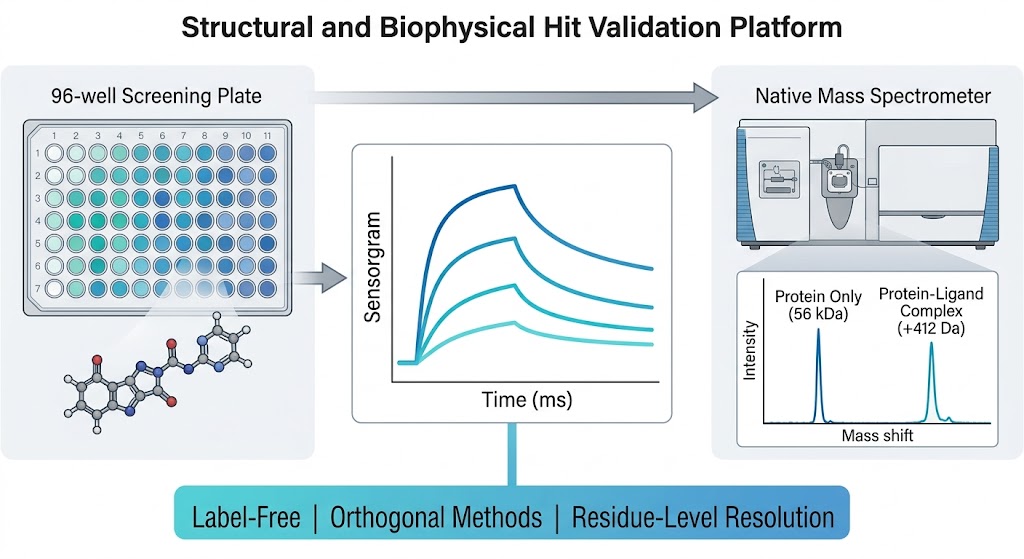
Structural and biophysical hit validation platform showing SPR sensorgrams, native mass spectra, thermal shift curves, and HDX-MS epitope maps for orthogonal binding confirmation.
Overview Approaches Structural MS Workflow Applications Demo Data Sample Why Integrated Case Study FAQ

Why Orthogonal Biophysical Validation Is Essential

Primary screening assays measure a functional or binding event through an indirect readout — fluorescence intensity, luminescence, or absorbance. Each readout type has well-characterized artifact mechanisms. Fluorescent compounds can quench or enhance signals regardless of binding. Aggregating compounds can sequester the target protein, producing apparent inhibition. Redox-active compounds can interfere with assay chemistry.

Biophysical methods address these limitations because they measure binding through a fundamentally different physical principle. SPR detects changes in refractive index at a sensor surface as mass accumulates — no label, no enzymatic turnover, no optical interference. Native ESI-MS detects the mass of the protein-ligand complex directly — the most direct possible binding readout. Thermal shift assays detect changes in protein melting temperature upon ligand binding — a thermodynamic signature independent of functional activity.

Using two or more orthogonal methods provides triangulated evidence that a hit is genuine. When SPR, native MS, and thermal shift all confirm binding, confidence that the hit represents a real interaction is substantially higher than any single assay can provide.

Biophysical Hit Validation Approaches

Surface Plasmon Resonance (SPR)

Provides real-time, label-free measurement of binding kinetics — association rate (ka), dissociation rate (kd), and equilibrium dissociation constant (KD). For fragment hits with weak affinity, SPR detects binding directly and ranks hits by residence time. Our SPR binding kinetics service covers both screening and full characterization formats.

Bio-Layer Interferometry (BLI)

An alternative optical biosensor measuring interference patterns of reflected white light. BLI uses disposable sensors and supports 96-well and 384-well plate formats for moderate-throughput hit validation. Our BLI binding confirmation service is optimized for rapid hit triage.

Native ESI-MS Binding Confirmation

Detects non-covalent protein-ligand complexes directly by mass measurement — the most direct binding readout available. A single experiment confirms binding, determines stoichiometry (1:1, 2:1, etc.), and rules out aggregation artifacts. Our native ESI-MS binding service offers both targeted and screening formats.

Thermal Shift Assay (TSA)

Measures the temperature at which a protein unfolds. Ligand binding typically stabilizes the protein, shifting the melting temperature (ΔTm) upward. The magnitude of the shift correlates with binding affinity, enabling rapid affinity ranking of hit series. Compatible with both purified proteins and cell lysates.

Ion Mobility MS (IM-MS)

Adds a conformational dimension by measuring the collision cross-section (CCS) of the protein-ligand complex. Ligand-induced conformational changes are detected as CCS shifts, providing structural evidence that complements binding affinity data. Our ion mobility MS (IM-MS) service integrates CCS binding analysis.

Equilibrium Dialysis MS Binding

For hits with complex binding behavior (multiple binding sites, aggregates), equilibrium dialysis coupled with MS quantification provides an independent binding measurement in solution phase. Particularly useful for hits that show unusual behavior in surface-based assays.

Structural Hit Validation with MS-Based Epitope Mapping

When biophysical binding is confirmed, the next question is where on the target protein the hit binds. Residue-level binding site information is essential for understanding structure-activity relationships, assessing selectivity, and guiding crystallography or computational modeling.

Hydrogen-Deuterium Exchange MS (HDX-MS). HDX-MS measures the rate at which backbone amide hydrogens exchange with deuterium in solution. Ligand binding reduces solvent accessibility and conformational flexibility, detected as reduced deuterium uptake. The result is a peptide-level map of the binding epitope spanning 10-30 residues. Our HDX-MS epitope mapping service is available for both targeted and discovery formats.

Fast Photochemical Oxidation of Proteins (FPOP). FPOP uses hydroxyl radical labeling to probe solvent-accessible protein surfaces at microsecond timescales. Ligand binding protects the interaction surface from radical labeling, producing a footprint of the binding epitope at single-amino-acid resolution — higher resolution than HDX-MS, requiring specialized laser-based instrumentation.

Cross-Linking Mass Spectrometry (XL-MS). For hits binding at protein-protein interfaces or inducing conformational changes, XL-MS captures spatial relationships by covalently linking nearby residues. The identified cross-links provide distance constraints for modeling the hit-binding mode, particularly useful for allosteric site hits. Our cross-linking mass spectrometry (XL-MS) service provides structural constraints for binding mode determination.

Covalent Labeling MS (DEPC, GEE). Targeted covalent labeling using residue-specific probes provides complementary epitope information by probing the accessibility of specific amino acid side chains in the presence and absence of the hit compound.

Our Workflow — From Hit to Validated Binding

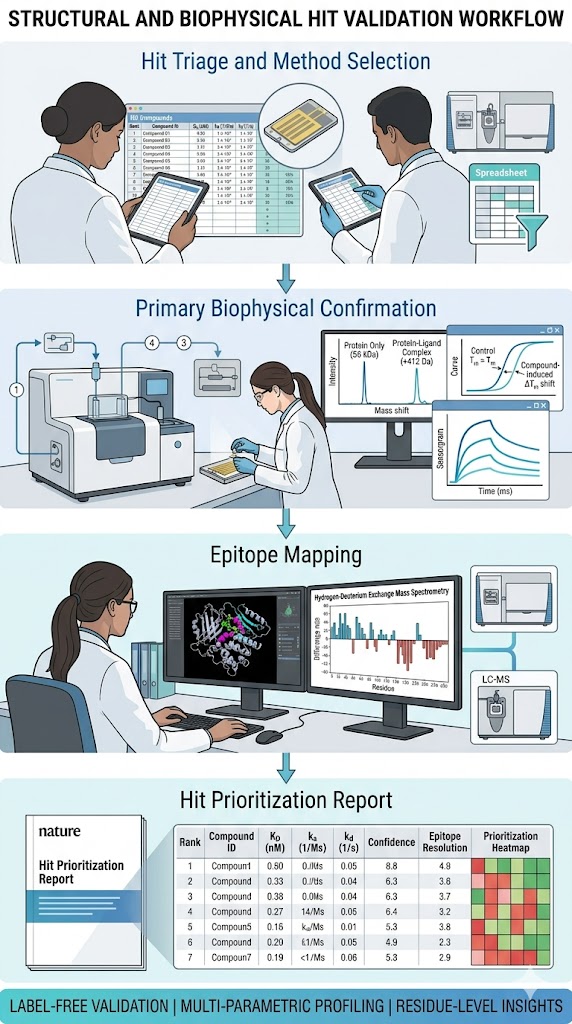
A structured four-stage process for hit validation projects.

1

Hit Triage and Method Selection

Based on hit list characteristics (number of hits, estimated affinity range, target properties), we recommend an appropriate validation tier — SPR or native MS screening for fragment hits, full tier 2 orthogonal validation for HTS hits.

2

Primary Biophysical Confirmation

Hits tested in at least two orthogonal assays. SPR or BLI confirms binding kinetics. Native MS confirms complex mass and stoichiometry. Thermal shift provides a thermodynamic signature. A hit is validated only when at least two methods agree.

3

Epitope Mapping

For validated hits advancing to lead generation, HDX-MS or FPOP maps the binding epitope. The epitope information assesses whether the hit binds the intended site, distinguishes competitive from allosteric binders, and guides crystallographic soaking.

4

Hit Prioritization Report

A comprehensive report for each validated hit includes binding affinity (KD), kinetics (ka/kd), stoichiometry, thermal shift (DeltaTm), binding epitope map, and prioritized ranking against the full hit list.

Four-stage workflow for hit validation: hit triage, primary biophysical confirmation by SPR and native MS, epitope mapping by HDX-MS, and hit prioritization report.

Applications

Structural and biophysical hit validation across discovery stages and target classes.

Fragment-Based Lead Discovery Validation

Confirming fragment hits identified by AS-MS, DEL, or biochemical screens. SPR and native MS are the primary validation methods for weak-affinity fragments.

Output: Validated fragment hits with KD, kinetics, and stoichiometry.

HTS Hit Triaging

Orthogonal biophysical validation of hits from high-throughput screening, eliminating false positives from aggregation, fluorescence, and redox artifacts.

Output: Prioritized hit list with false positive flagging.

DEL Hit Confirmation

Validating DNA-encoded library-selected compounds by SPR or BLI, compatible with the low-throughput, high-information-content format required for DEL follow-up.

Output: Confirmed DEL hits with binding parameters.

Binding Site Allocation

Using HDX-MS or FPOP to determine whether hits from different chemical series bind the same or different sites, informing medicinal chemistry strategy for series merging.

Output: Binding site classification for all validated hit series.

Hit-to-Lead Characterization

Characterizing binding mode of lead series compounds — kinetics, thermodynamics, and epitope — to guide medicinal chemistry optimization.

Output: Multi-parameter binding characterization for each series.

Biosimilar Binding Confirmation

Validating binding of antibody fragments, nanobodies, and alternative scaffolds to target antigens using BLI and native MS.

Output: Binding confirmation with kinetics and stoichiometry.

Representative Results

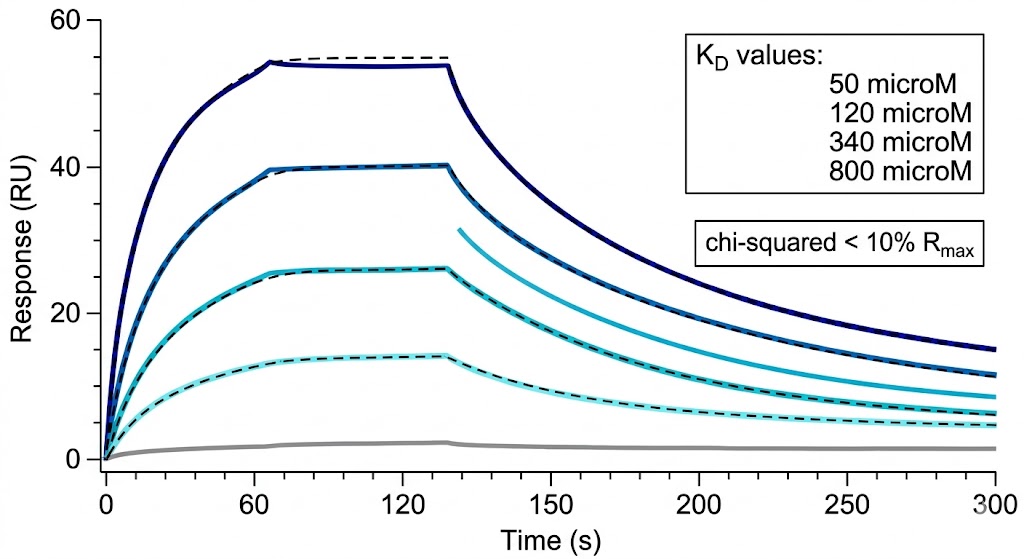
SPR sensorgram overlay showing concentration-dependent binding of four fragment hits with KD values from 50 to 800 micromolar concentration range.

SPR fragment hit validation

Overlay sensorgrams showing concentration-dependent binding of four fragment hits to the target protein. Three fragments show clear dose-response with KD values ranging from 50 microM to 800 microM (colored curves). The fourth fragment shows a flat response, indicating no binding — flagged as a false positive (grey). The sensorgram data enables immediate rank-ordering of hits by affinity and residence time for medicinal chemistry prioritization.

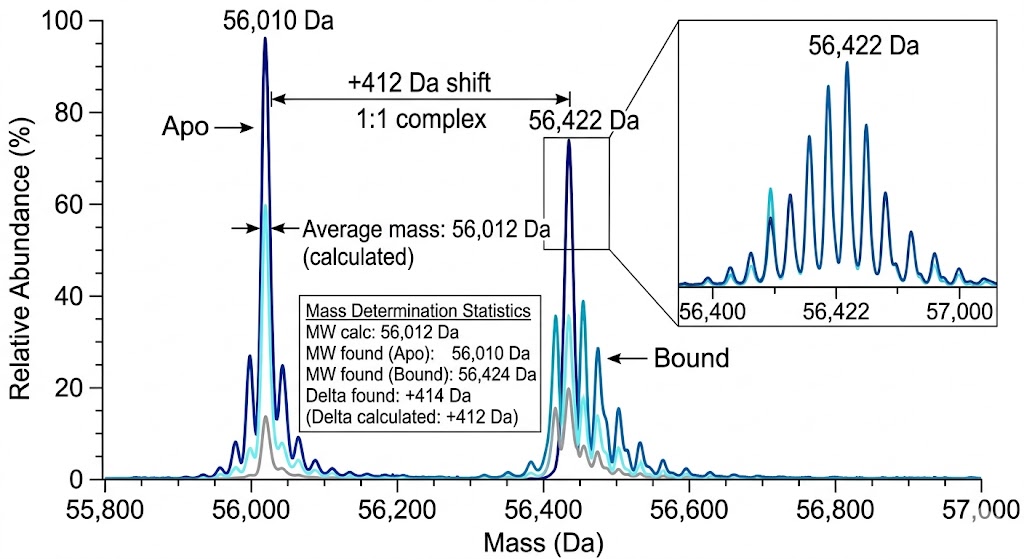
Native mass spectra showing protein mass shift upon compound binding confirming 1:1 stoichiometry and specific binding without aggregation artifacts.

Native MS binding confirmation

Deconvoluted mass spectra of the target protein (56 kDa) before and after incubation with a hit compound. The apo protein shows a single charge state series at 56,012 Da. After compound addition, a second series appears at 56,424 Da (+412 Da), corresponding to one molecule of hit compound bound per protein molecule. The 1:1 stoichiometry confirms specific binding. No higher-order complexes are observed, ruling out aggregation artifacts.

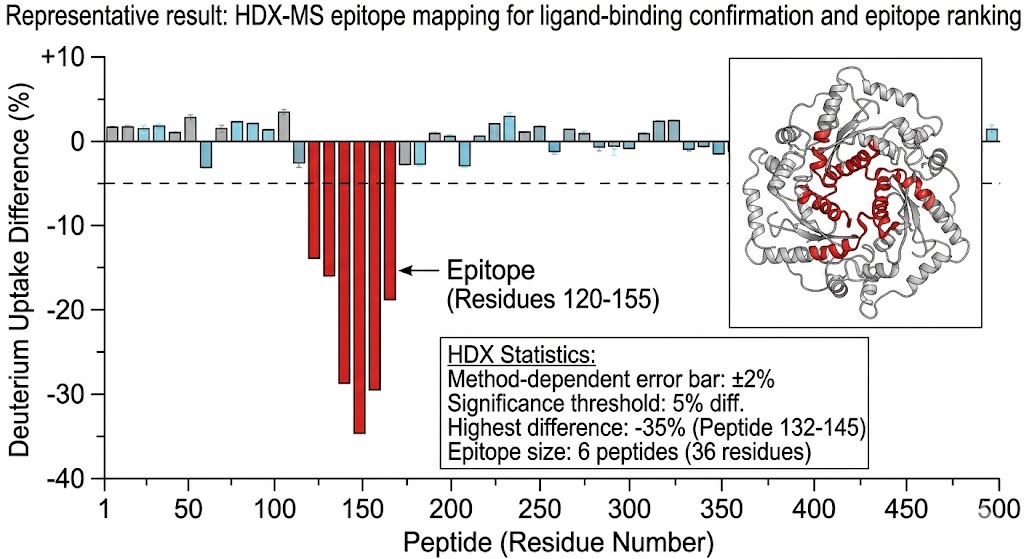
HDX-MS epitope map difference plot showing reduced deuterium uptake in six consecutive peptides defining the binding epitope of a validated hit compound.

HDX-MS binding epitope map

Difference plot showing deuterium uptake differences (bound minus apo) across 45 peptides covering the target protein. A cluster of six consecutive peptides covering residues 120-155 shows significantly reduced deuterium uptake upon hit binding (difference D = -15% to -35%), defining the binding epitope. The epitope maps to the target's active site pocket, consistent with the predicted mechanism of action. This information guides crystallographic soaking and medicinal chemistry strategy.

Sample Requirements

Sample TypeMinimum per ConditionRecommendedAmountFormat
Purified protein (SPR/BLI)35-650-200 microgPBS or HBS buffer
Purified protein (native MS)3510-50 microg50-200 mM ammonium acetate
Purified protein (HDX-MS)35-6100-500 microgPBS, no glycerol
Hit compound stock0.5 mg1-2 mg10-50 mMDMSO (100%)
Fragment stock0.1 mg0.5 mg50-100 mMDMSO

Note: For SPR and BLI, protein purity >90% is recommended. For native MS, buffer exchange into MS-compatible buffers is performed by our team. For HDX-MS, glycerol and hydrogen-bond-donating excipients must be avoided.

Why Integrated Validation Matters

CriterionSingle Biochemical AssaySingle SPR AssayOur Integrated Platform
Orthogonal confirmationNoSingle techniqueYes (SPR + native MS + TSA)
Binding kineticsNoYes (ka, kd, KD)Yes (all methods)
StoichiometryNoNoYes (native MS)
Epitope mappingNoNoYes (HDX-MS, FPOP, XL-MS)
False positive filteringLimitedGoodExcellent (triangulation)
Fragment compatibilityLimitedYesYes (SPR + native MS)
Structural informationNoneNoneResidue-level epitope map

What sets this approach apart: Our platform combines SPR, BLI, native MS, thermal shift, HDX-MS, and FPOP — delivering orthogonal binding confirmation from multiple physical principles that single-technique approaches cannot match.

Case Study: Crystallographic Fragment Screening Reveals Ligand Hotspots Validated by SPR and Biophysical Methods

Kim Y, Lucic A, Lenz C, et al. "Crystallographic fragment screening reveals ligand hotspots in TRIM21 PRY-SPRY domain." Communications Chemistry, 2025, 8, 185. DOI: 10.1038/s42004-025-01574-3 (CC BY 4.0).

Background

The TRIM21 PRY-SPRY domain is a protein interaction module central to antibody-mediated intracellular immunity. Despite its therapeutic potential, no small-molecule ligands had been reported for this domain. The study aimed to identify and validate chemical starting points for targeting TRIM21 using crystallographic fragment screening with orthogonal biophysical validation.

Methods

A crystallographic fragment screening (CFS) campaign was performed using a library of 768 fragments. Validating weak fragment hits required multiple orthogonal biophysical methods: SPR single-dose screening at 500 microM assessed binding, DSF at 2 mM measured thermal shifts, and NanoBRET competition assays were developed for cell-based binding confirmation.

  • Crystallographic fragment screening of 768 fragments against TRIM21 PRY-SPRY.
  • SPR single-dose screening at 500 microM with suramin as positive control.
  • DSF thermal shift at 2 mM compound concentration.
  • NanoBRET competition assay for cellular binding confirmation.
  • Fragment merging guided by crystallographic data.

Results

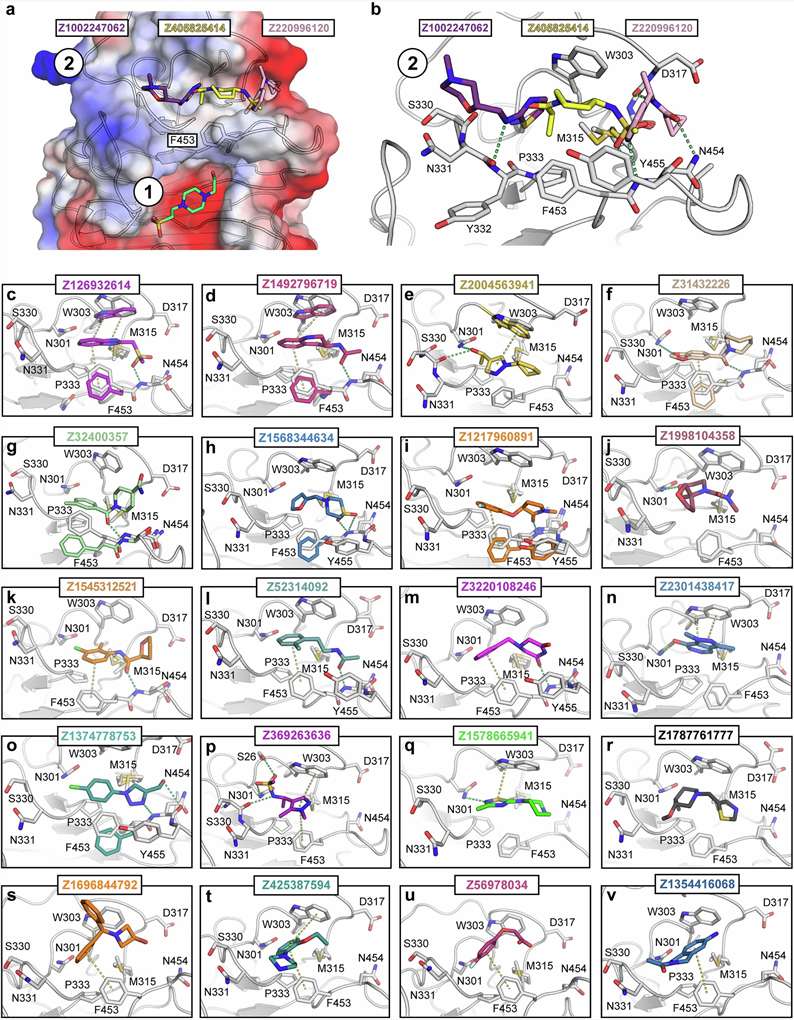
CFS identified 109 fragment hits (14% hit rate) distributed across five binding sites. SPR confirmed binding for a subset of hits, though the weak affinity (high micromolar to mM KD) made full dose-response challenging. DSF showed small but reproducible Tm shifts (up to 0.6 degrees C). NanoBRET competition assays confirmed binding for two fragments in live cells. Fragment merging guided by crystallographic data produced AL257 (EC50 approximately 143 microM), demonstrating that structural information from CFS can directly drive hit progression.

Conclusions

This study demonstrates that crystallographic fragment screening combined with orthogonal biophysical validation (SPR, DSF, NanoBRET) provides a robust pipeline for identifying and validating hits against challenging targets, even when individual validation methods show borderline signals.

Fig. 3 and Fig. 5 from Kim et al. 2025 showing SPR validation of fragment hits and crystallographic binding sites in TRIM21 PRY-SPRY domain.

Fig. 3, 5 from Kim Y, et al. 2025 (Communications Chemistry). SPR validation and crystallographic binding sites for 109 fragment hits. CC BY 4.0.

FAQ

Frequently Asked Questions

Q: What is the minimum affinity required for biophysical hit validation?

SPR typically detects binding down to ~100 microM KD for small molecules. Native MS can detect binding at similar affinity ranges. HDX-MS detects binding effects even at low fractional occupancy (10-20% bound).

Q: How many hits can be validated in a typical project?

Tier 1 screening handles 50-100 hits per week. Tier 2 full dose-response validates 10-20 prioritized hits per week. Epitope mapping handles 3-5 hits per week.

Q: Which method should I start with for hit validation?

For fragment hits (weak affinity, high count), start with SPR or native MS single-dose screening. For HTS hits (stronger affinity, fewer), start with full KD determination by SPR plus orthogonal confirmation.

Q: Can you validate hits without purified protein?

SPR, BLI, native MS, and HDX-MS require purified protein. Thermal shift and cellular target engagement assays can work with cell lysates or live cells.

Q: What is the turnaround time?

Tier 1 screening of 50-100 hits typically takes 2-3 weeks. Full tier 2 validation with epitope mapping takes 4-6 weeks.

References

  1. Kim Y, Lucic A, Lenz C, et al. "Crystallographic fragment screening reveals ligand hotspots in TRIM21 PRY-SPRY domain." Communications Chemistry, 2025, 8, 185. DOI: 10.1038/s42004-025-01574-3 (CC BY 4.0)
  2. Renaud JP, Chung CW, Danielson UH, et al. "Biophysics in drug discovery: impact, challenges and opportunities." Nature Reviews Drug Discovery, 2016, 15, 679-698. DOI: 10.1038/nrd.2016.123
  3. Erlanson DA, Fesik SW, Hubbard RE, et al. "Twenty years on: the impact of fragments on drug discovery." Nature Reviews Drug Discovery, 2016, 15, 605-619. DOI: 10.1038/nrd.2016.109

Validate your screening hits

Tell us about your target, hit list size, and estimated affinity range — our scientists will recommend the optimal validation tier and provide a detailed project proposal.

For Research Use Only (RUO). Not intended for diagnostic, therapeutic, or clinical decision-making purposes. Creative Proteomics services are designed to support preclinical research, drug discovery, and mechanism of action studies only.

Online Inquiry

Please submit a detailed description of your project. We will provide you with a customized project plan to meet your research requests. You can also send emails directly to for inquiries.

* Email
Phone
* Service & Products of Interest
Services Required and Project Description