Enzyme Activity and Reaction Mechanism Screening by MS — Label-Free Enzyme Kinetics, Inhibition Profiling, and Mechanism Elucidation

Measure the enzyme reaction directly: substrate mass, product mass, and reaction velocity — no fluorescent label, no coupled enzyme, no indirect proxy.

Enzyme activity measurement is fundamental to drug discovery — from primary inhibitor screening through lead optimisation to mechanism-of-action characterisation. Yet a substantial fraction of therapeutically relevant enzyme classes cannot be measured by fluorescence or absorbance-based assays. Methyltransferases, lyases, ligases, and isomerases lack chromogenic substrates. Coupled enzyme systems introduce artefacts, substrate limitations, and matrix incompatibility that compromise data quality. The limitation is not the enzyme — it is the detection method. Mass spectrometry-based enzyme activity screening circumvents this entirely: the mass spectrometer detects the substrate consumed and the product formed at their exact molecular masses, providing a direct, label-free measurement of enzyme activity that is independent of the optical properties of the molecules involved. Our enzyme activity and reaction mechanism screening service deploys high-resolution and triple-quadrupole MS platforms to deliver Michaelis-Menten kinetics, IC50 determination, inhibition mode classification, and reaction pathway characterisation — all from a single detection platform that reads the chemistry directly.

Key Advantages:

  • Label-free detection of substrate and product by accurate mass — no fluorescent tag, chromogenic substrate, or coupled enzyme required.
  • Applicable to every enzyme class: any enzyme whose substrate and product differ in mass is directly measurable.
  • Crude lysate compatibility — unpurified enzyme preparations can be used for activity and inhibition measurements.
  • Simultaneous kinetic and identity data — substrate consumption, product formation, and unexpected metabolites or intermediates are detected in the same experiment.
  • Multi-parameter characterisation from a single platform — Km, kcat, IC50, inhibition mode, and reaction mechanism are accessible within the same MS workflow.
  • Minimal assay development time — no probe engineering, no coupled enzyme optimisation, no fluorophore selection. If the substrate and product masses are known, the assay is defined.
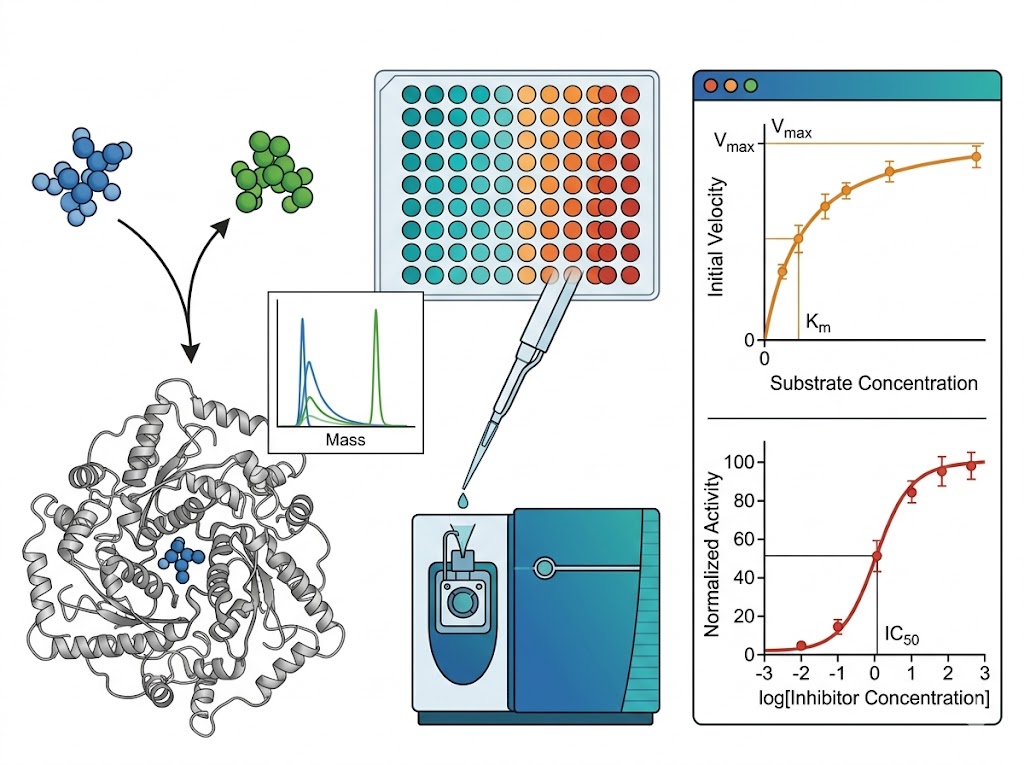
Enzyme activity screening by mass spectrometry overview: a label-free MS workflow showing enzyme and substrate in a reaction well, direct MS detection of substrate depletion and product formation, and data output including Michaelis-Menten kinetics, IC50 inhibition curve, and inhibition mode classification.
What Is MS Enzyme Screening Service Modes Tech Comparison Sample Demo Case Study FAQ

What Is MS-Based Enzyme Activity and Reaction Mechanism Screening?

MS-based enzyme activity screening uses mass spectrometry as the readout for enzyme-catalysed reactions. The principle is straightforward: an enzyme converts a substrate of known mass to a product of a different known mass. The mass spectrometer measures the abundance of both species at defined time points, yielding a direct measure of reaction progress without requiring the substrate or product to carry a spectroscopic label. The change in the substrate-to-product ratio as a function of time, substrate concentration, or inhibitor concentration defines the kinetic and pharmacological parameters of the reaction.

The approach operates across three throughput-regimes. For detailed kinetic characterisation, reactions are sampled at multiple time points by rapid quench-flow, stopped-flow, or direct infusion MS — delivering full Michaelis-Menten parameters (Km, Vmax, kcat) from direct product quantification. For inhibitor screening, reactions at a fixed time point across multiple compound concentrations produce dose-response IC50 data. For mechanism elucidation, isotope-labelled substrates, intermediate trapping experiments, and MSn fragmentation mapping reveal the reaction coordinate, transition state structure, and covalent intermediate identity.

These capabilities are deployed as an integrated service within our Target → Drug Discovery platform, where enzyme activity screening provides the kinetic foundation for hit validation, lead optimisation, and mechanism-of-action studies across diverse target classes and therapeutic areas.

Why MS for Enzyme Activity and Mechanism Studies

Direct detection of substrate and product at their exact masses

MS reads the enzyme reaction directly — the substrate mass decreasing, the product mass appearing. There is no signal chain, no fluorophore, no coupled enzyme. The measurement is chemically specific: the mass of the product confirms its identity, eliminating false positives from fluorescent compound interference or coupled enzyme cross-reactivity. For any reaction where substrate and product differ in molecular weight — which includes essentially every enzyme-catalysed transformation except pure cis-trans isomerisations — the MS readout is definitive.

Works for enzyme classes that fluorescence assays cannot reach

Methyltransferases, halogenases, ammonia lyases, carbamoyltransferases, acyltransferases, and ligases — enzyme classes that collectively represent a substantial fraction of the druggable enzyme genome — have no natural chromogenic substrate. Fluorescence-based assays for these enzymes require either a labelled substrate analogue (which may alter kinetics) or a coupled enzyme system (which introduces secondary interference). MS eliminates both dependencies: if the substrate and product differ in mass, the reaction is measurable without any modification.

Crude lysate compatibility for variant and biocatalyst screening

Enzyme variant libraries, metagenomic enzyme panels, and directed evolution campaigns require activity measurements from crude cell lysates where spectroscopic assays fail due to autofluorescence, light scattering, and competing enzyme activities. The MS readout identifies the product by its exact mass regardless of the lysate composition, provided no competing endogenous enzyme produces the same product mass. This eliminates the protein purification bottleneck and compresses the screening-to-discovery timeline.

Kinetic parameter accuracy from direct product quantification

Km and Vmax values derived from coupled enzyme assays are systematically influenced by the kinetic properties of the coupling enzymes, the concentration of the coupling substrate, and the accumulation of coupled product. MS derives these parameters from the direct quantification of the primary product — the actual molecule the target enzyme produces — at each substrate concentration. The resulting parameters reflect the true enzyme kinetics, not a convolution of the target and reporter enzyme systems.

Inhibition mechanism determination from global data fitting

Determining whether a hit is a competitive, non-competitive, or uncompetitive inhibitor requires measuring reaction velocity at multiple substrate concentrations across multiple inhibitor concentrations — a data set that is information-rich but acquisition-intensive by conventional methods. MS-based screening generates the full substrate × inhibitor matrix in a single experimental run, enabling global fitting to inhibition models with statistical confidence. The output includes not just IC50 values but the inhibition mechanism itself, directly informing SAR strategy.

Reaction intermediates and unexpected products are captured, not missed

A fluorescence readout reports that a reaction occurred. An MS readout reports what occurred — the product mass, any unexpected side-product masses, and any trapped intermediate masses. For mechanism elucidation studies, this is the difference between knowing that inhibition happened and understanding how it happened: which bond was cleaved, which atom was transferred, which transient intermediate accumulates in the presence of a mutant or inhibitor. This capability makes MS the method of choice for reaction mechanism studies in drug discovery.

Service Modes — Enzyme Activity and Mechanism Analysis by MS

We offer four service modes within our MS-based enzyme activity and mechanism platform, each designed for a specific stage of the drug discovery pipeline — from early kinetic characterisation through inhibition mechanism classification to full reaction pathway elucidation. All modes share the same core MS detection platform but differ in experimental design, data analysis depth, and deliverable format.

MODE 1

Michaelis-Menten Kinetics and Substrate Profiling by MS

Full kinetic characterisation of enzyme activity by direct MS quantification of product formation. The enzyme is incubated with substrate across a concentration range, and product formation is quantified at each substrate concentration by MS. The resulting velocity versus substrate concentration data are fitted to the Michaelis-Menten equation to yield Km, Vmax, and kcat. Substrate specificity profiling is performed by repeating the measurement across a panel of analogue substrates.

  • Format: 8–12 substrate concentrations in duplicate or triplicate; 2–5 time points per concentration; LC-MS or direct infusion MS readout.
  • Output: Km, Vmax, kcat with 95% confidence intervals; Michaelis-Menten and Lineweaver-Burk plots; substrate specificity ranking (kcat/Km) for panel screening.
  • Applications: Enzyme characterisation for target validation, substrate scope determination for biocatalyst development, comparative kinetic analysis of enzyme variants.
MODE 2

Enzyme Inhibition Profiling and Mode-of-Action Classification

IC50 determination and inhibition mechanism classification by MS-based activity measurement. The enzyme is incubated with substrate at Km concentration across 8–12 inhibitor concentrations. Primary IC50 data are generated from single-concentration substrate measurements. For inhibition mode classification, the IC50 determination is repeated at 3–5 substrate concentrations spanning the Km range, enabling global fitting to competitive, non-competitive, uncompetitive, and mixed inhibition models.

  • Format: 8–12 inhibitor concentrations × 3–5 substrate concentrations (full matrix mode); single-concentration substrate for IC50-only mode.
  • Output: IC50 with confidence interval; inhibition mechanism classification (AIC model selection); Ki determination for competitive and mixed inhibitors.
  • Applications: Hit-to-lead inhibition characterisation, lead optimisation SAR support, reversible versus irreversible inhibitor discrimination by time-dependent MS measurement.
MODE 3

Pre-Steady-State Kinetics and Transient Intermediate Detection

Millisecond-timescale kinetic measurements and reactive intermediate identification by rapid mixing quench-flow MS and direct infusion MS. Reactions are initiated by rapid mixing of enzyme and substrate, then quenched at defined time points (5 ms to several seconds) for MS analysis of intermediate and product accumulation. The pre-steady-state burst phase, lag phase, and intermediate accumulation profile reveal kinetic steps that are invisible to steady-state measurements.

  • Format: Rapid quench-flow with 5–100 ms time points; direct infusion MS for real-time monitoring; cryogenic intermediate trapping for unstable species.
  • Output: Pre-steady-state kinetic time courses; burst phase amplitude and rate constant; intermediate mass identification and time-dependent accumulation profile.
  • Applications: Enzyme mechanism validation, catalytic residue mutagenesis characterisation, covalent inhibitor pre-steady-state kinetic analysis. For continuous-flow kinetic configurations at defined residence times, our continuous-flow MS kinetics service provides an alternative platform.
MODE 4

Reaction Pathway Mapping and Mechanism Elucidation by MS

Comprehensive reaction pathway characterisation using stable isotope labelling, MSn fragmentation mapping, and covalent intermediate trapping. The enzyme reaction is conducted with isotope-labelled substrates (2H, 13C, 15N, 18O) to track atom transfer through the reaction coordinate. Product ions are mapped by multi-stage MS fragmentation (MSn) to establish bond connectivity and fragmentation pathways. Covalent enzyme intermediates are trapped by rapid denaturation and identified by intact protein MS or peptide-level MS/MS.

  • Format: Isotope labelling experiments with natural abundance controls; MSn fragmentation on product ions; intact protein MS for covalent intermediate detection.
  • Output: Reaction pathway diagram with atom tracking; MSn fragmentation maps; covalent intermediate mass and site identification. For complementary residence time characterisation of enzyme-ligand complexes, see our enzyme-ligand residence time MS service.
  • Applications: Enzyme mechanism validation, biosynthetic pathway elucidation, mechanism-based inhibitor design support, and biocatalytic reaction optimisation.

Analytical Workflow

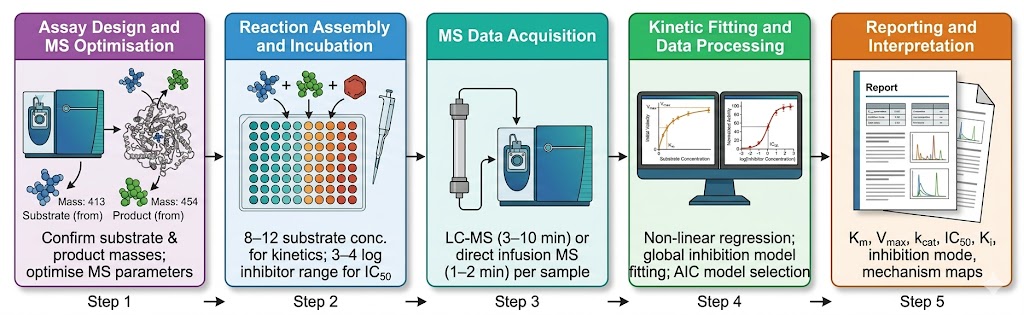
Five stages from assay design to fully characterised enzyme kinetic and inhibition data:

1

Assay design and MS parameter optimisation

We confirm the molecular masses of substrate and product by direct infusion MS and optimise the detection parameters — ionisation polarity, scan range, resolution, and fragmentation conditions — for the specific substrate–product pair. A preliminary time-course experiment establishes the linear range of product formation and defines the sampling time point for subsequent screening. This phase typically requires 2–3 days and the substrate and product standards or confirmed reaction mixture.

2

Reaction assembly and incubation

Enzyme reactions are assembled in 96-well plates at defined substrate, enzyme, and cofactor concentrations in the appropriate buffer. For Michaelis-Menten kinetics, substrate concentrations span at least 0.2× to 5× the expected Km (typically 8–12 concentrations). For inhibition studies, inhibitor concentrations span a 3–4 log range around the expected IC50. Reactions are incubated at the specified temperature and quenched at the defined time point by acid, base, organic solvent, or heat denaturation.

3

MS data acquisition

Quenched reactions are analysed by LC-MS or direct infusion MS. LC-MS provides chromatographic separation of substrate and product from matrix components, with run times of 3–10 minutes per sample. Direct infusion MS provides higher throughput (1–2 minutes per sample) but requires cleaner reaction matrices. For time-course experiments, each time point is analysed individually. For inhibition mode studies, the full substrate × inhibitor concentration matrix is acquired in a single automated batch.

4

Data processing and kinetic fitting

Raw MS data are processed to extract substrate and product ion abundances. Product concentration is calculated from the ion abundance ratio using a calibration curve generated from authentic product standards or by assuming equimolar ionisation efficiency between substrate and product when a standard is unavailable. Velocity versus substrate concentration data are fitted to the Michaelis-Menten equation (v = Vmax × [S] / (Km + [S])) using non-linear least-squares regression. Inhibition data are fitted to a four-parameter logistic model for IC50 determination and to competitive, non-competitive, and uncompetitive inhibition models for mechanism classification.

5

Data reporting and interpretation

Deliverables include a comprehensive kinetic data report with fitted parameters, statistical confidence intervals, and diagnostic plots (Michaelis-Menten, Lineweaver-Burk, Eadie-Hofstee for kinetics; dose-response curves, global inhibition model fits for inhibition studies). For mechanism elucidation studies, reaction pathway diagrams, isotope incorporation maps, and MSn fragmentation assignments are provided with annotated spectra. A written interpretation section contextualises the kinetic parameters for the drug discovery programme, including comparison to reference inhibitors where applicable.

Enzyme activity screening by MS analytical workflow: assay design and MS parameter optimisation, reaction assembly and incubation in 96-well plates, LC-MS or direct infusion MS data acquisition, Michaelis-Menten kinetic fitting and IC50 determination, and comprehensive data reporting with inhibition mechanism classification.

Applications by Enzyme Class and Drug Discovery Stage

MS-based enzyme activity screening is applicable across the full spectrum of enzyme classes and discovery stages, from early target validation through lead optimisation.

Methyltransferase and epigenetic enzyme activity screening

Protein methyltransferases, DNA methyltransferases, and RNA methyltransferases transfer a methyl group from SAM to their substrate — a reaction with no chromogenic readout. MS detects the mass shift of +14 Da upon methylation, providing direct quantification of methyl transfer without radioactive SAM or coupled enzyme systems. Histone methyltransferase, DNMT, and RNA methyltransferase substrates are all compatible.

Output: Methylation product quantification; SAM/SAH ratio as complementary readout; substrate specificity across peptide, protein, or nucleic acid substrate panels; IC50 and inhibition mode for methyltransferase inhibitor programmes.

Kinase activity profiling by direct product detection

Conventional kinase assays use fluorescence polarisation (FP) or Time-Resolved FRET (TR-FRET) with labelled tracer ligands or antibodies. MS detects the phosphorylated peptide or protein product directly by its +80 Da mass shift, providing a label-free readout that is independent of ATP concentration, antibody affinity, or tracer displacement. The direct detection of phospho-product eliminates false positives from fluorescent compound interference — a well-documented limitation of FP-based kinase screening.

Output: Phosphorylation product quantification; Km for ATP and peptide substrate; IC50 and inhibition mode (ATP-competitive vs non-competitive) for kinase inhibitor hits.

Hydrolase and protease substrate specificity mapping

Proteases, esterases, glycosidases, and phosphatases cleave substrates to produce products of defined lower mass. MS identifies the cleavage product by its exact mass, enabling multiplexed substrate specificity profiling where multiple substrates are incubated simultaneously and the appearance of each product mass is monitored in a single experiment. This is particularly powerful for deubiquitinase (DUB) and protease specificity profiling where multiple cleavage sites must be assessed in parallel.

Output: Cleavage product identification and quantification; substrate specificity ranking (kcat/Km) across multiplexed substrate panels; inhibitor IC50 with product identity confirmation.

Oxidoreductase and cytochrome P450 activity monitoring

Oxidoreductases — including cytochromes P450, monoamine oxidases, and dehydrogenases — catalyse oxidation and reduction reactions that are detectable by the corresponding mass change (+16 Da for hydroxylation, +2 Da for reduction, −2 Da for oxidation). MS detects both the substrate mass decrease and the product mass increase simultaneously, providing a direct measure of catalytic turnover. For NAD(P)H-dependent enzymes, the conversion of NAD(P)H to NAD(P)+ is also detectable by MS as a mass shift of −2 Da.

Output: Oxidised/reduced product identification and quantification; cofactor turnover monitoring; IC50 and mechanism data for oxidoreductase inhibitor programmes.

Lyase and ligase enzyme characterisation by MS

Lyases cleave C–C, C–O, C–N, and other bonds without hydrolysis or oxidation, producing products whose masses reflect the bond-cleavage pattern. Ligases join two substrates with concomitant ATP hydrolysis, producing a product whose mass equals the sum of the substrate masses minus the ATP-derived leaving group. Both enzyme classes are essentially invisible to fluorescence-based assays without engineered substrates. MS provides the only label-free readout for these enzyme families.

Output: Lyase cleavage product identification and quantification; ligase condensation product confirmation by accurate mass; ATP consumption monitoring by AMP/ADP mass detection.

Biocatalyst engineering and directed evolution support

Enzyme variant libraries generated by directed evolution or rational design require a high-throughput, label-free activity readout to identify improved variants. MS-based screening directly quantifies product formation from crude cell lysates, eliminating the purification bottleneck. The simultaneous detection of substrate and product masses also reveals changes in enzyme selectivity — a valuable capability when the goal is altered substrate scope rather than simply improved turnover.

Output: Variant activity ranking by product ion abundance; substrate scope comparison across variant panels; identification of variants with altered product profiles or improved selectivity. For higher-throughput variant screening across larger libraries, our high-throughput MS screening platform provides faster readout modes. For integrated whole-cell activity assessment, see our microreactor MS screening service.

Technology Comparison: MS vs Alternative Enzyme Activity Screening Platforms

PlatformDetection PrincipleLabel Required?Crude Lysate Compatible?Product Identity Confirmed?Enzyme Class LimitationKinetic Parameters
MS-Based Screening (this service)Accurate mass detection of substrate and productNone✅ Yes — full matrix tolerance✅ Yes — by accurate mass ± MS/MSNone — any enzyme with mass-differentiable substrate/productKm, Vmax, kcat, IC50, inhibition mode, Ki
Fluorescence / Absorbance AssayFluorescence intensity or absorbance changeRequired — fluorescent or chromogenic probe❌ Limited — autofluorescence, scattering❌ No — indirect signalHigh — requires chromophore on substrate or productIC50 only (mode not reliably determined)
Radiometric AssayRadioisotope detection (³H, ¹⁴C, ³²P)Required — radiolabelled substrate⚠️ Partial — regulatory and containment constraints⚠️ Partial — detects label position, not product massLow — requires labelled substrate synthesisKm, kcat (with labelled substrate)
SPR-Based Activity AssaySurface plasmon resonance — mass change at sensor surfaceNone (immobilisation required)❌ No — requires purified immobilised enzyme⚠️ Partial — detects binding events, not product identityModerate — requires surface-compatible immobilisationBinding kinetics (not catalytic turnover)
Coupled Enzyme (NADH-linked)Absorbance of NADH at 340 nm via coupled reporter enzymeIndirect — coupled enzyme system❌ No — competing NADH-consuming reactions❌ No — NADH signal is two steps removed from reactionHigh — only NAD(P)H-producing or -consuming reactionsIC50, apparent Km (confounded by coupling system)
NMR (Real-Time)Chemical shift monitoring of substrate/product nucleiNone⚠️ Partial — low sensitivity limits lysate work✅ Yes — by chemical shift assignmentLow sensitivity; high protein consumption; limited throughputKm, kcat (low throughput, high material demand)

Sample Requirements

ComponentFormat OptionsRecommended InputMinimum InputKey Notes
Enzyme (purified)Recombinant protein in storage buffer50–200 µg total per kinetic experiment10 µg per 8-concentration Km determinationProvide known activity (U/mg) if available; avoid glycerol >10%; ship on dry ice
Enzyme (crude lysate)Cell lysate expressing target enzyme≥ 0.5 mL at 1–5 mg/mL total protein100 µL at ≥ 1 mg/mLSpecify expression system; note endogenous enzyme activities that may interfere
SubstrateSolution in DMSO or aqueous buffer10 mM stock; ≥ 100 µL1 mM stock; 50 µLProvide accurate molecular weight; note stability and solubility limits; purified peptide substrates preferred over crude synthetic mixtures
Product StandardSolution or solid5 mM stock; ≥ 50 µL (or 1 mg solid)0.5 mM; 20 µLStrongly recommended for absolute quantification; if unavailable, relative quantification by substrate depletion is used
Test / Reference Inhibitor10 mM DMSO stock≥ 50 µL10 µL at 1 mMKnown inhibitor with published IC50 strongly recommended for assay validation; used for Z-factor determination
Cofactors / CosubstratesAqueous solution10× stock; ≥ 200 µL2× stock; 50 µLSAM, NAD(P)H, ATP, CoA, PLP, etc.; fresh preparations only (< 4 weeks); provide if not commercially available

All samples should be shipped on dry ice in sealed cryotubes or 96-well plates. For unstable enzymes or cofactors, discuss cold-chain logistics with our project management team before shipping. Kinetic assays in the absence of confirmed product standards still produce reliable relative kinetic parameters (Km, relative Vmax) by substrate depletion quantification, but absolute kcat values require authentic product standards for MS response calibration.

Deliverables

  • Full kinetic characterisation report: Michaelis-Menten plot (v vs [S]) with fitted curve, Km, Vmax, and kcat values with 95% confidence intervals; Lineweaver-Burk and Eadie-Hofstee diagnostic plots.
  • IC50 determination report: dose-response curves with four-parameter logistic fit, IC50 with 95% confidence interval, Hill slope coefficient.
  • Inhibition mode classification report: global fits to competitive, non-competitive, uncompetitive, and mixed inhibition models; AIC-based model selection; Ki values with confidence intervals.
  • Substrate specificity profiling data: kcat/Km values for each substrate in the panel; specificity ranking with statistical comparison; substrate selectivity fingerprint visualisation.
  • Pre-steady-state kinetic data: time courses with burst phase fitting; intermediate accumulation profiles with accurate mass identification.
  • Reaction mechanism elucidation data: isotope incorporation maps; MSⁿ fragmentation assignments for product ions; covalent intermediate mass and site identification (where applicable).
  • Raw MS data files in standard formats (mzXML, .raw) for customer re-processing or archival storage.
  • Written interpretation summary: contextualisation of kinetic and inhibition parameters for the drug discovery programme, comparison to reference compounds, and recommended next steps.

Representative Results

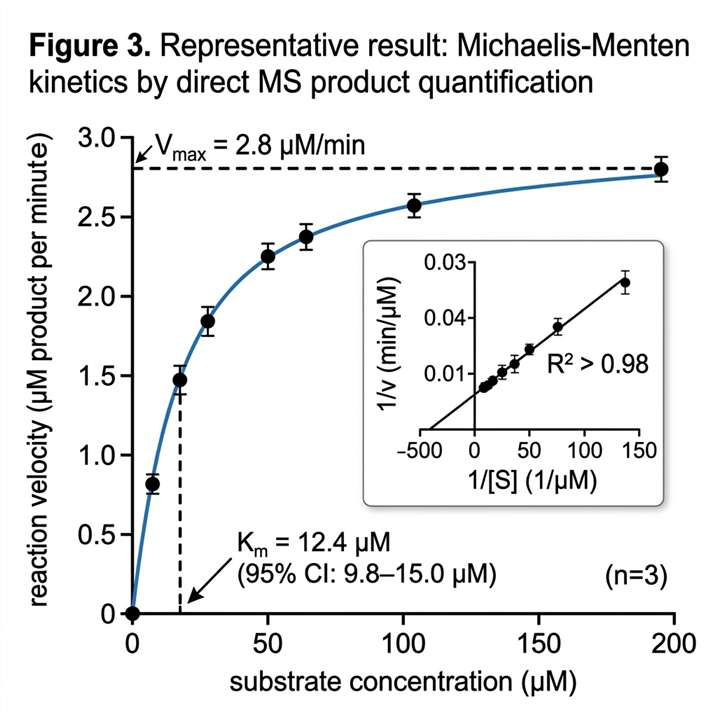
Michaelis-Menten kinetic plot from MS-based enzyme activity measurement: reaction velocity (product abundance per minute) plotted against substrate concentration in micromolar, showing a hyperbolic fit with Km and Vmax annotated.

Michaelis-Menten kinetics by direct MS product quantification

Representative Michaelis-Menten plot from MS-based enzyme activity measurement. Product formation was quantified by direct MS detection across 10 substrate concentrations (0.5–200 µM). Data points (n=3 per concentration) were fitted to the Michaelis-Menten equation by non-linear regression. Km = 12.4 µM (95% CI: 9.8–15.0 µM); Vmax = 2.8 µM/min; kcat = 14.2 s⁻¹. The inset Lineweaver-Burk plot shows linearity consistent with standard Michaelis-Menten kinetics, confirming that the MS readout does not alter the kinetic behaviour of the enzyme.

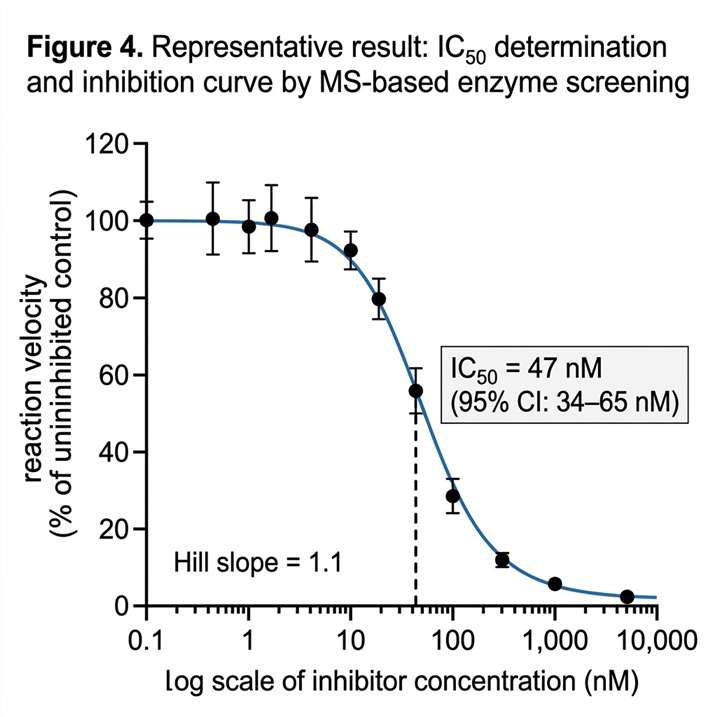
Dose-response IC50 inhibition curve from MS-based enzyme screening: reaction velocity (percent of control) plotted against inhibitor concentration in log scale across 10 concentrations, with four-parameter logistic fit and IC50 annotation.

IC50 determination and inhibition curve by MS

Dose-response inhibition data from MS-based screening of a reference inhibitor against a methyltransferase target. Substrate conversion was measured at each inhibitor concentration by direct MS quantification of the methylated product. Data shown as percent of uninhibited control velocity (mean ± SD, n=3). IC50 = 47 nM (95% CI: 34–65 nM) from four-parameter logistic fit. Hill slope = 1.1, consistent with single-site inhibition. The direct product mass readout eliminates the need for labelled SAM or antibody-based detection, providing IC50 data that are structurally validated at every concentration point.

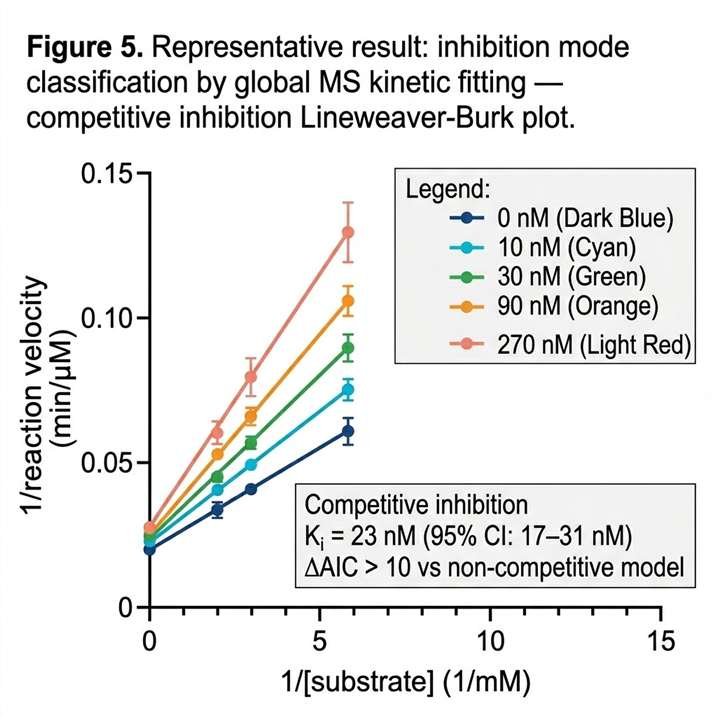
Global inhibition mode fitting plot from MS-based enzyme screening: Lineweaver-Burk plot at multiple inhibitor concentrations showing intersecting lines at the y-axis for competitive inhibition, with Ki annotation.

Inhibition mode classification by global MS kinetic fitting

Global inhibition mode analysis data from MS-based screening of a kinase inhibitor. Reaction velocity was measured at 5 substrate concentrations (1×, 2×, 3×, 5×, and 10× Km) across 6 inhibitor concentrations (0, 0.3×, 1×, 3×, 10×, 30× IC50). The Lineweaver-Burk double-reciprocal plot shows lines intersecting on the y-axis — the diagnostic pattern for competitive inhibition with respect to the peptide substrate. The Ki was determined by global fitting to the competitive inhibition model: Ki = 23 nM (95% CI: 17–31 nM). Model selection by AIC confirmed competitive inhibition as the preferred model (ΔAIC > 10 vs non-competitive and uncompetitive models).

Case Study: Label-Free MALDI-TOF MS Screening Enables Directed Evolution of a Cyclodipeptide Synthase with Novel Catalytic Activity

Zhang S., Zhu J., Fan S., Xie W., Yang Z., Si T. "Directed evolution of a cyclodipeptide synthase with new activities via label-free mass spectrometric screening." Chemical Science. 2022;13(25):7581–7586. https://doi.org/10.1039/d2sc01637k Open Access (CC BY-NC 3.0).

Background

Cyclodipeptide synthases (CDPS) are enzymes that catalyse the formation of cyclic dipeptides from aminoacyl-tRNA substrates — a reaction class with no chromogenic or fluorescent readout. The product (a cyclo-dipeptide or diketopiperazine) is detectable only by its mass, making CDPS an archetypal example of an enzyme class that is invisible to conventional screening. The authors sought to engineer the CDPS AlbC from Streptomyces noursei to accept non-cognate amino acid substrates and produce new diketopiperazine products — a goal that required screening thousands of enzyme variants for a reaction that could not be measured by any spectroscopic method.

Methods

The authors developed an automated, label-free MALDI-TOF MS screening platform. Site-saturation mutagenesis libraries at 14 active-site residues and error-prone PCR libraries (~4,500 clones in total) were expressed in E. coli and arrayed in 96-well plates. Each well was analysed by direct MALDI-TOF MS at a rate of approximately 5 seconds per sample — the product was detected by its monoisotopic mass without any purification, extraction, or labelling step. A robotic liquid handler integrated with the MALDI plate spotter enabled fully automated sample preparation and measurement. Product identification was confirmed by accurate mass matching to synthetic standards and by MS/MS fragmentation where needed.

Results

From the 4,500 screened variants, the F186L mutant was identified as capable of synthesising cyclo(L-Phe-L-Val) (cFV) — a diketopiperazine product that could not be detected from the wild-type AlbC enzyme. The new product was confirmed by accurate mass (m/z 269.15 [M+Na]⁺) and MS/MS fragmentation. The screening platform achieved a Z-factor of 0.68, confirming robust assay performance for a label-free MS readout in a directed evolution campaign. Molecular dynamics simulations of the F186L variant revealed that the mutation expands the substrate-binding pocket, enabling accommodation of the larger phenylalanine-valine substrate pair.

Significance for MS-Based Enzyme Activity Screening

This study demonstrates three principles directly relevant to our MS-based enzyme activity screening service: first, that label-free MS detection enables directed evolution for enzyme classes that cannot be measured by any spectroscopic method — the product mass is the readout, and no substrate modification is required; second, that MS throughput (~5 seconds per sample) is practical for library-scale screening in standard laboratory formats; and third, that the accurate mass readout provides definitive product identification, eliminating the need for downstream characterisation to confirm hit identity. These principles extend beyond CDPS to any enzyme class where the product has a distinct mass — including methyltransferases, lyases, ligases, oxidoreductases, and transferases — confirming MS as a universal platform for enzyme activity screening in drug discovery and biocatalyst development.

Figure from Zhang et al. 2022, Chemical Science, showing label-free MALDI-TOF MS screening results for cyclodipeptide synthase directed evolution: mass spectra identifying the new cFV product from the F186L mutant, and MS/MS fragmentation confirming product identity.

Figure 2 from Zhang et al. 2022 (Chemical Science, DOI: 10.1039/d2sc01637k, CC BY-NC 3.0). MALDI-TOF mass spectra showing the identification of the new cFV diketopiperazine product from the F186L AlbC variant and wild-type comparison.

FAQ

Frequently Asked Questions

Q: What enzyme classes are compatible with MS-based activity screening?

Any enzyme whose substrate and product differ in molecular mass is compatible — which includes oxidoreductases (e.g. +16 Da for hydroxylation, −2 Da for oxidation), transferases (e.g. +14 Da for methylation, +80 Da for phosphorylation), hydrolases (product masses lower than substrate by the cleaved group mass), lyases (product masses reflect bond cleavage pattern), isomerases (except pure cis-trans isomerisation where substrate and product masses are identical), and ligases (product mass equals sum of substrate masses minus leaving group). If the substrate and product have the same molecular formula, alternative detection modes such as ion mobility MS or derivatisation can be applied. Contact our team with your enzyme's substrate and product masses for a feasibility assessment.

Q: How does MS throughput compare with fluorescence plate readers for enzyme screening?

LC-MS based enzyme screening achieves throughputs of 3–10 minutes per sample — substantially lower than fluorescence plate readers operating at seconds per well. However, for focused library screening (hundreds to a few thousand compounds) and kinetic characterisation studies, this throughput is sufficient. Direct infusion MS and MALDI-TOF MS provide higher throughput (5 seconds to 2 minutes per sample) and are suitable for variant library screening and biocatalyst panels. The appropriate throughput platform is matched to the project scope during the assay design phase. For ultra-high-throughput MS screening (>10,000 samples per day), our acoustic ejection MS and RapidFire MS platforms provide faster alternatives.

Q: Can MS-based enzyme activity screening distinguish between reversible and irreversible inhibition?

Yes. Time-dependent inhibition is assessed by measuring residual enzyme activity after pre-incubation of the enzyme with the inhibitor at multiple pre-incubation times. A time-dependent shift in IC50 — decreasing IC50 with increasing pre-incubation time — is diagnostic of irreversible or slow-onset reversible inhibition. For covalent inhibitors, the intact protein mass shift (adduct mass) is detectable by intact protein MS, providing direct evidence of covalent modification. Both time-dependent activity profiling and intact protein MS are available within our service.

Q: Is a purified product standard required for MS-based enzyme kinetic assays?

An authentic product standard is strongly recommended for absolute kcat determination and accurate Vmax quantification, as it enables construction of a response calibration curve. However, reliable relative kinetic parameters — including Km and relative Vmax (in arbitrary units) — can be determined by measuring substrate depletion or by assuming equimolar MS response between substrate and product when the structural similarity is high. For projects at the early discovery stage where product standards are not yet synthesised, we recommend starting with relative kinetic measurements and adding absolute quantification when the product standard becomes available.

Q: Can MS-based screening detect allosteric enzyme modulation?

Yes. Allosteric modulators of enzyme activity are detected by their effect on reaction velocity measured by MS. The hallmark of allosteric modulation — a change in Vmax (non-competitive allostery) or a change in both Km and Vmax (mixed allostery) — is directly observable from the MS-derived velocity versus substrate concentration data at multiple modulator concentrations. Unlike allosteric binding detection methods (e.g., SPR, ITC) that measure binding only, MS-based activity screening measures the functional consequence of allosteric binding — making it possible to distinguish allosteric activators from inhibitors and to determine whether the allosteric effect is mediated through changes in substrate binding affinity, catalytic turnover, or both.

Q: What is the minimum amount of enzyme required for a full kinetic characterisation?

A full Michaelis-Menten kinetic characterisation (8–12 substrate concentrations in duplicate, 2–5 time points per concentration) typically requires 10–50 µg of purified enzyme, depending on turnover number and the sensitivity of the MS method for the specific product. For enzymes with high kcat (>10 s⁻¹), less material is needed. For variant library screening in crude lysates, the target enzyme must be expressed at a level sufficient to produce detectable product above background — typically corresponding to ≥0.1 µM active enzyme in the lysate. We assess material requirements during the feasibility phase and advise on the optimal experimental design based on available enzyme quantity and expected activity.

Design Your MS-Based Enzyme Activity Screening Campaign with the MassTarget Team

Tell us your enzyme, substrate, and screening goals — our scientists will assess MS feasibility, design the kinetic assay format, and propose a measurement strategy matched to your programme stage and decision timeline.

For Research Use Only (RUO). Not intended for diagnostic, therapeutic, or clinical decision-making purposes. Creative Proteomics services are designed to support preclinical research, drug discovery, and mechanism of action studies only.

Online Inquiry

Please submit a detailed description of your project. We will provide you with a customized project plan to meet your research requests. You can also send emails directly to for inquiries.

* Email
Phone
* Service & Products of Interest
Services Required and Project Description