Bioorthogonal Labeling and LC-MS/MS Target Identification Service

Click chemistry-compatible target identification for clickable probes, bioactive compounds, natural product analogs, and covalent ligands.

A bioactive compound can produce a strong cellular response, but the next question is often harder: which protein target is responsible?

At Creative Proteomics, our Bioorthogonal Labeling and LC-MS/MS Target Identification Service helps drug discovery and chemical biology teams identify candidate targets from clickable probes, bioactive compounds, natural product analogs, and covalent ligands.

We support probe feasibility review, bioorthogonal enrichment, LC-MS/MS analysis, target ranking, and decision-ready reporting. This click chemistry-compatible workflow is designed for projects where a clickable probe or analog can connect compound activity to enriched protein targets.

Key Advantages:

  • Click chemistry-compatible target identification.
  • Probe, control, and competition design support.
  • Bioorthogonal enrichment followed by LC-MS/MS.
  • Peptide evidence and target ranking.
  • Supports lysate, live-cell, and natural product projects.
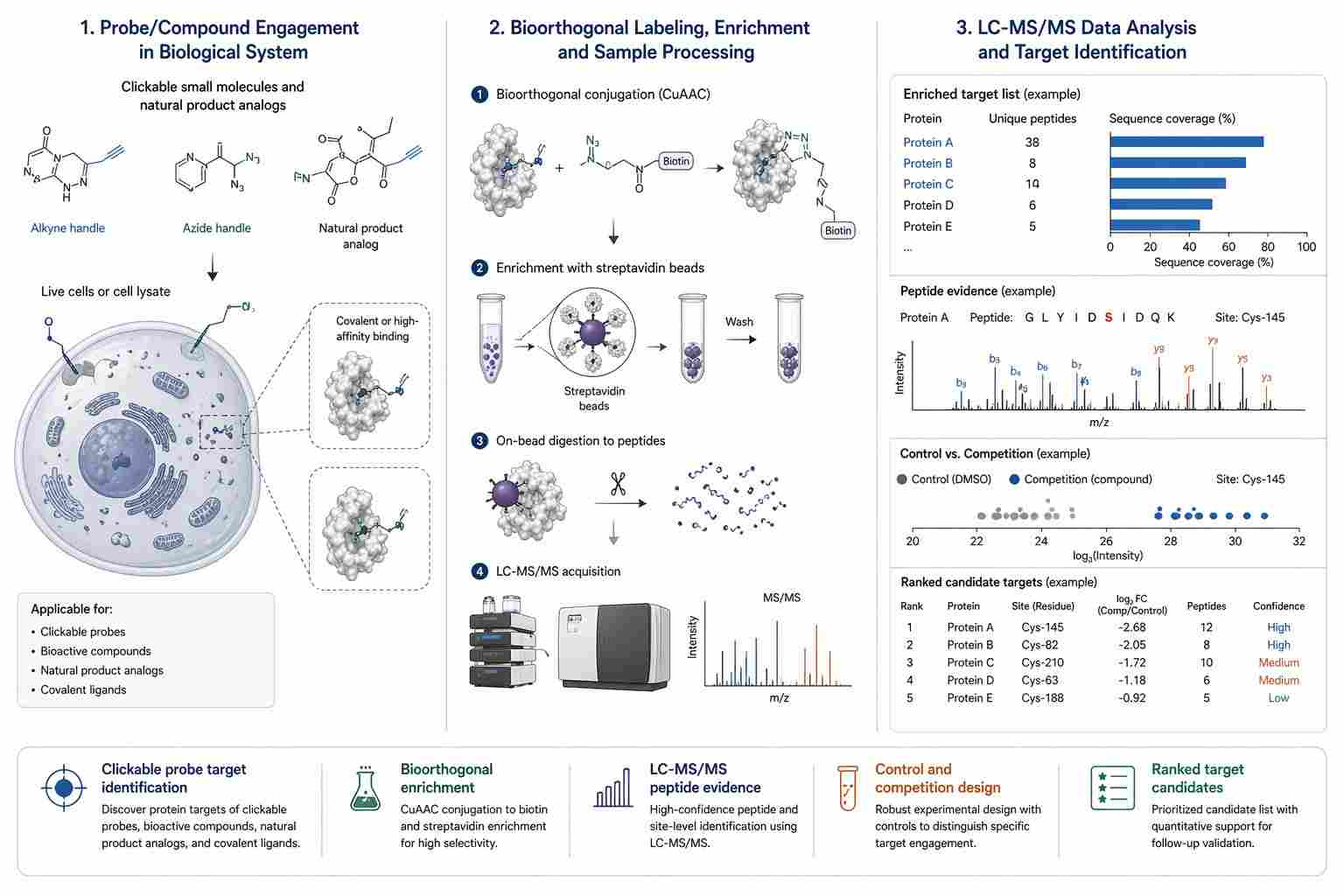
Bioorthogonal labeling and LC-MS/MS target identification workflow for clickable probes and bioactive compounds.
Target Identification Capabilities Workflow Project Types Sample Deliverables Demo Comparison Case Study FAQ Feasibility Review Disclaimer

Identify Candidate Targets from Clickable Probes and Bioactive Compounds

Bioorthogonal labeling-based target identification is a chemical proteomics workflow that connects a clickable small molecule, probe, or analog with enriched protein targets. The workflow typically combines probe treatment, bioorthogonal conjugation, affinity enrichment, protein digestion, LC-MS/MS analysis, and target ranking.

This service is useful when you have a compound with biological activity but need stronger evidence for the proteins it may engage. It is also useful when you already have an alkyne probe, azide probe, photoaffinity probe, or clickable analog and want to move from "active compound" to "candidate target list."

In this workflow, "click chemistry-compatible" means that the probe contains a small bioorthogonal handle, such as an alkyne or azide group, that can be linked to a larger enrichment tag after sample treatment. This helps keep the probe smaller during biological exposure while still enabling downstream enrichment and LC-MS/MS target identification.

What This Service Helps You Find

Our target identification workflow can help you generate:

  • Enriched candidate target proteins.
  • Probe versus control enrichment patterns.
  • Competition-dependent target changes.
  • Peptide-level evidence for protein identification.
  • Spectral support for target review.
  • Ranked target candidates for follow-up validation.
  • Pathway or functional context for enriched proteins.

We do not treat an enriched protein list as the final answer by itself. We help you interpret enrichment strength, control behavior, competition response, peptide evidence, and functional annotation together.

When This Workflow Is a Good Fit

This service is a strong fit when your project involves:

  • Clickable small-molecule probes.
  • Alkyne or azide analogs.
  • Natural product analogs.
  • Covalent probes.
  • Photoaffinity probes.
  • Phenotype-driven compounds.
  • Bioactive molecules with unclear direct targets.
  • Target fishing from cell lysates, intact cells, or tissue lysates.

For broader probe-based target discovery, you may also explore our Activity-Based Protein Profiling (ABPP-MS) service. If your question requires competition-based target engagement, our Competitive ABPP service may also be useful.

Our Service Capabilities for Bioorthogonal Target Identification Projects

A successful bioorthogonal target identification project depends on more than whether the probe contains a clickable handle. The probe must still bind or label the relevant protein target, the sample system must be compatible with the treatment conditions, and the controls must be strong enough to separate likely targets from background enrichment.

Our team supports the project from early design review to LC-MS/MS-based reporting.

Probe and Compound Feasibility Review

Before starting the experiment, we review the probe, compound, sample system, and project goal. This helps identify potential issues before valuable samples are used.

  • Parent compound activity, if available.
  • Probe structure and clickable handle.
  • Alkyne or azide placement.
  • Linker position and length.
  • Solvent and stock concentration.
  • Sample type and treatment format.
  • Known or suspected target biology.
  • Need for live-cell or lysate labeling.
  • Control and competition design.

If you do not yet have a clickable probe, we can help you evaluate whether this workflow is the right first step, or whether another target engagement method may be more suitable.

Bioorthogonal Labeling and Affinity Enrichment

After probe treatment, bioorthogonal chemistry can attach an enrichment-compatible tag, such as a biotin handle. Enriched proteins can then be captured, washed, digested, and analyzed by LC-MS/MS.

This workflow is especially useful when direct installation of a bulky affinity tag on the parent compound may affect binding, cell entry, or physicochemical behavior.

LC-MS/MS-Based Target Identification

Following enrichment and digestion, LC-MS/MS is used to identify enriched proteins and supporting peptides. The final result is not just a protein list. We organize the data so your team can review which targets have stronger enrichment, which have peptide support, and which are reduced by competition or inactive analog controls.

Control and Competition Design

False positives are a major concern in enrichment-based target identification. Background proteins, bead binders, endogenous biotin-associated proteins, highly abundant proteins, and complex-associated proteins can all appear in target lists.

  • No-probe control.
  • Probe-only group.
  • Vehicle control.
  • Parent compound competition.
  • Inactive analog control.
  • Bead or enrichment background control.
  • Biological replicates.

A strong control design makes the final ranking more useful for follow-up validation.

Target Ranking and Follow-Up Guidance

We help prioritize candidate targets using enrichment over control, reduction by competition, peptide and spectral evidence, replicate consistency, known biology or pathway context, protein family annotation, and background protein review.

The goal is to deliver a short, interpretable target list that helps your team decide what to validate next.

From Probe Labeling to Target Ranking: Workflow and QC Checkpoints

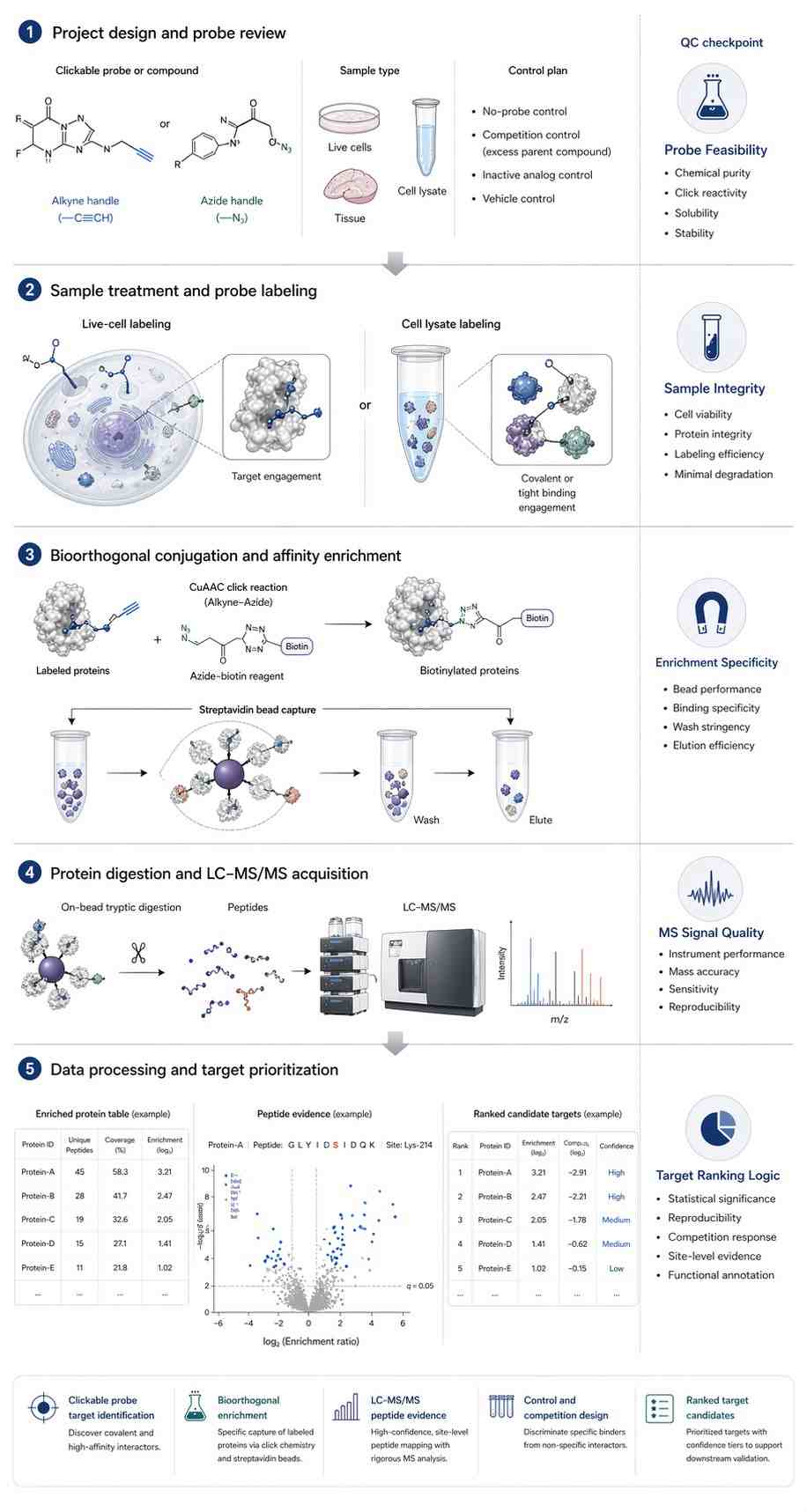
Our workflow follows the sample from project design through final result delivery. Each stage combines technical execution with QC checks that protect result quality.

1

Project Design and Probe Review

We begin by reviewing your compound, probe, sample type, controls, and target identification question. If the probe has an alkyne, azide, photoaffinity group, or other compatible handle, we evaluate how it fits the planned workflow.

QC checkpoint: probe and compound structure, handle placement, sample format, control design, and competition plan.

2

Sample Treatment and Probe Labeling

Samples are treated with the clickable probe under matched conditions. Depending on the project, this may be performed in cell lysate, intact cells, tissue lysate, or another agreed sample format.

For live-cell projects, the probe must be compatible with cellular exposure. For lysate projects, buffer composition and protein concentration become especially important.

QC checkpoint: matched treatment groups, protein concentration, live-cell or lysate compatibility, sample consistency, and replicate labeling.

3

Bioorthogonal Conjugation and Enrichment

After probe treatment, the clickable handle is linked to an enrichment tag through bioorthogonal chemistry. Labeled proteins are then captured using an affinity enrichment step.

This is where many background issues can appear. Non-specific proteins may bind beads or enrichment materials, and abundant proteins can sometimes dominate the signal.

QC checkpoint: conjugation efficiency, enrichment specificity, bead/background review, and control behavior.

4

Protein Digestion and LC-MS/MS Acquisition

Enriched proteins are digested into peptides and analyzed by LC-MS/MS. The LC-MS/MS run identifies peptides and proteins that are enriched in the probe-treated samples compared with controls.

QC checkpoint: digestion completeness, LC stability, MS signal quality, peptide identification quality, and replicate alignment.

5

Data Processing and Target Prioritization

The final data are processed into enriched protein tables, peptide evidence tables, comparison summaries, and visual outputs. We prioritize targets by combining enrichment, controls, competition response, peptide evidence, and annotation.

QC checkpoint: peptide confidence, enrichment ratio, competition response, missing value review, background filtering, and target ranking logic.

Vertical workflow for clickable probe labeling, enrichment, LC-MS/MS analysis, and target prioritization.

Project Types We Support

Bioorthogonal labeling and LC-MS/MS target identification can support several project types. The best format depends on the probe, compound, sample system, and the type of target evidence you need.

Clickable Probe Target Identification

If you already have an alkyne or azide probe, we can help evaluate whether it is suitable for enrichment-based target identification. This includes reviewing probe structure, treatment design, controls, and expected biological context.

Natural Product and Bioactive Compound Target Fishing

Natural products and bioactive compounds often show strong activity but unclear target mechanisms. If a clickable analog can be prepared, bioorthogonal enrichment followed by LC-MS/MS can help identify candidate targets for follow-up studies.

Covalent Ligand and Electrophilic Probe Target ID

Covalent or electrophilic compounds may be suitable for target identification when the probe design supports target capture and enrichment. For covalent lead characterization, our Covalent Inhibitor Profiling service can also support related project needs.

Photoaffinity Probe Follow-Up by LC-MS/MS

Photoaffinity probes can help capture weak or transient interactions. After crosslinking and enrichment, LC-MS/MS can help identify candidate targets and associated proteins.

Live-Cell Target Capture

Live-cell labeling may provide a more cellular-contextual view of target engagement, but it requires careful review of probe permeability, exposure conditions, and biological compatibility.

Cell Lysate or Tissue Lysate Enrichment Studies

Lysate-based enrichment can be useful when the project requires stronger control over protein concentration, buffer conditions, or probe exposure. Tissue lysates may also be considered when sufficient material and matched controls are available.

For broader residue-focused chemoproteomics, see our Reactive Residue Profiling service. For targetability-focused projects, see our Ligandability Mapping service.

Sample, Probe, Compound, and Control Requirements

Final requirements depend on probe chemistry, sample type, protein yield, and project design. The table below provides practical starting points for planning. We confirm exact requirements during feasibility review.

Sample / MaterialRecommended AmountRequired InformationControls to PrepareStorage and ShippingNotes
Cell lysate or cell pellet5 × 106 to 1 × 10⁷ cultured cells for proteomics-scale planningCell type, treatment condition, lysis method, protein concentration if availableNo-probe, probe-only, vehicle, competition, biological replicatesFlash-freeze, store at -80°C, ship on dry iceKeep cell number and processing consistent across groups
Trace cell sample200–5,000 cells may be possible for trace DIA-style planningCell source, collection method, expected protein yieldMatched controls and replicate planStore at -80°C and ship on dry iceRequires feasibility review before project start
Intact-cell labeling sampleProject-dependent; cell number and exposure format reviewed case by caseCell line, viability context, probe exposure condition, treatment formatVehicle, probe-only, competition, biological replicatesProcessed as agreed after reviewSuitable when cellular target capture is required
Animal tissue lysate30–50 mg for trace proteomics; 100–200 mg for broader omics-style planningSpecies, tissue type, collection method, treatment groupMatched tissue controls and replicatesFlash-freeze, store at -80°C, ship on dry iceRemove non-target tissue and keep collection conditions consistent
Plant tissue100–200 mg for soft tissue; hard plant tissue may require higher inputSpecies, tissue part, treatment condition, collection timingMatched controls and biological replicatesFlash-freeze, store at -80°C, ship on dry iceMaintain tissue location and collection timing across groups
Plasma / serum / biofluid20–100 μL depending on depletion and project scopeSample type, anticoagulant if applicable, processing methodMatched groups and replicatesAliquot, freeze, store at -80°C, ship on dry iceAvoid hemolysis and repeated freeze-thaw cycles
Culture supernatant5–20 mL depending on project scopeMedium type, serum status, collection timeMedium control and biological replicatesClarify by centrifugation, freeze, ship on dry iceSerum-free medium requirements should be reviewed before submission
Purified protein or focused targetAbout 150–300 μg is a practical planning rangeSequence, tag, buffer, concentration, known ligandsTarget-only, probe-only, competitionFrozen or cold-chain shipment as agreedBuffer compatibility is critical for labeling and LC-MS/MS
FFPE material10–20 slices, 10 μm thickness, about 1.5 × 2 cm areaTissue type, section thickness, storage historyMatched control sections if availableShip as agreed after feasibility reviewCompatibility depends on extraction quality and project goal
Clickable probeProject-dependentStructure, alkyne or azide handle, linker, parent compound activity, solventNo-probe and probe-only controlsShip according to probe stabilityCore feasibility input
Parent compound / competitorProject-dependentStructure, molecular weight, solvent, stock concentration, known activityVehicle and concentration series if neededShip according to compound stabilityImportant for target prioritization

Please label biological replicates clearly, avoid repeated freeze-thaw cycles, and provide any special treatment details. If the sample contains toxic, polymeric, surfactant-rich, corrosive, infectious, or unusual material, tell us before shipment so we can review feasibility.

What You Receive: Target Lists, Peptide Evidence, and Bioinformatics Analysis

Bioorthogonal labeling-based target identification produces layered data. We organize those data so your team can move from LC-MS/MS output to target decisions.

Minimum Deliverables

  • Raw LC-MS/MS data files.
  • Enriched protein identification table.
  • Peptide identification table.
  • Probe versus control comparison table.
  • Competition or inactive analog comparison table, if included.
  • Replicate-level quantitative summary.
  • QC summary.
  • Method summary.
  • Ranked candidate target list.
  • Visualization-ready summary figures.

Optional Analysis Add-ons

  • Pathway and functional enrichment analysis.
  • Protein family annotation.
  • Known target and off-target annotation.
  • Compound-series comparison.
  • Network or functional clustering.
  • Peptide and spectral evidence review pack.
  • Integration with quantitative ABPP, pull-down MS, or thermal stability profiling data.
  • Follow-up validation recommendation table.

How We Help Interpret the Target List

An enriched protein is not automatically a confirmed direct target. We help structure the evidence so your team can decide which candidates are worth follow-up.

  • Which proteins are enriched over no-probe or vehicle controls?
  • Which proteins decrease with parent-compound competition?
  • Which proteins are likely background or bead-associated signals?
  • Which candidates have stronger peptide and spectral support?
  • Which targets connect to the known phenotype or pathway?
  • Which candidates should move into orthogonal validation?

Representative Demo Results for Target Identification

The following demo outputs show how the results can be organized. These are representative output formats, not client-specific claims.

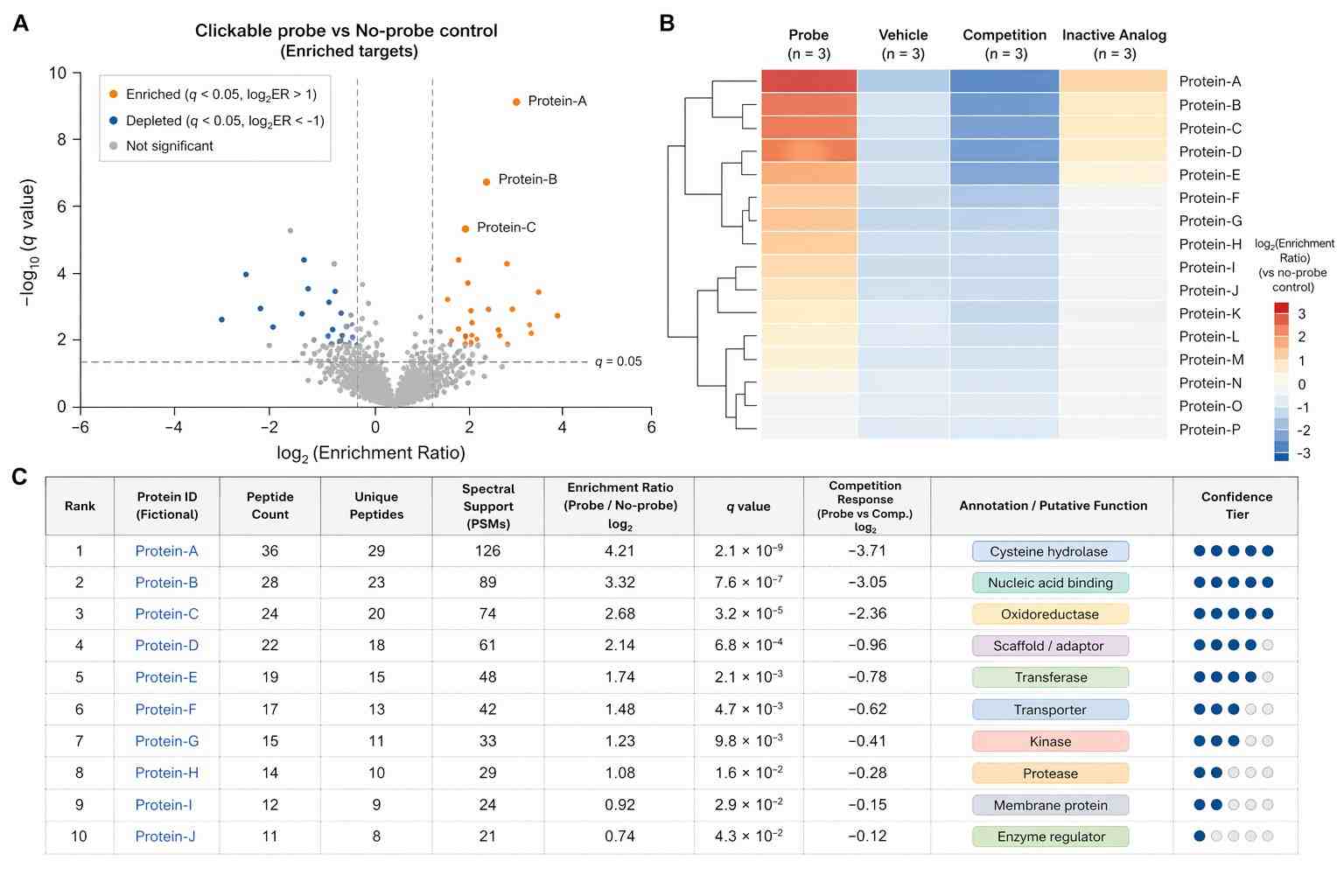
Demo LC-MS/MS target identification results with volcano plot, enrichment heatmap, and ranked target dashboard.

Integrated target identification demo results panel

Enriched target volcano plot, probe-control-competition heatmap, and ranked target evidence dashboard.

Demo 1: Enriched Target Volcano Plot

A volcano plot can compare probe-treated samples against no-probe or vehicle controls. Proteins with stronger enrichment and consistent replicate behavior can be highlighted as candidate targets.

How to read it: A useful candidate should show enrichment over background, reliable peptide evidence, and a pattern that fits the control design.

Demo 2: Probe-Control-Competition Heatmap

A heatmap can compare enrichment across probe, vehicle, inactive analog, and competition groups. This view helps separate proteins that respond to the active compound from proteins that appear across multiple background conditions.

How to read it: A stronger target candidate may show enrichment in the probe group and reduced signal in the competition group, while common background proteins may remain similar across conditions.

Demo 3: Ranked Target Evidence Dashboard

A target evidence dashboard can combine protein name, enrichment ratio, peptide count, spectral support, competition response, functional annotation, and confidence tier.

How to read it: This view helps your team move from a long protein list to a shorter group of candidates for follow-up validation.

Bioorthogonal Labeling Target ID vs Other Target Discovery Methods

Different target discovery methods answer different questions. We help you choose based on probe availability, target hypothesis, binding chemistry, sample type, and the evidence level you need.

MethodBest Use CaseEvidence LevelStrengthLimitationWhen to Choose
Bioorthogonal Labeling + LC-MS/MS Target IDClickable probe or bioactive compound target discoveryEnriched protein and peptide evidenceConnects probe labeling, enrichment, and LC-MS/MS target IDRequires a suitable clickable probe or analogChoose when a clickable probe or analog is available and target discovery is the goal
Affinity Pull-Down MSTagged compound target enrichmentProtein-level enrichmentBroad and familiar workflowA bulky tag may alter compound behaviorChoose when a stable affinity-tagged compound is available
Quantitative ABPPSite-level covalent ligand engagement and selectivityPeptide or residue-site competition evidenceStrong for site-level engagement and selectivity profilingRequires suitable activity-based probe chemistryChoose when site-level competition is the key question
Thermal Stability ProfilingProbe-free target engagementProtein-level stability shiftNo probe requiredDoes not directly identify a binding siteChoose when probe design is not feasible
Photoaffinity LabelingWeak or transient interaction captureCrosslinked target evidenceCan capture transient non-covalent interactionsRequires photoreactive probe design and optimizationChoose when a weak interaction needs covalent capture
Western Blot / Single-Target ValidationConfirmation of selected candidatesTarget-specific evidenceUseful for known candidate proteinsNot discovery-scaleChoose after MS has ranked candidate targets
Standard Quantitative ProteomicsPathway response after compound treatmentProtein abundance evidenceUseful for downstream biologyDoes not directly prove target engagementChoose when the goal is biological response profiling

How to Choose the Right Workflow

Choose Bioorthogonal Labeling + LC-MS/MS Target ID when you have a clickable probe or analog and need discovery-scale target identification.

Choose Quantitative ABPP when your main question is site-level covalent engagement or selectivity. For this direction, see our Isotope Labeling-Based Quantitative ABPP service.

Choose Thermal Stability Profiling when you do not have a probe and need a probe-free engagement screen. For this option, see our Proteome-wide Thermal Stability Profiling service.

Choose Photoaffinity Labeling when weak or transient non-covalent interactions need covalent capture.

Choose Pull-Down MS when a stable affinity-tagged compound is available and protein-level target identification is sufficient.

In many projects, the strongest evidence comes from combining methods. Bioorthogonal enrichment can support discovery-scale target identification, while quantitative ABPP, thermal stability profiling, or targeted validation can provide orthogonal support.

Literature-Supported Method Example: Bioorthogonal Chemistry in ABPP Target Identification

This literature example summarizes the findings and conclusions from Verhelst, Bonger, and Willems' review article, Bioorthogonal Reactions in Activity-Based Protein Profiling. It is not a Creative Proteomics customer case.

Background

The review explains that activity-based protein profiling can label and detect active enzyme species in cell lysates, cells, and whole animals. It also describes how ABPP has been used to study biological processes, identify drug targets, evaluate drug selectivity, and image probe targets.

A key problem discussed in the paper is that directly attaching large detection or affinity tags to an activity-based probe can change probe behavior. Large tags may reduce cell uptake, create steric clashes with the protein of interest, or affect probe localization. The authors present bioorthogonal chemistry as a way to use smaller mini-tags, such as alkyne or azide handles, during biological treatment and then attach larger detection or enrichment tags at a later stage.

Methods

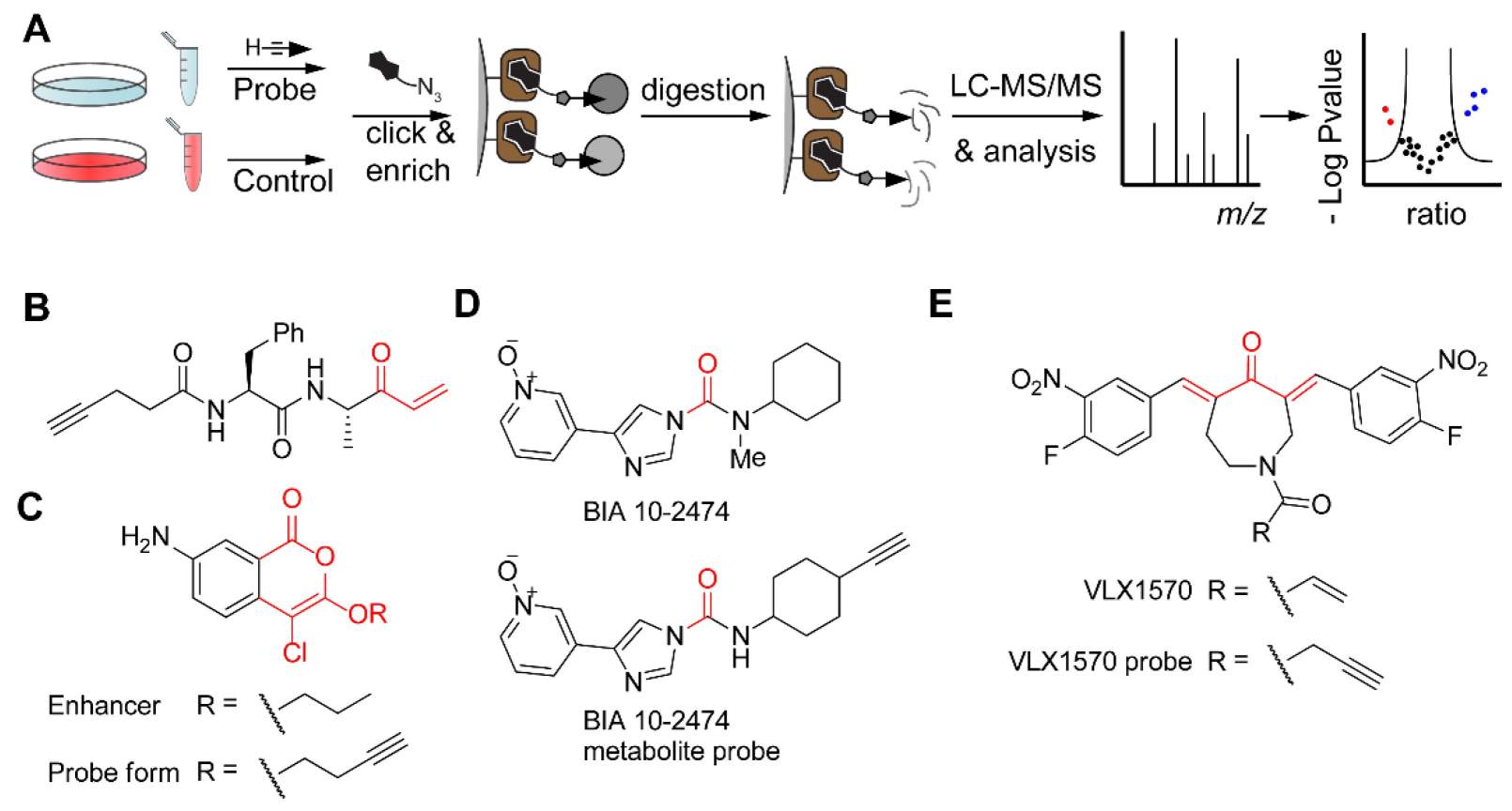
Figure 7, titled "Target identification in ABPP by making use of bioorthogonal chemistry," presents the target identification workflow.

In Figure 7A, live cells or a cell lysate are treated with a clickable probe. The paper recommends a control experiment without a probe or with a competitive inhibitor. After cell lysis, CuAAC is used with a biotin-tagged reagent. Labeled proteins are enriched on immobilized streptavidin, followed by tryptic digestion. The resulting peptides are analyzed by LC-MS/MS and processed, for example, by a volcano plot.

The figure also notes that the control experiment can be isotopically labeled, such as by SILAC, or that tryptic peptides can be labeled with heavy and light isotope labels before mixing. Label-free quantification is also described as an alternative. The figure further notes that proteins may be eluted before digestion to identify modified peptides, or that modified peptides may be released after on-bead digestion by using a cleavable linker.

Results

Figure 7 does not present a new numeric experimental dataset. Instead, it reports a target-identification workflow and several concrete literature examples of probes used in ABPP target and off-target studies.

The figure includes an alkyne-tagged activity-based probe based on an inhibitor of attachment and invasion of the Toxoplasma parasite. It also shows an enhancer of Toxoplasma invasion into host cells and an alkynylated derivative. In addition, the figure includes a FAAH inhibitor, BIA 10-2474, and a probe derived from a de-methylated metabolite. It also shows the DUB inhibitor VLX1570 and an alkyne-tagged probe form.

The review explains that enrichment and tandem MS-based ABPP workflows have been used to identify targets and off-targets of drugs or drug candidates. The authors group these studies into two main strategies: identifying targets of inhibitors discovered through phenotypic screening, and identifying off-targets of drugs that already have a known target. The review also states that exact binding-site identification can provide information about an enzyme's binding pocket or mechanism of action.

Conclusion

The authors conclude that bioorthogonal chemistry has been advantageous in ABPP because it allows late-stage introduction of experimental readout tags. This helps avoid problems that may occur when large tags are installed directly onto a probe, such as reduced cell uptake, steric clashes, or mislocalization.

The review also concludes that a two-step labeling approach gives researchers flexibility. A biological sample treated with an activity-based probe can be divided into aliquots, with one portion labeled for visualization and another portion conjugated to an affinity tag for target protein isolation.

The authors further state that, despite major advances, new bioorthogonal reactions are still needed to improve reaction kinetics, compatibility, and future applications. Their overall conclusion is that ABPP will continue to benefit from future developments in bioorthogonal chemistry.

For our clients, this literature example shows why probe design, late-stage enrichment tagging, control conditions, LC-MS/MS quality, and target ranking all need to be considered together when planning a bioorthogonal labeling-based target identification project.

Bioorthogonal chemistry workflow for clickable probe target identification by enrichment and LC-MS/MS.

Figure 7 from Verhelst, Bonger, and Willems, 2020, shows a bioorthogonal ABPP target identification workflow using clickable probes, enrichment, digestion, LC-MS/MS, and quantitative processing.

FAQ

FAQ: Planning a Bioorthogonal Target Identification Project

Q: What is bioorthogonal labeling-based target identification?

Bioorthogonal labeling-based target identification is a chemical proteomics workflow that uses a clickable probe or analog to label proteins, attaches an enrichment tag through bioorthogonal chemistry, enriches labeled proteins, and identifies candidate targets by LC-MS/MS.

Q: How is this service different from standard pull-down MS?

Standard pull-down MS often uses a compound directly attached to a bulky affinity tag. Bioorthogonal labeling allows a smaller clickable handle to be used during sample treatment, with the enrichment tag added later. This can be useful when tag size may affect compound behavior.

Q: What does click chemistry-compatible mean in this workflow?

It means the probe or analog contains a chemical handle that can react with a compatible tag after sample treatment. Common project examples include alkyne- or azide-containing probes that can be linked to enrichment tags for downstream LC-MS/MS analysis.

Q: Do I need an alkyne or azide probe before starting?

For this workflow, a clickable probe or analog is usually needed. If you do not yet have one, we can review your compound and project goal to help determine whether bioorthogonal target identification, pull-down MS, quantitative ABPP, or thermal stability profiling is the better next step.

Q: Can this workflow be used in live cells?

Yes, live-cell workflows may be possible when the probe is compatible with the cell system and treatment design. Probe permeability, exposure conditions, cell handling, and controls should be reviewed before project launch.

Q: What controls are needed for target identification?

Common controls include no-probe control, probe-only group, vehicle control, parent-compound competition, inactive analog control, and biological replicates. The final control design depends on the probe, sample type, and project question.

Q: How do you reduce false positives from background proteins?

We reduce false-positive risk through control design, enrichment background review, replicate comparison, peptide evidence review, competition response, and target ranking. Background proteins are not removed by assumption; they are assessed through the data structure.

Q: Can this service support natural product target identification?

Yes. If a natural product analog can be designed with a compatible clickable handle, this workflow can support target fishing and LC-MS/MS-based candidate target identification.

Q: What data deliverables will I receive?

Deliverables may include raw LC-MS/MS files, enriched protein tables, peptide identification tables, probe/control comparison tables, competition summaries, QC summaries, target ranking, visual outputs, and a method summary.

Q: How do I choose between this service, quantitative ABPP, and thermal stability profiling?

Choose this service when you have a clickable probe or analog and need target discovery. Choose quantitative ABPP when site-level covalent engagement is the main question. Choose thermal stability profiling when you do not have a probe and need a probe-free engagement method.

Start a Target Identification Feasibility Review

If you have a clickable probe, natural product analog, covalent ligand, or bioactive compound with an unclear target, we can help you decide whether bioorthogonal labeling and LC-MS/MS target identification is the right next step.

Share your probe structure, parent compound, sample type, control plan, and project question. Our team will review feasibility, recommend a workflow, and define the deliverables needed for interpretable target ranking.

Disclaimer

This service is for Research Use Only and is not intended for clinical diagnosis, treatment selection, or medical decision-making.

Online Inquiry

Please submit a detailed description of your project. We will provide you with a customized project plan to meet your research requests. You can also send emails directly to for inquiries.

* Email
Phone
* Service & Products of Interest
Services Required and Project Description