Live-Cell MS Profiling Service — Cellular Drug Target Engagement & Multi-Omics Analysis

Characterize drug-target interactions and cellular responses directly in living cells with integrated mass spectrometry-based proteomics, metabolomics, and lipidomics — from target engagement to multi-omics phenotypic profiling.

You've identified a promising compound. But does it actually engage its intended target inside living cells? And what else happens in the cell as a result? Traditional biochemical and lysate-based assays, while valuable for initial screening, cannot answer these questions — they miss the complexity of drug-target interactions in their native cellular environment, where protein complexes, post-translational modifications, subcellular compartmentalization, and metabolic context all influence pharmacology. Without direct evidence of drug binding and cellular response in living cells, researchers risk advancing compounds with poor target engagement, unanticipated off-target effects, or inadequate intracellular penetration.

MassTarget™ offers a comprehensive Live-Cell MS Profiling Service that combines multiple mass spectrometry-based modalities — including thermal stabilization assay (PISA-based), Proteome Integral Solubility Alteration (PISA), intracellular drug quantification by LC-MS/MS, and cellular multi-omics profiling — to provide an integrated view of drug behavior directly in live cells. Our service covers the full spectrum from target engagement validation to proteome-wide target deconvolution, intracellular drug concentration measurement, and downstream cellular response profiling through proteomics, metabolomics, and lipidomics.

By consolidating these complementary capabilities under one roof, we eliminate the need to coordinate across multiple vendors and provide a single, integrated workflow for live-cell drug profiling — enabling you to make confident, data-driven decisions earlier in the drug discovery process.
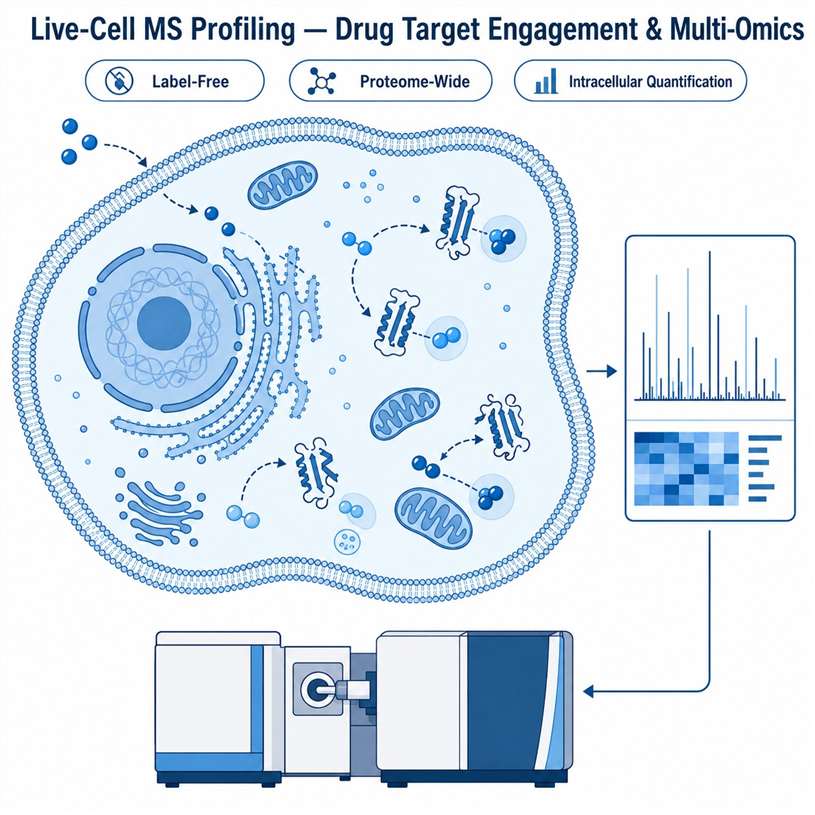
Live-cell MS profiling overview cellular drug target engagement
Overview Advantages Modes Workflow Platforms Sample Case Study FAQ

What Is Live-Cell MS Profiling?

Live-cell MS profiling is a suite of mass spectrometry-based techniques that measure drug-target interactions, intracellular drug concentrations, and downstream cellular responses directly in living cells — without fluorescent labels, genetic engineering, or cell lysis. The key difference from conventional biochemical assays: we work with intact cells, preserving the protein complexes, post-translational modifications, subcellular localization, and metabolic context that collectively determine drug pharmacology.

Our core methodologies include:

  • Thermal Stabilization Assay (PISA-Based) — Measures ligand-induced thermal stabilization of target proteins directly in live cells, providing label-free evidence of drug-target engagement at the proteome-wide scale
  • Proteome Integral Solubility Alteration (PISA) — A streamlined, high-throughput variant of thermal proteome profiling that identifies drug targets by comparing protein solubility between treated and untreated cells at defined temperatures
  • Intracellular Drug Quantification (LC-MS/MS) — Direct measurement of drug and metabolite concentrations inside cells, providing critical PK/PD correlation data
  • Cellular Multi-Omics Profiling — Quantitative proteomics, metabolomics, and lipidomics to map the full spectrum of drug-induced cellular responses

These approaches can be deployed individually or in combination, depending on your specific question — whether validating target engagement, deconvoluting the mechanism of action of a phenotypic hit, or profiling the cellular response to a lead compound. For researchers who need direct evidence of intracellular drug binding, our Drug Uptake & Retention MS service provides complementary measurements of drug accumulation within the cellular compartment.

Key Advantages

Physiological Relevance

Drug-target interactions measured in live cells preserve native protein complexes, PTMs, and subcellular context — unlike lysate-based or biochemical assays.

Label-Free & Modification-Free

No fluorescent tags, affinity handles, or compound modifications required. Suitable for unmodified small molecules, natural products, and clinical compounds.

Proteome-Wide Coverage

Thermal stabilization assay and PISA enable simultaneous profiling of thousands of proteins, identifying both on-target and off-target interactions in a single experiment.

Integrated Multi-Omics

Combine target engagement data with proteomic, metabolomic, and lipidomic readouts from the same cellular system for a complete mechanistic picture.

Intracellular Quantification

Direct LC-MS/MS measurement of unbound intracellular drug concentrations — essential for understanding the relationship between dose, target engagement, and pharmacological response.

Broad Sample Compatibility

Cell lines, primary cells, iPSC-derived cells, organoids, patient-derived cells, and tissue homogenates — all compatible with our live-cell profiling workflows.

Service Modes

We offer six complementary service modes that can be used individually or in combination to address specific drug profiling needs.

MODE 1

Thermal Stabilization Assay (PISA-Based)

Proteome-wide thermal stabilization profiling using high-resolution Orbitrap MS to identify drug-stabilized proteins across the entire proteome. Provides direct evidence of target engagement in live cells without compound modification.

Best for: Target validation, target deconvolution, off-target profiling.

MODE 2

PISA-Based Target Identification

Streamlined Proteome Integral Solubility Alteration workflow using label-free DIA-MS for high-throughput drug target identification. Compatible with 96-well plate format for scalable screening of multiple compounds or conditions.

Best for: High-throughput target ID, mechanism-of-action studies, phenotypic hit deconvolution.

MODE 3

Intracellular Drug Quantification

Quantitative LC-MS/MS measurement of intracellular drug and metabolite concentrations. Includes total and unbound fraction determination, time-course accumulation profiling, and efflux transporter assessment.

Best for: PK/PD correlation, cellular permeability studies, drug retention analysis.

MODE 4

Cellular Proteomics Profiling

Quantitative proteomics (TMTpro, label-free DIA) comparing drug-treated vs. control cells to map proteome-wide expression changes, pathway activation, and biomarker discovery.

Best for: Understanding drug mechanism of action, resistance mechanism profiling, biomarker identification.

MODE 5

Cellular Metabolomics & Lipidomics

Targeted and untargeted metabolomics and lipidomics profiling of drug-treated cells using LC-MS/MS and high-resolution Orbitrap MS. Captures metabolic reprogramming, energy metabolism shifts, and lipid remodeling.

Best for: Metabolic drug effects, oncometabolite profiling, lipid-mediated drug response.

MODE 6

Custom Multi-Omics Integration

Tailored combination of any of the above modes with advanced bioinformatics — including correlation analysis across omics layers, pathway enrichment, and integrated mechanistic interpretation.

Best for: Comprehensive drug profiling programs requiring integrated target engagement + cellular response data.

Service Workflow

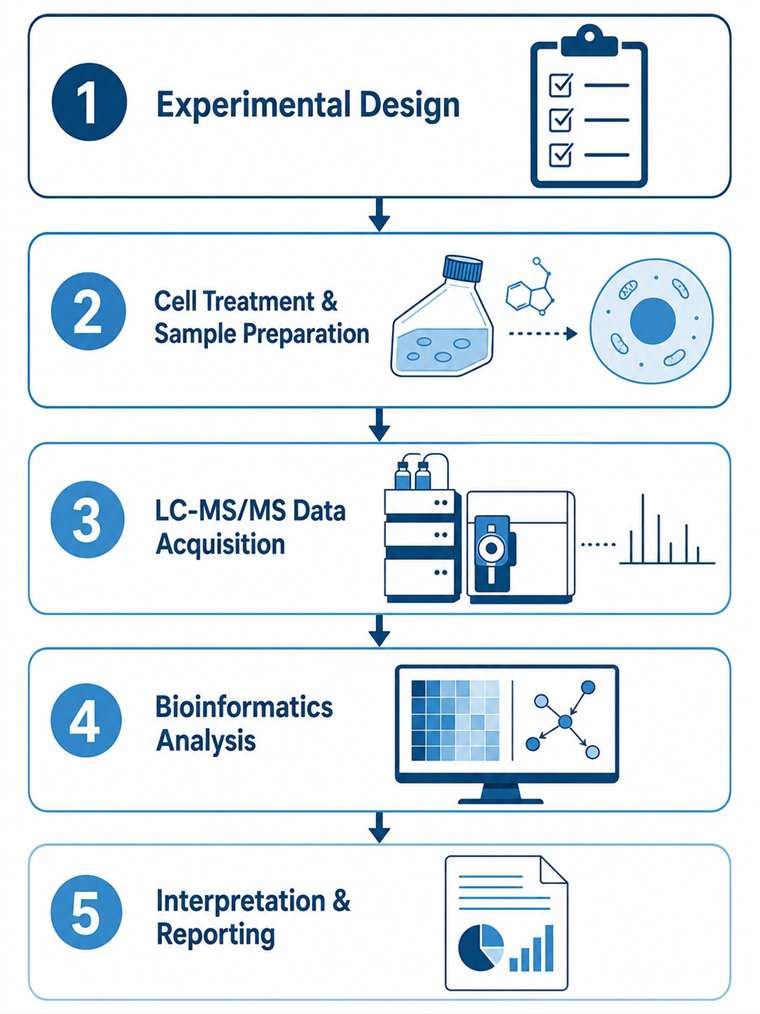
Our live-cell MS profiling workflow follows a structured five-stage process:

1

Experimental Design

Consultation to define the cellular model system, select appropriate profiling modalities (thermal stabilization assay, PISA, intracellular quantification, multi-omics), determine dose-response ranges, time points, and replicate requirements.

2

Cell Treatment & Sample Preparation

Drug treatment of live cells under optimized conditions, followed by thermal challenge (for thermal stabilization assay / PISA), cell washing, lysis, protein digestion, metabolite extraction, and quality control at each step.

3

LC-MS/MS Data Acquisition

High-resolution Orbitrap (Exploris 480, Q Exactive HF-X) and Q-TOF (timsTOF Pro) platforms with optimized acquisition methods for each modality — DIA for PISA, TMTpro for quantitative proteomics, MRM for targeted metabolomics.

4

Bioinformatics Analysis

Thermal stability profiling, differential expression analysis, pathway enrichment (KEGG, Reactome, GO), kinase-substrate network mapping, and integrated multi-omics correlation analysis.

5

Interpretation & Reporting

Comprehensive report integrating all profiling data layers, with identification of confirmed targets, off-target interactions, cellular response pathways, and publication-ready figures.

Live-cell MS profiling workflow five-step process

Service Process: Inquiry & Consultation → Project Proposal & Quote → Sample Submission → LC-MS/MS Analysis → Data Analysis & Report Delivery

Technology Platforms

MassTarget's live-cell MS profiling service is supported by advanced mass spectrometry platforms optimized for cellular drug profiling.

PlatformApplicationKey Specifications
Orbitrap Exploris 480Thermal stabilization assay, PISA, proteomicsHRAM, 480,000 resolution, FAIMS Pro, DIA capability
Q Exactive HF-XQuantitative proteomics (TMT)120,000 resolution, fast scanning, high sensitivity
Triple Quad 6500+Intracellular drug quantification, targeted metabolomicsMRM quantitation, high sensitivity, wide dynamic range
timsTOF Pro4D-proteomics, thermal stabilization assayPASEF, ion mobility separation, high sensitivity

Technology Comparison

DimensionLive-Cell MS (Thermal Stabilization / PISA)Lysate-Based TPPBiochemical Binding Assays
Physiological RelevanceHigh — intact cellular environmentModerate — lysate onlyLow — purified protein
Proteome CoverageProteome-wide (6,000+ proteins)Proteome-wide (5,000+ proteins)Single target
Label-FreeYesYesOften requires labels
Compound ModificationNot requiredNot requiredVaries by method
Intracellular Drug QuantificationYes — direct LC-MS/MSNoNo
Multi-Omics IntegrationYes — proteomics, metabolomics, lipidomicsProteomics onlyNo
ThroughputModerate to high (96-well PISA format)Low to moderateHigh (384/1536-well)
Turnaround Time4–8 weeks4–6 weeks2–4 weeks

Sample Requirements

Sample TypeRecommended AmountBiological ReplicatesStorageShipping
Adherent Cell Lines1–5 × 10⁷ cells per condition≥3Fresh or -80 °C pelletDry ice
Suspension Cells1–5 × 10⁷ cells per condition≥3Fresh or -80 °C pelletDry ice
Primary Cells1–5 × 10⁶ cells per condition3–5Fresh only (same-day processing recommended)Temperature-controlled
iPSC-Derived Cells1–5 × 10⁷ cells per condition≥3Fresh or -80 °C pelletDry ice
Organoids5–10 organoids per condition3–5Fresh in culture mediumTemperature-controlled
Tissue Biopsies20–50 mg per sample≥3Liquid N2 / -80 °CDry ice

General Guidelines: For thermal stabilization assay and PISA experiments, cells must be viable at the time of drug treatment. For intracellular drug quantification, we recommend including a minimum of 3 biological replicates and 3 technical replicates. For metabolomics samples, quenching in liquid nitrogen within seconds of collection is critical to preserve metabolite profiles. All samples should be flash-frozen immediately after collection and stored at -80 °C. Avoid repeated freeze-thaw cycles. For detailed guidance on intracellular drug concentration measurement, refer to our Intracellular Accumulation MS service page.

Deliverables

  • Comprehensive report with thermal stability profiles (thermal stabilization assay / PISA), target identification lists, and dose-response curves
  • Intracellular drug concentration data with total and unbound fraction determination
  • Quantitative proteomics data with differential expression analysis (volcano plots, heatmaps)
  • Metabolomics and lipidomics profiling with pathway enrichment analysis
  • Integrated multi-omics correlation analysis linking target engagement to cellular response
  • Publication-ready figures and data tables
  • Raw data files (RAW format) and processed data tables
  • Bioinformatics consultation session to discuss results

For functional cellular assays that complement target engagement data, our Cell-Based MS Screening service provides additional phenotypic readouts. If metabolic pathway analysis is of interest, explore our Cellular Metabolomics Screening and Cellular Lipidomics Drug Profiling services for deeper multi-omics characterization of drug-treated cells.

Representative Data

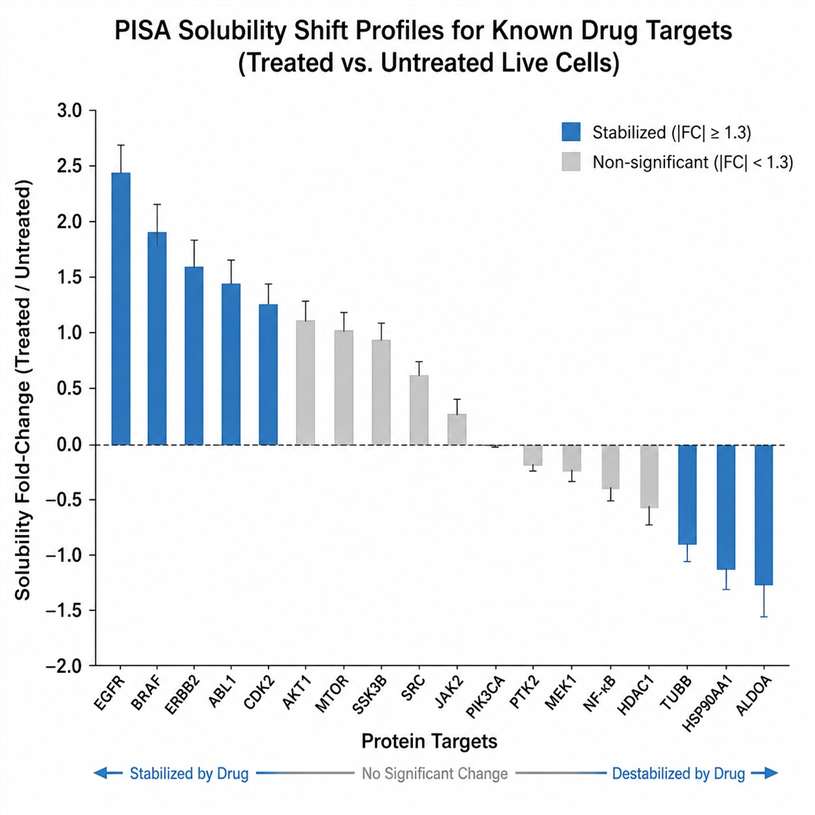
PISA solubility shift data for drug target identification

Proteome-wide target identification by PISA — solubility shift profiles for known and novel drug targets

Case Study: PISA-Based Drug Target Identification in Live Cells

Nature Communications (2024) — 10.1038/s41467-024-53240-2

Service Used

Thermal stabilization assay / PISA (Proteome Integral Solubility Alteration) — label-free DIA-based thermal proteome profiling

Background

Identifying the molecular targets of small-molecule drugs remains a major bottleneck in drug discovery. Traditional thermal proteome profiling (TPP) methods, while powerful, are limited by low throughput, long analysis times, and the need for expensive isobaric labeling reagents. A streamlined, label-free approach was needed to enable higher-throughput drug target identification across multiple compounds and biological contexts.

Approach

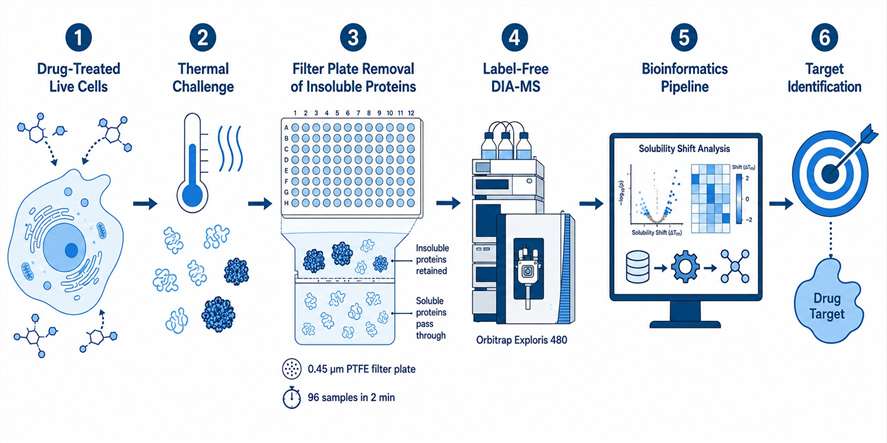
Batth et al. developed a streamlined PISA workflow that integrates several key innovations: (1) a filter plate-based removal of insoluble proteins using 0.45 μm PTFE filter plates (processing 96 samples in 2 minutes), (2) label-free DIA-based mass spectrometry on an Orbitrap Exploris 480, and (3) a dedicated bioinformatics pipeline for solubility shift analysis. The workflow was validated by screening 22 different drugs across multiple compound classes, including kinase inhibitors, HDAC inhibitors, and NSAIDs.

Key Findings

  • The optimized PISA workflow identified more than 2-fold more kinase targets and 7-fold more non-kinase targets compared to standard centrifugation-based TPP methods
  • DIA-based analysis identified more proteins with higher data completeness in approximately 25% of the analysis time required for TMT-based approaches
  • Screening of 22 drugs revealed both known and novel targets, including the identification of Pirin (PIR) as a target of the NSAID ibuprofen, confirmed by surface plasmon resonance (KD = 546 μM)
  • The workflow demonstrated organ-specific drug-target engagement when applied to rat tissue extracts (liver, spleen, kidney, muscle, hippocampus), revealing that some kinases showed stabilization in one organ but destabilization in another
  • The study challenged the traditional definition of drug targets by showing that more proteins exhibited destabilization than stabilization upon drug treatment, suggesting that many physiological drug effects arise from indirect perturbations of protein complexes and interaction networks

Impact

This study established PISA as a scalable, high-throughput alternative to conventional TPP, enabling proteome-wide drug target identification in live cells without the need for compound modification or isotopic labeling. The workflow's compatibility with 96-well plate formats and its demonstrated ability to identify both on-target and off-target interactions across diverse drug classes make it a powerful tool for early-stage drug discovery, mechanism-of-action studies, and safety pharmacology.

PISA workflow for drug target identification in live cells

Streamlined PISA workflow for drug target identification in live cells (adapted from Nature Communications 2024, Fig. 1, 10.1038/s41467-024-53240-2).

FAQ

Frequently Asked Questions

Q: What types of live-cell MS profiling assays do you offer?

We have six service modes covering the full spectrum: thermal stabilization assay (PISA-based) for target engagement, PISA for high-throughput target ID, intracellular drug quantification by LC-MS/MS, cellular proteomics, metabolomics and lipidomics, and custom multi-omics integration. You can pick one or combine several — the most common approach is to start with thermal stabilization or PISA for target engagement and layer on multi-omics for the cellular response side.

Q: How is live-cell MS profiling different from lysate-based assays?

The short answer: live-cell profiling preserves the cellular environment — protein complexes, PTMs, compartmentalization, and metabolic context — that lysate-based methods lose when you break the cells open. That means we can capture context-dependent pharmacology: whether your drug actually penetrates the cell, whether it gets effluxed, and whether it's metabolized inside the cell. Lysate-based assays can't answer those questions.

Q: What sample types are compatible with your live-cell profiling service?

We work with adherent and suspension cell lines, primary cells, iPSC-derived cells, organoids, patient-derived cells, and tissue biopsies. The key requirement for thermal stabilization assay and PISA is that cells must be viable at the time of drug treatment. For a standard profiling experiment, we recommend at least 1 × 10⁷ cells and 3 biological replicates per condition. If you're unsure whether your sample type is compatible, send us the details and we'll let you know.

Q: Can you measure intracellular drug concentrations?

Yes — that's one of our core capabilities. Mode 3 provides quantitative LC-MS/MS measurement of intracellular drug and metabolite concentrations, including total and unbound fraction determination, time-course accumulation profiling, and efflux transporter assessment. This data bridges the gap between dose and target engagement — you can't be sure your drug is reaching its target inside cells without measuring it directly.

Q: How do you ensure data quality and reproducibility?

We apply rigorous QC at every stage: cell viability assessment before drug treatment, internal standards for LC-MS/MS quantification, pooled QC samples for metabolomics, and a minimum of 3 biological replicates per condition. Our thermal stabilization assay and PISA workflows include technical replicates and established statistical frameworks for solubility shift analysis. Every project includes a full QC report alongside the data.

Q: What bioinformatics support is included?

Bioinformatics is included end-to-end. We handle thermal stability profiling and target identification (thermal stabilization assay / PISA), differential expression analysis with volcano plots and heatmaps, pathway enrichment (KEGG, Reactome, GO), and integrated multi-omics correlation analysis. You get publication-ready figures and a results discussion session with our bioinformatics team. If you have specific analysis requirements beyond the standard pipeline, we can discuss custom options during the project design phase.

Ready to Profile Your Compounds in Live Cells?

Tell us about your compound and cellular model — we'll design a live-cell profiling strategy that fits your specific drug discovery program. Our scientific team will review your requirements and get back to you with a project outline within 1–2 business days.

For research use only. Not for use in diagnostic procedures.

Online Inquiry

Please submit a detailed description of your project. We will provide you with a customized project plan to meet your research requests. You can also send emails directly to for inquiries.

* Email
Phone
* Service & Products of Interest
Services Required and Project Description