Microfluidic Chip–Mass Spectrometry Service

Integrate microfluidic chip processing with mass spectrometry detection for real-time, label-free assay monitoring. Our platform handles enzyme kinetics, drug metabolism, and binding studies with nL–μL sample volumes — combining the throughput of microfluidics with the specificity of high-resolution MS.

Conventional LC-MS gives you snapshots — time-point collections that miss what happens between injections. Plate-based fluorescence assays offer continuous readouts but force you to label your system, which can alter binding or kinetics. Our microfluidic chip mass spectrometry service sits in the middle: chip processing coupled directly to high-resolution MS for true real-time, label-free monitoring of biochemical reactions, consuming only nanoliters to low microliters per data point.

Key Advantages:

  • Real-time online MS — not endpoint snapshots
  • nL–μL volumes preserve precious compounds and proteins
  • Label-free detection keeps biomolecular interactions native
  • Automated chip workflows cut manual variability
  • Flexible chip designs for enzyme kinetics, binding, and metabolism
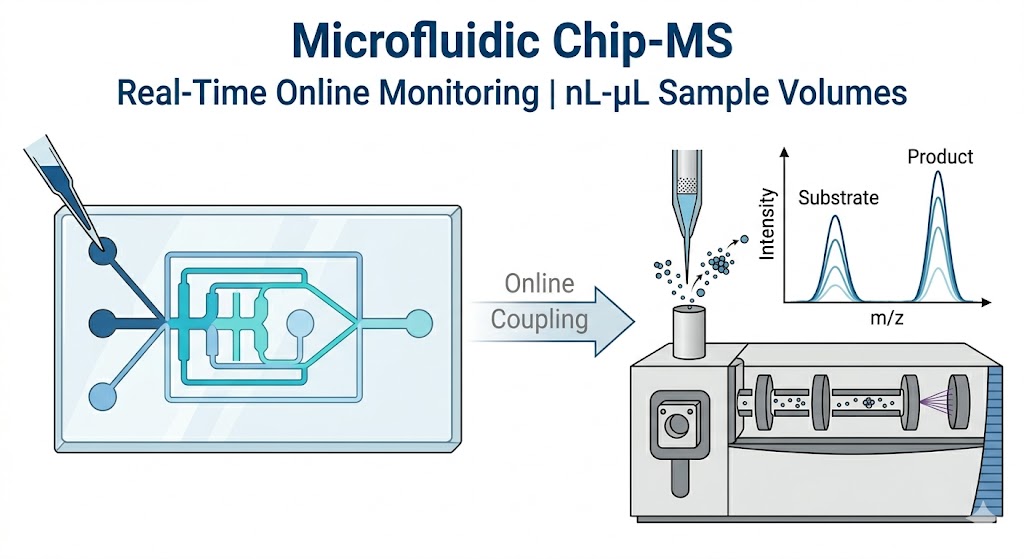
Microfluidic chip-MS integration showing microfluidic chip with channels connecting to mass spectrometer inlet for real-time online monitoring.
Overview Why Chip-MS Workflow Applications Sample Bioinformatics FAQ

Online Microfluidic-MS for Real-Time Assay Monitoring

Conventional LC-MS gives you snapshots — time-point collections that miss what happens between injections. Plate-based fluorescence assays offer continuous readouts but force you to label your system, which can alter binding or kinetics. Our microfluidic chip mass spectrometry service bridges that gap, coupling microfluidic chip processing directly with high-resolution mass spectrometry for real-time, label-free monitoring of biochemical reactions using nL to μL sample volumes.

How it works:

  1. Chip-based sample handling — Your sample moves through a custom or pre-configured microfluidic chip with integrated channels, reaction chambers, and mixing zones. The chip delivers precise volumes to the MS interface with minimal dead volume and carryover.
  2. Online MS coupling — The chip feeds directly into an Orbitrap or Q-TOF via a nanoESI or microfluidic-optimized source. As reactions run on-chip, the output flows continuously into the MS for real-time detection.
  3. Time-resolved acquisition — We collect full-scan MS or targeted SIM/SRM data across the reaction time course, capturing substrate consumption, product formation, and intermediates as they appear.
  4. Quantitative processing — Extracted ion chromatograms are integrated, response factors calibrated, and kinetic parameters (kcat, KM, IC50) calculated from the time-resolved trace.
  5. Interpreted report — You get processed curves, quantified rates, statistical analysis, and a written interpretation with notes on next steps.

When Microfluidic Chip–MS Outperforms Conventional LC-MS

Standard LC-MS works by discrete injections with chromatography between runs, which limits throughput and blocks true continuous monitoring. Fluorescence plate readers run continuously but report an indirect signal that can be misleading in complex matrices. Microfluidic chip–MS avoids both compromises.

DimensionConventional LC-MSPlate-Based FluorescenceMicrofluidic Chip–MS
Sample volume per data point5–50 µL10–100 µL0.1–10 µL
Real-time monitoringNo (batch injections)Yes (continuous)Yes (online coupling)
Label requirementNoneRequired (dye/antibody)None
Throughput50–200 samples/day1,000–10,000 wells/day200–1,000 data points/day
AutomationModerateHighHigh (chip-integrated)
Molecular specificityHigh (MS)Low (optical interference)High (MS)
Kinetic accuracyGood (but endpoint)Good (but indirect)Excellent (direct, real-time)
Compound consumed1–10 nmol per run0.1–1 nmol per well0.01–0.1 nmol per data point

The short version: choose chip–MS when sample is limited, when you need genuine time-resolved kinetics instead of endpoint estimates, or when labeling would compromise your assay. For a complementary chip-based separation approach, see our CE-MS affinity screening service.

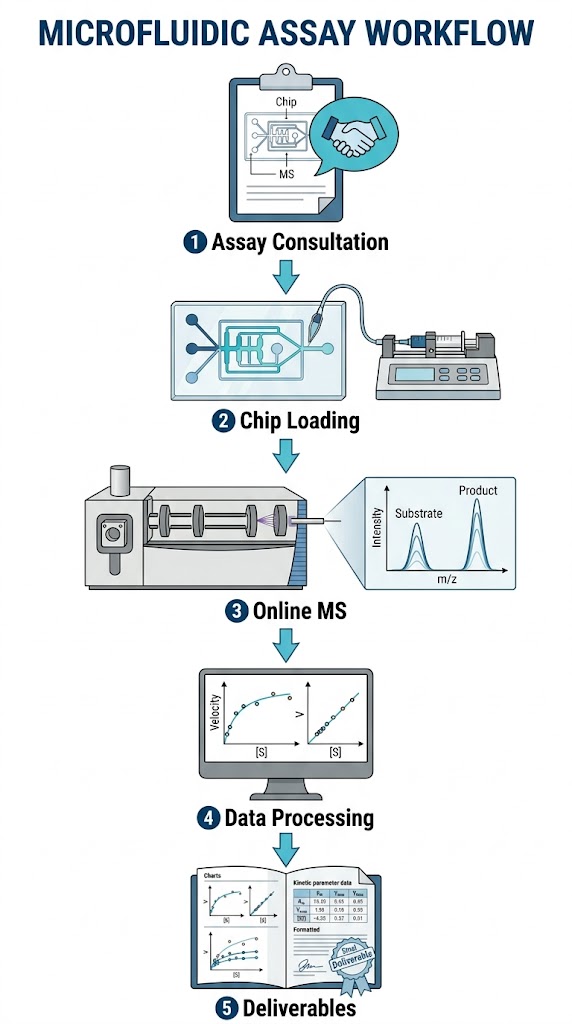
Our Chip-MS Workflow — From Sample to Data

Every project follows a pipeline built around data quality and practical throughput.

1

Assay Consultation and Chip Selection

We talk through your assay: reaction type (enzyme kinetics, binding, metabolism), sample matrix, what you want to detect, and the time resolution you need. We pick the right chip format — continuous-flow for steady-state kinetics, droplet-based for discrete reactions, or digital microfluidic for multi-step workflows.

2

Chip Loading and System Setup

Your sample goes into the chip via automated syringe pumps or integrated microfluidic controllers. The chip connects to the MS source through a zero-dead-volume union, and we tune flow rate, ionization voltage, and source temperature for your specific system.

3

Online MS Acquisition

Data runs continuously across the reaction time course. For enzyme kinetics we typically collect 50–200 time points per reaction. For inhibition studies we run 8–12 concentrations with matched controls.

4

Data Processing and Kinetic Fitting

Our pipeline handles peak detection, baseline correction, response calibration, and kinetic modeling — Michaelis-Menten for enzymes, four-parameter logistic for inhibition. Quality metrics include R² of curve fits, replicate CV, and signal-to-noise.

5

Deliverables

Kinetic curves with fitted parameters, raw extracted ion chromatograms, a quantified data table, and a written summary with method details and interpretation.

Five-step vertical workflow for microfluidic chip-MS: assay consultation, chip loading, online MS acquisition, data processing, and deliverables.

For automated chip-based processing, see our microreactor MS screening service.

Key Applications in Drug Discovery

APPLICATION 1

Enzyme Kinetics and Inhibitor Screening

This is where chip-MS shines most. The online format captures a full reaction time course in one experiment — no sampling artifacts, no endpoint extrapolation. We have applied this to kinases, phosphatases, hydrolases, transferases, and CYP450 enzymes. For inhibition screening, we generate IC50 curves from 8–12 concentrations in under two hours of chip time, consuming far less enzyme than conventional plate-based or LC-MS approaches.

APPLICATION 2

Drug Metabolism and Stability Monitoring

Microfluidic chips can simulate metabolic reactions by mixing drug compounds with microsomes, S9 fractions, or recombinant CYP isoforms in continuous-flow or droplet mode. The online MS readout tracks parent drug disappearance and metabolite appearance simultaneously, giving you time-resolved metabolic stability data and early metabolite profiles from a single run.

APPLICATION 3

Binding Assays and Target Engagement

Chip-MS detects non-covalent protein-ligand complexes under native conditions using nanoESI-MS — no immobilization, no labeling. The microfluidic format lets you screen compound libraries against target proteins with minimal consumption. For related native MS capabilities, see our native ESI-MS and droplet microfluidics MS services.

Sample Requirements and Project Planning

Sample TypeVolume RequiredMinimum ConcentrationBuffer CompatibilityRecommended Replicates
Purified enzyme + substrate10–100 µL per condition≥1 µM enzyme, ≥100 nM substrateMS-compatible (ammonium acetate, PBS with ≤0.1% BSA)3 per condition
Compound library (screening)1–5 µL per compound (1 mM stock)≥10 µM final assayDMSO ≤1% final, MS-compatible bufferSingle point + triplicate confirmation
Cell lysate / microsomes50–200 µL≥0.5 mg/mL proteinMS-compatible lysis buffer3 per condition
Biofluid (plasma, urine)20–100 µLVariableMinimal pretreatment3 per condition
Purified protein (binding)20–50 µL≥5 µM proteinAmmonium acetate (5–50 mM, pH 6.8–7.5)3 per condition

Planning notes:

  • Controls: Always include a vehicle-only control (matching solvent) and, where possible, a positive control compound.
  • Buffer constraints: High salt (>100 mM), detergents (>0.1%), or DMSO (>2%) can affect chip-MS performance. We will flag this during consultation and suggest adjustments.
  • Turnaround: Most projects finish in 3–5 weeks from sample receipt. Simple single-enzyme kinetics can be done in 2–3 weeks; larger screening campaigns may need 4–6 weeks.

Bioinformatics and Data Interpretation

Our pipeline turns chip-MS data into interpretable kinetics:

Real-Time Data Extraction

Extracted ion chromatograms (XICs) for substrate, product, and internal standard are generated automatically. Peak areas are integrated and normalized to the internal standard response.

Kinetic Parameter Calculation

For enzyme assays we fit initial velocities to the Michaelis-Menten model (v = Vmax[S]/(KM + [S])) to obtain kcat and KM. For inhibition we fit dose-response data to a four-parameter logistic model for IC50. All fits include 95% confidence intervals.

Quality Control

Every experiment includes pre-run system suitability (mass accuracy, signal stability), in-run QC standards at regular intervals, post-run carryover checks, and replicate variability monitoring (target CV <20%).

Deliverables Package

Processed kinetic curves with fitted parameters, raw and normalized extracted ion chromatograms, replicate-level quantification table, QC summary with system suitability results, and a written interpretation.

For broader MS-based screening approaches, see our affinity selection mass spectrometry (AS-MS) service.

Why Choose Our Microfluidic Chip–MS Platform

CriterionConventional CRO (LC-MS Only)Academic Core FacilityOur Integrated Service
Dedicated chip-MS workflow✗ (standard LC-MS)✓ (research-focused)✓ (service-optimized)
Online coupling expertiseVariable✓ Dedicated chip-MS team
Sample volume required5–50 µL1–10 µL0.1–10 µL
Real-time monitoring✗ (batch only)✓ (if instrument available)✓ (standard workflow)
Chip design options✓ Limited✓ Custom and pre-configured
Assay development support✗ Minimal✗ Self-service✓ Full consultation
Data interpretation✗ Raw data only✗ Limited✓ Full report with kinetics

What sets us apart:

  • Dedicated chip-MS platform — Purpose-built for microfluidic chip–MS, not adapted from standard LC-MS. The whole pipeline, from chip selection to source configuration to data analysis, is optimized for online coupling.
  • Method flexibility — Continuous-flow, droplet-based, or digital microfluidic — we pick the format that fits your assay, not the other way around.
  • Minimal sample consumption — Sub-microliter volumes routinely handled. That matters when your compound or protein is scarce.
  • Assay development experience — Our team has worked across enzyme kinetics, drug metabolism, binding assays, and cell-based chip-MS workflows. We help design the experiment, not just run samples.
  • End-to-end service — From consultation through chip selection, acquisition, and interpreted reporting, we manage the whole project so your team stays focused on the biology.
FAQ

Frequently Asked Questions

Q: What types of assays can be run on a microfluidic chip–MS platform?

Enzyme kinetics and inhibition, drug metabolism monitoring (microsomal stability, CYP profiling), non-covalent binding assays, compound screening, and online reaction monitoring. The platform is most valuable when you need real-time, label-free data with minimal sample consumption.

Q: How much sample do you need for a chip-MS experiment?

Typically 0.1 to 100 µL per condition. For enzyme kinetics, 10–50 µL of enzyme at ≥1 µM is enough for a full Michaelis-Menten curve. For compound screening, 1–5 µL of each compound at 1 mM stock usually suffices.

Q: Can chip-MS detect low-abundance compounds?

Within the sensitivity range of the MS platform — our Orbitrap and Q-TOF instruments provide sub-nanomolar detection limits for many analytes. The chip's low dead volume and efficient ionization help maintain sensitivity at small scale.

Q: How do you prevent cross-contamination between chip runs?

We use between-run solvent washes, blank injections to monitor carryover, single-use chips for high-sensitivity work, and dedicated channels for different sample types. Carryover is measured and reported in every QC summary.

Q: How long does a typical chip-MS project take?

Most projects complete in 3–5 weeks from sample receipt. Simple single-enzyme kinetics can be done in 2–3 weeks. Larger screening campaigns involving multiple conditions or libraries may need 4–6 weeks.

References

  1. Ha NS, Onley JR, Deng K, et al. "A combinatorial droplet microfluidic device integrated with mass spectrometry for enzyme screening." Lab on a Chip, 2023, 23, 3361–3369. DOI: 10.1039/D2LC00980C
  2. Steyer DJ, Kennedy RT. "High-throughput nanoelectrospray ionization-mass spectrometry analysis of microfluidic droplet samples." Analytical Chemistry, 2019, 91(10), 6645–6651. DOI: 10.1021/acs.analchem.9b00571
  3. Caruso G. "Editorial: Microfluidics and mass spectrometry in drug discovery and development: from synthesis to evaluation." Frontiers in Pharmacology, 2023, 14, 1201926. DOI: 10.3389/fphar.2023.1201926
  4. Gebreyesus ST, Siyal AA, Chen YJ, Tu HL. "Streamlined single-cell proteomics by an integrated microfluidic chip and data-independent acquisition mass spectrometry." Nature Communications, 2022, 13, 37. DOI: 10.1038/s41467-021-27778-4

Ready to run your assays with real-time, label-free chip-MS monitoring?

Contact our team to discuss your project and receive a detailed quotation.

Disclaimer: All products and services provided by Creative Proteomics are for research use only (RUO). They are not intended for use in diagnostic, therapeutic, or clinical procedures.

Online Inquiry

Please submit a detailed description of your project. We will provide you with a customized project plan to meet your research requests. You can also send emails directly to for inquiries.

* Email
Phone
* Service & Products of Interest
Services Required and Project Description