Integrated LiP-MS + Metabolomics for Target Deconvolution and MoA Elucidation

Integrated target deconvolution and mechanism-of-action profiling from a single biological experiment.

Phenotypic screening remains one of the most powerful strategies for discovering first-in-class therapeutics, yet it presents a fundamental challenge: a compound shows clear bioactivity, but its molecular target and mechanism of action remain unknown. Resolving this question has traditionally required running separate, disconnected assays — one for target identification and another for pathway-level readout — often on different platforms, with different samples, and at different times.

We designed our combined LiP-MS + Metabolomics service to close this gap. By running Limited Proteolysis–Mass Spectrometry (LiP-MS) and untargeted metabolomics on the same biological samples, we deliver two orthogonal layers of evidence from a single experiment. LiP-MS detects drug- or metabolite-induced conformational changes across the proteome, pinpointing the proteins that directly engage with your compound. Metabolomics captures the resulting shifts in metabolite abundance, revealing which metabolic pathways are activated, inhibited, or rewired as a consequence of target engagement.

Together, these two data types answer the question that neither can answer alone: not just which protein your compound binds, but what happens next. For discovery teams facing phenotypic hits with unknown targets, this integrated approach reduces the time from hit to mechanism hypothesis, eliminates the risk of cross-platform sample variability, and provides a single, coherent data package ready for internal review or publication.

Our service is part of the broader multi-omics integration platform at Creative Proteomics, and complements our standalone LiP-MS service by adding the metabolomics dimension that connects target engagement to functional outcome.
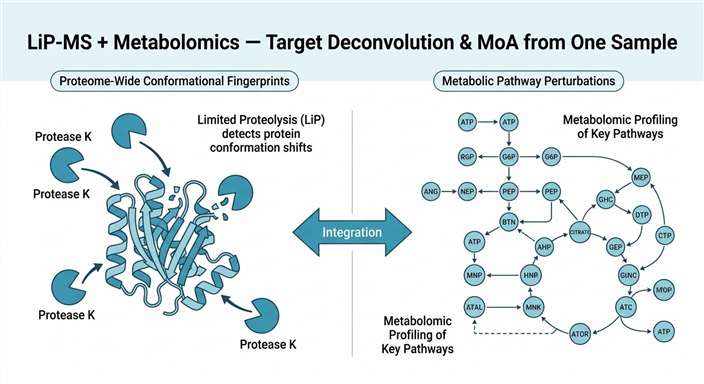
LiP-MS Metabolomics integrated workflow combining proteome-wide conformational detection with metabolic pathway profiling
Why Combine How It Works What It Reveals Applications Comparison Sample Case Study

Why Combine LiP-MS with Metabolomics for Target Deconvolution?

Phenotypic screening remains one of the most powerful strategies for discovering first-in-class therapeutics, yet it presents a fundamental challenge: a compound shows clear bioactivity, but its molecular target and mechanism of action remain unknown. Resolving this question has traditionally required running separate, disconnected assays — one for target identification and another for pathway-level readout — often on different platforms, with different samples, and at different times.

We designed our combined LiP-MS + Metabolomics service to close this gap. By running Limited Proteolysis–Mass Spectrometry (LiP-MS) and untargeted metabolomics on the same biological samples, we deliver two orthogonal layers of evidence from a single experiment. LiP-MS detects drug- or metabolite-induced conformational changes across the proteome, pinpointing the proteins that directly engage with your compound. Metabolomics captures the resulting shifts in metabolite abundance, revealing which metabolic pathways are activated, inhibited, or rewired as a consequence of target engagement.

Together, these two data types answer the question that neither can answer alone: not just which protein your compound binds, but what happens next. For discovery teams facing phenotypic hits with unknown targets, this integrated approach reduces the time from hit to mechanism hypothesis, eliminates the risk of cross-platform sample variability, and provides a single, coherent data package ready for internal review or publication.

Our service is part of the broader multi-omics integration platform at Creative Proteomics, and complements our standalone LiP-MS service by adding the metabolomics dimension that connects target engagement to functional outcome.
How the Combined LiP-MS + Metabolomics Workflow Works

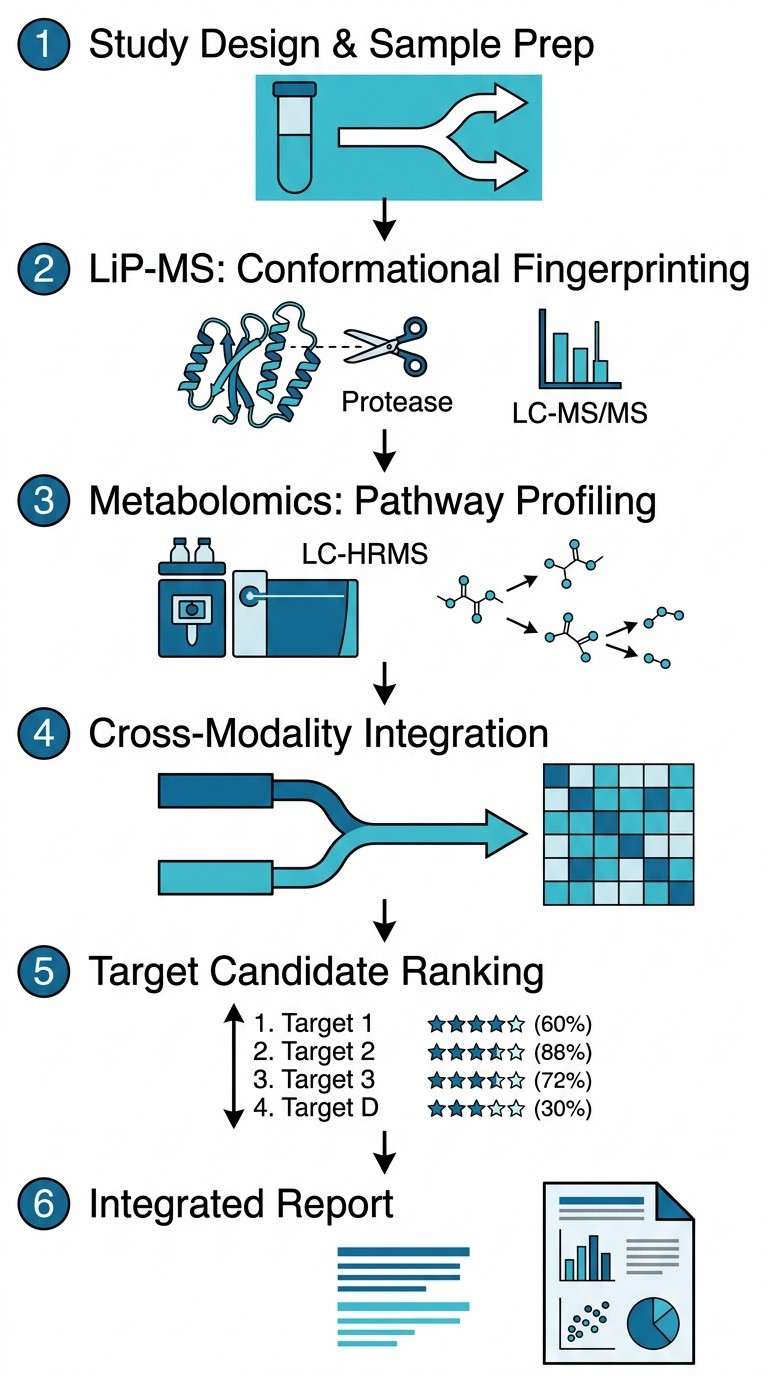
The integrated workflow is designed to maximize information yield from a single biological experiment while maintaining independent analytical rigor for each modality.

Step 1 — Study Design and Sample Preparation

We work with your team to define the perturbation conditions (compound dose, treatment duration, vehicle control) and the biological matrix (cell lysate, tissue homogenate, or biofluid). The same sample set is split into two parallel streams, ensuring that both LiP-MS and metabolomics data originate from identical biological material.

Step 2 — LiP-MS: Conformational Fingerprinting

The LiP-MS stream follows an established protocol based on limited proteolysis coupled with high-resolution LC-MS/MS. Samples are incubated with a non-specific protease (proteinase K) under controlled conditions that allow the enzyme to preferentially cleave exposed, flexible regions of proteins. When a compound binds to a protein, it alters local protease accessibility — either protecting the binding site or inducing distal conformational changes. These differences are quantified at the peptide level by label-free DIA-MS, producing a "conformational fingerprint" for each detected protein.

Step 3 — Metabolomics: Pathway-Level Perturbation Profiling

In parallel, the metabolomics stream performs untargeted LC-HRMS analysis using HILIC and C18 columns for broad metabolome coverage. Features are annotated by accurate mass, MS/MS fragmentation, and retention time matching against in-house and public spectral libraries. The output is a quantitative matrix of metabolite fold-changes between treated and control conditions, mapped to metabolic pathways.

Step 4 — Cross-Modality Bioinformatics Integration

This is the core differentiator of the combined service. Our bioinformatics pipeline correlates LiP-MS hits (proteins with significant conformational changes) with metabolomics hits (metabolites with significant abundance changes) using pathway-level enrichment analysis. If a LiP-MS hit protein is an enzyme in a pathway where multiple metabolites show coordinated changes, the confidence in that target assignment increases substantially. The correlation is visualized in an integrated report that places each candidate target in its metabolic context.

Step 5 — Target Candidate Ranking and Reporting

Candidates are ranked by a combined confidence score that integrates LiP-MS conformational significance, metabolomics pathway enrichment, and literature-based functional annotation. The final report includes the ranked target list, differential peptide tables, metabolite feature tables, integrated correlation plots, and a narrative interpretation.

For researchers who also need quantitative binding affinity, our LiP-Quant target deconvolution workflow can be layered onto the same LiP-MS data.

What LiP-MS + Metabolomics Reveals That Either Method Alone Cannot

LiP-MS Alone: Conformational Changes Without Functional Context

LiP-MS alone is a powerful tool for detecting which proteins change conformation upon compound treatment. It tells you whether a protein is engaged — directly or indirectly — by your molecule. But it does not tell you what those conformational changes mean for cellular function. A protein may change structure without producing a measurable biological effect, or the biologically relevant effect may occur downstream of the direct target.

Metabolomics Alone: Pathway Changes Without Target Attribution

Metabolomics alone captures the end point of cellular perturbation — the metabolite pool that has shifted in response to treatment. It tells you that something happened, and which pathways were affected. But it does not tell you which protein initiated the change. The same metabolite profile could arise from different upstream targets.

Combined: Causal Chain Evidence from Compound to Phenotype

Combined, the two methods provide causal chain evidence. The LiP-MS data identifies the most likely initiating protein targets. The metabolomics data shows whether those targets are functionally relevant by revealing the downstream metabolic consequences. When both data types converge on the same pathway, the confidence in the target assignment is far higher than either method alone could provide.

Concrete Scenario: Kinase Target Validation

Take a concrete scenario: if LiP-MS identifies a kinase as the top conformational hit, and metabolomics shows coordinated changes in metabolites downstream of that kinase's signaling cascade, the combined evidence strongly supports that kinase as the functional target. Conversely, if LiP-MS flags a protein but metabolomics shows no pathway-level perturbation, the hit may represent a non-functional binding event — valuable information that prevents wasted follow-up resources.

This integrated view is particularly valuable for teams using untargeted metabolomics for MoA studies, where the goal is not just to profile metabolic changes but to trace them back to their molecular origin.

Key Application Scenarios for the Combined Approach

SCENARIO 1

Phenotypic Hit with Unknown Target

A compound shows activity in a cell-based phenotypic assay, but affinity-based pull-down methods fail due to low binding affinity or the absence of a chemical handle. LiP-MS detects the conformational fingerprint across the proteome, identifying candidate targets without requiring target modification or immobilization. Metabolomics simultaneously profiles the downstream metabolic response, providing functional validation for the top candidates.

SCENARIO 2

Endogenous Metabolite Mechanism Resolution

Endogenous metabolites often exert their biological effects through unexpected protein interactions. LiP-MS can detect metabolite–protein interactions in their native state, without requiring the metabolite to be tagged or modified. Metabolomics confirms that the observed metabolite is indeed present and active in the system, closing the loop between the exogenous treatment and the endogenous metabolic network.

SCENARIO 3

Natural Product Target Identification

Natural product extracts contain complex mixtures of bioactive compounds, making target identification particularly challenging. LiP-MS works directly on complex mixtures and does not require purified single compounds, making it well suited for natural product research. Metabolomics can simultaneously profile the extract's composition and the cellular metabolic response.

SCENARIO 4

PROTAC and Molecular Glue Ternary Complex Validation

Induced-proximity modalities require detection of ternary complex formation, which conventional target ID methods often miss. LiP-MS can detect the structural changes associated with ternary complex stabilization. Metabolomics provides a readout of the downstream pathway engagement, confirming functional target degradation or modification.

SCENARIO 5

On-Target vs. Off-Target Differentiation

When a compound produces phenotypic effects, it is critical to distinguish intended target engagement from off-target activities. LiP-MS identifies all proteins that undergo conformational changes — both on- and off-target. Metabolomics helps prioritize: off-target hits that do not produce pathway-level metabolic perturbations are less likely to be functionally relevant.

LiP-MS + Metabolomics vs. Alternative Target ID Approaches

DimensionLiP-MS + Metabolomics (Combined)TPP (Thermal Proteome Profiling)Affinity Pull-Down MSActivity-Based Probes
Conformational informationYes — peptide-level structural fingerprintsIndirect — thermal stability shiftNoNo
Pathway-level readoutYes — integrated metabolomicsNoNoNo
Label-freeYesYesNo (requires immobilization/tag)No (requires reactive probe)
Proteome coverageHigh (thousands of proteins)HighModerate (depends on pulldown efficiency)Low (probe-dependent)
Sample requirementModerate (100–500 µg protein)ModerateHigh (requires large sample for pulldown)Low-Moderate
Works for low-affinity bindersYesSometimesNoNo
Works for endogenous metabolitesYesYesNoNo
ThroughputModerate (project-based)ModerateLowLow

Selection Guidance: Choose LiP-MS + Metabolomics when you need both target identification and functional pathway context from the same experiment. Choose TPP when thermal stability shifts are expected and pathway-level data is not required. Choose affinity pull-down when a high-affinity binder with a chemical handle is available. Choose activity-based probes when a specific reactive group can be installed without altering binding.

For teams already using thermal proteomics for MoA, the combined LiP-MS + Metabolomics approach provides an orthogonal and complementary line of evidence.

End-to-End Project Workflow

From sample receipt to integrated report in approximately 6 weeks.

1

Study Design & Sample Reception

Consultation on experimental design, compound properties, and control conditions. Sample quality check and acceptance.

2

Parallel Sample Processing

Sample aliquoting into LiP-MS and metabolomics streams. Limited proteolysis (proteinase K digestion) for LiP-MS. Metabolite extraction for LC-HRMS.

3

LC-MS/MS Data Acquisition

LiP-MS: DIA-MS acquisition on high-resolution Q-TOF. Metabolomics: HILIC and C18 LC-HRMS acquisition in positive and negative ionization modes.

4

Data Processing & QC

LiP-MS: peptide identification, quantification, and differential analysis. Metabolomics: feature detection, alignment, annotation, and statistical analysis. QC metrics reviewed for both streams.

5

Cross-Modality Integration

Bioinformatics correlation of LiP-MS hits with metabolomics pathway enrichment. Target candidate ranking by integrated confidence score.

6

Reporting & Review

Integrated report with ranked targets, differential data tables, correlation visualizations, and narrative interpretation. Review meeting with your team.

LiP-MS Metabolomics 6-step integrated workflow diagram

Sample Requirements for Combined LiP-MS + Metabolomics Studies

Sample TypeMinimum AmountRecommended AmountConcentrationBuffer ConditionsNotes
Cell Lysate (mammalian)200 µg protein500 µg protein2–5 mg/mLMS-compatible (no glycerol, low detergent)Provide cell count and treatment details
Tissue Homogenate50 mg tissue100 mg tissuePBS or MS-compatible bufferSnap-frozen preferred
Biofluid (plasma/serum)50 µL100 µLDeplete abundant proteins if needed
Bacterial/Yeast Lysate100 µg protein300 µg protein1–3 mg/mLMS-compatibleProvide lysis method details
Purified Protein Complex50 µg protein100 µg protein1–10 µMNative bufferProvide complex composition

Note: The same biological sample is used for both LiP-MS and metabolomics analyses. A minimum of 3 biological replicates per condition is recommended for statistical power. Additional replicates may be required depending on the expected effect size.

What You Receive: Integrated Deliverables Package

  • LiP-MS differential peptide table with peptide sequences, fold-changes, p-values, and structural annotation (protein domain, predicted accessibility)
  • Metabolomics feature table with metabolite identifications, fold-changes, p-values, and pathway assignments
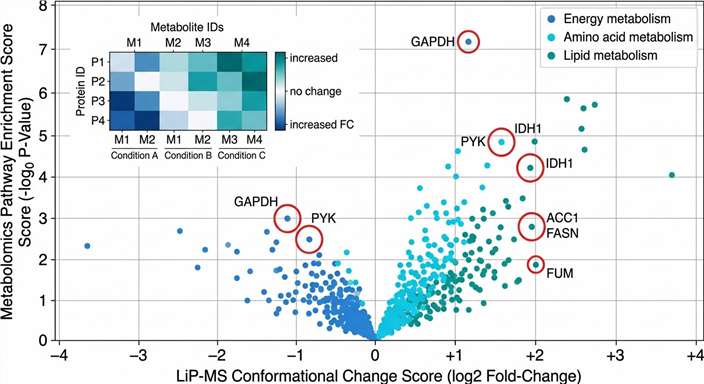
  • Integrated correlation report linking conformational changes to metabolic pathway perturbations, with pathway enrichment scores and cross-modality confidence metrics
  • Ranked target candidate list prioritized by combined LiP-MS score, metabolomics pathway enrichment, and functional annotation
  • Raw data files (mass spectrometry .raw files, search results) suitable for re-analysis or publication deposit
  • Methods section written in publication-ready format

Representative Data: Cross-Modality Integration

LiP-MS Metabolomics correlation heatmap linking conformational changes to metabolic pathway enrichment

Integrated correlation heatmap linking LiP-MS conformational scores to metabolomics pathway enrichment

Case Study: In-Cell LiP-MS Captures Proteome-Wide Structural Changes for Drug Target Deconvolution

Elsässer F, Florea R, Räsch F, Zedan M, Sen N-E, Pflästerer T, Kleele T, Loewith R, Weis K, de Souza N, Picotti P. "Limited proteolysis-coupled mass spectrometry captures proteome-wide protein structural alterations and biomolecular condensation in living cells." Molecular Systems Biology 22, 337–368 (2026). https://doi.org/10.1038/s44320-025-00182-6

Background

A key limitation of conventional LiP-MS is that it is performed on cell lysates, where the native cellular environment — including compartmentalization, macromolecular crowding, and biomolecular condensation — is lost. The authors sought to develop an in-cell LiP-MS method that delivers proteinase K directly into living cells, enabling proteome-wide detection of protein structural alterations under physiologically relevant conditions.

Methods

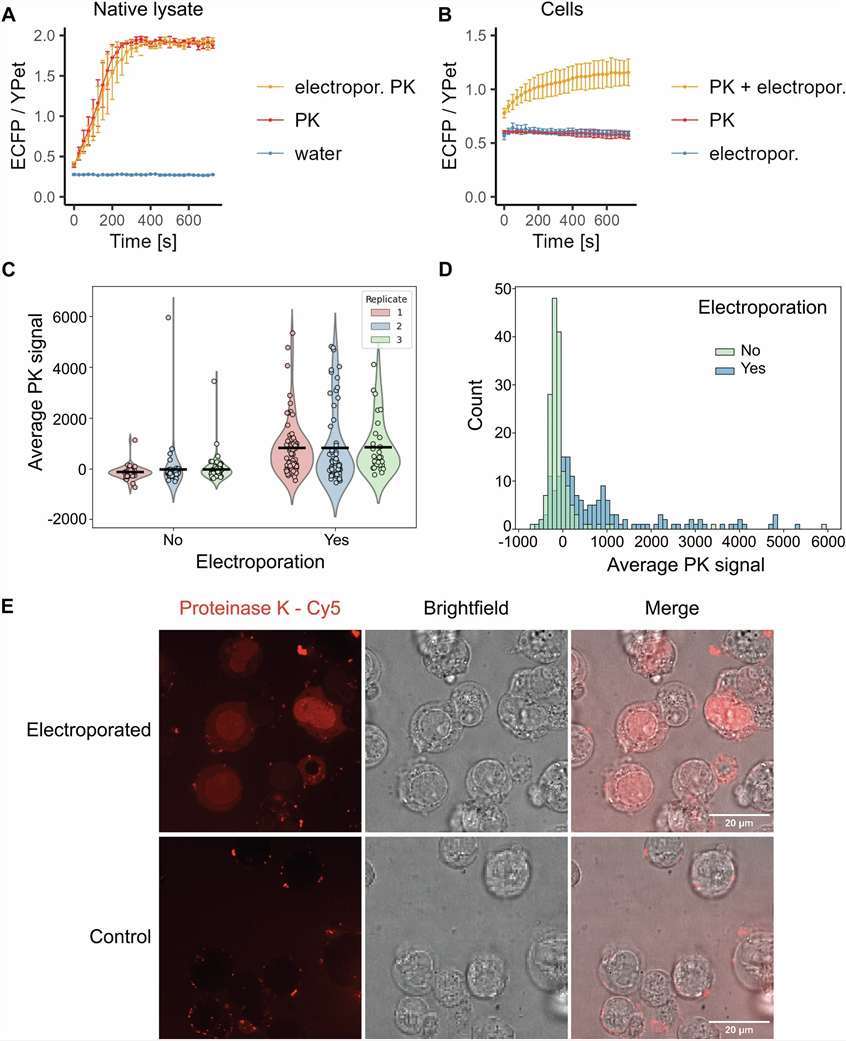
Proteinase K was delivered into living HEK293T cells by electroporation (Fig. 2). The electroporation conditions (1 pulse, 25 ms, 1000 V) were optimized to achieve efficient PK delivery with minimal impact on cell viability and the proteome. After PK treatment and cell lysis, samples were digested with trypsin and analyzed by DIA-MS. The resulting peptide-level data was processed to identify differentially cleaved peptides between treated and control conditions. In parallel, the authors applied the method to detect structural changes induced by rapamycin and by arsenite stress.

Results

The in-cell LiP-MS method achieved detection of 7,182 PK cleavage sites across 2,367 proteins. Rapamycin treatment produced the expected conformational change in its known target FKBP1A, validating the approach. Under arsenite stress, the method captured a time-resolved structural response: only 3 proteins (CKB, PPP1R12A, SERBP1) showed structural changes at 10 minutes, expanding to 2,325 peptides from 1,149 proteins at 20 minutes, and 20,841 peptides from 3,146 proteins at 90 minutes. The structurally altered proteins were enriched in stress granule and nuclear speckle components. G3BP1, a key stress granule protein, showed structural changes restricted to its RNA recognition motif at 20 minutes, progressing to all domains by 90 minutes — consistent with the known mechanism of stress granule assembly. SERBP1 showed enhanced association with monosomes at 10 minutes, confirmed by polysome profiling, indicating early ribosome hibernation.

Conclusions

In-cell LiP-MS provides a powerful tool for detecting proteome-wide protein structural alterations in living cells, capturing both direct drug-target interactions and downstream cellular responses. When combined with metabolomics, this approach can link target engagement to metabolic pathway perturbations, providing a complete picture of compound mechanism of action.

In-cell LiP-MS proteome-wide structural alteration detection data from Elsasser et al. 2026

Fig. 2 from Elsässer et al. (2026): In-cell LiP-MS workflow and proteome-wide structural alteration detection in living HEK293T cells.

FAQ

Frequently Asked Questions

Q: How is combined LiP-MS + Metabolomics different from running LiP-MS and metabolomics as separate projects?

The key difference is integration. When run separately, LiP-MS and metabolomics data are analyzed in isolation, making it difficult to determine whether a LiP-MS hit is functionally relevant or whether a metabolomics change is target-driven. Our combined service uses a single bioinformatics pipeline that correlates conformational changes with metabolic pathway perturbations, providing a unified confidence score for each candidate target. Additionally, running both analyses on the same biological sample eliminates cross-experiment variability.

Q: What types of compounds are compatible with this combined approach?

The combined approach is compatible with small molecules, natural products and extracts, endogenous metabolites, PROTACs, molecular glues, fragments, and peptides. The main requirement is that the compound can be delivered to the biological system (cell culture, tissue, or lysate) under conditions compatible with both LiP-MS and metabolomics workflows.

Q: Can I use the same biological sample for both LiP-MS and metabolomics analyses?

Yes — this is a core feature of the combined service. The same sample set is split into two parallel streams at the start of the workflow, ensuring that both data types originate from identical biological material. This eliminates the sample variability that plagues separate-service approaches.

Q: How do you integrate the two data types in the final report?

Integration is performed at the pathway level. LiP-MS hits are mapped to their associated metabolic pathways using KEGG and Reactome annotations. Metabolomics hits are independently mapped to the same pathways. Pathways where both LiP-MS hits and metabolite changes converge are flagged as high-confidence. The integrated report includes correlation heatmaps, pathway enrichment plots, and a narrative interpretation of the cross-modality evidence.

Q: What is the typical turnaround time for a combined LiP-MS + Metabolomics project?

A standard project requires approximately 6 weeks from sample receipt to final report, assuming 3–4 biological conditions with 3 replicates each. Timelines may vary depending on project complexity, sample availability, and the depth of bioinformatics analysis required.

Q: How does this approach compare with TPP (Thermal Proteome Profiling) for target identification?

TPP detects target engagement by measuring thermal stability shifts, while LiP-MS detects conformational changes directly. The two methods are complementary: TPP works best when compound binding stabilizes or destabilizes a protein, while LiP-MS can detect engagement even without a thermal shift. The addition of metabolomics gives LiP-MS + Metabolomics a unique advantage — it provides functional pathway context that TPP alone cannot deliver.

Plan Your Combined LiP-MS + Metabolomics Study

Share your project details and our scientists will design an integrated target deconvolution and MoA profiling strategy for your discovery program.

For Research Use Only. Not for use in diagnostic procedures.

Online Inquiry

Please submit a detailed description of your project. We will provide you with a customized project plan to meet your research requests. You can also send emails directly to for inquiries.

* Email
Phone
* Service & Products of Interest
Services Required and Project Description