Why an MS-Centric ADME Platform for Your Drug Development Pipeline
Every drug development program faces the same inflection point: a promising lead compound enters preclinical characterization, and suddenly the questions multiply. How stable is it in human liver microsomes? Does it cross intestinal epithelium? What metabolites form, and are any of them toxic? Where does it distribute, and how is it cleared?
Most teams answer these questions by piecing together assays from different CROs — a metabolic stability study here, a permeability assay there, a separate MetID project with yet another provider. Each handoff introduces variability in methods, data formats, and interpretation standards. And when the data comes back inconsistent, the question becomes: is it the compound, or is it the assay?
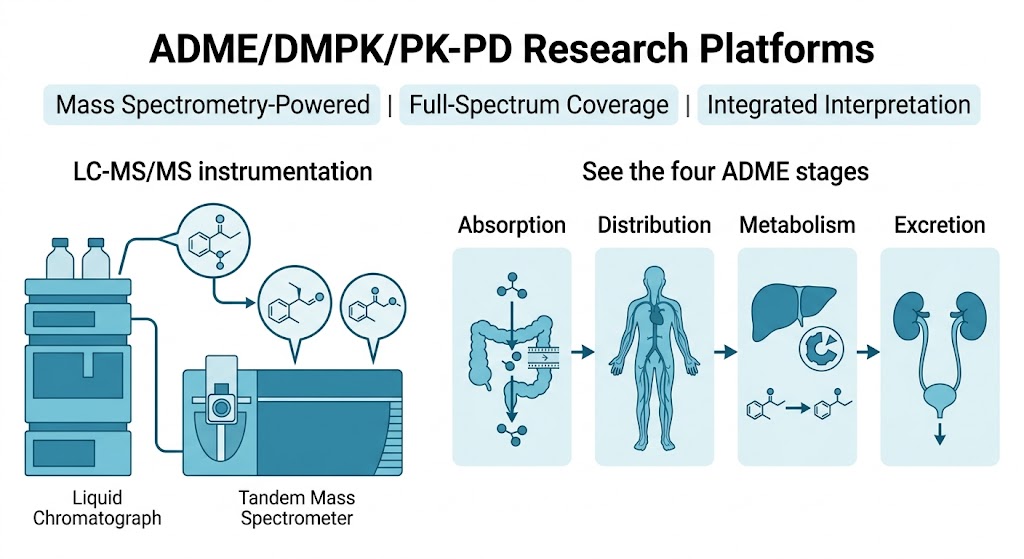
The MassTarget ADME/DMPK platform was built to eliminate that uncertainty. It is a single, MS-native analytical engine covering the full ADME continuum — from absorption and distribution to metabolism, excretion, and systems-level pharmaco-omics — all running on the same LC-MS/MS, HRMS, and RapidFire MS infrastructure, under the same QC framework, interpreted by the same scientific team.
What this means for your program:
- No assay handoff gaps — Metabolic stability, permeability, protein binding, MetID, PK bioanalysis, and pharmaco-omics all share the same analytical platform. Data from one assay feeds directly into the next, with consistent methodology and traceable QC.
- MS-native, not MS-as-add-on — Mass spectrometry is the analytical core of every assay, not a technique bolted onto a general bioanalytical lab. This means deeper expertise in method development for challenging compounds — covalent binders, reactive metabolites, natural products, and novel modalities.
- Scalable by design — Start with a single metabolic stability screen in human liver microsomes. Expand to multi-species comparison, add MetID, then build a full ADME panel. Add pharmaco-metabolomics or pharmaco-proteomics at any stage. All within the same platform, with data that accumulates rather than fragments.
- Regulatory-ready from day one — Methods are developed within the ICH M10 framework, so the data you generate at early discovery stages remains defensible when you move toward IND-enabling studies.