Multi-Omics Integration for Drug Discovery

Accelerating drug discovery through integrated MS-based multi-omics — from target engagement and MoA elucidation to biomarker discovery and systems pharmacology.

Modern drug discovery demands more than a single molecular view. Understanding how a candidate compound affects the proteome, metabolome, lipidome, and interactome simultaneously is essential for building a complete picture of efficacy, selectivity, and safety.

At Creative Proteomics, our MassTarget™ platform brings together 16 integrated MS-based omics modalities under one roof — from proteomics and metabolomics to interactomics, fluxomics, and network pharmacology. Whether you need to confirm target engagement, map mechanism of action, or build systems-level pharmacological models, we provide the expertise and infrastructure to deliver integrated multi-omics insights.

Key Advantages:

  • 16 complementary MS-based omics modalities in a single workflow
  • Drug-discovery-focused scientific consultation and experimental design
  • Cross-omics data integration with biological interpretation
  • Scalable from early target validation to late-stage lead optimization
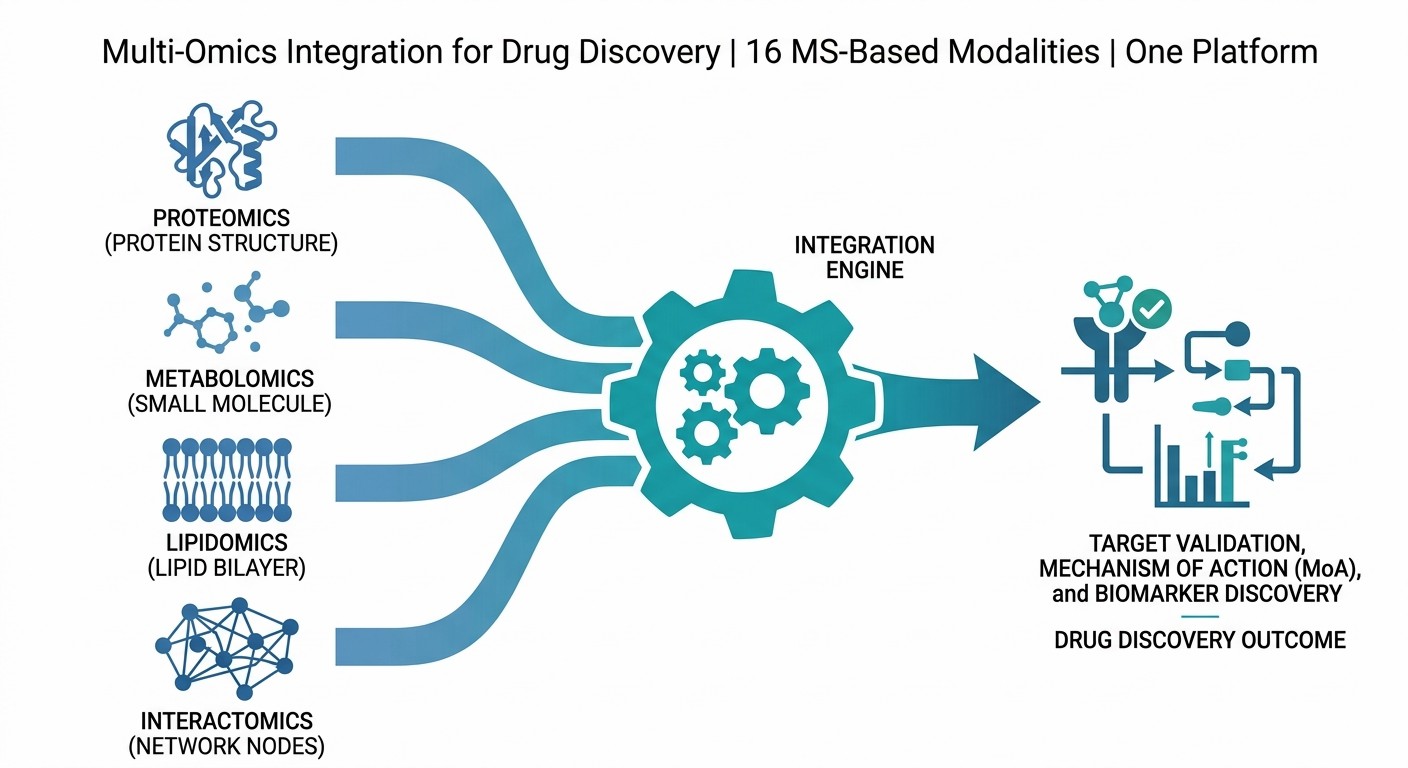
Multi-Omics Integration for Drug Discovery platform overview showing proteomics, metabolomics, lipidomics, and interactomics converging into unified drug discovery insights
Overview Proteomics & PTM Metabolomics & Lipidomics Structural Proteomics Systems Integration Workflow Why MassTarget Sample Deliverables FAQ

Integrated MS-Based Multi-Omics for Every Stage of Drug Discovery

Drug discovery programmes generate increasingly complex questions that no single omics technology can answer alone. Does a candidate engage its intended target at the protein level? What downstream metabolic pathways are perturbed? Are there off-target lipid or phosphorylation signatures that signal toxicity? These questions require an integrated view across multiple molecular layers.

Our MassTarget™ platform addresses this need by offering 16 complementary MS-based omics services, organized into four core categories. Each service is independently validated and can be deployed individually or combined into a custom multi-omics workflow tailored to your specific drug discovery question.

Our Multi-Omics Service Categories

CATEGORY 1

Proteomics & PTM Profiling

Measure drug-induced changes across the proteome, including post-translational modifications that drive signalling and degradation.

CATEGORY 2

Metabolomics & Lipidomics

Profile the small-molecule and lipid landscape to uncover metabolic mechanisms and lipid-mediated signalling.

CATEGORY 3

Structural & Conformational Proteomics

Probe drug-target interactions at the conformational level to confirm engagement and allosteric effects.

CATEGORY 4

Interactomics & Systems Biology

Map drug-induced interaction networks and build predictive models of pharmacological response.

Proteomics & PTM Profiling for Drug Response and Target Engagement

Proteomics provides the most direct readout of drug activity at the protein level. Changes in protein abundance, degradation, and post-translational modification reveal how a compound alters cellular signalling, engages its target, and triggers compensatory pathways.

Our proteomics services for drug discovery cover four complementary approaches. DIA/SWATH proteomics delivers deep, reproducible proteome coverage for drug-response profiling across dose and time. Shotgun proteomics provides unbiased discovery of drug-induced protein changes in any biological system. For signalling-focused studies, phosphoproteomics activation mapping captures kinase-driven phosphorylation events that mediate drug efficacy and resistance. And for targeted degradation programmes, ubiquitinomics offers direct evidence of PROTAC-mediated ubiquitination and degradation.

Each service is designed to integrate with other omics data — for example, correlating proteomic changes with metabolomic perturbations to build a complete mechanism-of-action picture.

Metabolomics & Lipidomics for Mechanism-of-Action Elucidation

Metabolites and lipids are the ultimate readouts of cellular phenotype. Drug-induced changes in metabolic flux, lipid composition, and small-molecule signalling provide critical insights into mechanism of action, off-target effects, and biomarker discovery.

Our metabolomics and lipidomics portfolio for drug discovery includes three core services. Untargeted metabolomics provides broad-spectrum profiling of thousands of metabolites to identify pathways perturbed by drug treatment, making it ideal for MoA elucidation and phenotypic screening follow-up. Targeted metabolomics panel screening offers quantitative, hypothesis-driven measurement of specific metabolic pathways — such as glycolysis, TCA cycle, or amino acid metabolism — with high sensitivity and reproducibility. Lipidomics drug profiling captures the full lipidome, including phospholipids, sphingolipids, and glycerolipids, to reveal lipid-mediated signalling and membrane remodelling induced by drug candidates.

These services can be deployed individually or combined with proteomics data to correlate protein-level changes with downstream metabolic consequences.

Structural & Conformational Proteomics for Drug–Target Interaction

Confirming that a drug candidate engages its intended target — and understanding the conformational consequences of that engagement — is critical for progressing compounds through the discovery pipeline. Our structural proteomics services use mass spectrometry to probe protein conformation, stability, and ligand-induced structural changes at proteome-wide scale.

LiP-MS combined with metabolomics couples limited proteolysis mass spectrometry with parallel metabolomics to simultaneously detect target engagement and metabolic perturbations in a single experiment. LiP-MS + TPP integrates limited proteolysis with thermal proteome profiling for orthogonal conformational evidence. DIA + TPP leverages data-independent acquisition for deeper thermal profiling coverage. And thermal proteomics for MoA provides a standalone thermal shift readout to identify drug targets and off-targets in complex biological samples.

Together, these approaches provide the structural evidence needed to validate target engagement and guide medicinal chemistry optimisation.

Interactomics & Systems-Level Integration

Drugs do not act in isolation — they perturb complex interaction networks that span protein–protein contacts, metabolic pathways, and signalling cascades. Understanding these network-level effects is essential for predicting efficacy, identifying resistance mechanisms, and avoiding toxicity.

Our systems-level services include AP-MS interactomics for proximity-dependent protein interaction mapping, which reveals how drug treatment rewires the interactome. AI-driven multi-omics integration applies machine learning to cross-omics datasets (proteomics, metabolomics, lipidomics, phosphoproteomics) to identify predictive biomarkers and mechanistic signatures. 13C tracer fluxomics tracks carbon flow through central metabolic pathways, providing dynamic rather than static metabolic information. Systems pharmacology MS modeling builds quantitative models of drug–target–pathway interactions. And network pharmacology + MS integrates experimental MS data with network biology to predict polypharmacology and multi-target effects.

These services are particularly valuable for complex therapeutic programmes where single-target models are insufficient.

How Multi-Omics Integration Works — Our Platform Approach

Successful multi-omics integration requires more than running multiple assays in parallel. It demands coordinated experimental design, consistent sample handling across omics workflows, and a unified data analysis framework that can correlate findings across molecular layers.

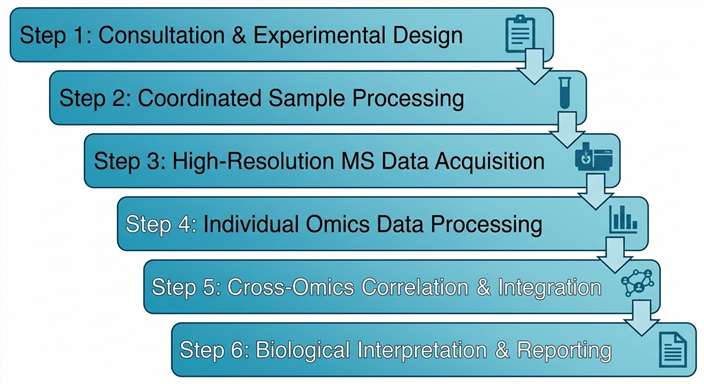
Our platform approach follows a structured workflow:

1

Consultation & experimental design

We work with your team to select the optimal combination of omics modalities based on your drug target, compound class, and biological question.

2

Coordinated sample processing

Samples are processed in parallel across selected omics workflows using standardised protocols to minimise batch effects and ensure data comparability.

3

High-resolution MS data acquisition

Each omics modality is analysed on optimised LC-MS/MS platforms (Orbitrap, QToF, QQQ) with appropriate acquisition strategies (DIA, DDA, PRM, MRM).

4

Individual omics data processing

Each dataset is processed independently using validated pipelines — peptide/protein identification, metabolite annotation, lipid identification, PTM site localisation.

5

Cross-omics correlation & integration

Multi-omics datasets are integrated using correlation analysis, pathway enrichment, and multivariate modelling to identify cross-layer relationships.

6

Biological interpretation & reporting

Integrated results are interpreted in the context of your drug discovery programme, with actionable insights and visualisations delivered in a comprehensive report.

Multi-omics integration workflow showing six steps from consultation to biological interpretation

Why Choose MassTarget for Multi-Omics Drug Discovery?

Choosing a multi-omics partner for drug discovery requires evaluating more than just the number of assays offered. The value lies in how those assays are integrated, how the data is interpreted, and whether the partner understands the specific demands of drug development programmes.

CapabilityMassTarget™ (Creative Proteomics)Single-Omics VendorsGeneral Multi-Omics CROs
MS-based omics modalities16 integrated services1–3 (specialised)5–10 (often including non-MS omics)
Drug discovery focusDedicated MassTarget™ brandVariableOften biomarker/clinical focused
Cross-omics integrationBuilt-in correlation & pathway analysisNot availableBasic data merging
Scientific consultationExpert guidance on assay selectionLimited to single modalityGeneral project management
PTM profilingPhosphoproteomics + UbiquitinomicsRareLimited
Structural proteomicsLiP-MS, TPP, thermal profilingNot availableRare
Systems pharmacologyFluxomics, network pharmacology, AI integrationNot availableRare

Sample Requirements for Multi-Omics Studies

Sample requirements vary depending on the combination of omics modalities selected. Below are general guidelines for common sample types across our multi-omics workflows. Our scientific team will provide detailed requirements during the consultation phase.

Sample TypeRecommended AmountRecommended Omics ApplicationsNotes
Cell lysate200 µg–1 mg proteinProteomics (DIA), Phosphoproteomics, UbiquitinomicsProvide treatment conditions and time points
Tissue homogenate10–50 mg tissueProteomics, Metabolomics, LipidomicsSnap-frozen recommended; avoid OCT embedding
Plasma / serum50–100 µLUntargeted Metabolomics, Lipidomics, Targeted PanelsEDTA plasma preferred; avoid haemolysis
Biofluid (CSF, urine)100–500 µLMetabolomics, LipidomicsCentrifuge to remove particulates; store at −80 °C
Cell culture media500 µL–1 mLMetabolomics, Fluxomics (13C tracer)Use labelled media for flux experiments

Deliverables

  • Individual omics reports with identification, quantification, and statistical analysis
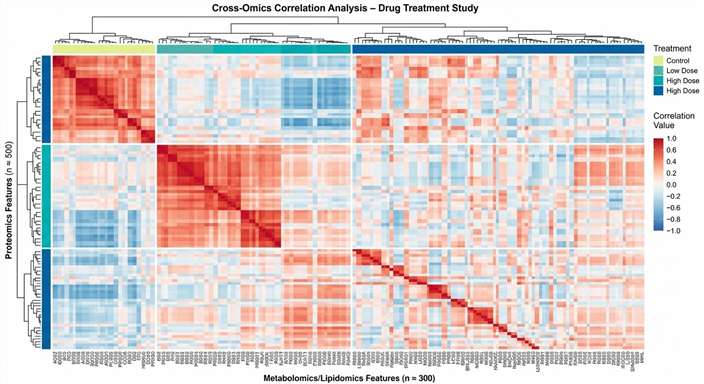
  • Cross-omics correlation analysis and integrated pathway enrichment maps
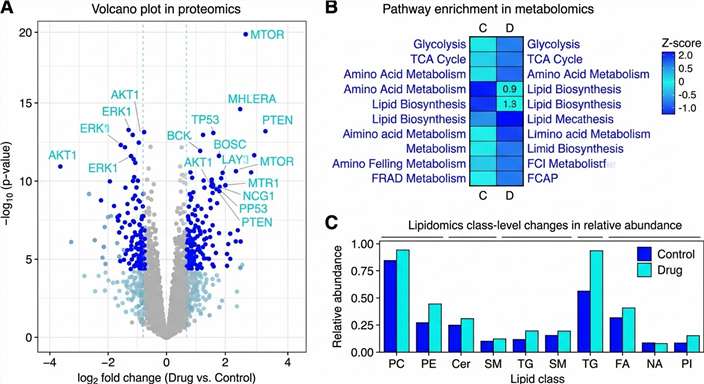
  • Custom visualisations (heatmaps, volcano plots, network diagrams, multi-panel figures)
  • Raw MS data files and processed data tables for each omics modality
  • Biological interpretation summary with actionable recommendations
  • Optional: AI-driven multi-omics integration report with predictive modelling

Representative Multi-Omics Integration Data

Cross-omics correlation heatmap showing integrated proteomics, metabolomics, and lipidomics data from a drug-treatment study

Cross-omics correlation heatmap

Multi-panel figure showing proteomics, metabolomics, and lipidomics changes in response to drug treatment

Multi-omics drug response overview

FAQ

Frequently Asked Questions

Q: What multi-omics modalities does MassTarget offer for drug discovery?

MassTarget offers 16 integrated MS-based omics services organised into four categories: Proteomics & PTM Profiling (DIA/SWATH, shotgun, phosphoproteomics, ubiquitinomics), Metabolomics & Lipidomics (untargeted, targeted panels, lipidomics), Structural & Conformational Proteomics (LiP-MS, TPP, thermal profiling), and Interactomics & Systems Biology (AP-MS, AI integration, fluxomics, systems pharmacology, network pharmacology).

Q: How are data from different omics platforms integrated and interpreted?

Our integration pipeline combines individual omics datasets through correlation analysis, pathway enrichment mapping, and multivariate modelling. We identify cross-layer relationships — for example, correlating proteomic changes with metabolomic perturbations — and deliver a unified biological interpretation report. For advanced projects, AI-driven integration and predictive modelling are available.

Q: Do I need to know which omics assays I need before starting?

Not at all. Our scientific consultation phase is designed to guide you through assay selection based on your drug target, compound class, and biological question. We help you choose the optimal combination of omics modalities — whether that is a focused two-assay study or a comprehensive multi-omics campaign.

Q: What sample types are compatible with multi-omics analysis?

We support a wide range of sample types including cell lysates, tissue homogenates, plasma/serum, CSF, urine, and cell culture media. Specific requirements vary by omics modality; our team will provide detailed sample preparation guidelines during project planning to ensure optimal results across all selected assays.

Q: How does multi-omics integration accelerate drug discovery compared to single-omics?

Single-omics approaches provide a limited view of drug activity. Multi-omics integration reveals cross-layer relationships — for example, how proteomic changes drive metabolic perturbations, or how lipid remodelling correlates with signalling pathway activation. This holistic view accelerates target validation, MoA elucidation, biomarker discovery, and lead optimisation by providing a complete molecular picture in a single coordinated study.

References

  1. Meissner F, Geddes-McAlister J, Mann M, Bantscheff M.The emerging role of mass spectrometry-based proteomics in drug discovery. Nat Rev Drug Discov. 2022 Sep;21(9):637-654.
  2. Zhang H, Lu KH, Ebbini M, Huang P, Lu H, Li L.Mass spectrometry imaging for spatially resolved multi-omics molecular mapping. npj Imaging. 2024;2:25.
  3. Zhao M, Che Y, Gao Y, Zhang X.Application of multi-omics in the study of traditional Chinese medicine. Front Pharmacol. 2024;15:1431862.

Plan a multi-omics campaign with the MassTarget™ team

Tell us about your drug discovery programme and our scientists will design a tailored multi-omics integration strategy for your project.

For Research Use Only. Not for use in diagnostic procedures.

Online Inquiry

Please submit a detailed description of your project. We will provide you with a customized project plan to meet your research requests. You can also send emails directly to for inquiries.

* Email
Phone
* Service & Products of Interest
Services Required and Project Description