Ligand-Observed ESI-MS Binding Assay Service

Label-free protein-ligand binding evidence with a low-sample workflow.

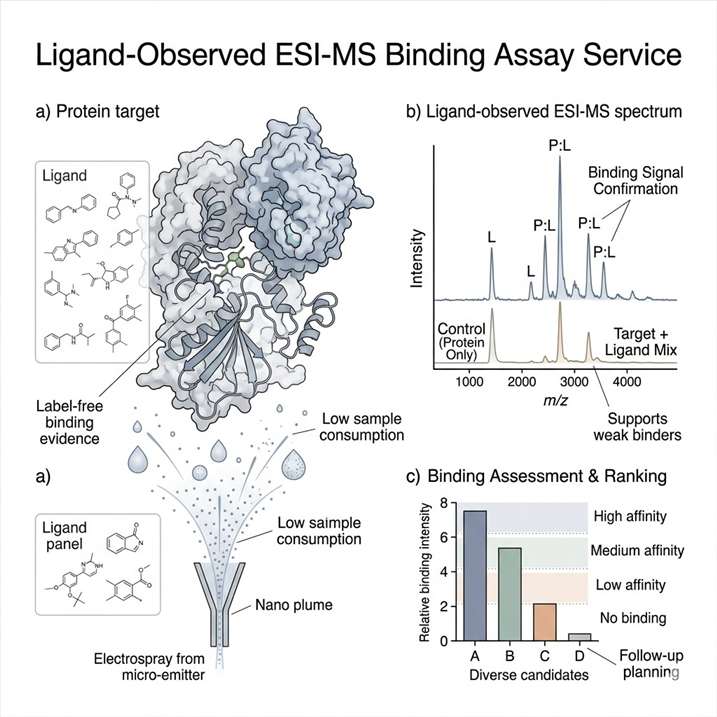
Ligand-observed ESI-MS binding assays help us detect protein-ligand interaction signals with a label-free, low-sample workflow that supports early confirmation, method comparison, and follow-up planning. We use this approach to help research teams evaluate binding evidence quickly and move forward with clearer next-step decisions.

Key Advantages:

  • Label-free binding evidence.
  • Low sample consumption.
  • Supports weak binders.
  • Useful for project-fit review.
  • Built for follow-up planning.
Ligand-observed ESI-MS service overview showing label-free binding evidence, low sample consumption, and follow-up planning.
Binding StudiesCapabilitiesProject FitWorkflowSignal QualityResultsSampleComparisonCase StudyFAQReferences

Ligand-Observed ESI-MS for Protein-Ligand Binding Studies

When your project needs a fast readout of whether a ligand is interacting with a target, ligand-observed ESI-MS can be a practical choice. This assay focuses on ligand-side signal behavior, making it useful when the main goal is to determine whether an interaction-related change is present and whether that result is strong enough to support the next step.

This format is especially useful in early discovery, hit confirmation, and orthogonal support work. In these settings, the immediate question is often not whether every mechanistic detail has been resolved, but whether a credible binding signal is present and whether the project should continue into deeper validation.

Ligand-observed ESI-MS is also attractive when sample availability is limited or when your team wants to add a label-free MS-based readout without moving immediately into a more complex experimental setup.

Our Ligand-Observed ESI-MS Binding Assay Capabilities

Low-sample project support

We can support projects that need a readable binding signal without requiring a large amount of target material.

Rapid binding confirmation

We help research teams evaluate whether a ligand-side signal is present and whether it is suitable for follow-up work.

Buffer and solvent review

We review sample condition, solvent system, and buffer composition before acquisition so the assay is not separated from project reality.

Weak binder assessment

We can support projects involving fragment-like or weaker-binding ligands when the goal is to gain early interaction evidence.

Decision-ready reporting

We organize the result into a form your team can use in project review and follow-up planning rather than leaving you with raw spectra alone.

Method-path support

We can position ligand-observed ESI-MS within a broader binding strategy when another orthogonal method is likely to be useful next.

When This Assay Is a Good Fit

Small molecules and fragment-like ligands

If you are working with small molecules or fragment-like ligands and need an early answer about whether an interaction-related signal is detectable, this assay can be a practical option.

Early confirmation and orthogonal support

If another method has already suggested possible binding, ligand-observed ESI-MS can help you examine the interaction from a different angle and strengthen the basis for follow-up work.

Projects that need readable evidence quickly

Some studies do not need the most complex method first. They need a clear signal, a realistic interpretation, and a decision about whether the project should move forward.

Workflow From Sample Review to Final Result Delivery

STEP 1

Project intake and assay-fit assessment

We begin by reviewing the target, ligand type, buffer composition, solvent system, expected signal behavior, and the main study objective. This first step helps determine whether ligand-observed ESI-MS is the right fit for the question you want to answer.

STEP 2

Target, ligand, solvent, and buffer review

We examine target integrity, ligand format, solvent content, salts, additives, and any special handling conditions. This is the first major QC checkpoint because poor compatibility at this stage can limit interpretability later.

STEP 3

Assay condition setup

Once the assay is judged suitable, we place the target and ligand system into an MS-compatible environment so control and ligand-exposed conditions can be compared directly.

STEP 4

Ligand-observed ESI-MS acquisition

Samples are analyzed under the selected conditions, with attention to stable ligand-side signal behavior and clean comparison between control and test states.

STEP 5

Signal review and comparative analysis

We review signal stability, background interference, and comparative behavior across controls and ligand-exposed samples to determine whether the result can support further work.

STEP 6

Data processing and final report delivery

We organize the result into a final report that may include raw and processed spectra, comparative views, QC comments, and interpretation notes linked to the next reasonable step.

How We Judge Binding Signal Quality

1

Signal stability

We first examine whether the ligand-side signal is stable enough to interpret. A weak or inconsistent signal may still be interesting, but it should not be treated the same way as a stable and repeatable pattern.

2

Spectral cleanliness

We review the effect of background, solvent, additives, and sample condition. If the spectral environment is too noisy or too distorted, the result may require cautious interpretation.

3

Comparative interpretation

Control versus ligand-exposed views, related ligand panels, and matched conditions often make the interpretation more useful than a single spectrum alone.

4

Confidence boundaries

Weak interactions can still be valuable, but the key question is whether the observed change is strong enough to support the next step in your workflow.

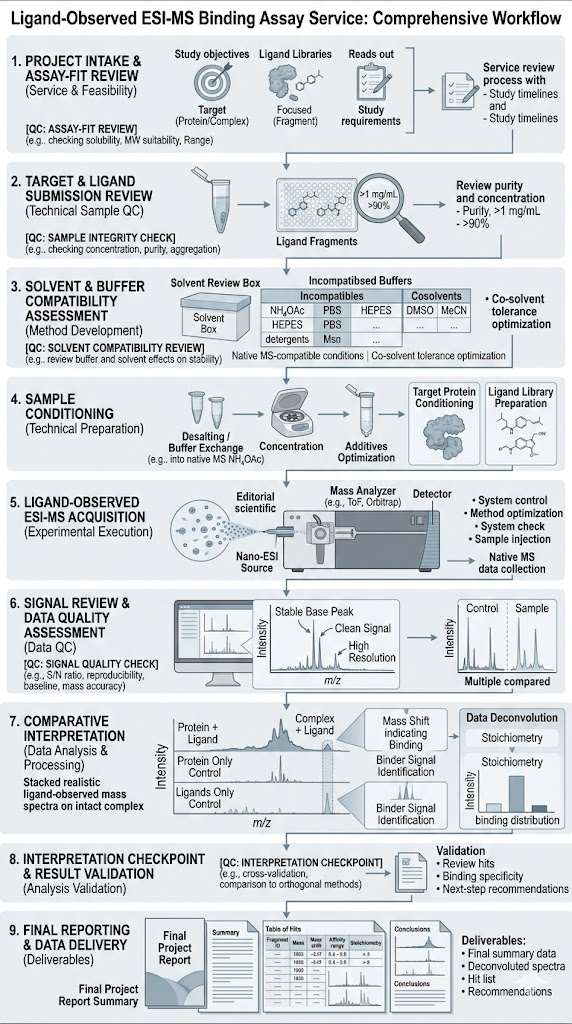
Vertical workflow for ligand-observed ESI-MS showing project review, solvent and buffer checks, acquisition, signal analysis, and reporting.

Representative Results You Can Receive

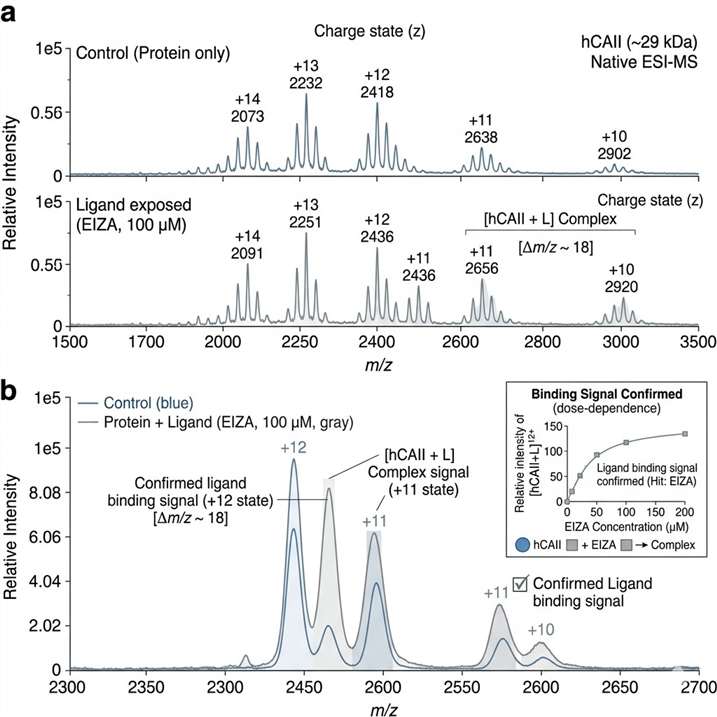
Ligand-observed ESI-MS result panel showing binding signal confirmation.

Binding signal confirmation view

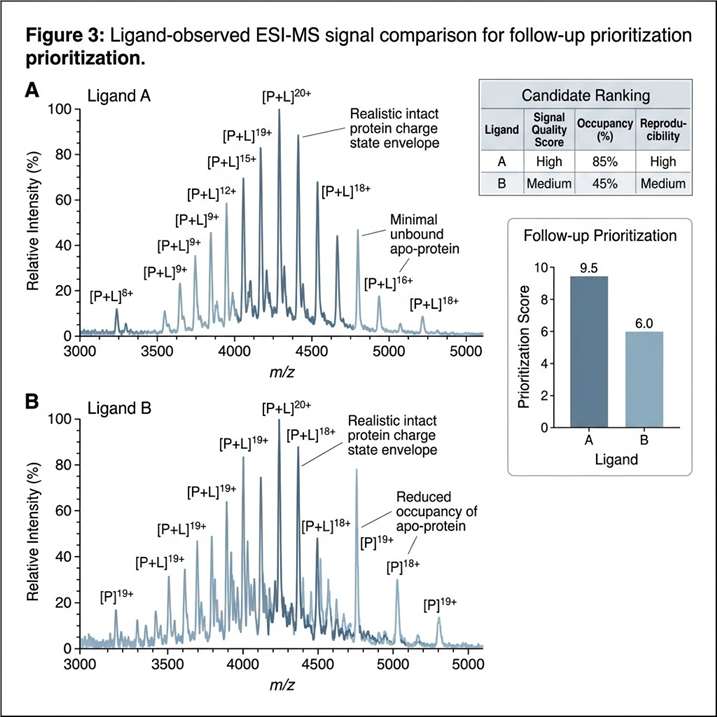
Comparative ligand-observed ESI-MS panel across ligands or assay conditions.

Comparative signal summary across ligands or conditions

Processed ligand-observed ESI-MS reporting panel with QC-linked interpretation.

QC-linked interpretation summary

A useful result should help your team move forward. Reports may include binding signal confirmation, comparative views across ligands or conditions, QC observations, and concise comments on how the result supports follow-up planning.

Sample Requirements and Submission Planning

Sample categoryPractical quantity guideHandlingSubmission notes
Purified protein target150 µg recommended; 300 µg optimizedFreeze promptly, store at -80°C, ship on dry iceBest fit for direct assay work
Cultured cell pellets5 × 106 recommended; 1 × 10⁷ optimizedPre-chilled PBS wash, quick-freeze, ship on dry iceUseful for upstream preparation workflows
Plasma / serum20 µL without depletion; 50-100 µL with depletion; >100 µL in metabolomics guideFreeze promptly, store at -80°C, ship on dry iceMainly relevant when starting from upstream biological material
Culture supernatant / medium10 mL recommended; 20 mL optimized; >2 mL in metabolomics guideQuick-freeze, store at -80°C, ship on dry iceUseful for upstream enrichment or feasibility review
Urine200-500 µLTransfer clear supernatant, quick-freeze, store at -80°C, ship on dry iceMainly relevant for upstream exploratory work

Please also provide ligand identity or panel information, solvent format, concentration or pooling design, and matched controls when available. If your samples contain unusual additives, surfactants, polymers, or special pretreatment conditions, please declare them before the project starts.

Ligand-Observed ESI-MS vs Other Binding Assays

MethodMain question it answersTypical outputStrengthLimitationBest use stage
Ligand-observed ESI-MSIs there a detectable ligand-side binding signal under the chosen assay conditions?Ligand-side binding evidence, comparative signal views, interpretable follow-up summaryLabel-free, relatively low sample burden, useful for early confirmation and follow-up planningDoes not replace methods designed for intact complex readout or deeper structural contextEarly confirmation, orthogonal support, follow-up prioritization
Native ESI-MS for noncovalent complexesDoes an intact complex form, and what does the complex-state view look like?Intact complex readout, complex-state interpretation, stoichiometry-aware viewsStrong when intact target-associated information matters mostPlaces more emphasis on complex-state interpretation than ligand-side readoutComplex-focused follow-up and native-state interpretation
Bio-Layer Interferometry (BLI) / SPRIs there measurable binding, and how strong or how fast is it?Response curves, affinity or kinetic informationStrong orthogonal route for confirmation and rankingDoes not provide the same MS-based signal formatOrthogonal confirmation, ranking, kinetic comparison
NMR binding assaysDoes the ligand or target show an NMR-detectable interaction pattern?Interaction evidence with method-specific structural contextUseful orthogonal approach, especially for weak binders and fragment-like ligandsRequires a different assay setup and does not replace MS-based signal reviewConfirmation and comparative method support
CE-MS Affinity Screening / Affinity Selection–MS (AS-MS)Can binders be enriched or separated in another affinity-MS workflow?Enrichment-based or separation-based binding informationUseful in projects that need a different MS-format screening logicDifferent evidence path from ligand-observed ESI-MSAlternative affinity-MS strategy

If your main goal is fast ligand-side binding evidence with low sample burden, ligand-observed ESI-MS is often a strong starting point. If your project needs intact complex information, kinetic detail, or a different orthogonal structure-based route, another method may be the better next step.

Case Study

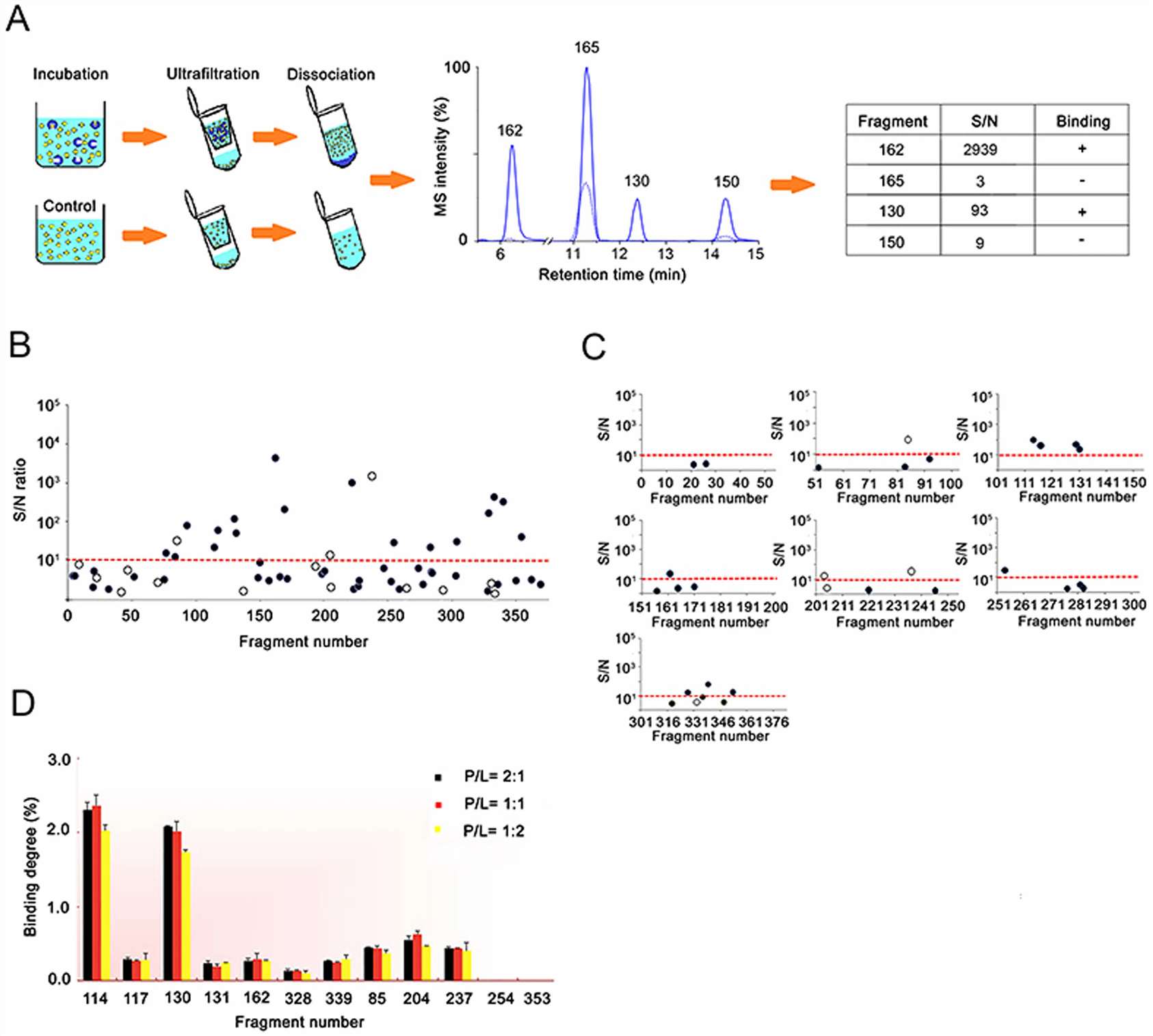
A Ligand-observed Mass Spectrometry Approach Integrated into the Fragment-Based Drug Discovery Process

Background

Fragment-based lead discovery depends on reliable early evidence that a fragment is interacting with the target. Because weak binders can be difficult to confirm with a single platform, ligand-observed mass spectrometry was investigated as a way to strengthen the early screening and confirmation workflow for the HCV RNA polymerase NS5B target.

Methods

The study integrated a ligand-observed mass spectrometry workflow into an FBLD campaign. A 384-member fragment library was screened through two independent screens of complex cocktails, followed by a validation assay to confirm the resulting candidates.

Results

The ligand-observed MS workflow identified 10 hits from the 384-member fragment library. The study also showed that the method could be used for quantitative measurement of weak binding affinities, and that these measurements were generally consistent with SPR analysis.

Conclusion

This case shows that ligand-observed MS can be integrated into a fragment-based discovery workflow as a practical method for early binding evidence, hit refinement, and follow-up planning. For projects involving weak binders or early-stage candidates, it supports a route that is fast, label-free, and compatible with broader orthogonal validation strategies.

Published case-study figure showing native MS workflow for electrophilic fragment screening and interpretation of unchanged, covalent-bound, and noncovalent-bound protein signals.
FAQ

Frequently Asked Questions

Q: When is ligand-observed ESI-MS a better fit than native MS?

Ligand-observed ESI-MS is often a better fit when your main need is a fast ligand-side binding signal with relatively low sample burden. Native MS becomes more useful when intact complex information is the main priority.

Q: Can this assay detect weak or fragment-like ligands?

It can be useful in those settings, especially when your project needs an early indication of whether a ligand-side interaction signal is present and worth taking forward.

Q: What sample and solvent information should be prepared before a project starts?

The most helpful starting information includes target format, buffer composition, additives, ligand identity or panel details, solvent system, concentration or pooling format, and any relevant controls.

Q: Is this assay more suitable for early confirmation or full screening?

It is often especially useful for early confirmation, assay comparison, and orthogonal support, although it can also contribute to broader screening workflows when the project design supports it.

Q: What kinds of results are typically included in the report?

You may receive raw and processed spectra, comparative signal views, QC observations, and a concise interpretation focused on follow-up planning.

Q: Can complex or borderline samples be reviewed before the assay starts?

Yes. Feasibility review is an important part of the service path, especially for samples with challenging buffers, solvents, or handling conditions.

Q: When should ligand-observed ESI-MS be paired with orthogonal validation?

It is often most useful to pair it with another method when your team needs stronger confirmation, more method diversity, or a different type of evidence for the same interaction question.

Discuss Your Ligand-Observed ESI-MS Project

Share your target, ligand panel, and assay conditions, and we will help you evaluate project fit, signal interpretability, and the most useful next-step binding strategy.

Disclaimer: This service and all related deliverables are for research use only. They are not intended for diagnostic procedures, clinical decision-making, or patient management.

Online Inquiry

Please submit a detailed description of your project. We will provide you with a customized project plan to meet your research requests. You can also send emails directly to for inquiries.

* Email
Phone
* Service & Products of Interest
Services Required and Project Description