Acoustic Ejection Mass Spectrometry (AEMS / Echo-MS) Service for Ultra-Fast Label-Free Screening

We deliver sub-2-second cycle time label-free screening by acoustic ejection mass spectrometry — enabling direct-to-biology reaction monitoring, enzyme kinetics, and ultra-HTS at nanoliter sample consumption.

Acoustic ejection mass spectrometry (AEMS), also known as Echo-MS, is an ultra-high-throughput analytical platform that uses focused acoustic energy to eject nanoliter droplets directly from a multiwell plate into an open-port interface (OPI), where they are carried by a solvent stream into an electrospray ionization (ESI) mass spectrometer. The entire process — from well to mass spectrum — takes less than 2 seconds per sample.

Key Advantages:

  • Sub-2-second cycle time — Acoustic droplet ejection + open-port interface MS achieves the fastest sample-to-result time of any MS-based screening platform.
  • Nanoliter sample consumption — Each acoustic ejection uses only ~2.5 nL of sample, preserving precious compounds and enabling repeated analyses.
  • Direct-to-biology screening — Analyse crude reaction products without purification, accelerating the design-make-test cycle.
  • No carryover, no cross-contamination — Contactless acoustic ejection eliminates sample-to-sample carryover inherent in autosampler-based systems.
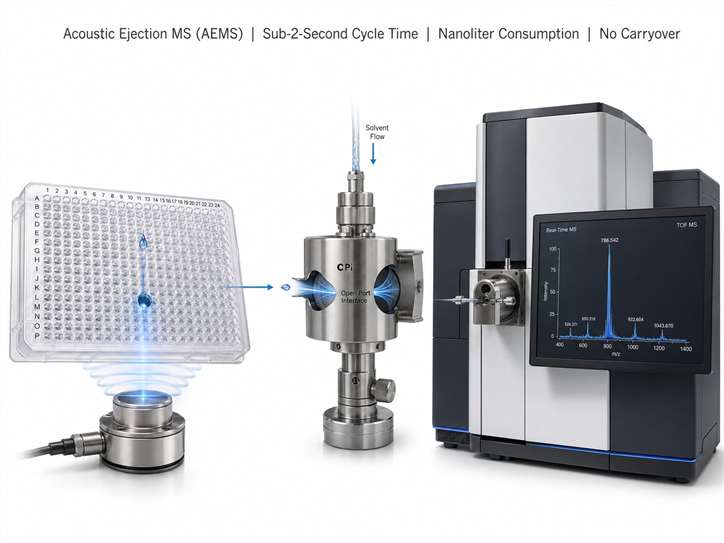
Acoustic ejection mass spectrometry (AEMS) platform diagram featuring acoustic droplet ejection, open-port interface, and high-resolution MS detection.
What Is AEMS Key Advantages Service Overview Workflow Technology Comparison Sample Demo FAQ

What Is Acoustic Ejection Mass Spectrometry (AEMS)?

Acoustic ejection mass spectrometry (AEMS), also known as Echo-MS, is an ultra-high-throughput analytical platform that uses focused acoustic energy to eject nanoliter droplets directly from a multiwell plate into an open-port interface (OPI), where they are carried by a solvent stream into an electrospray ionization (ESI) mass spectrometer. The entire process — from well to mass spectrum — takes less than 2 seconds per sample.

Unlike conventional LC-MS or even RapidFire SPE-MS, AEMS requires no chromatographic separation, no SPE cartridge, and no physical autosampler. The acoustic transducer transfers sample droplets contactlessly, eliminating carryover and enabling direct analysis from 384- and 1536-well plates.

This technology is particularly valuable for:

  • Ultra-high-throughput screening (uHTS) — Screen >30,000 samples per day with label-free MS detection.
  • Direct-to-biology medicinal chemistry — Analyse crude reaction products directly, bypassing purification.
  • Enzyme kinetics and IC50 determination — Nanoliter-scale kinetic assays with sub-2-second readout per data point.
  • ADME profiling — Metabolic stability and permeability assays at throughputs exceeding RapidFire.

Our AEMS service integrates with our broader high-throughput MS screening platform, providing a complementary ultra-fast option alongside RapidFire-MS and ASMS.

Key Advantages of AEMS for Drug Discovery

Unmatched Speed: Sub-2-Second Cycles

AEMS achieves 1.5–2.0 seconds per sample — 2–5× faster than RapidFire-MS and 100× faster than conventional LC-MS. A full 384-well plate is analysed in under 12 minutes.

Nanoliter Sample Consumption

Each acoustic ejection transfers approximately 2.5 nL of sample. This preserves precious compounds, enables multiple replicate analyses from a single well, and reduces solvent consumption to near-zero.

Contactless, Carryover-Free Operation

The acoustic ejection process is entirely contactless — no needle, no injection valve, no SPE cartridge. This eliminates sample-to-sample carryover and cross-contamination.

Direct-to-Biology Capability

Crude reaction mixtures, cell culture supernatants, and unpurified samples can be analysed directly. This enables medicinal chemists to screen reaction products without purification.

Broad Assay Compatibility

AEMS supports enzyme kinetics, inhibitor screening, ADME profiling, reaction monitoring, and label-free binding detection — all on a single platform with no hardware reconfiguration.

Service Overview — AEMS Capabilities

Our AEMS service supports discovery-stage research across multiple applications.

MODE 1

Ultra-High-Throughput Enzyme Kinetics

Label-free measurement of substrate depletion or product formation at sub-2-second per data point. Suitable for kinases, proteases, phosphatases, and other enzymatic targets. IC50 curves generated from 10-point dilutions in under 30 minutes.

MODE 2

Direct-to-Biology Reaction Screening

Crude medicinal chemistry reaction products are analysed directly by AEMS without purification. Product confirmation, conversion estimation, and byproduct identification in seconds per sample.

MODE 3

ADME/DMPK Profiling

Metabolic stability, CYP inhibition, and permeability assays at throughputs exceeding 30,000 samples per day. Nanoliter sample consumption preserves compound supply for downstream assays.

MODE 4

Fragment and Small-Molecule Library Screening

Label-free screening of fragment and small-molecule libraries by AEMS. Weak binders detected by direct MS readout with minimal sample consumption.

MODE 5

Integrated AEMS + ASMS Validation

Primary hits from AEMS screening are triaged by affinity selection mass spectrometry (ASMS) for orthogonal binding confirmation, creating a seamless ultra-HTS to validation pipeline.

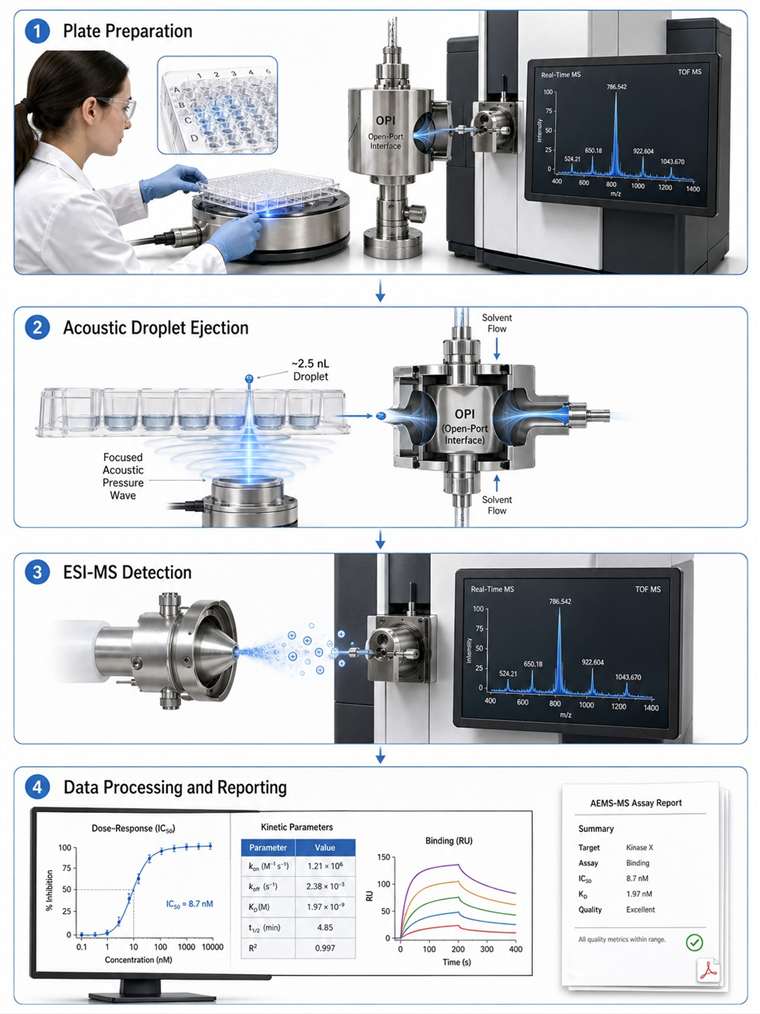
AEMS Workflow: From Plate to Result in Under 2 Seconds

Our standard AEMS workflow runs through four stages:

1

Plate Preparation

Samples are prepared in standard 384- or 1536-well plates. No special plate format required. Sample volume: 10–50 µL per well for 384-well plates; 5–10 µL for 1536-well plates.

2

Acoustic Droplet Ejection

A focused acoustic transducer generates a pressure pulse that ejects a ~2.5 nL droplet from the well surface. The droplet is captured by the open-port interface (OPI) and carried by a continuous solvent flow.

3

ESI-MS Detection

The sample droplet enters the ESI source, where it is ionised and analysed by high-resolution time-of-flight (TOF) or triple quadrupole mass spectrometry. Full-spectrum acquisition or MRM modes are available.

4

Data Processing and Reporting

Automated peak detection and quantification. Results reported as ion counts, percent conversion, IC50 values, or kinetic parameters. Data are compatible with standard informatics pipelines.

Technology Comparison: AEMS vs. RapidFire-MS vs. Conventional LC-MS

TechniqueCycle TimeSample VolumeCarryoverSPE RequiredThroughput (samples/day)Key Application
AEMS (Creative Proteomics)1.5–2 s~2.5 nLNoneNo>30,000Direct-to-biology, uHTS enzyme kinetics
RapidFire-MS2–10 s~10 µLLowYes>10,000ADME, SPE-requiring assays
Conventional LC-MS3–5 min5–20 µLLowNo300–500Targeted quantification, metabolite ID
MALDI-TOF HTS1–5 s~1 µLNoneNo>20,000High-throughput mass fingerprinting

Selection Strategy: AEMS is the method of choice when maximum throughput (>30,000 samples/day) and minimal sample consumption are critical. For assays requiring SPE cleanup (e.g., plasma protein binding), our RapidFire-MS service may be more appropriate.

Sample Requirements

Sample TypeRequired VolumeConcentrationPlate FormatBuffer ConditionsNotes
Compound (screening)10–50 µL1 µM–1 mM384-wellDMSO ≤1% finalProvide plate map and compound IDs
Compound (IC50)30–50 µL per dilution10-point 3-fold384-wellAssay bufferDuplicate or triplicate recommended
Crude Reaction Mixture10–30 µLN/A384-wellAny (dilute if needed)No purification required
Protein/Enzyme50–100 µL per assay0.1–10 µM384-wellMS-compatible bufferProvide activity data if available
Plasma/Matrix (ADME)30–50 µL per time pointN/A384-wellK2EDTA or heparinTime-zero sample required

Note: AEMS is compatible with a wide range of sample matrices. For complex or viscous samples, we recommend a preliminary consultation to optimise ejection conditions.

Deliverables

  • Raw MS data files (full-spectrum or MRM) with automated peak integration
  • Percent conversion, percent inhibition, or activity values per sample
  • IC50 curves with 95% confidence intervals (dose-response mode)
  • Kinetic parameters (Km, Vmax, Ki) for enzyme characterisation
  • Summary report with quality control metrics and recommendations

Representative AEMS Data

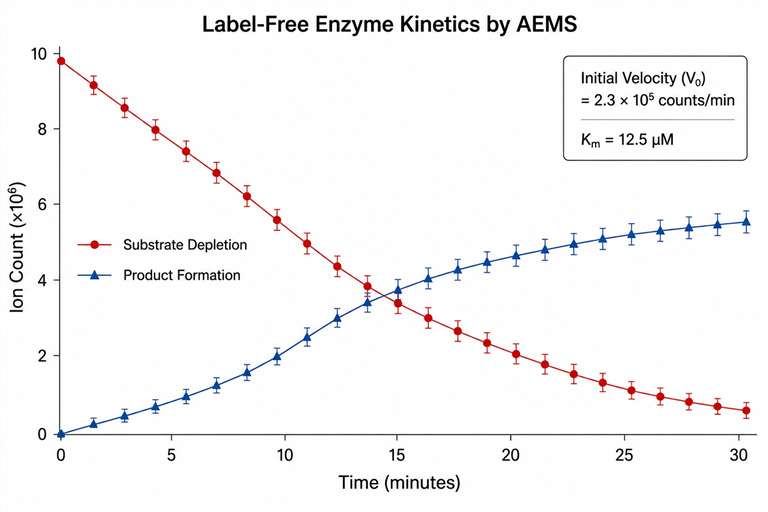
AEMS time-course plot showing substrate depletion and product formation over time with calculated kinetic parameters.

Example: Label-Free Enzyme Kinetics by AEMS

A representative time-course measurement of enzyme activity by AEMS. Each data point represents a single 1.5-second acoustic ejection. Substrate depletion and product formation are monitored simultaneously by full-spectrum MS acquisition.

FAQ

Frequently Asked Questions

Q: What is acoustic ejection mass spectrometry (AEMS) and how does it work?

AEMS uses focused acoustic energy to eject nanoliter droplets from a multiwell plate into an open-port interface coupled to an ESI mass spectrometer. The entire process — from well to mass spectrum — takes under 2 seconds with no physical contact.

Q: How does AEMS differ from RapidFire-MS in throughput and application?

AEMS achieves 1.5–2 s/sample vs. 2–10 s/sample for RapidFire-MS, and uses ~2.5 nL vs. ~10 µL per injection. AEMS is best for direct-infusion compatible samples; RapidFire-MS is better for assays requiring SPE cleanup.

Q: What types of samples are compatible with AEMS analysis?

AEMS is compatible with small molecules, peptides, lipids, and metabolites in MS-compatible solvents. Crude reaction mixtures, cell culture supernatants, and DMSO stocks can be analysed directly without purification.

Q: What is the minimum sample volume required for AEMS?

For 384-well plates, 10–50 µL per well is recommended. For 1536-well plates, 5–10 µL is sufficient. Each acoustic ejection consumes only ~2.5 nL, enabling hundreds of replicate analyses from a single well.

Q: Can AEMS be used for direct-to-biology screening of crude reaction mixtures?

Yes. This is one of AEMS's key advantages. Crude medicinal chemistry reaction products can be analysed directly without SPE or LC purification, enabling real-time reaction monitoring and rapid SAR feedback.

Q: How does AEMS compare with other ultra-HTS technologies in cost and throughput?

AEMS offers the highest throughput (>30,000 samples/day) and lowest sample consumption (~2.5 nL) of any MS-based platform. The cost per data point is competitive with fluorescence HTS while providing the specificity of direct MS detection.

Reference

  1. Zhang, J., et al. Acoustic ejection mass spectrometry: fundamentals and applications in drug discovery. Expert Opin Drug Discov 17, 775–787 (2022).
  2. Sinclair, I., et al. Acoustic Ejection Mass Spectrometry for High-Throughput Analysis. Anal Chem 93, 10846–10854 (2021).
  3. Kempa, E.E., et al. Acoustic ejection mass spectrometry empowers ultra-fast protein biomarker analysis. Nat Commun 15, 5098 (2024).

Start Your AEMS Project with MassTarget™

Share your screening requirements and sample details and our scientists will design a tailored AEMS strategy for your discovery program.

For research use only. Not for use in diagnostic procedures.

Online Inquiry

Please submit a detailed description of your project. We will provide you with a customized project plan to meet your research requests. You can also send emails directly to for inquiries.

* Email
Phone
* Service & Products of Interest
Services Required and Project Description