Target → Drug Discovery Service — Integrated MS-Based Pipeline from Hit Finding to Lead Validation

From gene to lead: mass spectrometry bridges every stage of the drug discovery cascade.

Small molecule drug discovery begins with a target — a protein whose modulation is expected to produce a therapeutic benefit — and ends with a lead compound suitable for preclinical development. Between these two milestones lies a multi-stage pipeline: identifying chemical matter that engages the target, confirming the interaction is specific and functionally relevant, and iteratively optimising potency, selectivity, and drug-like properties. Mass spectrometry is the only analytical platform that can provide label-free, direct molecular evidence at every stage of this pipeline — from fragment screening to covalent warhead profiling to biophysical hit validation.

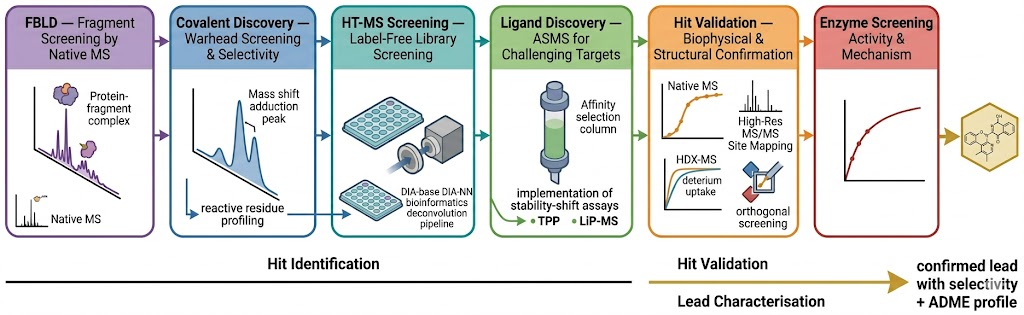
At Creative Proteomics MassTarget, our Target → Drug Discovery platform integrates six complementary MS-based service lines into a coherent pipeline, each addressing a distinct stage or modality of the hit-finding and lead-validation process. Whether your programme requires fragment-based lead discovery for a challenging target, covalent inhibitor screening with proteome-wide selectivity profiling, high-throughput MS screening of focused libraries, ligand discovery for undruggable targets, structural and biophysical hit validation, or enzyme activity and mechanism characterisation, our MS-based platform delivers label-free, direct molecular readouts that fluorescence-based assays cannot provide.

Key Advantages:

  • Six integrated service lines under one project — no handoff between separate CROs for screening, validation, and selectivity profiling.
  • Label-free MS detection for all readouts — no fluorescent tags, no chromogenic substrates, no antibody reagents required.
  • Compatible with challenging target classes — membrane proteins, protein-protein interactions, intrinsically disordered proteins, and low-abundance targets.
  • Orthogonal validation built into the pipeline — native MS, HDX-MS, and activity-based profiling confirm hits from any primary screening modality.
  • Scalable throughput — from fragment libraries (hundreds of compounds) to focused screening sets (thousands) to full HTS campaigns by HT-MS.
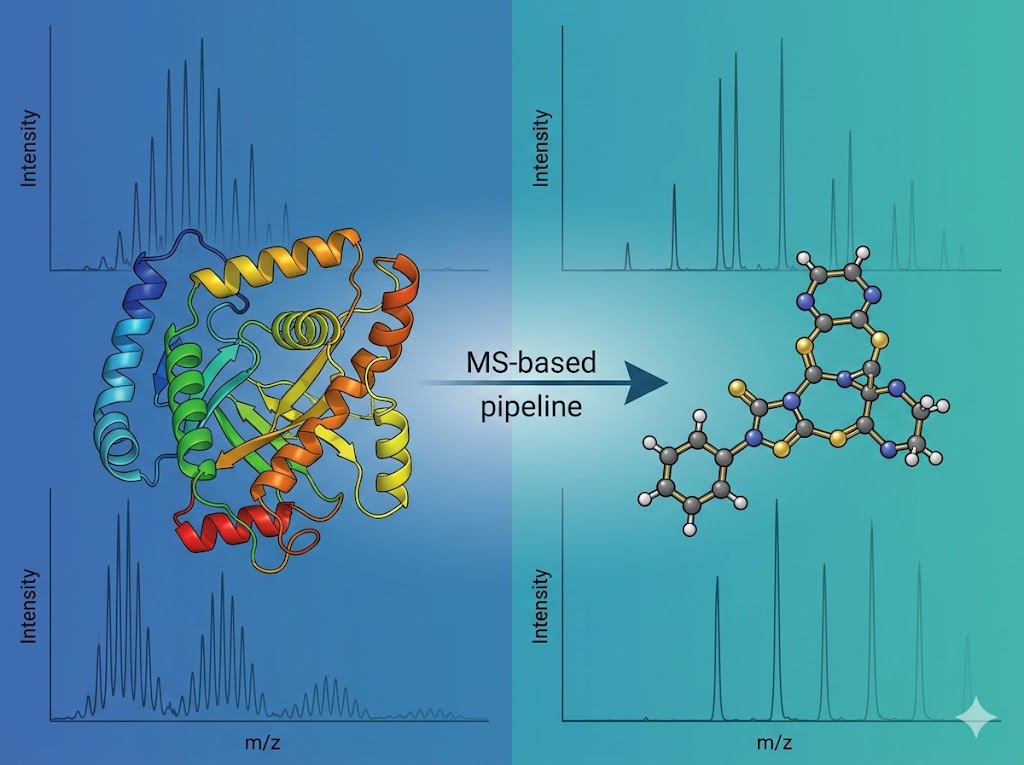
Target to drug discovery pipeline overview: from a validated target protein through six integrated MS-based service lines — fragment-based lead discovery, covalent drug discovery, high-throughput MS screening, ligand discovery for challenging targets, structural and biophysical hit validation, and enzyme activity screening — to a confirmed lead compound with selectivity and ADME data.
What Is MS Drug Discovery Pipeline How It Connects FAQ

What Is MS-Based Target → Drug Discovery?

MS-based target-to-drug discovery is the systematic application of mass spectrometry across the drug discovery value chain, from the point where a validated target enters hit identification through to the selection of a lead compound for preclinical development. Unlike conventional screening pipelines that rely on fluorescence, absorbance, or luminescence readouts — each requiring assay-specific reagents and suffering from target-class limitations — MS-based discovery uses the mass of the compound, the target, and their complex as the direct detection signal.

The pipeline encompasses six interconnected modalities, each optimised for a specific discovery context: fragment-based lead discovery (FBLD) for identifying low-molecular-weight starting points; covalent drug discovery for electrophilic warhead screening and target engagement profiling; high-throughput MS screening for label-free compound library screening at scale; ligand discovery for challenging targets that lack tractable binding sites; structural and biophysical hit validation for confirming and characterising target-compound interactions; and enzyme activity screening for functional characterisation of hits against enzymatic targets. Together, these modalities provide an end-to-end MS-based discovery engine that can be tailored to any target class and any programme stage.

What unifies the six service lines is the detection principle: every readout is grounded in the direct measurement of molecular mass — the compound mass, the target mass, the complex mass, or the enzymatic product mass — rather than an indirect optical or radiometric proxy. This label-free foundation means that assay development time is dramatically reduced, target classes that are inaccessible to fluorescence screening become tractable, and the data carries intrinsic chemical identity confirmation that no indirect assay can provide.

Why Mass Spectrometry for Drug Discovery

Covers target classes that fluorescence assays cannot reach

Membrane proteins, protein-protein interaction interfaces, intrinsically disordered proteins, and RNA targets represent a substantial fraction of the druggable genome but are systematically excluded from fluorescence-based screening campaigns because they lack a suitable spectroscopic readout. MS-based detection is blind to the optical properties of the target and compound — if the target and compound have distinct masses, an MS readout is feasible regardless of whether the target is a GPCR, a transcription factor, or a scaffolding protein.

Delivers chemical identity confirmation with every data point

A fluorescence signal tells you that something happened in the well. An MS readout tells you exactly what happened: the exact mass of the compound that bound, the mass of the target-ligand complex, the mass of the enzymatic product formed, or the mass shift from a covalent adduct. This intrinsic chemical confirmation eliminates false positives from fluorescent compound interference, aggregates, and assay artefacts that plague optical readouts.

Provides orthogonal validation within the same platform

One of the most costly sources of attrition in drug discovery is the failure of hits from a primary screening campaign to reproduce in orthogonal biophysical assays. Because MS-based detection covers multiple modalities — binding MS (ASMS, native MS), activity MS (enzyme assays), and structural MS (HDX, crosslinking) — orthogonal validation can be performed within the same platform using the same detection principle, eliminating cross-platform variability as a source of irreproducibility.

Reduces assay development time

Fluorescence-based HTS campaigns require weeks to months of assay development: substrate synthesis, probe validation, enzyme titration, signal optimisation, and miniaturisation. MS-based screening requires only that the target and compound have detectable masses — assay development is measured in days, not weeks, and the same generic detection workflow applies across target classes with minimal optimisation per target.

Generates selectivity data as a natural byproduct

Quantitative proteomic analysis performed in parallel with screening campaigns automatically generates selectivity data across the proteome — identifying off-target interactions, covalent adduction at unintended sites, and pathway-level effects of hit compounds — without requiring a separate selectivity panel. This is particularly valuable for covalent inhibitor programmes where proteome-wide reactivity must be assessed before lead advancement.

Reduces compound consumption compared to conventional biophysics

Native MS and ASMS operate at low-micromolar to sub-micromolar protein concentrations with minimal compound consumption per data point — typically 10–100 pmol of compound per measurement. For fragment libraries or covalent warhead panels where compound quantities are often limited by synthesis scale, this efficiency translates directly into broader screening coverage from the same material investment.

Our Integrated Drug Discovery Pipeline

The MassTarget drug discovery platform comprises six service lines, each addressing a specific stage or modality of the hit-finding and validation pipeline. They can be deployed individually or combined into an integrated campaign that spans from initial hit identification through structural confirmation and selectivity profiling.

SERVICE 1

Fragment-Based Lead Discovery (FBLD)

Fragment-based lead discovery identifies low-molecular-weight (typically <300 Da) starting compounds that bind weakly but efficiently to the target, then elaborates them into potent leads through iterative medicinal chemistry. Native MS is uniquely suited to FBLD because it detects intact protein-fragment complexes directly from the mass of the assembly, without requiring fragment modification, immobilisation, or tag-based detection. Our FBLD service covers fragment library screening by native MS, hit validation by dose-response binding curves, and SAR-by-MS for fragment elaboration. Learn more about our FBLD service →

SERVICE 2

Covalent Drug Discovery and Reactive Site Profiling

Covalent inhibitors require a fundamentally different screening paradigm: the readout must detect both binding and bond formation, distinguishing reversible engagement from irreversible adduction. MS provides this directly — the mass shift of the target protein upon covalent adduction is an unequivocal signal of bond formation. Our covalent drug discovery service covers electrophilic warhead screening, irreversible binding kinetics by intact MS, and proteome-wide selectivity profiling by quantitative chemoproteomics to identify off-target modification. Learn more about our covalent drug discovery service →

SERVICE 3

High-Throughput MS Screening

For focused libraries, targeted compound sets, or fragment elaboration libraries of up to several thousand compounds, HT-MS screening delivers label-free binding and activity data at throughputs compatible with drug discovery timelines. Ambient ionisation interfaces (DESI, ASAP, open-port sampling probe) enable direct sampling from 96- and 384-well plates at rates of one well per 10–60 seconds without chromatographic separation. Our HT-MS screening service supports binding assays by ASMS, enzyme activity screening by direct MS, and covalent adduction profiling at throughputs of 1,500–8,000+ data points per day. Learn more about our HT-MS screening service →

SERVICE 4

Ligand Discovery for Challenging Targets

Certain targets — protein-protein interaction interfaces, allosteric sites, RNA, and membrane proteins — present binding surfaces that are not amenable to conventional screening formats. MS-based ligand discovery addresses these challenges through affinity selection (ASMS), where the target is incubated with compound pools and bound ligands are identified directly by MS after size-exclusion or centrifugal separation. Our ligand discovery service deploys ASMS, native MS, and chemoproteomic workflows tailored to each target class. Learn more about our ligand discovery service →

SERVICE 5

Structural and Biophysical Hit Validation

Before committing to medicinal chemistry, every hit requires orthogonal confirmation that the observed activity derives from specific, stoichiometric target engagement. MS-based biophysical validation delivers this through native MS (confirming intact protein-ligand complex mass), HDX-MS (mapping binding epitopes), and crosslinking MS (proximity constraints for binding site localisation). Our hit validation service provides the orthogonal data package — Kd by native MS titration, stoichiometry confirmation, and binding site information — that separates genuine hits from artefacts. Learn more about our hit validation service →

SERVICE 6

Enzyme Activity and Reaction Mechanism Screening

For enzymatic targets, the functional readout — substrate consumption or product formation — is the most direct measure of hit quality. MS-based enzyme screening detects substrate and product masses directly, without coupled enzyme systems, chromogenic substrates, or fluorescent probes, making any enzyme with a mass-distinguishable substrate-product pair screenable. Our enzyme screening service covers inhibitor IC₅₀ determination, Michaelis-Menten kinetics, inhibition mode analysis, and substrate scope profiling by direct MS detection. Learn more about our enzyme screening service →

For programmes that have progressed beyond hit identification and require ADME/PK characterisation, our ADME/DMPK/PK-PD research platform provides downstream LC-MS/MS bioanalysis, metabolic stability, and metabolite identification services that extend the pipeline from hit validation to preclinical candidate selection. For broader integration with target identification, cellular pharmacology, and multi-omics characterisation, our multi-omics integration for drug discovery platform connects the drug discovery pipeline with upstream target discovery and downstream mechanism-of-action analysis.

How the Pipeline Connects: From Target to Lead

Six service lines integrated into a unified workflow from validated target to confirmed lead.

1

Entry: validated target with defined screening strategy

A programme enters at any stage depending on the target class and prior knowledge. For a target with no known ligands, the pipeline begins with FBLD (to identify weak fragment binders from a 1,000–5,000-compound library) or ligand discovery for challenging targets (ASMS for PPI or membrane protein targets). For a target with known substrate or established biochemical assay, the pipeline begins with enzyme screening or HT-MS screening for focused compound library profiling. The entry strategy, concentration ranges, controls, and acceptance criteria are defined during project design.

2

Hit identification by primary screening

Primary screening is executed by the selected modality: native MS for fragment libraries, intact MS for covalent warhead panels, ASMS for affinity selection against challenging targets, or enzyme activity MS for functional screening. Each modality delivers a preliminary hit list with the intrinsic chemical identity confirmation that MS provides — every hit is defined by the exact mass of the bound compound or the mass shift of the modified target — eliminating optical artefacts at the primary screening stage.

3

Hit confirmation and orthogonal validation

Primary hits from any screening modality are advanced to biophysical hit validation: dose-response binding curves by native MS, competition experiments with known ligands or substrates, and stoichiometry confirmation by intact complex mass measurement. For covalent hits, the mass shift is confirmed at the intact protein level and mapped to the modified residue by peptide-level LC-MS/MS. This triage step eliminates false positives from compound aggregation, non-specific binding, and assay interference before they consume medicinal chemistry resources.

4

Selectivity profiling and mechanism characterisation

Confirmed hits enter selectivity profiling: quantitative proteomics across the expressed proteome (for covalent inhibitors, to assess off-target reactivity) or enzyme panel profiling across related family members (for reversible inhibitors). Mechanism-of-action data — binding site location by HDX-MS or crosslinking MS, inhibition mode by steady-state kinetics — is generated in parallel, providing the structural and mechanistic rationale for medicinal chemistry optimisation.

5

Exit: confirmed lead with integrated data package

At this stage the programme has a compound with confirmed target engagement by native MS, quantitative binding affinity (Kd), selectivity profile across related targets or the proteome, functional activity data (enzyme inhibition or cellular activity), and preliminary ADME properties — the integrated data package required for advancement into lead optimisation and in vivo pharmacology studies.

Target to drug discovery workflow diagram showing the integrated pipeline from validated target through six MS-based discovery modalities — FBLD, covalent screening, HT-MS, ligand discovery, hit validation, and enzyme screening — to confirmed lead with selectivity profile and ADME data.

FAQ

Frequently Asked Questions

Q: How do I choose which service line to start with for my target?

The entry point depends on your target class and available information. For targets with no known ligands: FBLD (if the target is purified and MS-compatible) or ligand discovery by ASMS (for PPI targets, membrane proteins, and challenging systems). For targets with known substrates or biochemical activity: enzyme screening or HT-MS. For covalent inhibitor programmes: covalent drug discovery. We recommend a discovery consultation call where our scientists assess your target's properties and recommend the optimal starting point.

Q: Can multiple service lines be run in parallel, or must they be sequential?

They can be deployed in any combination. A typical integrated campaign runs FBLD or HT-MS screening in parallel with biophysical assay development for hit validation, so that confirmed hits flow immediately into validation without delay. Covalent screening and selectivity profiling can be run as a single integrated workflow since the proteome-wide selectivity readout requires only the target and compound for parallel assessment of adduction and off-target reactivity. Our project managers coordinate parallel workstreams to compress the overall timeline.

Q: What target quantities are required for each service line?

FBLD by native MS: 5–20 µM protein concentration, 50–200 µg total per screening set. HT-MS (ASMS): comparable requirements at 2–10 µM. Covalent screening: 2–10 µM protein for intact MS readouts. Biophysical validation: similar to FBLD requirements. Enzyme screening: 1–10 µg per assay point depending on turnover rate. For targets where material is limited, we optimise miniaturised formats to minimise consumption. Typical total protein requirement for a full pipeline campaign is 1–5 mg, depending on scope.

Q: How does MS-based hit validation compare with SPR or ITC for orthogonal confirmation?

Native MS and SPR show good concordance for binding affinity measurements across a wide range of Kd values (nM to mM). Native MS offers specific advantages: it directly reports complex stoichiometry (1:1 vs 1:2 vs higher-order), detects weak binding at concentrations accessible to SPR with fewer surface-related artefacts, and requires no surface immobilisation that could alter binding geometry. ITC provides thermodynamic parameters (ΔH, ΔS) that MS does not. We routinely cross-validate hits by native MS as a first orthogonal check, then recommend SPR or ITC for thermodynamic characterisation if required for lead optimisation decisions.

Q: What is the typical timeline from target receipt to confirmed hit?

FBLD: 3–4 weeks from purified target to fragment hit list with dose-response validation. HT-MS screening (1,000–5,000 compounds): 2–3 weeks. Covalent screening: 2–3 weeks including proteome-wide selectivity profiling. Biophysical validation of confirmed hits: 1–2 weeks. An integrated campaign spanning screening through validation typically completes in 5–8 weeks depending on the scope and number of compounds.

Q: Can the pipeline handle targets that are only available as crude lysates or membrane preparations?

Yes, for selected service lines. HT-MS and ASMS can tolerate moderate lysate complexity and are compatible with membrane protein preparations when detergent-solubilised. Covalent screening by intact MS requires purified target for the mass-shift readout, but the selectivity profiling arm works in whole-cell lysates. Enzyme screening is compatible with crude lysates provided there is no competing endogenous activity at the same substrate-product mass. FBLD by native MS requires purified target for unambiguous mass assignment. We assess target purity requirements on a case-by-case basis during project design.

References

  1. Sternicki L.M., Poulsen S.A. Fragment-based drug discovery campaigns guided by native mass spectrometry. RSC Med Chem. 2024;15(7):2270–2285.
  2. Lucas S.C.C., Blackwell J.H., Hewitt S.H., et al. Covalent hits and where to find them. SLAS Discov. 2024;29(3):100142.
  3. Kirkman T., Dos Santos Silva C., Tosin M., Bertacine Dias M.V. How to find a fragment: methods for screening and validation in fragment-based drug discovery. ChemMedChem. 2024;19(24):e202400342.

Design Your Drug Discovery Campaign with the MassTarget Team

Tell us your target, programme stage, and compound status — our scientists will recommend the optimal service line combination and design an integrated hit-finding strategy matched to your target class and development timeline.

For Research Use Only (RUO). Not intended for diagnostic, therapeutic, or clinical decision-making purposes. Creative Proteomics services are designed to support preclinical research, drug discovery, and mechanism of action studies only.

Online Inquiry

Please submit a detailed description of your project. We will provide you with a customized project plan to meet your research requests. You can also send emails directly to for inquiries.

* Email
Phone
* Service & Products of Interest
Services Required and Project Description