Sulfur(VI) Fluoride Exchange (SuFEx) Chemoproteomics Service

Maximize the potential of your Sulfur(VI) fluoride exchange (SuFEx) covalent ligands. Our specialized chemoproteomics service delivers high-resolution target site mapping and proteome-wide selectivity profiling.

Using gentle enrichment and advanced bioinformatics, we prevent adduct loss and ensure high-confidence MS2 data, providing the transparent evidence you need to accelerate your covalent drug discovery pipeline.

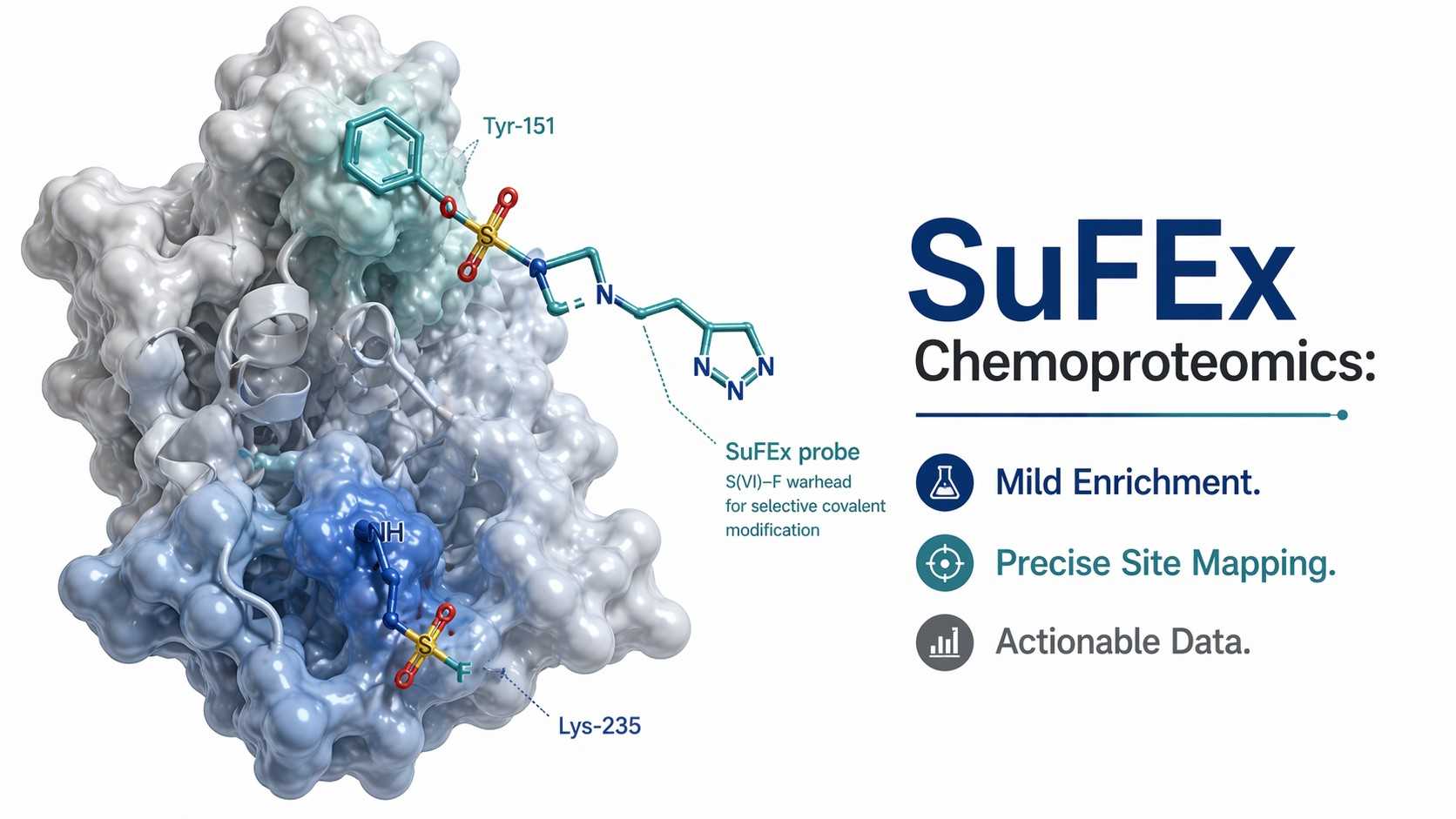
SuFEx Chemoproteomics Service platform diagram featuring multi-residue coverage, complex matrix adaptability, and actionable data deliverables.
Overcoming the Bottleneck Capabilities Workflow & QC Deliverables Bioinformatics Strategy Comparison Sample Requirements Case Study FAQ

Overcoming the SuFEx MS Profiling Bottleneck

In recent years, the discovery of Sulfur(VI) fluoride exchange (SuFEx) chemistry has revolutionized the way we design covalent drugs. By utilizing sulfonyl fluoride (SVI-F) warheads, researchers can now target nucleophilic amino acids beyond traditional cysteine—such as tyrosine, lysine, histidine, and serine. This opens up massive new opportunities for targeting previously "undruggable" proteins and developing novel molecular glues.

However, moving from a successful chemical synthesis to actual biological target identification presents a major technical bottleneck. When standard mass spectrometry (MS) sample preparation protocols are used, the delicate SVI-F covalent bonds often break down (hydrolyze) due to harsh pH levels or high temperatures. Even if the sample reaches the mass spectrometer intact, SuFEx adducts tend to exhibit "neutral loss"—meaning the probe breaks apart unexpectedly inside the machine before the protein sequence can be read. This leads to missing data, high background noise, and overwhelming false-positive rates.

Our platform is built specifically to address these exact problems. By combining carefully controlled, mild sample preparation with custom-tuned bioinformatics algorithms, we successfully capture and identify these fragile modifications, translating your complex chemistry into clear, actionable biological data. We prioritize the stability of the covalent linkage, ensuring that the critical evidence of target engagement is preserved from the moment of lysis to the final spectral readout.

Our Chemoproteomics Service Capabilities & Advantages

We want to be clear about what we can achieve for your project and where our specific capabilities shine. We provide platform-level evidence that links your early hits to definitive cellular mechanisms, ensuring you do not waste time on dead-end compounds.

Tyrosine, Lysine, and Histidine Site Mapping

We do not just confirm that your probe binds to a protein; we pinpoint the exact amino acid residue it attaches to. This structural proof is critical for guiding your next round of medicinal chemistry optimization and understanding the binding pocket environment.

Proteome-Wide Target & Off-Target Discovery

We scan thousands of proteins simultaneously to reveal the full selectivity landscape of your compound. This early off-target identification helps prevent late-stage toxicity failures and provides a comprehensive view of compound reactivity.

Adaptable Probe Strategies

Whether you are using an intact probe equipped with a biotin tag or employing click chemistry (using an alkyne or azide handle to attach a reporter tag later), our workflows are fully adaptable to your specific molecular design and experimental goals.

Complex Sample Matrix Adaptability & Synergy

Our methods handle heterogeneity in live cell models and primary tissues. We seamlessly integrate this profiling with our chemoproteomics services to support your entire hit-to-lead journey, or incorporate live-cell ABPP to understand real-time interactions in vivo.

If you have a unique probe structure or an unconventional mechanism of action, let's discuss how we can adapt our methods to fit your specific chemical environment.

End-to-End Workflow with Strict QC Checkpoints

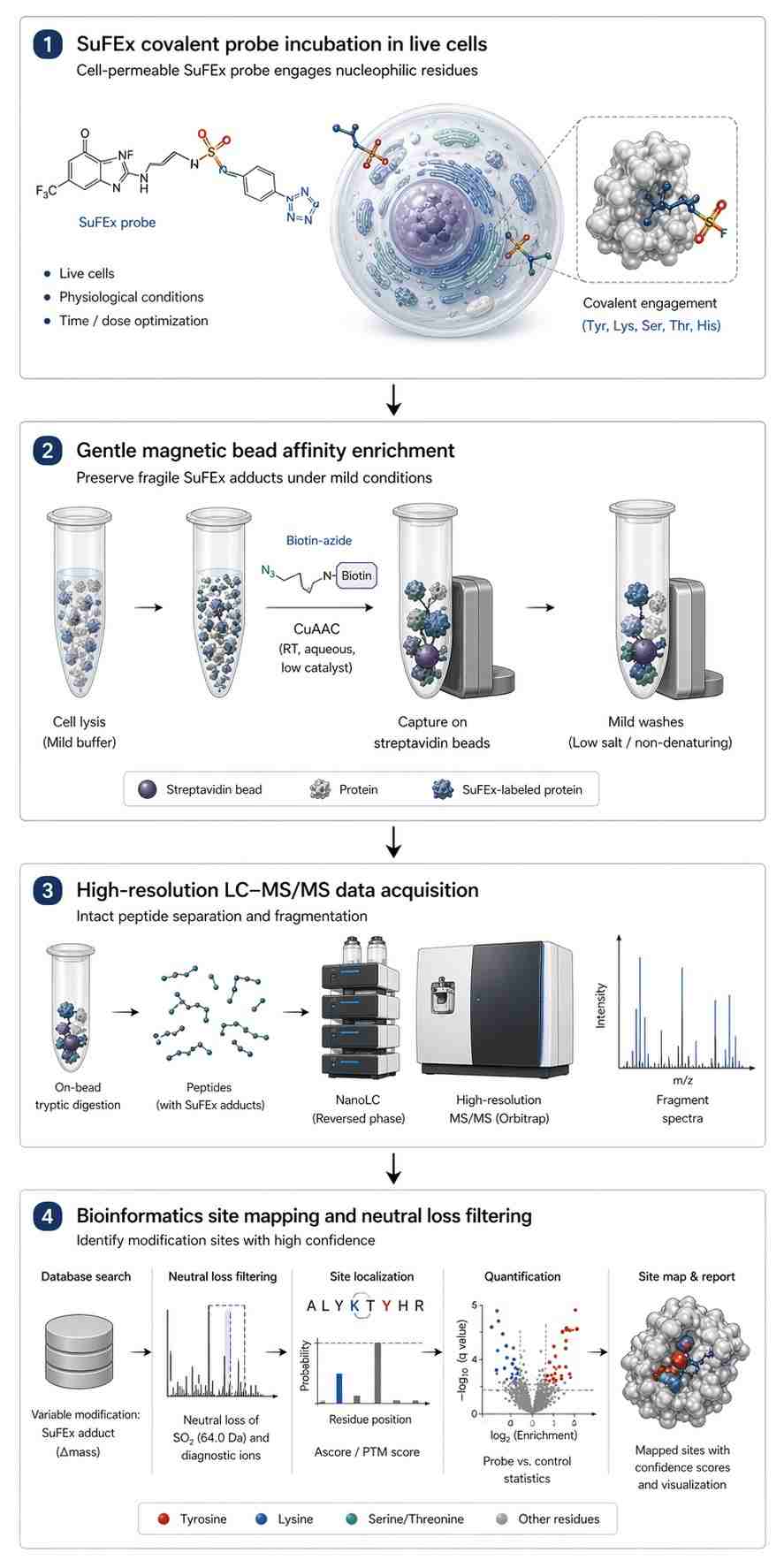
A successful chemoproteomics project requires more than just running a mass spectrometer. We follow a tightly managed, end-to-end workflow—from the moment your sample arrives to the delivery of your final report—integrating strict quality control (QC) at every vulnerable step.

1

Project Initiation & Probe Evaluation

We start by reviewing the exact mass and reactive properties of your SuFEx probe. We select specific, mild lysis buffers and pH-controlled environments to ensure the SVI-F bond remains stable throughout the process.

2

Sample Processing & Live-Cell Incubation

If requested, we incubate your probes directly in live cell models to capture true interactions in their natural physiological state. This is crucial for reflecting real-time binding kinetics and selectivity.

3

Gentle Affinity Enrichment (QC Checkpoint 1)

We capture the probe-protein complexes using tailored magnetic beads. QC: We assess enrichment efficiency and confirm that on-bead enzymatic digestion has produced the right peptide sizes without washing away covalent adducts.

4

LC-MS/MS Acquisition (QC Checkpoint 2)

The peptides are analyzed using high-resolution mass spectrometry. QC: We adjust collision energies specifically for SVI-F compounds to minimize neutral loss, while using spike-in standards to monitor instrument stability.

5

Bioinformatics & Site Mapping (QC Checkpoint 3)

Our custom algorithms search the data for the specific mass shift of your probe, accounting for characteristic fragmentation patterns. QC: False Discovery Rates (FDR) are strictly controlled at the peptide level (≤1%).

6

Data Delivery & Expert Consultation

You receive a structured data package, and our experts walk you through the site-mapping spectra to help you interpret the biological implications and guide your discovery strategy.

A longitudinal scientific flowchart in Nature journal style showing SuFEx probe incubation, gentle enrichment, LC-MS/MS data acquisition, and bioinformatics site mapping.

Actionable Data Deliverables & Demo Results

We believe that high-quality covalent inhibitor profiling requires total data transparency. You will never receive an unverified list of proteins from us. Instead, we provide visual, structural evidence for every major hit.

Here are the primary deliverables you will receive:

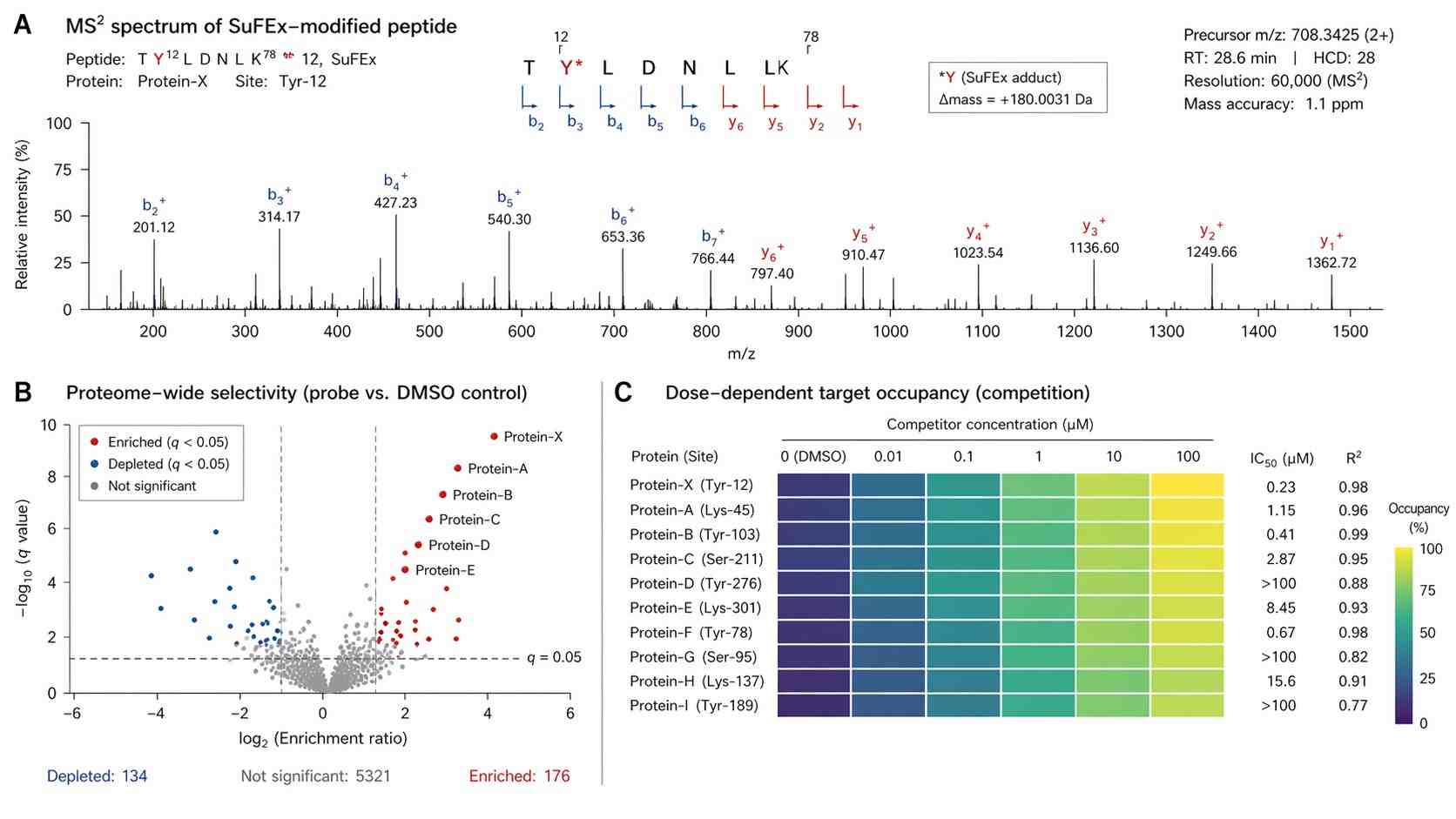
  • SuFEx Site-Specific MS2 Mapping: You will receive annotated, high-resolution fragmentation spectra (showing the specific b and y ion peaks) that unambiguously confirm the exact tyrosine or lysine residue bound by your probe. This direct readout is the gold standard for binding site confirmation.
  • Global Selectivity Volcano Plot: A clear visual graph comparing your probe-treated samples against control groups (vehicle or competition controls). Statistically significant targets and off-targets are easily identifiable, helping you gauge overall selectivity at the proteome level.
  • Target Occupancy Heatmap: A visual matrix demonstrating how effectively your probe engages its target across different dosage concentrations, providing insight into binding affinity and effective concentration (EC50) values.

A composite scientific data panel showing MS2 fragmentation spectrum confirming a SuFEx-modified residue, a volcano plot for selectivity, and a heatmap of dose-dependent occupancy.

Bioinformatics Support for SVI-F Spectra

Translating SuFEx mass spectra into reliable data requires specialized software processing. Because SVI-F adducts often fragment unpredictably—often losing the SO2F group or other neutral molecules—standard proteomic software will simply ignore the data. We use open-search algorithms and custom diagnostic ion filtering to capture these hidden signals.

Standard Deliverables Include:

  • Full access to Raw MS data files (.raw format) so your internal team can re-analyze or archive the primary evidence.
  • Confidence-scored peptide summary tables indicating exact modification sites, modification localization probabilities (A-score), and intensity values.
  • Annotated MS2 site-mapping spectra for your prioritized hits, highlighting the key fragments that confirm the covalent bond.

Optional Add-ons:

  • Network topology and protein-protein interaction (PPI) analysis to understand the broader biological impact and pathway effects of your targets.
  • Gene Ontology (GO) and pathway enrichment analysis (KEGG/Reactome) for any identified off-targets to predict potential phenotypic side effects.
  • Structural mapping of modified residues onto known PDB structures to visualize the binding pocket and steric accessibility.

Profiling Strategy: Traditional Cys-ABPP vs. SuFEx

If you are transitioning from traditional cysteine-targeting acrylamides to new SuFEx warheads, your mass spectrometry strategy must adapt accordingly. The chemical differences necessitate a shift in how samples are enriched and how data is analyzed.

Comparison DimensionTraditional Cys-ABPPSuFEx Chemoproteomics
Target ResiduesPrimarily Cysteine (highly reactive)Tyrosine, Lysine, Histidine, Serine
Sample Prep StringencyStandard buffers and room temperature processingMild, pH-controlled buffers (pH 7.0–7.5) required to prevent adduct hydrolysis
MS/MS ComplexityStandard b/y ion series; highly predictableHigh complexity; requires algorithms to handle probe neutral losses and unusual fragmentation
Enrichment YieldHigh (Cys reactivity is robust)Variable; requires highly sensitive enrichment to capture lower-reactive residues
Structural UtilityIdeal for deep, accessible kinase pocketsExcellent for shallow protein-protein interaction (PPI) surfaces and allosteric sites

Strategy Guide: Evaluate your target's binding pocket. If it lacks an accessible cysteine, transitioning to a SuFEx warhead is highly strategic. SuFEx probes offer unique advantages for targeting residues in shallow or unconventional pockets. However, ensure that your downstream MS provider has the capability to handle the lower stability and higher spectral complexity of these SVI-F adducts.

Sample Requirements & Probe Submission Guidelines

Proper sample preparation is critical for preserving SuFEx modifications. Adhering to these guidelines helps prevent the loss of covalent bonds before analysis. We handle all probe submissions under strict confidentiality (CDA).

Sample TypeRecommended InputContainer & BufferShippingNotes
Live Cell Pellets≥ 1 × 10⁷ cellsWash with cold PBS, snap-frozenDry iceAvoid harsh lysis buffers prior to shipment; we utilize mild, neutral protocols for lysis.
Tissue Samples≥ 50 mgPre-washed, snap-frozenDry icePlease specify the tissue origin, perfusion status, and any pre-treatments.
SuFEx Probes1–5 mgAmber vialDry iceStrict IP protection; you only need to provide the exact Delta Mass (mass shift), not the full chemical structure.
Pre-enriched Beads> 20 μL bed volumeNeutral buffer provided by usCold packMust use our recommended mild washing protocols to prevent hydrolysis of sensitive linkages.

Validated Chemoproteomics Case Studies

Profiling SVI-F Reactive Functionalities in the Proteome

Reference link: https://pmc.ncbi.nlm.nih.gov/articles/PMC9942091/

Background

The development of Sulfur(VI) fluoride exchange chemistry offers a powerful way to target non-cysteine residues. However, researchers needed to robustly evaluate the proteome-wide reactivity and hydrolytic stability of these SVI-F electrophiles in a complex cellular environment to determine their suitability as chemical biology tools.

Methods

Researchers synthesized a focused panel of SVI-F probes and applied them directly in live-cell chemoproteomic workflows. The team utilized specific, mild enrichment strategies and high-resolution MS/MS to evaluate how these probes reacted with diverse nucleophilic amino acids across the human proteome, including Tyrosine and Lysine.

Results

As demonstrated in Figure 1 of the referenced study, the advanced MS workflow successfully mapped the SVI-F electrophiles modifying Lysine, Tyrosine, Histidine, and Serine residues. The data revealed hundreds of novel protein targets based on the specific type of SVI-F used, while also demonstrating that reactivity can be tuned by structural modification of the SuFEx handle.

Conclusion

This workflow definitively proves that SVI-F electrophiles can serve as robust tools to expand the ligandable proteome beyond cysteine, provided that specialized, gentle chemoproteomic MS strategies are employed to capture and analyze the resulting data.

Figure 1 from PMC9942091 showing the profiling of Sulfur(VI) Fluorides as reactive functionalities across the proteome.

Figure 1: Profiling of SVI-F functionalities expanding the ligandable proteome.

FAQ

Frequently Asked Questions

Q: How do you prevent SuFEx adduct hydrolysis during MS sample preparation?

We avoid standard harsh lysis buffers (such as those with very high or low pH) and high temperatures. Instead, we use customized, pH-neutral extraction buffers (typically pH 7.0–7.4) and perform protein digestions under highly controlled, mild conditions to ensure the sulfonyl fluoride linkages remain intact throughout the entire enrichment and analysis process.

Q: What specific proprietary information regarding our SuFEx probe do we need to share?

We prioritize your IP security. You do not need to share the core chemical structure of your probe. We only require the exact "Delta Mass" (the precise mass added to the protein upon binding) and the specific reactive handles used for enrichment (such as an alkyne or azide group for click chemistry).

Q: How does your bioinformatics pipeline handle the MS/MS neutral losses typical of SVI-F adducts?

Standard software often rejects spectra if the probe fragments or breaks apart during the collision process. We utilize advanced, open-search algorithms and specific neutral-loss filters designed to recognize the diagnostic ions and predictable mass losses associated with SVI-F fragmentation, ensuring we recover valid hits that other platforms miss.

Q: Can you perform quantitative occupancy assays for Tyrosine-targeting SuFEx ligands?

Yes. By using advanced label-free quantification (LFQ) or isotopic labeling techniques (e.g., TMT or SILAC) alongside our site-mapping workflow, we can accurately measure the dose-dependent target occupancy of your SuFEx ligands at specific tyrosine or lysine sites within the proteome.

References

  1. Profiling Sulfur(VI) Fluorides as Reactive Functionalities for Chemical Biology Tools and Expansion of the Ligandable Proteome.
  2. Advances in sulfonyl exchange chemical biology: expanding druggable target space.
  3. Modular Approaches to Synthesize Activity- and Affinity-Based Chemical Probes.

Disclaimer: All services and data provided by our platform are for Research Use Only (RUO). Not for use in diagnostic procedures. The information provided is not intended to substitute for professional medical advice or clinical diagnosis.

Plan a SuFEx Profiling campaign with the MassTarget™ team

Share your target and delta mass details, and our scientists will design a tailored chemoproteomic screening strategy for your discovery program.

Online Inquiry

Please submit a detailed description of your project. We will provide you with a customized project plan to meet your research requests. You can also send emails directly to for inquiries.

* Email
Phone
* Service & Products of Interest
Services Required and Project Description