High-Throughput Activity-Based Protein Profiling Service

Screen covalent compounds, evaluate proteome-wide target engagement, and prioritize selective chemical probes with LC-MS/MS-based chemoproteomics.

High-throughput activity-based protein profiling helps discovery teams screen covalent compounds, evaluate proteome-wide target engagement, and prioritize selective chemical probes using LC-MS/MS-based chemoproteomics. At Creative Proteomics, we support compound-fit review, competitive profiling, reactive-site evidence, QC-guided data interpretation, and decision-ready deliverables for covalent drug discovery programs.

Key Advantages:

  • Screen covalent fragments and electrophilic compounds.
  • Profile proteome-wide target engagement.
  • Compare selectivity across analog series.
  • Map reactive residues when supported.
  • Receive QC-guided data deliverables.
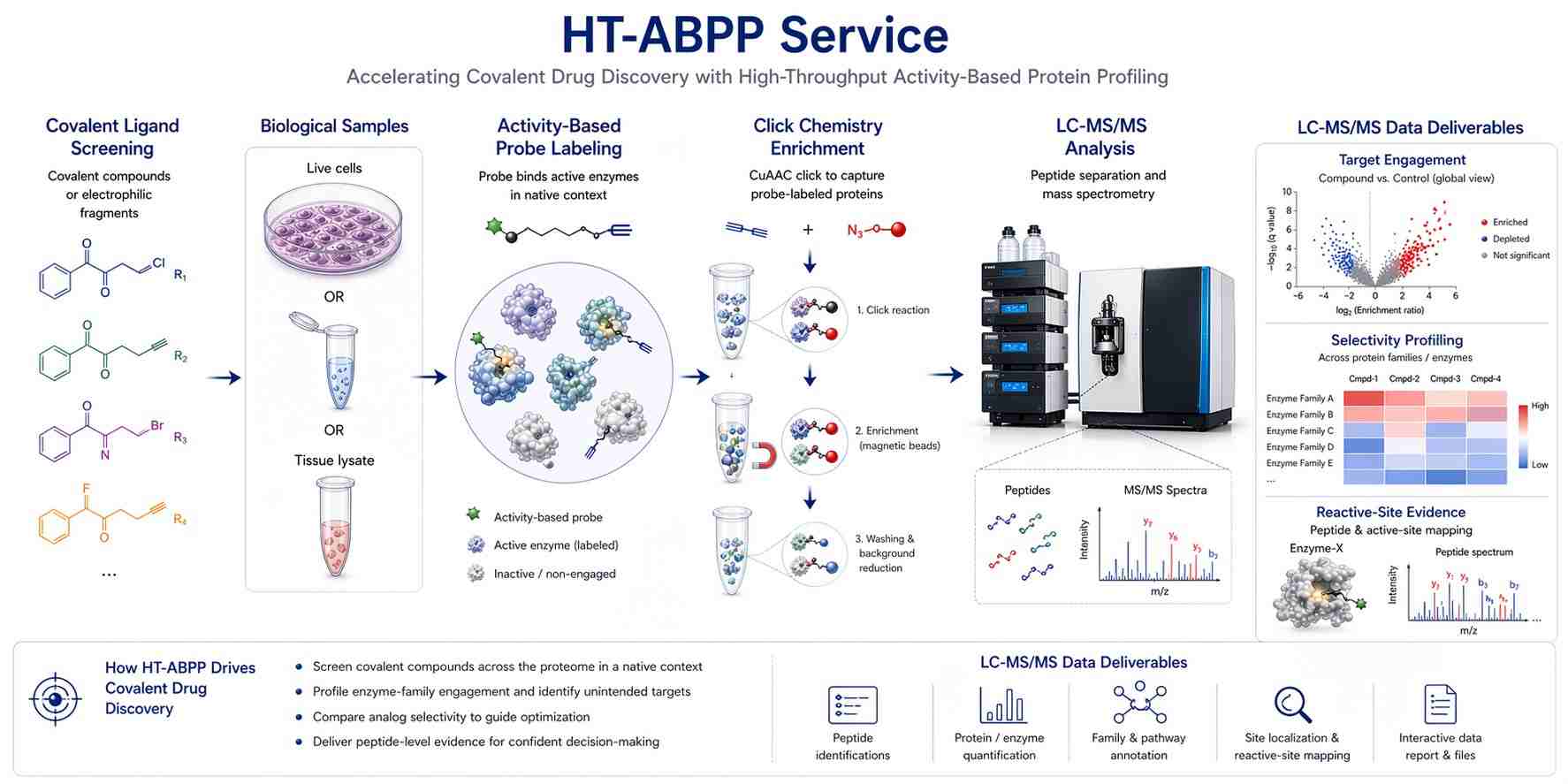
High-throughput activity-based protein profiling service workflow for covalent ligand discovery and target engagement.
HT-ABPP Capabilities Workflow Sample Demo Results Deliverables Comparison Strategy Case Study FAQ

HT-ABPP for Covalent Ligand Discovery and Proteome-Wide Target Engagement

High-throughput activity-based protein profiling, often shortened to HT-ABPP, is a mass spectrometry-based chemoproteomics approach for measuring functional protein engagement in complex biological samples. Instead of only asking whether a compound changes total protein abundance, HT-ABPP asks whether a compound competes with activity-based probe labeling, changes a functional protein signal, or reveals a selective interaction pattern across the proteome.

In a typical HT-ABPP project, a biological system is treated with a compound, analog series, or vehicle control. An activity-based probe is then used to label a defined reactive or functional protein space. After enrichment, digestion, LC-MS/MS acquisition, and data analysis, the result is a prioritized view of targets, off-targets, probe-competed proteins, and, where supported, peptide- or residue-level evidence.

This makes HT-ABPP especially useful when your team needs more than a single-target assay. We use it to help answer questions such as:

  • Which covalent compounds show meaningful target engagement?
  • Which proteins are competed by each compound?
  • Does an analog series become more selective during optimization?
  • Are there broad off-target signals that may need follow-up?
  • Can a reactive residue or ligandable site be supported by peptide-level data?

HT-ABPP fits naturally within a covalent drug discovery workflow, where early hits must be ranked not only by apparent activity, but also by selectivity, biological context, and the quality of supporting proteomics evidence.

For related target-engagement approaches, see our Competitive ABPP and Global ABPP (LC-MS/MS) services.

Our HT-ABPP Service Capabilities

We designed our HT-ABPP service for teams that need actionable chemoproteomics evidence, not just a method description. We help evaluate project fit, design the profiling strategy, process samples through probe-based LC-MS/MS workflows, and deliver structured results that can support compound prioritization and follow-up validation.

MODE 1

Covalent Fragment and Electrophilic Compound Screening

For covalent fragments, electrophilic libraries, and focused analog sets, HT-ABPP can help identify compounds that compete with probe labeling in a reproducible and interpretable way. This is valuable when biochemical activity alone does not explain target engagement, or when a compound class may show broad reactivity.

  • Compare vehicle controls, individual compounds, analog series, or concentration conditions.
  • Turn reactive compound lists into target engagement and selectivity profiles.
MODE 2

Competitive ABPP for Target Engagement

In competitive ABPP, candidate compounds are introduced before or alongside an activity-based probe. A reduction in probe labeling can indicate compound engagement within the probe-accessible protein space.

  • Suitable for covalent inhibitors with known or suspected reactive groups.
  • Useful for analog comparison during lead optimization.
  • Supports early target engagement studies in cell or lysate systems.
MODE 3

Reactive Residue and Ligandable Site Profiling

When the study design and probe chemistry support it, HT-ABPP can provide peptide- or site-level evidence. This helps connect compound response to a more specific protein region or reactive residue class.

MODE 4

Proteome-Wide Selectivity and Off-Target Profiling

For covalent drug discovery, selectivity matters as much as potency. HT-ABPP can help reveal whether a compound produces a narrow engagement pattern or broad nonspecific labeling across the measured protein space.

  • Summarize ranked protein tables and selectivity plots.
  • Compare compounds with target-by-compound heatmaps.
  • Support decisions about compounds needing deeper validation or redesign.
MODE 5

Live-Cell, Lysate, and Tissue Lysate ABPP Study Design

Different sample systems answer different questions. Live-cell ABPP can be valuable when cellular permeability and intact-cell context matter. Lysate ABPP gives more controlled access to the proteome and can be useful for compound comparison. Tissue lysate ABPP can help when disease-relevant biological matrices are central to the project.

  • Match sample system to compound properties and project goals.
  • Use Live-cell ABPP when cellular context is central.

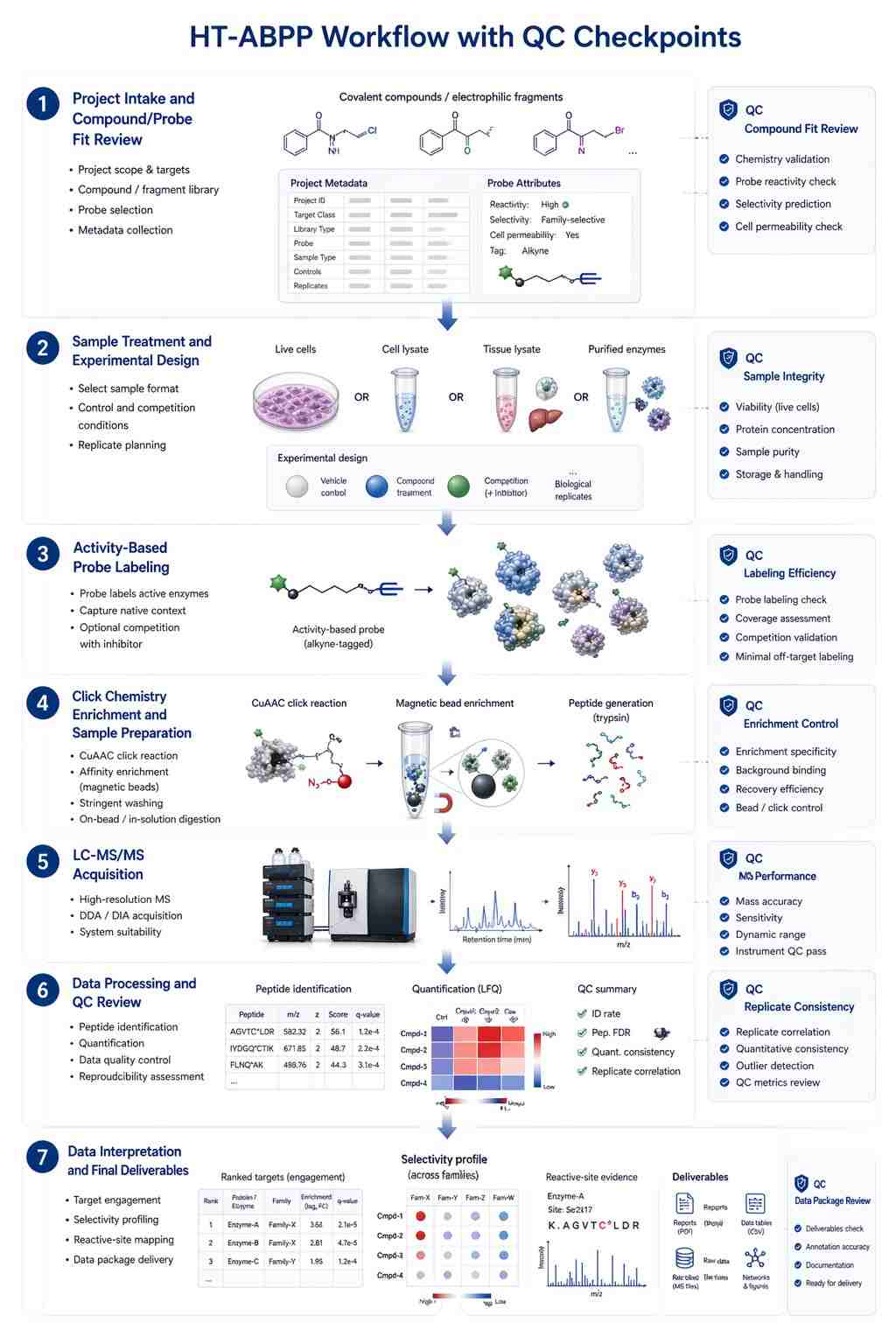
HT-ABPP Workflow with QC Checkpoints

Our workflow follows the sample from project intake to final data delivery. Each stage combines technical execution with QC review so the final interpretation is grounded in the sample system, compound design, probe chemistry, and MS data quality.

1

Project Intake and Compound / Probe Fit Review

We review the biological question, compound class, sample type, probe strategy, comparison groups, compound identity, reactive group, solubility, treatment conditions, and required controls.

2

Sample Treatment and Probe Labeling

Samples are prepared as live cells, cell lysates, tissue lysates, or another approved matrix. Compounds and controls are applied according to the agreed design, followed by activity-based probe labeling.

3

Click Chemistry, Enrichment, and Digestion

Where applicable, probe-labeled proteins or peptides are enriched through click chemistry and affinity-based capture. The enriched material is digested and cleaned before LC-MS/MS.

4

LC-MS/MS Acquisition and Quantification

Prepared peptide samples are analyzed by LC-MS/MS to capture reproducible, quantifiable signals that support target ranking, site-level interpretation, and compound comparison.

5

Data Filtering, QC Review, and Interpretation

We review probe controls, vehicle controls, replicate consistency, competition ratios, protein-level evidence, and site-level evidence where applicable.

Vertical HT-ABPP workflow diagram with QC checkpoints from sample treatment to LC-MS/MS data analysis.

The final interpretation is built around practical questions: which targets show consistent compound competition, which signals are broad or likely nonspecific, which analogs appear more selective, which proteins or sites deserve follow-up validation, and which results should be treated as exploratory.

Sample Requirements and Project Intake Checklist

Sample quality strongly affects ABPP results. For proteomics projects, sample representativeness, accuracy, reproducibility, timeliness, and low-temperature handling are core principles. Samples should be prepared consistently across groups, protected from degradation, and transported under appropriate cold-chain conditions when needed.

The table below gives a practical planning view. Final requirements depend on the selected sample system, probe chemistry, and experimental design.

Sample / Input TypeRecommended Information to ProvideProject FitCompatibility ConsiderationsQC CheckpointsNotes
Live-cell treated samplesCell line, treatment design, compound concentration range, exposure conditionCellular target engagement and permeability-aware profilingCompound solubility, cell state, labeling windowReplicate consistency, labeling signal, enrichment controlReview design before sample preparation
Cell lysatesSpecies, cell type, lysis condition, protein concentration estimateControlled proteome access and compound comparisonBuffer compatibility, detergent level, protein integrityProtein quality, probe labeling, background signalSuitable when intact-cell permeability is not the main question
Tissue lysatesTissue source, storage condition, disease model or treatment groupDisease-relevant or model-specific profilingMatrix complexity, protein degradation risk, sample heterogeneitySample integrity, labeling efficiency, replicate behaviorRequires careful group matching
Compound library / analog seriesCompound ID, structure if available, solvent, stock concentration, reactive groupCovalent screening and selectivity comparisonSolubility, reactivity, DMSO tolerance, grouping logicCompound-fit review, control designProvide analog relationships when available
Activity-based probeProbe class, target family or residue class, handling notesDefines the measurable protein spaceProbe selectivity, labeling condition, enrichment strategyProbe control, labeling pattern, enrichment behaviorProbe choice determines data scope

Before submission, we recommend preparing the compound list, grouping logic, sample type, biological question, treatment design, comparison groups, known target or pathway information, probe class if available, and any buffer, solvent, toxicity, or handling concerns.

Representative HT-ABPP Demo Results

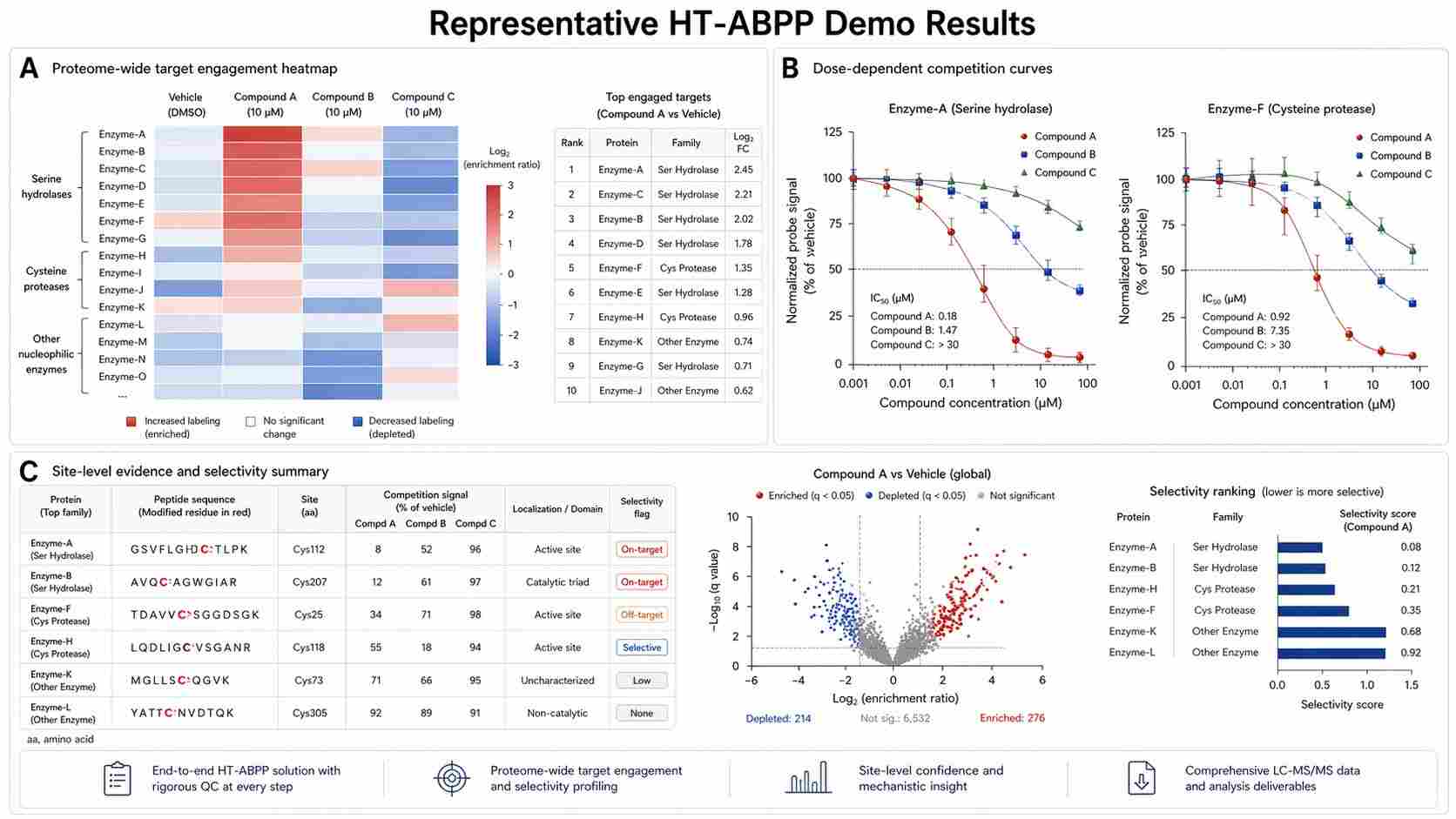
HT-ABPP results should help your team make decisions. We structure demo outputs around the questions most teams ask after profiling: which targets are engaged, which compounds are selective, and which findings have site-level support.

Representative HT-ABPP demo results showing target engagement heatmap, dose-response curve, and site-level evidence table.

Representative HT-ABPP output types

Demo 1: Competitive ABPP Target Engagement Profile

A target engagement heatmap can compare vehicle, compound A, compound B, compound C, and concentration conditions. Proteins with reduced probe labeling appear as candidate competed targets.

  • See which proteins respond to each compound.
  • Compare target patterns across compounds.
  • Identify broad off-target signals.
  • Prioritize targets for follow-up.

Demo 2: Dose-Response Competition Curve

For selected proteins or sites, dose-response curves can show whether probe competition increases with compound concentration. This is especially useful for analog comparison and prioritization.

  • Review concentration-dependent trends.
  • Compare compound response strength.
  • Flag weak or inconsistent signals.

Demo 3: Site-Level Evidence and Selectivity Summary

Where supported by the data, peptide- or site-level tables can connect protein-level findings to more specific evidence. A selectivity summary can then show whether the compound response is narrow, moderate, or broad across the measured chemical space.

  • Review whether the evidence is protein-level or site-supported.
  • Connect peptide or residue features to target calls.
  • Identify off-targets that need follow-up.

Bioinformatics Analysis and Data Deliverables

ABPP data can be complex. We organize deliverables so your team can review the data, trace the interpretation, and reuse the results for internal discussions.

DeliverableWhat It Helps You Review
Raw LC-MS/MS filesPrimary data archive and reanalysis support
Search result filesProtein and peptide identification review
Protein-level quantified tableRanked targets and compound-response overview
Peptide / site-level evidence table, where applicableResidue or peptide-supported interpretation
Competitive labeling response tableProbe competition and engagement comparison
QC summaryReplicate behavior, controls, and data quality
Ranked target / off-target candidate listPrioritized follow-up planning
Visualization-ready figuresInternal presentation and scientific review
Methods and parameter summaryTraceability of analysis settings
  • Optional add-ons may include dose-response modeling, analog series comparison, pathway or functional enrichment, protein family annotation, reactive residue class summary, custom filtering, and orthogonal validation recommendation matrices.
  • The final data package helps prioritize compounds, remove broadly reactive compounds from consideration, nominate target proteins or sites, compare analog selectivity, and support MoA hypotheses with proteome-wide evidence.

HT-ABPP vs Other Target Discovery and Engagement Methods

No single target discovery method answers every question. HT-ABPP is strongest when the project needs proteome-wide functional engagement, covalent compound competition, selectivity profiling, or reactive-site evidence. Other methods may be better for affinity, thermal response, structural validation, or purified-target characterization.

MethodBest-Fit QuestionComplex Proteome CompatibilitySite-Level Evidence PotentialStrengthMain LimitationBest Follow-Up Use
HT-ABPPWhich proteins or sites are functionally engaged by a covalent compound?Strong, depending on probe and sample designStrong when peptide/site evidence is capturedProteome-wide engagement and selectivity profilingScope depends on probe-accessible chemical spaceHit ranking, selectivity review, target nomination
Pull-Down ProteomicsWhich proteins bind to a modified compound or probe?StrongUsually protein-level, sometimes site-supportedUseful for enrichment of compound-associated proteinsCompound modification or linker may affect bindingDirect binder enrichment and validation
Thermal Stability ProfilingWhich proteins show stability changes after compound treatment?StrongUsually protein-levelUseful for cellular target engagement without probe labelingNot all binding events cause measurable stability shiftsOrthogonal target engagement support
DARTS / LiP-MSWhich proteins change proteolytic accessibility after ligand binding?Moderate to strongLiP-MS can provide region-level informationProbe-free readout of structural protection or accessibilityRequires careful proteolysis and interpretationStructural accessibility follow-up
SPR / ITCWhat is the affinity, kinetics, or thermodynamics for a purified target?Low; purified target requiredNo proteome-wide site mapStrong biophysical characterizationNot proteome-wide and lower screening scaleConfirming purified target binding
Standard Quantitative ProteomicsWhich proteins change in abundance after treatment?StrongProtein-level abundanceGood for downstream biological responseDoes not directly measure probe competition or covalent engagementPathway response and MoA context

For orthogonal engagement work, HT-ABPP can be paired with Proteome-wide Thermal Stability Profiling when a project benefits from both covalent engagement and protein stability evidence.

How to Choose the Right HT-ABPP Strategy

Choose Live-Cell ABPP When Cellular Engagement Matters

Live-cell ABPP is useful when compound permeability, intact-cell context, and cellular target engagement are central to the question. It can help reveal whether a compound engages targets under more biologically relevant conditions.

  • Compound access to cells matters.
  • Cellular activity needs target-level support.
  • Off-target behavior in intact cells is a concern.
  • Engagement evidence should be closer to the biological model.

Choose Lysate ABPP When You Need Controlled Proteome Access

Lysate ABPP is useful when controlled exposure to the proteome is more important than intact-cell permeability. It can reduce some cellular variables and help compare compound competition under more controlled conditions.

  • Compound permeability is unknown or not relevant.
  • The goal is direct proteome competition.
  • You need a controlled analog comparison.
  • You want to explore target space before cell-based follow-up.

Choose Tissue Lysate ABPP When Disease-Relevant Matrices Matter

Tissue lysate ABPP can be useful when the protein environment of a disease model, tissue type, or biological matrix is central to the question. It requires careful sample matching and handling because tissue heterogeneity can affect interpretation.

  • Tissue biology is central to the program.
  • Cell lines may not represent the target context.
  • Sample groups can be collected and stored consistently.
  • The project needs model-specific proteome evidence.

Choose Competitive ABPP When You Already Have Candidate Compounds

Competitive ABPP is a strong fit when compounds already exist and the key question is which proteins, sites, or protein families they engage. It is especially useful for covalent fragments, electrophilic compounds, and analog series.

  • You need target engagement evidence.
  • You need selectivity comparison.
  • You want to identify off-target risks.
  • You want a ranked target list for follow-up.

Literature-Supported Case: ABPP-HT for Cellular Inhibitor Profiling

Background

In early drug discovery, potency and selectivity are both critical. A compound may show activity in a biochemical assay, but its behavior in a cellular matrix can differ because of permeability, protein accessibility, pathway context, and off-target engagement.

Jones and colleagues addressed this challenge in ABPP-HT - High-Throughput Activity-Based Profiling of Deubiquitylating Enzyme Inhibitors in a Cellular Context. The study focused on deubiquitylating enzyme inhibitors and evaluated how an accelerated ABPP workflow could support inhibitor selectivity profiling in cellular and tissue-derived biological contexts.

Methods

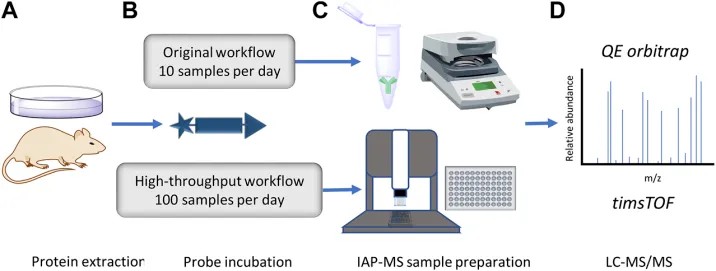
The study developed a high-throughput-compatible activity-based protein profiling workflow using activity-based probe labeling, immunoaffinity purification, sample preparation, LC-MS/MS, and label-free quantification. Figure 1 describes the accelerated DUB inhibitor ABP immunoprecipitation workflow, including protein extraction and inhibitor treatment, HA-Ub-PA probe incubation, anti-HA enrichment, and LC-MS/MS proteomic analysis.

The authors optimized multiple workflow variables, including starting material, probe labeling, immunoaffinity purification, elution, and sample preparation. They also used filtering rules during data analysis, removing DUBs based on no-probe controls, missing values in probe controls, or signals near the lower limit of MS dynamic range. Raw data and MaxQuant search results were deposited to PRIDE under dataset identifier PXD023036.

Results

The study reported that ABPP-HT implemented a semi-automated proteomic sample preparation workflow that increased throughput capabilities by approximately ten times compared with the classical ABPP workflow while preserving enzyme profiling characteristics. The method identified a reduced but representative panel of DUBs, about 15-25 DUBs compared with about 30-40 DUBs in regular ABPP.

The authors used FT671, a selective USP7 inhibitor, and NEM, a broad cysteine modifier, to test whether the workflow could distinguish selective and non-selective inhibition patterns. They observed that NEM inhibited USP7 in both cells and brain in a non-selective way, while FT671 retained a selective USP7 profile. The study also tested multiple compounds and concentrations, including four USP7 inhibitors, two USP30 inhibitors, and two broad cysteine modifiers. The results were summarized in heat maps for USP7 inhibitors, USP30 inhibitors, and non-selective modifiers.

Conclusion

This study shows why HT-ABPP project design must balance throughput, target coverage, QC, and interpretability. A faster workflow is valuable only when it still supports meaningful enzyme or target profiling, clear control filtering, and selectivity interpretation. For covalent ligand discovery projects, the same principle applies: sample design, probe strategy, enrichment, LC-MS/MS acquisition, and data analysis should be planned together before screening begins.

ABPP-HT workflow optimization figure for high-throughput cellular inhibitor profiling using activity-based probes and mass spectrometry.

Figure 1 from Jones et al. supports the connection between sample treatment, activity-based probe labeling, enrichment, and LC-MS/MS analysis in an accelerated ABPP setting.

FAQ

Frequently Asked Questions

Q: What is high-throughput activity-based protein profiling?

High-throughput activity-based protein profiling is a chemoproteomics approach that uses activity-based probes and LC-MS/MS to profile functional protein engagement across many samples, compounds, or conditions. It is especially useful for covalent ligand discovery, competitive target engagement, and selectivity profiling.

Q: How is HT-ABPP different from standard proteomics?

Standard proteomics often measures protein abundance. HT-ABPP measures probe-accessible functional protein signals, such as activity-based labeling or compound competition with probe labeling. This makes it more suitable for target engagement and covalent compound selectivity questions.

Q: When should I choose competitive ABPP?

Choose competitive ABPP when you already have candidate compounds and want to know which proteins or sites they engage in a complex proteome. It is especially useful for covalent compounds, electrophilic fragments, and analog series comparison.

Q: Can HT-ABPP be used for covalent ligand discovery?

Yes. HT-ABPP is well suited to covalent ligand discovery because it can help profile compound engagement, reactive-site behavior, and off-target patterns across a probe-accessible protein space.

Q: Does HT-ABPP support live-cell samples?

Yes, live-cell ABPP can be used when cellular engagement and compound permeability are important. Final feasibility depends on the compound, probe, cell model, treatment condition, and sample handling plan.

Q: What sample information should I prepare before submission?

Please prepare the sample type, species or cell model, treatment design, compound list, solvent information, concentration range, probe information if available, and desired comparison groups. Any known solubility, toxicity, or buffer concerns should also be shared.

Q: What types of demo results can I expect?

Representative outputs may include target engagement heatmaps, dose-response competition curves, ranked target tables, off-target summaries, peptide or site-level evidence tables, QC summaries, and visualization-ready figures.

Q: Can HT-ABPP identify off-targets?

HT-ABPP can help identify potential off-target signals within the measured probe-accessible protein space. Follow-up validation is usually needed to confirm biological relevance and direct binding.

Q: Does HT-ABPP provide site-level evidence?

Site-level evidence may be available when the probe, enrichment strategy, peptide coverage, and data quality support it. We review this during project design and data interpretation.

Q: How should I choose between HT-ABPP, pull-down proteomics, and thermal profiling?

Choose HT-ABPP when you need proteome-wide functional engagement or covalent compound competition evidence. Choose pull-down proteomics when compound enrichment is the main strategy. Choose thermal profiling when protein stability changes provide useful orthogonal target engagement evidence.

Compliance Disclaimer

This service is provided for Research Use Only.

Online Inquiry

Please submit a detailed description of your project. We will provide you with a customized project plan to meet your research requests. You can also send emails directly to for inquiries.

* Email
Phone
* Service & Products of Interest
Services Required and Project Description