Global ABPP and LC-MS/MS Chemoproteomics Service

Proteome-wide activity-state, reactive-site, and ligandability profiling by activity-based probe labeling and LC-MS/MS.

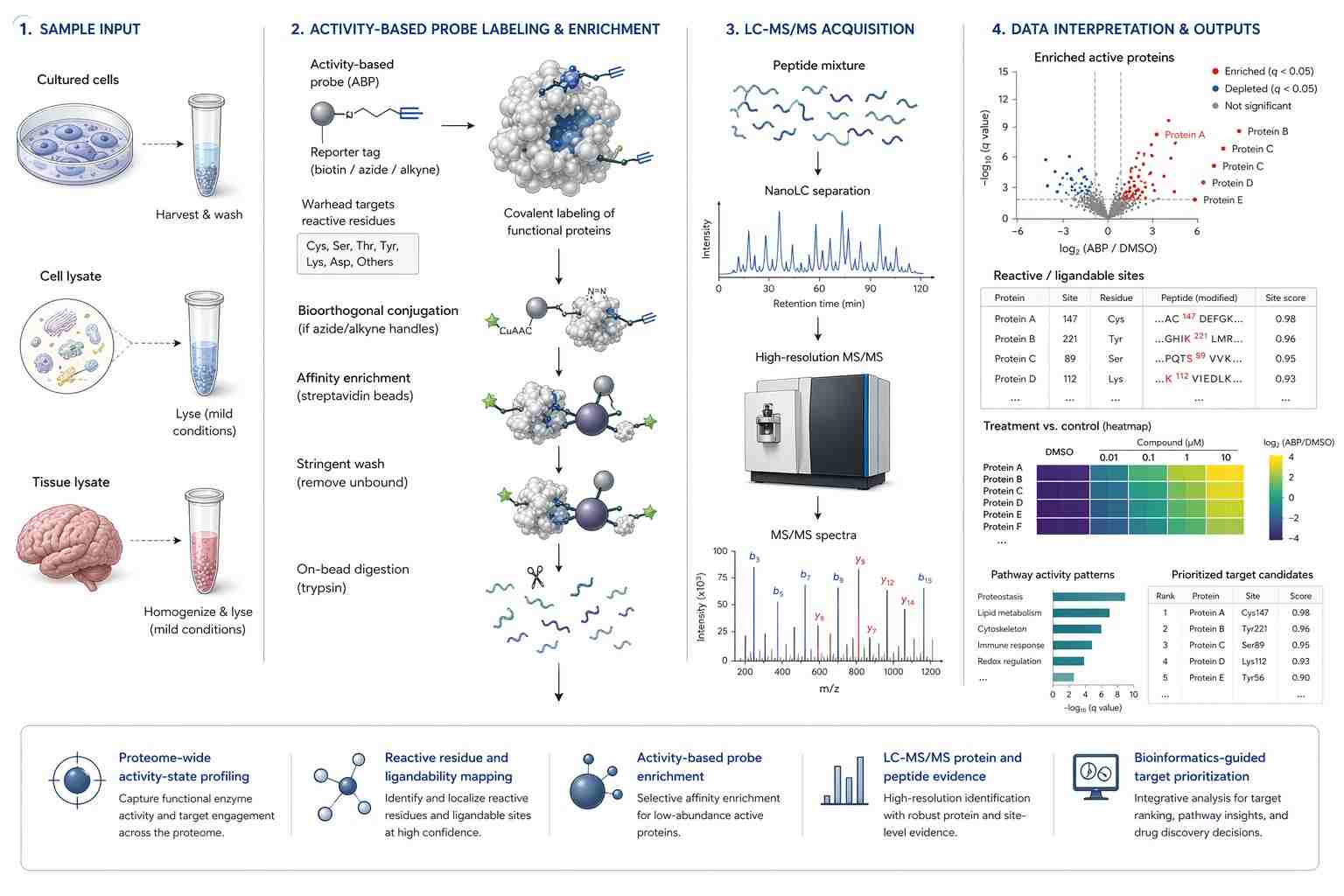
Protein abundance does not always show protein activity. Our Global ABPP and LC-MS/MS Chemoproteomics Service helps research teams profile activity-linked proteins, reactive or ligandable sites, and treatment-associated target landscapes using activity-based probe labeling, enrichment, LC-MS/MS, and bioinformatics analysis.

At Creative Proteomics, we support Global ABPP projects from probe strategy and sample planning through enrichment, LC-MS/MS acquisition, data processing, and decision-ready reporting.

Key Advantages:

  • Proteome-wide activity-state profiling.
  • Reactive residue and ligandability mapping.
  • Activity-based probe labeling and enrichment.
  • LC-MS/MS protein and peptide evidence.
  • Bioinformatics support for target prioritization.
Global ABPP and LC-MS/MS chemoproteomics workflow for activity-state profiling and target prioritization.
Activity States Capabilities Workflow Project Types Sample Deliverables Demo Comparison Case Study FAQ Feasibility Review Disclaimer

See Protein Activity States Beyond Standard Proteomics

Standard quantitative proteomics is powerful for measuring protein abundance, but abundance alone may not show whether a protein is active, ligandable, inhibited, or functionally changed after treatment.

Global activity-based protein profiling uses activity-based probes to label functional protein subsets in complex biological samples. When combined with LC-MS/MS, Global ABPP can help identify probe-labeled proteins, enriched activity-linked proteins, reactive residues, ligandable sites, and treatment-associated changes.

This makes Global ABPP especially useful when your project needs a functional proteomics readout, not only an expression-level readout.

What Global ABPP Measures

Depending on probe chemistry, sample type, and project design, Global ABPP can support:

  • Probe-labeled proteins.
  • Active enzyme families.
  • Reactive or ligandable sites where supported.
  • Treatment versus control activity-state changes.
  • Target and off-target activity landscapes.
  • Protein family or pathway-level activity patterns.
  • Prioritized targets for follow-up validation.

A Global ABPP result should not be interpreted as a complete map of all active proteins in a sample. Coverage depends on the activity-based probe, residue chemistry, sample preparation, protein abundance, labeling conditions, enrichment quality, and LC-MS/MS depth.

When This Service Is Useful

This service is a strong fit when your project involves:

  • Proteome-wide activity-state comparison.
  • Reactive residue discovery.
  • Ligandability mapping.
  • Drug-treated versus control profiling.
  • Enzyme family activity mapping.
  • Target or off-target landscape exploration.
  • Disease model or tissue lysate activity profiling.
  • Follow-up prioritization after phenotypic screening.

For foundational probe-based activity profiling, you may also explore our Activity-Based Protein Profiling (ABPP-MS) service.

Our Global ABPP Service Capabilities

A successful Global ABPP project depends on more than running an enrichment experiment. The project needs the right probe strategy, matched controls, consistent sample preparation, LC-MS/MS quality control, and clear interpretation boundaries.

Our team helps design and execute the complete chemoproteomics workflow.

Probe Strategy and Experimental Design

We review the activity-based probe, target enzyme class or residue class, sample type, treatment design, and intended readout before the project begins.

  • Whether the probe fits the biological question.
  • Whether the goal is protein-level or site-level evidence.
  • Whether treatment versus control comparison is needed.
  • Whether competition or inhibitor controls should be included.
  • Whether the project should use lysate, live-cell, or tissue lysate format.
  • Whether Global ABPP should be combined with another MassTarget™ workflow.

Cell Lysate, Live-Cell, and Tissue-Compatible Formats

Global ABPP can be designed around different biological contexts. Cell lysate workflows provide strong control over protein concentration, buffer conditions, and probe exposure. Live-cell workflows may better preserve cellular context but require careful review of probe permeability and treatment conditions. Tissue lysate workflows may be useful for disease models or translational research, but sample heterogeneity and matrix background must be considered.

Enrichment, Digestion, and LC-MS/MS Execution

After probe labeling, probe-labeled proteins or peptides are enriched, cleaned, digested, and analyzed by LC-MS/MS. The exact workflow depends on probe design and whether the experiment aims to identify enriched proteins, probe-labeled peptides, or specific reactive sites.

We focus on sample consistency, enrichment specificity, digestion quality, LC stability, MS signal quality, and replicate alignment.

Control-Based Interpretation and Background Review

Background signals can occur in enrichment-based workflows. Common sources include non-specific binding, abundant proteins, bead-associated proteins, incomplete enrichment specificity, and inconsistent sample preparation.

  • Vehicle control.
  • No-probe control.
  • Probe-only group.
  • Treatment versus control groups.
  • Competition or inhibitor group, when appropriate.
  • Biological replicates.

Target, Pathway, and Protein Family Prioritization

Global ABPP often produces a broad list of enriched or changed proteins. We help organize the result into a more useful interpretation framework by combining enrichment strength, replicate consistency, peptide evidence, site evidence where available, protein family context, pathway annotation, and project-specific biology.

For residue-focused discovery, our Reactive Residue Profiling service can support deeper investigation. For druggability questions, see our Ligandability Mapping service.

From Probe Labeling to LC-MS/MS Readout: Workflow and QC Checkpoints

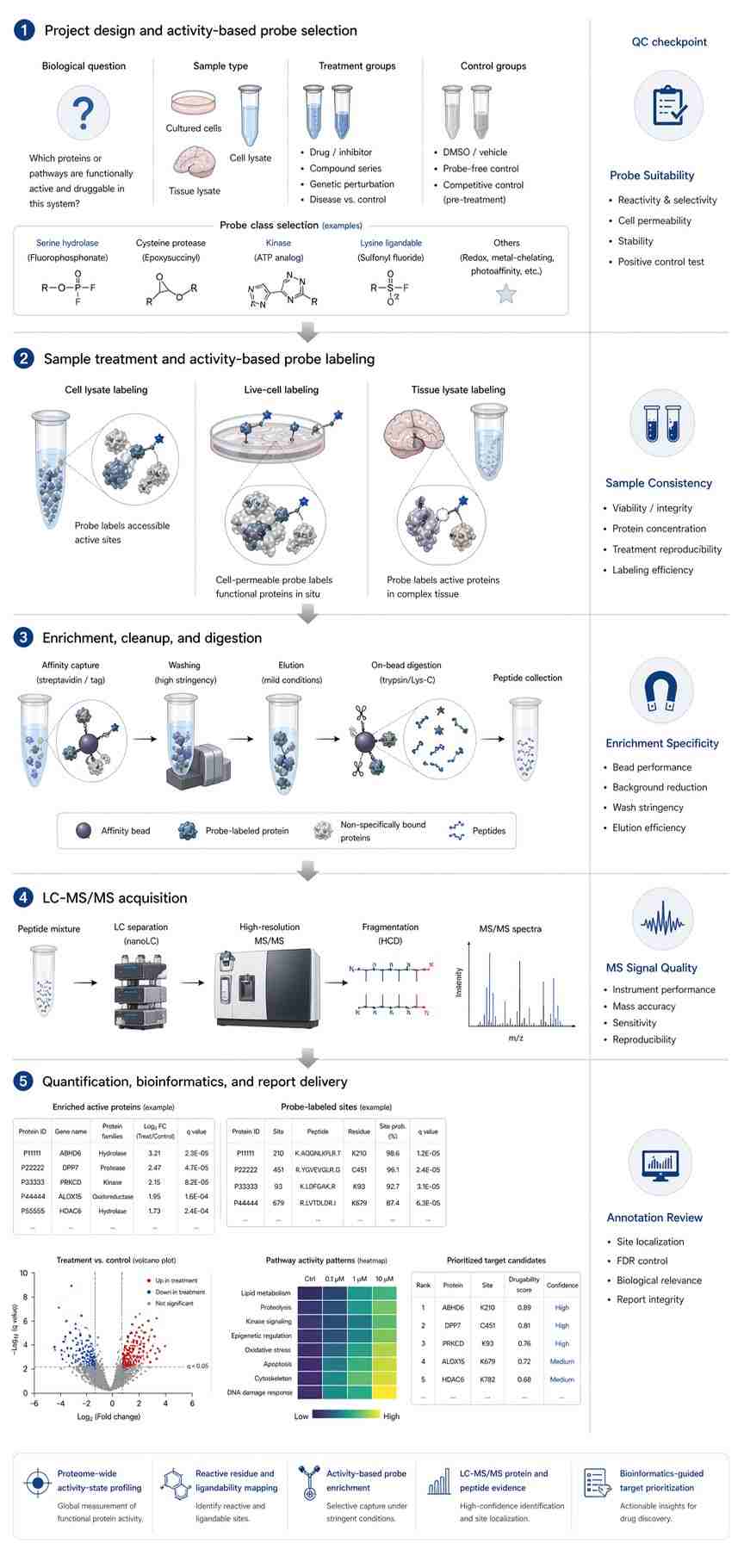
Our workflow follows the sample from project design to final reporting. Each stage includes technical execution and QC checkpoints.

1

Project Design and Probe Selection

We begin by reviewing your biological question, sample type, treatment plan, activity-based probe, intended target class or residue class, and required readout.

QC checkpoint: probe suitability, sample format, treatment/control design, biological replicates, and interpretation goal.

2

Sample Treatment and Activity-Based Probe Labeling

Samples are treated under matched conditions. Depending on the project, labeling may be performed in cell lysate, live-cell systems, tissue lysates, or focused validation formats.

The activity-based probe labels a functional subset of proteins or residues based on probe chemistry and biological accessibility.

QC checkpoint: protein amount, cell or tissue consistency, treatment matching, sample integrity, and replicate design.

3

Enrichment, Cleanup, and Digestion

Probe-labeled proteins or peptides are enriched and cleaned to reduce background. Proteins are then digested into peptides for LC-MS/MS analysis.

QC checkpoint: enrichment specificity, background signal, digestion quality, sample recovery, and control behavior.

4

LC-MS/MS Acquisition

Prepared peptides are analyzed by LC-MS/MS. The acquisition strategy may be selected based on project goals, sample complexity, and whether broad profiling or targeted follow-up is needed.

QC checkpoint: LC stability, MS signal quality, peptide identification, run alignment, and replicate-level consistency.

5

Quantification, Bioinformatics, and Report Delivery

The data are processed into protein tables, peptide or site tables where supported, treatment/control comparison summaries, QC summaries, and visual outputs.

QC checkpoint: replicate consistency, missing value review, background filtering, protein/site annotation, pathway interpretation, and target prioritization logic.

Vertical Global ABPP workflow with probe selection, labeling, enrichment, LC-MS/MS, and bioinformatics QC.

Project Types Supported by Global ABPP

Global ABPP can support several project types across drug discovery, chemical biology, proteomics, and translational research.

Proteome-Wide Activity-State Profiling

Global ABPP helps compare functional protein subsets across biological conditions, such as treated versus control groups, stressed versus baseline samples, or model versus reference samples.

Reactive Residue and Ligandability Mapping

Probe-labeled peptide or site-level evidence, when supported by the workflow, can help identify reactive or ligandable regions of the proteome. This is useful for covalent ligand discovery and chemical biology studies.

Compound Treatment and Target Landscape Profiling

When a compound changes probe labeling patterns, Global ABPP can help reveal activity-linked protein changes and candidate target landscapes. For covalent compounds, our Covalent Inhibitor Profiling service may also support lead characterization.

Off-Target Landscape Exploration

Reactive compounds and activity-based probes can produce broad protein-level effects. Global ABPP can help identify proteins or families that require follow-up review.

Enzyme Family Activity Mapping

ABPP is widely used for enzyme-focused studies because activity-based probes can label functional enzyme classes. The final design depends on probe specificity and project goals.

Disease Model or Tissue Activity Profiling

Tissue or disease-model lysates can be considered when sufficient material and matched controls are available. These studies require careful sample matching and feasibility review.

Sample, Probe, and Control Requirements

Final requirements depend on sample type, probe chemistry, protein yield, treatment design, and analysis depth. The table below provides practical planning values. We confirm exact requirements during feasibility review.

Sample / MaterialRecommended AmountRequired InformationControls to PrepareStorage and ShippingNotes
Cell lysate or cell pellet5 × 106 to 1 × 10⁷ cultured cells for proteomics-scale planningCell line, treatment condition, lysis method, protein concentration if availableVehicle, no-probe, probe-only, treatment/control, biological replicatesFlash-freeze, store at -80°C, ship on dry iceUseful for broad activity profiling
Trace cell sample200–5,000 cells may be possible for trace DIA-style planningCell source, collection method, expected protein yieldMatched controls and replicate planStore at -80°C and ship on dry iceFeasibility review is required
Live-cell or intact-cell sampleProject-dependent; cell number and exposure format reviewed case by caseCell line, probe concentration, treatment time, viability contextVehicle, probe-only, treatment/control, biological replicatesProcessed as agreed after reviewUseful when cellular context matters
Animal tissue lysate30–50 mg for trace proteomics; 100–200 mg for broader planningSpecies, tissue type, treatment group, collection methodMatched tissue controls and replicatesFlash-freeze, store at -80°C, ship on dry iceRemove non-target tissue and keep collection conditions consistent
Plant tissue100–200 mg for soft tissue; hard plant tissues may require higher inputSpecies, tissue part, treatment condition, collection timingMatched controls and biological replicatesFlash-freeze, store at -80°C, ship on dry iceMaintain tissue location and collection timing across groups
Plasma / serum / biofluid20–100 μL depending on depletion and project scopeSample type, anticoagulant if applicable, processing methodMatched groups and replicatesAliquot, freeze, store at -80°C, ship on dry iceAvoid hemolysis and repeated freeze-thaw cycles
Culture supernatant5–20 mL depending on project scopeMedium type, serum status, collection timeMedium control and biological replicatesClarify by centrifugation, freeze, ship on dry iceSerum-free medium requirements should be reviewed
Purified protein or focused validation sampleAbout 150–300 μg is a practical planning rangeSequence, tag, buffer, concentration, expected activityTarget-only, probe-only, inhibitor or competition control if neededFrozen or cold-chain shipment as agreedUseful after global discovery
Activity-based probeProject-dependentProbe class, warhead, reporter or enrichment handle, target classNo-probe and probe-only controlsShip according to probe stabilityCore project variable
Compound / treatment conditionProject-dependentStructure, solvent, concentration, exposure designVehicle and treatment/control groupsShip according to compound stabilityNeeded for treatment-response ABPP

Please label biological replicates clearly, avoid repeated freeze-thaw cycles, and provide detailed notes for drug treatment, stress treatment, infection, injury, temperature treatment, drought stress, or other special conditions.

What You Receive: ABPP Data Package and Bioinformatics Analysis

Global ABPP generates layered proteomics data. We organize the results so your team can move from LC-MS/MS output to functional interpretation.

Minimum Deliverables

  • Raw LC-MS/MS data files.
  • Enriched protein identification table.
  • Probe-labeled peptide or site table where supported.
  • Treatment/control quantitative comparison table.
  • Replicate-level quantitative summary.
  • QC summary.
  • Method summary.
  • Protein family or pathway annotation.
  • Prioritized candidate target or activity-state summary.
  • Visualization-ready figures.

Optional Analysis Add-ons

  • Pathway enrichment analysis.
  • Protein family grouping.
  • Site-level prioritization.
  • Target or off-target annotation.
  • Compound-series comparison.
  • Integration with Competitive ABPP or Quantitative ABPP.
  • Integration with Thermal Stability Profiling or standard proteomics.
  • Follow-up validation recommendation table.

For probe-based target deconvolution projects, our Bioorthogonal Labeling and LC-MS/MS Target Identification service may be a complementary option.

How We Help Interpret the Data

  • Which proteins are enriched after probe labeling?
  • Which protein families or pathways show activity-linked changes?
  • Which changes are treatment-associated rather than background?
  • Which proteins have peptide or site evidence?
  • Which findings require follow-up validation?
  • Which results should not be over-interpreted because of probe coverage or missing values?

Representative Demo Results for Global ABPP

The following demo result types show how Global ABPP data can be presented. These are representative output formats, not client-specific claims.

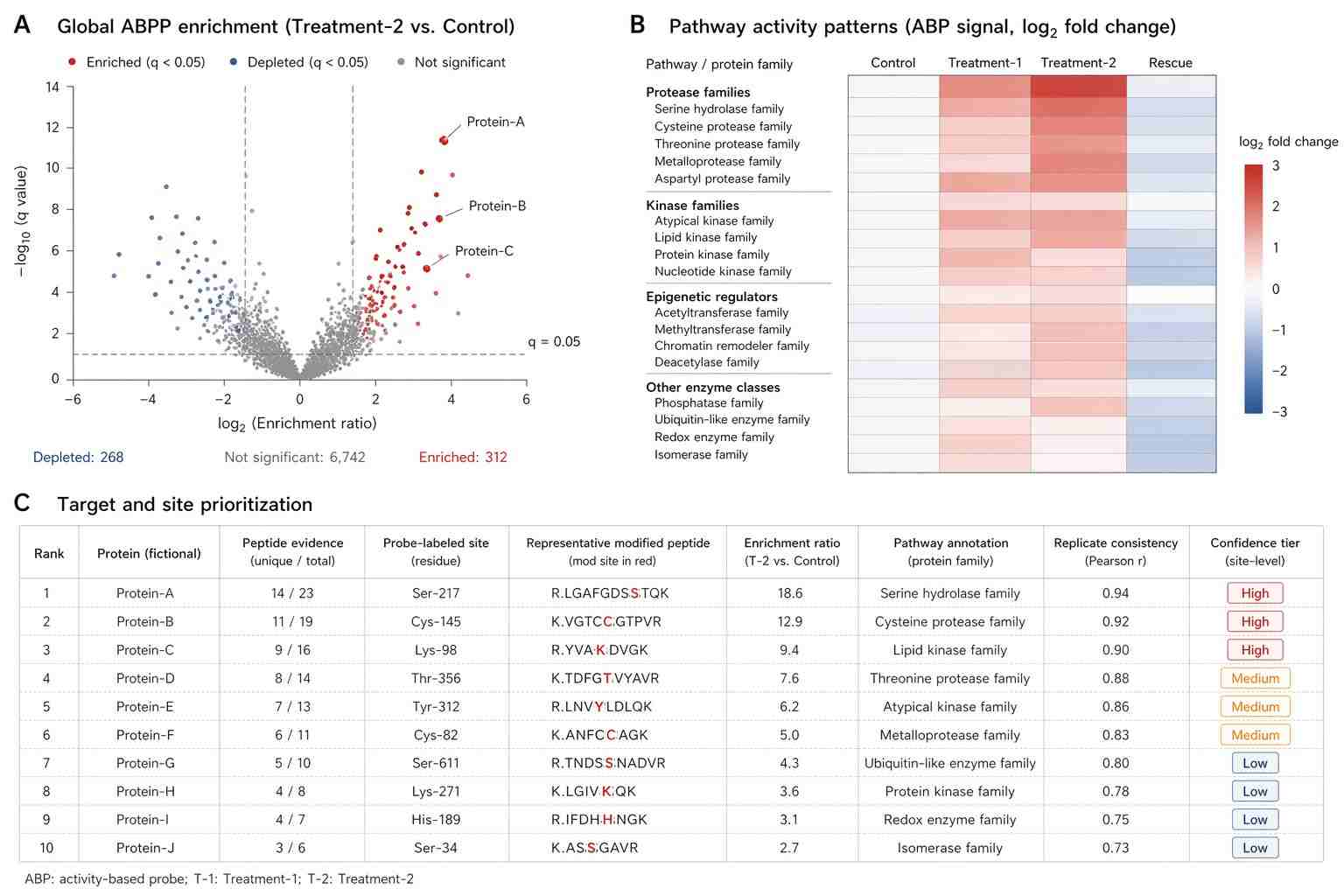
Demo Global ABPP results showing enriched proteins, pathway heatmap, and target prioritization dashboard.

Integrated Global ABPP demo results panel

Global enriched protein volcano plot, protein family or pathway heatmap, and target/site prioritization dashboard.

Demo 1: Global Enriched Protein Volcano Plot

A volcano plot can compare treatment and control groups. Enriched proteins with consistent replicate behavior can be highlighted for further review.

How to read it: Strong candidates should show enrichment above background, consistent replicates, and a relationship to the project question.

Demo 2: Protein Family or Pathway Activity Heatmap

A heatmap can show activity-linked changes across protein families, enzyme groups, or pathways.

How to read it: This view helps reveal whether a treatment shifts a broad functional class rather than only a single protein.

Demo 3: Target and Site Prioritization Dashboard

A dashboard can combine protein name, site evidence where available, peptide support, enrichment ratio, pathway annotation, and confidence tier.

How to read it: This view helps move from a broad ABPP table to a focused candidate list for follow-up validation.

Global ABPP vs Other Proteomics and Target Discovery Methods

Different methods answer different biological questions. We help select the workflow based on whether you need activity-state evidence, abundance response, site-level competition, probe-free engagement, or focused validation.

MethodBest Use CaseEvidence LevelStrengthLimitationWhen to Choose
Global ABPP + LC-MS/MSActivity-state and reactive-site landscape profilingEnriched protein and peptide/site evidenceFunctional proteomics beyond abundanceProbe coverage depends on chemistryChoose for broad activity or ligandability profiling
Standard Quantitative ProteomicsProtein abundance and pathway responseProtein abundance evidenceBroad expression-level profilingDoes not directly measure activity stateChoose for downstream abundance response
Competitive ABPPCompound engagement and selectivityCompetition-based probe signal changesStrong for target/off-target competitionRequires matched probe and compound designChoose when compound occupancy is the main question
Quantitative / Isotope Labeling ABPPSite-level quantitative comparisonPeptide/site-level quantitative evidenceStrong for site-level competition and selectivityMore design-dependentChoose for site-level covalent ligand profiling
Thermal Stability ProfilingProbe-free compound engagementProtein stability shiftNo probe requiredDoes not directly identify reactive residue or active siteChoose when probe design is not feasible
Biochemical / Targeted Validation AssaySingle-target validationTarget-specific functional readoutFocused and interpretableNot discovery-scaleChoose after ABPP prioritizes candidates

How to Choose the Right Workflow

Choose Global ABPP when you need a broad activity-state or reactive proteome landscape.

Choose Standard Proteomics when the main question is protein abundance or downstream pathway response.

Choose Competitive ABPP when the main question is compound-target competition. For this direction, see our Competitive ABPP service.

Choose Quantitative ABPP when site-level covalent ligand selectivity is the priority. For this route, see our Isotope Labeling-Based Quantitative ABPP service.

Choose Thermal Stability Profiling when you need a probe-free target engagement screen. See our Proteome-wide Thermal Stability Profiling service.

In many programs, the strongest evidence comes from combining discovery-scale functional profiling with orthogonal target validation.

Literature-Supported Case Study: DIA-Enabled ABPP for High-Throughput DUB Activity Profiling

This literature-supported case study is based on the English open-access article ABPP-HT*—Deep Meets Fast for Activity-Based Profiling of Deubiquitylating Enzymes Using Advanced DIA Mass Spectrometry Methods. It is not a Creative Proteomics customer case.

Background

Deubiquitylating enzymes, or DUBs, regulate ubiquitination and are important in cellular processes such as protein degradation and signaling. The paper notes that DUB inhibitors are being developed for diseases including Parkinson's disease and cancer. Because DUB inhibitor selectivity can be affected by potency, permeability, reversibility, stability, and off-target reactivity, the authors used ABPP with LC-MS/MS to measure active DUB profiles in a cellular matrix.

The study also addressed a practical problem in ABPP drug discovery workflows. Earlier high-depth ABPP could identify more than 70 DUBs in MCF-7 breast cancer cells but required low-pH C18 HPLC pre-fractionation and multiple 60-minute LC-MS/MS runs. A later high-throughput ABPP-HT workflow reached about 100 samples per day, but its depth dropped to about 15–25 DUBs. The authors therefore aimed to retain high throughput while improving DUBome depth and data completeness.

Methods

The authors used MCF-7 cell lysates and the HA-Ub-PA activity-based probe, which contains an HA tag for immunoprecipitation, ubiquitin for DUB specificity, and a propargylamine warhead that binds active-site cysteine residues. Lysates were diluted to 3.33 mg/mL, with 250 μg of protein per reaction unless otherwise stated. Inhibitors or DMSO control were incubated with lysate for 1 hour at 37°C, followed by HA-Ub-PA probe labeling for 45 minutes at 37°C.

The workflow used automated immunoprecipitation on an Agilent Bravo AssayMAP liquid handling platform, tryptic digestion, Evosep/timsTOF LC-MS/MS, and comparison of DDA and DIA data acquisition strategies. The authors compared Fragpipe and MaxQuant for DDA analysis and DIA-NN and MaxDIA for DIA analysis. They also tested known DUB inhibitors, including FT827, HBX41108, P22077, and the pan-DUB inhibitor PR619, to evaluate whether the workflow could support inhibitor selectivity profiling.

Results

Figure 1 shows that DIA data analyzed with DIA-NN quantified more DUBs than DDA data analyzed with Fragpipe for the same ABPP-HT samples. DIA-NN identified an additional 10 DUBs that were not quantified by Fragpipe. The authors also compared HA-Ub-PA probe samples with a no-probe control. In Fragpipe analysis, all quantified DUBs except USP4 were enriched more than 10-fold. In DIA-NN analysis, all DUBs except USP15, USP34, USP38, USP48, and OTUD7B were enriched more than 10-fold in the presence of HA-Ub-PA.

The same figure also illustrates why background review matters in ABPP data interpretation. DIA-NN quantified 912 total proteins compared with 218 total proteins for Fragpipe, reflecting higher sensitivity but also increased detection of co-immunoprecipitated or non-specific background proteins. The authors therefore emphasized the value of no-probe controls when interpreting enriched proteins.

Figure 2 evaluates reproducibility and missing values. Both DIA/DIA-NN and DDA/Fragpipe showed average DUBome CV values below 10%. Fragpipe and DIA-NN with match-between-runs had no missing values in this dataset. The authors noted that this is important because, in inhibitor profiling, the absence of a signal at high inhibitor concentration could otherwise be confused with a missing value.

Figure 3 tests sensitivity using peptide injection titration after immunoprecipitation from 100 μg of lysate. Without match-between-runs, both DIA-NN and Fragpipe detected a representative panel of 10–15 DUBs with only 50 ng of peptides injected. DIA data analyzed with DIA-NN and match-between-runs was the most sensitive across the titration.

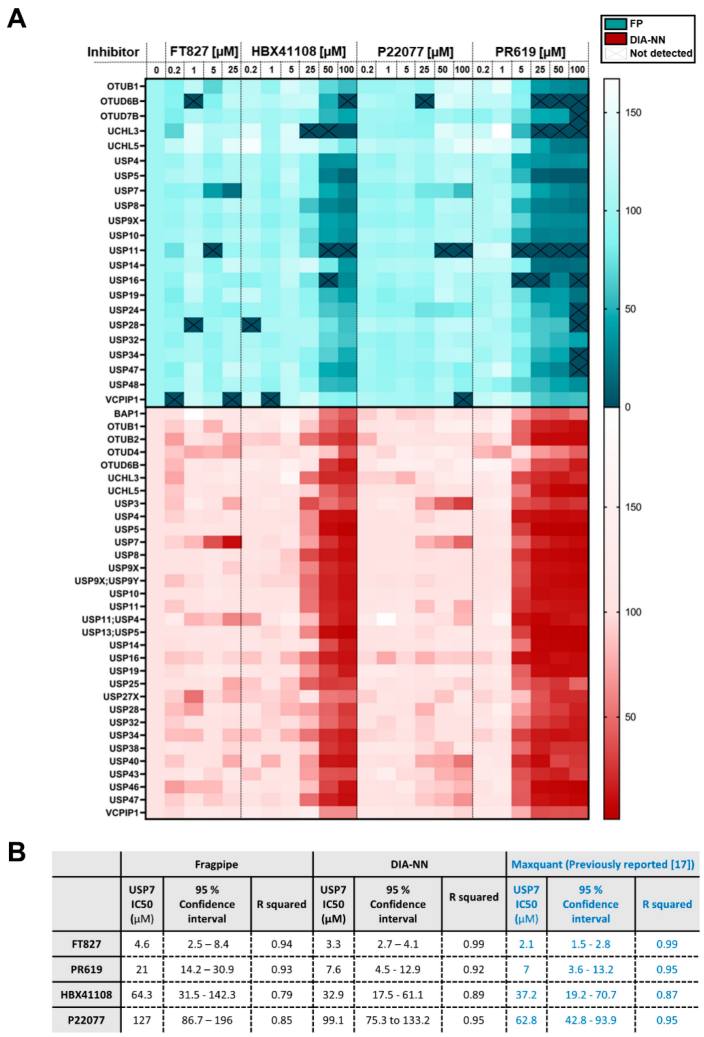
Figure 4 demonstrates inhibitor profiling. After filtering low-intensity DUBs that did not show concentration-dependent behavior, DIA/DIA-NN identified 29 DUBs, compared with 22 DUBs identified by DDA/Fragpipe. Both workflows confirmed known inhibitor profiles across the DUBome. FT827 showed high specificity for USP7, while PR619 showed broad reactivity across the DUB panel. The authors also reported that DIA-NN showed fewer missing values than Fragpipe across the larger inhibitor dataset, especially at high PR619 concentrations.

Conclusion

The authors concluded that optimizing data acquisition and search-engine selection increased the depth of a high-throughput ABPP workflow by about 50% while maintaining fast sample processing. Their ABPP-HT* method combined DIA-MS and DIA-NN analysis to improve sensitivity, reduce missing values, and support more reliable DUB inhibitor selectivity profiling.

For Global ABPP service planning, this English literature case supports several EEAT points. First, ABPP can provide functional enzyme activity evidence that is not captured by abundance proteomics alone. Second, LC-MS/MS acquisition and data-analysis strategy can strongly affect depth, missing values, and interpretation. Third, no-probe controls, replicate consistency, enrichment review, and inhibitor concentration-response behavior are essential for distinguishing real activity-linked signals from background.

ABPP-HT DUB inhibitor profiling heatmap and IC50 analysis by DIA LC-MS/MS.

Figure 4 from Jones et al., 2022, shows ABPP-HT* DUB inhibitor profiling, including DUB activity heatmaps and IC50 analysis for USP7 inhibitors and a pan-DUB inhibitor.

FAQ

FAQ: Planning a Global ABPP Project

Q: What is Global ABPP and how does it work with LC-MS/MS?

Global ABPP uses activity-based probes to label functional protein subsets in complex samples. Labeled proteins or peptides are enriched, digested, and analyzed by LC-MS/MS to generate activity-linked protein or site-level evidence.

Q: How is Global ABPP different from standard quantitative proteomics?

Standard quantitative proteomics mainly measures protein abundance. Global ABPP focuses on probe-labeled functional proteins or reactive sites, making it more useful for activity-state, ligandability, and target landscape questions.

Q: What kinds of activity-based probes can be used?

Probe choice depends on the enzyme class, residue class, and project goal. Examples may include probes for specific enzyme families or reactive residue classes such as cysteine or lysine.

Q: Can Global ABPP detect ligandable or reactive residues?

Yes, when the probe chemistry and LC-MS/MS workflow support site-level evidence. However, site coverage depends on probe design, labeling efficiency, peptide detectability, and data quality.

Q: Can Global ABPP compare drug-treated and control samples?

Yes. Global ABPP can compare treatment and control groups to identify activity-linked changes, enriched proteins, or altered probe-labeling patterns.

Q: What sample types can be used for Global ABPP?

Common sample types include cell lysates, live-cell systems, tissue lysates, purified proteins, and selected biofluids. The best format depends on the probe, treatment design, and project question.

Q: What controls are needed for a Global ABPP project?

Common controls include vehicle control, no-probe control, probe-only group, treatment/control groups, biological replicates, and competition or inhibitor controls when appropriate.

Q: What is the difference between protein-level and site-level ABPP evidence?

Protein-level evidence identifies enriched or changed proteins. Site-level evidence identifies specific probe-labeled peptides or residues, which can provide more detailed information about reactive or ligandable regions.

Q: How should I interpret proteins that are not detected?

A protein that is not detected should not automatically be interpreted as inactive. Non-detection can result from probe chemistry, protein abundance, site accessibility, sample preparation, MS depth, or filtering thresholds.

Q: How do I choose between Global ABPP, Competitive ABPP, Quantitative ABPP, and Thermal Stability Profiling?

Choose Global ABPP for broad activity-state profiling. Choose Competitive ABPP for compound competition. Choose Quantitative ABPP for site-level selectivity. Choose Thermal Stability Profiling when a probe-free engagement method is needed.

Start a Global ABPP Feasibility Review

If you want to profile protein activity states, reactive residues, ligandable sites, or treatment-associated target landscapes, we can help you determine whether Global ABPP is the right next step.

Share your sample type, probe class, treatment/control design, expected readout, and available sample amount. Our team will review feasibility, recommend a workflow, and define the data package needed for interpretable LC-MS/MS chemoproteomics results.

Disclaimer

This service is for Research Use Only and is not intended for clinical diagnosis, treatment selection, or medical decision-making.

Online Inquiry

Please submit a detailed description of your project. We will provide you with a customized project plan to meet your research requests. You can also send emails directly to for inquiries.

* Email
Phone
* Service & Products of Interest
Services Required and Project Description