Drug Permeability (Caco-2/PAMPA) MS Service

Cell-based and artificial membrane permeability assessment with LC-MS/MS bioanalysis for preclinical ADME profiling.

Our integrated platform combines Caco-2 cell monolayers and Parallel Artificial Membrane Permeability Assays (PAMPA) with sensitive LC-MS/MS detection to deliver quantitative apparent permeability coefficients (Papp, Pe) that directly inform compound ranking, BCS classification, and preclinical advancement decisions.

Key Advantages:

  • Integrated Caco-2 + PAMPA under one roof — mechanistic and high-throughput models
  • Optimised LC-MS/MS MRM detection for low-permeability and challenging compounds
  • Dual QC protocol: TEER measurement + Lucifer Yellow permeability for every assay
  • Transporter identification: P-gp, BCRP, and MRP2 with inhibitor panel
  • Multiple pH conditions (5.5–7.4) for GI segment simulation
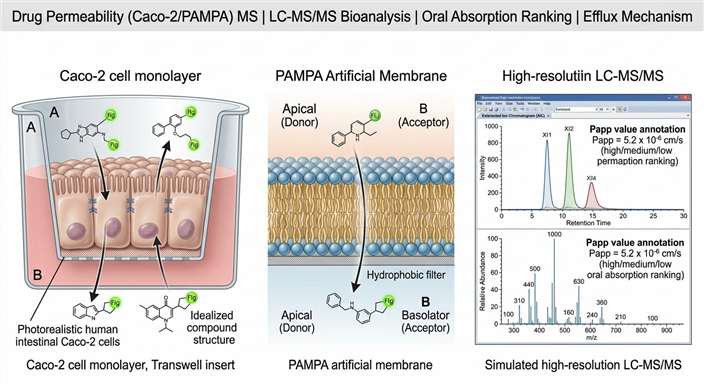
Drug permeability Caco-2 PAMPA MS assay principle diagram
When to Assess Workflow Capabilities Applications Sample Why Us FAQ

When Do Drug Discovery Teams Need Permeability Assessment?

Oral bioavailability decides whether a promising compound becomes a successful drug. Among the many factors governing oral absorption, intestinal permeability — the ability of a molecule to cross the intestinal epithelium — is arguably the most decisive. Without adequate permeability, even a highly potent compound will not reach its systemic target at therapeutic concentrations.

We regularly hear this question from discovery teams during lead optimization: Does our compound have the permeability characteristics needed for oral dosing? Answering it requires reliable in vitro data, and two complementary models dominate the field — Caco-2 cell monolayers and Parallel Artificial Membrane Permeability Assays (PAMPA).

Our Caco-2 permeability assays use human colon carcinoma cells cultured on Transwell inserts to form polarized monolayers that morphologically and functionally resemble human intestinal epithelium. This model captures both passive transcellular diffusion and active transport processes, including efflux by P-gp, BCRP, and MRP2 transporters. It remains the most widely accepted in vitro surrogate for predicting human oral absorption.

PAMPA uses an artificial lipid membrane to measure passive transcellular permeability exclusively. It offers higher throughput, lower cost, and greater reproducibility than cell-based assays — ideal for early-stage compound screening and for deconvoluting whether poor absorption stems from passive diffusion limitations or active transport mechanisms.

Both models, when paired with sensitive LC-MS/MS bioanalysis, deliver quantitative apparent permeability coefficients (Papp for Caco-2; Pe for PAMPA) that directly inform compound ranking, BCS classification, and preclinical advancement decisions. Our integrated Drug Permeability (Caco-2/PAMPA) MS Service provides both models under one roof, supported by optimized LC-MS/MS method development and comprehensive quality controls.

For a broader overview of our ADME/DMPK service portfolio, visit our ADME/DMPK/PK-PD Research Platforms.

Our Caco-2/PAMPA-MS Workflow

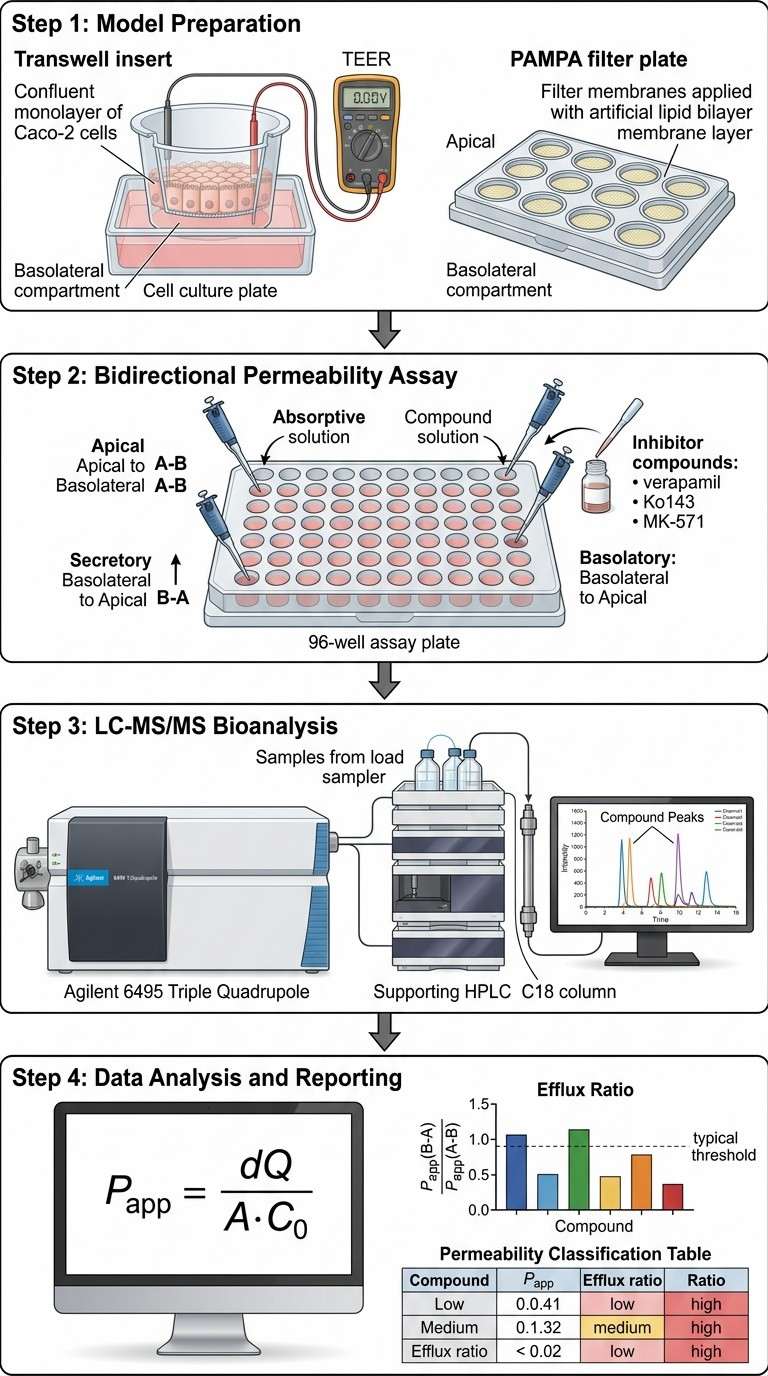
Our permeability assessment workflow delivers reliable, reproducible data across four integrated stages:

1

Model Preparation

Caco-2 Monolayer Culture: We seed Caco-2 cells (ATCC HTB-37) on 24-well or 96-well Transwell polycarbonate membrane inserts at 60,000–100,000 cells/cm². Monolayers are cultured for 18–22 days with regular medium changes (DMEM with 10% FBS, 1% non-essential amino acids, 1% L-glutamine). We monitor monolayer integrity by transepithelial electrical resistance (TEER) throughout the culture period. Only monolayers with TEER ≥ 300 Ω·cm² proceed to the assay.

PAMPA Membrane Assembly: For PAMPA assays, we prepare a lipid-infused artificial membrane in 96-well filter plates. The donor compartment receives the test compound solution; the acceptor compartment contains buffer separated by the lipid membrane. Standard lipid composition is 10% (w/v) lecithin in dodecane, applied to the filter pores.

2

Bidirectional Permeability Assay

Caco-2 Assay: Test compounds are prepared at 10 µM in transport buffer (HBSS with 10 mM HEPES, pH 7.4). For bidirectional assessment, we add compounds to either the apical (A) or basolateral (B) compartment. Lucifer Yellow (100 µM) is co-incubated as a paracellular permeability marker. After 2-hour incubation at 37°C with orbital shaking, we collect samples from both receiver and donor compartments. For efflux mechanism identification, parallel incubations use transporter-specific inhibitors: verapamil (100 µM) for P-gp, Ko143 (1 µM) for BCRP, and MK-571 (50 µM) for MRP2.

PAMPA Assay: Test compounds are added to the donor compartment at 10–200 µM in buffer at the specified pH (standard pH 7.4; optional pH 5.5, 6.0, or 6.8 for GI segment simulation). The plate incubates at room temperature for 5 hours. After incubation, we collect samples from both donor and acceptor compartments. Lucifer Yellow verifies membrane integrity.

3

LC-MS/MS Bioanalysis

We analyze samples on our optimized LC-MS/MS platform (Agilent 6495 Triple Quadrupole or equivalent). Key parameters include:

  • Chromatography: C18 reversed-phase column (2.1 × 50 mm, 1.7 µm), gradient elution with 0.1% formic acid in water/acetonitrile
  • Detection: MRM (Multiple Reaction Monitoring) with compound-specific precursor-to-product ion transitions
  • Quantification range: 0.1–10,000 nM (compound-dependent)
  • Sample preparation: Protein precipitation or dilute-and-shoot, optimized per compound
  • Internal standard: Deuterated analog or structural analogue

For detailed information on our LC-MS/MS bioanalysis capabilities, see our LC-MS/MS bioanalysis services.

4

Data Analysis and Reporting

Papp Calculation (Caco-2): Papp = (dQ/dt) / (C₀ × A) where dQ/dt is the rate of compound appearance in the receiver compartment, C₀ is the initial donor concentration, and A is the membrane surface area.

Efflux Ratio (ER): ER = Papp(B→A) / Papp(A→B). An ER > 2.0 indicates significant efflux. Inhibitor studies identify the specific transporter(s) involved.

Effective Permeability (Pe, PAMPA): Pe = C × ln(1 − [drug]acceptor / [drug]equilibrium)

Permeability Classification:

CategoryPapp (×10⁻⁶ cm/s)Pe (×10⁻⁶ cm/s)
Low≤ 0.5< 1.5
Moderate0.5 – 2.5
High≥ 2.5≥ 1.5

Recovery Calculation: Mass balance is calculated as (drug recovered from both compartments / initial drug amount) × 100%. Recovery < 70% triggers investigation for non-specific binding or solubility issues, with optional BSA-containing buffer re-assay.

Four-stage Caco-2 PAMPA MS workflow diagram

Service Process:

Project Consultation — Our scientists discuss your compound series, permeability model preference, and experimental requirements to design the optimal assay strategy.

Assay Design and Quotation — A detailed experimental plan and quotation are provided based on the agreed scope of work.

Model Preparation and Assay Execution — Caco-2 monolayers or PAMPA membranes are prepared, and the permeability assay is executed with full QC monitoring.

Data Review and Interpretation — Results are reviewed with your team, with options for iterative follow-up experiments.

Final Report and Support — A complete data package is delivered, with continued support for data interpretation and publication.

Key Analytical Capabilities

ParameterCapability
Caco-2 cell sourceATCC HTB-37, passage 55–65
Caco-2 culture duration18–22 days
Assay format24-well or 96-well Transwell
Detection platformAgilent 6495 Triple Quadrupole LC-MS/MS
Quantification range0.1–10,000 nM (compound-dependent)
MRM transitionsOptimized per compound
ThroughputUp to 96 compounds per batch (single concentration)
Bidirectional assessmentA→B and B→A for all compounds
QC metricsTEER (≥300 Ω·cm²), Lucifer Yellow Papp (≤0.5 × 10⁻⁶ cm/s)
PAMPA pH range5.5–7.4 (standard 7.4)
PAMPA incubation5 hours at room temperature
Recovery troubleshootingBSA-containing buffer option for sticky compounds
Transporter identificationP-gp (verapamil), BCRP (Ko143), MRP2 (MK-571)
Reference compoundsAtenolol (low), Metoprolol (high), Digoxin (P-gp substrate)
Regulatory alignmentICH M10 guidelines

Applications in Drug Discovery

1

Oral Absorption Ranking and Lead Optimization

Permeability data helps rank-order compounds within a chemical series for oral absorption potential. Compounds with Papp(A→B) ≥ 2.5 × 10⁻⁶ cm/s are classified as highly permeable and likely to achieve good oral absorption. This ranking directly informs which compounds advance to in vivo PK studies. When combined with metabolic stability assessment, permeability data provides a comprehensive early ADME profile.

2

Efflux Mechanism Elucidation

A high efflux ratio (ER > 2.0) signals that a compound is actively transported out of cells — potentially limiting oral absorption and CNS penetration. Using our inhibitor panel (verapamil, Ko143, MK-571), we identify the specific efflux transporter responsible. This information guides medicinal chemistry teams designing compounds to evade efflux and helps assess drug-drug interaction (DDI) risk.

3

BCS Classification Support

The Biopharmaceutics Classification System (BCS) categorizes drugs by solubility and permeability. Permeability classification from Caco-2 or PAMPA data, combined with solubility data, determines BCS class. This classification has regulatory implications for bioequivalence study waivers and formulation strategy. Our data supports BCS classification submissions under ICH M10 framework. For complementary data, we also offer plasma protein binding studies.

4

BBB Permeability Prediction (PAMPA-BBB)

Using a specialized lipid composition that mimics the blood-brain barrier, our PAMPA-BBB variant predicts passive diffusion potential for CNS-targeted compounds. This is particularly valuable for CNS drug discovery programs where brain penetration is a key success criterion.

5

Formulation Development Support

Permeability data at multiple pH conditions (pH 5.5–7.4) informs formulation strategy by predicting how absorption may vary along the gastrointestinal tract. For compounds with pH-dependent permeability, enteric coating or pH-modifying formulations can be designed to optimize absorption.

Sample Requirements and Deliverables

Sample Requirements

ParameterRequirement
Compound amount≥ 2 mg per compound (single concentration, bidirectional)
Purity≥ 95% preferred; ≥ 90% acceptable
Solubility≥ 10 µM in transport buffer (DMSO stock ≤ 0.5% final)
Molecular weightNo upper limit (LC-MS/MS compatible)
Number of compoundsSingle to 96 per batch
Control compoundsProvided by us (atenolol, metoprolol, digoxin)
Special requirementsBSA-containing buffer for sticky compounds; pH-specific buffer for GI simulation

Deliverables

Our final report includes:

  • Papp values: A→B and B→A apparent permeability coefficients (×10⁻⁶ cm/s)
  • Efflux ratio: ER = Papp(B→A) / Papp(A→B)
  • PAMPA effective permeability (Pe): Classification as high or low
  • Transporter identification: P-gp, BCRP, or MRP2 involvement (if inhibitor studies performed)
  • Recovery percentage: Mass balance for each compound
  • QC metrics: TEER values, Lucifer Yellow Papp, reference compound performance
  • Permeability classification: Low / Moderate / High per established thresholds
  • Data interpretation notes: Guidance on data quality flags and recommended follow-up

Why Choose Creative Proteomics for Permeability Assessment?

Integrated Caco-2 + PAMPA Under One Roof

Most providers offer either Caco-2 or PAMPA separately, requiring you to coordinate between different vendors. Our platform integrates both models, allowing you to choose the right assay for each stage of discovery — or combine both for comprehensive mechanistic understanding — through a single point of contact.

Optimised LC-MS/MS Sensitivity for Challenging Compounds

Low-permeability compounds, highly bound molecules, and compounds with poor MS ionization efficiency require detection sensitivity beyond standard UV-based quantification. Our optimized LC-MS/MS MRM methods achieve quantification limits down to 0.1 nM, ensuring reliable Papp values even for the most challenging compounds.

Dual QC Protocol for Every Assay

We apply TEER measurement and Lucifer Yellow co-incubation as dual QC metrics for every Caco-2 assay, not just periodic validation. This ensures monolayer integrity is confirmed at the individual well level, providing confidence that permeability data reflects true transcellular transport rather than paracellular leakage.

Comprehensive Transporter Identification Panel

Unlike services limited to P-gp/BCRP identification, our inhibitor panel includes P-gp (verapamil), BCRP (Ko143), and MRP2 (MK-571). When ER > 2.0 is observed, we identify the specific transporter responsible, enabling targeted medicinal chemistry optimization.

pH Flexibility for GI Segment Simulation

Standard permeability assays at pH 7.4 alone may miss pH-dependent absorption effects. We offer multiple pH conditions (5.5, 6.0, 6.8, 7.4) to simulate different GI segments, providing data that directly informs formulation strategy for ionizable compounds.

Regulatory Alignment Under ICH M10

Our assay protocols and data reporting follow ICH M10 guidelines for bioanalytical method validation, ensuring that permeability data generated through our service is suitable for regulatory submissions and cross-study comparisons.

For discovery-stage teams that need reliable permeability data without the overhead of in-house Caco-2 culture, our integrated platform delivers a single-provider solution with optimized sensitivity, dual QC, and comprehensive reporting. We also offer complementary ADME services including pharmaco-metabolomics to complete your preclinical ADME profiling.

Frequently Asked Questions

When should I choose Caco-2 over PAMPA for permeability assessment?

Caco-2 is the right choice when you need mechanistic data — distinguishing passive diffusion from active transport or efflux, identifying specific efflux transporters (P-gp, BCRP, MRP2), or assessing paracellular permeability. PAMPA is better suited for rapid, cost-effective passive diffusion screening across a large compound set, or for deconvoluting whether poor absorption is due to passive permeability limitations versus active efflux. For comprehensive assessment, we recommend both models: PAMPA for initial screening, followed by Caco-2 for mechanistic characterization of selected compounds.

How do you handle compounds with poor recovery or solubility issues?

Poor recovery in permeability assays usually results from non-specific binding to the assay plate, low aqueous solubility, or cellular retention. For compounds with recovery < 70%, we offer a re-assay using transport buffer supplemented with 0.5–1% BSA (bovine serum albumin), which reduces non-specific binding and improves solubility. We also perform a pre-assay solubility check at the test concentration. Recovery data is always reported alongside permeability values so you can assess data reliability.

What QC metrics do you use to validate Caco-2 monolayer integrity?

We apply a dual QC protocol for every Caco-2 assay. First, TEER is measured before and after the assay — monolayers must maintain TEER ≥ 300 Ω·cm² throughout. Second, Lucifer Yellow is co-incubated as a paracellular flux marker; its Papp must be ≤ 0.5 × 10⁻⁶ cm/s, confirming monolayer integrity. Reference compounds (atenolol, metoprolol, digoxin) are included in every batch to validate assay performance.

Can you perform permeability assays at non-standard pH conditions?

Yes. While our standard assay runs at pH 7.4 (simulating the fasted-state intestinal environment), we can accommodate pH 5.5, 6.0, 6.5, 6.8, or custom values to simulate different gastrointestinal segments. This is particularly useful for compounds with pH-dependent ionization, where permeability may vary significantly along the GI tract. Please specify your pH requirements at project initiation.

How do you report efflux data and what is the threshold for significant efflux?

We report efflux ratio (ER) as Papp(B→A) / Papp(A→B). An ER > 2.0 is considered indicative of significant efflux. For compounds exceeding this threshold, we perform follow-up inhibitor studies to identify the specific transporter(s) involved. The efflux ratio in the presence of a specific inhibitor (e.g., verapamil for P-gp) should decrease to ≤ 2.0 if that transporter is responsible. We report both the baseline ER and the inhibitor-modulated ER for complete mechanistic interpretation.

References

  1. Hubatsch I, Ragnarsson EGE, Artursson P. Determination of drug permeability and prediction of drug absorption in Caco-2 monolayers. Nature Protocols. 2007;2(9):2111–2119. doi:10.1038/nprot.2007.303
  2. Kansy M, Senner F, Gubernator K. Physicochemical high throughput screening: parallel artificial membrane permeation assay in the description of passive absorption processes. Journal of Medicinal Chemistry. 1998;41(7):1007–1010. doi:10.1021/jm970530e
  3. Araújo LS, Crevelin EJ, Moraes LAB, Furtado NAJC. Comprehensive UPLC-MS/MS method for quantifying four key intestinal permeability markers in Caco-2 models. Molecules. 2025;30(17):3477. doi:10.3390/molecules30173477
  4. Storchmannová K, Balouch M, Juračka J, Štěpánek F, Berka K. Meta-analysis of permeability literature data shows possibilities and limitations of popular methods. Molecular Pharmaceutics. 2025;22(3):1293–1304. doi:10.1021/acs.molpharmaceut.4c00975

Ready to advance your drug discovery program with reliable, LC-MS/MS-based permeability data?

Contact our team to discuss your project requirements and receive a detailed quotation.

For Research Use Only. Not for use in diagnostic or clinical procedures.

Online Inquiry

Please submit a detailed description of your project. We will provide you with a customized project plan to meet your research requests. You can also send emails directly to for inquiries.

* Email
Phone
* Service & Products of Interest
Services Required and Project Description