Small-Molecule Target Identification Service

Six integrated chemical proteomics service lines for small-molecule target deconvolution — from affinity pull-down MS and PAL-MS through ABPP, TPP, LiP-MS, and reactive residue profiling.

Your team has a bioactive compound — a hit from a phenotypic screen, a natural product with promising activity, or a tool compound with an uncharacterized mechanism. The critical question is: which protein does it bind? Without identifying the target, advancing the compound through medicinal chemistry and preclinical development is impossible.

The MassTarget platform addresses this challenge through six complementary chemical proteomics service lines designed for small-molecule target identification. Whether your compound is covalent or reversible, requires modification or cannot be derivatized, one or more of these approaches can identify its protein target with high confidence.

Key Advantages:

  • Six complementary chemical proteomics approaches for diverse compound types
  • TPP and LiP-MS require no compound modification
  • Dedicated PAL-MS probe design and synthesis support
  • Competitive ABPP with multiple enzyme-family probe panels
  • Reactive residue profiling for covalent inhibitor development
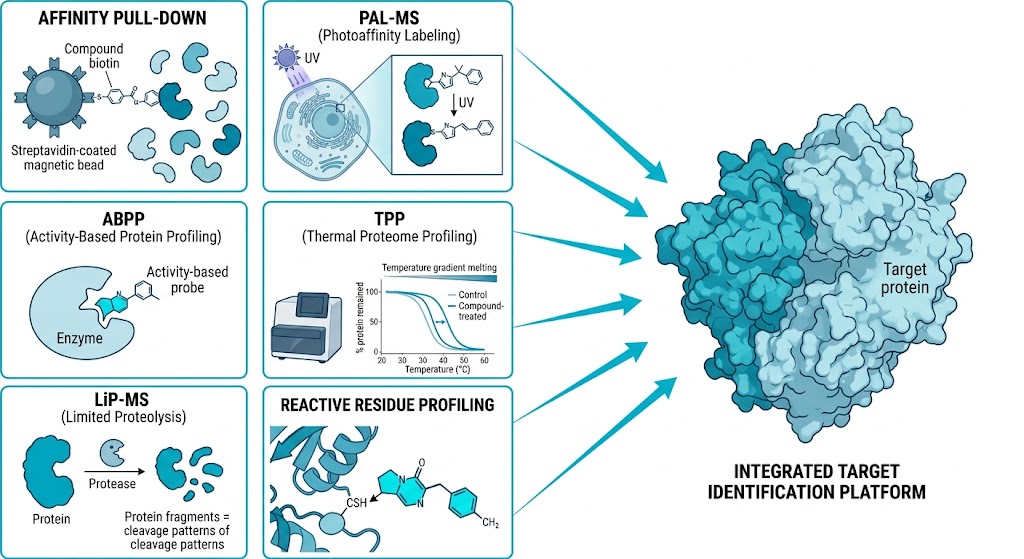
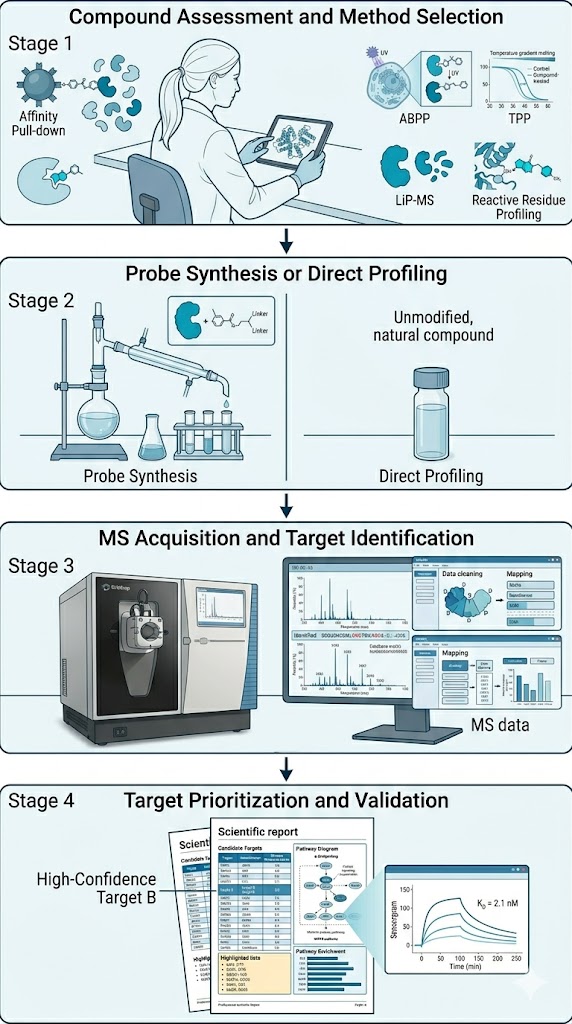
Small-molecule target identification platform showing six chemical proteomics service lines converging on target deconvolution: affinity pull-down MS, PAL-MS, ABPP, TPP, LiP-MS, and reactive residue profiling.
Overview Service Lines Workflow Applications Demo Data Sample Bioinformatics Why Choose Case Study FAQ

The Target Identification Bottleneck in Small-Molecule Drug Discovery

Target deconvolution is one of the most challenging steps in modern drug discovery. Unlike biochemical screens where the target is known from the outset, phenotypic and natural product-based discovery programs generate hits with unknown mechanisms. The compound might engage a single protein, a multi-protein complex, or multiple unrelated targets. It might bind covalently or reversibly, at an orthosteric or allosteric site. Each scenario requires a different experimental approach — and choosing the wrong approach can lead to missed targets or false assignments.

The MassTarget platform addresses this challenge through an integrated suite of six complementary chemical proteomics service lines — Affinity Pull-Down MS, Photoaffinity Labelling (PAL-MS), Activity-Based Protein Profiling (ABPP), Thermal Proteome Profiling (TPP), Limited Proteolysis MS (LiP-MS), and Reactive Residue Profiling — that together cover the full spectrum of target deconvolution scenarios. Whether your compound is covalent or reversible, soluble across membrane compartments, or active in live cells versus lysates, one or more of these approaches can identify its protein target with statistical confidence.

For complementary label-free target engagement profiling, see our thermal proteome profiling (TPP) service.

Six Service Lines for Small-Molecule Target Deconvolution

Identifying the target of a small molecule requires matching the compound's properties to the right chemical proteomics strategy. The MassTarget platform offers six dedicated service lines.

Affinity Pull-Down MS

The most direct approach. The small molecule is immobilized on agarose or magnetic beads through a suitable linker, then incubated with cell lysate. Binding proteins are retained, eluted, and identified by LC-MS/MS. Competition with excess free compound distinguishes specific from nonspecific binding. Best for compounds with moderate-to-high affinity and a solvent-accessible group for linker attachment.

Photoaffinity Labelling (PAL-MS)

For weak or transient interactions that cannot survive pull-down conditions. A photocrosslinkable group (diazirine or benzophenone) and bioorthogonal handle are incorporated into the compound. UV irradiation in live cells or lysates covalently captures nearby proteins. Click chemistry enables enrichment and MS identification. Our PAL-MS service covers probe design consultation and optimization.

Activity-Based Protein Profiling (ABPP)

Uses mechanism-based probes that selectively react with enzyme active sites. Competitive ABPP reveals which enzymes your compound engages across complex proteomes. Ideal for covalent inhibitors, natural products with electrophilic warheads, and compounds targeting enzyme families — kinases, proteases, deubiquitinases, and hydrolases. Covers global, family-specific, competitive, and HT-ABPP formats.

Thermal Proteome Profiling (TPP)

Requires no compound modification. The compound is added to live cells or lysates and thermal stability of every detectable protein is measured across a temperature gradient. Target proteins show shifted melting curves upon compound binding. The method of choice when the compound cannot be derivatized, or when unbiased proteome-wide target discovery is needed.

Service Line 5 — Limited Proteolysis MS (LiP-MS). Detects compound-induced conformational changes by differential proteolysis patterns. When a small molecule binds its target, the target's susceptibility to limited proteolysis changes. Useful for detecting allosteric binding events that TPP may miss. Our activity-based protein profiling (ABPP) service provides additional enzyme-target identification capabilities with multiple family-specific probe panels.

Service Line 6 — Reactive Residue Profiling. For cysteine-reactive, lysine-reactive, or other electrophilic compounds. Identifies the exact amino acid residues modified by the compound across the proteome. Essential for covalent inhibitor development where knowing the exact modification site guides medicinal chemistry. For orthogonal validation, our affinity selection MS (AS-MS) and cross-linking mass spectrometry (XL-MS) services provide complementary binding and structural evidence.
Our Workflow — From Compound to Confirmed Target

A four-stage process designed to match the right chemical proteomics strategy to your compound and deliver a verified target list.

1

Compound Assessment and Method Selection

We begin with a structured evaluation of your compound's properties: solubility, stability, functional groups for derivatization, estimated potency, and known mechanism. A covalent compound with an electrophilic warhead routes to ABPP and residue profiling. A reversible compound with a linker attachment point starts with affinity pull-down. A compound that cannot be modified proceeds to TPP.

2

Probe Synthesis or Direct Profiling

For PAL-MS and affinity pull-down, we design and coordinate synthesis of the tagged probe. For ABPP, we select the appropriate activity-based probe panel. For TPP and LiP-MS, the compound is used directly. All approaches include competition, vehicle-only, and probe-only controls.

3

MS Acquisition and Target Identification

Enriched proteins are digested and analyzed by high-resolution LC-MS/MS. Label-free quantification or TMT multiplexing enables quantitative comparison between compound-treated and control conditions. Proteins significantly enriched or stabilized are identified as candidate targets.

4

Target Prioritization and Validation

Candidate targets are filtered by statistical criteria and prioritized by functional relevance. Orthogonal validation by BLI, SPR, or cellular target engagement assays confirms the compound-target interaction. The final report includes a ranked target list, supporting MS data, and recommended follow-up strategies.

Four-stage workflow for small-molecule target identification: compound assessment and method selection, probe synthesis or direct profiling, MS acquisition, and target prioritization with validation.

Key Applications

Small-molecule target identification is directly applicable across multiple drug discovery stages and compound modalities.

Phenotypic Hit Deconvolution

When a phenotypic screen yields active compounds with unknown targets, chemical proteomics provides the most direct route to target identification. Affinity pull-down MS or PAL-MS identifies engaged proteins, enabling mechanism-of-action studies and structure-guided medicinal chemistry optimization.

Output: Ranked target list with enrichment ratios and competition data; pathway context for identified targets.

Natural Product Target Discovery

Natural products often have complex, polypharmacological mechanisms. ABPP and affinity-based approaches are effective for identifying the multiple targets through which natural products exert their biological effects. Our PAL-MS service is well-suited for natural product probes with available derivatization sites.

Output: Multi-target engagement profile; polypharmacology network map.

Covalent Inhibitor Selectivity Profiling

For targeted covalent inhibitors, knowing which cysteine residues are modified across the proteome is essential for selectivity optimization. Reactive residue profiling with isotopically labeled probes provides quantitative, proteome-wide maps of residue-specific compound engagement.

Output: Proteome-wide cysteine reactivity map; off-target modification sites with quantification.

Fragment-Based Lead Discovery Follow-Up

Fragments identified by AS-MS or NMR screening require target identification to progress. TPP or LiP-MS identifies protein targets of fragment hits without compound modification, accelerating the hit-to-lead transition for fragment-derived programs.

Output: Target protein identification; binding site evidence from TPP melt curves or LiP fingerprints.

MoA Deconvolution for Preclinical Candidates

For candidates advancing toward development, a complete understanding of the mechanism of action is essential. Multi-method chemical proteomics — combining TPP, ABPP, and affinity pull-down — provides comprehensive target engagement and off-target profiles that directly inform safety assessment.

Output: Comprehensive target engagement and off-target profile; pathway-level MoA model.

Molecular Glue and PROTAC Target Profiling

Proximity-inducing modalities create new protein-protein interfaces that are challenging to characterize. Proximity-based approaches such as BioTAC and PAL-MS can capture compound-induced complexes, identifying both the primary target and the neo-interacting protein.

Output: Target and neo-interacting protein identification; induced complex composition.

Representative Results

Affinity Pull-Down Target Identification

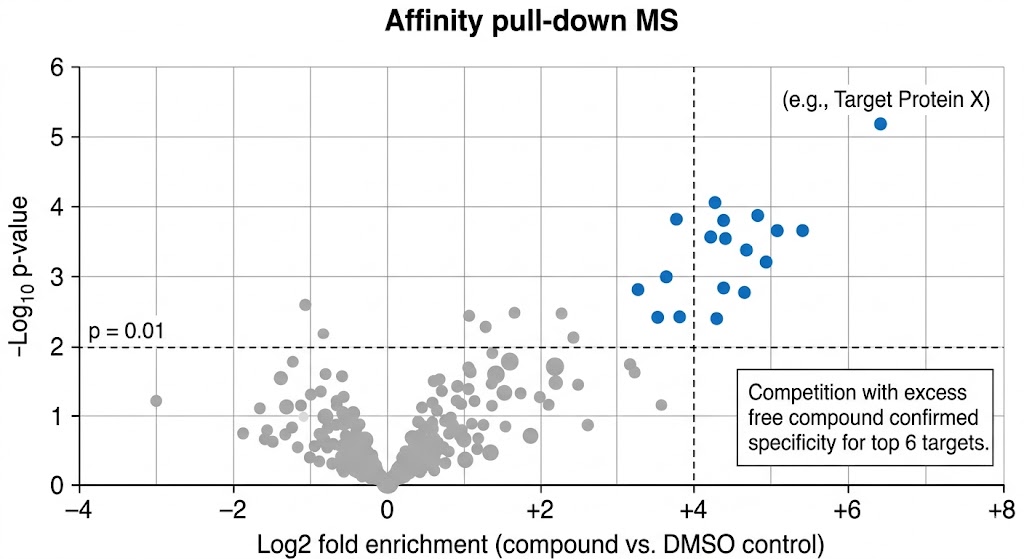
A bioactive natural product with unknown mechanism was immobilized on agarose beads. After incubation with HEK293T cell lysate and competitive elution, 14 proteins were identified with significant enrichment (LFQ ratio > 4, p < 0.01). The top-ranked target was confirmed by SPR (Kd = 340 nM) and cellular target engagement assays.

Competitive ABPP for Covalent Inhibitor Selectivity

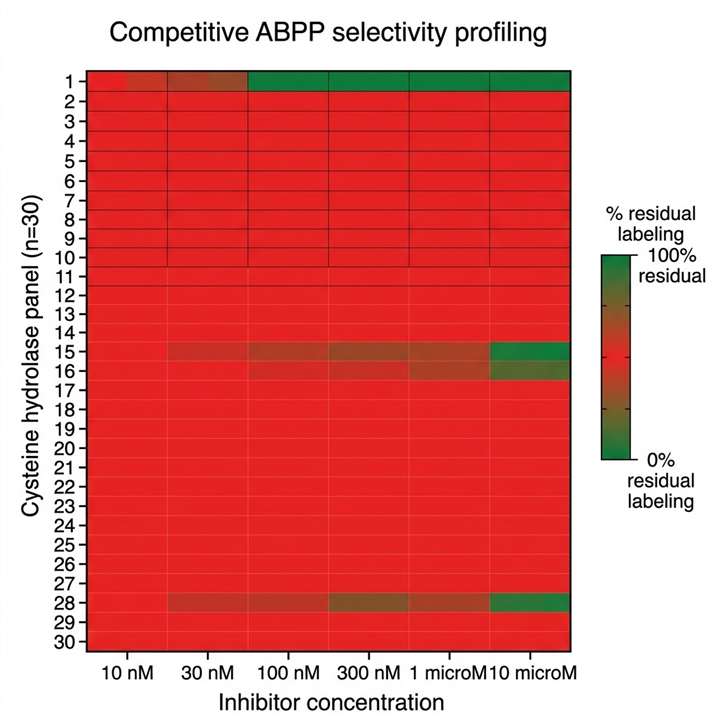
A targeted covalent inhibitor was profiled against a panel of cysteine-reactive activity-based probes. The compound showed >100-fold selectivity for its intended target over 28 of 30 detectable cysteine hydrolases, with two off-targets identified at 10-fold lower selectivity. Residue-level mapping confirmed modification at the intended active-site cysteine.

TPP Target Identification Without Compound Modification

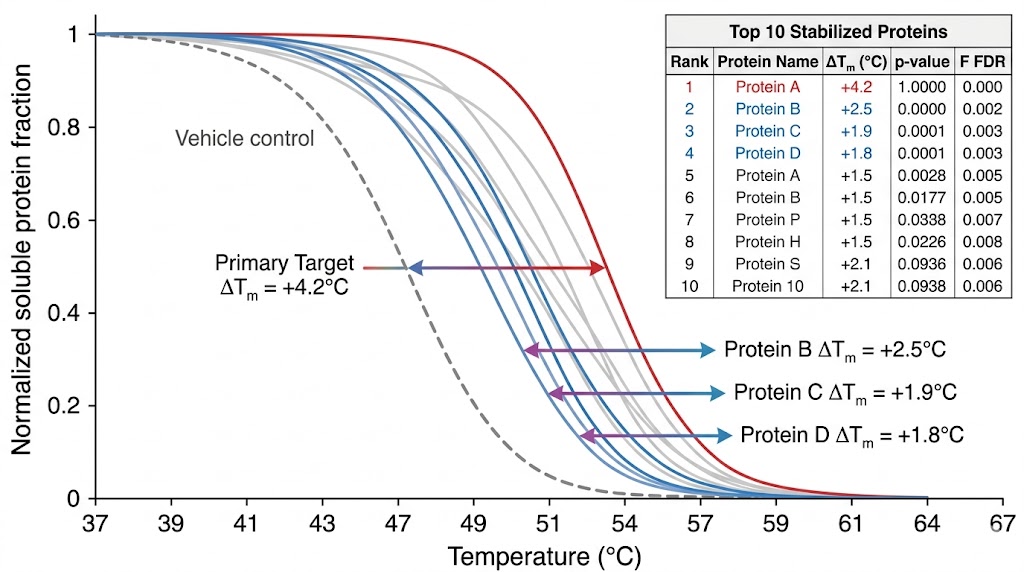
A compound that could not be derivatized was profiled by TPP in K562 cells. The primary target was identified by a melting temperature shift of 4.2 °C (p < 0.001), and three downstream pathway proteins showed shifted melting curves, providing both target ID and pathway context in a single experiment.

Demo Results — Chemical Proteomics Data

Volcano plot showing protein enrichment by affinity pull-down MS with compound vs control, highlighting 14 significantly enriched proteins above the significance threshold, with the top target labeled.

Affinity pull-down MS: target enrichment volcano plot

Volcano plot from affinity pull-down MS of an immobilized natural product. Log2 fold enrichment (compound vs DMSO control) on x-axis; -Log10 p-value on y-axis. Fourteen proteins above significance threshold (p < 0.01, fold change > 4), highlighted in blue. Top-ranked target confirmed by SPR with Kd = 340 nM. Competitive elution with excess free compound confirmed specificity for the top six hits.

Competitive ABPP selectivity heatmap showing a covalent inhibitor tested against 30 cysteine hydrolase activity-based probes, with >100-fold selectivity shown for the intended target.

Competitive ABPP: covalent inhibitor selectivity heatmap

Selectivity heatmap from competitive ABPP profiling of a targeted covalent inhibitor. Each row represents a detectable cysteine hydrolase; each column shows the inhibitor concentration tested. Color intensity represents residual probe labeling (red = no competition, green = full competition). The intended target (row 1) shows complete competition at 100 nM. Two off-targets show partial competition at 10 microM. Twenty-eight hydrolases show no significant competition at any concentration.

TPP melting curve shift plot showing ten proteins with compound-induced thermal stability shifts, with the primary target showing a 4.2 °C shift and three downstream pathway proteins with smaller shifts.

TPP melt curve shifts: label-free target identification

Thermal stability shift plot from TPP analysis of an unmodified compound in K562 cells. Ten proteins with significant melting temperature shifts (|deltaTm| > 1.5 °C, FDR < 0.05) shown. Primary target (red) shifts by 4.2 °C (p < 0.001). Three downstream pathway proteins (blue) show 1.8-2.5 °C shifts. Six additional hits at lower significance shown in gray. No compound modification required.

Sample Requirements

Sample TypeMinimum per ConditionRecommendedAmountFormat
Compound (affinity pull-down)1 mg5-10 mg10 mM stockDMSO or compatible solvent
Compound (PAL probe synthesis)0.5 mg parent2-5 mg parentStructure-dependentSolid or solution
Compound (TPP/LiP-MS)0.5 mg2 mg10 mM stockDMSO or compatible
Cell lysate or live cells2 conditions3-5 conditions2 x 107 cellsSnap-frozen pellet
Reference compound (positive control)0.1 mg0.5 mg10 mM stockDMSO

Note: For affinity pull-down, the compound must have a suitable functional group for linker attachment — we assess this during initial evaluation. For PAL-MS, a photoactivatable analogue is required; we offer probe design consultation and synthesis coordination. For TPP, no compound modification is needed.

Bioinformatics and Data Analysis

Our bioinformatics pipeline is specifically designed for chemical proteomics target identification data, where the key challenge is distinguishing specific compound-target interactions from background binding.

Data Processing and Statistical Analysis. Raw MS data is processed using MaxQuant or Proteome Discoverer. Proteins are quantified by label-free LFQ intensities or TMT reporter ions. Statistical significance is assessed by moderated t-tests with FDR correction. For competitive ABPP, ratios of probe labeling with and without competitor compound are calculated.

Target Prioritization. Candidate targets are ranked by a composite score incorporating enrichment ratio, statistical significance, reproducibility across replicates, and biological plausibility. For affinity pull-down, competition with excess free compound serves as the primary specificity filter. For TPP, melting curve shift magnitude and significance are the primary criteria for target ranking.

Validation Planning. Based on the identified targets and the compound's properties, we recommend orthogonal validation strategies — SPR or BLI for binding affinity confirmation, cellular target engagement assays, or genetic perturbation (CRISPR, RNAi) for functional validation of the compound-target relationship.

Why Choose Our Service

CriterionIndividual Academic LabStandard CROOur Integrated Service
Method coverage1-2 methods1 method6 methods (pull-down + PAL + ABPP + TPP + LiP + residue)
Probe design supportLimited (user-managed)Not availableFull consultation + synthesis coordination
TPP capabilityExpensive to set upRarely availableFully validated TPP pipeline
ABPP probe panelsLimited probe accessSingle probe typeMultiple enzyme-class panels
Reactive residue profilingSpecialized expertiseNot availableDedicated Cys/Lys profiling pipeline
Target validationUser-managedNot includedBLI/SPR as integrated step

What sets us apart: Six complementary chemical proteomics service lines covering the full target deconvolution spectrum. Dedicated TPP and LiP-MS pipelines requiring no compound modification. ABPP with multiple enzyme-family probe panels. Probe design and synthesis support for PAL-MS projects. Full bioinformatics with statistical target prioritization.

Case Study: BioTAC Proximity Labeling for Small-Molecule Target Identification in Living Cells

Tao AJ, Jiang J, Gadbois GE, et al. "A biotin targeting chimera (BioTAC) system to map small molecule interactomes in situ." Nature Communications, 2023, 14, 8016. DOI: 10.1038/s41467-023-43507-5 (CC BY 4.0).

Background

Identifying the protein targets of small molecules in their native cellular environment is a fundamental challenge in chemical biology. Existing methods have limitations: affinity pull-down requires interactions to survive washing steps, while PAL-MS provides a static snapshot without distinguishing direct targets from neighbors. The authors developed BioTAC — a proximity labeling platform that combines targeted compound delivery with proximity-dependent biotinylation for unbiased target identification in living cells.

Methods

The BioTAC system uses a bifunctional molecule linking the compound of interest to a recruitable proximity labeling enzyme (miniTurbo-FKBP12F36V). Upon compound-target binding, the enzyme biotinylates proteins within its labeling radius. Biotinylated proteins are enriched on streptavidin beads and identified by LC-MS/MS.

  • BioTAC molecules constructed for JQ1 (BET inhibitor), alisertib (Aurora A inhibitor), and trametinib (MEK1/2 molecular glue).
  • Proximity labeling in live HEK293T cells followed by streptavidin enrichment.
  • Label-free LC-MS/MS quantification with statistical comparison to controls.
  • Validation of identified targets by immunoblotting and competition experiments.

Results

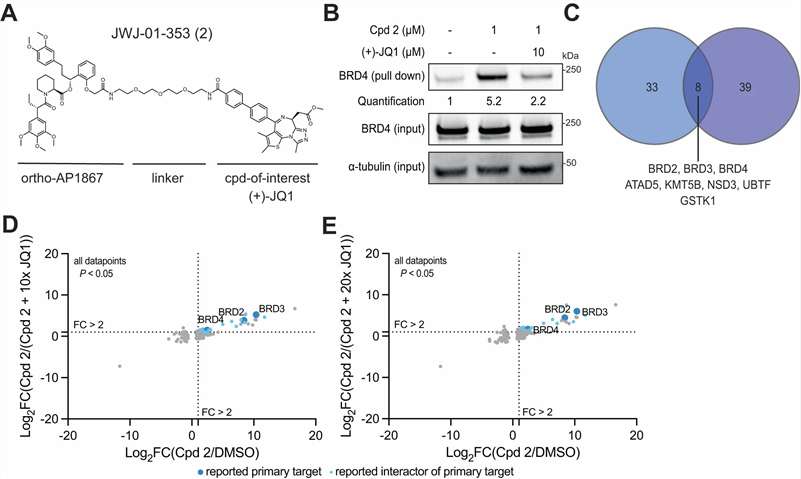
BioTAC achieved selective target enrichment for all three compounds. For JQ1, BRD2/3/4 were among the top enriched proteins. For alisertib, Aurora A was identified with high selectivity over Aurora B (Fig. 3). Most notably, for trametinib — a clinical MEK1/2 inhibitor that acts as a molecular glue to induce MEK-KSR1 complex formation — BioTAC successfully detected both MEK1/2 and the induced KSR1 interaction in a single experiment (Fig. 6). This demonstrated the system's unique ability to capture compound-induced protein complexes that are difficult to detect by traditional affinity methods.

Conclusions

BioTAC demonstrated that proximity labeling can be harnessed for unbiased small-molecule target identification in living cells, capturing both direct targets and compound-induced complexes. This study exemplifies the power of chemoproteomic approaches for target deconvolution and supports offering multiple complementary methods — affinity-based, activity-based, and proximity-based — within a single platform.

BioTAC system design and validation: Figure 3 showing target enrichment for JQ1 (BRD proteins) and alisertib (Aurora A), and Figure 6 showing trametinib-induced MEK1/2-KSR1 complex detection.

Fig. 3 and Fig. 6 from Tao AJ, et al. 2023 (Nature Communications). BioTAC target identification for JQ1, alisertib, and trametinib-molecular glue-induced complex detection. CC BY 4.0.

FAQ

Frequently Asked Questions

Q: What is the minimum amount of compound needed for target identification?

For TPP and LiP-MS, 0.5-2 mg is typically sufficient. For affinity pull-down, 1-5 mg immobilized compound is recommended. For PAL-MS, probe synthesis requires 0.5-5 mg of the parent compound depending on derivatization strategy. We assess the specific requirement during initial compound evaluation.

Q: Can you identify targets of compounds that cannot be chemically modified?

Yes. TPP and LiP-MS require no compound modification whatsoever. These methods are ideal for compounds where structure-activity relationships or synthetic constraints prevent derivatization.

Q: How do you distinguish specific targets from nonspecific background?

We use multiple orthogonal strategies: competition with excess free compound (affinity pull-down), vehicle-only and probe-only controls (PAL-MS, ABPP), statistical filtering with FDR control via SAINT scoring, and orthogonal validation by SPR/BLI where possible.

Q: What types of compounds are compatible with this service?

The service covers small molecules (MW under 1000 Da), natural products, fragments, covalent inhibitors, and tool compounds. Both reversible and covalent binders are compatible. For each compound type, we recommend the most appropriate service line.

Q: How long does a typical target identification project take?

A single-method project with affinity pull-down or TPP typically requires 4-8 weeks. PAL-MS projects with probe synthesis take 8-12 weeks. Multi-method projects combining 2-3 approaches require 10-16 weeks for full analysis.

References

  1. Tao AJ, Jiang J, Gadbois GE, et al. "A biotin targeting chimera (BioTAC) system to map small molecule interactomes in situ." Nature Communications, 2023, 14, 8016. DOI: 10.1038/s41467-023-43507-5
  2. Savitski MM, et al. "Tracking cancer drugs in living cells by thermal profiling of the proteome." Science, 2014, 346(6205), 1255784. DOI: 10.1126/science.1255784
  3. Meissner F, et al. "The emerging role of mass spectrometry-based proteomics in drug discovery." Nature Reviews Drug Discovery, 2022, 21(9), 637-654. DOI: 10.1038/s41573-022-00409-3

Design your target identification strategy with the MassTarget team

Tell us about your compound — its structure, activity, and biological context — and our scientists will recommend the optimal chemical proteomics approach and provide a detailed project proposal.

For Research Use Only (RUO). Not intended for diagnostic, therapeutic, or clinical decision-making purposes. Creative Proteomics services are designed to support preclinical research, drug discovery, and mechanism of action studies only.

Online Inquiry

Please submit a detailed description of your project. We will provide you with a customized project plan to meet your research requests. You can also send emails directly to for inquiries.

* Email
Phone
* Service & Products of Interest
Services Required and Project Description