DNMT Activity MS Assay

Direct, label-free mass spectrometry detection of DNA methyltransferase activity for DNMT1, DNMT3A, and DNMT3B. Measure 5-methylcytosine product formation without radioactivity or antibodies.

Ideal for inhibitor screening, kinetic characterization, and isoform selectivity profiling in epigenetic drug discovery programs. For higher throughput needs, explore our High-Throughput MS Screening platform.

  • Label-free direct 5mC detection by LC-MS/MS
  • DNMT1/3A/3B isoform-selective readout
  • No radioactivity, no antibody interference
  • SAM/SAH ratio measurement available
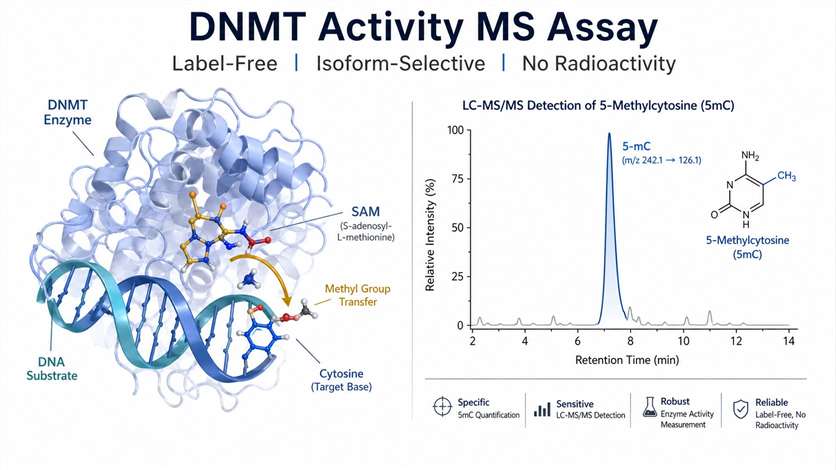
DNMT activity MS assay concept with enzyme and DNA substrate
What Is DNMT Activity MS Key Advantages Service Modes Workflow Platform Instrumentation Technology Comparison Sample Deliverables Demo Case Study FAQ

What Is DNMT Activity MS?

DNA methyltransferases (DNMTs) catalyze the transfer of a methyl group from S-adenosyl-L-methionine (SAM) to the C5 position of cytosine in DNA, yielding 5-methylcytosine (5mC). At MassTarget™, we measure this activity directly by LC-MS/MS — quantifying the 5mC product without coupled enzymes, antibodies, or radioactive labels.

The key difference from other assay formats is what gets measured. Indirect methods infer activity through coupled enzyme reactions, antibody binding, or tritiated SAM incorporation. Our mass spectrometry-based DNMT assay reads the actual methylation product. This eliminates compound autofluorescence interference, antibody cross-reactivity, and the regulatory burden of radioactive waste. On top of that, a single LC-MS/MS run simultaneously resolves 5mC, unmodified cytosine (dC), SAM, and SAH — giving you both activity data and mechanistic cofactor information from the same injection.

We cover the three major catalytically active human DNMT isoforms — DNMT1 (maintenance methylation), DNMT3A, and DNMT3B (de novo methylation) — using DNA substrates and reaction conditions optimized for each isoform's catalytic preferences.

Key Advantages of MS-Based DNMT Activity Assays

Direct Label-Free Detection

We detect the 5mC product directly by mass spectrometry. No coupled enzymes, no antibodies, no radioactive labels — which means no signal interference from your compound libraries and unambiguous evidence of methylation activity.

Isoform-Selective Readout

Each DNMT isoform gets its own optimized assay. That means you get isoform-specific IC50 values and selectivity ratios — not a single readout that lumps all activity together.

No Radioactivity Required

No 3H-SAM, no scintillation counting, no radioactive waste disposal. Your team can run these assays without special licensing or handling protocols.

SAM/SAH Ratio Measurement

We quantify SAM consumption and SAH production in the same run as 5mC. This gives you a direct read on substrate utilization and product inhibition — information that endpoint fluorescence or ELISA formats simply cannot provide.

High Sensitivity and Wide Dynamic Range

Our LC-MS/MS method achieves low femtomole sensitivity for 5mC with a linear range spanning three to four orders of magnitude. That covers both low-activity enzyme variants and potent inhibitor evaluation in a single assay format.

Compatible with Complex Buffer Systems

MS detection tolerates DMSO up to 5% v/v, detergents, and reducing agents that would interfere with fluorescence or luminescence readouts. Your compound libraries can be screened under conditions that keep them soluble and active.

DNMT Activity MS Service Modes

We offer six service modes to match your specific DNMT assay requirements, from single-isoform activity measurement to full kinetic characterization and SAM/SAH ratio analysis.

MODE 1

DNMT1 Activity Assay

Hemimethylated DNA substrates and reaction conditions optimized for maintenance methyltransferase activity. Use this when your program targets DNMT1-specific pathways in cancer epigenetics.

MODE 2

DNMT3A Activity Assay

Configured for de novo methylation on unmethylated CpG-containing DNA substrates. Designed for teams working on DNMT3A in hematological malignancies or developmental disorders.

MODE 3

DNMT3B Activity Assay

Unmethylated substrate sequences optimized for DNMT3B de novo methylation. Supports drug discovery efforts targeting DNMT3B in specific cancer subtypes and ICF syndrome research.

MODE 4

Isoform Selectivity Profiling

Run DNMT1, DNMT3A, and DNMT3B in parallel under comparable conditions. You get selectivity ratios and differential inhibition profiles to guide compound optimization.

MODE 5

Enzyme Kinetics (Km, Vmax, kcat)

Full Michaelis-Menten characterization using variable SAM and DNA substrate concentrations. For teams that need kinetic parameters to understand mechanism of action.

MODE 6

SAM/SAH Ratio Analysis

Targeted LC-MS/MS measurement of SAM and SAH levels in DNMT reaction mixtures. Provides mechanistic insight into substrate consumption and product inhibition.

DNMT Activity MS Workflow

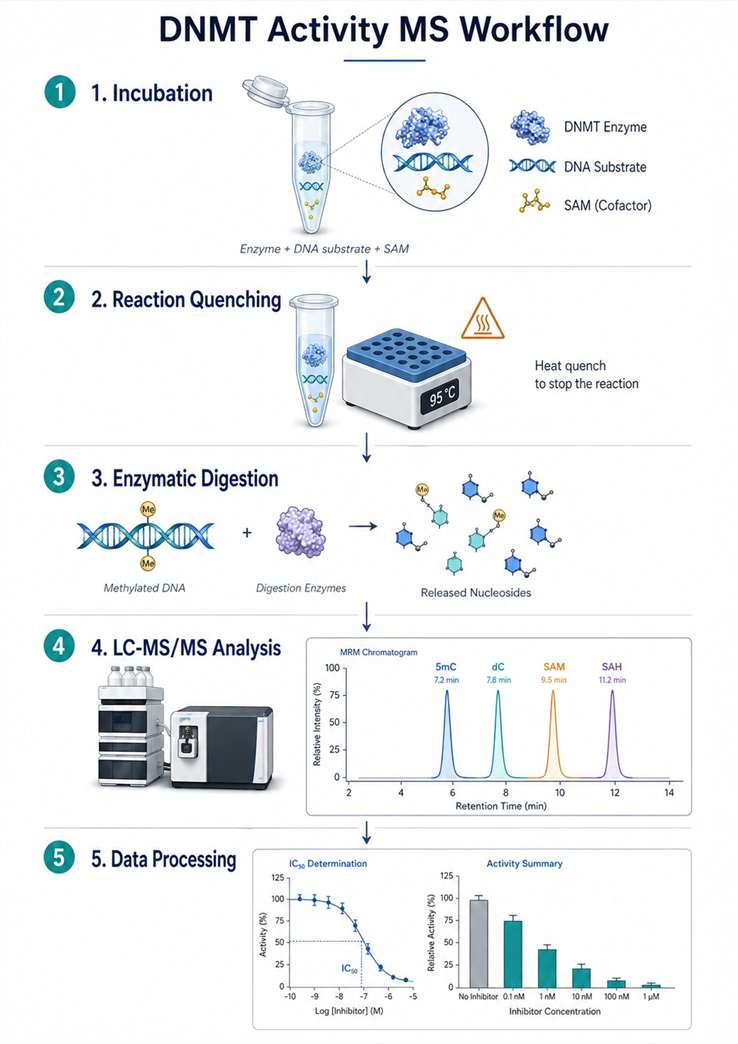
The workflow consists of five technical stages and a five-step service process:

1

Enzyme-Substrate Incubation

Recombinant DNMT (DNMT1, DNMT3A, or DNMT3B) is incubated with a defined DNA substrate and SAM cofactor in optimized reaction buffer. For inhibition studies, compounds are added at specified concentrations.

2

Reaction Quenching

The methylation reaction is stopped at the designated time point by heat denaturation or acidification, preserving the 5mC product for analysis.

3

DNA Hydrolysis

DNA is enzymatically digested to individual nucleosides using a nuclease cocktail (DNase I, snake venom phosphodiesterase, alkaline phosphatase), releasing 5mC and unmodified dC.

4

LC-MS/MS Analysis

Hydrolyzed samples are separated by reversed-phase LC and analyzed by tandem mass spectrometry in MRM mode. 5mC, dC, SAM, and SAH are quantified against stable isotope-labeled internal standards.

5

Data Processing and Reporting

Raw MS data are processed to calculate % 5mC conversion, IC50 values, kinetic parameters, and SAM/SAH ratios. Results are compiled into a comprehensive project report.

DNMT activity MS workflow from incubation to LC-MS/MS analysis

Service Workflow:

1. Project Consultation — Tell us your DNMT isoform target, compound format, and assay requirements.

2. Assay Development — We optimize reaction conditions, substrate selection, and LC-MS/MS parameters for your specific project.

3. Assay Execution — DNMT activity MS assays run in 96- or 384-well plate format with appropriate controls.

4. Data Analysis — Raw MS data are processed, QC metrics (Z' factor, CV%) are calculated, and results are reviewed.

5. Report Delivery — You receive a comprehensive data package including chromatograms, calculated values, IC50 curves, and a project summary report.

Platform Instrumentation

Our DNMT activity MS platform integrates advanced liquid chromatography, high-sensitivity triple quadrupole mass spectrometry, and automated data systems for robust and reproducible methyltransferase activity quantification. For rapid label-free screening, also explore our MALDI-TOF HTS platform.

Module CategoryInstrument / SystemCore CapabilityWhy It Matters
Liquid ChromatographyACQUITY UPLC I-Class / Vanquish UHPLCHigh-resolution nucleoside separationBaseline separation of 5mC from dC and other modified nucleosides
Mass SpectrometryXevo TQ-XS / QTRAP 6500+Triple quadrupole MS with MRMAttomole-level sensitivity for 5mC quantification
Ionization SourceElectrospray Ionization (ESI)Soft ionization of polar nucleosidesPreserves analyte integrity for accurate quantification
Data SystemMassLynx / Analyst SoftwareAutomated peak integrationEnables batch processing of multi-well plate data

Technology Comparison: MS-Based vs. Alternative DNMT Assay Methods

TechniqueDetection PrincipleLabel RequirementThroughputSensitivity (LOD)Isoform SelectivitySAM/SAH RatioHazardous Reagents
LC-MS/MS (MassTarget™)Direct 5mC quantification by mass-to-charge ratioNone (label-free)96-384 wellLow femtomoleYes (isoform-specific)YesNone
Radiometric (3H-SAM)Scintillation counting of tritiated methyl transfer3H-SAM96-384 wellPicomoleIndirectNo3H radioactivity
Fluorescence (MTase-Glo)Coupled enzyme — SAH to AMP to luciferaseCoupled enzyme system96-384 wellPicomoleIndirectNoNone
ELISA / Antibody-BasedAnti-5mC antibody bindingPrimary + secondary antibodies96 wellSub-nanogramNoNoNone
FRET / Fluorescence PolarizationFluorescent probe modification or displacementFluorescent label96-384 wellNanomoleNoNoNone
HPLC-UVUV absorbance of 5mC at 280 nmNoneLow throughputNanomoleNoNoNone

Selection Guidance: LC-MS/MS is the only method that combines label-free direct detection, isoform selectivity, SAM/SAH ratio capability, and high sensitivity — all without radioactivity. For drug discovery teams that need unambiguous, publication-ready activity data, MS-based DNMT assays deliver the highest information content per experiment. For related epigenetic enzyme targets, see our HDAC Activity MS and Kinase MS Activity Assays services.

Sample Requirements for DNMT Activity MS Assays

Sample TypeRequired AmountConcentrationPurityBuffer ConditionsNotes
Recombinant DNMT Enzyme5-20 µg per reaction0.1-1 µM≥80%Tris-HCl pH 7.5-8.0, 1 mM DTT, 10% glycerolSpecify isoform (DNMT1/3A/3B) and construct details
DNA Substrate0.5-5 µg per reaction1-10 µM≥90% (HPLC-purified)TE buffer or nuclease-free waterSpecify sequence, length, methylation status
SAM Cofactor10-100 µM final1-10 mM stock≥85%5 mM H2SO4 in 10% ethanol (-80 °C storage)Provide purity certificate if available
Inhibitor / Compound10 µL per concentration point10 mM stock in DMSO≥90%DMSO (≤5% final)Provide plate map and concentration range
Control Compound10 µL10 mM stock≥95%DMSOReference inhibitor recommended (e.g., decitabine, SGI-1027)

Deliverables

  • Raw LC-MS/MS chromatograms (5mC, dC, SAM, SAH channels)
  • Calculated % 5mC conversion for each reaction
  • IC50 curves and values (inhibitor screening projects)
  • Kinetic parameters (Km, Vmax, kcat) where applicable
  • SAM/SAH ratio data
  • QC metrics (Z' factor, % CV for replicates)
  • Comprehensive project report with methods and results summary

Representative DNMT Activity MS Data

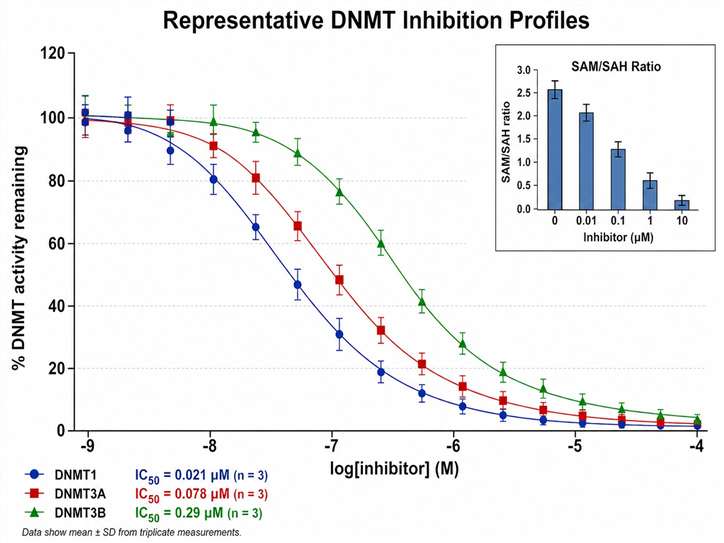
DNMT dose-response IC50 curves for isoform-selective screening

Dose-Response Inhibition Curves

IC50 plot showing DNMT1 inhibition by a reference compound. X-axis: log[inhibitor] (M), Y-axis: % DNMT activity remaining. Error bars from triplicate measurements.

Case Study: AS-MS and LC-MS/MS Reveal Potent DNMT2 Inhibitors Targeting a Cryptic Allosteric Binding Site

Frey A.F., Schwan M., Weldert A.C., et al. DNA-encoded library screening uncovers potent DNMT2 inhibitors targeting a cryptic allosteric binding site. iScience 28, 113300 (2025). https://doi.org/10.1016/j.isci.2025.113300

Background

DNMT2 (TRDMT1) methylates cytosine 38 in tRNA Asp and has been linked to cancer progression and cellular stress responses. Despite its therapeutic potential, no selective small-molecule DNMT2 inhibitors had been reported. The authors set out to change that using DNA-encoded library (DEL) screening with orthogonal validation.

Methods

A 4.4-billion-member DEL was screened against recombinant human DNMT2 by affinity selection mass spectrometry (AS-MS). Hit compounds were validated by SPR and cellular thermal shift assays (thermal stabilization assay). Cellular target engagement was confirmed by LC-MS/MS quantification of tRNA m5C modifications. Key steps:

  • DEL selection with His-tagged DNMT2 protein
  • AS-MS binding affinity determination (Figure S6)
  • LC-MS/MS analysis of tRNA hydrolysates for m5C quantification (Figure 5B-5F)
  • Compound 16 showed sub-micromolar cellular activity

Results

The DEL screen identified benzimidazole-based compounds binding to a previously unknown cryptic allosteric pocket in DNMT2. Compound 3 showed KD of 0.7 µM by AS-MS. Compound 16, the optimized lead, reduced tRNA m5C levels by >70% at 1 µM in cellular assays (LC-MS/MS readout). The compounds showed selectivity over DNMT1 and other methyltransferases.

Conclusions

This study demonstrated that AS-MS combined with LC-MS/MS-based cellular target engagement provides a powerful workflow for methyltransferase inhibitor discovery. The identification of a druggable allosteric site in DNMT2 opens new opportunities for targeting this enzyme. Critically, the LC-MS/MS methodology for quantifying tRNA modifications was essential for confirming cellular target engagement — a capability directly relevant to our DNMT activity MS service.

DNMT2 inhibitor discovery by AS-MS and LC-MS/MS methods

Schematic of the DEL-AS-MS and LC-MS/MS workflow used for DNMT2 inhibitor discovery.

FAQ

Frequently Asked Questions

Q: What is a DNMT activity MS assay, and how does it measure DNA methyltransferase activity?

It's an LC-MS/MS-based method that directly quantifies 5-methylcytosine (5mC) formation after incubating a DNMT enzyme with its DNA substrate and SAM cofactor. The key advantage: we measure the actual methylated product, not an indirect signal from a coupled enzyme or antibody.

Q: Which DNMT isoforms can you assay — DNMT1, DNMT3A, and DNMT3B?

All three. We've optimized DNA substrates and reaction conditions for DNMT1 (maintenance), DNMT3A, and DNMT3B (de novo) separately. If you need isoform selectivity ratios, we can run them in parallel under comparable conditions.

Q: How does MS-based DNMT detection compare with radiometric (3H-SAM) or fluorescence-based assays?

MS avoids radioactivity hazards and fluorescence interference from compound libraries. More importantly, it gives you direct 5mC quantification rather than a coupled enzyme readout, which means more accurate IC50 values and the ability to measure SAM/SAH ratios in the same run.

Q: What throughput can I expect for DNMT inhibitor screening?

Our plate-based LC-MS/MS workflow handles 96- and 384-well formats. For a typical project, we can evaluate hundreds to thousands of compounds with automated data processing.

Q: Can you measure SAM/SAH ratios alongside DNMT activity?

Yes — SAM, SAH, and 5mC are all detected in a single LC-MS/MS run. You get both the activity readout and mechanistic insight into substrate consumption and product inhibition from the same injection.

Q: What data deliverables will I receive from a DNMT activity MS project?

Raw chromatograms, calculated % conversion (5mC/dC ratio), IC50 curves (for inhibitor studies), kinetic parameters (Km, Vmax), SAM/SAH ratios, and a full project report. Everything you need for publication or internal decision-making.

References

  1. Frey A.F., Schwan M., Weldert A.C., et al. DNA-encoded library screening uncovers potent DNMT2 inhibitors targeting a cryptic allosteric binding site. iScience 28, 113300 (2025).
  2. Seiler C.L., Fernandez J., Koerperich Z., et al. Maintenance DNA methyltransferase activity in the presence of oxidized folates. Biochemistry 58(6), 677-688 (2019).
  3. Boulias K., Greer E.L. Detection of DNA methylation in genomic DNA by UHPLC-MS/MS. Methods in Molecular Biology 2198, 79-90 (2021).

For Research Use Only. Not for use in diagnostic procedures.

Plan a DNMT activity MS campaign with the MassTarget™ team

Share your DNMT target, compound format, and assay requirements. Our scientists will design a tailored DNMT activity MS strategy for your epigenetic drug discovery program.

Online Inquiry

Please submit a detailed description of your project. We will provide you with a customized project plan to meet your research requests. You can also send emails directly to for inquiries.

* Email
Phone
* Service & Products of Interest
Services Required and Project Description