Stable Isotope Labeling (SIL) Natural Products Analysis Service

Track metabolic fate, elucidate biosynthetic pathways, and link natural products to their gene clusters using LC-HRMS/MS-based stable isotope labeling.

Stable isotope labeling (SIL) introduces non-radioactive isotopic tracers — ¹³C, ¹⁵N, or ²H — into biological systems to track the fate of specific precursors through metabolic networks. Coupled with high-resolution LC-HRMS/MS, SIL enables researchers to monitor isotopologue distributions, quantify metabolic flux, and establish direct precursor–product relationships in complex biological matrices.

At MassTarget (a service brand of Creative Proteomics), our Stable Isotope Labeling (SIL) Natural Products Analysis Service covers the full pipeline: from isotope precursor selection and experimental design, through metabolic labeling and sample preparation, to high-resolution MS acquisition, isotopologue pattern analysis, and biological interpretation. We combine natural product chemistry expertise with advanced LC-HRMS/MS instrumentation and bioinformatics tools — including IsoAnalyst-compatible data analysis — to deliver actionable results from your labeling experiments.

Whether you are studying microbial polyketide biosynthesis, plant specialized metabolism, or fungal natural product pathways, our platform provides the analytical rigor to move your research forward.

Key Advantages:

  • Natural product-specific expertise in chemistry, biosynthesis, and metabolomics.
  • BGC association capability via parallel SIL strategies compatible with IsoAnalyst.
  • Comprehensive precursor library including ¹³C-glucose, ¹³C-acetate, ¹³C/¹⁵N-amino acids, and custom precursors.
  • Advanced LC-HRMS/MS platform with high-resolution Orbitrap and Q-TOF mass spectrometers.
  • Integrated bioinformatics pipeline for isotopologue analysis, flux estimation, and BGC association.
  • Full-service support from experimental design through final data interpretation.
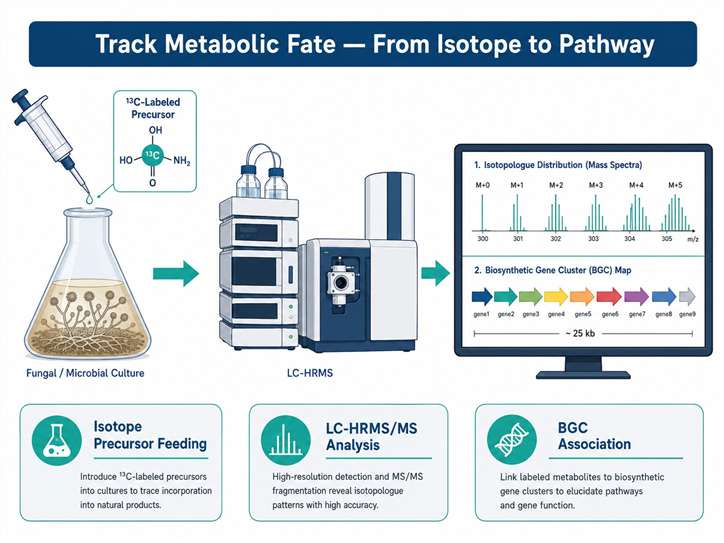
Stable isotope labeling natural products analysis service overview with LC-HRMS/MS workflow and key capabilities
Overview Advantages Use Cases Workflow Comparison Sample Demo Case Study FAQ

What Is Stable Isotope Labeling (SIL) Natural Products Analysis?

Stable isotope labeling (SIL) works by introducing non-radioactive isotopic tracers — ¹³C, ¹⁵N, or ²H — into a biological system, then following where those labeled atoms go. Coupled with high-resolution liquid chromatography-tandem mass spectrometry (LC-HRMS/MS), SIL lets you track isotopologue distributions, measure metabolic flux, and establish direct precursor–product relationships even in the most complex biological matrices.

At MassTarget (a service brand of Creative Proteomics), our Stable Isotope Labeling (SIL) Natural Products Analysis Service covers the full pipeline: from isotope precursor selection and experimental design, through metabolic labeling and sample preparation, to high-resolution MS acquisition, isotopologue pattern analysis, and biological interpretation. We combine natural product chemistry expertise with advanced LC-HRMS/MS instrumentation and bioinformatics tools — including IsoAnalyst-compatible data analysis — to deliver actionable results from your labeling experiments.

Whether you are studying microbial polyketide biosynthesis, plant specialized metabolism, or fungal natural product pathways, our platform provides the analytical rigor to move your research forward. For a broader overview of our natural product capabilities, see our Natural Product MS Discovery Service.

Key Advantages

Natural Product-Specific Expertise

We know natural products — their chemistry, their biosynthesis, and the practical challenges of working with complex microbial extracts, plant matrices, and fermentation broths. Our workflows are built around these realities.

BGC Association Capability

Our parallel stable isotope labeling strategies are compatible with the IsoAnalyst platform, making it possible to directly associate natural products with their biosynthetic gene clusters — a critical link for genome mining and natural product discovery.

Comprehensive Precursor Library

We stock a wide range of labeled precursors: ¹³C-glucose, ¹³C-acetate, ¹³C/¹⁵N-amino acids, ¹⁵N-NH₄Cl, ²H-labeled substrates, and more. Custom precursors are also available. We will help you pick the right labeling strategy for your specific question.

Advanced LC-HRMS/MS Platform

Our lab runs high-resolution Orbitrap and Q-TOF mass spectrometers coupled to UHPLC systems — the kind of mass accuracy, resolution, and sensitivity needed for precise isotopologue quantification across a wide dynamic range.

Integrated Bioinformatics Pipeline

Data analysis covers isotopologue pattern recognition, natural abundance correction, metabolic flux estimation, and BGC association. Our pipeline works with IsoAnalyst, SIMPEL, and other leading SIL data platforms.

Full-Service Support

From the initial consultation to final data interpretation, our scientists stay involved. You get detailed reports, raw data files, and customized bioinformatics analysis — everything needed for publication-ready results.

When to Use This Service

Linking Natural Products to Biosynthetic Gene Clusters

Your genome sequencing has turned up putative BGCs, but the corresponding natural products are unknown. Parallel SIL experiments can establish direct connections between isotope labeling patterns and BGC-encoded biosynthesis — speeding up the discovery process.

Elucidating Biosynthetic Pathways

SIL feeding experiments let you trace how labeled precursors move through downstream metabolites, revealing the sequence of enzymatic transformations and establishing precursor–product relationships within complex biosynthetic networks.

Distinguishing Endogenous vs. Exogenous Metabolites

In a complex extract, is that metabolite produced by your organism or did it come from the growth medium? SIL experiments give you a definitive answer. Combined with our LC-HRMS/MS Dereplication workflow, you can rapidly resolve this question.

Quantifying Metabolic Flux in Engineered Strains

For metabolic engineering and synthetic biology, SIL-MS provides quantitative carbon flux data through specific pathways — letting you measure exactly how genetic modifications affect target metabolite production.

Dereplicating Known Compounds

Combined with our Bioassay-Guided Fractionation service, isotope labeling patterns help you rapidly distinguish known compounds from novel ones, streamlining the prioritization of new natural product leads.

Validating Biosynthetic Engineering Outcomes

When engineering heterologous hosts or modifying native producers, SIL-MS provides direct evidence that the desired biosynthetic pathway is functional and that labeled precursors are being channeled into the target product.

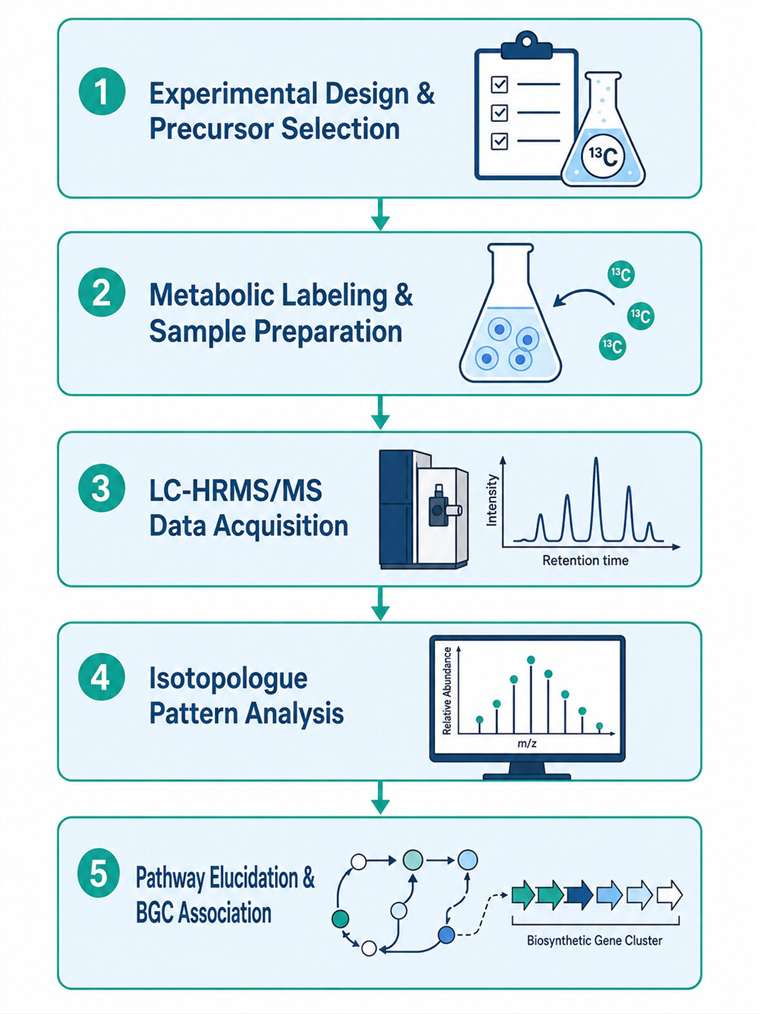
SIL-MS Workflow

Our SIL Natural Products Analysis Service follows a systematic five-step pipeline.

1

Experimental Design

We start with a detailed consultation: what are your research objectives, which labeled precursors make sense, what controls are needed, and what labeling strategy fits best — metabolic labeling, precursor feeding, or chemical derivatization.

2

Isotope Labeling

Labeled precursors are introduced into the biological system under controlled conditions. Depending on your design, this could mean feeding labeled substrates to microbial cultures, plant tissues, or cell lines, with careful monitoring of incorporation kinetics.

3

Sample Preparation

After the labeling period, samples are harvested, quenched, and extracted using protocols optimized for your sample type — cold methanol extraction, liquid–liquid extraction, or solid-phase extraction, with quality control at every step.

4

LC-HRMS/MS Acquisition

Extracts are analyzed by UHPLC coupled to high-resolution Orbitrap or Q-TOF mass spectrometers. We use full-scan MS, data-dependent MS/MS, and targeted MS/MS acquisition to capture comprehensive isotopologue information.

5

Data Analysis

Raw data goes through our integrated bioinformatics pipeline: feature detection, isotopologue pattern extraction, natural abundance correction, and metabolic flux analysis. You receive isotopologue distribution tables, enrichment curves, pathway maps, and — where applicable — BGC association reports compatible with IsoAnalyst. For substructure-level insights, see our MS2LDA (Substructure Discovery) service.

SIL-MS workflow diagram showing five steps from experimental design to data analysis

Technology Comparison: SIL-MS vs. Alternative Approaches

DimensionSIL-MS (This Service)Traditional NP CharacterizationUntargeted MetabolomicsStable Isotope Ratio MS
Metabolic Pathway InformationDynamic flux dataStatic structure onlyRelative abundance onlyBulk isotope ratios
BGC AssociationDirect linkingRequires separate genomicsNot possibleNot possible
Structural ElucidationMS/MS fragmentationFull characterization (NMR + MS)MS/MS library matchingLimited
Quantitative AccuracyHigh (isotope dilution)Semi-quantitativeSemi-quantitativeHigh
ThroughputModerate (batch processing)Low (per compound)High (untargeted)Moderate
Cost per Sample$$$$$$$$$

For complementary molecular networking approaches, explore our GNPS Molecular Networking service.

Sample Requirements

Sample TypeRecommended AmountLabeling MethodReplicationStorage & Shipping
Microbial culture (liquid)10–50 mLMetabolic (¹³C-glucose, ¹⁵N-NH₄Cl)≥ 3 biological replicatesSnap-freeze, -80°C, dry ice
Plant tissue100–500 mg fresh weightMetabolic (¹³CO₂, ¹⁵N fertilizer)≥ 3 biological replicatesSnap-freeze in liquid N₂, -80°C
Cell culture1–10 × 10⁶ cellsMetabolic (¹³C-glucose, ¹³C-glutamine)≥ 3 biological replicatesPBS wash, snap-freeze, -80°C
Purified NP fraction≥ 50 µgChemical derivatization≥ 2 technical replicatesDry, RT or -20°C
Fermentation broth5–50 mLMetabolic precursor feeding≥ 3 biological replicatesFilter sterilize, -80°C

Deliverables

  • Detailed experimental report — labeling conditions, MS parameters, and analytical methods fully documented
  • Raw data files — complete LC-HRMS/MS datasets in standard formats (.raw, .d, or .mzML)
  • Processed data — extracted ion chromatograms, mass spectra, and feature tables
  • Isotopologue analysis — distribution tables, enrichment curves, natural abundance-corrected data
  • Metabolic pathway maps — annotated pathway diagrams with flux information where applicable
  • BGC association report — IsoAnalyst-compatible output linking labeled metabolites to predicted BGCs
  • Customized interpretation — biological context and recommendations for next steps

Representative Data

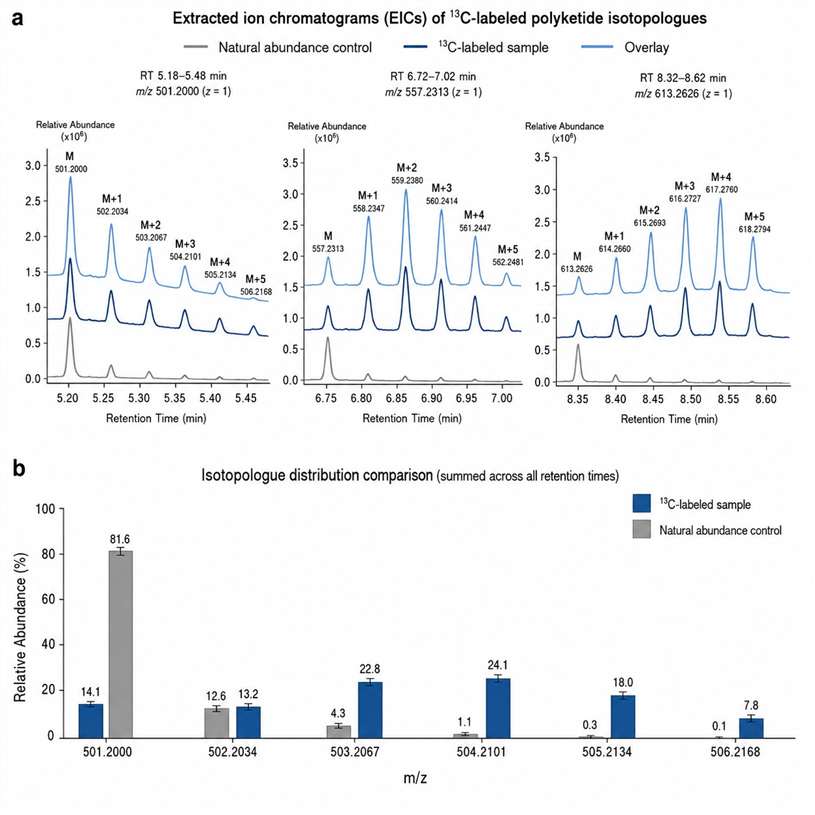
Isotopologue distribution pattern of 13C-labeled polyketide metabolite from SIL-MS analysis

Isotopologue distribution analysis of ¹³C-labeled polyketide metabolites

Case Study: Elucidating Polyketide Biosynthetic Pathways via SIL-MS Precursor Feeding

Klitgaard A., Frandsen R.J.N., Holm D.K., Knudsen P.B., Frisvad J.C., Nielsen K.F. "Combining UHPLC-high resolution MS and feeding of stable isotope labeled polyketide intermediates for linking precursors to end products." Journal of Natural Products 78(7):1518–1525 (2015). https://doi.org/10.1021/np500979d

Background

Understanding how fungi build polyketides matters for both basic science and industrial applications. But establishing direct precursor–product relationships in complex fungal metabolomes is difficult with conventional methods alone.

Challenge

Researchers at the Technical University of Denmark wanted to know whether specific stable isotope-labeled polyketide intermediates — ¹³C₈-6-methylsalicylic acid (6-MSA) and ¹³C₁₄-YWA1 — were incorporated into known fungal polyketide end products across multiple genera (Fusarium, Byssochlamys, Aspergillus, and Penicillium).

SIL-MS Approach

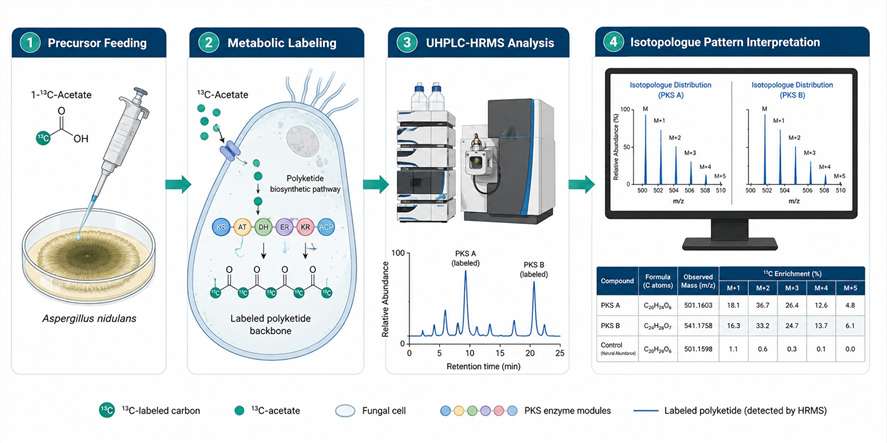
The team combined stable isotope-labeled precursor feeding with UHPLC-HRMS analysis. Internally produced ¹³C-labeled intermediates and commercial ¹³C₇-benzoic acid and ²H₇-cinnamic acid were fed to fungal cultures. After incubation, extracts were analyzed by UHPLC-DAD-QTOFMS to detect labeled end products based on characteristic mass shifts.

Key Results

  • 6-MSA was not incorporated into terreic acid or patulin in any of the six tested species, suggesting these toxic polyketides are produced in compartmentalized cellular environments.
  • Instead, 6-MSA was diverted to (2Z,4E)-2-methyl-2,4-hexadienedioic acid — a detoxification product.
  • YWA1 was incorporated into aurofusarin, rubrofusarin, and antibiotic Y in Fusarium spp.
  • Benzoic acid was incorporated into asperrubrol in Aspergillus niger.
  • Precursor incorporation levels ranged from 0.7% to 20% in wild-type strains.

Conclusion

This study showed that SIL-MS precursor feeding is an effective strategy for elucidating polyketide biosynthetic pathways — and revealed unexpected metabolic compartmentalization that would have been difficult to detect using genomic or metabolomic methods alone.

SIL-MS precursor feeding workflow for polyketide biosynthetic pathway elucidation in fungi

Schematic of the stable isotope-labeled precursor feeding and UHPLC-HRMS analysis workflow used for polyketide pathway elucidation.

FAQ

Frequently Asked Questions

Q: What types of stable isotope precursors do you offer?

We carry ¹³C-glucose, ¹³C-acetate, ¹³C/¹⁵N-amino acids, ¹⁵N-NH₄Cl, ²H₂O, and ²H-labeled substrates — plus custom precursors for specialized needs. Our team will help you pick the right one for your system and question.

Q: How long does a typical SIL-MS project take?

Plan on 4–8 weeks from sample receipt for most projects, covering experimental design, labeling, sample prep, LC-HRMS/MS analysis, and data interpretation. Rush timelines are possible — just ask.

Q: Can I provide my own isotope-labeled substrates?

Absolutely. If you already have labeled precursors, we can work them into your experimental workflow. Contact us ahead of time so we can confirm compatibility with our platform and set up appropriate controls.

Q: How do you ensure isotopologue quantification accuracy?

We use natural abundance correction algorithms, unlabeled control samples for baseline correction, replicate injections for technical reproducibility, and internal standards for normalization. Multiple layers of QC, in other words.

Q: What is the minimum sample amount required?

It depends on the sample type. For microbial cultures, at least 10 mL; for plant tissues, 100 mg fresh weight; for cell cultures, 1 × 10⁶ cells. Talk to our team for recommendations specific to your material.

Q: Do you provide bioinformatics support for isotopologue data?

Yes. Our pipeline covers isotopologue pattern extraction, natural abundance correction, metabolic flux estimation, and BGC association. Results come in publication-ready formats, and we offer extended consultation for custom analysis needs.

References

  1. McCaughey, C.S., van Santen, J.A., van der Hooft, J.J.J., Medema, M.H., Linington, R.G. An isotopic labeling approach linking natural products with biosynthetic gene clusters. Nature Chemical Biology 18, 295–304 (2022).
  2. Klitgaard, A., Frandsen, R.J.N., Holm, D.K., Knudsen, P.B., Frisvad, J.C., Nielsen, K.F. Combining UHPLC-high resolution MS and feeding of stable isotope labeled polyketide intermediates for linking precursors to end products. Journal of Natural Products 78(7), 1518–1525 (2015).
  3. Dong, Y., Feldberg, L., Aharoni, A., Heinig, U. Metabolite annotation through stable isotope labeling. Trends in Analytical Chemistry 181, 118037 (2024).

Ready to trace your natural product's metabolic fate?

Contact our experts to design your SIL-MS experiment — from precursor selection through data interpretation.

Online Inquiry

Please submit a detailed description of your project. We will provide you with a customized project plan to meet your research requests. You can also send emails directly to for inquiries.

* Email
Phone
* Service & Products of Interest
Services Required and Project Description