Natural Product & Complex Mixture MS Discovery Service

Accelerate natural product hit discovery with integrated MS-based dereplication, molecular networking, and affinity selection. From complex extracts to active compounds — faster, smarter, and without extensive purification.

Natural products remain one of the most prolific sources of novel drug leads, yet their inherent chemical complexity poses a formidable challenge for traditional discovery pipelines. Crude extracts, microbial fermentation broths, and fractionated libraries can contain hundreds to thousands of unique compounds, making the isolation and identification of bioactive molecules a time-intensive and resource-heavy endeavor.

Our Natural Product & Complex Mixture MS Discovery Service addresses this bottleneck head-on. By integrating high-resolution LC-MS/MS, ion mobility MS, and affinity selection-MS with advanced computational workflows — including GNPS molecular networking, feature-based molecular networking, MS2LDA substructure discovery, and SIRIUS/CSI:FingerID — we enable rapid dereplication, structural annotation, and bioactive compound prioritization directly from complex mixtures. This MS-centric approach drastically reduces the iterative fractionation cycles required by traditional bioassay-guided methods, accelerating the journey from extract to active compound.

Whether you are working with plant extracts, marine organism samples, microbial fermentation broths, or synthetic complex mixtures, our platform delivers publication-quality data with comprehensive bioinformatics support.

  • LC-HRMS/MS with GNPS molecular networking
  • Integrated dereplication and structural annotation
  • Affinity selection-MS for bioactive compound identification
  • Multi-platform MS (Orbitrap, Q-TOF, Ion Mobility)
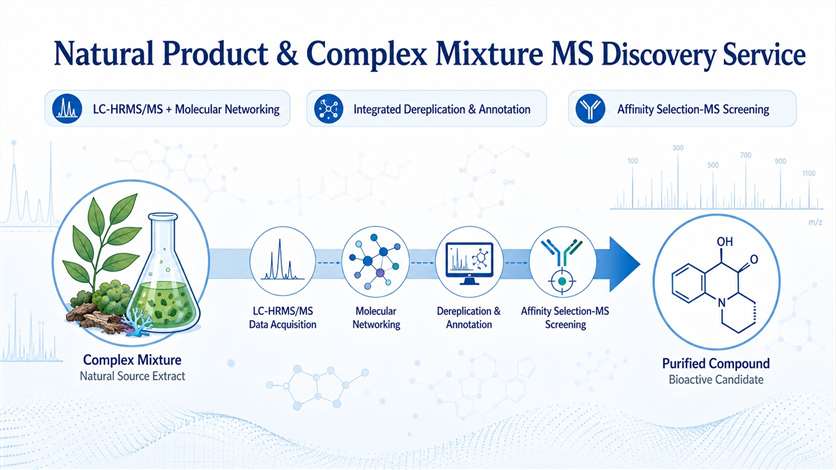
Natural Product and Complex Mixture MS Discovery Service overview featuring LC-HRMS/MS, GNPS molecular networking, affinity selection-MS, and multi-platform MS capabilities.
Overview Key Advantages Service Portfolio Workflow Sample Case Study FAQ

Overview — Integrated MS-Based Natural Product Discovery

Natural products remain one of the most prolific sources of novel drug leads, yet their inherent chemical complexity poses a formidable challenge for traditional discovery pipelines. Crude extracts, microbial fermentation broths, and fractionated libraries can contain hundreds to thousands of unique compounds, making the isolation and identification of bioactive molecules a time-intensive and resource-heavy endeavor.

Our Natural Product & Complex Mixture MS Discovery Service addresses this bottleneck head-on. By integrating high-resolution LC-MS/MS, ion mobility MS, and affinity selection-MS with advanced computational workflows — including GNPS molecular networking, feature-based molecular networking, MS2LDA substructure discovery, and SIRIUS/CSI:FingerID — we enable rapid dereplication, structural annotation, and bioactive compound prioritization directly from complex mixtures. This MS-centric approach drastically reduces the iterative fractionation cycles required by traditional bioassay-guided methods, accelerating the journey from extract to active compound.

Whether you are working with plant extracts, marine organism samples, microbial fermentation broths, or synthetic complex mixtures, our platform delivers publication-quality data with comprehensive bioinformatics support. For deeper dereplication capabilities, explore our dedicated LC-HRMS/MS dereplication service.

Key Advantages of Our MS-Based Natural Product Discovery Platform

Multi-Platform MS Coverage

Access to Orbitrap Exploris 480, Q Exactive HF-X, timsTOF Pro, and Q-TOF platforms for complementary HRMS, MS/MS, and ion mobility data, ensuring comprehensive coverage across diverse natural product chemistries.

Integrated Bioinformatics

GNPS molecular networking, feature-based networking, MS2LDA, SIRIUS/CSI:FingerID, and custom in-house databases for comprehensive dereplication and structural annotation. Our GNPS molecular networking pipeline enables rapid chemical relationship mapping across samples.

Rapid Dereplication

Identify and eliminate known compounds early using spectral library matching, accurate mass (<3 ppm), and retention time correlation, dramatically reducing the time spent on re-isolating known molecules.

Affinity Selection-MS Integration

Combine AS-MS workflows (ultrafiltration, SEC, magnetic bead-based) to directly identify target-binding compounds from mixtures, providing a direct functional readout without extensive fractionation. Our affinity selection-mass spectrometry (AS-MS) platform is optimized for natural product applications.

Publication-Ready Deliverables

Molecular network visualizations, dereplication summary tables, bioactivity correlation heatmaps, and annotated MS/MS spectra formatted for direct use in manuscripts and presentations.

Scalable Throughput

From single-sample deep profiling to multi-condition comparative studies with automated data processing pipelines, accommodating projects of any scale.

Explore Our Natural Product MS Service Portfolio

Our natural product discovery platform comprises a comprehensive suite of specialised MS-based services. Each can be deployed independently or combined into an integrated workflow tailored to your project goals. Browse the portfolio below and click through to learn more about each service.

SERVICE 1

LC-HRMS/MS Dereplication

High-resolution LC-MS/MS profiling with automated feature detection, spectral deconvolution, and database matching against GNPS, MoNA, and in-house libraries for rapid identification of known compounds in complex mixtures.

SERVICE 2

GNPS Molecular Networking

Feature-based molecular networking (FBMN) for visualising chemical relationships across samples. Cluster analysis enables rapid identification of compound families, structural analogs, and potentially novel chemotypes.

SERVICE 3

Feature-Based Molecular Networking (FBMN)

Advanced feature-based networking that integrates quantitative feature tables with MS/MS molecular networking, enabling correlation of chemical space with sample metadata and bioactivity data.

SERVICE 4

MS2LDA Substructure Discovery

Unsupervised fragmentation pattern mining using MS2LDA to identify substructures and chemical motifs (Mass2Motifs) shared across compounds, providing orthogonal structural context beyond spectral matching.

SERVICE 5

Native Metabolomics for Ligand Discovery

Native MS-based metabolomics approach for direct identification of protein-bound metabolites and endogenous ligands from complex biological mixtures without prior fractionation.

SERVICE 6

Small-Molecule/Protein Complex Native MS

Native ESI-MS for direct detection and characterisation of non-covalent small-molecule/protein complexes, providing binding stoichiometry and relative affinity information from complex mixtures.

SERVICE 7

Bioassay-Guided Fractionation + LC-MS

Integrated fractionation and MS analysis workflow where bioactivity data is correlated with MS features to prioritise active compounds for isolation, combining traditional activity screening with modern MS-based metabolomics.

SERVICE 8

Deep Learning–Assisted MS Annotation

AI-powered in silico fragmentation prediction and compound annotation using deep learning models (SIRIUS/CSI:FingerID, CANOPUS) for improved structural characterisation of unknown natural products.

SERVICE 9

Stable Isotope Labeling Natural Products

Isotopic labelling strategies for tracking precursor incorporation, distinguishing genuine metabolites from contaminants, and elucidating biosynthetic pathways in natural product-producing organisms.

SERVICE 10

Structure–Activity Relationship (SAR-MS)

MS-based SAR profiling that correlates structural features of natural product analogues with bioactivity data, enabling rapid identification of pharmacophoric elements within compound series.

SERVICE 11

Structural Elucidation via MSⁿ

Multi-stage mass spectrometry (MS², MS³, MS⁴) for detailed structural characterisation of unknown compounds, supported by molecular formula assignment and fragmentation pathway analysis.

Our Workflow — From Complex Extract to Active Compound

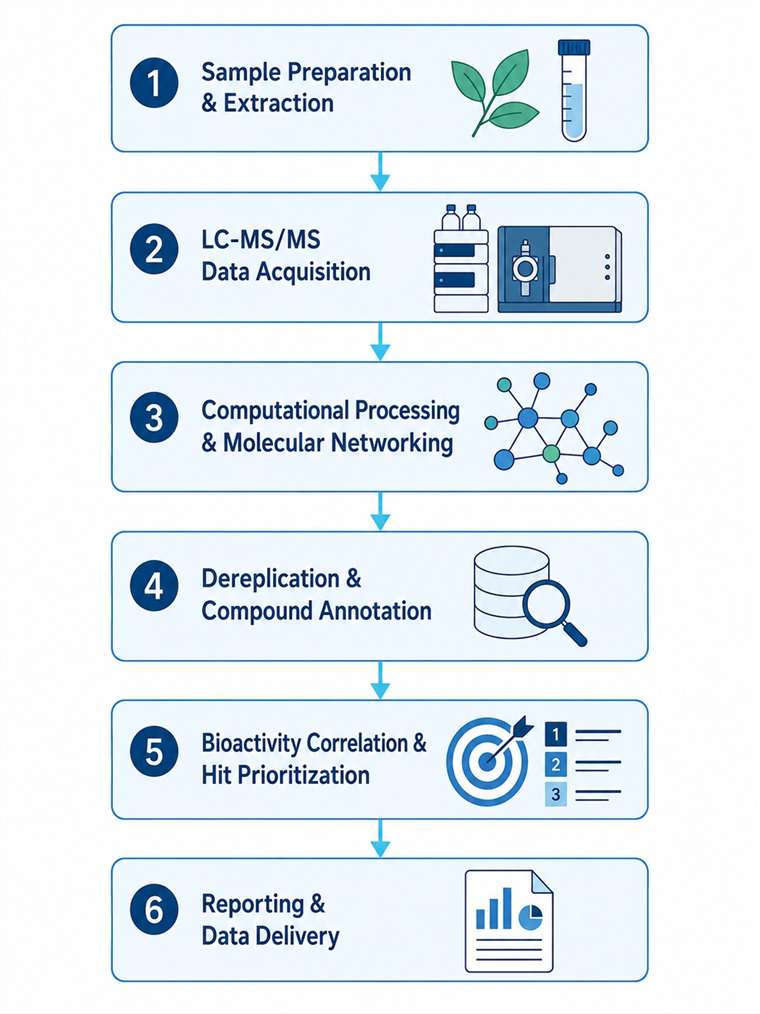
Our integrated MS-based workflow transforms complex natural product mixtures into prioritized hit compounds through six streamlined stages:

1

Sample Preparation & Extraction

Your sample (plant extract, microbial broth, marine organism, fraction) is prepared using optimized protocols for your specific matrix. Pre-fractionation is available for highly complex mixtures.

2

LC-MS/MS Data Acquisition

High-resolution LC-MS/MS data is acquired on Orbitrap or Q-TOF platforms using data-dependent acquisition (DDA) or data-independent acquisition (DIA) methods optimized for natural product coverage.

3

Computational Processing & Molecular Networking

Raw data is processed through our bioinformatics pipeline: feature detection, alignment, and GNPS molecular networking. Feature-based molecular networking (FBMN) and MS2LDA provide additional structural context.

4

Dereplication & Compound Annotation

Detected features are matched against spectral libraries (GNPS, MoNA, in-house) and in silico fragmentation tools (SIRIUS/CSI:FingerID). Known compounds are flagged and novel features are prioritized.

5

Bioactivity Correlation & Hit Prioritization

MS features are correlated with bioactivity data (if provided) to identify bioactive compounds. Hits are ranked by confidence level, novelty, and bioactivity strength for downstream validation.

6

Reporting & Data Delivery

A comprehensive report is delivered, including molecular network visualizations, annotated compound tables, dereplication summaries, and raw data files.

Natural product MS discovery workflow diagram illustrating six steps from sample preparation through LC-MS/MS acquisition, molecular networking, dereplication, bioactivity correlation, to final reporting.

Sample Requirements

Sample TypeRecommended AmountFormulationStorage ConditionNotes
Crude plant extract≥50 mg dry extractDMSO or MeOH solution-20°C, light-protectedPre-fractionation recommended for highly complex mixtures
Microbial fermentation broth≥10 mL (or 50 mg extracted residue)Lyophilized or MeOH extract-80°CFilter before injection
Marine organism extract≥25 mg dry extractMeOH or EtOAc solution-20°C, light-protectedDesalting recommended
Pre-fractionated sample≥5 mg per fractionDMSO or MeOH-20°CProvide fractionation method details
Pure compound (reference)≥1 mgDMSO or MeOH-20°CFor MS/MS library building

Deliverables

  • Annotated compound table with retention time, m/z, molecular formula, identification confidence level, and database match scores
  • GNPS molecular network visualization (interactive HTML + static figure)
  • Dereplication summary listing known compounds, their sources, and bioactivity context
  • Feature-based molecular networking (FBMN) results with MS²LDA substructure annotations
  • Raw data files (.raw, .mzXML, or .mzML)
  • Bioinformatics processing report detailing all parameters, software versions, and database versions used
  • Publication-ready figures including molecular networks, chromatograms, and MS/MS spectra

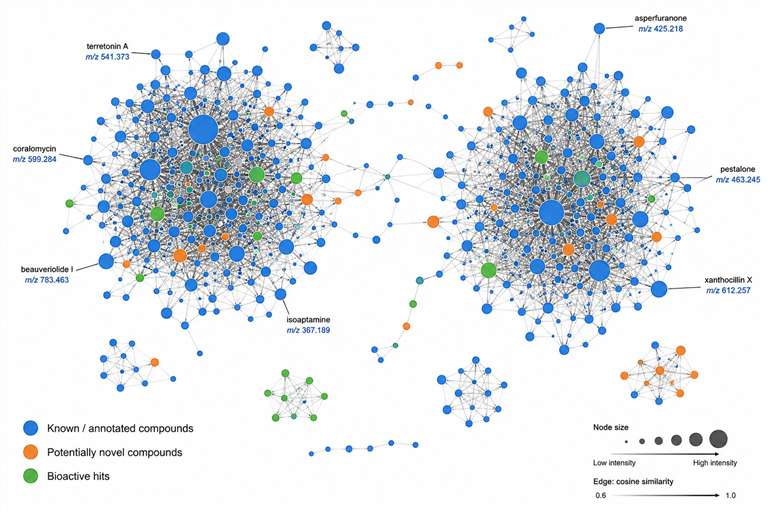
Representative Data — GNPS Molecular Network of Natural Product Extracts

GNPS molecular network visualization showing clustering of natural product compounds by MS/MS spectral similarity, with annotated compound families and bioactivity correlation.

GNPS molecular network of natural product extracts showing compound families and bioactivity correlation

Case Study — MS-Based Metabolomics Accelerates Bioactive Natural Product Discovery

Demarque D.P., Dusi R.G., de Sousa F.D.M., et al. "Mass spectrometry-based metabolomics approach in the isolation of bioactive natural products." Scientific Reports. 2020;10:1053. https://doi.org/10.1038/s41598-020-58046-y

Background

Demarque et al. (2020) sought to establish a mass spectrometry-based metabolomics strategy for discovering larvicidal compounds against Aedes aegypti from the Brazilian plant Annona crassiflora. Traditional bioassay-guided fractionation of complex plant extracts is slow and labor-intensive, often requiring multiple rounds of fractionation and bioassay testing.

Methods

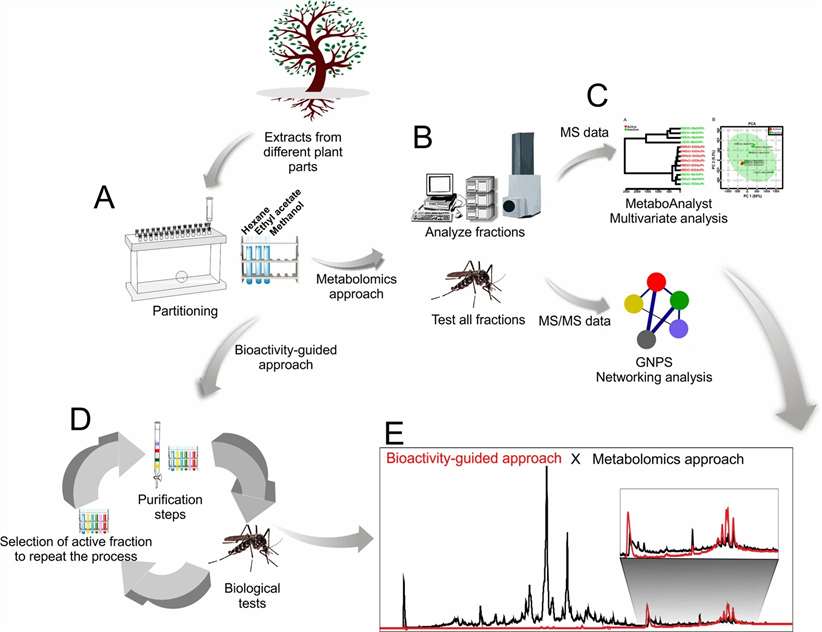
The research team applied a dual-platform metabolomics approach. All fractions from A. crassiflora extracts were analyzed by LC-MS and LC-MS/MS. The LC-MS data were processed using MetaboAnalyst for multivariate statistical analysis (PCA, sPLS-DA), while the LC-MS/MS data were uploaded to GNPS for molecular networking. Fractions showing >10% mortality at 125 µg/mL against A. aegypti larvae were classified as active.

Results

sPLS-DA identified m/z 661.4646 (C₃₇H₆₆O₈ + Na⁺) as the top discriminatory feature between active and inactive fractions. GNPS molecular networking revealed two major clusters of compounds in the active fractions, both annotated as Annonaceous acetogenins — a known class of bioactive natural products. Traditional bioassay-guided isolation confirmed that the active compounds were indeed acetogenins, with purified fractions showing LD₅₀ values of 5.6–11.1 µg/mL against the mosquito larvae.

Conclusions

The MS-based metabolomics approach successfully predicted the active compounds directly from complex mixture data, dramatically reducing the number of fractionation cycles needed. This study demonstrates how our integrated MS workflow can accelerate natural product discovery by prioritizing bioactive features early in the pipeline.

Comparative workflow diagram from Demarque et al. 2020 (Sci Rep, Fig. 5) illustrating traditional bioassay-guided fractionation versus MS-based metabolomics approach for natural product discovery.

Fig. 5 from Demarque et al. (2020) — Comparative workflow between traditional bioassay-guided fractionation and the MS-based metabolomics approach for accelerated natural product discovery.

FAQ

Frequently Asked Questions

Q: What types of natural product samples can you analyze?

We accept plant extracts, marine organism extracts, microbial fermentation broths, fungal cultures, and fractionated libraries in various formulations. Each sample type is processed using optimized protocols for its specific matrix. Please consult our team for unusual sample types or specialized matrices.

Q: How does MS-based natural product discovery differ from traditional bioassay-guided fractionation?

MS-based approaches use metabolomics and molecular networking to prioritize bioactive features early, reducing the iterative fractionation cycles required by traditional methods. This can cut project timelines from months to weeks while simultaneously providing comprehensive chemical context for all detected compounds, not just those that show activity in a specific assay.

Q: What bioinformatics tools do you use for natural product dereplication?

We employ GNPS molecular networking, feature-based molecular networking (FBMN), MS2LDA, SIRIUS/CSI:FingerID, and custom in-house databases for comprehensive dereplication and structural annotation. Our bioinformatics pipeline is continuously updated to incorporate the latest tools and spectral libraries.

Q: Can you identify novel compounds from complex mixtures?

Yes. Our integrated workflow combines molecular networking, MS/MS spectral libraries, and in silico fragmentation tools to flag and characterize potentially novel compounds that do not match any known spectral entries. Molecular networking is particularly powerful for this, as unannotated clusters often represent previously undescribed chemotypes.

Q: What is the minimum sample amount required for analysis?

For crude extracts, we recommend ≥50 mg dry weight. For pre-fractionated samples, ≥5 mg per fraction is typically sufficient. Smaller amounts may be accommodated with prior consultation, though this may limit the depth of profiling possible. We recommend a preliminary consultation to determine the optimal sample amount for your specific project goals.

Q: How do you ensure the accuracy of compound identification?

We use multi-level identification confidence: MS¹ accurate mass (<3 ppm), MS/MS spectral matching against GNPS and in-house libraries, retention time correlation, and orthogonal validation when needed. Our reporting follows the Metabolomics Standards Initiative (MSI) identification confidence levels, providing transparent communication of annotation certainty.

References

  1. Demarque D.P., Dusi R.G., de Sousa F.D.M., et al. Mass spectrometry-based metabolomics approach in the isolation of bioactive natural products. Scientific Reports. 2020;10:1053.
  2. Kim H.W., Choi S.Y., Jang H.S., et al. Exploring novel secondary metabolites from natural products using pre-processed mass spectral data. Scientific Reports. 2019;9:17430.
  3. Borges R.M., Teixeira A.M. On the part that NMR should play in mass spectrometry metabolomics in natural products studies. Frontiers in Natural Products. 2024;3:1359151.

Accelerate Your Natural Product Discovery

Ready to transform your complex natural product mixtures into prioritized hit compounds? Share your project details and our scientists will design a tailored MS-based discovery strategy for your research program.

Online Inquiry

Please submit a detailed description of your project. We will provide you with a customized project plan to meet your research requests. You can also send emails directly to for inquiries.

* Email
Phone
* Service & Products of Interest
Services Required and Project Description