RapidFire-MS Screening Service for Ultra-High-Throughput Drug Discovery

We deliver sub-10-second cycle time LC-MS screening by RapidFire — enabling label-free ADME profiling, enzyme kinetics, and hit validation at speeds that match medicinal chemistry output, without capital investment.

RapidFire-MS is an ultra-high-throughput mass spectrometry platform that combines automated solid-phase extraction (SPE) sample cleanup with high-speed MS detection, achieving cycle times of 2–10 seconds per sample. Unlike conventional LC-MS methods that require 3–5 minutes per injection, RapidFire-MS uses a three-pump SPE system to rapidly desalt and deliver samples directly to the mass spectrometer, eliminating the chromatographic separation bottleneck.

Key Advantages:

  • Sub-10-second cycle time — RapidFire SPE-MS/MS processes each sample in seconds, not minutes, enabling true ultra-high-throughput screening.
  • Label-free direct detection — No fluorescent tags, no antibody reagents, no assay development — measure substrate conversion or binding directly by mass.
  • Broad assay compatibility — ADME profiling, enzyme kinetics, IC50 determination, permeability, protein binding, and more on a single platform.
  • No capital expenditure — Access RapidFire infrastructure on a per-project basis, avoiding $300K–$500K instrument investment.
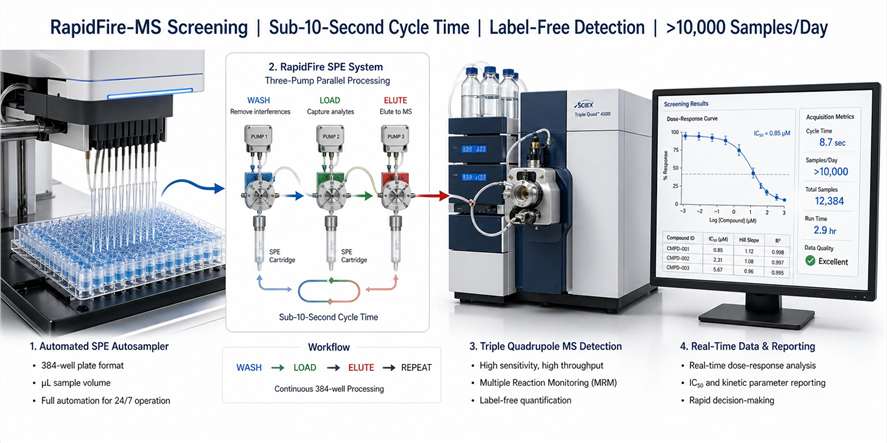
RapidFire-MS ultra-high-throughput screening platform diagram featuring automated SPE sample cleanup, high-speed MS detection, and key application areas.
What Is RapidFire-MS Key Advantages Service Overview Workflow Technology Comparison Sample Demo FAQ

What Is RapidFire-MS Screening?

RapidFire-MS is an ultra-high-throughput mass spectrometry platform that combines automated solid-phase extraction (SPE) sample cleanup with high-speed MS detection, achieving cycle times of 2–10 seconds per sample. Unlike conventional LC-MS methods that require 3–5 minutes per injection, RapidFire-MS uses a three-pump SPE system to rapidly desalt and deliver samples directly to the mass spectrometer, eliminating the chromatographic separation bottleneck.

This technology is particularly valuable for:

  • ADME/DMPK profiling — Metabolic stability, CYP inhibition, plasma protein binding, and permeability assays at throughputs exceeding 10,000 samples per day.
  • Enzyme kinetics and IC50 determination — Label-free direct detection of substrate depletion or product formation for any enzymatic target.
  • Hit-to-lead SAR support — Rapid IC50 generation for medicinal chemistry campaigns without developing orthogonal assays.

Our RapidFire-MS service integrates with our broader high-throughput MS screening platform, providing a seamless pipeline from ultra-fast primary screening to detailed hit characterisation.

Key Advantages of RapidFire-MS for Drug Discovery

Unmatched Speed

Conventional LC-MS runs at 3–5 min/sample. RapidFire-MS achieves 2–10 s/sample — a 20–100× throughput improvement. A typical 384-well plate is processed in under 15 minutes.

True Label-Free Screening

No fluorescent or radioactive labels required. Direct MS detection eliminates assay interference from compound autofluorescence, quenching, or signal artifacts common in plate-based HTS.

Minimal Sample Preparation

The integrated SPE cartridge performs online desalting and cleanup — no offline extraction, centrifugation, or filtration steps. Load the plate and walk away.

Quantitative Precision

Triple quadrupole MRM detection provides excellent quantitative precision (CV <15%) across a wide dynamic range, suitable for both screening and IC50 determination.

Versatile Assay Menu

From ADME (metabolic stability, CYP inhibition, permeability) to enzyme kinetics (kinase, protease, phosphatase, transferase) to binding assays — all on the same platform.

Service Overview — RapidFire-MS Capabilities

Our RapidFire-MS service supports discovery-stage research across multiple assay types and therapeutic areas.

MODE 1

ADME/DMPK Profiling

Metabolic stability (microsomal, hepatocyte), CYP inhibition (CYP1A2, 2C9, 2C19, 2D6, 3A4), plasma protein binding, and Caco-2 permeability. Up to 10,000 data points per day.

MODE 2

Enzyme Kinetics and IC50 Determination

Label-free measurement of substrate depletion or product formation. Suitable for kinases, proteases, phosphatases, hydrolases, and transferases. IC50 curves generated within 24 hours of assay setup.

MODE 3

High-Throughput Inhibitor Screening

Primary screening of compound libraries (10³–10⁵ compounds) against enzymatic targets. Hit rate typically 0.5–2%. Confirmed hits triaged by dose-response.

MODE 4

Fragment Screening by RapidFire-MS

Label-free fragment library screening with RapidFire speed. Weak binders detected by direct MS readout. Hits validated by orthogonal biophysical methods.

MODE 5

Integrated RapidFire + AEMS Workflow

Primary hits from RapidFire-MS screening are triaged by acoustic ejection MS (AEMS) for orthogonal confirmation, creating a continuous ultra-HTS to validation pipeline.

RapidFire-MS Workflow: From Sample to Result in Seconds

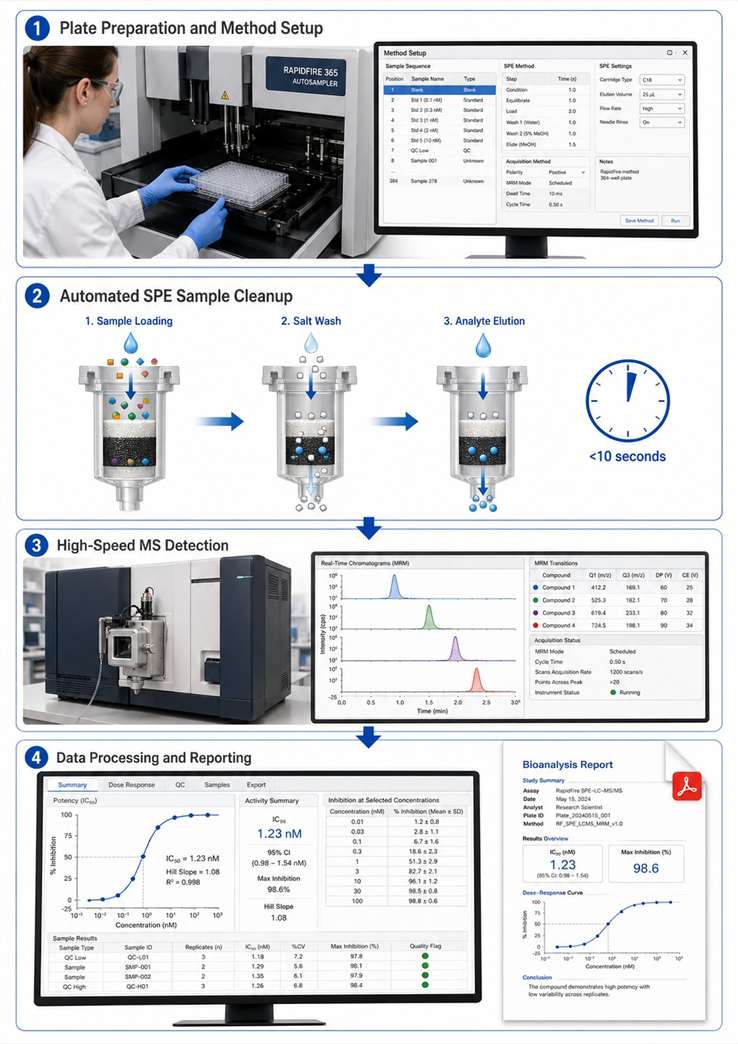
Our standard RapidFire-MS workflow runs through four stages:

1

Plate Preparation and Method Setup

Samples are prepared in 96- or 384-well plates. The RapidFire method (SPE cartridge type, wash conditions, elution solvent, MS acquisition parameters) is optimised for the specific assay.

2

Automated SPE Sample Cleanup

The RapidFire autosampler aspirates ~10 µL from each well, loads it onto the SPE cartridge, washes away salts and matrix components, and elutes the analytes directly into the mass spectrometer — all in under 10 seconds.

3

High-Speed MS Detection

Eluted analytes are detected by triple quadrupole (MRM) or high-resolution QToF mass spectrometry. Multiple transitions can be monitored per sample for multiplexed assays.

4

Data Processing and Reporting

Raw MS data are processed using automated peak integration and quantification. Results are reported as inhibitor concentrations, percent inhibition, IC50 values, or kinetic parameters (Km, Vmax, Ki).

Technology Comparison: RapidFire-MS vs. Conventional LC-MS and HTS

TechniqueCycle TimeLabel-FreeAssay DevelopmentThroughput (samples/day)Key Application
RapidFire-MS (Creative Proteomics)2–10 sYesMinimal>10,000ADME, enzyme kinetics, fragment screening
Conventional LC-MS3–5 minYesModerate300–500Targeted quantification, metabolite ID
Fluorescence HTS1–5 minNoExtensive10,000–100,000Cell-based and biochemical assays
ASMS (Affinity Selection MS)5–10 minYesLow500–1,000Binding hit identification
SPR5–15 minYesModerate100–500Kinetics and affinity

Selection Strategy: RapidFire-MS is the method of choice when throughput (>1,000 samples/day) and label-free detection are both required. For binding-based hit identification at lower throughput, our affinity selection mass spectrometry (ASMS) service may be more appropriate.

Sample Requirements

Sample TypeRequired AmountConcentrationFormatBuffer ConditionsNotes
Compound (screening)10–50 µL10 µM–1 mM96/384-well plateDMSO ≤1% finalProvide plate map and compound IDs
Compound (IC50)8–10 point serial dilution10-point 3-fold96/384-well plateAssay bufferDuplicate or triplicate recommended
Protein/Enzyme50–200 µg per assay0.1–10 µMIn solutionMS-compatible bufferProvide activity data if available
Substrate100–500 µL10–100 µMIn solutionAssay bufferProvide MRM transitions if known
Plasma/Matrix (ADME)50–100 µL per time pointN/A96-well plateK2EDTA or heparinTime-zero sample required

Note: Sample requirements are assay-dependent. We recommend a preliminary consultation to optimise conditions for your specific assay type and matrix.

Deliverables

  • Raw MS data files and processed peak integration results
  • Percent inhibition or activity values per compound
  • IC50 curves with 95% confidence intervals (for dose-response mode)
  • Kinetic parameters (Km, Vmax, Ki) for enzyme characterisation
  • Summary report with quality control metrics and recommendations

Representative RapidFire-MS Data

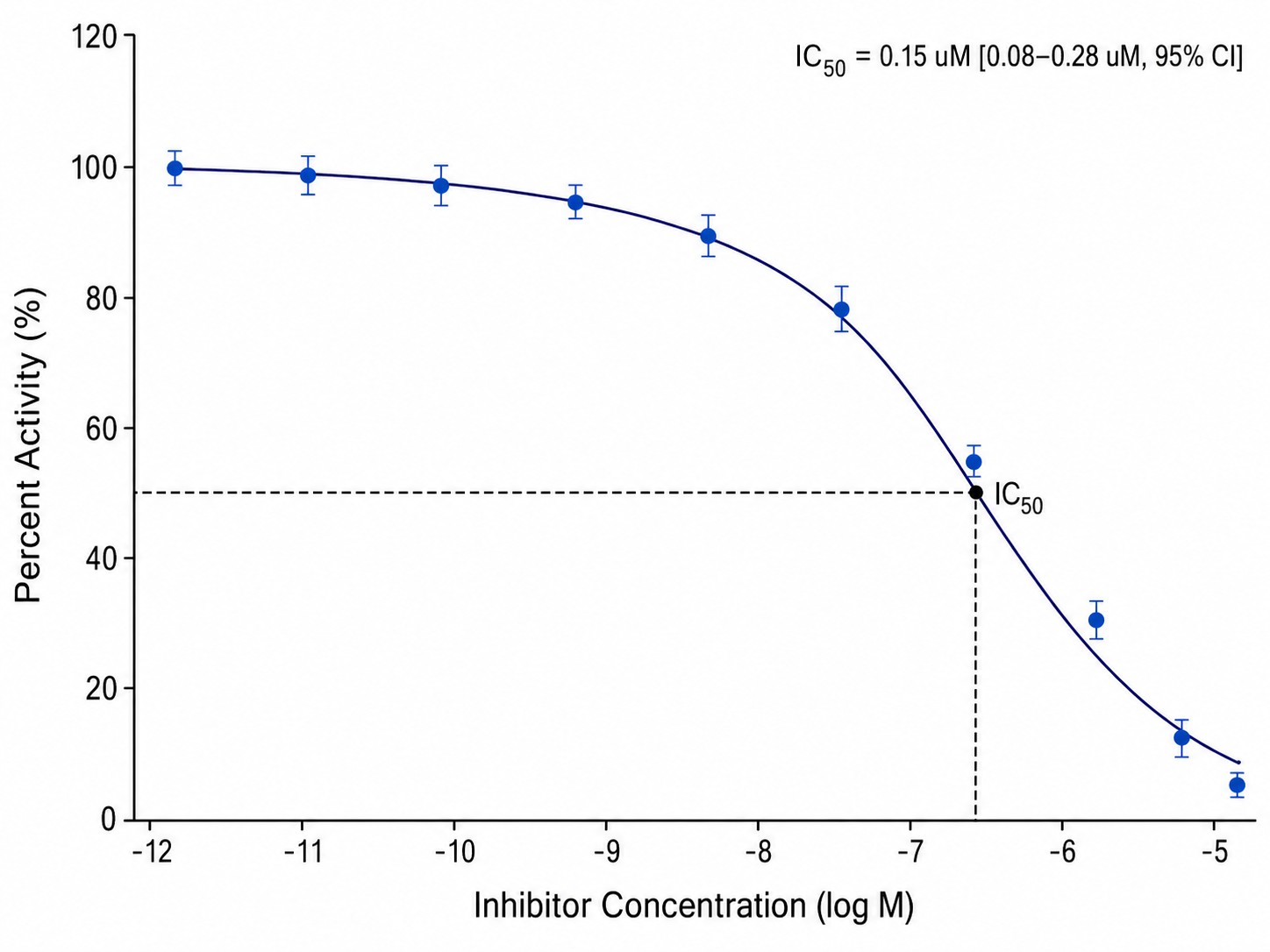
RapidFire-MS IC50 dose-response curve showing inhibitor concentration versus percent activity with four-parameter logistic fit.

Example: IC50 Determination by RapidFire-MS

A representative 10-point dose-response curve generated by RapidFire-MS for a kinase inhibitor. Each data point represents a single 5-second RapidFire injection. The IC50 value is calculated by four-parameter logistic fit with 95% confidence intervals.

Case Study: RapidFire-MS for High-Throughput ADME Profiling

Wu, X., Wang, J., Tan, L., Bui, J., Gjerstad, E., McMillan, K., Zhang, W. In Vitro ADME Profiling Using High-Throughput RapidFire Mass Spectrometry: Cytochrome P450 Inhibition and Metabolic Stability Assays . Journal of Biomolecular Screening 17(6), 761–772 (2012).

Background

Early ADME profiling is essential in drug discovery because compounds with poor metabolic stability or drug-drug interaction risk can fail later in development. Conventional LC-MS methods provide quantitative information but can become a throughput bottleneck when large compound sets need to be evaluated across multiple ADME assays.

Methods

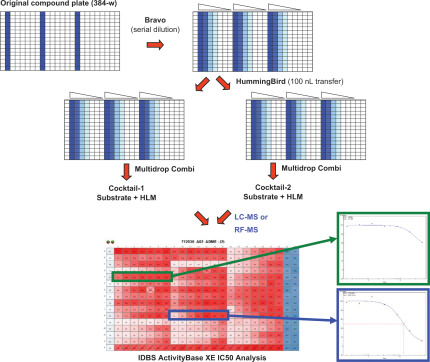
Wu et al. integrated a RapidFire system with an API4000 mass spectrometer to establish a high-throughput RF-MS workflow for in vitro ADME profiling. The platform was used to develop and optimize cytochrome P450 inhibition assays, time-dependent inhibition assays, and microsomal stability assays, enabling parallel evaluation of ADME endpoints alongside biochemical and cellular characterization.

Results

The RapidFire-MS workflow supported profiling of more than 100 compounds per week and produced data consistent with classic LC-MS methods. Compared with conventional LC-MS workflows, the RF-MS system delivered approximately a 20-fold increase in throughput. The authors also noted an important limitation: because RapidFire-MS does not provide full chromatographic separation of compounds, substrates, and metabolites, a small number of cases may require additional interpretation or follow-up confirmation.

Conclusions

This study demonstrates how RapidFire-MS can accelerate quantitative ADME profiling while preserving mass spectrometry-based analyte specificity. For drug discovery teams, the work supports the use of RapidFire-MS as a high-throughput platform for CYP inhibition, time-dependent inhibition, and microsomal stability assays, especially when rapid compound triage is required before deeper LC-MS confirmation.

RapidFire-MS ADME profiling workflow showing plate-based sample input, automated SPE cleanup, MS detection, and throughput comparison.

Representative RapidFire-MS workflow for high-throughput ADME profiling and compound triage.

FAQ

Frequently Asked Questions

Q: What is RapidFire-MS and how does it differ from conventional LC-MS?

RapidFire-MS replaces the LC column with an automated SPE cartridge, reducing cycle time from 3–5 minutes to 2–10 seconds per sample. It is designed for ultra-high-throughput applications where chromatographic separation is not required.

Q: What types of assays are compatible with RapidFire-MS screening?

RapidFire-MS supports ADME profiling (metabolic stability, CYP inhibition, permeability), enzyme kinetics (kinase, protease, phosphatase assays), and direct binding detection. Essentially any assay where a small molecule analyte can be detected by MS.

Q: How fast is RapidFire-MS compared to traditional LC-MS methods?

RapidFire-MS achieves 2–10 seconds per sample, compared to 3–5 minutes for conventional LC-MS. This represents a 20–100× throughput improvement, enabling >10,000 samples per day.

Q: What are the sample requirements for RapidFire-MS analysis?

Samples are prepared in standard 96- or 384-well plates. Typical volume is 10–50 µL per well with DMSO concentration ≤1%. No offline sample cleanup is required — the RapidFire SPE cartridge handles desalting automatically.

Q: Can RapidFire-MS be used for both ADME profiling and enzyme kinetics?

Yes. The same RapidFire platform supports both applications by simply changing the SPE method and MS acquisition parameters. This versatility makes it a cost-effective single-platform solution for discovery-stage screening.

Q: How does RapidFire-MS compare with other ultra-high-throughput MS platforms like AEMS?

RapidFire-MS uses SPE-based sample cleanup with ESI-MS detection, while AEMS uses acoustic droplet ejection with open-port interface MS. RapidFire-MS is better suited for assays requiring SPE cleanup; AEMS offers even faster cycle times (<2 s) for direct-infusion compatible samples.

Reference

  1. Haslam, C., et al. Ultra-high-throughput mass spectrometry in drug discovery. Expert Opin Drug Discov 19, 159–168 (2024).
  2. Bretschneider, T., et al. RapidFire BLAZE-Mode Is Boosting ESI-MS Toward High-Throughput-Screening. SLAS Technol 24, 386–393 (2019).
  3. Winter, M., et al. Advances in high-throughput mass spectrometry in drug discovery. EMBO Mol Med 15, e14850 (2023).

Start Your RapidFire-MS Project with MassTarget™

Share your assay requirements and compound details and our scientists will design a tailored RapidFire-MS screening strategy for your discovery program.

Online Inquiry

Please submit a detailed description of your project. We will provide you with a customized project plan to meet your research requests. You can also send emails directly to for inquiries.

* Email
Phone
* Service & Products of Interest
Services Required and Project Description