Pharmaco-metabolomics Service — Integrated Drug, Metabolite & Endogenous Metabolome Profiling

Connecting metabolic phenotype with pharmacokinetic and pharmacodynamic outcomes through dual-platform LC-MS pharmaco-metabolomics.

Pharmaco-metabolomics sits at the intersection of drug metabolism science and systems biology. Unlike conventional metabolomics, which profiles the endogenous metabolome in isolation, or standard ADME studies, which track only the parent drug and its known metabolites, pharmaco-metabolomics captures all three dimensions simultaneously — the parent drug, its Phase I/II metabolites, and the broad endogenous metabolome — from a single biological sample.

At Creative Proteomics, our pharmaco-metabolomics service is designed for drug discovery teams who need to understand not just where a drug goes, but what it does to the metabolic network. By combining targeted quantification on triple-quadrupole MS with untargeted high-resolution accurate-mass profiling, we deliver a complete metabolic picture that supports candidate selection, toxicity mechanism elucidation, biomarker discovery, and translational study design.

Key Advantages:

  • Simultaneous profiling of parent drug, drug metabolites, and endogenous metabolites from a single injection.
  • Dual-platform LC-MS approach: QqQ (targeted MRM quantification) + Orbitrap/QToF (untargeted HRMS profiling).
  • Seamless integration with existing PK/PD study designs — no additional animal cohorts required.
  • Metabolite identification at MSI Level 1/2 confidence with library matching and isotopic pattern confirmation.
  • Experienced DMPK and metabolomics scientists delivering interpretable, publication-ready results.
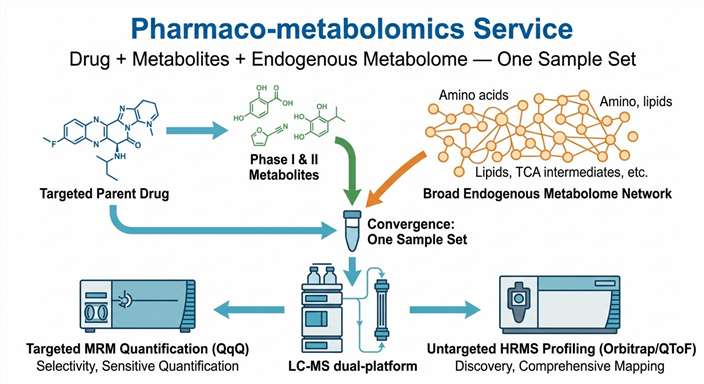
Pharmaco-metabolomics dual-platform LC-MS profiling workflow
When Needed Workflow Capabilities Applications Sample Case Study FAQ

When Do Drug Discovery Teams Need Pharmaco-metabolomics?

Pharmaco-metabolomics is not a routine add-on — it is a targeted investigative tool deployed when standard ADME or metabolomics data leave critical questions unanswered.

Scenario 1: PK/PD disconnect. Drug exposure levels appear adequate, yet the expected pharmacodynamic effect is absent or variable. Standard PK data cannot explain the gap. Pharmaco-metabolomics reveals whether the drug is perturbing the expected metabolic pathways, whether competing metabolic routes are being activated, or whether pre-existing metabolic phenotypes are modulating drug response. A study by Phapale (2021) demonstrated that integrating metabolomics into PK workflows can identify pre-dose metabolite signatures that predict post-dose drug exposure and response, offering a mechanistic explanation for PK/PD variability that conventional bioanalysis cannot provide.

Scenario 2: Unexplained preclinical toxicity. A candidate shows target-organ toxicity in rodent or non-rodent studies, but the mechanism is unclear. Pharmaco-metabolomics maps drug-induced metabolic perturbations — altered energy metabolism, oxidative stress markers, lipid dysregulation, or amino acid pathway disruption — that point to the underlying toxicological mechanism. This metabolic context is often the difference between advancing a candidate with a known risk profile and terminating a programme without understanding why.

Scenario 3: Candidate differentiation during hit-to-lead. When multiple chemical series show comparable in vitro potency and similar PK profiles, the metabolic phenotype becomes a differentiator. Which candidate causes fewer off-target metabolic perturbations? Which one shows a cleaner metabolic footprint? Pharmaco-metabolomics provides the data to make this call objectively.

Scenario 4: Individual variability in drug response. Pre-dose metabolic profiling can stratify subjects or animals by their baseline metabotype, predicting who will be a responder, a non-responder, or at risk of adverse events. This approach, termed "PM-informed pharmacogenomics" by Phapale, uses the metabolome as a phenotypic readout that captures gene–environment interactions that genotype alone cannot resolve.

Our Pharmaco-metabolomics Workflow

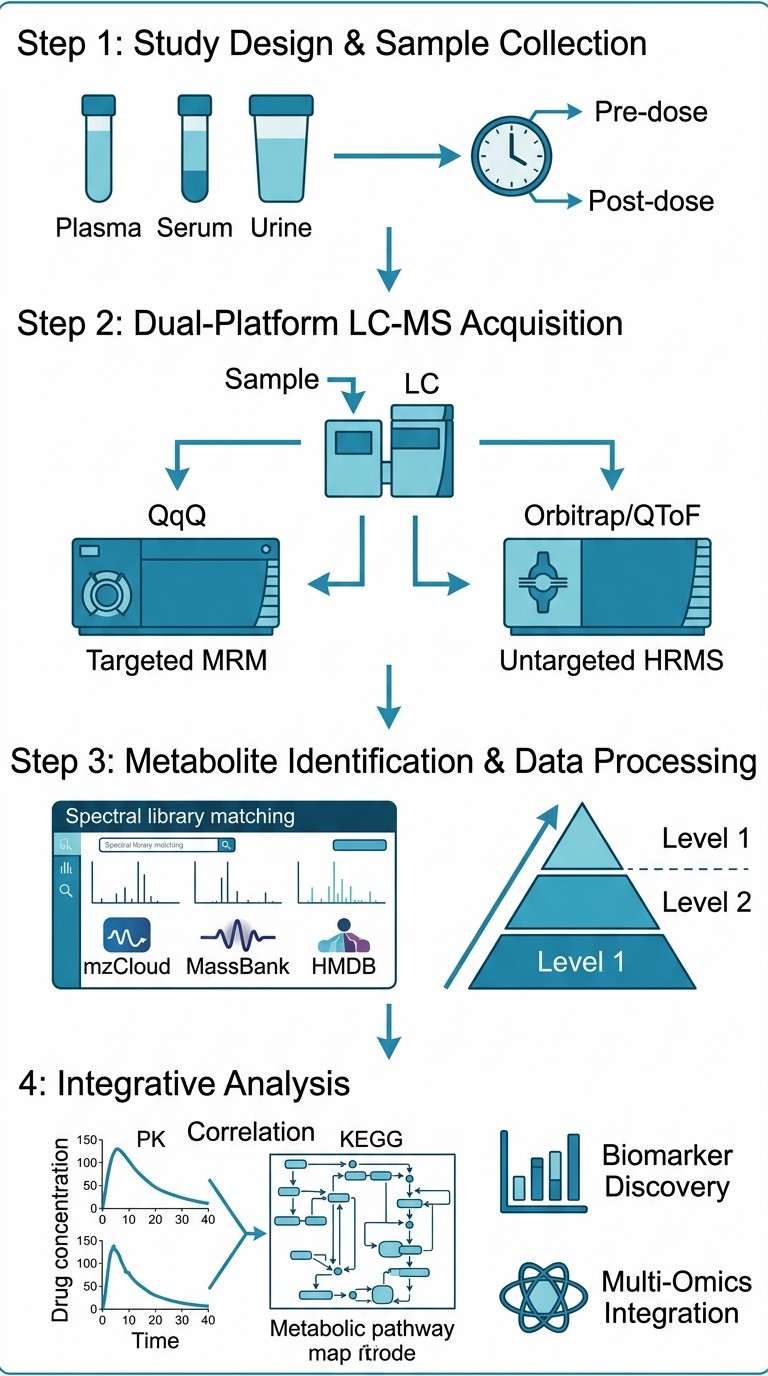
Our pharmaco-metabolomics workflow is designed to integrate seamlessly into existing preclinical and early clinical study designs. The four-stage process ensures comprehensive data capture while maintaining alignment with ICH M10 bioanalytical method validation principles.

1

Study Design and Sample Collection

We work with your team to define the sampling schedule: pre-dose (baseline), multiple post-dose time points aligned with your PK curve, and optional follow-up samples for late metabolic effects. Sample types accepted include plasma, serum, urine, tissue homogenates, CSF, and cell lysates. All samples are collected, processed, and stored under controlled conditions to preserve metabolic integrity.

2

Dual-Platform LC-MS Acquisition

Each sample undergoes parallel analysis on two complementary platforms: targeted quantification (QqQ, MRM mode) for parent drug and up to 50 known or predicted metabolites against stable isotope-labelled internal standards; and untargeted profiling (Orbitrap/QToF, full scan + DDA/DIA MS/MS) capturing 500–2,000 metabolic features per sample.

3

Metabolite Identification and Data Processing

Untargeted features are processed through a multi-tier identification pipeline: MS/MS spectral library matching (mzCloud, MassBank, HMDB, in-house libraries), retention time and isotopic pattern confirmation, Level 1 identification (authentic standard match) where available, and Level 2 identification (MS/MS spectral match) for the remainder. Targeted data are processed through quantitative workflows with batch QC and calibration curve acceptance.

4

Integrative Analysis

The final analytical stage connects the three data layers: pharmacokinetic–metabolome correlation (which endogenous metabolites track with drug exposure?), pathway enrichment mapping (which metabolic pathways are perturbed by drug treatment?), biomarker discovery (which pre-dose metabolites predict post-dose response or toxicity?), and optional multi-omics integration with proteomics or transcriptomics data from the same study.

Four-stage pharmaco-metabolomics workflow diagram

Key Analytical Capabilities

Our pharmaco-metabolomics platform integrates targeted and untargeted mass spectrometry to deliver comprehensive metabolic coverage from a single study design. The table below summarises the core analytical capabilities available across our dual-platform LC-MS workflow.

CapabilityPlatformWhat It Delivers
Targeted drug + metabolite quantificationQqQ (MRM)Absolute concentration of parent drug and up to 50 known/predicted metabolites
Untargeted metabolome profilingOrbitrap/QToF (HRMS)500–2,000 metabolic features per sample, unbiased coverage
Simultaneous acquisitionDual-platform LC-MSDrug, drug metabolites, and endogenous metabolites from one sample set
Stable isotope normalizationQqQ + HRMSInternal standard-corrected quantification across all data layers
Metabolite identificationMS/MS library + in-houseLevel 1 (standard match) or Level 2 (spectral match) confidence
PK–metabolome correlationBioinformatics pipelineStatistical association between drug exposure and metabolic perturbation
Pathway enrichmentKEGG, HMDB, MetaCycBiological context for observed metabolic changes

Applications in Drug Discovery and Development

Pharmaco-metabolomics provides actionable insights across multiple stages of the drug discovery and development pipeline, from early candidate selection through translational biomarker identification.

Preclinical Candidate Selection

During lead optimisation, pharmaco-metabolomics provides a metabolic phenotype fingerprint for each candidate. Compounds that show minimal perturbation of central energy metabolism, lipid homeostasis, and amino acid pathways are prioritised. Those that trigger oxidative stress markers or disrupt mitochondrial metabolism are flagged for mechanistic follow-up.

Toxicity Mechanism Elucidation

When a candidate shows target-organ toxicity, pharmaco-metabolomics identifies the specific metabolic pathways involved. Drug-induced phospholipidosis can be detected through altered lysophospholipid and phospholipid profiles; mitochondrial toxicity manifests as changes in acylcarnitine and TCA cycle intermediate patterns; hepatotoxicity is often preceded by bile acid and glutathione pathway perturbations.

Biomarker Discovery for Efficacy and Toxicity

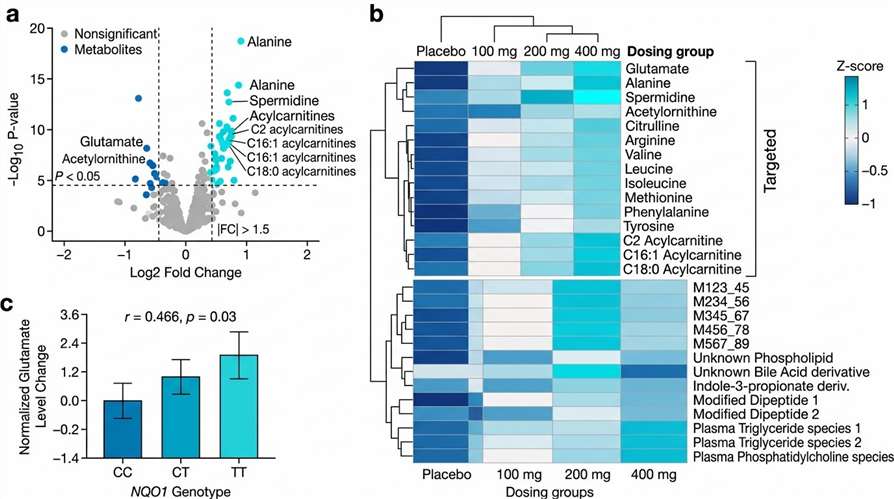
Pre-dose metabolic profiles can identify subjects at risk of adverse events or poor response. A 2025 study by Jang et al. demonstrated this in a first-in-human trial of the β-lapachone derivative WK0202, where pharmaco-metabolomics revealed drug-induced changes in glutamate metabolism, arginine biosynthesis, and lipid metabolism consistent with NQO1-mediated Nrf2 pathway activation.

Drug–Drug Interaction Assessment

By mapping the metabolic pathways affected by a candidate, pharmaco-metabolomics can predict potential DDI risks before clinical combination studies. If a drug perturbs pathways that overlap with the metabolic clearance route of a co-administered drug, that interaction risk is flagged early.

Translational Biomarker Identification

Metabolic biomarkers identified in preclinical models can be validated in early clinical samples using the same analytical platform, providing a direct translational bridge. This reduces the risk of biomarker failure at the preclinical-to-clinical transition.

Sample Requirements

Sample TypeMinimum VolumeRecommended VolumeStorage Condition
Plasma (EDTA/heparin)50 µL200 µL−80 °C
Serum50 µL200 µL−80 °C
Urine100 µL500 µL−80 °C
Tissue homogenate50 mg equivalent100 mg equivalent−80 °C
CSF30 µL100 µL−80 °C
Cell lysate1×106 cells5×106 cells−80 °C

Deliverables

  • Raw data files (RAW format from MS platforms)
  • Processed peak tables with annotated metabolite identifications (Excel/CSV)
  • Quantitative concentration data for targeted analytes (with QC metrics)
  • Multivariate statistical analysis report (PCA, PLS-DA, OPLS-DA)
  • Pathway enrichment maps and KEGG pathway visualisations
  • PK–metabolome correlation plots and statistical summary
  • Full methods section (suitable for regulatory documentation or publication)
  • Project summary report with biological interpretation

Why Choose Creative Proteomics for Pharmaco-metabolomics?

Integrated ADME + Metabolomics Ecosystem

Unlike standalone metabolomics providers, our pharmaco-metabolomics service is embedded within a broader DMPK/PK-PD platform that includes metabolic stability, metabolite identification, bioanalysis, and toxic metabolite detection. This means your pharmaco-metabolomics data can be directly correlated with parallel ADME endpoints from the same study — no cross-provider alignment headaches.

Dual-Platform Coverage

Our QqQ (targeted) and Orbitrap/QToF (untargeted) platforms are operated under a unified QC framework. You get absolute quantification of your drug and its key metabolites alongside unbiased coverage of the endogenous metabolome, all from the same sample set.

Experienced Scientific Team

Our scientists have deep expertise in both DMPK bioanalysis and metabolomics — a combination that is surprisingly rare. This means your pharmaco-metabolomics study is designed, executed, and interpreted by people who understand the pharmacokinetic context, not just the metabolomics.

Transparent Quality Control

Every study includes: pooled QC sample injection throughout the analytical run, blank and extraction blank monitoring, internal standard recovery tracking, replicate analysis (technical and biological where appropriate), and acceptance criteria for all quantitative endpoints.

Regulatory Alignment

Our bioanalytical workflows are aligned with ICH M10 guidelines. While pharmaco-metabolomics is a research-use service, the data generated is suitable for regulatory submission support, preclinical advancement, and publication.

Case Study: Pharmaco-metabolomics in a First-in-Human Trial of a β-Lapachone Derivative

Jang Y, Kang J, Li Y, Chae W, Yang E, Lee S, Cho J-Y. "Pharmacometabolomics uncovers key metabolic changes in the first-in-human study of β-lapachone derivative." Metabolomics 21:122 (2025). https://doi.org/10.1007/s11306-025-02332-1

Background

WK0202 is a β-lapachone derivative designed to activate NQO1, increasing intracellular NAD+ levels and activating the Sirtuin1 pathway for potential use in reducing chemotherapy-induced side effects. As a first-in-human candidate, understanding its systemic metabolic effects was critical before advancing to patient studies.

Methods

A randomised, placebo-controlled, first-in-human trial was conducted in 27 healthy male volunteers. Subjects received daily oral doses of WK0202 (100, 200, or 400 mg) or placebo for 14 days. Plasma samples were collected pre-dose and on Day 15 post-dose. Targeted metabolomics (188 metabolites via Biocrates Absolute IDQ p180 kit on UPLC-MS/MS) and untargeted metabolomics (UPLC-Q Exactive Orbitrap MS) were performed on all samples. Multivariate statistics, pathway enrichment, and genotype–metabolite correlation analyses were applied.

Results

Pharmaco-metabolomics revealed 15 significantly altered metabolites in the targeted panel and 13 in the untargeted panel. Key findings included: decreased glutamate and acetylornithine; increased alanine, spermidine, and short-chain acylcarnitines; and upregulation of DHA, EPA, and multiple phospholipid species. Pathway analysis pointed to Nrf2 pathway activation — consistent with the proposed mechanism. The change in glutamate levels correlated significantly with NQO1 genotype (r = 0.466, p = 0.03), with individuals carrying the low-activity NQO1*2/*2 genotype showing the largest glutamate decrease.

Conclusions

This study demonstrated that pharmaco-metabolomics can map the systemic metabolic effects of a first-in-human candidate, identify mechanism-consistent biomarkers, and reveal genotype–metabolite relationships that would not be apparent from PK data alone. The identified metabolic signatures — particularly in glutamate and lipid metabolism — provide a foundation for patient stratification and efficacy monitoring in subsequent clinical development.

Pharmaco-metabolomics case study plasma metabolite profiling

Study design and pharmaco-metabolomics workflow used in the first-in-human trial of β-lapachone derivative WK0202.

FAQ

Frequently Asked Questions

Q: What is the difference between pharmaco-metabolomics and standard metabolomics?

Standard metabolomics profiles the endogenous metabolome to characterise a physiological or disease state. Pharmaco-metabolomics goes further — it simultaneously analyses the parent drug, its known and unknown metabolites, and the endogenous metabolome, and then correlates these data layers to understand how drug exposure affects metabolic networks and how pre-existing metabolic phenotypes modulate drug response.

Q: Can pharmaco-metabolomics be integrated with existing PK studies?

Yes — this is one of the key advantages. Pharmaco-metabolomics can be layered onto an existing PK study design by collecting additional pre-dose baseline samples and extending the analytical scope of post-dose samples. No additional animal cohorts or clinical visits are required.

Q: What types of biological samples are compatible?

Plasma, serum, urine, tissue homogenates, CSF, and cell lysates are all compatible. The sample volume requirements are modest (50–200 µL for biofluids), making it feasible to add pharmaco-metabolomics endpoints to most preclinical and early clinical studies.

Q: How do you ensure metabolite identification confidence?

We apply a tiered identification strategy aligned with the Metabolomics Standards Initiative (MSI) guidelines. Level 1 identification requires matching to an authentic standard analysed under identical conditions. Level 2 identification uses MS/MS spectral library matching (mzCloud, MassBank, HMDB, in-house libraries) combined with retention time and isotopic pattern confirmation.

Q: What is the typical turnaround time?

For a standard pharmaco-metabolomics study (50–100 samples, targeted + untargeted analysis), the typical turnaround is 6–8 weeks from sample receipt. Timelines are confirmed at project kick-off and depend on study size, complexity, and the number of targeted analytes requiring method development.

Q: Do you provide statistical analysis and pathway interpretation?

Yes — the deliverable package includes full multivariate statistical analysis (PCA, PLS-DA, OPLS-DA), univariate analysis (volcano plots, fold-change, FDR-corrected p-values), pathway enrichment mapping, and a written interpretation report. Optional multi-omics integration is available for studies with parallel proteomics or transcriptomics data.

References

  1. Phapale P. Pharmaco‑metabolomics opportunities in drug development and clinical research. Analytical Science Advances. 2021;2(11-12):611-616. doi:10.1002/ansa.202000178
  2. Jang Y, Kang J, Li Y, Chae W, Yang E, Lee S, Cho J-Y. Pharmacometabolomics uncovers key metabolic changes in the first-in-human study of β-lapachone derivative. Metabolomics. 2025;21:122. doi:10.1007/s11306-025-02332-1
  3. Nijdam FB, et al. Pharmacometabolomics Enables Real-World Drug Metabolism Sciences. Metabolites. 2025;15(1):39. doi:10.3390/metabo15010039
  4. Stolaki EV, Psatha K, Aivaliotis M. Metabolomics and Pharmacometabolomics: Advancing Precision Medicine in Drug Discovery and Development. Metabolites. 2025;15(11):750. doi:10.3390/metabo15110750

Plan a Pharmaco-metabolomics Study with the MassTarget™ Team

Share your drug candidate and study design details, and our scientists will design a tailored pharmaco-metabolomics strategy for your discovery program.

For Research Use Only. Not for use in diagnostic procedures.

Online Inquiry

Please submit a detailed description of your project. We will provide you with a customized project plan to meet your research requests. You can also send emails directly to for inquiries.

* Email
Phone
* Service & Products of Interest
Services Required and Project Description