Target Engagement & Selectivity Profiling Service — Confirm Engagement, Map Selectivity, De-Risk Your Leads

Does your compound actually engage its target in cells? What else does it hit?

A biochemical IC50 tells you your compound can inhibit a purified protein in a buffer. It does not tell you whether the compound reaches that protein inside a cell, whether it engages at concentrations that align with the cellular phenotype, or which other proteins it hits along the way. Answering those questions — quantitatively, in the relevant cellular context, across the expressed proteome — is the function of our Target Engagement & Selectivity Profiling service.

We deploy four orthogonal mass spectrometry platforms — thermal stabilisation assay (PISA/TPP), limited proteolysis-MS (LiP-MS), activity-based protein profiling (ABPP-MS), and photoaffinity labelling MS (PAL-MS) — to deliver cellular engagement evidence and proteome-wide selectivity data for compounds at any stage from hit confirmation to preclinical candidate de-risking. The output is not a single number but an integrated picture: does the compound bind its intended target in cells? At what concentration? For how long? And what else does it engage?

At Creative Proteomics MassTarget, our engagement profiling service is built for medicinal chemistry and lead optimization teams who need to distinguish compounds that merely look good in a biochemical assay from those that actually engage their target in the cellular environment where efficacy must ultimately be achieved. For compounds requiring broader mechanism-of-action contextualisation alongside engagement profiling, our thermal proteomics for MoA service integrates engagement data with downstream pathway analysis.

Key Advantages:

  • Quantitative target engagement in live cells — %TE, cellular IC50, residence time estimates.
  • Proteome-wide selectivity profiling across 5,000–8,000 proteins — not a pre-defined panel.
  • Four orthogonal platforms matched to compound type and project stage.
  • Low compound consumption: 1–5 mg sufficient for full engagement + selectivity campaign.
  • Turnaround: 2–5 weeks depending on platform count and depth.
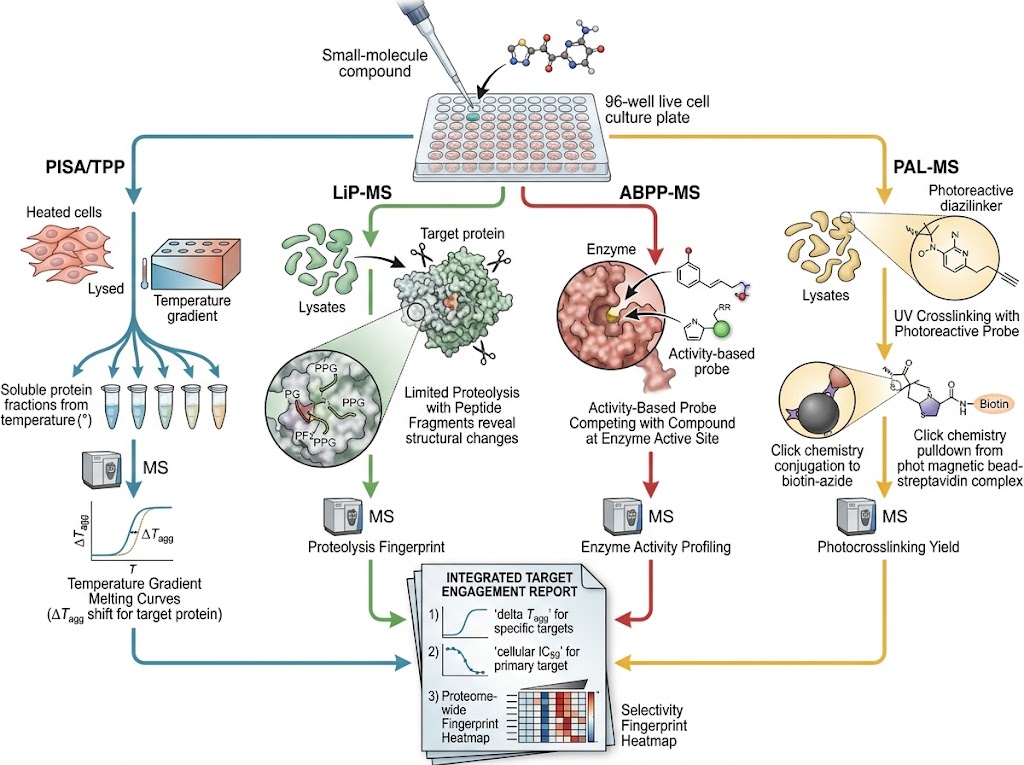
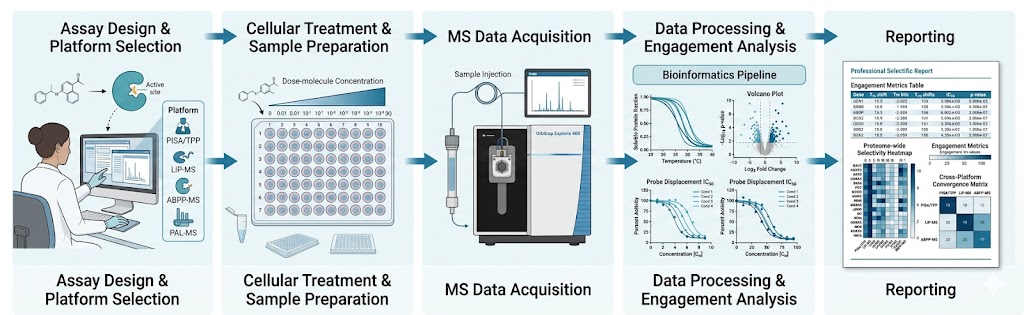
Target engagement and selectivity profiling service overview: compound-treated live cells analysed by four orthogonal MS platforms — PISA/TPP thermal shift, LiP-MS conformational change, ABPP-MS probe competition, and PAL-MS photoaffinity capture — converging on an integrated target engagement and off-target selectivity report for drug discovery teams.
What Is Engagement Profiling Platform Suite Tech Comparison Sample Demo Case Study FAQ

What Is Target Engagement & Selectivity Profiling?

Target engagement profiling answers a binary question with a quantitative dimension: does compound X bind protein Y in a biologically relevant context, and with what potency? The "biologically relevant context" is what distinguishes engagement profiling from conventional biochemical assays. Live cells maintain native ATP concentrations, physiological pH and ionic strength, protein–protein interaction networks, and subcellular compartmentalisation — all of which can profoundly affect whether and how a compound engages its intended target.

Selectivity profiling extends the question to the entire proteome: beyond the intended target, what other proteins does the compound engage? Pre-defined selectivity panels (e.g., a 100-kinase biochemical panel) are useful but inherently limited — they can only detect engagement of proteins that were chosen for the panel. Chemoproteomics-based selectivity profiling measures engagement across the expressed proteome without pre-selection, capturing off-targets that no panel would have predicted but that could cause toxicity in vivo.

The two questions are complementary and often addressed within the same experiment. A PISA/TPP thermal shift experiment simultaneously measures engagement of the intended target (stabilisation at the expected concentration) and maps all other proteins whose thermal stability changes upon compound treatment — providing a single-experiment engagement + selectivity readout.

Why Multi-Platform Engagement Profiling Changes the Selectivity Equation

Measures engagement in live cells, not just buffer

Intracellular ATP concentrations (mM range), protein binding, compartmentalisation, and post-translational modifications all shift apparent potency — sometimes by orders of magnitude. Cellular engagement profiling accounts for these factors, delivering potency metrics that reflect the environment where efficacy must be achieved.

Proteome-wide selectivity without pre-selection bias

Fixed-kinase panels and biochemical selectivity assays can only detect off-targets that were chosen for the panel. Chemoproteomics-based profiling measures engagement across 5,000–8,000 expressed proteins without pre-selection, routinely identifying non-kinase off-targets — transporters, metabolic enzymes, structural proteins — that no panel would capture.

Orthogonal platforms for cross-validated confidence

Each platform measures a different physicochemical consequence of drug binding — thermal stability, proteolytic susceptibility, active-site competition, or crosslinking efficiency. When two or more independent methods converge on the same target, the confidence in that assignment far exceeds what any single method can provide.

Quantitative metrics for medicinal chemistry decisions

Engagement profiling delivers cellular IC50 values, thermal shift magnitudes, and occupancy estimates that can be used directly in SAR comparisons alongside biochemical data. The ability to rank-order compounds by cellular engagement potency enables medicinal chemists to select the best candidates for advancement.

Our Engagement & Selectivity Platform Suite

We deploy four primary platforms for target engagement and selectivity profiling, each providing a distinct type of evidence about the compound–proteome interaction landscape. All four platforms are compatible with live-cell treatment, and three of the four require no compound modification whatsoever. Our scientists recommend a platform combination during project design based on compound properties, target biology, and project objectives.

PLATFORM 1

Thermal Stabilisation Assay — PISA/TPP

Drug binding alters the thermal stability of target proteins. Cells treated with compound or vehicle are heated across a temperature gradient; soluble protein fractions are analysed by quantitative DIA-MS to identify proteins that are stabilised or destabilised by compound binding.

  • Engagement metric: thermal shift magnitude (ΔTagg), significance vs vehicle control
  • Selectivity metric: number and identity of all significantly shifted proteins across the proteome
  • Cellular IC50: derived from concentration-response thermal shift series
  • Proteome coverage: 5,000–8,000 proteins per experiment
  • Best for: any soluble compound; completely label-free — no compound modification required; works in live cells, lysates, and ex vivo tissues
  • Our dedicated thermal shift proteomics service deploys the PISA workflow in 96-well format for multiplexed compound profiling
PLATFORM 2

Limited Proteolysis–MS — LiP-MS

Drug binding induces conformational changes that alter the proteolytic susceptibility of target proteins. Limited proteolysis with a broad-spectrum protease, followed by quantitative MS, identifies peptides with altered accessibility — providing both engagement confirmation and structural footprint of the binding event.

  • Engagement metric: peptide-level accessibility change score per protein
  • Selectivity metric: all proteins with significant conformational change across the proteome
  • Binding site evidence: peptide-level localisation of the conformational footprint
  • Proteome coverage: up to 9,000 proteins in human cell lines
  • Best for: allosteric modulators, conformational binders, compounds where thermal shift produces weak or no signal
  • Our LiP-MS service provides peptide-resolution engagement evidence complementary to thermal shift data
PLATFORM 3

Activity-Based Protein Profiling — ABPP-MS

An activity-based probe that labels the active site of a target enzyme family is competed with the test compound. Reduced probe labelling indicates target engagement. The same readout simultaneously reports engagement across all enzyme-family members detected by the probe.

  • Engagement metric: probe displacement IC50 per enzyme site
  • Selectivity metric: full enzyme-family engagement profile with rank-ordered IC50 values
  • Proteome coverage: up to ~60,000 reactive cysteine sites across ~13,000 proteins (HT-ABPP); enzyme-family-specific panels available
  • Best for: covalent inhibitors, enzyme-directed compounds, kinase inhibitor selectivity
  • Our high-throughput ABPP and ABPP-MS services offer multiple probe formats and competition modes
PLATFORM 4

Photoaffinity Labelling MS — PAL-MS

A photoreactive analogue of the compound is UV-crosslinked to its binding proteins in live cells or lysate, enriched via click chemistry–biotin pulldown, and identified by LC-MS/MS. Competitive PAL-MS (compound vs. probe) distinguishes specific from non-specific engagement.

  • Engagement metric: enrichment ratio; competitive displacement IC50
  • Selectivity metric: all competitively displaced proteins across the captured proteome
  • Binding site evidence: crosslinked peptide identification by MS2
  • Proteome coverage: 2,000–6,000 proteins depending on probe properties
  • Best for: non-covalent compounds; compounds amenable to probe synthesis; orthogonal confirmation of thermal shift hits
  • Our photoaffinity labelling MS service includes probe design consultation and synthesis coordination

Integrated Engagement Profiling Workflow

Five stages from compound receipt to integrated engagement and selectivity report:

1

Assay design and platform selection

Compound properties, target biology, and project objectives are assessed. The optimal primary platform (typically PISA/TPP for label-free engagement) and orthogonal confirmation platform are selected. For compounds with no prior SAR or probe chemistry, label-free methods are recommended as the primary approach. This stage takes approximately 1 week and defines the project plan and acceptance criteria.

2

Cellular treatment and sample preparation

Cells are treated with compound at the specified concentration range — single concentration for engagement confirmation (typically 1–10 µM) or 6–8 point dose-response for cellular IC50 determination. Biological triplicates are prepared per condition. For live-cell methods, cells are harvested after compound incubation, washed to remove excess compound, and processed according to the platform-specific protocol. For lysate-based methods, lysate is incubated with compound and processed directly. This stage takes approximately 1 week.

3

MS data acquisition

Samples are analysed on Orbitrap Exploris 480 or Q Exactive HF-X platforms. PISA/TPP uses DIA acquisition across 10 temperature points. ABPP-MS uses TMT or label-free quantification. PAL-MS uses DDA or DIA depending on sample complexity. LiP-MS uses DIA for deep peptide-level coverage across the proteome. Acquisition parameters are optimised for each platform to maximise protein identification depth and quantification precision.

4

Data processing and engagement analysis

Raw MS data are processed through the relevant search and quantification pipeline (Spectronaut, MaxQuant, or Proteome Discoverer). For PISA/TPP, melting curves are fitted per protein; thermal shift magnitude and significance are calculated. For ABPP, probe displacement IC50 values are determined. For LiP-MS, peptide accessibility changes are scored. Statistical analysis identifies significantly engaged proteins with FDR control. Candidates are ranked by effect magnitude, statistical significance, and convergence across replicates.

5

Reporting and data delivery

Deliverables include per-protein engagement metrics (thermal shift magnitude, IC50, significance), proteome-wide selectivity fingerprint (volcano plot, shifted protein list), cross-platform convergence matrix, raw and processed MS data, and a written interpretation report summarising engagement findings, comparison to reference compounds, and recommended follow-up strategy.

Target engagement and selectivity profiling workflow: assay design and platform selection, cellular treatment with compound dose-response, MS data acquisition on Orbitrap platforms, data processing with melting curve fitting and significance calculation, and final reporting with engagement metrics and selectivity fingerprint.

Applications Across Drug Discovery

Target engagement and selectivity profiling is most impactful where the cost of an incorrect potency estimate — or an undetected off-target — is highest.

Lead Optimisation Cellular Engagement Confirmation

Biochemical HTS hits require cellular engagement confirmation before SAR investment. PISA/TPP at a single concentration (10 µM) in the relevant cell line confirms or refutes target engagement within 2–3 weeks, enabling go/no-go decisions based on cellular rather than biochemical activity.

Output: Thermal shift magnitude per target; cellular engagement confirmation with statistical confidence; go/no-go recommendation for compound series advancement.

Kinase Inhibitor Selectivity Profiling

Kinase inhibitor programs routinely generate compounds with excellent biochemical potency but unanticipated cellular off-targets. PISA/TPP provides a proteome-wide selectivity fingerprint at each optimisation cycle, while ABPP-MS delivers family-level engagement profiles across the kinome with site-specific resolution.

Output: Proteome-wide off-target landscape; kinase-family engagement heatmap; cellular IC50 values for on-target and off-target kinases.

Covalent Inhibitor Target Engagement and Occupancy

Covalent inhibitors require measurement of target occupancy over time, not just equilibrium binding. ABPP-MS measures probe displacement as a function of time and concentration, providing %TE and residence time estimates in live cells.

Output: Time-resolved target occupancy curve; %TE at defined time points; irreversible engagement confirmation by washout resistance.

PROTAC and Molecular Glue Ternary Complex Confirmation

PROTAC-induced ternary complex formation can be detected by PAL-MS (capturing the complex via the PROTAC probe) and by PISA/TPP (detecting thermal destabilisation of the neo-substrate undergoing degradation). Our ubiquitinomics service provides complementary ubiquitin remnant profiling for degradation confirmation.

Output: Ternary complex constituents; degradation signature profile; E3 ligase–neo-substrate pair identification.

Fragment-to-Lead Cellular Engagement Confirmation

Fragment hits from NMR or SPR are typically weak (mM–µM Kd) and require cellular confirmation before fragment elaboration investment. PISA/TPP at high fragment concentrations captures thermal shifts that confirm target engagement in cells despite weak affinity, providing confidence for fragment-to-lead progression.

Output: Fragment engagement confirmation in live cells; thermal shift magnitude at high concentration; prioritised fragment series for elaboration.

Preclinical Candidate Off-Target De-Risking

Before candidate nomination, a proteome-wide selectivity assessment identifies off-targets that could drive toxicity. PISA/TPP combined with LiP-MS provides cross-platform off-target detection with orthogonal confidence, ensuring that off-target risks are understood before preclinical advancement.

Output: Cross-validated off-target list; off-target engagement magnitude and statistical confidence; prioritised targets for downstream toxicity risk assessment.

Technology Comparison: Chemoproteomics Engagement Profiling vs Alternative Approaches

ApproachContextProteome CoverageThroughputCompound RequiredEngagement Quantified?
PISA/TPP (this service)Live cells or lysate5,000–8,000 proteins1–3 weeks1–5 mgYes — ΔTagg, cellular IC50
Biochemical IC50 (purified protein)Buffer only1 protein1 dayµgNo cellular context
Kinase panel (DiscoverX, NanoBRET)Live cells or lysate100–350 kinases1–2 weeks1–5 mgPre-defined panel only; misses non-kinase off-targets
SPR/BLIPurified protein1 protein1–2 daysµgNo cellular context
Western blot thermal shiftLive cells1 protein at a time1–2 weeks1–5 mgSingle-target only

For projects requiring deeper kinase-family selectivity profiling with dedicated probe panels, our high-throughput ABPP platform provides site-resolved engagement data across the expressed kinome. For label-free thermal shift screening at single-protein resolution, our thermal shift proteomics service delivers standalone PISA/TPP workflows.

Sample Requirements

ComponentFormat OptionsRecommended InputMinimum InputKey Notes
Compound (test article)Powder or DMSO stock5–10 mg (or 10 mM stock, 100 µL)1 mg (or 5 mM stock, 50 µL)Provide MW, purity, known solubility; note any light/oxygen/moisture sensitivity; avoid TFA >0.05%
Cell line (live-cell methods)Adherent or suspension; frozen pellet2 × 107 cells per condition (triplicate)5 × 10⁶ cells per conditionProvide cell type, passage number, culture conditions; confirm compound permeability; coordinate treatment timeline
Target informationProtein name, gene symbol, known modifiersTarget ID and known biochemical IC50Target ID onlyEnables focused engagement analysis; not required for unbiased selectivity profiling
Reference inhibitor (positive control)10 mM DMSO stock≥ 50 µL10 µLKnown target binder recommended as positive control for assay validation; provide target identity and IC50 if available
Activity-based probe (ABPP only)Synthesised probe100 µL at 100 µMDiscuss with teamProbe design and synthesis can be coordinated through our service; provide SAR data for probe-bearing analogue if available

All samples should be shipped on dry ice with completed sample submission forms. Biological triplicates are recommended for all quantitative comparisons; minimum two independent biological replicates for publication-grade data. For compounds that degrade on thawing or are light-sensitive, discuss cold-chain and handling requirements with our team before shipment.

Deliverables

  • Engagement report per target: thermal shift magnitude (ΔTagg), significance (p-value), cellular IC50 from dose-response series (when applicable), % target occupancy (for covalent inhibitors)
  • Proteome-wide selectivity fingerprint: volcano plot showing all significantly shifted proteins, ranked off-target list with effect magnitude and statistical confidence, kinase-family engagement heatmap (for kinase inhibitors)
  • Cross-platform convergence matrix: comparison of engagement calls across orthogonal methods with concordance scoring
  • Raw MS data: full .raw or .mzML files for independent re-analysis or regulatory submission
  • Processed quantification tables: protein-level and peptide-level quantification with statistical metrics per method
  • QC report: protein coverage depth, CV distribution, Z-factor per plate, replicate correlation, method-specific quality metrics
  • Written interpretation report: integrated summary of engagement and selectivity findings, comparison to reference compounds, and recommended follow-up strategy including follow-up validation priorities

Representative Results

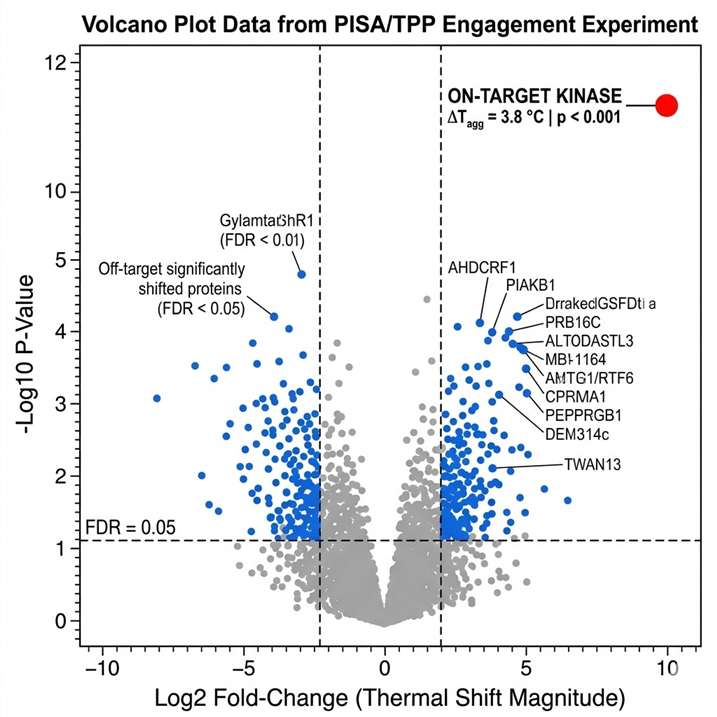
PISA/TPP thermal shift volcano plot from a live-cell kinase inhibitor engagement experiment, showing log2 fold-change on x-axis versus -log10 p-value on y-axis, with on-target kinase highlighted in red and significantly shifted off-target proteins in blue.

PISA/TPP thermal shift engagement: volcano plot from live-cell profiling

PISA/TPP screen of a clinical-stage kinase inhibitor in live K562 cells at 1 µM identified the intended kinase target with a thermal shift of ΔTagg = 3.8°C (p < 0.001) and 17 additional significantly shifted proteins (FDR < 0.05). The volcano plot reveals a clear separation between the on-target hit (red) and background (grey), with off-target proteins (blue) distributed across the effect-size range. Triplicate measurements per condition; Z-factor = 0.71 for the plate series.

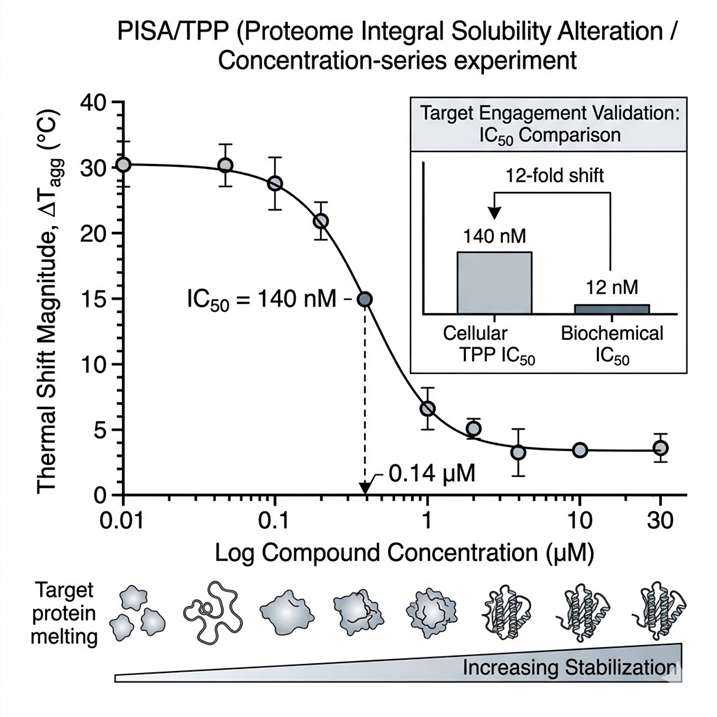
Cellular IC50 dose-response curve from PISA/TPP thermal shift concentration series, showing thermal shift magnitude on y-axis versus log compound concentration on x-axis, with four-parameter logistic fit and IC50 annotation.

Cellular IC50 determination: thermal shift concentration-response

Eight-concentration dose-response PISA/TPP experiment (0.01–30 µM) for a lead optimisation compound against its intended kinase target in live HCT116 cells. Thermal shift magnitude (ΔTagg) plotted against log compound concentration, fitted with a four-parameter logistic curve. Cellular IC50 = 140 nM (95% CI: 80–240 nM), compared to biochemical IC50 of 12 nM — a 12-fold rightward shift attributable to intracellular ATP competition and protein binding. The concentration-dependent thermal shift confirms on-target engagement at pharmacologically relevant concentrations.

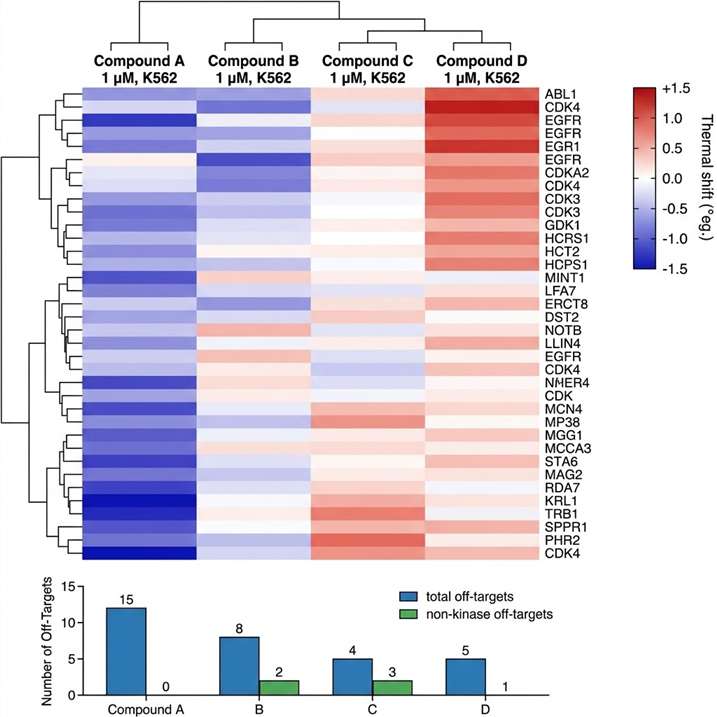
Proteome-wide selectivity fingerprint heatmap showing thermal shift magnitude for all significantly shifted proteins across a panel of four kinase inhibitors at 1 microM, with hierarchical clustering by shift pattern revealing compound-specific off-target profiles.

Selectivity fingerprint: multi-compound proteome-wide thermal shift heatmap

Proteome-wide selectivity comparison of four clinical-stage kinase inhibitors at 1 µM in K562 cells. The heatmap displays all 42 proteins that showed significant thermal shift (FDR < 0.05) in at least one of the four compound treatments, with hierarchical clustering on both compounds and targets. Each compound exhibits a distinct selectivity fingerprint: two compounds show highly selective profiles (≤5 off-targets), while the other two engage 12–18 off-targets including non-kinase proteins — information that is invisible to fixed kinase panels and that directly informs candidate differentiation.

Case Study: Live-Cell Kinase Inhibitor Target Engagement and Selectivity Profiling by Thermal Stabilisation Assay

Glocker U.M., Braun F., Eberl H.C., Bantscheff M. "A probe-based target engagement assay for kinases in live cells." Molecular & Cellular Proteomics 2025;24(5):100963. https://doi.org/10.1016/j.mcpro.2025.100963 PMCID: PMC12076712.

Background

Kinase inhibitor development has long relied on biochemical IC50 values from purified kinase domain assays for SAR decisions. However, intracellular ATP concentrations (mM range vs. µM in biochemical assays), compound permeability, protein binding, and kinase localisation can all shift apparent potency — sometimes by orders of magnitude. A method that measures kinase engagement directly in live cells, without compound modification, would provide a more translationally relevant potency metric for medicinal chemistry optimisation.

Methods

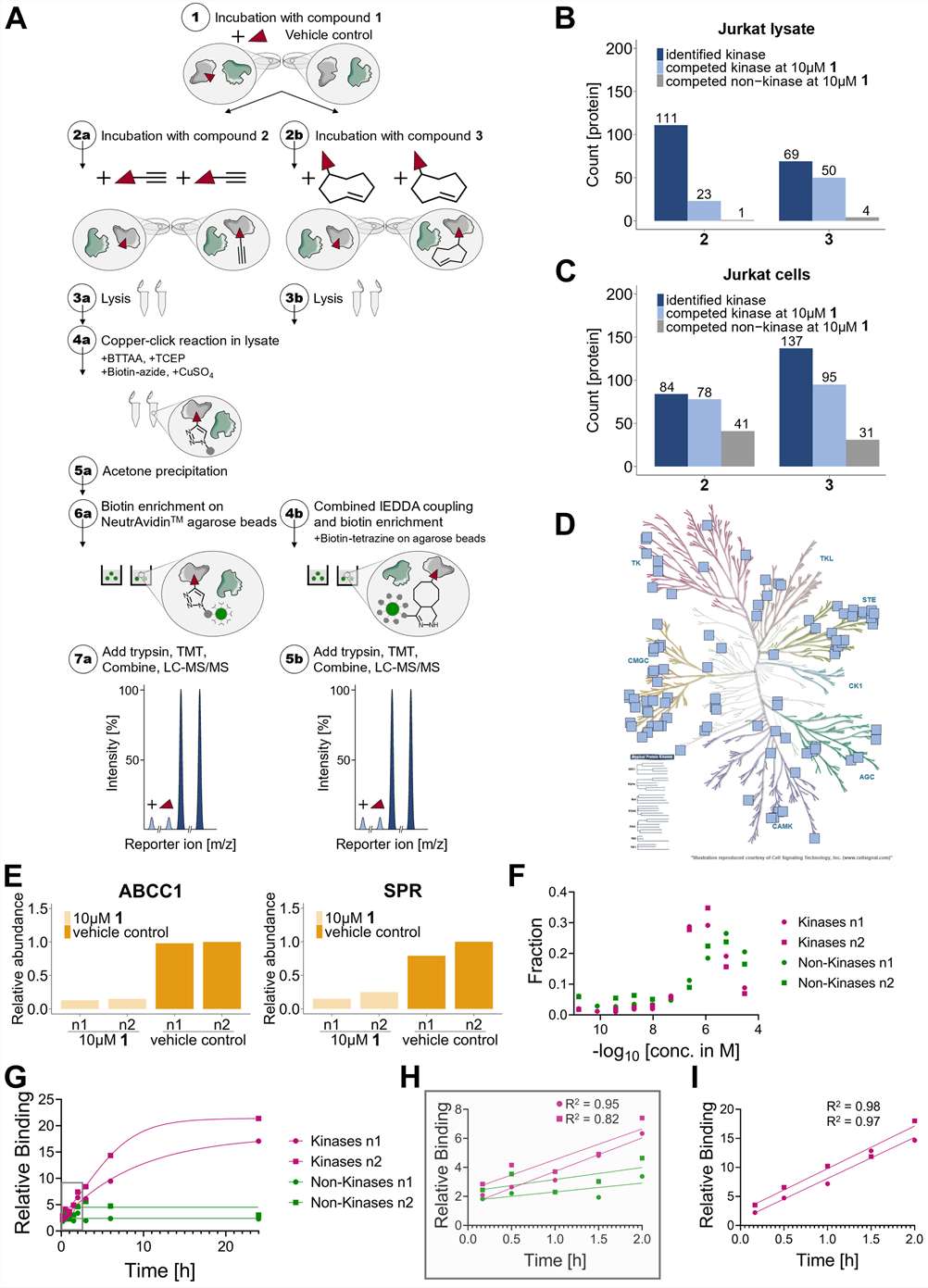
The authors developed an improved cell-permeable covalent probe (XO44 conjugated to a strained trans-cyclooctene via IEDDA bioorthogonal chemistry) that broadly reacts with lysine residues in kinase active sites. Live K562 cells were treated with test compounds (dasatinib, dinaciclib, and others) at eight concentrations in 96-well format, then lysed and labelled with the XO44 probe. Labelled kinases were captured by biotin–streptavidin enrichment and quantified by TMT-based MS. Target engagement was determined as concentration-dependent reduction in probe labelling — yielding cellular IC50 values for each detected kinase. Results were compared head-to-head with lysate-based Kinobeads assays.

Results

The assay quantified cellular IC50 values for 150–200 kinases per experiment. For dasatinib, cellular IC50 values showed excellent rank-order agreement with lysate-based Kinobeads data (Spearman r = 0.94), confirming that cellular engagement profiling recapitulates known selectivity profiles. For dinaciclib, however, cellular IC50 values shifted systematically higher (3–10 fold) compared to lysate measurements, suggesting that intracellular ATP concentration and cell penetration significantly affect engagement of this compound class. The study also identified sepiapterin reductase (SPR) and multidrug resistance protein 1 (ABCC1) as previously unreported off-targets — findings that no pre-defined kinase panel would have captured.

Significance for Target Engagement & Selectivity Profiling

This study demonstrates three principles: first, that cellular target engagement measurements can be quantitatively robust (Spearman r = 0.94 vs lysate) while revealing cell-specific potency shifts that biochemical assays miss; second, that proteome-wide profiling (even with a kinase-directed probe) can identify unexpected off-targets outside the intended enzyme class; and third, that 96-well plate formats enable practical throughput for medicinal chemistry timelines. The approach directly parallels our PISA/TPP and ABPP-MS engagement profiling workflows, which apply the same logic — competition-based quantification in live cells — across broader proteome coverage without requiring a kinase-specific probe.

Figure from Glocker et al. 2025, Molecular & Cellular Proteomics, showing the live-cell kinase target engagement workflow with XO44 probe, cellular IC50 comparison between dasatinib and dinaciclib in live K562 cells vs lysate-based Kinobeads, and identification of SPR and ABCC1 as previously unreported off-targets.

Figure 2 from Glocker et al. 2025 (Mol Cell Proteomics, DOI: 10.1016/j.mcpro.2025.100963, PMC12076712). Live-cell kinase target engagement profiling using the XO44 probe — cellular IC50 comparison between live-cell and lysate formats, demonstrating cell-specific potency shifts and off-target discovery beyond pre-defined kinase panels. CC BY 4.0.

FAQ

Frequently Asked Questions

Q: How is target engagement profiling different from target identification?

Target identification asks "what protein does my compound bind?" — it is a discovery exercise for unknown targets. Target engagement profiling asks "does my compound bind its known/putative target in cells, and what else does it engage?" — it is a confirmation and characterisation exercise for compounds with at least a target hypothesis. The methods overlap, but the experimental design, data analysis, and deliverables are optimised for different questions.

Q: Can you measure target engagement for any compound class?

Most compound classes are compatible with at least one platform. Soluble non-covalent compounds are ideal for PISA/TPP and LiP-MS. Covalent inhibitors are suited to ABPP-MS and PISA/TPP. Compounds with SAR enabling probe synthesis are candidates for PAL-MS. We assess compatibility during project design and recommend the optimal platform combination for each chemical class.

Q: How quantitative is the engagement measurement?

The degree of quantification depends on the platform. PISA/TPP yields a thermal shift magnitude (ΔTagg) that correlates with target occupancy — concentration-response series produce cellular IC50 estimates comparable to biochemical values adjusted for cellular ATP and protein binding. ABPP-MS with probe competition yields IC50 values per enzyme site with typical CV<20%. LiP-MS provides accessibility change scores that are semi-quantitative and best interpreted in rank-order across compound series.

Q: Can your selectivity profiling detect off-targets that a kinase panel would miss?

Yes — and this is one of the primary advantages of chemoproteomics-based profiling. PISA/TPP measures thermal shifts across all expressed proteins without pre-selection. Typical off-target findings include non-kinase enzymes, structural proteins, transporters, and metabolic enzymes that no pre-defined panel would capture but that may be biologically relevant for safety assessment. This proteome-wide view is particularly valuable for preclinical candidate de-risking.

Q: How much compound do you need for a full engagement + selectivity campaign?

A combined PISA/TPP engagement confirmation plus proteome-wide selectivity profiling campaign typically requires 5 mg of compound. A single-concentration engagement screen can be performed with 1 mg. Dose-response cellular IC50 determination requires 3–5 mg depending on the number of concentrations and replicates. We optimise experimental design to extract maximum engagement information from available material.

Q: How long does a project take?

Single-concentration engagement confirmation: 2–3 weeks. Engagement + selectivity (PISA/TPP with dose-response): 3–4 weeks. Full multi-platform campaign (PISA/TPP + LiP-MS or ABPP): 4–5 weeks. Timelines assume cell culture and compound availability. Project timelines are confirmed during the assay design phase and depend on the number of platforms deployed and the complexity of the biological system.

Q: Do I need to provide a specific cell line, or can you use a standard line?

You can provide your own cell line of interest, or we can use standard cell lines (K562, HEK293T, HCT116, HepG2, A549, Jurkat, and others) from our cell culture bank. The choice depends on whether the target is expressed in the standard line and whether the disease biology is best modelled in a specific cellular background. We assess target expression levels and recommend the appropriate cell line during project design.

Q: Can you profile PROTACs or molecular glues with these platforms?

Yes. PROTAC-induced ternary complex formation can be detected by PAL-MS using a photoreactive PROTAC probe, capturing both the E3 ligase and the recruited neo-substrate in a single experiment. PISA/TPP detects the thermal destabilisation signature that accompanies active degradation — a characteristic downward thermal shift of the neo-substrate. These platforms provide complementary evidence for ternary complex formation and functional degradation.

References

  1. Glocker U.M., Braun F., Eberl H.C., Bantscheff M. A probe-based target engagement assay for kinases in live cells. Mol Cell Proteomics. 2025;24(5):100963.
  2. Rüegger J., Gagestein B., Janssen A.P.A., et al. CellEKT: a robust chemical proteomics workflow to profile cellular target engagement of kinase inhibitors. Mol Cell Proteomics. 2025;24(6):100961.
  3. van Bergen W., et al. Site-specific competitive kinase inhibitor target profiling using phosphonate affinity tags. Mol Cell Proteomics. 2025;24(2):100906.
  4. Patel S., Karlsson M., Klahn J.T., et al. Quantitative target engagement of RIPK1 in human whole blood via the cellular thermal shift assay. SLAS Discov. 2024;29(2):100135.

Design Your Engagement Profiling Campaign with the MassTarget Team

Submit your compound and target information — our scientists will recommend the optimal platform combination and design an engagement profiling strategy matched to your project stage and decision timeline.

For Research Use Only (RUO). Not intended for diagnostic, therapeutic, or clinical decision-making purposes. Creative Proteomics services are designed to support preclinical research, drug discovery, and mechanism of action studies only.

Online Inquiry

Please submit a detailed description of your project. We will provide you with a customized project plan to meet your research requests. You can also send emails directly to for inquiries.

* Email
Phone
* Service & Products of Interest
Services Required and Project Description