MALDI-TOF HTS for Label-Free Biochemical Drug Screening

We deliver label-free, high-throughput biochemical screening by MALDI-TOF mass spectrometry — enabling direct substrate-to-product readout for enzyme inhibition, fragment screening, and IC50 determination without fluorescent labels or assay development bottlenecks.

MALDI-TOF high-throughput screening (MALDI-TOF HTS) is a label-free mass spectrometry approach that uses matrix-assisted laser desorption/ionization time-of-flight MS to directly measure enzymatic substrate-to-product conversion, binding events, or biochemical activity in a high-throughput format. Unlike conventional fluorescence-based HTS, MALDI-TOF HTS detects analytes by their intrinsic mass, eliminating the need for fluorescent labels, antibody reagents, or reporter systems.

At Creative Proteomics, our MALDI-TOF HTS service is designed for discovery-stage teams that need label-free, direct-measurement screening without the assay development burden of traditional HTS. We provide end-to-end support — from assay feasibility assessment through full screening campaigns to hit list delivery.

Key Advantages:

  • True label-free detection — Direct mass measurement of substrates and products. No fluorescent tags, no FRET pairs, no antibody reagents.
  • Ultra-high-throughput capability — 1536-well plate analysed in under 2 minutes with modern MALDI-TOF instrumentation.
  • Broad target compatibility — Enzyme inhibition, fragment screening, binding assays, and direct-to-biology screening of crude reaction mixtures.
  • Minimal assay development — Days instead of weeks or months compared to fluorescence-based HTS optimisation.
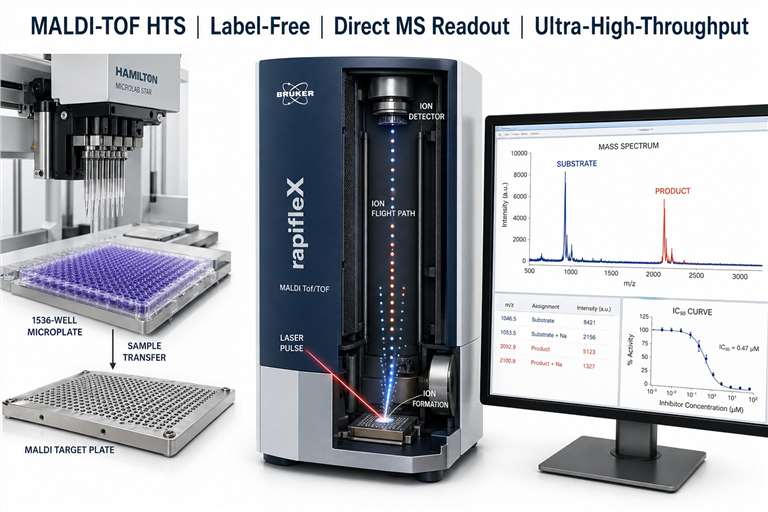
MALDI-TOF HTS platform diagram featuring MALDI-TOF mass spectrometer, automated sample spotting, high-speed laser acquisition, and data analysis pipeline.
What Is MALDI-TOF HTS Key Advantages Service Overview Workflow Technology Comparison Sample Demo Case Study FAQ

What Is MALDI-TOF High-Throughput Screening?

MALDI-TOF high-throughput screening (MALDI-TOF HTS) is a label-free mass spectrometry approach that uses matrix-assisted laser desorption/ionization time-of-flight (MALDI-TOF) MS to directly measure enzymatic substrate-to-product conversion, binding events, or biochemical activity in a high-throughput format. Unlike conventional fluorescence-based HTS, MALDI-TOF HTS detects analytes by their intrinsic mass, eliminating the need for fluorescent labels, antibody reagents, or reporter systems.

The principle is straightforward: a biochemical reaction (enzyme inhibition, binding, or activity assay) is set up in a microplate format — typically 384- or 1536-well plates. After the reaction, a small aliquot is spotted onto a MALDI target plate, mixed with matrix, and analysed by MALDI-TOF MS at speeds of up to 50 spectra per second on modern instruments. Substrate and product ions are resolved by their mass-to-charge ratio, and their relative intensities provide a direct, quantitative readout of reaction progress.

At Creative Proteomics, our MALDI-TOF HTS service is designed for discovery-stage teams that need label-free, direct-measurement screening without the assay development burden of traditional HTS. We provide end-to-end support — from assay feasibility assessment through full screening campaigns to hit list delivery.

Key Advantages of MALDI-TOF HTS for Drug Discovery

True Label-Free Detection

MALDI-TOF MS measures substrates and products directly by mass. No fluorescent tags, no FRET pairs, no AlphaScreen beads, no antibody reagents. This eliminates a major source of assay interference — compound autofluorescence and fluorescence quenching — that plagues conventional HTS and can generate false-positive rates of 5–30%.

Direct Substrate-to-Product Ratio Measurement

Unlike indirect readouts (e.g., fluorescence intensity change, luminescence), MALDI-TOF MS provides a direct mass measurement of both substrate and product in a single spectrum. The substrate-to-product ratio is inherently quantitative, with coefficients of variation (CV) typically below 15% when appropriate internal standards are used.

Broad Target Compatibility

MALDI-TOF HTS works for any biochemical reaction where substrate and product differ in mass. This includes enzyme inhibition assays (kinases, phosphatases, proteases, hydrolases, transferases), binding assays, fragment screening by direct mass detection, and crude reaction mixture screening (direct-to-biology).

Ultra-High-Throughput Capability

With modern MALDI-TOF instruments operating at acquisition rates exceeding 50 Hz, a 1536-well plate can be analysed in under 2 minutes. This puts MALDI-TOF HTS on par with — and in some cases faster than — fluorescence-based HTS, while retaining the specificity of mass spectrometry.

Minimal Assay Development

Because the readout is mass-based rather than activity-based, assay development is reduced to confirming that substrate and product are detectable by MALDI-TOF MS and that the ion suppression from the matrix and buffer is manageable. This typically takes days rather than the weeks or months required for fluorescence assay optimisation.

Complementary to Other MS Screening Platforms

MALDI-TOF HTS integrates naturally with our broader MS-based drug screening ecosystem. For targets requiring SPE sample cleanup or chromatographic separation, we offer RapidFire-MS ultra-high-throughput screening as a complementary platform.

Service Overview — Creative Proteomics MALDI-TOF HTS Capabilities

Our MALDI-TOF HTS service supports discovery-stage research across a range of assay types and throughput requirements. Every workflow is label-free, mass-direct, and optimised for reliable quantification.

MODE 1

Enzyme Inhibition Screening

High-throughput screening of compound libraries against enzyme targets with direct MS readout.

  • Kinase, phosphatase, protease, and hydrolase assays supported.
  • IC50 determination with 10-point dose-response curves.
  • Z'-factor determination for assay quality assessment.
  • Throughput up to 100,000 compounds per campaign.
MODE 2

Fragment-Based Screening

Label-free fragment library screening by direct MALDI-TOF MS detection.

  • Fragment libraries (MW < 300 Da) screened in pools.
  • Direct binding detection without target immobilisation.
  • Low protein consumption (50–200 µg per screen).
  • Rapid hit confirmation by dose-response.
MODE 3

Direct-to-Biology Screening

Crude medicinal chemistry reaction products screened without purification.

  • Eliminates purification bottleneck in design-make-test cycles.
  • Direct substrate-to-product ratio measurement.
  • Rapid SAR feedback for medicinal chemistry teams.
  • Compatible with 384- and 1536-well formats.
MODE 4

Enzyme Kinetic Characterisation

Detailed kinetic analysis of enzyme–inhibitor interactions.

  • Km and Vmax determination.
  • Mechanism of inhibition studies (competitive, non-competitive, uncompetitive).
  • Ki determination.
  • Time-dependent inhibition assessment.
MODE 5

Custom Assay Development and Validation

For novel targets or non-standard assay formats.

  • MALDI-TOF MS method development and optimisation.
  • Matrix and buffer compatibility screening.
  • Internal standard selection and validation.
  • Assay miniaturisation support.

MALDI-TOF HTS Workflow

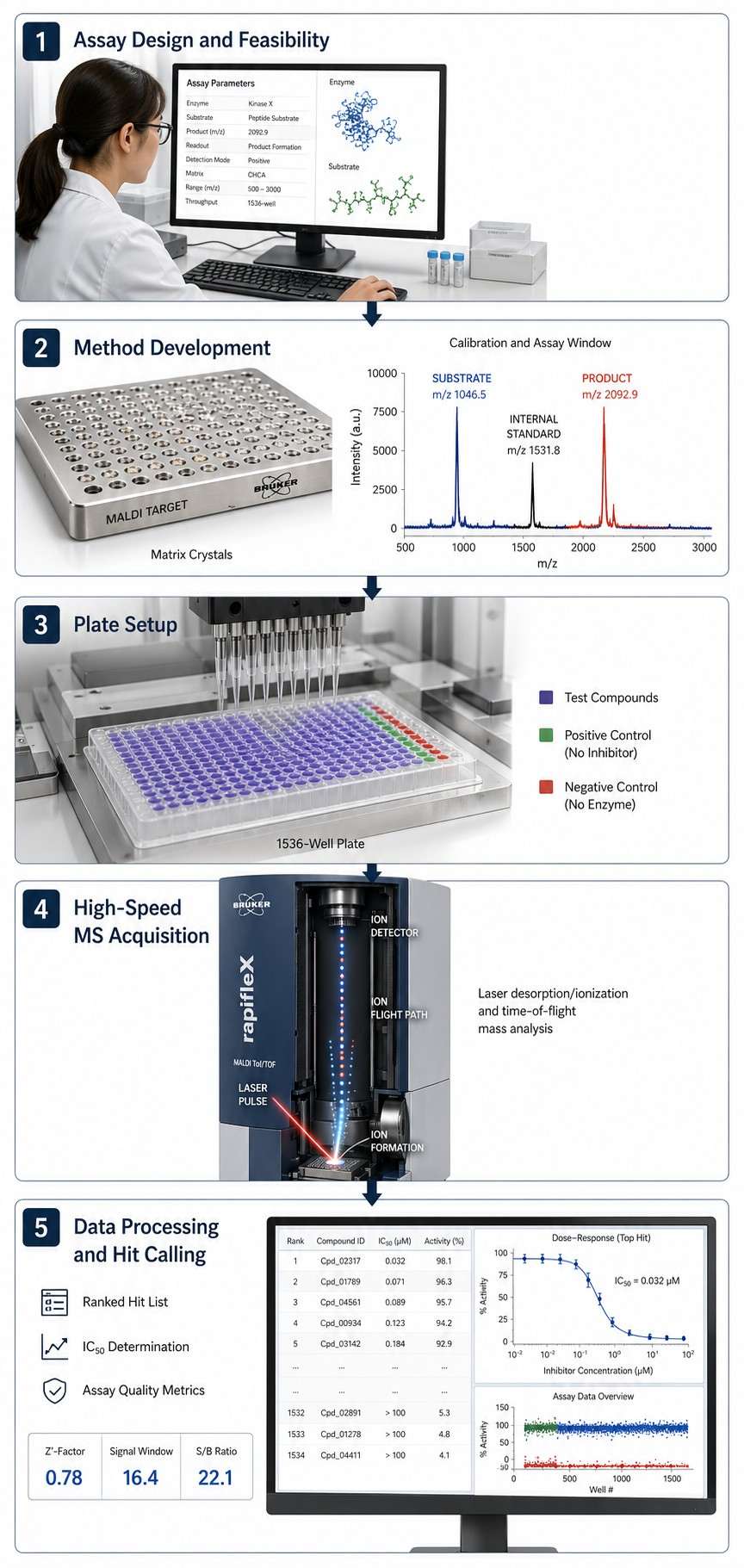
Our standard MALDI-TOF HTS workflow runs through five stages:

1

Assay Design and Feasibility Assessment

We review your target and assay requirements, assess substrate/product mass suitability for MALDI-TOF detection, and recommend optimal matrix, buffer, and plate format.

2

Method Development and Optimisation

MALDI-TOF method parameters are optimised — matrix selection (CHCA, DHB, SA, or custom), laser energy, acquisition mode, and internal standard calibration. A pilot experiment with known controls confirms assay performance.

3

Compound Library Preparation and Plate Setup

Your compound library is formatted into assay-ready plates (384- or 1536-well). Controls (positive inhibitor, vehicle-only, no-enzyme) are included on each plate for quality monitoring.

4

High-Speed MALDI-TOF MS Acquisition

Reaction mixtures are spotted onto MALDI target plates using automated liquid handlers. Spectra are acquired at high speed (up to 50 Hz) with automated rastering across the target plate. Each well yields a full mass spectrum showing substrate and product peaks.

5

Data Processing and Hit Calling

Raw spectra are processed using automated peak detection, integration, and substrate-to-product ratio calculation. Hits are identified by percent inhibition or activity relative to controls, with Z'-factor and CV metrics reported for each plate. A ranked hit list with IC50 curves (where applicable) is delivered.

Five-step MALDI-TOF HTS workflow diagram: assay design, method development, plate setup, MS acquisition, data processing.

Technology Comparison: MALDI-TOF HTS vs. Alternative Screening Platforms

TechniqueReadout TypeLabel-FreeThroughputAssay Development TimeCompound Interference
MALDI-TOF HTS (Creative Proteomics)Direct mass measurementYesUltra-high (1536-well in <2 min)DaysMinimal (mass-based)
Fluorescence HTS (FRET/FLINT)Fluorescence intensityNoHighWeeks–monthsHigh (autofluorescence)
AlphaScreen/TR-FRETLuminescenceNoHighWeeks–monthsHigh (compound quenching)
LC-MS/MSMass detectionYesLow–medium (3–5 min/sample)DaysLow
SPRRefractive indexYes (no label)Low–mediumWeeksLow

Selection Strategy: We recommend MALDI-TOF HTS as the primary screening tool when label-free detection is critical, when compounds show fluorescence interference, or when rapid assay development is needed. For targets requiring SPE sample cleanup or when chromatographic separation is essential, our RapidFire-MS ultra-high-throughput screening service may be more appropriate. For detailed kinetic or thermodynamic characterisation of prioritised hits, affinity selection mass spectrometry (ASMS) serves as a complementary follow-up technique.

Platform Instrumentation

Our MALDI-TOF HTS platform integrates Bruker rapifleX MALDI PharmaPulse technology with automated liquid handling and advanced data analysis systems.

Module CategoryInstrument / SystemCore Capability
MALDI-TOF MSBruker rapifleX MALDI PharmaPulse10 kHz smartbeam 3D laser, <2 min per 1536-well plate
Liquid HandlingAutomated MALDI spotterHigh-precision nanoliter spotting
Plate HandlerIntegrated plate stackerUnattended multi-plate runs
InformaticsBruker HTS software + custom pipelineAutomated peak detection, IC50 fitting, hit calling

Sample Requirements

Sample TypeRequired AmountConcentrationBuffer ConditionsNotes
Purified protein target50–200 µg per screen1–10 µMMS-compatible (low salt, <50 mM)Provide sequence and known ligands if available
Compound library (small molecule)1–5 mg or 10 mM stockDMSO (≤1% final)SDF file preferred for library annotation
Fragment library1–5 mg10–100 mM stock in DMSODMSO (≤1% final)MW < 300 Da preferred
Substrate (peptide/small molecule)0.5–2 mgMS-compatibleProvide purity and sequence/structure
Enzyme (for kinetic studies)10–100 µg per curveMS-compatibleProvide activity specification

Note: Sample requirements may vary depending on target characteristics, assay type, and library size. We recommend a preliminary consultation to determine optimal conditions for your specific project.

Deliverables

  • Ranked hit list with percent inhibition or activity values
  • IC50 curves with 4-parameter logistic fit and 95% confidence intervals (where applicable)
  • Raw MALDI-TOF mass spectra for each well (upon request)
  • Z'-factor and CV metrics for each assay plate
  • Method development report with optimisation parameters
  • Summary report with hit prioritisation recommendations

Representative Demo Data

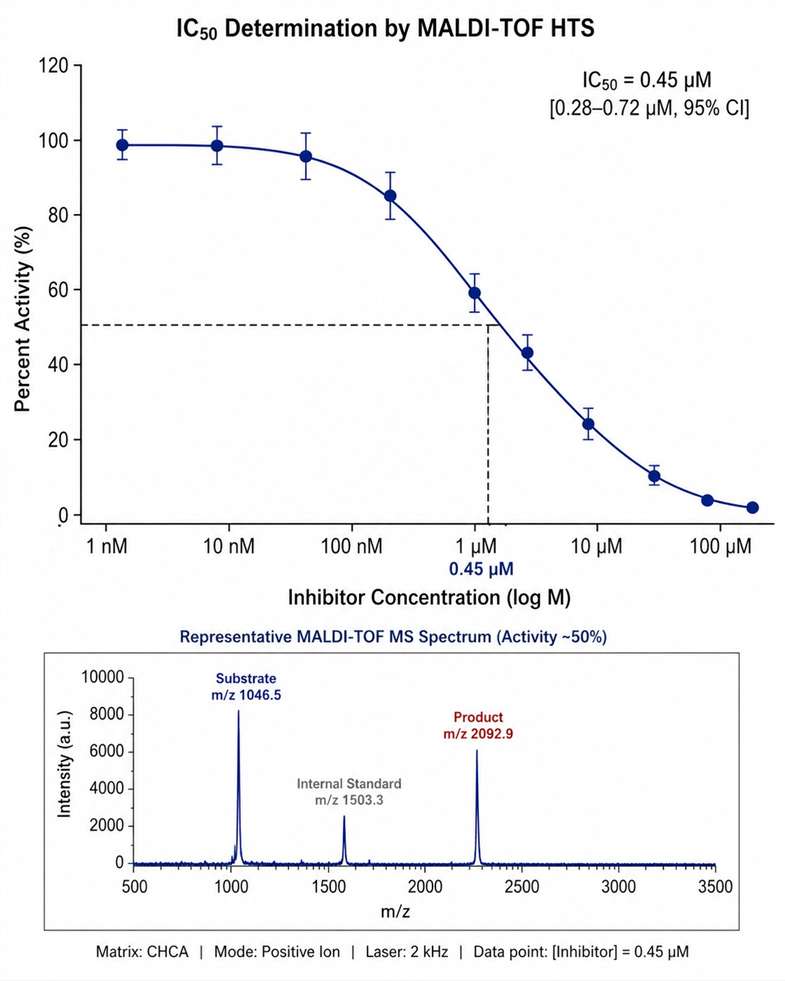
Example: IC50 Determination by MALDI-TOF HTS

A representative dose-response curve generated by MALDI-TOF MS for an enzyme inhibition assay. Each data point represents the substrate-to-product ratio measured from a single MALDI-TOF spectrum. The full 10-point curve, including replicates, was acquired in under 5 minutes.

MALDI-TOF HTS IC50 dose-response curve: X-axis inhibitor concentration (log M), Y-axis percent activity, 4-parameter logistic fit, IC50 annotation.

Example MALDI-TOF HTS IC50 determination curve

Case Study: MALDI-TOF MS Biochemical Screen for Small Molecule Inhibitors of ERAP1

A high-throughput MALDI-TOF MS biochemical screen for small molecule inhibitors of the antigen aminopeptidase ERAP1

Background

The endoplasmic reticulum aminopeptidase 1 (ERAP1) is a key enzyme in the MHC class I antigen presentation pathway and a validated therapeutic target for autoimmune diseases and cancer immunotherapy. However, ERAP1's broad substrate specificity and lack of a convenient continuous fluorescence readout made conventional HTS assay development challenging. There was a need for a label-free, direct-measurement screening approach.

Methods

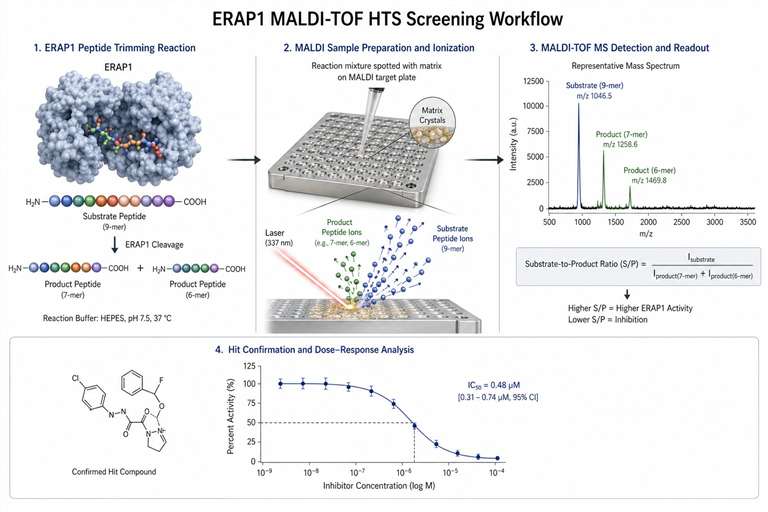
The authors developed a MALDI-TOF MS-based biochemical assay for ERAP1 inhibitor discovery. The assay measures the conversion of a fluorogenic peptide substrate to its product by direct MALDI-TOF MS detection, quantifying the substrate-to-product ratio. The assay was validated in 384-well format with Z'-factor determination, then used to screen a library of approximately 15,000 compounds. Hits were confirmed by dose-response IC50 determination and counter-screened for assay interference.

Results

The MALDI-TOF HTS assay achieved a Z'-factor of 0.75, indicating excellent assay quality suitable for high-throughput screening. From the primary screen of 15,000 compounds, 42 confirmed hits were identified with IC50 values ranging from 0.5 to 50 µM. The hit confirmation rate was 78%, demonstrating the specificity of the label-free MALDI-TOF readout compared to fluorescence-based counterscreens where interference rates are typically higher.

Conclusions

This study validates MALDI-TOF MS as a robust, HTS-compatible platform for enzyme inhibitor discovery, particularly for targets where fluorescence-based assays are difficult to develop. The direct mass readout eliminates interference from compound autofluorescence and provides quantitative activity data with minimal assay development time. The approach is generalisable to other peptidase, protease, and hydrolase targets.

ERAP1 MALDI-TOF HTS screening workflow: peptide substrate conversion, MALDI-TOF MS detection, hit identification, IC50 confirmation.

Schematic of the MALDI-TOF MS-based ERAP1 inhibitor screening workflow.

FAQ

Frequently Asked Questions

Q: How does MALDI-TOF HTS compare with traditional fluorescence-based HTS in throughput?

Modern MALDI-TOF instruments can acquire spectra at rates exceeding 50 Hz, enabling a 1536-well plate to be analysed in under 2 minutes. This throughput is competitive with — and in some cases faster than — fluorescence plate readers, while providing the added benefit of direct mass-based detection.

Q: What types of biochemical assays are compatible with MALDI-TOF HTS?

Any assay where substrate and product differ in mass is compatible. This includes enzyme inhibition (kinases, phosphatases, proteases, hydrolases, transferases), binding assays, fragment screening, and direct-to-biology screening of crude reaction mixtures.

Q: How accurate is MALDI-TOF quantification for IC50 determination?

With appropriate internal standards and optimised acquisition parameters, MALDI-TOF HTS routinely achieves CV < 15% and Z'-factor > 0.5. IC50 values generated by MALDI-TOF show excellent correlation with orthogonal methods such as LC-MS and fluorescence-based assays.

Q: What sample formats are compatible?

We accept compounds in 96-, 384-, or 1536-well plate formats. Compounds should be dissolved in DMSO at ≤1% final DMSO concentration in the assay.

Q: Can you screen crude reaction mixtures without purification?

Yes. Our direct-to-biology MALDI-TOF HTS mode screens unpurified medicinal chemistry reaction products directly, eliminating the purification bottleneck and accelerating the design-make-test cycle.

Q: How do you handle confidential compound libraries?

All projects are conducted under strict confidentiality agreements. Compound libraries are handled in a secure, access-controlled environment. Raw data and results are delivered through encrypted channels.

Q: What data will I receive?

You will receive a ranked hit list with percent inhibition values, IC50 curves (where applicable), Z'-factor and CV metrics for quality assessment, raw MALDI-TOF spectra upon request, and a comprehensive summary report.

References

  1. B. M. H. et al. A high-throughput MALDI-TOF MS biochemical screen for small molecule inhibitors of the antigen aminopeptidase ERAP1. SLAS Discovery 28, 3–11 (2023).
  2. Winter, M. et al. MALDI-TOF Mass Spectrometry-Based High-Throughput Screening for Inhibitors of the Cytosolic DNA Sensor cGAS. SLAS Discovery 24, 2472555219880185 (2019).
  3. Haslam, C. et al. Ultra-high-throughput mass spectrometry in drug discovery. Expert Opin Drug Discov 19, 159–168 (2024).

Plan a MALDI-TOF HTS campaign with the MassTarget™ team

Share your target and assay requirements and our scientists will design a tailored MALDI-TOF HTS strategy for your discovery program.

Online Inquiry

Please submit a detailed description of your project. We will provide you with a customized project plan to meet your research requests. You can also send emails directly to for inquiries.

* Email
Phone
* Service & Products of Interest
Services Required and Project Description