Protein Microarray with MS Readout for Label-Free Target Identification

Proteome-wide target fishing without compound modification — combining protein microarray coverage with mass spectrometry identification power.

Finding the protein target of a bioactive compound is often the hardest part of early drug discovery. Traditional approaches such as pull-down proteomics and chemical proteomics require labeled probes, antibody development, or functional assays — each adding time, cost, and potential artifacts.

At Creative Proteomics, our Protein Microarray with MS Readout service gives you a direct, label-free path from compound to target. We immobilize thousands of individually purified proteins on a single microarray slide, incubate your compound directly, and identify bound proteins by LC-MS/MS — delivering a ranked list of candidate targets with peptide-level evidence.

Key Advantages:

  • No compound modification required — use your molecule as-is, including natural product extracts and crude mixtures.
  • Proteome-wide coverage — 10,000–20,000+ purified proteins screened in a single experiment.
  • MS-based identification — every hit backed by sequenced peptides with FDR-controlled confidence.
  • Works with challenging compounds — covalent binders, fragments, peptides, and unpurified samples.
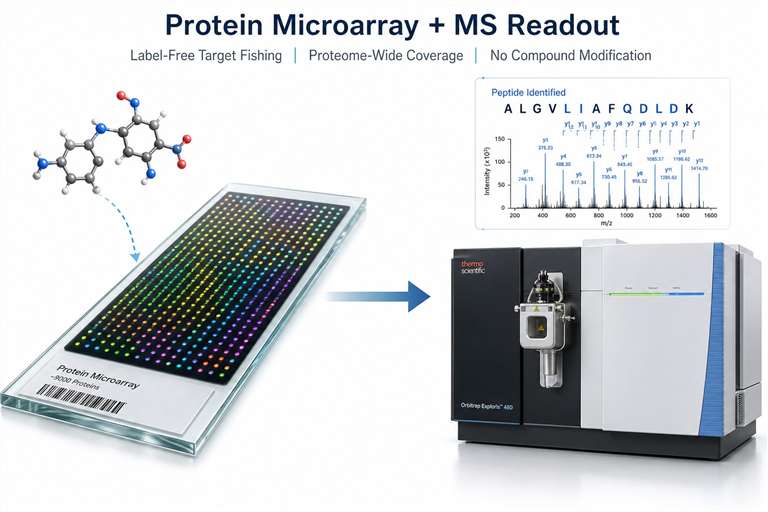
Protein microarray with MS readout workflow diagram showing compound incubation on protein array followed by LC-MS/MS identification.
What Is Protein Microarray + MS How It Works Service Overview Applications Sample Demo FAQ

What Is Protein Microarray with MS Readout?

Protein microarray with MS readout is a label-free target identification platform that combines the broad proteome coverage of functional protein microarrays with the sequence-level identification confidence of mass spectrometry.

Unlike conventional fluorescence-based protein microarrays — which require a labeled compound or a detection antibody — our MS readout approach identifies bound proteins directly by their peptide sequences. This means you get the same gold-standard evidence used across discovery proteomics: multiple sequenced peptides per protein, sequence coverage, and FDR-controlled confidence scoring.

The core principle is straightforward: your compound is incubated on a microarray displaying thousands of individually purified, full-length human proteins. Proteins that bind to your compound remain attached through stringent wash steps. We then digest those bound proteins directly on the chip and identify them by high-resolution LC-MS/MS. The result is an unbiased, proteome-wide snapshot of your compound's protein interaction landscape.

Key Benefits of Protein Microarray with MS Readout

No compound modification needed

Pull-down workflows, ABPP, and photoaffinity labeling all require attaching a biotin, alkyne, or photo-crosslinker to your compound. That synthesis step takes time, can alter binding behavior, and may be impossible for natural product mixtures or scarce compounds. Our approach uses your molecule as-is.

Proteome-wide coverage in one experiment

A single microarray displays 10,000–20,000+ individually purified proteins — covering a large fraction of the human proteome. Unlike pull-downs from cell lysate (where detection skews toward highly expressed proteins), our format gives you unbiased coverage in a single run.

MS-level identification confidence

Fluorescence-based readouts tell you something bound — but only indirectly. MS readout tells you what bound, by sequencing the actual peptides. That's the same confidence standard used in clinical proteomics, with FDR-controlled scoring and sequence coverage for every hit.

Works with challenging compound classes

Natural product extracts, crude synthetic mixtures, fragments, covalent binders, and peptides — none of these need special handling. Because there is no labeling step, the format is compatible with almost any compound chemistry.

Why It Matters for Drug Discovery Teams

For biotech, pharma, and academic groups facing difficult-to-drug targets, complex natural products, or limited time for assay development, protein microarray with MS readout provides a streamlined alternative to conventional target identification workflows. Traditional methods often require months of probe design, synthesis, and validation. Our approach delivers a ranked target list in weeks — with no probe development, no antibody generation, and no compromise on data quality.

How It Works — Protein Microarray + MS Readout Workflow

Our workflow is designed to take you from compound to candidate target list in a clean, reproducible sequence. Each step is optimized for sensitivity, reproducibility, and minimal sample consumption. For alternative target fishing strategies, explore our affinity selection MS and proximity labeling platforms.

STEP 1

Protein microarray preparation

Thousands of individually purified, full-length human proteins are printed on a coated glass slide. Each protein is present in replicate spots with control proteins for quality assessment.

STEP 2

Compound incubation

Your compound — small molecule, natural product, fragment, or peptide — is incubated directly on the microarray under optimized buffer conditions. Binding reaches equilibrium during controlled incubation.

STEP 3

Stringent washing

Unbound and weakly bound compounds are removed through a series of optimized wash steps. Stringency is calibrated to retain specific binders while minimizing background.

STEP 4

On-chip protein digestion

Bound proteins are digested directly on the microarray using trypsin or other proteases. The resulting peptides are collected for MS analysis.

STEP 5

LC-MS/MS identification

Peptides are separated by nanoLC and analyzed by high-resolution tandem mass spectrometry. Each peptide is sequenced and matched to its parent protein.

STEP 6

Data analysis & reporting

MS data are processed through our informatics pipeline: peptide identification, FDR filtering, protein grouping, and enrichment scoring against control conditions. You receive a ranked list of candidate targets with full peptide evidence.

Service Overview — Creative Proteomics Capabilities

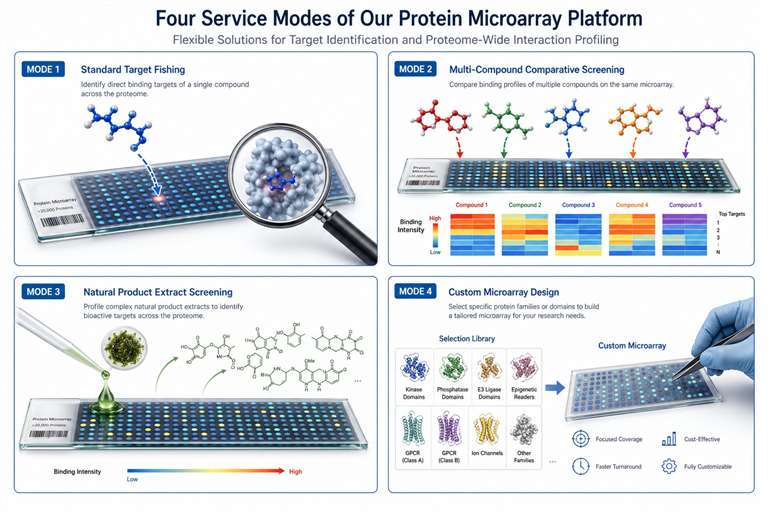
Our Protein Microarray with MS Readout service is built on a fully integrated platform combining high-density protein microarrays, state-of-the-art mass spectrometry, and advanced bioinformatics. We offer flexible service modes to match different research needs.

MODE 1

Standard Target Fishing

Single compound screening against the full proteome microarray. Ideal for identifying primary and secondary targets of a well-characterized small molecule or natural product.

  • One compound per experiment
  • Full proteome coverage (10,000+ proteins)
  • Ranked hit list with peptide evidence
MODE 2

Multi-Compound Comparative Screening

Compare binding profiles across a series of related compounds, analogs, or tool molecules. Useful for SAR-by-target analysis and off-target profiling.

  • Up to 5 compounds in parallel
  • Comparative enrichment analysis
  • Heatmap visualization of binding profiles
MODE 3

Natural Product Extract Screening

Screen complex natural product extracts or fraction libraries directly — no purification or labeling required. Identify protein targets of bioactive constituents in mixtures.

  • Compatible with crude extracts and fractions
  • Deconvolution of multi-component binding
  • Optional fractionation-guided prioritization
MODE 4

Custom Microarray Design

For specialized applications, we can design and print custom protein microarrays targeting specific protein families, pathways, or disease areas.

  • Custom protein selection (kinases, GPCRs, etc.)
  • Flexible array density and layout
  • Compatible with MS or fluorescence readout

Applications

Protein microarray with MS readout is most impactful when researchers need unbiased, proteome-wide target information without the constraints of probe-based methods. Below are representative research scenarios where this approach provides a clear technical advantage.

Drug Target Deconvolution

Identify the protein targets of bioactive compounds discovered in phenotypic screens. Our approach provides an unbiased, proteome-wide survey without requiring prior knowledge of the mechanism of action. For complementary approaches, see our photoaffinity labeling and yeast display platforms.

Common scenarios:

  • Phenotypic hit-to-target
  • Natural product mechanism-of-action studies
  • Fragment-based target identification

Off-Target Profiling

Assess the selectivity of lead compounds across the proteome early in development. Early identification of off-target interactions can guide medicinal chemistry optimization and reduce late-stage attrition. Explore our competitive ABPP and thermal shift proteomics services for complementary selectivity profiling.

Common scenarios:

  • Lead optimization selectivity panels
  • Polypharmacology assessment
  • Toxicity mechanism investigation

Natural Product Target Discovery

Traditional natural product research often identifies bioactive extracts without knowing the molecular targets. Our platform works directly with crude extracts and fractions, enabling target identification without isolation or labeling.

Common scenarios:

  • Traditional medicine mechanism studies
  • Marine natural product target ID
  • Microbial metabolite target deconvolution

Antibody Specificity Profiling

Evaluate the binding specificity of monoclonal antibodies, nanobodies, or other protein-based therapeutics across the human proteome. Identify potential cross-reactivity risks before advancing to clinical development.

Common scenarios:

  • Therapeutic antibody specificity screening
  • CAR-T target validation
  • Bispecific antibody off-target assessment

Protein-Protein Interaction Discovery

Identify novel interaction partners for a protein of interest using a pull-down format on the microarray. MS readout provides unbiased identification of captured interacting proteins.

Common scenarios:

  • Signaling pathway mapping
  • Novel binding partner discovery
  • Protein complex characterization

Probe and Tool Compound Validation

Before investing in chemical probe development, verify the proteome-wide selectivity of your tool compound. Our platform provides the data needed to qualify compounds for use in cellular and in vivo studies.

Common scenarios:

  • Chemical probe selectivity assessment
  • Positive control validation
  • Comparator compound profiling

Platform Instrumentation

Creative Proteomics' Protein Microarray with MS Readout platform integrates high-density protein microarray printing, nanoLC separation, and high-resolution Orbitrap mass spectrometry to deliver sensitive and reproducible target identification.

Module CategoryInstrument / SystemCore CapabilityWhy It Matters
Protein MicroarrayHuProt™ Human Proteome Microarray v4.021,000+ unique full-length human proteinsBroadest coverage of the human proteome for unbiased target fishing
Microarray PrintingOmniGrid Accent / sciFLEXARRAYERHigh-precision contact & non-contact printingConsistent spot morphology and reproducible protein loading
LC SeparationnanoLC 425 / EASY-nLC 1200High-sensitivity peptide separationMaximizes peptide identification from on-chip digests
Mass SpectrometryOrbitrap Exploris 480 / Q Exactive HF-XHigh-resolution, accurate-mass MS/MSConfident peptide sequencing and FDR-controlled protein identification
InformaticsProteome Discoverer / MaxQuant + custom pipelineAutomated peptide identification, FDR filtering, enrichment scoringRanked hit lists with full audit trail and peptide-level evidence

Technology Comparison: Protein Microarray + MS vs. Alternative Target ID Methods

TechniqueCore PrincipleTypical ApplicationsKey StrengthsKey Limitations
Protein Microarray + MS ReadoutIncubate compound on protein microarray → wash → on-chip digest → identify bound proteins by LC-MS/MSTarget deconvolution, off-target profiling, natural product target ID
  • No compound modification required
  • Proteome-wide coverage in one experiment
  • MS-level identification confidence
  • Requires purified proteins on array (no membrane protein complexes in native state)
  • Identifies direct binders; may miss indirect interactions
Chemical Proteomics (ABPP / Pull-down + MS)Immobilize probe on beads → incubate with lysate → wash → elute → MS identificationTarget ID for covalent inhibitors, natural products
  • Works with endogenous proteins in native cellular context
  • Can identify protein complexes
  • Requires probe synthesis and immobilization
  • Requires compound modification (biotin/alkyne tag)
  • Detection bias toward abundant proteins
CETSA / TPP (Thermal Proteome Profiling)Heat-treated lysate → measure protein stability shifts upon ligand binding by MSTarget engagement in cells, target validation
  • Works in live cells or lysates
  • No compound modification
  • Low throughput; requires extensive MS instrument time
  • Limited to proteins with measurable thermal shifts
  • High false-negative rate for some target classes
Fluorescence-Based Protein MicroarrayIncubate labeled compound or detection antibody on array → fluorescence readoutAntibody specificity, protein-protein interactions
  • High throughput
  • Simple readout
  • Requires labeled compound or detection antibody
  • Indirect detection (no sequence-level evidence)
  • Label may alter binding properties
Y2H / Co-IPGenetic or affinity-based capture of interacting proteinsProtein-protein interaction mapping
  • Established, widely used
  • Can identify complexes
  • High false-positive rate
  • Not suitable for small molecule targets
  • Limited throughput for drug target ID

Sample Requirements

Sample TypeRecommended AmountConcentrationPurityBuffer ConditionsNotes
Small Molecule1–5 mg≥ 1 mM stock≥ 90% preferredDMSO or MS-compatible bufferProvide structure or SMILES if available
Natural Product Extract100–500 µg (total mass)≥ 1 mg/mLCrude or partially purifiedDMSO or aqueous bufferProvide source and extraction method
Peptide / Fragment0.5–2 mg≥ 500 µM stock≥ 85%DMSO or aqueous bufferProvide sequence or structure
Antibody / Protein Therapeutic10–50 µg≥ 1 mg/mL≥ 90%PBS or similarProvide target information if known
Control Compound0.5–1 mg≥ 1 mM stock≥ 95%DMSOKnown binder recommended for method validation

Note: For protein samples requiring upstream proteomics analysis (e.g., target validation by pull-down or Co-IP), please refer to our Proteomics Sample Submission Guidelines for detailed tissue, cell, and fluid sample preparation protocols. Recommended starting amounts: animal soft tissues ≥100 mg, plant tissues ≥100 mg, plasma/serum ≥20 µL, cells ≥5×10⁶, microbial pellets ≥50 µL. For trace samples (DIA), animal tissues 30–50 mg, cells 200–5000, plasma 10 µL are sufficient.

Deliverables

  • Ranked list of candidate target proteins with enrichment scores
  • Peptide-level evidence: sequenced peptides, sequence coverage, and identification scores
  • FDR-controlled hit list with statistical confidence metrics
  • Comparison with control conditions (background binding subtraction)
  • Full MS data package: raw files, search results, and annotated spectra
  • Experimental methods report: microarray layout, incubation conditions, wash stringency, MS parameters

Representative Demo Data

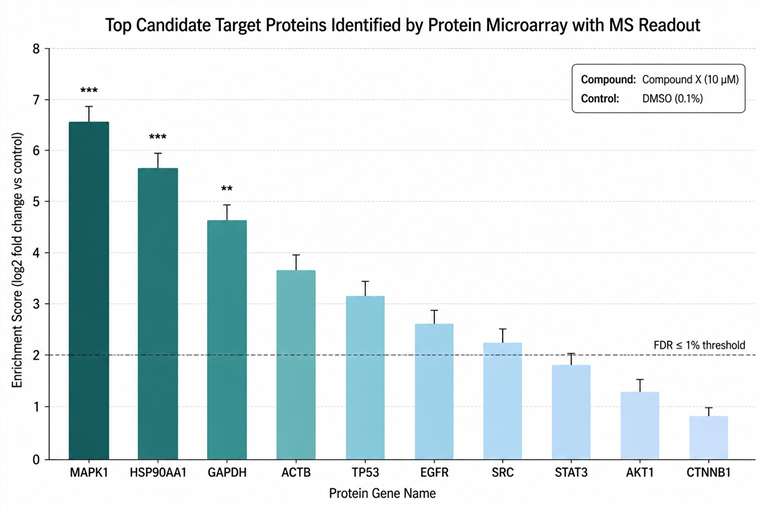
Ranked hit list bar plot showing enrichment scores for top candidate target proteins identified by protein microarray with MS readout.

Example target ranking plot — top hits identified by protein microarray + MS readout

FAQ

Frequently Asked Questions

Q: How is protein microarray with MS readout different from a standard fluorescence-based protein microarray?

In a standard fluorescence-based microarray, you need a labeled compound or a detection antibody to visualize binding — the signal is indirect. With MS readout, bound proteins are digested on-chip and identified directly by peptide sequencing via LC-MS/MS. This gives you sequence-level evidence for every hit, eliminates the need for compound labeling, and provides FDR-controlled confidence scores.

Q: Do I need to modify or label my compound?

No. One of the key advantages of this platform is that your compound is used as-is. There is no requirement for biotinylation, fluorophore conjugation, alkyne tags, or any other modification. This is particularly valuable for natural product extracts, scarce compounds, and molecules where derivatization may alter activity.

Q: How many proteins are on the microarray?

Our standard human proteome microarray contains over 21,000 unique full-length human proteins and isoform variants, covering approximately 17,000 unique genes — the broadest commercially available coverage of the human proteome. Custom arrays targeting specific protein families or pathways are also available.

Q: What types of compounds can be screened?

Our platform is compatible with a wide range of compound types: small molecules, natural product extracts and fractions, peptides and macrocycles, fragments, covalent binders, antibodies and protein therapeutics, and unpurified synthetic mixtures. The key requirement is that the compound is soluble and stable in the incubation buffer.

Q: How do you distinguish specific binders from background?

We run parallel control experiments (buffer-only or compound-free incubations) to establish baseline binding for each protein on the array. Hits are identified by enrichment scoring — comparing peptide counts and MS signal intensities between compound and control conditions. Only proteins meeting statistical thresholds (FDR ≤ 1%) are reported as candidate targets.

Q: What is the typical turnaround time?

A standard target fishing experiment — from compound receipt to final report — typically takes 3–4 weeks. This includes microarray incubation, washing, on-chip digestion, LC-MS/MS analysis, data processing, and reporting. Timelines may vary depending on the number of compounds, replicates, and any custom requirements.

Q: Can you work with non-human proteomes?

Yes. While our standard array is the human proteome microarray, custom arrays can be designed for mouse, rat, or other model organisms. We can also print arrays combining human and pathogen proteins for infectious disease target discovery. Please contact us to discuss your specific requirements.

Reference

  1. Sutandy, F.X.R., Qian, J., Chen, C.S., Zhu, H.Overview of protein microarrays. Current Protocols in Protein Science 72, 27.1.1–27.1.16 (2013).
  2. Syahir, A., Usui, K., Tomizaki, K., Kajikawa, K., Mihara, H.Label and label-free detection techniques for protein microarrays. Microarrays 4(2), 228–244 (2015).
  3. Wang, J., Gao, L., Lee, Y.M., et al.Target identification of natural and traditional medicines with quantitative chemical proteomics approaches. Pharmacology & Therapeutics 162, 10–22 (2016).
  4. Schirle, M., Bantscheff, M., Kuster, B.Mass spectrometry-based proteomics in preclinical drug discovery. Chemistry & Biology 19(1), 72–84 (2012).

Plan your target identification campaign with the MassTarget™ team

Share your compound details and research goals — our scientists will design a tailored protein microarray + MS readout strategy for your discovery program.

For Research Use Only. Not for use in diagnostic procedures.

Online Inquiry

Please submit a detailed description of your project. We will provide you with a customized project plan to meet your research requests. You can also send emails directly to for inquiries.

* Email
Phone
* Service & Products of Interest
Services Required and Project Description