Covalent Fragment Screening (MS-Based) Service

Accelerate your fragment-based drug discovery (FBLD) with our high-throughput, MS-based covalent fragment screening service. Leveraging high-resolution intact mass spectrometry, we directly observe 1:1 covalent binding events, filter out over-labeling artifacts, and seamlessly transition to LC-MS/MS site mapping.

We provide unambiguous, label-free data for your toughest targets, helping your team move from a promising fragment to a validated lead compound with speed and structural confidence.

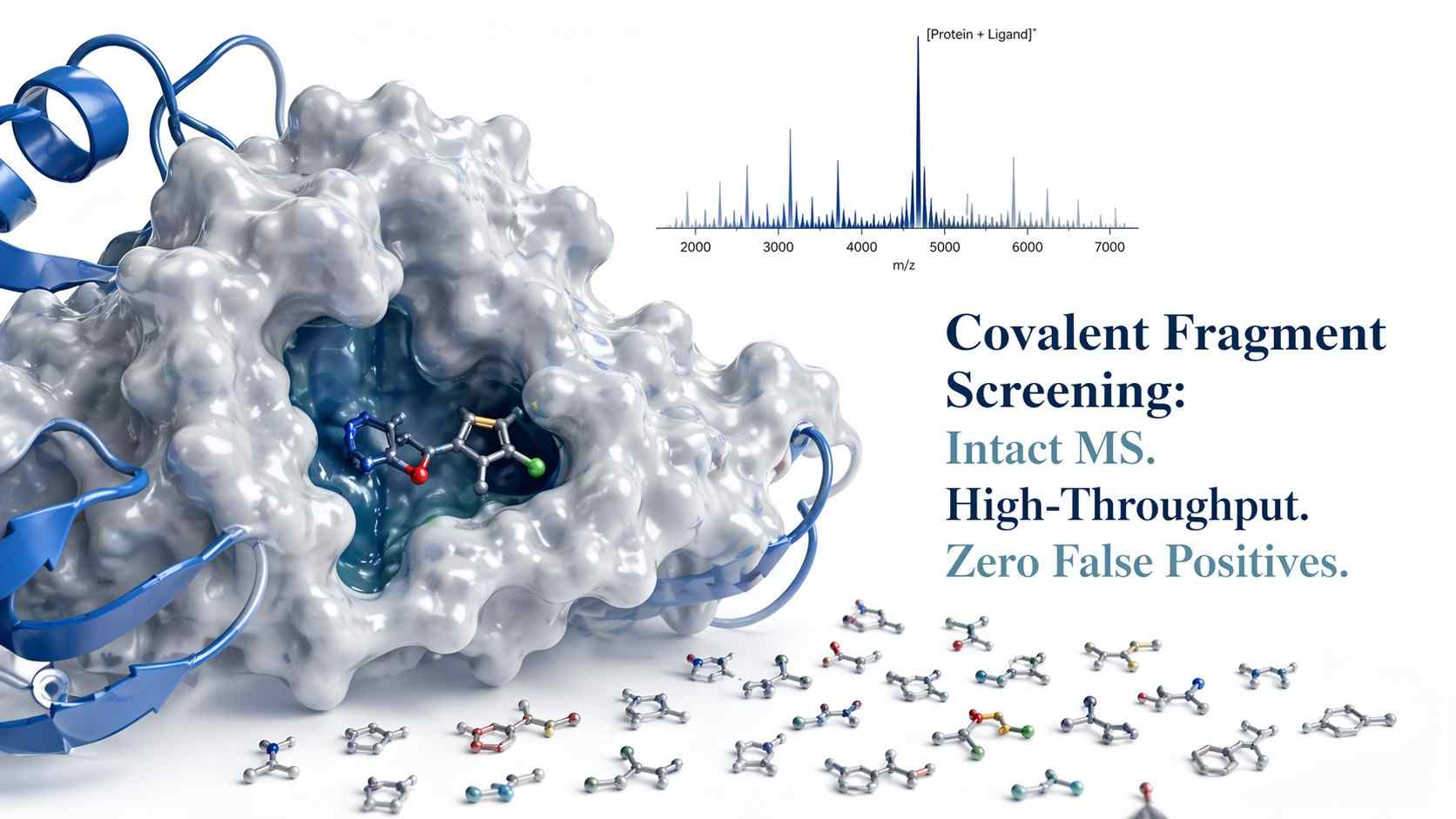
Covalent Fragment Screening Service platform diagram featuring intact MS, deconvolution, and peptide mapping.
Overcoming Bottlenecks Capabilities Workflow & QC Data Deliverables Bioinformatics Screening Strategy Sample Requirements Case Study FAQ

Overcoming the Bottlenecks of Covalent FBLD

Fragment-based drug discovery (FBLD) has become a cornerstone of modern pharmaceutical research, particularly when confronting targets that lack deep, well-defined binding pockets. By exploring chemical space with low-molecular-weight molecules (typically<300 Da), researchers can identify highly efficient starting points for drug development. However, developing covalent fragments—designed to form an irreversible or reversible permanent bond with a target amino acid residue—presents immense analytical challenges that traditional screening methods struggle to resolve.

Standard biophysical techniques, such as Thermal Shift Assays (TSA) or Surface Plasmon Resonance (SPR), provide indirect evidence of binding. While historically useful, these methods are notorious for generating high false-positive rates when dealing with covalent binders. At the high concentrations required for fragment screening (often in the millimolar range), compounds may cause a thermal shift simply by non-specifically aggregating on the protein surface, rather than forming a true, functional covalent bond. Conversely, specific but structurally subtle covalent binders might be missed entirely (false negatives) if their binding does not induce a substantial change in the target protein's global thermodynamic stability.

Mass spectrometry (MS) revolutionizes this process by offering a direct, label-free readout of the binding event. By measuring the exact monoisotopic mass of the target protein before and after incubation with a fragment library, we can observe the precise "mass shift" (+ΔMass) that occurs exclusively when a covalent bond is formed. This approach eliminates the reliance on reporter dyes, complex assay development, or indirect stability measurements, providing a definitive, evidence-based path forward for medicinal chemists.

Our Covalent Fragment Screening Capabilities

We offer a comprehensive suite of mass spectrometry services tailored to the specific needs of covalent drug discovery. Our platform is engineered to handle the entire discovery funnel, ensuring that you transition smoothly from primary screening of vast libraries to the final structural confirmation of the binding site.

High-Throughput Intact MS Primary Screening

To maximize throughput without compromising sensitivity, we employ advanced "pooled library" screening strategies. Incubating pools of 5 to 10 fragments simultaneously, we utilize high-resolution intact MS to deconvolve the complex signals and identify exactly which fragment formed a covalent bond, dramatically reducing protein consumption.

Hit Confirmation & Over-Labeling Filtering

One of the most significant risks is "over-labeling" by non-selective fragments (producing +2, +3 mass shifts). Our platform utilizes precise quantitative algorithms to identify and filter out these non-specific artifacts (PAINS). We strictly prioritize compounds that exhibit clean, stoichiometric 1:1 binding ratios.

LC-MS/MS Peptide Mapping Site Identification

We provide seamless integration with LC-MS/MS peptide mapping. By digesting the covalently modified protein, we can pinpoint the exact amino acid residue where the covalent bond has formed. This covalent inhibitor profiling capability provides the structural "smoking gun" needed for rational drug design.

End-to-End Screening Workflow with Strict QC Checkpoints

We believe that a robust screening campaign is built on relentless quality control. Our end-to-end workflow is systematically designed to ensure data integrity at every single stage, providing you with a transparent, reproducible, and highly reliable evidence chain.

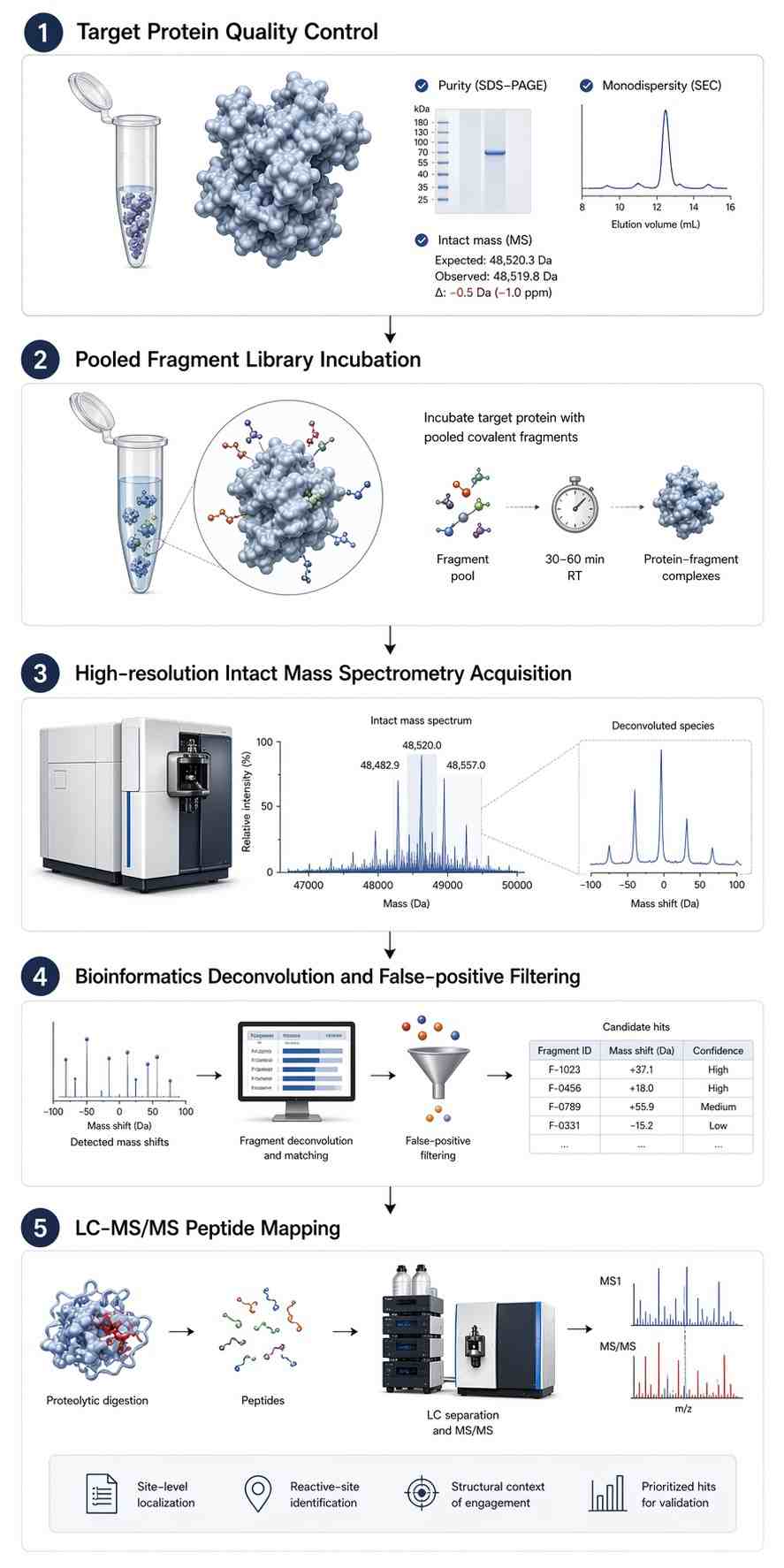
1

Target Protein QC & Baseline Confirmation

We rigorously verify the identity, purity, and folding state of your target protein via an initial intact MS run to establish the exact baseline mass and identify any existing PTMs.

2

Pooled Fragment Incubation

Fragments are incubated with the target under highly optimized physiological conditions, controlling buffer, pH, and temperature to maintain stability while permitting reactivity.

3

High-Resolution Intact MS Acquisition

Samples are rapidly desalted and injected into our HRMS systems, precisely tuned to unambiguously resolve the minor mass shifts (150-250 Da) on large intact proteins.

4

Deconvolution & False-Positive Filtering (QC Checkpoint)

Our proprietary bioinformatics pipeline deconvolutes complex pool spectra. QC: Strict statistical thresholds distinguish 1:1 specific adducts from background noise and flag multi-labeling artifacts.

5

Hit Confirmation via Peptide Mapping

For the highest-priority hits, the modified protein is digested and analyzed via LC-MS/MS to map the exact binding site, validating the mechanism of action.

6

Comprehensive Data Reporting

We deliver a fully transparent data package, including original annotated spectra, deconvoluted hit lists, site-mapping evidence, and actionable insights.

A longitudinal scientific flowchart in Nature journal style showing: Target protein QC, Pooled fragment incubation, Intact MS acquisition, Deconvolution filtering, and LC-MS/MS Site Mapping.

Actionable Data Deliverables & Demo Results

In modern drug discovery, data is only as valuable as its transparency and interpretability. We adhere to a strict "white box" delivery model, ensuring that your medicinal chemists and structural biologists have full access to the primary analytical evidence supporting every identified hit.

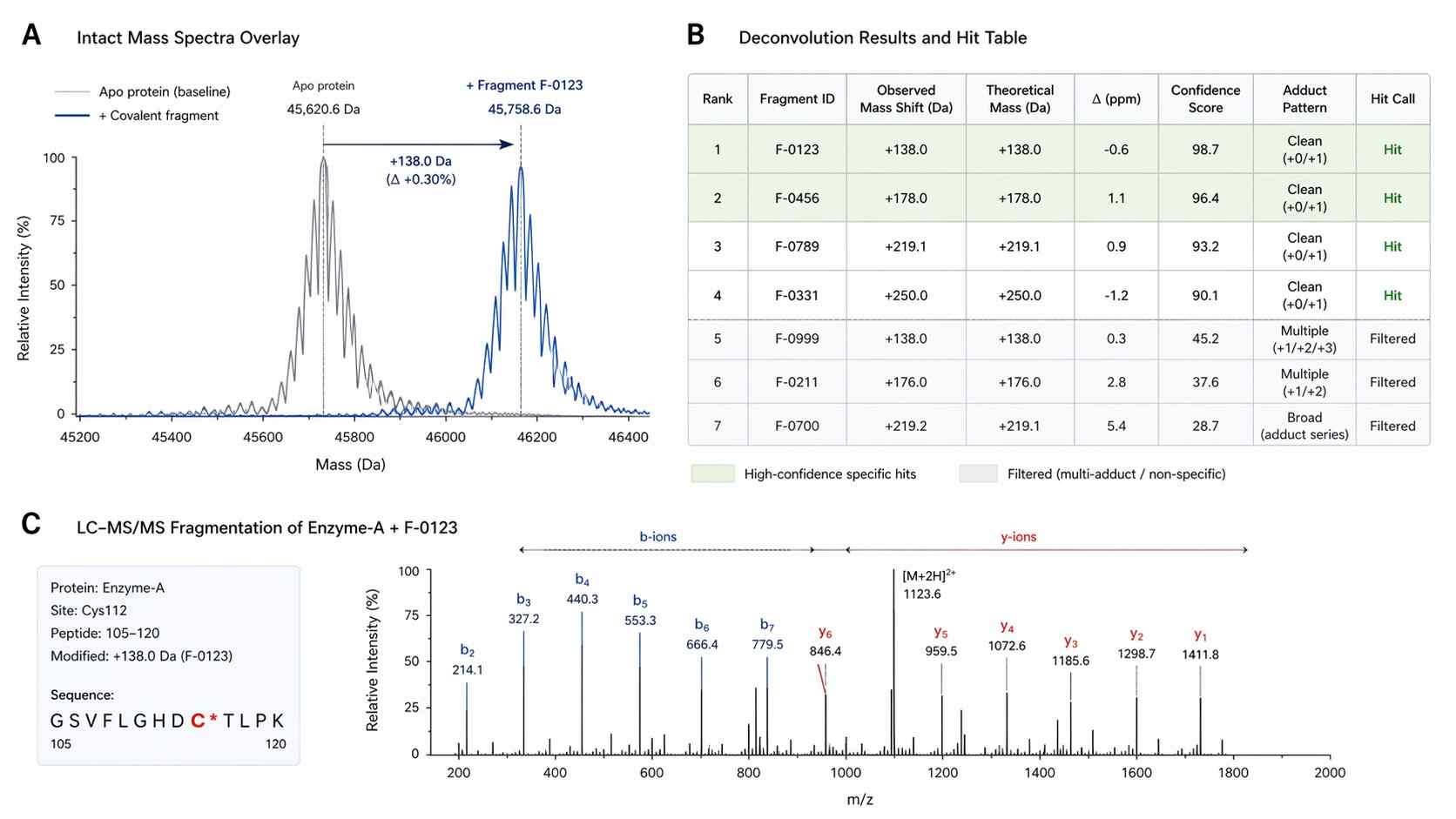
  • Intact MS Mass Shift Overlays: We provide clear visual overlays comparing the mass spectrum of the unliganded control protein directly against the spectrum of the fragment-incubated sample. This offers unambiguous, label-free confirmation of covalent adduct formation (+ΔMass).
  • Deconvolution Hit Tables: You will receive a structured, easily sortable database of all screened fragments. This table scores fragments based on their specific binding efficiency and explicitly highlights our filtering process that removes multi-adduct (over-labeled) false positives.
  • Peptide Mapping MS2 Spectra: For structurally confirmed hits, we provide deeply annotated MS2 fragmentation spectra. These high-resolution outputs pinpoint the exact modified amino acid residue, providing the structural rationale essential for subsequent covalent inhibitor profiling and lead optimization.

A composite 3-panel scientific graphic showing Intact MS overlay, a clean deconvolution hit table, and an annotated MS2 spectrum mapping the bound residue.
Direct observation of covalent mass shifts and site-specific peptide mapping.

Bioinformatics Support for Pooled Library Deconvolution

The true bottleneck of high-throughput MS screening often lies not in the data acquisition, but in the complex data analysis. When screening "pools" of compounds, the resulting intact mass spectra contain hundreds of overlapping isotopic envelopes and charge states. Our bioinformatics team utilizes advanced Maximum Entropy deconvolution algorithms designed specifically for intact protein MS.

These advanced computational tools allow us to:

  • Extract High-Resolution Zero-Charge Masses: We convert complex multi-charged m/z (mass-to-charge) spectra into clear, readable zero-charge molecular weights, resolving mass differences as small as a few Daltons even on proteins exceeding 50 kDa.
  • Automated Delta-Mass Match-Making: Our software automatically calculates the mass shifts and cross-references them against the specific chemical structures and expected monoisotopic masses provided in your fragment library.
  • Rigorous Artifact Mitigation: By analyzing the peak intensity distributions, we can statistically differentiate true covalent binding from baseline noise, salt adduct artifacts, or non-covalent carryover, ensuring the highest possible confidence in the final hit selection.

If your team requires validation of hit selectivity in a cellular context post-screening, we seamlessly transition these hits into our comprehensive chemoproteomics services to assess proteome-wide off-target liabilities.

Selecting Your Screening Strategy: MS vs. Traditional Methods

Choosing the optimal primary screen is a strategic decision that heavily impacts the cost, speed, and success rate of your discovery timeline. Use the following comparative analysis to understand why intact mass spectrometry is rapidly becoming the preferred primary screening tool for covalent FBLD.

Comparison DimensionIntact Mass Spectrometry (MS)Thermal Shift Assay (TSA)X-ray Crystallography
Binding EvidenceDirect: Observes explicit mass shiftIndirect: Measures global stability changeDirect: Observes complete 3D structure
Throughput CapacityHigh: Pooled screening of thousandsHigh: Fast plate-based readsLow: Resource-intensive, one structure at a time
Target Protein RequirementsModerate: Low microgram quantities per poolLow: Minimal protein neededHigh: Requires large amounts of highly pure, crystallizable protein
False Positive SusceptibilityLow: Filters non-specific over-labeling directlyHigh: Extremely sensitive to aggregation and buffer effectsLowest: Absolute structural confirmation
Covalent ConfirmationAbsolute: Direct observation of mass additionInferred: Requires secondary biochemical validationAbsolute: Visible electron density of the covalent link

The Strategic Recommendation: While TSA is useful for exceptionally low-cost, preliminary non-covalent screens, and X-ray crystallography remains the ultimate gold standard for final structural proof, Intact MS serves as the optimal high-throughput primary screen for covalent fragments. It combines the rapid throughput of plate-based assays with the absolute certainty of direct mass-addition evidence. This strategic deployment significantly reduces the number of false leads sent to downstream structural biology teams.

Target Requirements & Library Submission Guidelines

To guarantee the success and sensitivity of your screening campaign, we enforce strict guidelines for target protein preparation and library submission. Should your project require screening of non-covalent interactions alongside covalent ones, our Affinity Selection Mass Spectrometry (ASMS) platform is available as a complementary workflow.

Sample TypeRecommended InputPurity / ConditionQC CheckpointsNotes
Target Protein> 2 mg≥ 85% purity (SDS-PAGE)Intact Mass ConfirmationAvoid strong detergents (SDS) and primary amines (Tris) in buffers.
Client Fragment Library10 mM in DMSOHigh LC-MS purity in 96/384-well platesSolubility CheckMust include exact monoisotopic mass and SMILES/structure under strict CDA.

Custom Library Access: If you do not possess an internal library, we can provide access to our highly curated, proprietary covalent fragment collections, specifically optimized for chemical diversity, appropriate reactivity, and drug-like properties.

Validated Covalent Screening Case Studies

Identifying Chemical Starting Points for UCHL1 Covalent Inhibitors

Reference link: https://pmc.ncbi.nlm.nih.gov/articles/PMC11702861/

Background

UCHL1 (Ubiquitin C-terminal Hydrolase L1) is a highly significant target implicated in oncology and neurodegenerative diseases. Research teams sought novel covalent inhibitors but struggled with traditional screening methods due to the enzyme's complex binding pocket and high susceptibility to non-specific binders and pan-assay interference.

Methods

Utilizing an automated, high-throughput intact mass spectrometry platform, researchers screened a diverse electrophilic fragment library in a highly efficient pooled format against the purified UCHL1 protein. The screening specifically focused on identifying fragments capable of forming a stable 1:1 covalent bond with the target's catalytic residue.

Results

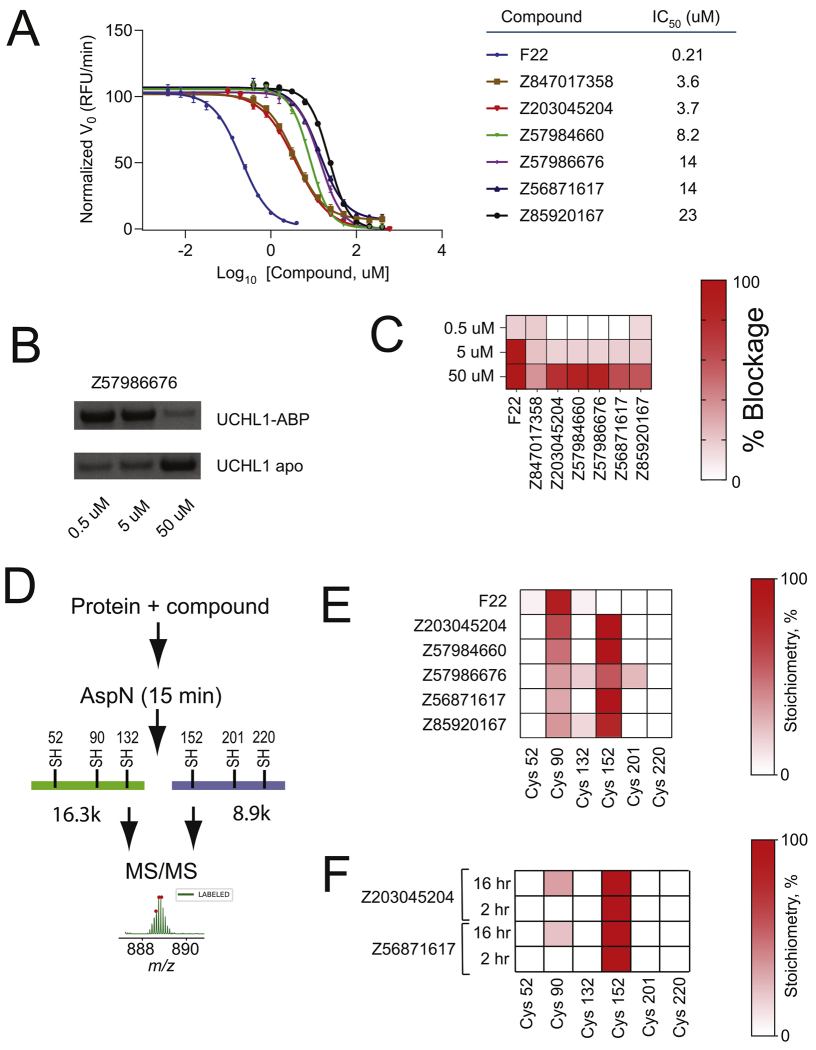
As demonstrated in Figure 4 of the referenced study, the intact MS platform successfully identified 27 high-quality covalent hits. The high-resolution mass spectra provided clear, label-free evidence of target engagement. Crucially, the platform's resolution allowed the team to distinguish between specific 1:1 binding events and undesirable non-specific multi-labeling, ensuring only clean hits progressed.

Conclusion

This comprehensive workflow proved that high-resolution mass spectrometry is an exceptionally efficient and reliable strategy for primary covalent screening. The resulting clean hits provided a diverse set of chemical scaffolds that served as the robust foundation for the subsequent development and optimization of potent UCHL1 inhibitors.

Figure 4 from PMC11702861 showing intact MS confirmation of covalent fragment hits.

Figure 4: Intact MS validation of covalent mass shifts generated by specific fragment hits.

FAQ

Frequently Asked Questions

Q: What is the maximum library size you can screen in a single campaign?

Our high-throughput, automated MS injection systems can comfortably handle libraries ranging from 500 to over 5,000 fragments per campaign. By leveraging scientifically validated pooled screening strategies (typically 5 to 10 fragments per well), we can complete these large-scale screens in a fraction of the time required by single-compound methods.

Q: How do you distinguish specific 1:1 binding from non-specific over-labeling in Intact MS?

Specific, biologically relevant binding typically results in a single, clear mass shift corresponding to the addition of exactly one fragment molecule (+ΔMass). Non-specific over-labeling appears as a "staircase" of cascading peaks in the mass spectrum, indicating that two, three, or more fragments have indiscriminately attached to the protein surface. Our deconvolution software automatically detects these patterns, severely penalizes or flags multi-adduct compounds, and removes them from your final hit list.

Q: Can you screen membrane proteins or intrinsically disordered proteins (IDPs)?

Yes. While membrane proteins require specialized non-ionic detergent-handling or nanodisc stabilization to remain soluble, and intrinsically disordered proteins (IDPs) require meticulous buffer optimization to maintain their native-like conformational states, our biophysics team possesses extensive experience adapting Intact MS protocols for these highly challenging target classes.

Q: Do we need to provide our own fragment library, or do you have a proprietary one?

We offer maximum flexibility to suit your program's needs. You can ship us your own proprietary fragment library (safeguarded under a CDA), or you can utilize our pre-established covalent fragment library, which contains thousands of diverse scaffolds with chemically validated, tuned reactivities.

References

  1. Open-source electrophilic fragment screening platform to identify chemical starting points for UCHL1 covalent inhibitors.
  2. Rapid Covalent-Probe Discovery by Electrophile-Fragment Screening.
  3. Advances in high-throughput mass spectrometry in drug discovery.

Disclaimer: All services and data provided by our platform are for Research Use Only (RUO). Not for use in diagnostic procedures. The information provided is not intended to substitute for professional medical advice or clinical diagnosis.

Plan a Covalent Screening campaign with the MassTarget™ team

Share your target details and library requirements, and our scientists will design a tailored Intact MS screening strategy for your discovery program.

Online Inquiry

Please submit a detailed description of your project. We will provide you with a customized project plan to meet your research requests. You can also send emails directly to for inquiries.

* Email
Phone
* Service & Products of Interest
Services Required and Project Description