Quantitative ABPP Service for Covalent Ligand Discovery

Site-level covalent target engagement profiling through isotope labeling-based chemoproteomics and LC-MS/MS.

Covalent ligand discovery often raises a practical question: which protein sites are truly engaged by your compound, and which signals are background or downstream effects?

At Creative Proteomics, our Quantitative ABPP Service for Covalent Ligand Discovery helps drug discovery teams map compound-engaged protein sites, evaluate covalent ligand selectivity, and prioritize targets using isotope labeling-based chemoproteomics and LC-MS/MS.

We support projects from early feasibility review through sample processing, probe competition, enrichment, LC-MS/MS acquisition, site-level quantification, and data interpretation.

Key Advantages:

  • Site-level covalent target engagement profiling.
  • Competitive ABPP for selectivity and off-target mapping.
  • LC-MS/MS-based peptide and residue evidence.
  • Custom workflow design for probes and compounds.
  • Decision-ready tables, QC summaries, and visual outputs.
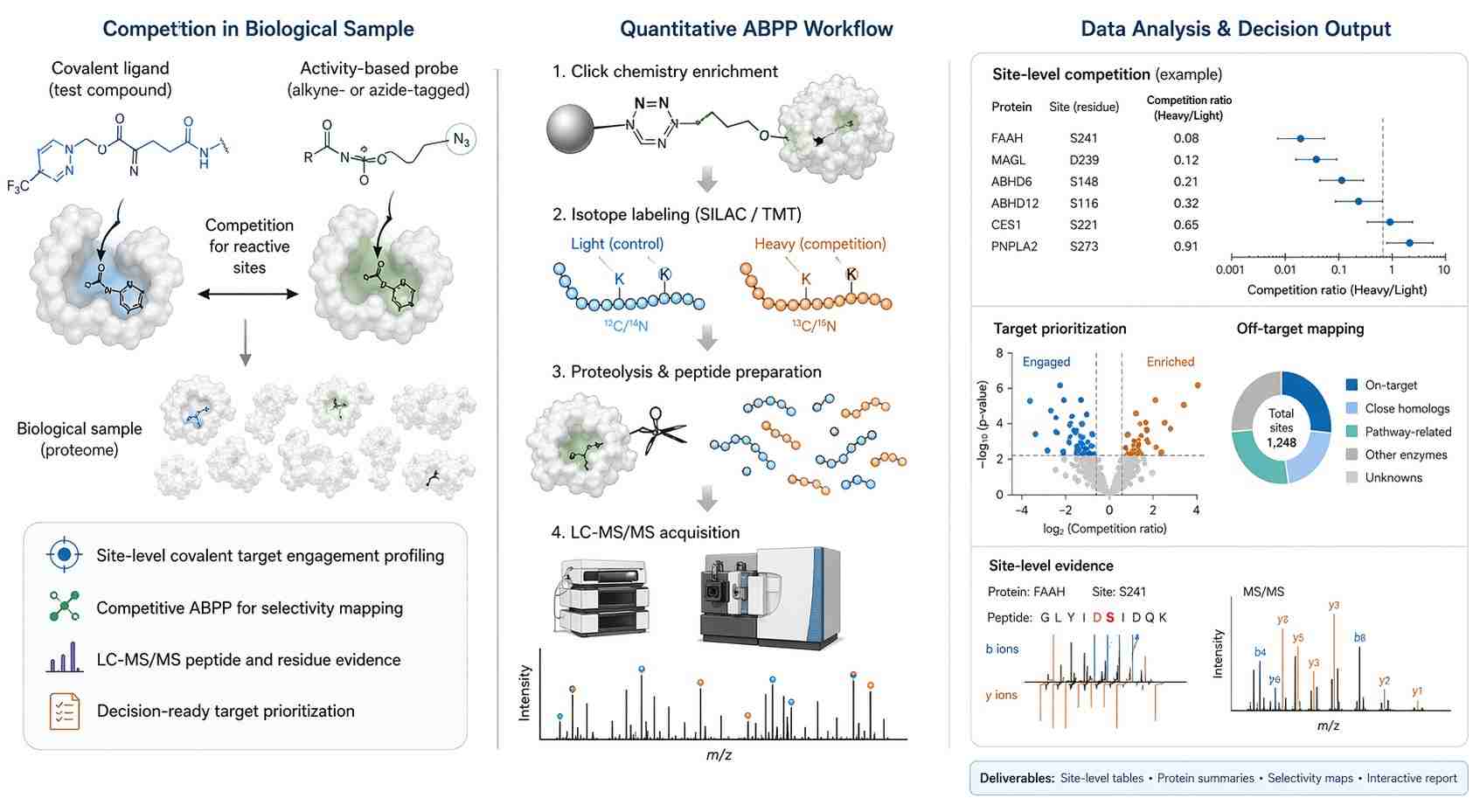
Quantitative ABPP service workflow for covalent ligand discovery and LC-MS/MS site-level profiling.
Site-Level ABPP Capabilities Workflow Project Types Sample Deliverables Demo Comparison Evidence FAQ Plan Project Disclaimer

Site-Level Quantitative ABPP for Covalent Ligand Discovery

Quantitative activity-based protein profiling is a chemoproteomics approach that measures probe-labeled protein sites across treatment groups. In covalent ligand discovery, it helps show whether a compound competes with probe labeling at specific peptide or residue sites, supporting target engagement, selectivity review, and off-target prioritization.

Our service focuses on isotope labeling-based quantitative ABPP, where probe-labeled peptides are enriched and measured by LC-MS/MS. When a covalent ligand competes with probe labeling, the change in peptide or site signal can help reveal compound-engaged targets.

This approach is designed for teams working with covalent inhibitors, electrophilic fragments, reactive probes, and compounds with unclear mechanisms of action.

What This Service Measures

Our quantitative ABPP workflow can support several types of readouts:

  • Probe-labeled peptide or residue sites.
  • Competition-dependent signal changes.
  • Candidate on-target and off-target proteins.
  • Site-level selectivity patterns.
  • Compound-series differences.
  • Target prioritization based on quantitative evidence.

Instead of treating ABPP as a simple enrichment experiment, we design the project around the biological question: target discovery, selectivity profiling, residue-site mapping, or follow-up validation planning.

When It Is Most Useful

This service is a strong fit when your project involves:

  • Covalent inhibitor target engagement.
  • Electrophilic fragment profiling.
  • Reactive cysteine or residue ligandability studies.
  • Unknown mechanism-of-action investigation.
  • Off-target risk assessment.
  • Lead optimization for reactive compounds.
  • Comparison of related compound analogs.

For broader ABPP workflows, you may also explore our Activity-Based Protein Profiling (ABPP-MS) service. For competition-focused target engagement, see our Competitive ABPP service.

Our Service Capabilities for Quantitative ABPP Projects

A successful quantitative ABPP project depends on more than the method name. The outcome depends on probe suitability, sample quality, competition design, enrichment specificity, LC-MS/MS depth, and data interpretation.

Our team supports the full project path from design review to data-ready reporting.

Covalent Ligand and Fragment Profiling

We help evaluate covalent inhibitors, electrophilic fragments, and reactive small molecules through compound-versus-probe competition experiments.

  • Does the compound compete with probe labeling at the expected site?
  • Are there additional competed sites across the proteome?
  • Does one analog show a cleaner selectivity profile than another?
  • Which protein targets should move into follow-up validation?

For discovery programs focused on reactive small molecules, our Covalent Inhibitor Profiling service can be combined with quantitative ABPP to support lead characterization.

Probe-Based and Project-Specific Workflow Design

Before the experiment begins, we review probe structure, labeling chemistry, compound design, sample amount, controls, replicate plan, expected target class, and reporting needs.

This helps reduce avoidable failure points, such as incompatible buffers, weak enrichment, poor labeling conditions, missing controls, or unclear comparison groups.

Site-Level Chemoproteomic Readout

For covalent ligand discovery, site-level evidence is often more useful than protein-level enrichment alone. A protein may appear in a target list, but the binding site or competed residue may determine whether the result is actionable.

Our workflow is designed to prioritize peptide- and residue-level evidence whenever the experimental design and data quality support it.

Selectivity and Off-Target Mapping

Covalent ligands can engage intended targets and unexpected proteins. Quantitative ABPP helps compare competed sites across treatment groups, dose levels, or compound analogs.

This supports selectivity profiling during hit validation and lead optimization, especially when a compound shows promising activity but the off-target profile is not yet clear.

How the Workflow Connects Probe Labeling to LC-MS/MS Evidence

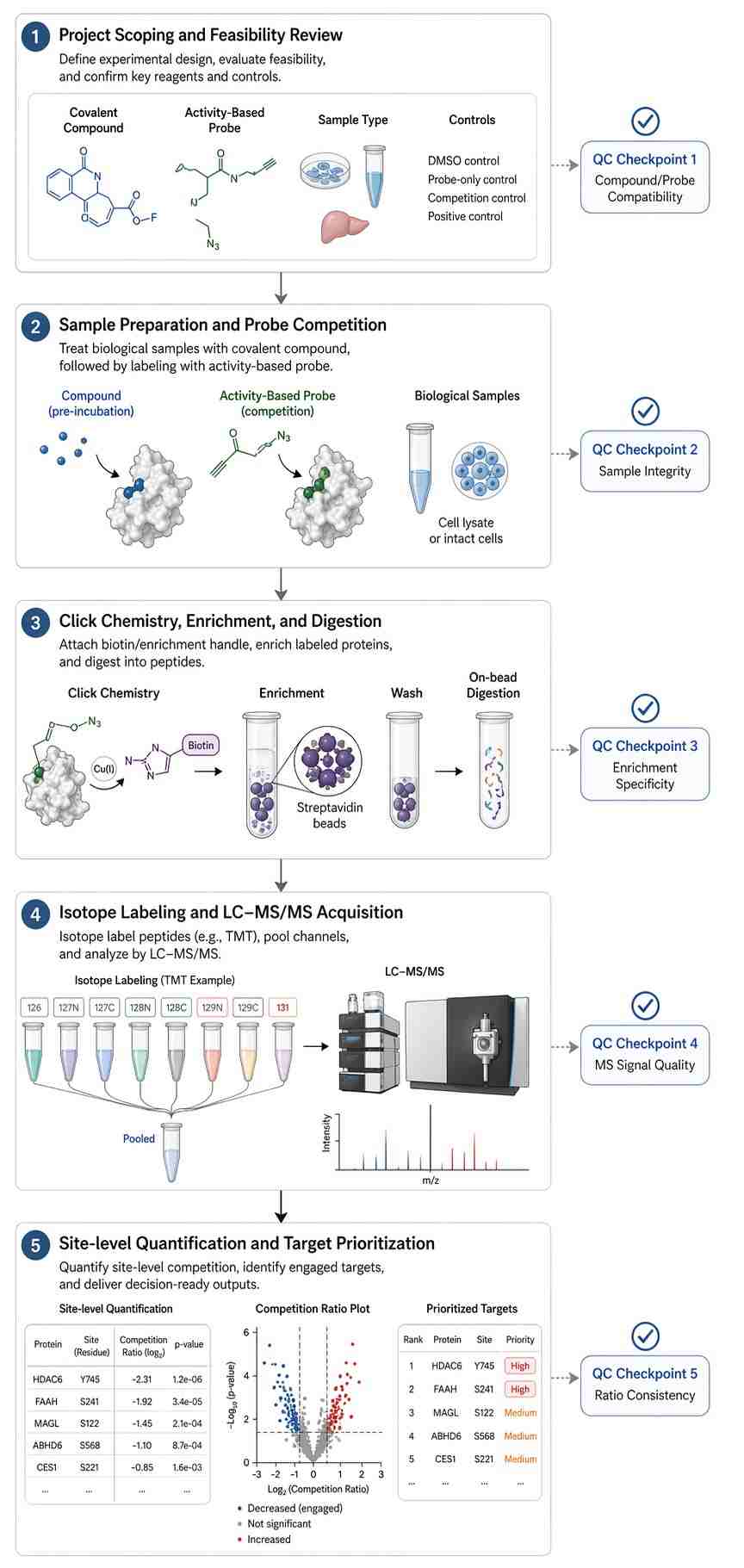
Our workflow follows the sample from project intake through final result delivery. Each stage includes technical steps and QC checkpoints that protect data interpretability.

1

Project Scoping and Feasibility Review

We review your project question, compound information, probe details, sample type, expected readout, controls, and comparison design.

QC checkpoint: compound/probe compatibility, sample format, treatment plan, and control logic.

2

Sample Preparation and Probe Competition

Samples are prepared under matched conditions. Depending on the project, samples may be treated with compound first, followed by probe labeling, or processed in a format agreed during feasibility review.

The core technical logic is simple: if a compound occupies or modifies a reactive site, probe labeling at that site may decrease. That quantitative change becomes part of the site-level evidence.

QC checkpoint: sample integrity, protein concentration, matched treatment groups, and replicate consistency.

3

Click Chemistry, Enrichment, and Digestion

After probe labeling, bioorthogonal chemistry is used to attach an enrichment handle. Labeled proteins or peptides are enriched, cleaned, and digested for LC-MS/MS analysis.

QC checkpoint: enrichment specificity, bead/background control review, digestion completeness, and sample recovery.

4

Isotope Labeling and LC-MS/MS Acquisition

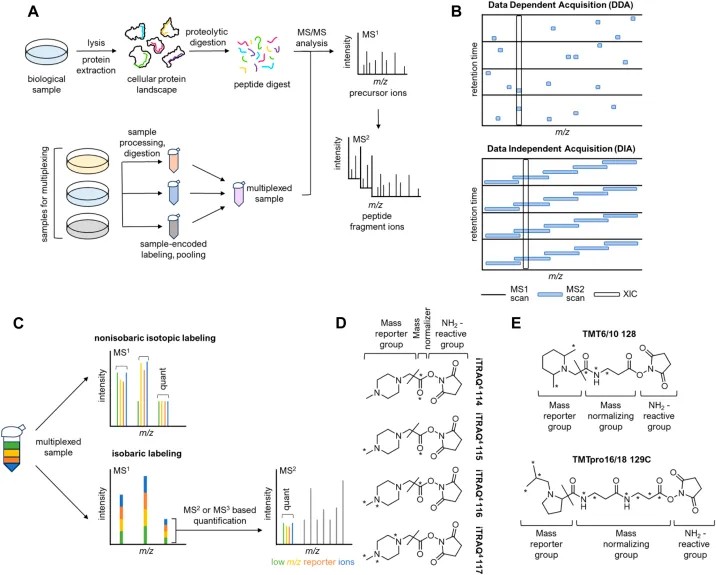
Isotope labeling allows quantitative comparison between treatment groups. The prepared peptide samples are analyzed by LC-MS/MS to identify and quantify probe-labeled peptides or related site-level features.

QC checkpoint: labeling consistency, LC performance, MS signal quality, and replicate alignment.

5

Site-Level Quantification and Target Prioritization

The final data are processed to identify competed sites, quantify relative signal changes, and prioritize target candidates.

QC checkpoint: peptide confidence, ratio consistency, missing value review, annotation quality, and target prioritization logic.

Vertical quantitative ABPP workflow with sample, enrichment, LC-MS/MS, and data QC checkpoints.

Project Types Supported by Isotope Labeling-Based Quantitative ABPP

Our quantitative ABPP service supports multiple project types in covalent ligand discovery and chemical biology.

Covalent Inhibitor Target Engagement

For compounds with a proposed target, quantitative ABPP can help evaluate whether the compound competes at relevant protein sites in a complex proteome.

Electrophilic Fragment Screening Support

For electrophilic fragments or early covalent hits, ABPP can help identify reactive sites and prioritize compounds with cleaner engagement patterns.

Our Covalent Fragment Screening service can be used when the project begins with a fragment library or compound series.

Reactive Cysteine and Residue Ligandability Mapping

Many covalent discovery programs focus on cysteine, but reactive-site profiling can extend to other residue classes when suitable probe chemistry is available.

For broader site discovery, see our Reactive Residue Profiling service and Ligandability Mapping service.

Selectivity Profiling During Lead Optimization

When several analogs show activity, quantitative ABPP can compare their competition patterns across protein sites. This helps identify compounds with a more focused target profile.

Mechanism Support for Phenotype-Driven Compounds

If a compound produces a strong phenotype but the direct target is unclear, quantitative ABPP can provide a site-level target map to guide follow-up experiments.

Off-Target Risk Exploration

For reactive compounds, off-target engagement can influence project risk. Quantitative ABPP can help reveal unexpected competed sites and prioritize which ones need further validation.

Sample, Probe, and Compound Requirements

Final requirements depend on sample type, target biology, probe chemistry, and project design. The table below provides practical starting points for project planning.

Sample / MaterialRecommended AmountRequired InformationControls to PrepareStorage and ShippingNotes
Cell lysate or cell pelletFor proteomics-scale projects, 5 × 10⁶ to 1 × 10⁷ cells is a useful planning rangeCell type, treatment condition, lysis method, protein concentration if availableVehicle, probe-only, compound + probe, biological replicatesFlash-freeze, store at -80°C, ship on dry iceKeep cell number and processing consistent across groups
Trace cell sample200–5,000 cells may be possible for trace DIA-style proteomics planningCell source, collection method, expected protein yieldMatched controls and replicate planStore at -80°C and ship on dry iceFeasibility review is required before project start
Animal tissue lysate30–50 mg for trace proteomics; 100–200 mg for broader omics-style planningSpecies, tissue type, collection method, treatment groupMatched tissue controls and biological replicatesQuickly freeze and store at -80°C; ship with dry iceRemove non-target tissue and avoid repeated freeze-thaw cycles
Plant tissue100–200 mg for soft tissue; hard plant tissue may require higher inputSpecies, tissue part, treatment condition, collection timingMatched controls and biological replicatesFlash-freeze and store at -80°C; ship on dry iceKeep tissue location and collection timing consistent
Plasma / serum / biofluid20–100 μL depending on depletion and project scopeSample type, anticoagulant if applicable, processing methodMatched groups and replicatesAliquot, freeze, store at -80°C, ship on dry iceAvoid hemolysis and repeated freeze-thaw cycles
Culture supernatant5–20 mL depending on project scopeMedium type, serum status, collection timeMedium control and biological replicatesClarify by centrifugation, freeze, ship on dry iceSerum-free medium requirements should be reviewed before submission
Purified protein or focused targetAbout 150–300 μg is a practical planning rangeSequence, tags, buffer, concentration, known ligandsTarget-only, probe-only, compound + probeFrozen or cold-chain shipment as agreedBuffer compatibility is critical for labeling and LC-MS/MS
FFPE material10–20 slices, 10 μm thickness, about 1.5 × 2 cm areaTissue type, section thickness, storage historyMatched control sections if availableShip as agreed after feasibility reviewCompatibility depends on project goal and extraction quality
Compound / covalent ligandProject-dependent; provide stock concentration and solventStructure, molecular weight, reactive group, purity if available, expected targetVehicle and concentration series if neededShip according to compound stabilityDMSO concentration and solubility should be reviewed
Activity-based probeProject-dependentProbe structure, warhead, clickable handle, known target class, storage conditionProbe-only and no-probe controlsShip according to probe stabilityProbe quality strongly affects enrichment and site detection

Before submission, please label biological replicates clearly, avoid repeated freeze-thaw cycles, and provide any special treatment details. If your sample contains toxic, corrosive, polymeric, surfactant-rich, infectious, or otherwise unusual material, tell us before shipment so we can review feasibility.

What You Receive: Data Package and Bioinformatics Analysis

Quantitative ABPP generates complex data. We organize the results so your team can move from raw spectra to target decisions.

Minimum Deliverables

  • Raw LC-MS/MS data files.
  • Peptide-spectrum match or peptide identification table.
  • Probe-labeled peptide or modified-site table when supported.
  • Protein-level target table.
  • Competition or isotope ratio table.
  • Replicate-level quantitative summary.
  • QC summary.
  • Method summary.
  • Prioritized target candidate list.
  • Visualization-ready summary figures.

Optional Analysis Add-ons

  • Dose- or competition-dependent site response profiling.
  • Compound-series selectivity comparison.
  • Pathway and functional enrichment analysis.
  • Protein family or domain annotation.
  • Known target and off-target annotation.
  • Residue environment annotation when available.
  • Integration with pull-down MS, thermal stability profiling, or standard proteomics data.

How We Help Interpret the Results

We do not just return a spreadsheet. We help structure the evidence around the questions your team needs to answer:

  • Which sites show the strongest competition?
  • Which proteins have multiple supporting peptide signals?
  • Which targets are expected and which are unexpected?
  • Which findings may require orthogonal validation?
  • Which off-targets may affect lead optimization decisions?

Representative Demo Results: From Site Ratios to Target Decisions

The following demo result types show how quantitative ABPP data can be presented. These are representative output formats, not client-specific claims.

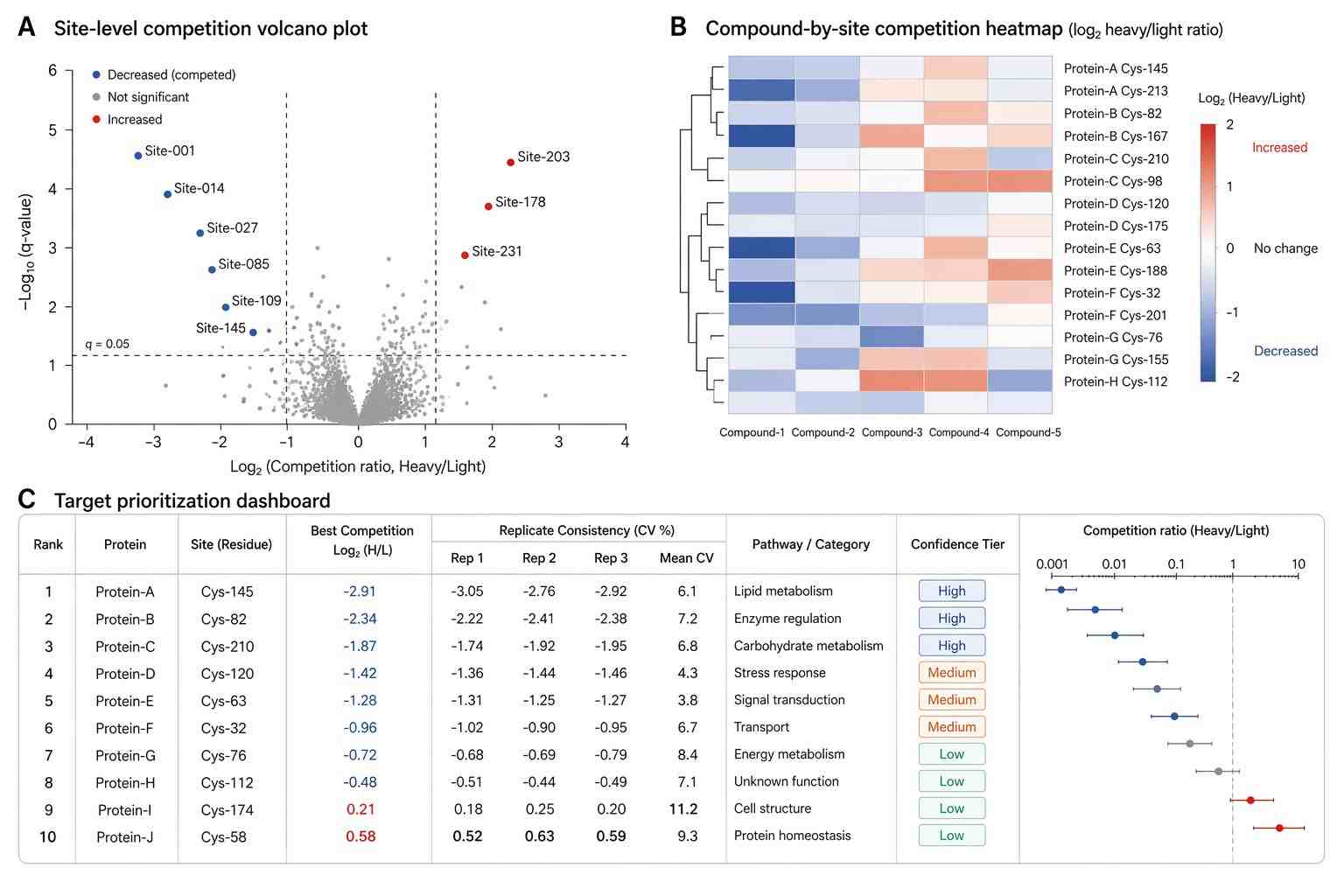
Demo quantitative ABPP results showing volcano plot, competition heatmap, and target prioritization dashboard.

Integrated quantitative ABPP demo results panel

Site-level competition volcano plot, compound-by-site competition heatmap, and target prioritization dashboard.

Demo 1: Site-Level Competition Volcano Plot

A site-level volcano plot displays competed peptide or residue sites across treatment groups. Sites with stronger competition and consistent replicate behavior can be highlighted for target review.

How to read it: A strong candidate site should show a clear quantitative change, consistent replicate behavior, and interpretable peptide or protein annotation.

Demo 2: Compound-by-Site Competition Heatmap

A compound-series heatmap compares relative competition patterns across multiple compounds and protein sites.

How to read it: A cleaner compound profile may show stronger engagement at intended sites and fewer broad off-target site changes. This format is useful during analog comparison.

Demo 3: Target Prioritization Dashboard

A target prioritization dashboard combines protein name, competed site, isotope ratio, replicate consistency, annotation, pathway context, and confidence tier.

How to read it: This view helps project teams move from LC-MS/MS output to a short list of candidates for follow-up validation.

Quantitative ABPP vs Alternative Target Engagement Methods

No single target engagement method answers every question. We help clients choose the right workflow based on the evidence they need.

MethodBest Use CaseEvidence LevelStrengthLimitationWhen to Choose
Quantitative ABPPCovalent ligand target engagement and site-level selectivityPeptide or residue-site competition evidenceDirectly links compound competition to probe-labeled sitesRequires suitable probe chemistry and careful controlsChoose when you need site-level evidence and proteome-wide selectivity profiling
Pull-Down MSEnriching binding proteins using a tagged compound or affinity handleUsually protein-level enrichmentUseful for broad target discovery when a probe is availableTagging may change compound behavior; binding site evidence may be limitedChoose when a stable affinity probe exists and protein-level target ID is sufficient
Thermal Stability ProfilingProtein stability shifts after compound treatmentProtein-level stability responseProbe-free and proteome-wideDoes not directly identify covalent residue sitesChoose when probe design is not feasible and engagement evidence is still needed
Standard Quantitative ProteomicsProtein abundance and pathway responseAbundance-level evidenceGood for downstream biology and pathway changesDoes not directly prove target engagementChoose when the goal is response profiling rather than direct target mapping
Biochemical Target AssaySingle-target potency or activityTarget-specific functional readoutFocused and easy to interpret for known targetsNot proteome-wide and may miss off-targetsChoose after candidate targets are prioritized
Intact Protein MSPurified protein-compound adduct confirmationProtein mass shift or adduct evidenceStrong for focused purified-protein validationNot suitable for broad proteome-wide target discoveryChoose when you need to confirm covalent adduct formation on a known protein
Targeted PRM / MRMFollow-up quantification of selected peptidesTargeted peptide-level quantificationUseful for validating selected candidatesRequires prior target selection and assay setupChoose after discovery data identifies candidate sites

How to Choose the Right Workflow

Choose Quantitative ABPP when your core question is: "Which protein site does my covalent compound compete or engage?"

Choose Competitive ABPP when selectivity across a protein family or proteome matters more than total protein abundance.

Choose Pull-Down MS when you already have a strong affinity probe and protein-level enrichment is enough.

Choose Thermal Stability Profiling when probe design is not feasible and you need a proteome-wide engagement view. For this route, see our Proteome-wide Thermal Stability Profiling service.

Choose Standard Quantitative Proteomics when the goal is to understand pathway response, stress response, or downstream biology after compound treatment.

In many drug discovery programs, the strongest evidence comes from combining methods. Quantitative ABPP can identify site-level engagement, while thermal stability profiling, pull-down MS, or standard proteomics can add orthogonal context.

Literature Evidence for Quantitative Proteomics in Covalent Ligand Discovery

Quantitative ABPP sits within a broader chemoproteomics and quantitative proteomics toolkit for covalent ligand discovery. Published studies and reviews show why MS-based quantitative evidence is valuable when teams need to connect compound treatment with selectivity, target engagement, and mechanism-focused follow-up.

A useful background reference is Quantitative proteomics and applications in covalent ligand discovery. The article discusses how quantitative proteomics strategies can support selectivity profiling and mechanistic interpretation in covalent ligand discovery.

For ABPP-specific method context, Ligand discovery by activity-based protein profiling provides a recent overview of how ABPP supports ligand discovery. For broader covalent drug discovery context, Chemoproteomic methods for covalent drug discovery reviews chemoproteomic approaches used to study covalent compounds.

We use this type of literature foundation to help clients frame method selection. If your team already has internal target hypotheses, compound-series data, or orthogonal assay results, we can align the quantitative ABPP design with those existing data so the final output supports practical next-step decisions.

Literature-supported chemoproteomics evidence chain for covalent ligand discovery.

MS-based quantitative evidence can support covalent ligand selectivity review and target prioritization.

FAQ

FAQ: Planning a Quantitative ABPP Project

Q: What is quantitative ABPP, and how is it used in covalent ligand discovery?

Quantitative ABPP is a chemoproteomics approach that measures probe-labeled protein sites across different treatment groups. In covalent ligand discovery, it can show whether a compound competes with probe labeling at specific protein sites, helping identify targets and off-targets.

Q: How does isotope labeling-based quantitative ABPP differ from standard ABPP?

Standard ABPP can identify probe-labeled proteins or active sites. Isotope labeling-based quantitative ABPP adds group-to-group comparison, allowing researchers to measure how compound treatment changes probe labeling at specific sites.

Q: Do I need an existing activity-based probe before starting a project?

In most competitive ABPP workflows, a suitable probe is needed. If you do not have one, we can review your project goal and help determine whether probe design, another ABPP format, pull-down MS, or thermal stability profiling is a better first step.

Q: What sample types can be used for quantitative ABPP?

Common sample types include cell lysates, intact-cell systems, tissue lysates, purified proteins, and selected biofluids. The best format depends on the compound, probe, biological question, and available material.

Q: Can this workflow identify off-targets of covalent inhibitors?

Yes. When the probe, sample, and competition design are suitable, quantitative ABPP can reveal additional protein sites that are competed by the compound. These candidates can then be prioritized for follow-up validation.

Q: What is the difference between protein-level and site-level ABPP results?

Protein-level results identify proteins associated with labeling or enrichment. Site-level results identify specific peptide or residue sites, which can be more useful for covalent ligand discovery because the binding or reaction site often drives interpretation.

Q: How does quantitative ABPP compare with pull-down MS?

Pull-down MS often enriches proteins associated with a tagged compound or affinity handle. Quantitative ABPP focuses on probe-labeled sites and compound competition, making it more useful when site-level engagement and selectivity are important.

Q: How does quantitative ABPP compare with thermal stability profiling?

Thermal stability profiling is probe-free and measures protein stability shifts after compound treatment. Quantitative ABPP uses probe labeling and competition to measure reactive or ligandable sites. The two methods can be complementary.

Q: What information should I provide for feasibility review?

Please provide sample type, species or cell line, compound structure or identifier, solvent, stock concentration, probe information, expected target class, treatment design, control groups, and available sample amount.

Q: What data deliverables will I receive from a quantitative ABPP project?

Deliverables may include raw LC-MS/MS files, peptide and protein tables, site-level competition ratios, QC summaries, target prioritization tables, visual result summaries, and a method summary.

Plan Your Quantitative ABPP Project with MassTarget™

If you are evaluating a covalent ligand, electrophilic fragment, or reactive probe, we can help you review whether quantitative ABPP is the right next step.

Share your compound, probe, sample type, and project question. Our team will review feasibility, recommend a workflow, and help define the controls and deliverables needed for interpretable LC-MS/MS results.

Disclaimer

This service is for Research Use Only and is not intended for clinical diagnosis, treatment selection, or medical decision-making.

Online Inquiry

Please submit a detailed description of your project. We will provide you with a customized project plan to meet your research requests. You can also send emails directly to for inquiries.

* Email
Phone
* Service & Products of Interest
Services Required and Project Description