DESI Plate-Based High-Throughput Screening (HTS)

Accelerating drug discovery with ambient ionization mass spectrometry — direct analysis from multiwell plates at sub-second throughput.

DESI Plate-Based HTS (Desorption Electrospray Ionization Mass Spectrometry High-Throughput Screening) is an ambient ionization technique that enables direct, label-free MS analysis of samples directly from standard multiwell plates without chromatographic separation. With demonstrated throughput exceeding one sample per second, DESI plate-based HTS provides an ultra-rapid, cost-effective alternative to conventional LC-MS-based screening for reaction optimization, enzyme activity assays, and label-free bioassay readouts in drug discovery workflows.

At Creative Proteomics, our MassTarget™ DESI Plate-Based HTS platform integrates automated liquid handling, robotic plate positioning, and high-resolution mass spectrometry to deliver high-quality screening data with minimal sample preparation and rapid turnaround.

Key Advantages:

  • Ultra-high throughput (>1 sample/sec) — direct DESI analysis from 96/384/1536-well plates
  • No chromatography — eliminates LC separation, reducing run time and solvent consumption
  • Label-free detection — no fluorescent tags, no reporter assays, no immobilisation
  • Ambient ionization — analysis under open-air conditions, compatible with native assay buffers
  • Minimal sample preparation — direct analysis from reaction mixtures without workup
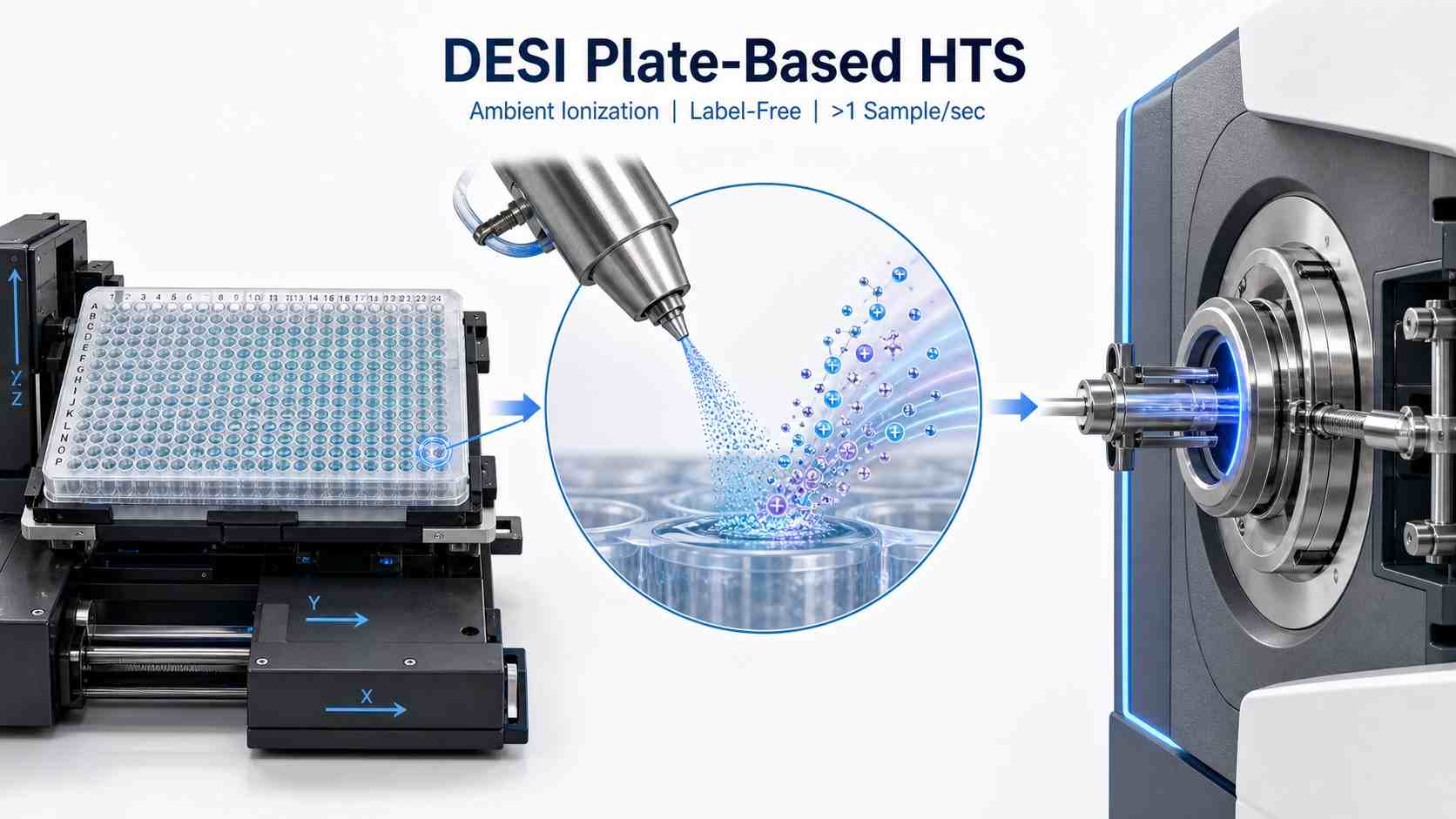
DESI plate-based high-throughput screening platform featuring DESI ionization spray from multiwell plate to mass spectrometer inlet for direct analysis.
What Is DESI Plate-Based HTS How It Works Applications Technology Comparison Sample Deliverables FAQ

What Is DESI Plate-Based HTS?

Desorption Electrospray Ionization (DESI) is an ambient ionization technique introduced by Cooks and colleagues at Purdue University. In DESI, a fine spray of charged solvent droplets is directed at a sample surface, where the impact desorbs and ionizes analytes, which are then transferred into the mass spectrometer inlet for detection. When coupled with automated plate positioning, DESI enables direct analysis of samples in multiwell plates — a configuration we call DESI Plate-Based HTS.

Unlike conventional LC-MS-based screening, which requires minutes per sample for chromatographic separation, DESI plate-based HTS analyzes each sample in less than one second directly from the assay plate. The technique is label-free, operates under ambient conditions, and requires no sample derivatisation, matrix application, or SPE cartridge consumables. These characteristics make it particularly attractive for high-throughput applications where speed and simplicity are critical.

DESI plate-based HTS has been successfully applied to a broad range of drug discovery workflows, including reaction screening and optimization, enzyme activity assays and inhibition studies, label-free binding detection, and direct-to-biology screening of unpurified synthetic mixtures. For complementary approaches, we also offer RapidFire MS and MALDI-TOF HTS as part of our integrated HT-MS screening portfolio.

Key Benefits of DESI Plate-Based HTS

Sub-second throughput

Each sample is analyzed in under one second directly from the multiwell plate, enabling screening campaigns of thousands of samples per day without LC bottlenecks.

Zero consumable cost

No SPE cartridges, no LC columns, no matrix, no derivatisation reagents — the only consumable is the spray solvent, making per-sample cost extremely low.

Native assay conditions

DESI operates under ambient, open-air conditions and is compatible with native assay buffers, preserving enzyme activity and native binding interactions.

Broad analyte compatibility

Small molecules, peptides, lipids, natural products, and reaction intermediates can all be detected directly from the assay plate without method re-optimization.

How DESI Plate-Based HTS Works

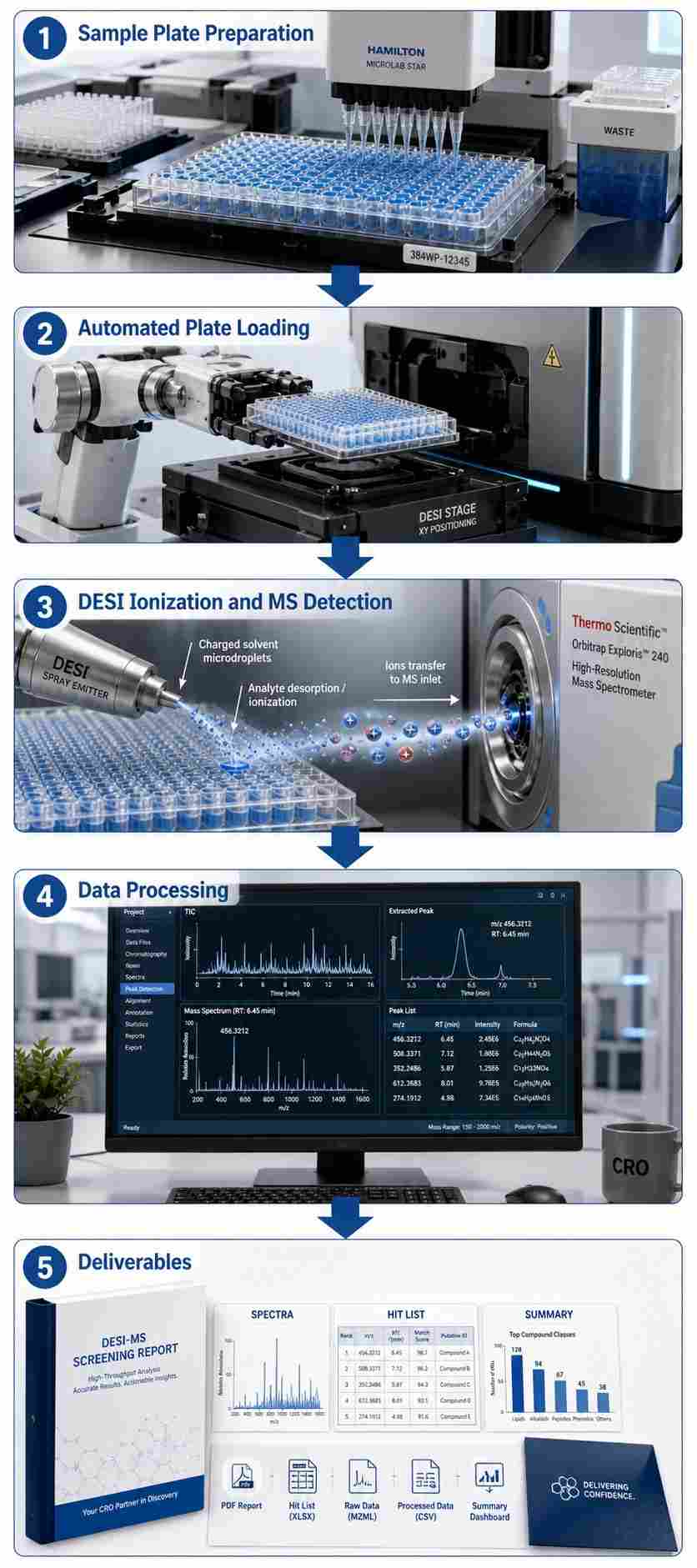
Our DESI plate-based HTS workflow follows a streamlined, automated process designed to minimize hands-on time and maximize data quality.

1

Sample Plate Preparation

Samples are prepared in standard multiwell plates (96, 384, or 1536-well format) using automated liquid handling. No special sample preparation or matrix application is required.

2

Automated Plate Loading

The prepared plate is loaded onto the DESI stage with robotic XY positioning for precise well-to-well movement. Plate alignment and calibration are performed automatically.

3

DESI Ionization and MS Detection

Charged solvent droplets are directed at each well, desorbing and ionising analytes in under one second per well. Ions are transferred into the mass spectrometer for high-resolution analysis.

4

Data Processing and Hit Calling

Raw mass spectra are processed using automated peak detection and alignment. Hits are identified based on predefined criteria and compiled into ranked hit lists.

5

Deliverables

We provide a comprehensive data package including raw mass spectra, processed peak lists, hit ranking tables, and optional custom data visualizations.

DESI plate-based HTS workflow diagram showing five steps from sample plate preparation to data deliverables.

Key Applications of DESI Plate-Based HTS

DESI plate-based HTS is applicable across a broad range of drug discovery workflows, from early reaction screening to downstream binding validation.

Reaction Screening and Optimization

Rapid evaluation of reaction conditions — solvent, temperature, catalyst, stoichiometry — directly from the multiwell plate without workup. Ideal for accelerating SAR studies, late-stage functionalization screening, and route scouting in medicinal chemistry.

Enzyme Activity Assays and Inhibition Studies

Label-free enzyme assays using DESI-MS for cytochrome P450s, kinases, proteases, and transferases. Direct MS readout provides substrate consumption and product formation kinetics without fluorogenic substrates. IC50 determination and inhibition mode analysis supported.

Label-Free Binding and Bioassay Readouts

Detect non-covalent binding events directly from the assay matrix, complementing established affinity selection methods. Particularly advantageous for targets where functional assays are unavailable or label-dependent artefacts are a concern.

Direct-to-Biology Screening

Crude reaction mixtures analyzed directly without purification, enabling ultra-rapid triage of synthetic products. Eliminates purification bottlenecks and reduces cycle time from synthesis to screening data.

DESI Plate-Based HTS vs. Alternative HT-MS Technologies

TechnologyCore PrincipleThroughputSample PrepBest For
DESI Plate-Based HTSAmbient ionization from multiwell plates>1 sample/secMinimal (none required)Reaction screening, enzyme assays, label-free bioassays
RapidFire 400 (Agilent)Online SPE-MS with autosampler~10-15 sec/sampleMinimalQuantitative analysis, ADME screening, PK
Acoustic Ejection MS (Sciex Echo MS)Acoustic droplet ejection + ESI~1 sample/secMinimalHigh-throughput label-free screening
MALDI-TOFLaser desorption from matrix co-crystals~1 sample/secMatrix application requiredHigh-mass analytes, imaging, peptide screening
Conventional LC-MSLC separation + ESI-MS2-10 min/sampleFiltration/centrifugationQuantitative analysis, complex mixtures, metabolite ID

Sample Requirements

Sample TypeRequired AmountConcentrationFormatNotes
Enzyme Assay Mix5–50 µL per wellSubstrate: 1–100 µM; Enzyme: 0.1–10 nM96/384/1536-well plateMS-compatible buffer (no glycerol, low detergent)
Reaction Mixture5–50 µL per wellProduct ≥ 1 µM preferable96/384/1536-well plateAnalyze directly without workup
Compound Library1–10 mM stock in DMSO10–100 µM final assay concentration96/384/1536-well plateSolubility check recommended
Binding Assay10–50 µL per wellTarget: 0.1–10 µM; Ligand: 1–100 µM384/1536-well plateNative buffer preferred

General Guidelines:

  • Avoid non-volatile buffers (phosphate, HEPES at high concentration) where possible
  • Glycerol concentrations should be kept below 5% (v/v)
  • Detergents (Triton, Tween) should be kept below 0.1% (v/v)
  • Samples should be free of particulates to avoid spray instability
  • For enzyme assays, provide substrate Km and enzyme concentration if available

For detailed sample submission guidance, refer to our comprehensive HT-MS screening service page and sample requirements documentation. Our team consults on plate layout design, including control placement, replicate allocation, and concentration response formatting for IC50 studies. We also support integration with enzyme activity and mechanism studies for downstream hit characterization.

Deliverables

  • Raw mass spectra for each well position
  • Processed peak lists with accurate mass identification
  • Hit ranking table with intensity or binding enrichment metrics
  • Reaction conversion plots (for enzyme assays)
  • Optional: IC50 curves, inhibition mode analysis
  • Custom data visualisation upon request

Representative DESI HTS Demo Data

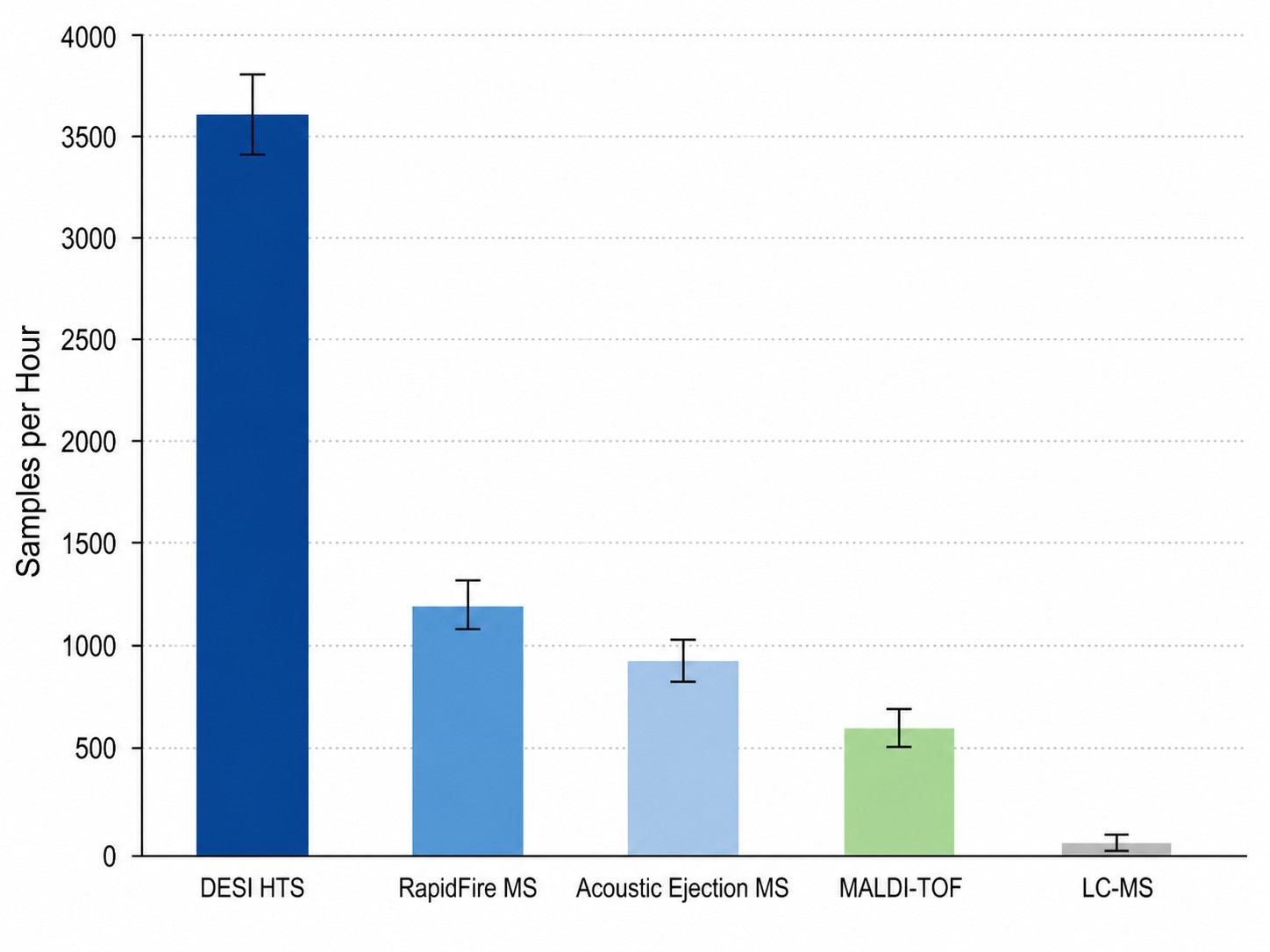
DESI HTS throughput comparison bar chart showing samples per hour for DESI plate-based HTS versus RapidFire MS, acoustic ejection MS, MALDI-TOF, and conventional LC-MS.

Throughput comparison: DESI HTS vs. alternative HT-MS platforms

FAQ

Frequently Asked Questions

Q: How does DESI plate-based HTS differ from conventional LC-MS screening?

DESI analyzes samples directly from the multiwell plate without LC separation, achieving throughput of more than one sample per second compared to 2–10 minutes per sample for LC-MS. This makes DESI ideal for high-volume screening campaigns where absolute quantitation is not required.

Q: What types of assays are compatible with DESI plate-based HTS?

DESI HTS is compatible with enzyme activity assays, reaction screening and optimization, label-free binding detection, and direct-to-biology screening of crude reaction mixtures. The technique performs best for assays where relative signal changes are sufficient for hit calling.

Q: What throughput can I expect from DESI plate-based HTS?

Our DESI HTS platform achieves throughput exceeding one sample per second, equivalent to more than 3,000 samples per hour. A full 384-well plate can be analyzed in approximately 5–7 minutes.

Q: Do I need special plates for DESI analysis?

DESI HTS can be performed using standard polystyrene or polypropylene multiwell plates (96, 384, or 1536-well). No special surface treatment or conductive coating is required.

Q: Can DESI detect weak or low-abundance signals?

With high-resolution mass spectrometry, DESI HTS can detect analytes at low micromolar to sub-micromolar concentrations, depending on the ionization efficiency of the analyte and the complexity of the sample matrix.

Q: How does DESI plate-based HTS compare with RapidFire or acoustic ejection MS?

All three technologies offer high throughput compared to conventional LC-MS. DESI offers the unique advantages of zero consumable cost, ambient ionization, and compatibility with standard multiwell plates without modification.

References

  1. Shepherd RA, Fihn CA, Tabag AJ, McKinnie SMK, Sanchez LM. 'Need for speed: high throughput' — mass spectrometry approaches for high-throughput directed evolution screening of natural product enzymes. Nat Prod Rep. 2025;42(6):1037-1054. doi:10.1039/d4np00053f. https://doi.org/10.1039/d4np00053f
  2. Zhang W, Chiang S, Li Z, et al. Automated high-throughput system combining small-scale synthesis with bioassays and reaction screening. SLAS Technol. 2021;26(6):607-618. doi:10.1177/24726303211047839. https://doi.org/10.1177/24726303211047839
  3. Ghosh J, Morato NM, Feng Y, Cooks RG. High-throughput drug derivatization and bioassay by desorption electrospray ionization mass spectrometry. ChemPlusChem. 2025;90(6):e202500164. doi:10.1002/cplu.202500164. https://doi.org/10.1002/cplu.202500164
  4. Prudent R, Annis DA, Dandliker PJ, et al. Exploring new targets and chemical space with affinity selection-mass spectrometry. Nat Rev Chem. 2021;5:62-71. doi:10.1038/s41570-020-00229-2. https://www.nature.com/articles/s41570-020-00229-2

Plan a DESI HTS campaign with the MassTarget™ team

Share your screening objectives and assay requirements — our scientists will design a tailored DESI plate-based HTS strategy for your discovery program.


For research use only. Not for use in diagnostic procedures. Creative Proteomics provides DESI plate-based HTS services exclusively for research and development purposes. Results are not intended for clinical diagnosis or medical decision-making.

Online Inquiry

Please submit a detailed description of your project. We will provide you with a customized project plan to meet your research requests. You can also send emails directly to for inquiries.

* Email
Phone
* Service & Products of Interest
Services Required and Project Description