Drug Discovery Solutions — From Disease Biology to Validated Leads

A single mass spectrometry partner across your entire discovery pipeline — no handoffs, no fragmented data, no assay transfer delays.

Drug discovery demands integration: the target identified by proteomics must connect seamlessly to the binding assay that confirms ligand engagement; the hit from a high-throughput screen must be validated by the same MS platform that will characterize its mechanism. Yet most discovery programs piece together data from separate CROs — one for proteomics, another for screening, a third for structural biology — losing weeks to assay transfer and months to reconciling incompatible data formats.

Our Drug Discovery Solutions platform closes this gap. We operate the full spectrum of mass spectrometry technologies under one roof — from discovery proteomics and interactomics for target identification through affinity selection MS, MALDI-TOF HTS, and fragment-based screening for hit finding, to covalent binding characterization and PROTAC complex profiling for lead optimization. Every dataset shares a common informatics backbone, every result transfers directly to the next stage, and every decision is supported by the same analytical team that generated the underlying data. The result is a discovery pipeline where the transition from target to hit to lead is measured in weeks, not quarters.
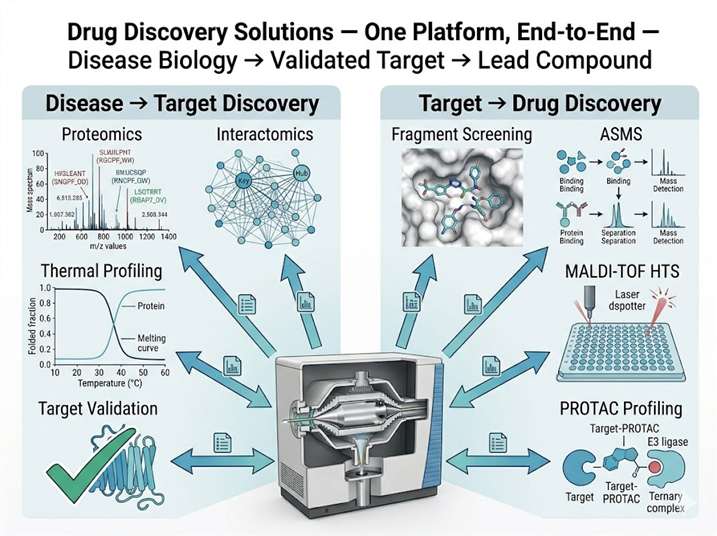
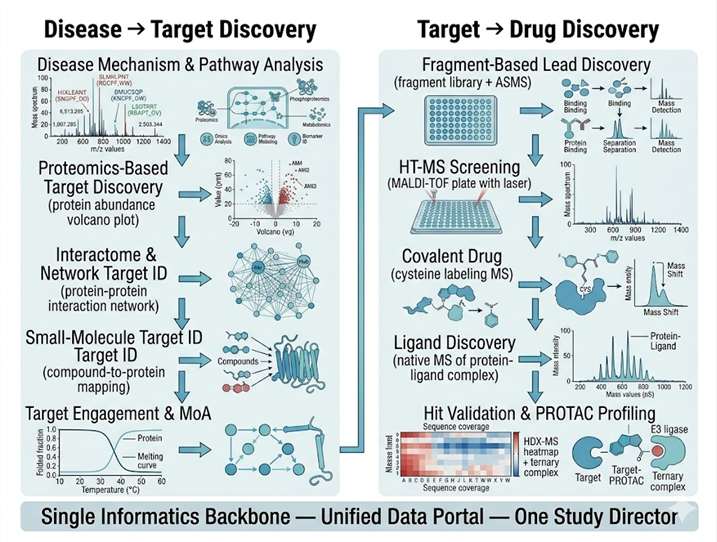
Integrated mass spectrometry drug discovery solutions platform overview
Our Approach Disease → Target Target → Drug Case Study FAQ

An Integrated MS Platform for Drug Discovery — Not a Catalogue of Assays

Most CRO drug discovery offerings are structured as catalogues: a list of assays you can order individually. This places the integration burden entirely on your team — you must know which assay to request at which stage, how to transfer samples and data between providers, and how to reconcile results generated on different instruments with different informatics pipelines.

Our approach is different. We structure our drug discovery solutions as two connected pillars — Disease → Target Discovery and Target → Drug Discovery — each comprising a logical sequence of mass spectrometry capabilities that mirror how discovery programs actually progress. You engage us at any entry point, and we design the analytical path forward. Because every technology operates within the same laboratory ecosystem, data flows without reformatting, samples move without requeuing, and decisions at each stage are informed by the full analytical history — not just the most recent assay result.

This integration is made possible by the breadth of our MS platform, which spans quantitative discovery proteomics (DIA, TMT), affinity-based target deconvolution (thermal profiling, limited proteolysis, pull-down MS), interactome mapping (AP-MS, crosslinking MS), high-throughput biochemical and binding screening (MALDI-TOF, ASMS, RapidFire, acoustic ejection MS), fragment-based and covalent drug discovery, and structural biology support (HDX-MS, native MS, ion mobility). A single study director coordinates your program across all modalities, ensuring analytical continuity from the first proteomics experiment to the final lead optimization report.

Pillar 1: Disease → Target Discovery

Disease Mechanism & Pathway Analysis

Multi-omics profiling (proteomics, phosphoproteomics, metabolomics, lipidomics) of disease-relevant models to map dysregulated pathways and prioritize nodes amenable to therapeutic intervention. Disease mechanism & pathway analysis →

Proteomics-Based Target Discovery

Quantitative discovery proteomics (DIA, TMT, label-free) comparing disease vs. normal tissue, drug-sensitive vs. resistant lines, or time-course perturbation experiments to nominate differentially expressed or modified proteins as candidate targets. Proteomics-based target discovery →

Interactome & Network Target Identification

Affinity purification-MS (AP-MS), proximity labeling (BioID/TurboID), and crosslinking MS to map the protein interaction network surrounding a disease protein or pathway — identifying druggable nodes within the interactome. Interactome & network target ID →

Biomarker to Target Translation

When a disease biomarker is known but therapeutically actionable targets are not, we apply a suite of target deconvolution approaches — thermal proteome profiling, limited proteolysis-MS, and chemical proteomics — to connect the biomarker to druggable protein nodes. Biomarker to target translation →

Global & Small-Molecule Target Identification

For phenotypic screening hits or natural products with unknown mechanisms: thermal shift-based target deconvolution, affinity pull-down MS, photoaffinity labeling, and label-free DIA proteomics to identify the protein target(s) of bioactive small molecules — whether a single lead compound or a library of phenotypic hits. Global target ID → | Small-molecule target ID →

Target Validation & Selectivity Profiling

Once a candidate target is nominated: target engagement assays (thermal stabilization shift, DARTS, limited proteolysis), selectivity profiling across the proteome, off-target identification, MoA analysis, drug–target interaction validation, and functional validation — all by MS, all within the same laboratory. Target engagement → | MoA analysis → | Drug-target validation →

Pillar 2: Target → Drug Discovery

Fragment-Based Lead Discovery (FBLD)

MS-based fragment screening by ASMS, native MS, and covalent fragment approaches. Screen 500–2,000 fragments per pool against purified protein targets; detect weak binders (Kd > 1 mM) without labels or immobilization. Fragment-based lead discovery →

Covalent Drug Discovery & Reactive Site Profiling

Identify ligandable cysteines, profile electrophilic fragment reactivity, and characterize covalent inhibitor binding stoichiometry and selectivity — all by intact protein MS and bottom-up proteomics. Covalent drug discovery →

High-Throughput MS Screening

MALDI-TOF, RapidFire-MS, acoustic ejection MS, and ASMS platforms screening up to 100,000 compounds per day. Label-free detection eliminates fluorescent interference; direct mass readout distinguishes isomeric products invisible to optical assays. High-throughput MS screening →

Ligand Discovery for Challenging Targets

For targets considered undruggable by conventional criteria — disordered proteins, shallow binding pockets, protein–protein interfaces — we apply native metabolomics, DNA-encoded library (DEL) screening with MS decoding, and ion mobility-enabled binding detection. Ligand discovery for challenging targets →

Hit Validation & Structural Biology Support

Biophysical hit validation by native MS, HDX-MS, and ion mobility-MS for binding mode characterization. For advanced leads: PROTAC complex profiling, molecular glue target identification, and ternary complex stoichiometry determination by native MS. Hit validation → | PROTAC profiling →

Enzyme Activity & Reaction Mechanism Screening

Continuous-flow MS for real-time enzyme kinetics, residence time determination by MS, and electrochemical-MS reaction profiling for metabolism prediction — bridging the gap between biochemical screening and DMPK. Enzyme activity screening →

Why an Integrated MS Platform Matters

One data standard, one informatics backbone

Proteomics identifies the target; ASMS confirms binding; native MS measures stoichiometry. Because all three experiments run on the same Orbitrap platform with the same raw data format, cross-experiment analysis — comparing the proteomics abundance of a target with its thermal shift magnitude, for example — requires no reformatting and no data reconciliation meetings. Results are delivered as unified reports, not as disconnected PDFs from separate vendors.

Sample continuity — no loss, no delay, no requeue

Protein purified for target ID is the same aliquot used for fragment screening. The cell lysate prepared for proteomics is the same batch used for thermal profiling. Samples never leave our laboratory ecosystem between workflow stages, eliminating freeze-thaw cycles, shipping delays, and the sample loss that accumulates with every inter-CRO transfer. For programs with limited starting material — patient-derived xenografts, primary cells, rare tissue — this continuity is often the difference between completing the full pipeline and running out of sample after the first experiment.

Single study director, end-to-end accountability

One scientist who understands your target biology — not a rotating cast of project managers — coordinates every MS experiment in your program. When the screening data suggest an unexpected binding mode, the same study director can immediately authorize HDX-MS to characterize it, without negotiating scope changes with a separate CRO contract. This continuity of scientific oversight means faster decisions, fewer misunderstandings, and a single point of accountability for timelines and data quality.

Technology-matched to biology, not to a catalogue

Because we operate the full range of MS technologies, we select the analytical approach based on your target biology — not based on which assay happens to be available in our catalogue. A membrane protein target with no known ligands goes to native metabolomics for ligand discovery, not to a biochemical assay that requires a known substrate. A covalent inhibitor program with an unknown reactive cysteine profile goes to intact protein MS and bottom-up proteomics, not to a fluorescence polarization assay blind to labeling stoichiometry. The technology follows the biology — not the other way around.

Case Study

BiDAC-Dependent Degradation of Plasma Membrane Proteins via the Endolysosomal System

Villa S, Jafri Q, Lazzari-Dean JR, Sangha M, Olsson N, Lefebvre AEYT, Fitzgerald ME, Jackson K, Chen Z, Feng BY, Nile AH, Stokoe D, Bersuker K. (2025) BiDAC-dependent degradation of plasma membrane proteins by the endolysosomal system. Nature Communications, 16: 4345.

Study design: Targeted protein degradation (TPD) has transformed drug discovery by enabling removal of disease-driving proteins rather than merely inhibiting their activity. Bifunctional degradation activating compounds (BiDACs) recruit E3 ubiquitin ligases to tag target proteins with ubiquitin, marking them for destruction. The prevailing model held that BiDAC-induced ubiquitination directs target proteins exclusively to the proteasome. The research team at Calico Life Sciences and C4 Therapeutics challenged this assumption, investigating whether BiDACs targeting the receptor tyrosine kinases EGFR and Her2 could also engage the endolysosomal degradation pathway — a finding with major implications for degrading membrane protein targets resistant to proteasomal degradation. Creative Proteomics provided TMT-based quantitative proteomics to assess the proteome-wide specificity of BiDAC-induced degradation.

Key results: The study demonstrated that BiDAC-induced K48-linked polyubiquitin chains on EGFR and Her2 directed these membrane proteins to lysosomes for degradation — not the proteasome — fundamentally expanding the mechanistic scope of targeted protein degradation. A CRISPR/Cas9 screen identified PQLC2, a lysosomal arginine/lysine transporter, as an unexpected but essential factor: PQLC2 regulated lysosomal pH and morphology independently of its canonical transport function, acting as a microenvironment gatekeeper for degradative competency. TMT proteomics confirmed that BiDAC treatment produced highly selective degradation of the intended targets without affecting the broader proteome. This established that BiDACs are modular, multi-pathway degraders — programmable to engage either proteasomal or lysosomal destruction depending on the target's subcellular localization, a finding directly relevant to the design of degraders against membrane proteins historically considered undruggable.

Relevance to our drug discovery solutions: This study encapsulates the integrated discovery logic that our platform enables: target identification (CRISPR screen + TMT proteomics to identify PQLC2 as a regulator of degradation), mechanism-of-action analysis (TMT proteomics confirming degradation selectivity), and lead characterization (defining the ubiquitin chain topology and trafficking itinerary that distinguish proteasomal from lysosomal degraders). For drug discovery programs developing TPD therapeutics — PROTACs, molecular glues, or BiDACs — our integrated platform supports every stage: from target nomination and ligandability assessment through ternary complex characterization by native MS to proteome-wide selectivity profiling by TMT or DIA proteomics, all within a single partner workflow.

BiDAC-dependent plasma membrane protein degradation via endolysosomal system — targeted protein degradation case study figure
FAQ

Frequently Asked Questions

Q: How does engaging a single MS partner across the entire discovery pipeline improve data quality?

When proteomics, screening, and structural MS experiments are performed on the same instrument platform with the same sample preparation standards, cross-experiment comparisons become quantitative rather than anecdotal. For example, thermal proteome profiling identifies a target's melting temperature shift in response to a compound; the same Orbitrap then confirms direct binding by native MS and quantifies the binding stoichiometry — all three data points are directly comparable because they share the same mass accuracy, resolution, and calibration. When these experiments are split across CROs, each using different instrument vendors and data processing pipelines, systematic offsets between datasets are inevitable and often invisible — you cannot tell whether a discrepancy reflects biology or instrument bias.

Q: What types of targets are suitable for your discovery platform?

Our MS platform accommodates the full spectrum of drug targets: soluble proteins (kinases, phosphatases, metabolic enzymes, epigenetic readers/writers/erasers), membrane proteins (GPCRs, ion channels, transporters, RTKs), protein complexes (transcription factor assemblies, ubiquitin ligase complexes, ribonucleoprotein particles), and nucleic acid targets (RNA, DNA G-quadruplexes, riboswitches). For membrane proteins — historically the most challenging target class — we offer MS-compatible detergent screening, nanodisc reconstitution, and native MS with ion mobility for direct mass measurement of detergent-solubilized complexes. Each target class has a tailored analytical path; we help you define it during study design rather than retrofitting your target to a pre-existing assay.

Q: Can you work with our existing medicinal chemistry or structural biology data?

Yes — and this is one of the strongest arguments for an integrated MS partner. If you have existing SAR, co-crystal structures, or biochemical IC50 data, we incorporate these as prior knowledge into the MS experimental design: HDX-MS experiments are designed to probe the binding interface suggested by your crystal structure; covalent fragment screens are focused on cysteines your medicinal chemistry team has already identified as modification-tolerant; and the thermal profiling experiment is powered to detect shifts at the target and known off-targets your team has flagged. The MS data does not replace your existing knowledge — it extends it, providing orthogonal binding evidence, cellular target engagement data, and proteome-wide selectivity that complements your existing structural and biochemical understanding.

Q: What throughput can we expect at each stage?

Proteomics target ID studies (10–50 samples) are typically completed in 2–4 weeks including data analysis and pathway enrichment. Thermal proteome profiling for target deconvolution (10-temperature point experiment) takes 3–4 weeks. ASMS pooled screening throughput reaches 5,000–50,000 compounds per week depending on pool size. MALDI-TOF HTS achieves up to 100,000 data points per day for biochemical assays. Native MS binding confirmation processes 50–200 compounds per day. For programs requiring acceleration, we offer expedited timelines with dedicated instrument access. The key differentiator is not the throughput of any single assay but the elimination of inter-assay delays — when target ID and hit screening run in the same laboratory, the time from target nomination to validated hit list is compressed by the weeks or months otherwise spent on CRO transitions.

Q: How do you handle data management and IP security across the integrated workflow?

All raw MS data, processed results, and analysis reports reside on a dedicated, access-controlled server with project-specific encryption. We provide a secure data portal where your team can browse, download, and query results from every experiment in your program — proteomics, screening, binding, and structural MS — through a single interface. Data never transits through third-party cloud services or subcontractor networks because there are no subcontractors: every experiment is performed in our own laboratories by our own scientists. At program completion, we transfer the complete data package to your designated repository and provide a certificate of data destruction upon request. We are experienced in working under the confidentiality requirements of pharmaceutical discovery programs and routinely execute mutual nondisclosure agreements with data handling provisions specified at the study protocol level.

References

  1. Dueñas ME, Peltier-Heap RE, Leveridge M, Annan RS, Büttner FH, Trost M. Advances in high-throughput mass spectrometry in drug discovery. EMBO Mol Med. 2023;15(1):e14850.
  2. Villa S, Jafri Q, Lazzari-Dean JR, Sangha M, Olsson N, Lefebvre AEYT, Fitzgerald ME, Jackson K, Chen Z, Feng BY, Nile AH, Stokoe D, Bersuker K. BiDAC-dependent degradation of plasma membrane proteins by the endolysosomal system. Nat Commun. 2025;16:4345.

From Disease Hypothesis to Validated Lead — One Partner, One Platform

Whether you are entering at target identification with a disease model in hand, or at lead discovery with a validated target and a compound collection ready to screen, our integrated MS platform eliminates the fragmentation that slows discovery. Contact our scientific team to discuss your program — we will propose an analytical path matched to your target biology, your starting point, and your timeline.

Online Inquiry

Please submit a detailed description of your project. We will provide you with a customized project plan to meet your research requests. You can also send emails directly to for inquiries.

* Email
Phone
* Service & Products of Interest
Services Required and Project Description