Ubiquitinomics PROTAC Evaluation Service for Targeted Protein Degradation Studies

Connect degrader-induced ubiquitination with protein degradation outcomes and off-target response patterns.

Ubiquitinomics PROTAC Evaluation Service helps degrader discovery teams connect treatment-induced ubiquitination changes with protein degradation outcomes, off-target response patterns, and validation-ready mechanism hypotheses. We combine ubiquitinated peptide enrichment, total proteomics, LC-MS/MS, bioinformatics, and pathway interpretation to support PROTAC, molecular glue, and targeted protein degradation studies.

At Creative Proteomics, we help you look beyond a simple “target down or not” result. Our goal is to help you understand how degrader treatment changes the ubiquitinome, how those changes relate to protein abundance, and which findings are most useful for follow-up validation.

Our service helps you:

  • Connect ubiquitination-site changes with target protein degradation.
  • Compare PROTAC, molecular glue, dose, time-course, or analog groups.
  • Identify potential off-target degradation and broad proteome response.
  • Receive paired ubiquitinomics and total proteomics deliverables.
  • Prioritize validation candidates for internal degrader program review.
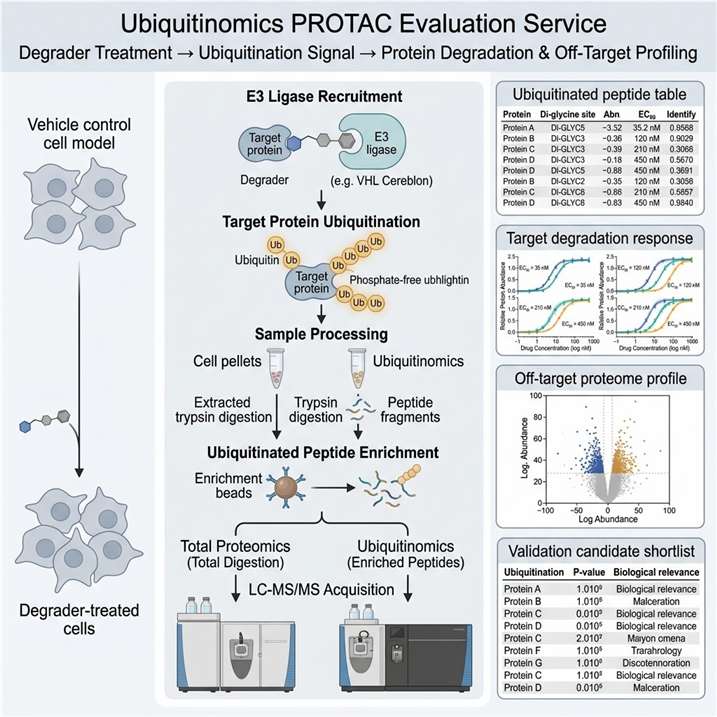
Overview of PROTAC ubiquitinomics evaluation workflow.
Evaluation Workflow Questions Answered Right Fit Workflow & QC Study Design Sample Bioinformatics Demo Results Method Comparison Applications Case Study Start Project FAQ References Disclaimer

Evaluate Degrader-Induced Ubiquitination and Protein Degradation in One Workflow

PROTACs and related targeted protein degraders are designed to bring a target protein into proximity with an E3 ubiquitin ligase. This can promote target ubiquitination and downstream proteasomal degradation. In real projects, however, a decrease in target protein abundance may not tell the whole story.

A degrader can cause direct target degradation, delayed downstream response, compensatory pathway changes, or unexpected off-target protein loss. Paired ubiquitinomics and total proteomics help separate these layers. Ubiquitinomics brings you closer to the ubiquitination step, while total proteomics shows the final protein abundance outcome.

This MassTarget service is built for PROTAC, molecular glue, and degrader programs where a single protein-level readout is not enough. We help you connect ubiquitinated peptides, protein abundance changes, off-target response, and validation priorities into one interpretable view.

For teams already using total proteomics, our Proteomics Service can support the abundance layer of degrader evaluation. Ubiquitinomics adds the upstream ubiquitination layer needed for a more mechanism-aware view.

What This Service Helps You Answer

Is target ubiquitination increased after treatment?

For a degrader project, one of the first questions is whether treatment changes ubiquitination patterns around the intended target or related substrate proteins. Ubiquitinomics can help identify regulated ubiquitinated peptides or sites that support a target-degradation hypothesis.

Does ubiquitination align with target protein loss?

Ubiquitination and protein abundance do not always change at the same time. A paired workflow lets us compare ubiquitination signals with protein abundance changes across treatment groups, time points, or doses.

Are off-target proteins affected?

Off-target degradation is a major concern in targeted protein degradation programs. Total proteomics can show broader protein abundance changes, while ubiquitinomics can add context by revealing unexpected ubiquitinome remodeling after degrader treatment.

Which analog, dose, or time point looks most promising?

When you are comparing a degrader series, a single endpoint assay may not provide enough detail. We help organize ubiquitination, degradation, and pathway-response data into a clearer decision framework for analog ranking.

When Ubiquitinomics Is the Right Fit for PROTAC Evaluation

FIT 1

PROTAC candidate screening

Ubiquitinomics is a strong fit when you have one or more PROTAC candidates and need to compare target degradation, ubiquitination evidence, and broad proteome response. It can support early candidate prioritization before deeper validation.

FIT 2

Molecular glue response profiling

Molecular glues can induce degradation by stabilizing interactions between an E3 ligase and a substrate protein. Ubiquitinomics and proteomics can help evaluate substrate response, degradation outcome, and broader pathway effects in treated models.

FIT 3

Off-target degradation assessment

If a degrader produces a strong phenotype but selectivity is unclear, paired omics can help identify proteins that change beyond the intended target. This helps separate expected target loss from broader cellular response.

FIT 4

Resistant vs sensitive model comparison

Some cell models respond strongly to a degrader, while others show limited degradation or adaptive resistance. Comparing sensitive and resistant models can help reveal degradation-linked pathways, off-target patterns, or compensatory responses.

Paired Ubiquitinomics + Total Proteomics Workflow with QC Checkpoints

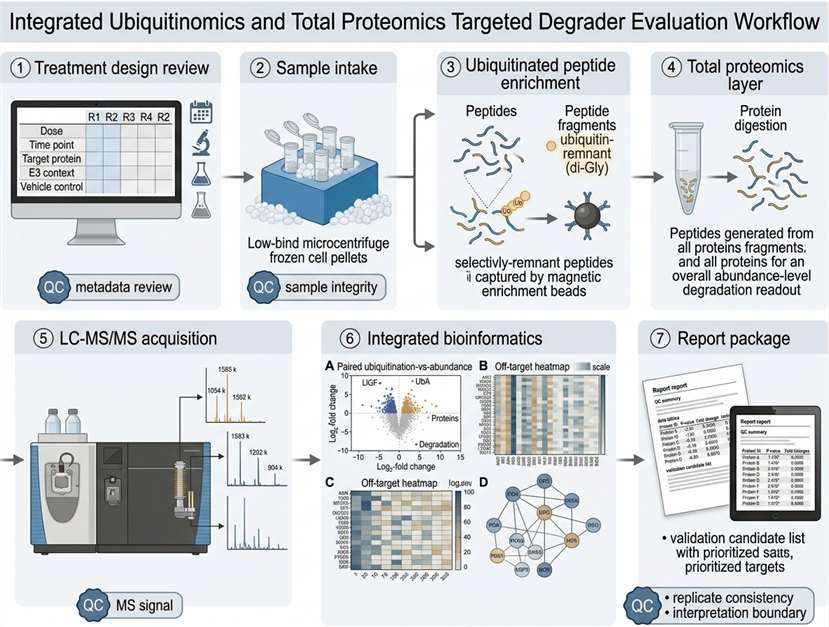
Our workflow combines ubiquitinated peptide analysis with project-level review, so the final interpretation stays connected to your treatment design. Each step is designed to protect sample consistency, support LC-MS/MS data quality, and make the results easier to review.

1

Degrader treatment design review

We review your degrader, target, E3 ligand, dose levels, time points, vehicle controls, and biological question.

2

Sample intake and preparation

Degrader-treated samples are reviewed for storage, amount, lysis compatibility, and replicate structure.

3

Ubiquitinated peptide enrichment

Ubiquitinated peptides are enriched before LC-MS/MS analysis to support coverage of ubiquitination-related evidence.

4

Total proteomics preparation

A paired abundance layer is prepared when total protein-level degradation outcomes are needed.

5

LC-MS/MS and integrated interpretation

Ubiquitinomics and proteomics samples are analyzed, compared, and interpreted with pathway and network context.

Workflow for paired ubiquitinomics and total proteomics evaluation.
StepWhat HappensQC CheckpointWhy It Matters
1. Degrader treatment design reviewWe review your degrader, target, E3 ligand, dose levels, time points, vehicle controls, and biological question.Treatment metadata, control logic, group balanceGood comparison design is essential for interpreting ubiquitination and protein loss.
2. Sample intake and preparationDegrader-treated samples are reviewed for storage, amount, lysis compatibility, and replicate structure.Sample integrity, freeze-thaw history, protein yieldUbiquitination and degradation readouts can be sensitive to sample handling.
3. Ubiquitinated peptide enrichmentUbiquitinated peptides are enriched before LC-MS/MS analysis.Enrichment performance, peptide recovery, contamination riskEnrichment quality affects coverage of ubiquitination-related evidence.
4. Total proteomics preparationA paired abundance layer is prepared when total protein-level degradation outcomes are needed.Protein digestion quality, sample consistency, replicate correlationTotal proteomics helps connect ubiquitination signals with protein abundance changes.
5. LC-MS/MS acquisitionUbiquitinomics and proteomics samples are analyzed by LC-MS/MS.MS signal quality, identification rate, missing-value patternStable acquisition supports reliable group comparison.
6. Integrated bioinformatics interpretationUbiquitination and protein abundance results are compared with pathway and network context.Statistical filtering, biological consistency, interpretation boundaryThe output should support hypotheses and validation priorities, not overstate mechanism proof.
7. Report and deliverable packageWe return data tables, figures, QC summary, and interpretation notes.File completeness, figure clarity, method summaryYour team receives outputs for internal review and follow-up planning.

Study Design Inputs Before Evaluation

A strong PROTAC evaluation project starts with the right treatment design. Before sample submission, we ask you to share the experimental context behind the degrader response.

  • Degrader type: PROTAC, molecular glue, or related targeted degrader
  • Intended target protein and expected degradation phenotype
  • E3 ligase binder or E3 ligase context, if known
  • Treatment dose, exposure time, and vehicle control
  • Control compound, inactive analog, or non-degrading analog, if available
  • Whether a proteasome inhibitor condition is included
  • Number of biological replicates per group
  • Cell line, tissue model, or resistant/sensitive model context
  • Existing evidence from Western blot, total proteomics, target engagement, or functional assays
  • Desired outputs, such as ubiquitinated peptide table, degradation response plot, off-target summary, or validation candidate list

Proteasome inhibitor conditions should be reviewed carefully. They may help capture ubiquitinated substrates in some experimental designs, but they can also change protein turnover and cellular stress context. We treat this as a project-design variable, not a one-size-fits-all requirement.

Sample Requirements for Degrader Evaluations

The table below provides practical starting points for planning PROTAC and degrader-treated samples. Ubiquitinomics-specific feasibility may depend on protein yield, sample complexity, enrichment strategy, and the depth of analysis required.

Sample TypeRecommended InputContainer / FormatShippingRequired MetadataNotes
PROTAC-treated cell pellets5 × 106 cells for label-free/DIA proteomics starting point; larger input may be reviewed for ubiquitinomics feasibilityLow-bind tube or cryovialDry iceDegrader name, target, E3 ligand, dose, time point, vehicle, replicate IDBest default sample type for paired ubiquitinomics and total proteomics evaluation.
Molecular glue-treated cell pelletsProject-dependent; sufficient protein yield requiredLow-bind tube or cryovialDry iceMolecular glue compound, suspected substrate, E3 ligase context, treatment designUseful for substrate discovery and response profiling.
Time-course degrader samplesConsistent input across time pointsLow-bind tubeDry iceTime points, dose, control, replicate ID, viability contextUseful when ubiquitination and degradation may occur at different windows.
Dose-response degrader samplesConsistent input across dose groupsLow-bind tubeDry iceDose levels, treatment duration, target, control, replicate IDUseful for degrader analog or exposure-condition ranking.
Resistant vs sensitive cell modelsMatch input and collection conditions across modelsLow-bind tube or cryovialDry iceModel identity, response phenotype, treatment group, replicate IDSupports comparison of degradation response and adaptive pathway changes.
Treated tissue or xenograft-derived material30–50 mg for trace DIA tissue feasibility; 100–200 mg commonly used for routine tissue proteomics planningCryovialDry iceTissue source, treatment, sampling time, region, replicate IDFeasibility should be reviewed before enrichment-based workflows.
Existing protein lysatesProject review requiredFrozen tubeDry iceLysis buffer, inhibitor condition, protein concentration, freeze-thaw historyBuffer compatibility must be reviewed before ubiquitinated peptide enrichment.

Bioinformatics Analysis and Deliverables

We design the analysis around the degrader question. For some projects, the main goal is target degradation confirmation. For others, the key need is off-target response, analog ranking, or pathway interpretation. The paired workflow gives us more context than either ubiquitinomics or total proteomics alone.

For deeper interpretation, our team can connect degrader evaluation outputs with Network Analysis Service and Functional Annotation and Enrichment Analysis Service when E3-substrate, pathway, or network-level interpretation is important.

Analysis LayerMinimum DeliverablesOptional Add-ons
Ubiquitination layerRaw and processed ubiquitinomics data package; ubiquitinated peptide or ubiquitination-site identification table; differential ubiquitination analysisTime-course ubiquitination trajectory analysis; molecular glue response profiling
Protein abundance layerPaired total proteomics protein abundance table; target degradation response summary; ubiquitination-to-abundance comparisonDose-response degrader ranking; PROTAC analog comparison
Pathway and off-target interpretationOff-target protein response summary; visualization files including ubiquitination heatmap, degradation plot, volcano plot, paired overlay, and pathway summaryE3 ligase / substrate network interpretation; pathway enrichment and functional annotation; off-target degradation risk summary
Review packageQC summary for sample, enrichment, MS acquisition, and replicate consistency; method and parameter summary for review and reproducibilityValidation marker prioritization; integration with cell viability, target engagement, or phenotypic assay data; multi-omics integration

Example output files:

  • ubiquitinated_peptide_quantification_matrix.xlsx
  • differential_ubiquitination_results.xlsx
  • protein_abundance_degradation_summary.xlsx
  • ubiquitination_vs_abundance_overlay.xlsx
  • off_target_response_summary.xlsx
  • pathway_enrichment_results.xlsx
  • network_edge_table.csv
  • qc_summary.pdf
  • method_and_parameter_summary.txt

We use careful interpretation language. Ubiquitinomics can support a degrader mechanism hypothesis, but it should be evaluated alongside abundance, time, dose, replicate consistency, and follow-up validation.

Representative Demo Results: What the Output Can Show

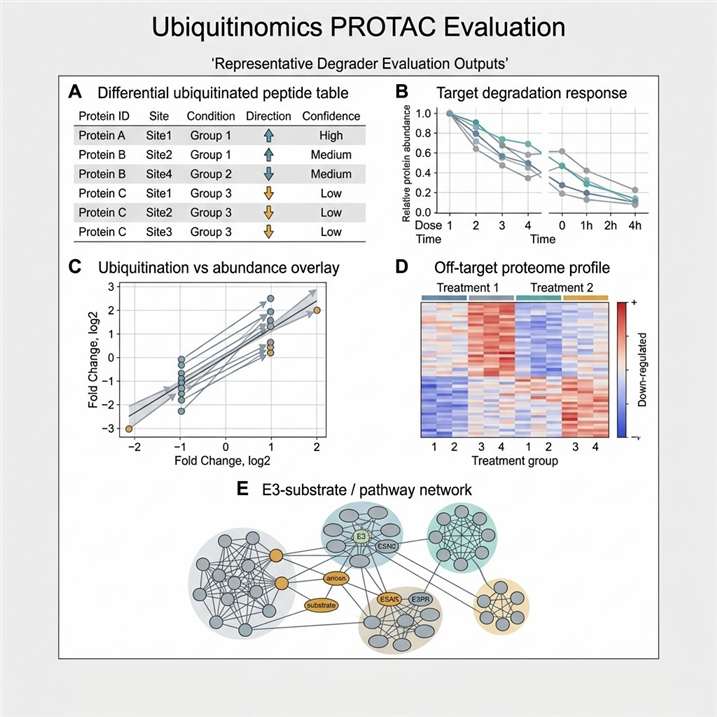
A ubiquitinomics PROTAC evaluation report may include several result types. The exact outputs depend on your study design, but the examples below show what your team can expect from a paired evaluation.

Demo results for PROTAC ubiquitinomics evaluation.

Representative degrader evaluation outputs

Demo Result TypeWhat It ShowsHow You Can Use It
Differential ubiquitinated peptide tableRegulated ubiquitinated peptides or sites with protein ID, site, condition, direction, and confidence fieldsReview target-linked and off-target ubiquitination changes.
Target degradation response plotProtein abundance changes across degrader treatment groupsCheck whether the intended target decreases after treatment.
Ubiquitination vs abundance overlayRelationship between ubiquitination signal and protein abundance reductionEvaluate whether ubiquitination and degradation trends align.
Dose-response degradation plotDegrader response across concentration levelsCompare exposure conditions or analog potency patterns.
Time-course ubiquitination trendWhether ubiquitination appears before, alongside, or after protein lossSelect useful windows for follow-up validation.
Off-target degradation heatmapUnexpected protein abundance changes beyond the intended targetIdentify broad proteome remodeling or potential liabilities.
E3-substrate or pathway networkCandidate substrate, E3 context, and pathway groupingOrganize complex degradation responses into interpretable maps.
Validation candidate shortlistRanked targets, off-targets, or ubiquitinated peptides for follow-upPlan Western blot, PRM, IP-MS, or functional validation.

Choosing the Right Degrader Evaluation Method

Different methods answer different questions in a PROTAC or molecular glue program. The strongest design often uses more than one readout, especially when you need both mechanism evidence and degradation outcome.

MethodMain Question AnsweredUbiquitination EvidenceDegradation Outcome EvidenceOff-Target DiscoveryBest-Fit Use CaseLimitation
UbiquitinomicsDoes degrader treatment change ubiquitination patterns?StrongIndirect unless paired with abundance dataModerate to strongMapping ubiquitinated peptides and candidate substrate changesTime-sensitive and enrichment-dependent.
Total proteomicsWhich proteins decrease or increase after treatment?IndirectStrongStrongTarget degradation confirmation and broad proteome responseDoes not directly show ubiquitination remodeling.
Western blot degradation assayDoes a known target decrease?NoStrong for selected targetsLowFocused validation of known target proteinsLow throughput and antibody-dependent.
Target engagement assayDoes the degrader bind or engage the target?NoNo direct degradation outcomeLowUpstream binding, occupancy, or proximity studiesDoes not show ubiquitination or protein loss.
Ternary complex / proximity assayDoes the compound bring target and E3 ligase together?IndirectNo direct degradation outcomeLowMechanistic proximity confirmationDoes not show full proteome response.
Paired ubiquitinomics + total proteomicsDo ubiquitination signals align with degradation outcomes?StrongStrongStrongDegrader evaluation, off-target profiling, analog rankingRequires stronger study design and paired interpretation.

A practical selection rule is straightforward. Choose Western blot when you already know the target and only need focused confirmation. Choose total proteomics when you need broad protein abundance and off-target degradation information. Choose ubiquitinomics when you need to see whether degrader treatment changes ubiquitination patterns. Choose paired ubiquitinomics and total proteomics when the key question is whether the ubiquitination signal connects with the degradation outcome.

Applications in Targeted Protein Degradation Research

PROTAC analog ranking

Medicinal chemistry teams often need to compare analogs with different linkers, warheads, or E3 ligase binders. Paired ubiquitinomics and total proteomics can help compare target response, degradation selectivity, and broad proteome impact.

Molecular glue response evaluation

Molecular glue projects may require substrate discovery or response profiling. Ubiquitinomics can help identify ubiquitination changes, while total proteomics can show whether the substrate protein abundance changes after treatment.

Off-target degradation profiling

Unexpected degradation can affect interpretation and candidate prioritization. We help you compare intended target loss with broader protein abundance changes and ubiquitination signals.

Resistance-associated degradation response

Resistant and sensitive models may show different ubiquitination, degradation, or pathway-response patterns. Paired analysis can help identify where the response diverges.

E3 ligase / substrate network interpretation

When your project involves a known or suspected E3 ligase, network-level interpretation can help organize candidate substrates, related pathways, and follow-up validation priorities.

For projects involving broader cellular response, our Live-Cell MS Profiling Service and Drug-Resistance Mechanism Analysis Service can support additional response or resistance-focused study designs.

Case Study: Literature Example Pending Verification for Degrader Evaluation

Background

A case study will be added only after the paper, license, figure number, and figure content are fully verified from reliable sources. The target case should involve PROTAC, molecular glue, or targeted protein degradation evaluation using ubiquitination evidence, proteomics evidence, or both.

Candidate Source Direction for Verification

The most suitable future case should come from a peer-reviewed degrader study that includes mass spectrometry-based ubiquitination or proteomics evidence, dose-response or time-course degrader treatment, and a figure that can be used or redrawn with clear permission. Potential verification directions include PROTAC mechanism studies, molecular glue substrate discovery studies, and degrader selectivity studies that connect ubiquitination signals with protein abundance outcomes.

Useful background sources for screening candidate case studies include PROTAC targeted protein degraders: the past is prologue and Induced protein degradation: an emerging drug discovery paradigm. These sources support the broader targeted protein degradation context but are not being used as verified case studies.

How the Case Will Be Used After Verification

  • Background: the degrader system and biological question
  • Methods: ubiquitination, proteomics, structural, or degradation assays used in the paper
  • Results: specific observations linked to exact figure panels
  • Conclusion: how the study supports paired ubiquitination and degradation evaluation
  • Figure information: exact figure number, caption logic, and license-safe reuse note

Until verification is complete, we will not claim specific results, figure numbers, or image reuse rights for any paper.

How to Start a Ubiquitinomics PROTAC Evaluation Project

Send us your degrader treatment design and project goal first. Our team can help review whether ubiquitinomics, total proteomics, or a paired workflow best fits your question.

Useful starting information includes:

  • Degrader type: PROTAC, molecular glue, or related degrader
  • Intended target protein and E3 ligase context, if known
  • Treatment dose and exposure time
  • Vehicle, inactive analog, or non-degrading analog control
  • Whether a proteasome inhibitor condition is included
  • Number of biological replicates
  • Cell line, tissue model, or resistant/sensitive model context
  • Existing data from Western blot, target engagement, total proteomics, or functional assays
  • Desired deliverables, such as ubiquitinated peptide table, degradation response plot, off-target summary, or validation candidate list

Share your degrader treatment design with Creative Proteomics, and we will help you plan an evaluation workflow that fits your targeted protein degradation question.

FAQ

Frequently Asked Questions

Q: What is Ubiquitinomics PROTAC Evaluation Service?

Ubiquitinomics PROTAC Evaluation Service measures degrader-induced ubiquitination changes and connects them with protein degradation, off-target proteome response, and validation priorities.

Q: How is ubiquitinomics different from total proteomics for PROTAC evaluation?

Ubiquitinomics focuses on ubiquitinated peptides or sites, which are closer to the ubiquitination step. Total proteomics focuses on protein abundance changes, which show degradation outcomes and broader proteome response.

Q: Should I run ubiquitinomics and total proteomics together?

A paired workflow is useful when you need to connect ubiquitination signal with protein abundance outcome. This is often helpful for PROTAC analog ranking, off-target profiling, and mechanism interpretation.

Q: Can this service detect off-target degradation?

Total proteomics can help identify proteins that change beyond the intended target. Ubiquitinomics can add context by showing whether unexpected ubiquitination changes are also present.

Q: Can ubiquitinomics prove direct target degradation?

Not by itself. Ubiquitinomics can support a mechanism hypothesis, but direct target degradation should be interpreted with abundance data, time-course context, dose response, controls, and follow-up validation.

Q: Does this support molecular glue projects?

Yes. Molecular glue projects can also benefit from ubiquitination and proteome-level response profiling, especially when the substrate or downstream response is uncertain.

Q: What samples are suitable for PROTAC ubiquitinomics?

Common starting materials include degrader-treated cell pellets, molecular glue-treated cell models, time-course samples, dose-response samples, resistant vs sensitive models, and compatible lysates. Final feasibility depends on protein yield, buffer compatibility, sample quality, and study design.

Q: How should I choose dose and time points?

Dose and time points should match the expected kinetics of ubiquitination and protein degradation. When timing is uncertain, a focused time-course design may help capture early ubiquitination and later abundance changes.

Q: Should proteasome inhibitor conditions be included?

Proteasome inhibitor conditions may help capture ubiquitinated substrates in some designs, but they can also alter protein turnover and cellular response. We review this as part of project planning.

Q: What deliverables will I receive?

Deliverables may include ubiquitinated peptide tables, differential ubiquitination results, paired protein abundance tables, target degradation summaries, off-target response summaries, pathway or network outputs, QC summaries, and method notes.

References

Compliance / Disclaimer

Creative Proteomics provides this service for Research Use Only. This service is not intended for clinical diagnosis, medical decision-making, patient management, or therapeutic use.

Online Inquiry

Please submit a detailed description of your project. We will provide you with a customized project plan to meet your research requests. You can also send emails directly to for inquiries.

* Email
Phone
* Service & Products of Interest
Services Required and Project Description